Trauma, Infidelity, and EMDR in Couples Therapy - Jon Dabach with Dr. Monique Thompson
In this interview, host Jon Dabach (John) talks with Dr. Monique Thompson about how trauma, especially following infidelity, impacts couples and how clinicians can intervene. Dr. Thompson emphasizes the primacy of a trauma‑informed therapeutic alliance, describing a typical intake that begins with individual sessions followed by joint sessions, and the importance of establishing trust, hope, and expectancy. She outlines polyvagal‑informed grounding, breathing (4‑7‑8), and other resourcing techniques to calm the nervous system before deeper work. The conversation then shifts to EMDR, where Dr. Thompson explains the core concept of bilateral stimulation (visual, tactile, movement), the desensitization‑reprocessing phases, session length, pacing based on a client’s window of tolerance, and cautions against self‑administered EMDR. She discusses how EMDR can be integrated for both partners, often after individual trauma work, and how it fits alongside other modalities (CBT, DBT, MBT). The interview also covers practical considerations: assessing the impact on children using ACE guidelines, creating safety plans, and using a shared‑decision‑making model. Dr. Thompson identifies relational health markers (sex, humor, physical affection) and red flags (hostility, sexlessness). She describes a 12‑step‑inspired framework for infidelity recovery, focusing on living and direct amends, and notes the need for referrals when personality disorders (e.g., borderline) require specialized treatment. Ethical issues around splitting couples, confidentiality, and therapist fatigue are addressed. The interview concludes with Dr. Thompson’s contact information.
Chapters
Dr. Monique Thompson, thanks so much for coming in and talking about some of the hard stuff that we deal with, you know, on our side of the proverbial couch. I appreciate you being here.
I'm so glad to be here. I've been looking forward to this all day.
So I'm going to dive right in because selfishly, I wanted to speak to you because trauma is something that a lot of people in relationships don't talk about. There's a lot of buzzwords online. I feel like narcissism had its run for a while. I feel like attachment styles has had a run for a while. Trauma is one of them, but people don't realize that trauma plays a pretty big role in relationships.
Yes.
And so I'm going to, I'm going to pick a specific instance And I want you to dive into how you would treat it, how you would kind of explain it to the client. And, you know, speaking to people who aren't physicians and practitioners, obviously, let's say you have someone who comes in and they had, you know, their, let's say the wife is distraught and she's in this kind of trauma loop where she just can't, you know, her muscles are tensing when she gets aggravated talking about. an affair that the husband had, and it could even be 2 or 3 years back, and they just can't seem to move forward. This has happened several times to me in my practice just in the last week. And I'm curious how you would, you know, what tools do you pick to work with? How do you approach it? Let's start there.
So I'm pretending that this is me talking to the person, not colleague to colleague, but okay.
Yeah.
So One thing, and you're right, this is for you and I, this is every day.
Yeah, yeah, yeah.
For you, for you, it was last— for me, it was this morning. Okay, this morning. Um, and it will be tomorrow morning. Every day, at least one of my cases is right there. Somebody else is way down the road. We've done all this hard work and someone's coming back for maintenance. So every week I see these different phases. And to be fair, it also gives me hope. Because it can be pretty dark, mysterious, and chaotic when you first find out you're very activated. And to this person, I'd want them to know that everything you're feeling, on the one hand, it is normal, but it is not necessarily healthy. And to not mix the definition of the two, likely you are not crazy.
Right.
I think you are not crazy, but you're going to feel Very crazy, like you're losing it. And when your nervous system, which is what's happening here, when your nervous system is stuck in those moments, it can be hard to think about even the basic things. You may be trying to make major life decisions, which means that my first step with this person is to say, let's pick a time in the future where we'll come back to all these major life decisions. We'll come back to them, but our first thing is to get you out of this burning building. You know, we can't decide if we're going to save this house because you're in the burning house right now. So first we've got to get the human out of the burning building. Now we need to make sure that you don't have damage to your lungs, that you're okay, get you medically cleared. Now that you're medically cleared, we still got to check out this house. We don't know what— we got the human out, but the house may be Burnt to the ground. So the first thing for this person is to get care, trauma-informed care. That first session, we're probably going to do some breathing exercises to create a safe environment for the two of us. We need— the evidence is completely consistently, persistently about the first priority being a therapeutic alliance. between me and that person, or between you and your clients. The first thing is you have to trust me, I have to trust you. We have to have this really thick alliance. Once we have that alliance, any modality is at our disposal. If we do not have that alliance, nothing.
Let's pause. We're still using some technical terms. So this—
Okay, yes, yes, yes.
You know, I think that— okay, I like—
I'll use that word, trust. I need to trust you, you need to trust me. I'll use that word. And you're right. Yes.
So, so, so, and I think there's a good point you're making, which people don't realize about therapy, about counseling in general. The trust is at least half, at least half of the actual work. And I love what you said, all the modalities, all the different techniques, whether you're using CBT or MBT or DBT or EMDR. They all work in their own way, right?
Yes.
But the trust has to be the foundation.
Yes. Yes. 1,000%. Yes. You're right. It's at least 50%, if not more. And when missing is when what we call ruptures or breaches in trust happen. And if you don't feel like you can trust someone, your willingness, your interest to talk about things that make you feel very vulnerable, it's not going to be really there. Um, what do we need to talk about? Things that make you feel vulnerable.
Yeah.
And that consistent, you know, next day appointment, next week appointment, having the consistency in the appointments falls apart when you don't trust who you're going to see. So our first order of business to this poor wife who's distraught and possibly having lots of conflicting Feelings that are all true at the same time. So she may be feeling, oh, I hate him. I love him. Sure, I don't want to leave. I want to stay, right? I can't believe this happened. I kind of felt like it may be going on, and I didn't trust my instincts. I want to trust him again. I don't think I could ever trust him again. Like all of these are happening. At the same time, and that sense of overwhelm, that sense of confusion. So now the nervous system is just constantly giving this really peaked experience. Well, the harm there is not just emotional, it is also biological. And if there are children or there will be children in the future, the person also has to take some level of self-awareness, ownership, responsibility for their genetic markers. Whatever you experience, it pays forward, your strengths and your weaknesses. So for us to get calm is number one.
Number one.
And in this situation, I'd want this beautiful person who's trusting me to just literally like, let's put our trust right here with each other and we slow down. I use a lot of polyvagal theory in my work. I will slow down my voice. My youngest daughter calls it my kindergarten teacher voice, which I'm like, I can't use any tricks with her anymore. Like she's caught on. My kindergarten teacher voice. I'll say, slow down. And you just kind of let your voice be like a lullaby. You know, hey sis, I can only imagine your pain. Talk to me. Softening my tone because that person will now Co-regulate with me. And we are developing trust. The person says something like, you know what? And I just feel like if I had known this was going to happen, I would never have married him.
Sure.
Oh, that's such a— oh, that's so heavy. I can only imagine. What do you notice that in your body? So we're starting to check in somatically. Why do I need that information? Because I'm kind of assessing as I go on how much, you know, How much damage are we probably dealing with? And is this person having any relief through the day, which they likely are, but maybe you're not self-aware that you're having—
Sure.
Maybe some windows of relief, but that window of tolerance for dealing with this may be tiny. And so today we just want the person to feel heard, understood, compassionate listening. Whatever they say is accepted as is. And we make our intention to continue working together. Yeah. So that we actually can get somewhere. So the first goal with this person is that we connect a trust bond so that we can continue working together, because down the road is when we start to see results. It's not reasonable for everything to I mean, I know there's microwaves in the world and you can send a document to somebody over your phone lickety-split. We do not have actual microwave therapy or life coaching or anything like that.
Right.
If there's trauma present, we're going to have to be respectful and honor this trauma and treat it. Plus, you can see it. I like to use pictures, John. I use the pictures a lot. So in that first session, I'll sometimes pull up a couple of pictures and say, you know, these are brain scans of people's brains when they're experiencing trauma. And this is what it looks like after the trauma is treated. And we have plenty of clinical studies that tell us about how long that takes. It doesn't take forever, but there is a period of, you know, of time between starting and seeing the results. And it was not in 24 hours for anybody, you know?
Right.
So those things I try to do a little psychoeducation or to the— a little education.
Right.
I use a shared decision-making model, which means the more you know about whatever it is, the closer we get to shared knowledge, then we can make shared decisions where you would make the same decision I would have also made with the same level of knowledge. So sometimes this session is long. So for my first appointments, I will sometimes do a 45-minute session. 5-minute long session if we're gonna do a lot of, you know, prepping for it. But it sometimes really helps to have a longer first visit so that all those magical, beautiful things and scientific things can happen.
Now, what if they come in together, right? Let's say that wife comes in with their husband and you realize we have to address the trauma the wife's going through. Obviously, the husband's going through his own separate trauma, but let's say he's the— she's the one that's much more activated, can't move forward, she's stuck that loop. How do you handle that situation?
Well, my format with all couples is one-on-one with each and 2 joints as our beginning together. Those 4 visits can happen the same day, no problem. Or they can happen over a scattering of about 7 to 14 days. I do prefer that we get them done, like within small time between. So one-on-one with each person, because I need to know the whole story from your perspective. Yeah. Completely. The first joint is exactly as you mentioned. I actually need to see this dynamic. I need to see it with my own two eyes so I can see a little bit what's going on. Because sometimes just because the other person isn't yelling and screaming or expressing their pain, that doesn't mean they're not in pain or likewise traumatized. Often the person who cheated will say to me, this was so unlike me. I don't know why I did it. I don't either. I don't know either. Or I was thinking of leaving and then I changed my mind, but now I'm having an affair and I don't know what to do about that because now I don't want to stop the affair, but I also don't want to get divorced. And then I got caught before I made my own decision, and now I, I'm right where I was. I hadn't made a decision about what I wanted to do, and now I need to make— so there's— it's not always true that they're not equally experiencing trauma, but their experience of the trauma, definitely different.
Yeah.
Then there's a follow-up joint where I am honest with people. And there are 2 things I always say. One is if there are children involved, we have to slow all of this down because they are impacted by the environment at home. Even family tension impacts the developing human brain. And if there are children at home, I'm going to want to change our frequency and we're going to take a different approach. If there's no kids, then it does give us a little bit more wiggle room because there's, there's no innocent bystanders.
Now, when you say frequency, are you, are you saying that if there are kids, you tend to meet with people more often, more regularly?
I want us to put the fires out more quickly. So people who are experiencing something like this, The level of tension is just, um, it's incredible. So you may see things like the parents are not sleeping in the same room, or one of them is not sleeping at the same house, or they're at home, they're sleeping in the same room, but there's this stonewalling going on where one is not speaking, or any of Gottman's, you know, um, Four Horsemen that spell the end of days.
Sure.
But those things are like rising to the top, so the kids can feel this tension. None of this is supposing anymore. We know for sure from doing brain scans on kids who were not in abusive situations, but just were in homes where there was a lot of family tension, it affected development of the cord between the amygdala and the prefrontal cortex. Those kids go on to have a higher risk of depression and anxiety symptoms, not necessarily full disorders, but their brains tend to take a hit. Want to avoid that by quickly getting mom and dad to, all right, here's our safety plan. Like, we're going to meet this often to get you to the point where you are at least emotionally speaking, creating a safe environment at home for the kids. You're not choosing to stay married forever. You're not saying we're not going to get divorced. You just need to, for right now, Create a safe enough place at home where that damage is gonna stop. That's gonna have to stop. And I don't have— I'm a kid person at heart. Way back at the beginning, like over 30 years ago, I had an award from the city of Dallas for my work with kids. And at one point in time, I was an elected official. I was vice president of the school board. I literally have a genuine heart for kids. So John, sometimes that's a hard conversation with people because I say, here's a pathway, a treatment plan that will work for us to protect the kids. And I need you to tell me if you think you can or if you think you can't. And if you can't, then let me find somebody for you to work with because I'm not going to participate in work that I already know won't work, if that makes sense.
Sure.
If there's no kids, we got a lot of work going on. Like, right, yeah, a lot of people, but it's still a similar approach of, well, let's come up with some data.
Is there a cutoff for the age of kids that you find, like if they're 17 and living at home, or—
I use the ACE studies, you know, the Adverse Childhood Events studies, age 18 and under. So if they are under the age of 18, then I take that approach without fail. If they are college age, they're not even living at home, Um, I like to know some of those parameters, like, are they maybe adults, but are they living at home? Um, are they living away? And that does inform my approach a lot. I'm like, I'm willing to be a little bit more flexible. Um, sometimes, sometimes, and this probably has happened to you, this is not a one-alarm fire. Sometimes this is almost 911 levels, you know, situation. So I just kind of situation by situation make that part of the decision. But in all cases, um, the second thing— so first was, are there kids? The second one is, what tolerance do you think you have for our work before we make a decision on your staying or your leaving? Because typically people are coming because they are not sure if they want to stay or if they want to go.
Sure.
So then we pick a time in the future, 3 months, 6 months, 9 months. That we're working and staying in neutral while we get to that point, and then we make a decision. Okay, well, where do we want? Who's leaning where? And somebody may say, "Yeah, I'm totally out. I'm done." Okay, well, then that point forward, we're working on a healthy divorce. But I can tell you there are some signs of health that I look for, that I look for at the very beginning. They don't always tell me for sure if things are going to work out, but there are some signs of health that I look for. And there's some signs of, you know, that give me concern. There's some signs that give me concern.
What are those signs? Give me, give me a few.
I realized this.
I can't tease it out. I mean, I have the secret to knowing something great. I'm just gonna sit quiet and not ask.
Well, listen, listen to some of your podcasts. You are, you do the same thing. Sex. Sex. Is it?
I tell everybody sex and laughter. If you have sex and laughter in your relationship, why are you coming in? Is there a financial problem?
You know, like, exactly. I listened to some of your stuff. I'm like, okay, we on the same wavelength. Sex and exactly. And the sex helps some things be funny. So I'm serious, you know. So, um, this true story. At one point in my practice, I had 4 couples expecting babies. Just saying. On the regular, I'm like, let's focus on the sex. What's going on with the sex? When did you stop having sex? How long have you not had sex? Occasionally there is a legitimate medical every—
Yeah, sure.
You know, every unicorn moment. But typically this started off the bad habit that became the marriage. So if that's happening, and I'm unfortunately, you know, there have been people that I've worked with, couples that hadn't had sex in 5, 10, Like for a long period of time.
Yeah, sure. A decade.
Exactly. That can be recovered, but I make no guarantees. But it is a sign of health that I'm looking for, which is, tell me about your sex life. Scale of 1 to 10, how happy are you with your sex life? And when I hear people say, oh, that's fine, then I'm like, what? In my mind, I never tell them, oh, this will be a piece of cake. But in my mind, I'm like, we probably can get into stuff today. I feel like I'm the car salesman. We can get you in a new car today. credit is $850, we get you right there. So if they have good sex, um, and a sense of humor, right? A sense of humor. So people are laughing with me, or they're looking at each other and there's those giggles. I look for that dynamic between them, for cuddling. Um, if they're in the session and they're both on camera and I see somebody, you know, lean over, they're having that physical contact, those are all signs of health that I'm looking for. I do not coach for it in the first session. I'm just observing. On the other hand, like, what are the things that I look at and say we, we might be in trouble? Um, hostility.
Sure.
If the hostility is just there, no matter what.
Sure.
Oh yes, if it's over the simplest thing, you know, if I say, you know, I think I may have you wrong. I told you, I told you to give her the right email address and see you out. And I'm like, oh my Oh my goodness. Okay. And the person says, I thought I did. I know you thought you did, but I told you you didn't. And then it escalates. Okay. So the hostility, the hostility is one and the no sex. If people haven't had sex and it has become a sexless marriage, um, it, it, it is, it is not always the end of days. I genuinely, I've worked with, I have, I have seen, I see the impossible all the time. So much so that now it doesn't Just look, my husband jokes, he says, well, impossible is Thursday. I'm like, yeah, at this point, impossible is Thursday. So I don't shy from it. When I was a younger therapist, I would hear some things and think, there is no freaking way.
Right.
But then things worked out repeatedly, repeatedly, repeatedly. And I got my first postcard in, I think, year 3 or so of my practice. I had gotten exhausted in the work with this couple. exhausted. I had actually physically stopped a couple of our sessions just to get a drink of water. I was just like, there's no way. But I hung in there. They hung in there. Then sometimes I was hanging in there by myself.
Right.
And sometimes the one partner was hanging in there for everybody in the room. I mean, it was just hard. It was a lot of hard, hard work. In the end, we were done. And I remember when we were done, I was like, I cannot believe This worked out. I got a postcard in the mail from them and it was just the most beautiful thing ever. In hindsight, I wish I would have kept it someplace. But at the time, this is, you know, how old I am. I had— I still had those fireproof cabinets with actual folders for shirts. And so it went in there, you know. I still have them in my office.
Don't knock them.
Right. I'm like, we might be twins. I have one in the garage.
Yeah.
Um, but so, you know, of course, you know, after so long, people probably— after so long, we don't have to keep those records forever.
No. Yeah. A number of years.
Then when the time came, like, yeah, I got her. And I look back on that now and I'm like, oh my goodness, I should have pulled— I didn't think to keep it kind of as a keepsake. But that's happened more than one time where it looks impossible. I sometimes am listening to the complaint of the person who brought everybody into therapy going, I don't know how you put up with that either, in my head. But it works out. It works out. The sex matters so much though. It matters so much.
Well, I agree. I agree. My wife would agree too, I hope. So let's, let me kind of wrap my head around this. So the way you start with clients is you do 2 individual sessions, and then 2 joint sessions.
Yes.
And then a question I get a lot, because I split my couples up all the time. And then I do individual sessions with them. And people are like, I was told that's not allowed. I I have— my therapist told me that you can't do that. It's a conflict of interest. And so I want to, first of all, selfishly, I want to normalize it. I think, you know, sometimes, you know—
Not always.
But what is—
It's not a hard rule. It's sometimes it's true and sometimes it's not true. You have to— if somebody needs the psychological space to actually process an area of content that would just be too much for the joint, then I will say to them, I think you need more psychological space than I can give you, and I'm going to send you to someone. So I have, you know, a list of colleagues that, depending on what's going on, I will say, I think this person would be great. And we— it's been 25, so some of them, it's been over 20 years of us sharing caseloads where maybe they had the couple and one member needs to come see me.
Right.
Or I have the couple and one member needs to go see them. But it is not unusual for me to do all of the work in-house.
Right.
And I bear the responsibility, me, of ethically figuring out when someone needs to be referred versus they could and they could not, or when there is absolutely no reason.
Sure.
For you to go someplace else. And you likely have had this happen. Sometimes adding another cook to the kitchen is just going to make a mess. Oh yeah.
Yeah. I mean, especially if they start interviewing a bunch of other therapists and then I've gotten the call from a nervous therapist. She's like, she should, she should divorce this man. He sounds like a narcissist. And I'm like, where did, what? You've never met the man. You know? So it's, it's, it's, uh, you never know what you're going to get. It's a bit of a mixed bag. Let's talk about some of, you mentioned modalities. One of the models of therapy you use is EMDR.
Yes.
I don't think I've ever talked about EMDR. on the show. And so let's start from scratch. Um, you know, what is it? You don't have to go into the history with Francine Shapiro and all that stuff, but kind of just high level, what is it? What does it actually look like? Because a lot of people, when they, most people have never heard of it, even though there's, I think, 30,000 practitioners who do it, but most people who never do it. And when they think of therapy, they think of the movie therapy, you know, like the, when you come in and talk to somebody on a couch and lie down, they're still thinking of psychoanalysis. And so when they come in and they see someone doing this, they're like, wait, what are we doing? So I think it's good to kind of explain what it is and also how you use it with couples.
Oh, you're going to love this. So I'm going to tell you the traditional, just like you said, the box recipe version of it. And then I'm going to tell you how I use it. Great. I've added seasoning. Okay.
Got it.
So EMDR, eye movement desensitization and reprocessing. Um, is a modality where you're going to use bilateral stimulation, and that is just a long fancy word meaning left, right.
Okay.
So, um, anytime someone comes in, trauma can be anything where you are stuck. So think of it that way. It doesn't always have to be life or death, or you meet the criteria for post-traumatic stress disorder. It's something that's stuck. So like your scenario At the beginning where the woman was stuck. She's like, I cannot get past this. She's stuck. So that's the language you're listening for, is the person feels stuck. And this is basically to get them unstuck.
Sure.
So if you think about like you use some really good glue on something and just peeling it off is not going to work. So then you go maybe get some hot water or something to make it soluble so that it is unstuck. stuck. EMDR is that thing that you're using to get it unstuck. All right, so you use left-right movements, and that left-right movement can be with following someone's finger. There's, um, remote EMDR.
Just for the people who are listening and can't see the visuals, you know, what Monique did is she moved her finger left and right across the frame. So there's visual stimulation where you would follow it with your eye.
Exactly, exactly. Moving your eyes left to right, but you can move your body left, right as well. So you may see people do a butterfly hug, and I know they can't see me, but you basically cross your arms over your body.
Crossing arms.
Yes, and you alternate tapping your body with your left, right hand. You can move your feet up and down, but what you're doing is starting with the earliest, worst moment that's stuck. Okay. You start back there and work your way forward. But what happens over time is the brain starts to learn and it actually continues its little journey on learning in between your EMDR sessions. So you may have, let's say, a 90-minute EMDR session and then another 90-minute EMDR session. But then you may start noticing that You're able to check out that moment that was stuck and you notice you're not feeling as provoked as you normally would. So that's what we call getting to desensitization. The level, usually you'll get a score 0 to 10, where 10 means I'm completely provoked. Every time I think about it, I feel all of these uncomfortable feelings. I have all these uncomfortable negative thoughts. But then you eventually get to zero, which is when you have no— you're not provoked, okay? But you might not yet have a strong true thought yet, so you just desensitized. The next step is reprocessing, where you're now able to look at the same event and have a different adaptive thought about it. That is very, very true. That is beautiful. And I'm telling you, so this is what I have learned is that both those thoughts about the event were born at the same time. It's just that you couldn't see the one that was adaptive because the trauma was in front of it and you just couldn't see it. But once the trauma is cleared, it's clear as day. And people will say, I don't know why I didn't see that before. Well, the trauma. So you can, for your listeners, they can There's a place I would recommend checking out Dr. Daniel Amen's work because he scanned brains showing the difference between before and after EMDR. There's a long YouTube video where his wife Tana talks about her experience with doing EMDR. You can look at Prince Harry doing his little Good Morning America interview where he shows you the butterfly technique. The beauty of EMDR to me is it is Non-invasive. You're not using any medicine. Your human body is the primary instrument. You just need a guide to get you through your first processing. There are workbooks and things like that about self-administering EMDR, but I'm going to offer a word of caution to anybody that if you have never treated the trauma at all, I 100% do not recommend that you try to do EMDR.
Yeah. Because you—
On your own. On your own, right. Think of it more like Pandora's box with toxins and radioactive stuff in there, and you can't see into the box. You have to reach your hand down into the box to find this thing. Well, while your hand was down into the box, all of that radioactive stuff, all that stuff was was there, and now your hand has to still come out and be of use to you. Yeah, but you're looking at it like, why is my hand glowing? Like, so what's going on? Let's, you know, so let's do it with somebody else for a sec.
So we're using bilateral stimulation. So we're either using, uh, a finger, or some people use a light bar or something. If you're doing it on Zoom, sometimes they use graphics on the screen to move your eyes. Or you can what?
I walk. I have my clients walk.
And so just the move, the kinetic movement of moving your leg?
Left, right. It's the left, right. So think for BLS, think left, right, left, right. So when Francine Shapiro discovered it, she was out what? Walking. She was out for a walk. So I have my people walk, and when they're walking, they're doing the left, right, left, right. And you walk with them? Because of technology, I'm on video with them or audio with them. Um, we do all— so EMDR has Um, prescriptive steps. So there's all your prep work before you're actually doing EMDR. So they're well-resourced before we go for a walk. But you can walk anything you're doing, left, right, left, right. So people can't go outside, I have people that have like walking pads where they can walk indoors, or you can just lift your legs up and down, right? Up and down, up and down. Tapping knees too. Tapping knees, tapping knees.
Buzzers.
Or yes, or the buzzers. Yes, exactly. So just think left, right. Exactly. The key is left, right, left, right.
The question I had for you, because people are going to say, why? Like, what's with the left, right? Like, why is that a thing?
So from the clinical studies, it seems that that moves the brain into a place where it can be in a working phase of actually figuring out what to do with the trauma. While you're visiting it versus only visiting it. So I feel like that's the best lay example versus only visiting.
That's a great succinct answer. Yeah, for sure.
Yes. Okay. Yes.
Okay, great.
So it's kind of distracting you. So the left-right movement is kind of— I— so another word I use with my clients is it's like anesthesia. So if you were going to get a day surgery, it depends on which— they still may put that area of your body Numb.
Right.
It may still numb that area of your body. If we were to look at your brain, we would still see all this stuff going on because you're actually experiencing the pain, but you are not consciously aware of the pain. When that numbness wears off, when that anesthesia wears off, right, you're going to feel it. So this is partly why I say don't do the self-administered EMDR because you're going to awaken to it. Yes.
In case it ever helps you, I'll explain it the way I, when I, where I do bilateral stimulation, I say, listen, your brain, your brain has 2 jobs, right? Your brain, your brain's first job is to keep you safe.
Yes.
You have to keep you safe from survival. And then your brain's second job is to enjoy life, find meaning and love and all that stuff. I said, the problem is if you're in a place where you're running away from a lion, You're not going to plan for your retirement. You can't consciously think of something when you're in this state of threat. And so there are ways to hack. There's, it's like a bio, right? Yes.
Yes.
Breathwork is one of them, right? Because you can't run away from a lion and take in deep breaths. Your body doesn't work that way. You can't run away from a lion and look left, right, left, right, left, right. Your brain's like, wait a second, this is physiologically impossible. Possible. We're not in an active state of threat, and so it allows both parts of the brain to work together.
Um, yes, so they have to trust you. So I would say I have, I have people from every walk of life, and some of the people that I've had do the MTR with me are doctors. You know, they're doctors, they are surgeons, and getting them to do it required that trust that we talked about at the very beginning, trusting me And so repeatedly after, so at least the after, after we've done it, it's consistent. People are like, I cannot believe that worked. I cannot believe that worked. But it does. And I try it myself. You know, I try it too. So I'm like, yeah, I know. It just seems like it won't work, but it does.
I, you know, I think it's more than trust. I think that there's, you mentioned it earlier on, and I kind of call myself an ambassador of hope. And that speaks to the first, the first thing that matters in the relation is the relationship, the trust. The second thing that people, and if you ask an average therapist, they don't remember, but the second most important part is expectancy. And so if you don't have, if you can't get them to expect that it's going to work, if you can't instill that hope, you're dead in the water.
Yes. Good point. Good point. Good point. So I should say that about the EMDR that It's— there's a prescriptive amount of time, no matter what kind of issue you bring to the table.
Right.
Typically, people need about 9 90-minute sessions and they can experience observable relief, objective relief. So many practitioners will have you do a few assessments, objective assessments, get your scores on depression screens, PHQ-9, your— they'll get your PDS score, see where you are at the beginning and then maybe midway and then at the end. The observable change is right there on the one hand. On the other hand, sometimes people think, well, how, you know, I'm afraid to go into this. I don't know what to do. You know, I'm afraid. So the thing there is to just slow down. Just slow down. We don't have to do all these sessions next week or tomorrow. Our relationship and understanding of what's happening and your sense of consent about it is very, very important. Very important for people to feel safe. That breathing, I love polyvagal breathing. I love the 4-7-8 breathwork. I love all that. And typically I want to know, are people sleeping well? Um, during any given day, do they have someone that they are talking to that helps them feel heard, understood, loved, connected? Because those are what I mean to say resourcing.
Right.
You need, you need all that. Your Your most, you know, your long-term companion is you and your relationship with yourself also matters. And so those things help people feel safe and feel like I can versus I can't. So those kind of things are very important too, even in couples. If couples weren't, you know, sometimes helping people remember why they came together in the first place. What happened that you weren't out of your mind when you got together? You know, what drew you to each other in the first place? Tell me about the most, you know, the best sex you've ever had. When was that? What was that like? You know? Bringing up those memories. I don't practice brain spotting, but I do say, you know, try to find that in your mind, that moment. Let's live there for a little while and tell me what it's like using grounding through that visualization. You know, tell me about that moment when you were there. What was it like? Give me all the details. And you'll visibly notice people relaxing. And now we have a moment for you to go to, you know, in between the sessions. There's your mental vacation. Sometimes there's a fun video SoulPancake has about calling somebody who meant something to you and just telling them thank you.
Yeah.
And the release of oxytocin and serotonin from just that gesture of gratitude is enormous. It is just a beautiful shower of happy chemicals dousing your body, helping you feel energized and hopeful, and dousing yourself with those moments Throughout your day when you start difficult work in couples or even an individual is an important self-care and matters more than a bubble bath, right? That matters more.
Right. And so let's say you're with, so EMDR sessions are 90 minutes. One thing that, um, people might be curious.
Or 45. I do them at 45 or 90. Okay.
And do you tend to space them closer together? In terms of trying to get a couple in a week, or are you—
Based on window of tolerance. So I have some who have a window of tolerance. Earlier today I did a 90-minute session, but that person has a pretty significant window of tolerance. Um, right before us I had someone whose window of tolerance is not there yet. We're in the resourcing stage. We did not do EMDR, but we did target mapping where we identified things. Oh, when we get to the EMDR, we probably should, you know, that's probably on our list of things Right. Um, yesterday I did a 45-minute, um, EMDR session with someone, um, and we got all the way to clear but not reprocessing. So it just, you know, each person, there's a different rhythm. But I do take the responsibility of making sure we are moving forward versus sitting and doing nothing. So even with someone who's not starting active EMDR, Are we target mapping? Are we resourcing? You know, what are we doing? I have a self-paced course that my patients can take to kind of understand EMDR if they want to. Some are not going to do that course. We do the education in session. But I just want us to be very consenting before we do it.
Yeah. And then when you have a couple, and does it happen where sometimes you split them up and they're both doing EMDR? And then they come back, and do you notice a huge difference in the way they're? They notice.
They notice. They notice. They notice. So you want to. I do a full assessment on everybody. When people come in and there's been infidelity, for example, it's not uncommon for like there's been a threat of divorce. Someone is still in discovery phase. So although they found out about the infidelity, they're still. Getting all the pieces together. Many people don't think about it, but there's no real such thing as infidelity without financial infidelity accompanying.
So you gotta buy the hotel room, you gotta—
yeah, right, right. So, um, that's part of what discovery continues to happen is that people start putting financial pieces together.
So follow the money.
Yes. Yeah, yeah. So in those individual sessions, we have a lot of We've had conversations about living versus direct amends. And I'd like for us to start working on living and direct amends as soon as we can. Even if we have trauma work, is trauma work, but you can stop spending or cancel your subscription to that site. There are some small things you can do.
Sure.
That are seemingly small but are big as gestures of building trustworthiness. this again. So I'd like to see that happening as quickly as we can. Whether people are staying together or not, I prefer authenticity and integrity to return whether you're staying together or not.
Yeah.
So those are 2 things that I— and those are difficult sessions for sure, but necessary.
So another difficult thing that has come up in my practice as well is, you know, you deal with personality disorders and infidelity. So narcissism comes up, but I've also noticed borderline comes up quite a bit. I've had a couple clients who are histrionic. Do you find that, you know, I don't deal so much with antisocial, thank God, it doesn't really come up as much in my particular practice for whatever reason. But Just because it would be very difficult to try to get the empathy for infidelity recovery. But do you find that there are extra challenges? Do you not pay attention to that at all? People who have impulsivity issues where they really do have this very deep-seated abandonment fear. How do you handle that?
Trauma first. So with borderline personality disorder, any of the person— any of the families of personality disorder, Cluster A, B, whatever it is, you want to look in their childhood and figure out what kind of trauma the person might have experienced. Sometimes it is not, um, so obvious as physical or sexual abuse. Sometimes it's emotional abandonment.
Right.
But finding those wounded places and using the EMDR to start there can be significantly helpful. There are some studies on using EMDR with sex offenders. And those studies combined both forensic CBT with the EMDR. I have a history of working earlier in my career when I was an intern for 5 years with adult male sex offenders and with adults on probation and parole. So some of the forensic work comes in handy.
Yeah.
When you have someone with trace or features, you need to know. If someone fully meets the criteria, you will know. So there's a lot of guessing there, but a lot of people don't meet the criteria, but they have tracing features. Tracing features are hard to see when someone's in pain. So my first step is to treat the trauma, see what's left.
Yeah.
Um, and then work on— so 12 steps is a framework that I love for infidelity, um, because the 12-step programs Have a success rate with people who do have traits, features, or even personality disorders. Those steps, especially steps 8 and 9, are cleanup steps for when someone needs to clean something up, whether they're going to stay or not. And then the gift to the other person that was harmed is now a clean choice. This person has made amends. They're making living amends. But you need space to still see what you choose to do because you cannot expect that they will not have traits and features. You cannot get rid of those. You cannot get rid of a personality disorder, but you can bring integrity back. And so now that's one time though, I may, I likely do, I won't say I likely, I do. I have a colleague I send people who have They've been treated for the trauma. We see that this is impeding our work for the couples. I may send them for DBT to a colleague who, that's all she does is borderline personality disorder using dialectical behavior therapy.
Yeah.
Right.
Okay.
Yeah.
What are we not talking about that we should be talking about?
Me coming back because we are out of time. I know. Um, so I would love to come back. You have me back sometime. I think what we haven't maybe talked about is the fatigue that people experience in couples counseling.
Yeah.
Yeah, it is, it is not a fast turnaround for most people. Um, and sometimes people think because they've been in therapy or in coaching or going to conventions and going to retreats and reading books that that must mean that they're not doing something right. That is, it could not be further from the truth. It is an investment in something that truly Matters. It was the longest study ever, Harvard study, 85 years. What they found was what matters most is you figuring that relationship out. That's what matters most is the longevity of your life and your health is figuring that relationship out. There could not be a better investment. But I noticed that fatigue happens. And so that's something that we— another time we could probably talk about. Yes. Yeah.
Yeah. I might just call you to vent about it myself. Oh man. Well, Monique, Dr. Monique Thompson, how do people get a hold of you?
Visit my website, Dr. Monique Thompson. You can follow me on Instagram, it's Dr. Monique Thompson, @DrMoniqueThompson. I am on a lot of different platforms just kind of sharing this truth about like mental health and infidelity and things like that. But find me on my website or on Instagram. Um, listen to this podcast, tell John to have her back. Y'all come find me over here a few times, and that's, that's how they can find me. Awesome.
Thank you so much.
Okay. All right.
More from Monique
How long have I been calling my husband Big Daddy Wonderfulness The Unconquerable

Tune in tomorrow morning on K104 Dede In The Morning for my monthly mental health segment.

Catch me on K104 tomorrow morning, we're talking about couples disconnect and sexual dissatisfaction
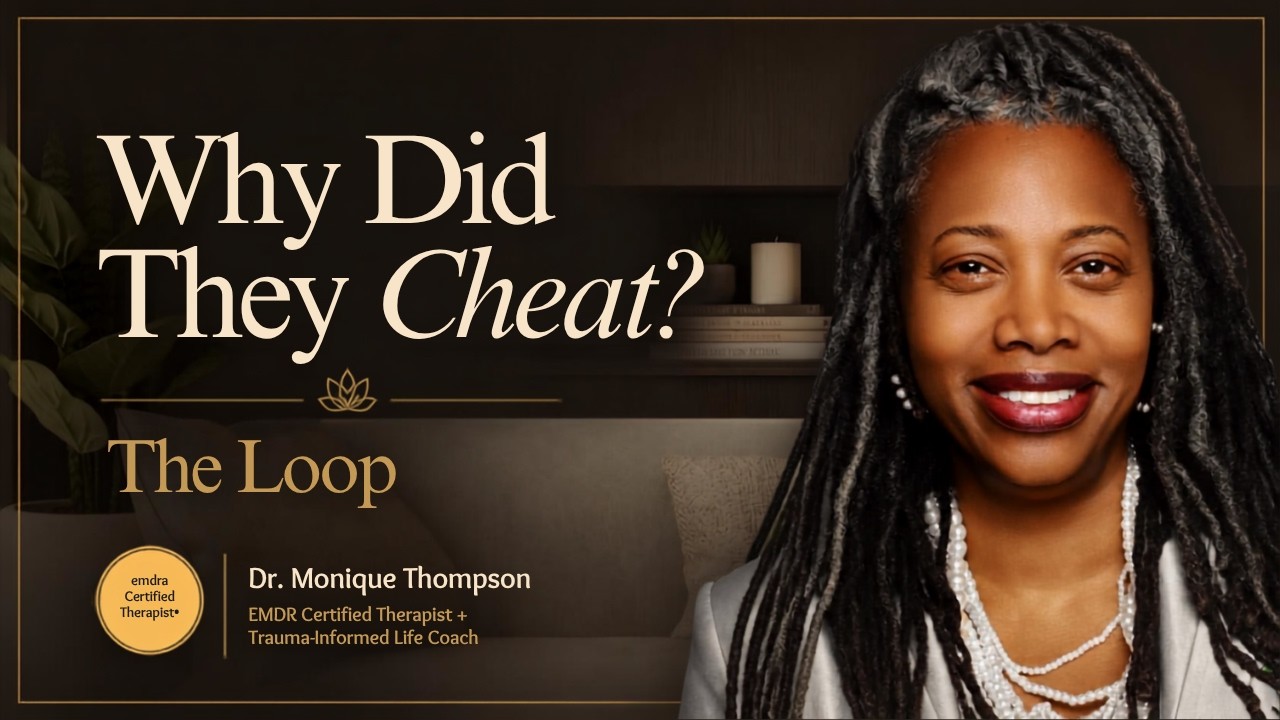
My partner said: I cheated because we weren't having sex. The "Why Did They Cheat?" Loop