234 - Hassan Bencheqroun, MD, MBA | Pulmonary & Critical Care | Pre-Health Shadowing
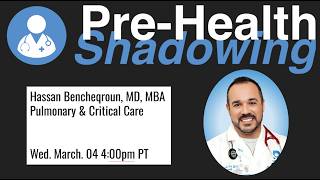
In this live Pre‑Health Shadowing session, Dr. Hassan Bencheqroun (MD, FCCP, MBA) answers a heartfelt question from Marcos, an international student from Ecuador, about the worthiness of pursuing a medical career as a non‑traditional applicant. Dr. Bencheqroun shares his own transcontinental journey from Morocco to U.S. pulmonary and critical care practice, highlighting the twists, visa hurdles, financial constraints, and personal setbacks he faced. He emphasizes listening to one’s inner drive, focusing on what you truly want rather than how to achieve it, and the importance of perseverance, mentorship, and community support. The discussion also touches on comparative pathways (studying medicine in the home country vs. the U.S.), strategic use of shadowing, clerkships, and networking, and the financial realities of student loans and employment. Dr. Bencheqroun briefly showcases a custom GPT clinical‑reasoning tool for participants. The session concludes with Raj’s wrap‑up, encouraging participants to engage with the Pre‑Health Shadowing community, complete a post‑session assessment for a free certificate, consider donations, and stay connected via social media and newsletters.
Questions this video answers
Dr. Bencheqroun advises that if you feel the calling in your bones, you should pursue it despite obstacles; focus on what you want, not how you’ll get there, and be prepared for twists and turns. He stresses that the journey may be longer and harder, but the personal fulfillment makes it worthwhile.
Chapters
Hi everybody, thank you so much for joining today's session. And today we're here with Dr. B, and Raja is going to be presenting the session. So I'll pass it on to you.
Everyone see my screen?
Okay.
It's still loading. Okay, yeah.
Okay, perfect. Um, I'm Raj. I'm joined with, uh, Danielle and Manasvi and our special guest, uh, Dr. B. Uh, first off, first of all, welcome everyone and thank you for joining us today. We are Pre-Health Shadowing, an international nonprofit organization. Our mission is to empower aspiring healthcare professionals by providing virtual shadowing opportunities. We're thrilled to have you here as part of our community, and your participation and support are crucial in driving forward our shared goals in the medical field. As part of our commitment to inclusivity, we provide closed captions to support students of all abilities and needs. We need your— we value your feedback and are always looking to improve accessibility. If you have any ideas or suggestions, please email us at info@prehealthshadowing.com. And to ensure our communications don't get lost in your spam folder, please save us as a contact. By joining our email list, you'll never miss a session update. We're also on Instagram @prehealthshadowing, and if you're on TikTok, you can find us there too with the same handle. Don't forget to sign up to our email list. It's the best way to ensure you're always informed by our latest sessions and opportunities. We're always thrilled to welcome new students from all around the globe, and it's always fascinating to learn where everyone is joining from. So feel free to share in the chat where you're calling from. And where you're chatting from. I'm personally from New York. Slide 5, uh, are you interested in becoming a pre-health shadowing member? We have a fantastic opportunity for you to join as a volunteer. It's completely remote so you can contribute from anywhere in the world. And to get started, just register on our website to gain valuable experience and make a positive impact in the pre-health field. If you have any questions, feel free to ask or visit our website for more information. We're recruiting for our leadership team and it's open to everyone. This is your chance to apply your skills, learn new ones, and make a real impact, all from the comfort from your home as it's 100% remote. Just head to our website and fill out the application form. Now let's take a closer look at the available leadership roles within our pre-health shadowing program. We're looking for leaders in all of these departments. You can also propose your own new department or role here if you feel free and it can holistically help PHS. If any of these roles resonate with you, I encourage you to use the link provided to our team. Our high school training program, or HTP, is a fantastic way to gain valuable skills and insight as both leadership and in the healthcare field before you step foot on a college campus. All you need to do is fill out the interest form available on our website. Our entire operation relies on generous donations and invaluable time contributed by our dedicated volunteers. This is what allows us to continue offering these opportunities to learners from all backgrounds and walks of life. If you have the means, please consider making a donation. Every contribution, no matter the size, helps us maintain and grow this inclusive educational experience. Feel free to type any question you have in the chat. We want this to be as interactive and informative as possible, so please don't hesitate to participate. After completing the session, you'll have the opportunity to earn a digital certificate, and this certificate verifies your hours and can be accessed by your professional's course page at prehealthshadowing.com. It's important to take good notes during your shadowing experience. These notes will help you during the assessment but also enhance your learning. Remember, the certificate is a great addition to your professional portfolio, showcasing your dedication and the skills you've acquired. If you guys could please turn on your camera, that would be great as well, since this approach aims to replicate an in-person environment, enhancing the experience. Now I'm pleased to hand things over to our professional guest, Dr. B, and we'd love for you to share a bit about yourself and you can take it from here. You—
thank you, I appreciate it. Hello everybody, it's a pleasure to be here. I am delighted because this reminds me of my beginnings. But today is very interesting. I'm going to excuse myself for just a second. My dogs are barking up a storm, so I'm going to just make sure that the door is locked and I'll be right back. Would you excuse me for a second?
Yeah, no worries.
Thank you again. So let me, um, share with you today is a very special day because approximately 27 years ago today, I was almost finishing my medical school and I got into a car accident. I was a passenger and I almost lost my life there. And it gave me a bit of a perspective. It made me a different doctor. And so today is very interesting because I always decided that every time this day arrives, that I will be giving back because it is gratitude for being still here and for having— it's not really a job, it's a calling, it's a tradition. There's not a lot of places where in your workplace, just because you have a title, whether it's nurse, doctor, respiratory therapist, that people will trust you with things that they would not trust their own loved ones with. And that trust is carried through centuries. I happen to, whenever I want to give back to my community, because of the fact that I am a physician, it is easier to just give back because you're already touching people in the moments in which they are most vulnerable. So when I first, um, remember, I've always wanted to be a doctor, not because of a title or anything, because I literally— it's the cliché of wanting to help. And so it helped me see that I could end somebody's suffering just by knowing something I learned in school. This is the day that I survived. I had a head injury. I was in a coma. I come out of the hospital and I realized I was 20-some years old at the time. And I realized that because of the swelling in my brain, my memories were not mine. You can see my head was disfigured and I had stitches all over. My eyes were bulging. And so my looks weren't mine. And even everything that I thought defined me was not mine because I could lose it in a second. But while I was in and out of coma, everybody kept telling me that when I was with it, I was kind. And then I learned that kindness is the one thing that was mine. And so if anybody gives me a compliment about how smart or hardworking or good-looking, whatever that might be, it just— I learned to just say thank you. But if somebody calls me kind, that lands. From there, I went and graduated medical school. And if you want to know something about medical school in Morocco, you go after high school. And you spend 7 or 8 years in medical school. Everything you learn is medical. You learn biostatistics, biochemistry, bio everything. And it's a long road and it's a choice that you make when you enter medical school. And so this is the day where I defended my dissertation and I graduated. And this is me taking the Hippocratic oath. And this is now after— still, I'm considering myself mid-career in medical school, and I would like to share with you some of the twists and turns in which that defined my trajectory. I am a pulmonary and critical care physician currently in San Diego, California. And I stated I'm originally from Morocco. I have many leadership positions, associate director of a tele-ICU, and I'll go into what is a tele-ICU. I am an educator in AI in healthcare, academia, and medical education, and I host a podcast, the AI Ready Doctor Podcast. And this is my trajectory. I was born in Morocco, and then I moved from here to do residency in New York and in Boston. And then when I finished there, I went to California, and that's where I did my, basically my career. When I finished my training in Morocco, I started in 1994, I finished in, I came to the US in 2000. From 2000 to 2004, I took the USMLE exams and I actually I couldn't speak English at the time. I had to learn English, medical English. I studied in Arabic and French. Those are my languages when I first— when I grew up. And then you had to learn to not just present yourself in print resumes and CVs and letters of recommendation. You had to interview. And that is not something that I was used to. In the 4 years between 2001 and 2004, or 2000 to 2004, what I did was I worked as a phlebotomist drawing blood from people. Then I worked as an EKG technician. Then I worked at UC San Diego doing research between creating mutations in DNA and separating proteins on a gel and doing lots of experiments. I did community college tutoring in science and math and French. And then I worked in a hospital as a discharge planner. So those are the ones that help when somebody is going home or transitioning to a nursing home. You help them with the paperwork and the insurances and so on. I even crossed to Mexico so that I can actually practice, um, medicine since I couldn't do it in the US, so I don't lose my skills. And eventually in 2004, I went to New York. I did residency there, and fellowship is where I do my specialty training in pulmonary and critical care. And then in 2010, I graduated and I came to California. I opened— I joined a private practice, and I had to learn that medicine isn't just about healing the sick. It's also a business. You had to learn the business of medicine. You had to learn what insurances are. You couldn't just I used to think, well, I'm just going to work as a salaried person, so I don't care about how much I make. I just want to help the sick. Unfortunately, that's not a choice you get to make. You still have to learn how the business of medicine works. And around 2015, I went back and did my MBA, and then I opened two businesses. I never knew that I had it in me to be a business owner. Turns out that I opened two. And around 2020, you all know what happened. It was COVID. And so both my specialties, lung specialist and intensive care, both of them were needed in the pandemic. So while everybody stayed at home, I did not stay at home. I was working night and day between coming out of Palm Springs, day shift, and then driving to LA, going to LA County, covering the night shift, driving back, going to San Diego. Covering some hospitals there and then even remotely connecting to New York in several hospitals so I can volunteer and help out. It was an interesting time and I continued with my businesses because patients needed me. And in 2022, I closed both of them and I joined a global company for clinical trials and research. And I opened a third business, which is AI. Medical AI Academy, and that I teach how AI can fit into life sciences and medicine. I teach my colleagues, I teach nurses, and now I'm speaking internationally about how to apply AI to medicine. And because of the pandemic, there's not enough of us, not enough of pulmonologists, not enough of critical care. So for me, I needed to transcend just the one-on-one in one room patient-physician. I needed to impact more people in the small amount of time that I have. And that led me to innovate and started to use Zoom or the equivalent of Zoom in order to reach patients that were all over the United States, 19 states. I have 19 licenses and I connect through a virtual platform and I see patients via camera, and I communicate with the nurse. I talk to their— to the families, and I connect to their medical records. I put my notes in, my orders, and that allowed me a reach that I never imagined possible. So why pulmonary and critical care medicine? What is it? Well, 2 specialties in one. I've always wanted to be one that took care of everything, but in a hyper-specialized way. So initially, I thought I was going to be an emergency room physician. And if you've seen The Pit, there was something similar to it that was, um, that there's something similar to it that is, uh, that used to be when I grew up, and that was called ER, and that was quite enticing for me. But I learned that when you are in the emergency room, you just examine the patient, you stabilize them, and then you ship them over to somebody else who cares for them for the rest of their stay in the hospital. And that's a critical care doctor. So I take care of patients at the brink of death that are on life support, that are fighting for their life, that have multiple organs that are failing. I take care of patients either that are departing this world or that I save from passing away. And while I was deciding to train in that, there was a second specialty. It could be anesthesia, it could be cardiology. I chose pulmonary because when people are about to die, studies show that there are two things they're afraid of. Breathlessness and pain. So I picked one. And if I was going to treat patients that are on breathing machines, might as well know breath. And that's how I picked those two specialties. And that's how I trained at Tufts and Harvard in Boston. As a physician in these two specialties, I am a hospital physician because I take care of patients in the intensive care unit. And I can also have an office because I see patients that are in the office with breathing difficulties, asthma, smoking, emphysema, lung cancer, and a host of other conditions. So those are the conditions that I see patients for. Interstitial lung disease, which is scar tissue in the lungs. Pulmonary hypertension, which is high blood pressure in the pulmonary circulation. Sleep disorder breathing. I do lots of procedures. I can place stents in people. I can laser people's lungs. I can snake a camera inside people's lungs people's lungs and clean them. I can tell them whether after surgery they'll be better or they'll have complications with their lungs. And in critical care, those are patients that come to me with respiratory failure or multi-organ failure, maybe after a trauma like I myself was, maybe at the end of life. And so those are some of the patient populations that I see. So what is a day in the life of Dr. B? I could have a clinic day starting from 8:00 AM where I would see patients, breathing tests to see where the limitations are coming from, or look at their imaging, CAT scans, MRIs. I would see in the clinic, if it's just a clinic day, somewhere between 16 to 20 scheduled patients. I may have around 12 o'clock to 1 o'clock a trip to the hospital and do procedures there, such as what we call a bronchoscopy. It's a camera that you snake into somebody's lungs. I will see afternoon as well. And in around 4:00, 4:30, I would finish my notes and follow-up calls, any labs that came back abnormal, any biopsy that came back positive. And then I go home. Usually, not always on time. And if it is a hospital day where I see patients in the ICU, I will start my day around 6:37 where I just see the vital signs. I usually see them on my computer. And if it is a day where I'm in the hospital and I'm doing a 12-hour shift in the ICU, I would meet with my residents and we would do quick rounds just to settle everything, make sure that there's nothing anything that is urgent to be taken care of. And then in the afternoon, in the morning, we see multidisciplinary rounds where the pharmacist, the nurse, the therapist, the physical therapist, the nutritionist, myself, the pharmacist, we round patient per patient, usually about, it can be anywhere between 10 to 20 patients. If it is on tele-ICU, the only thing that changes is I'm not in the hospital. I'm in front of my computer like you. Right now, but they will be dragging an iPad or a computer or a camera in the patient's room. And I would connect and I would speak through the microphone with the team. If I'm in the hospital, I might do some procedures, again, the bronchoscopy, but I would put somebody on a ventilator. I would put a rubber tube that is called a central line where I could give medications to my patients. Midday, I start to meet with families to update them on their loved one. Where are they at? And maybe I speak to them about living wills and what were their previous wishes. Same thing in the afternoon. And around 7 PM, I sign out and then I go home and rinse and repeat. So I want to take you on a journey with me. What is a typical patient? So this is Mrs. Smith. She's 68 years old. She was brought to the ER by her family. And she's been complaining of shortness of breath, fever, and cough. And I look at her vital signs, which are the heart rate is elevated. Normally it's about 60 to 70. Hers is 115. That's elevated. So her heart is racing. Her blood pressure is low. You and I have a blood pressure of 120, 110. Hers is 80. So she— without blood pressure, you There's no life. So I would have to activate real quick some resuscitative measures. She's breathing 28 times a minute. You and I breathe about 12, 14, 16, maybe 18. And her oxygen— you and I, our oxygen is 100%. Hers is 84, and she's got a fever. So just because you have that, you can't just panic. You have to calm yourself down and you have to activate. There are two types of brains. There's the brain that is right here and now. Let's do something right now. I don't have to have a diagnosis. I don't have to have a label. I need to stabilize my patient first. Or you have the slow brain, which is, I have some time to think, what could this be? So before I tell you what I did, what concerns us the most right now? Low oxygen, low blood pressure, elevated blood heart rate. There are various simultaneous life threats. And so I have participated in what we call a morning report where we bring these cases and we discuss them. And so what you can use this link to go, it's an entire hour that tells you how we think about patients and we create scenarios. For example, You have to make sure that you do not anchor yourself into one diagnosis. We call this a differential diagnosis, not most likely. If you go after the most likely and you are wrong, then you had no plan B. So from the left to the right, as physicians, we are pattern recognition experts. If I see fever and if I see low oxygen and if I see stuff on her X-ray, then chances are this is a lung infection. First and foremost. When she has low blood pressure and high heart rate, then that infection has moved away from just the point of origin and it's spreading through the entire body. We call that sepsis. And we conclude that this is a sepsis with the point of origin being respiratory. But we can't just anchor ourselves there. We have to go, what other thing can cause this? It could be just a community-acquired pneumonia. But it could be COVID. It could be the flu. It could be aspiration, which is sometimes the elderly lose the gag protective reflex and stuff fall down the wrong pipe. You and I would choke on it, but they do not have that protective mechanism. So if something falls down the wrong pipe, it might cause them a chemical pneumonia. It isn't an infection pneumonia. And so you have a list of possibilities. And then you do the immediate management, which is you have to secure the airway, put them on a ventilator. You have to give them antibiotics. You have to give them medications that are derivatives of adrenaline to keep their blood pressure stabilized while you are supporting them to treat the underlying problem. And you have to resuscitate their blood pressure by giving them fluids. Or if they have anemia, you give them blood transfusions. And then as you're doing that, you have to avoid the trap of anchoring yourself to one diagnosis too early. And you have to revisit her labs over and over, pivot, change your mindset. Maybe look at her imaging. Sometimes the person looks like a pneumonia, but that pneumonia is also— what hides behind it is cancer. So you have to keep yourself open to other diagnoses even though you have an answer. There is no such thing as a perfect diagnosis. And people are entitled to have one thing and the other. So you train your brain to think in a multitude of ways instantaneously because your patient's life depends on it. In the past, year or two, we now have AI as our thinking partner. So what I did as a medical educator, I created a custom GPT. And that custom GPT, I called it clinical reasoning. And that custom GPT is— I put in it all my slides, all my knowledge about clinical reasoning, what are the traps of clinical reasoning and how do we think and what are some of the constant problems that we may have. And so I put that in there instead of teaching my students how these are the slides that teach you how to think. I created an error simulation medical educator. Where you can say, for example, give us a short high-stakes ED case and make us earn every clue by explaining the thinking at every step, or surprise us with a case that seems obvious at first. So let's click on this, and it's gonna give you a case. So it made teaching my students interactive. It's not always just remember and regurgitate. And for example, this is level 1, the chest pain that looked too easy. It's a 49-year-old man, a school administrator arrives at the emergency room with central severe central chest pain that began 90 minutes ago while climbing stairs at work. He describes it as a chest pain that is crushing, rates it at 9 out of 10. The pain seems to move towards the upper back. He has high blood pressure diagnosed 5 years ago but takes treatment irregularly and smokes. No known diabetes. And write a one-sentence problem representation, 50 points, and give your top 4 differentials. And my students go through this, and as they answer, it answers with them. So this is what I— how I teach. I teach in a gamified, interactive way. Because now AI is there to be your partner. And most people are afraid that your generation would use AI to teach, but they do not know that your generation will come up with a non-traditional way of learning. So it does use the Socratic method, asks you what else, never just hands you the answer. It exposes all of the biases that you might fall trap so that you constantly are on your toes. Because while this is just on here on a ChatGPT or AI, in the real world, it would be a patient and it's somebody else's father or mother or best friend. And so it keeps adapting the difficulty to you. And it's safe to fail. If you fail, then it teaches you where you felt wrong. So the ICU experience teaches you critical decisions. Do you put on life support or not? Do you escalate treatment or do you decrease the treatments? Do you push forward or do you— it's time to meet with the family and say to them to say goodbye. It teaches you that you work in a team. The time where the doctor was leading the way is no longer. We work in a team. Everyone has a role and everybody depends on the other role, even the social work, the chaplain, the physical therapist. It teaches you the ethical thought process. And you are there to support and lead your team. It teaches you to perform procedures under pressure, whether to intubate or place a central line. And the real challenge is because you have to develop a strength of character. You go to one room and you say, I'm so sorry, your loved one is dying. And you hold hands with them and you pray with them and you cry with them. And you come out of that room and the next room, yay, your loved one is getting better and they're coming out of the ICU and they're going to go home. And so it's almost like a schizophrenic experience. And sometimes you have to make decisions. Most people think that doctors have it rough because of the knowledge. The knowledge now is in your hands. It's not about the knowledge. It's about making the call in the face of uncertainty, incomplete data. Being wrong has consequences, and I carry with me the scars of many people in which I got it wrong and I went and apologized. Or, and sometimes you have to adapt. You can't freeze because somebody depends on you. So we carry a weight, and that's the human side. How many times I come home and I cry? How many times I come home and I play with my dogs because I have seen too much. The difficult moments, you learn to be there for others, to put yourself aside. Is there anything else I can do? How to tell a family their loved one won't survive. How to hold a teenager saying to their mother, mom, please, I won't be naughty anymore. Just stay with me. And they're talking to their mother who's in a coma and who's going to die. And you're there and you're holding their hands, but then you couldn't You go home and you cry. And in the past year, my own father went through an illness, and he's now a terminal cancer patient. And I had to be the son and the doctor, how to advocate and how to step back and how to grieve, how to convey the message. When I heard he had cancer, I had to go through a few moments myself and then drive to the hospital and walk in and hold his hand. And manage his reaction and then carry the message to my family and manage their reaction and still go to work and carry it to others. So there is something to be said for those moments. But there's also the rewarding moments where I had a patient who almost died and walked into to say, you're paralyzed, but you're going to walk. And she had a stuffed teddy bear. And I said to her, you're going to bring me that teddy bear. That's mine. And you're going to walk into my clinic and give it to me. And 3 months later she did. It wasn't like you and I walk in, but that's something. Or the family trusting that you're doing the right decision by them, or the resident or the medical student who finally gets it. And suddenly you feel like you're impacting patients you will never meet through educating somebody. And then knowing that you gave everything you had. The tele-ICU is where now you carry the same expertise, but thousands of miles away where there's a hospital where patients need you, but there's nobody with your expertise there. And just because there's a camera, there's the internet, and there's the telehealth model, you're able to carry it through a rural hospital or hospitals in downtown LA. It doesn't get any more urban than that. But there's not enough of us. Either we died or we exited medicine because we were burned out. And so it gives me immense, immense satisfaction to be able to provide that. AI in critical care. Now we have AI that can tell us ahead of time in a few hours this person is going to have cardiac arrest, or the chest X-rays, or the imaging, or the AI reasoning. Can you help me reason through a case that I can't seem to figure out what's wrong? Can you help me with the decision? AI will not replace us, but doctors who use it might replace those who don't. So what did What they didn't tell you in pre-med. What are the courses that matter the most? I hated statistics. I hated research. I absolutely hated biochemistry. I cannot tell you how shy I was. I hated public speaking. I do not know how. And on top of this, when I became a doctor, I still had to come here and do it in English, in a different language. You kidding me? Coding? I knew nothing of coding. I didn't know I wanted to have a business or all of this. Skills to develop now are the clinical skills, the communication, Toastmasters International, debate teams, patient advocacy, leadership, club officers. These are things that you think are small, but you will learn From there, how to navigate conflicts, how to navigate discord, how to navigate disagreeing and still working together. AI literacy, it isn't about learning just to code. It's about how does AI work in non-consequential situations like making a reservation or deciding where to spend your vacation so that you can use it and understand how does it give you those answers. Like, wait, that's not what I asked you. Why would you give me that? Oh, maybe I should have asked you differently.
Wow.
This is about a restaurant reservation. If I ask for a patient now, I have a framework how I'm going to ask. So those are things that you will understand how it's gonna help you. Shadow today. You're already ahead of multiple people by doing this. Volunteer in the ICU. Don't be afraid of of blood. Don't be afraid of— put yourself in there and then learn if that's something that's only in your head or it's real. Email 10 researchers, go to the grand rounds and force yourself to go shake the hand of somebody. I teach my medical students to use AI. Take a picture of the slide that is on the screen and load it up on Gemini and say, this is a slide of a lecture I'm attending. Give me a clever question to ask so that I can be remembered by the speaker so I can connect with them later. It takes away that, that discouragement that, oh my God, I don't wanna feel like a fool. And that gives you the daringness to continue doing this. Join, join interest groups. Right now it's about communities. Join communities. And if you don't want it, drop. Go to the next one. Follow physicians online. Get on social media. That is now where I get most of my opportunities is by following physicians online. Don't be afraid of social media. Use what you know of the algorithm so that you can command it to give you what you want. If you click on celebrities or influencers, well, then you're following what the algorithm does for you. I follow medical journals. I follow editors. I follow authors. And now when I open social media, it's like going to school. It teaches me what has been published yesterday or who is the influencer in this particular diagnosis that I'm interested in or research that I'm interested in. So the honest version is I make good money. It isn't about the money. I can have flexibility. Do I want to spend the next 2 or 3 years just doing office? I can do that. Do I want to be in the hospital? I can do that. Do I want to do both? I can do that. I had a significant problem with— my dad got sick. Well, I transitioned to tele-ICU. I no longer do office. I don't do outpatient anymore and still make good money and still can spend time with my family. So don't think that the traditional model is what you need to follow. And let's normalize going into the industry. I work in clinical research. Nobody told me that that's something I could do. I'm a paid speaker internationally. Nobody told me that as a physician I could do that. I have friends that are editors for movies and cinema. As a physician, you can do that. You can do a medical journalist. You can work for news media and be their correspondent. You can do hospital employed and educate and be an academician. You can be medical director. There's plenty, plenty you can do. But what surprised me the most is how much I love the puzzle solving, how the losses that I had 20-plus years ago are still with me. I can tell you what I was wearing that day and the person who was the family. No one teaches you the business of medicine. That's on you. And how far my career expanded beyond the ICU. So what's the future? You are in the audience today, that those physicians are around you. You need to spend time learning AI because this is going to be your future. You need to spend time learning social media. It's going to be the way you communicate. You need to know that you can no longer trust the institution to be between you and your patients. Insurances, pharma, medical legalities. All of these people have crowded the room between you and your patient. Learn to reach your patient directly. And the only way you can do that is through social media, through newsletters, through going out there to public libraries and giving talks. We can no longer hide in our rooms, in our offices, in our hospitals. And what I wish somebody had told me, your non-traditional path is is not a weakness. It's a strength. I worked as a phlebotomist. I went to Mexico on weekends to stay clinical. That journey shaped the way I am as a physician. Develop your thinking, not just your knowledge. AI can give you knowledge now. It's your thinking and creativity that'll make you you and make you indispensable. Medicine and technology are no longer separate fields. You cannot just follow the stethoscope. Nowadays, the ultrasound is your stethoscope. Human skills are irreplaceable. Humanity. Sit by your patient, hold their hand, listen to their stories. That's what's going to make you the physician of the future. And your career would look nothing like your plan. And yes, that is perfect. So with that, ask me anything. I'll hand it over to the moderator. Can you hear me okay? We can.
All right, perfect. I see, what are the biggest misconceptions students have about pulmonology or critical care medicine?
In a quick answer, everybody thinks as a lung specialist, I just hand over inhalers. And that's it. Nobody knows just how much procedural medicine I do between cameras, between lasers, between how much I can actually make people breathe better with hands-on, almost surgical stuff that I do. That is for pulmonology. And with respect to breathlessness, there are two types of breathlessness. There is the actual problem of breathlessness, like an asthma or smoking or cough. And there is the perception of our brain of breathlessness. Sometimes you measure the oxygen, it's good. Sometimes you look at the X-ray and it's normal, and yet the patient is short of breath. You can't just tell them, well, everything is normal, go ahead, go away. You still have to figure out, and sometimes you have to modulate the perception of the brain because we're individuals. Some of us are hypersensitive and some of us are desensitized. We can't just have one approach to everybody. As far as critical care, a lot of what you see on TV that ER docs do, we do. The clear, the, you know, resuscitating, the living on the edge. A lot of the patients through the ER, they spend a few hours in the ER, but they spend days with us. And they could come back to us and come back to us. So you develop an understanding of the whole body. You are not just somebody who sticks sharp objects in people. And those are some of the misconceptions that you have. And the last one I will tell you is you live with your patients. What I mean by that is when I convey that somebody is dying and go to say goodbye, Many people have told me, you become desensitized to this, huh? And that is the biggest misconception because absolutely not. We see in them our father, our mother. We treat them like our own so that when my own needed somebody, I put enough karma in the world that they got people that advocated for them as if it was me. So those are some of the biggest misconceptions. Good question.
Uh, I see Masa— sorry if I mispronounce your name— it has a question. If you want to unmute and ask.
Hello, thank you so much for this presentation. It was really awesome and has a lot of valuable information. Um, I had a question about your MBA background. Um, do you think it was necessary to get an MBA to be able to establish the businesses that you were able to establish? Do feel like it benefited you. And, um, a follow-up to that is, do you think a better path is to do the MBA before medical school or after medical school? Because I'm really considering it. I minored in business while being a bio major, and I want to get into, you know, maybe like a private practice or administration, and I'm trying to see what is the best route to do that?
I love your question, Masa, and thank you for your kind words. I opened my two business before my MBA. The MBA, most of the time when you listen to social media, they say to you, why do you even want to go to school? First, you end up with a lot of debt, and secondly, a lot of what you study you don't really use. And I disagree. It isn't the examples of what you study, it is the thinking that helps. You develop a thinking that becomes native to the business. When I wanted to open my third business, I had a much better understanding of the forces at play. What should I pay attention to? And when my nephew yesterday, who's 16, was telling me he wanted to open a business, I found myself asking him questions to make him think, the framework of which I learned in the MBA. Did I need the MBA to open my business? No. Did I need my MBA before my medical school or even after? Not necessarily. Physicians, by virtue of where we go, whether physicians or nurses or whatever, we have an analytical brain that just comes part of who we are. That MBA gives you a framework and the thought process that helps you skip steps that otherwise you would have gone through painstakingly before you reach that level. And the MBA gives you the tools to, you know, get ahead quicker, if that makes sense.
Thank you.
You're welcome.
In patients with severe pneumonia and escalating oxygen requirements, what physiologic markers or trajectory indicators What metrics do you use to decide the optimal timing for intubation before respiratory collapse?
Delightful. I'm glad you asked that question. It shows me the thought process that goes in your mind. The metrics by which you look at is not just the oxygen. Generally speaking, it's the vital signs that you look at, but also the work of breathing. And the work of breathing is an abstract thought process that you measure What is the use of their muscles that normally they wouldn't engage to breathe with? Usually we breathe with the diaphragm, but sometimes you start to use other muscles like the sternocleidomastoids and the intercostals. You start to breathe 28, 30 times a minute. You know that person is going to tire out at some point. So you start to see that trajectory. You know that that fever is burning calories that they are diverting away from healing, you know that they're going to take a step back before moving forward. The work of breathing, though, is a very interesting thing. You can't just say, what is the work of breathing now? You have to know what is the work of breathing that is imposed, but also what was the work of breathing at baseline before they had that pneumonia. Somebody has a, I don't know, lung cancer and they cut out half of the right lung. Well, they didn't start like you and I. So I will be a lot quicker to act in that person than somebody else who has the same diagnosis but didn't have that history. Or someone who has emphysema. They have an additional insult. Or someone who has liquid in their lungs that is pushing their lung. Sometimes that work of breathing, if I know ahead of time I may just go in and do a procedure and remove that fluid, allow the lung to expand, allow more air to go in, and maybe avoid them to go on life support and mechanical ventilation. So there is two types of work of breathing. The one that was before your baseline, where did you start off with? Did you start normal or not? And then the imposed one, which is the pneumonia and maybe some phlegm that is closing some parts of your lungs. That's kind of what you watch for. You also watch inflammatory markers that you send for and other things. But for the most part, it's a sort of sum-up of all of this. At the end, you make a choice. You make a decision. Some of us are conservative. And Some of us are daring and more brave. Some of us are more aggressive and some of us would wait until being absolutely sure. Physicians are just like humanity. You know, there's a breadth of personalities and that goes for nurses, that goes for pharmacists, every healthcare worker. We are a diverse population.
Perfect. Next question. It says, in ARDS management, how do you balance lung protective ventilation with permissive hypercapnia when patients begin to develop hemodynamic instability?
Love the question. So to put context, ARDS is acute respiratory distress syndrome. And what that means is there is an inflammation or some sort of insult. Generally, it's a pneumonia. And instead of thinking about it as you are immune deficient, it's actually you overreact. And so your lungs are overreacting and they start to produce substances that are inflammation substances and they spill them in the bloodstream. That spillage goes all over the body and every organ system bathes in those. We used to call them bad humors in the 1800s, and we used to bleed people, which was not far-fetched, to tell you the truth, with all they had at that time. And to stem the storm that the body's going through. So that's what ARDS management. We also know that we used to have the lungs basically bathe into this and they get filled with a lot of, you would call it, you know, stuff, proteinaceous material, and it clogs the lungs. And when you look at how much of the lungs have air left, and you put it all together and you measure it, it's almost a baby lung. And so we used to just give adults breaths to lungs that didn't have adult volumes. And so in 2001, there was a trial in which investigators looked at what if we gave just a little bit of air and took the price by— well, it's not just oxygen. It's also the waste of the lung needs to come out called carbon dioxide. So, if you only gave a little bit of air, then you are not going to get some of that waste and it's going to accumulate in your body. And we call that elevated carbon dioxide or hypercapnia. And we found out that we could allow for a higher level than normal of hypercapnia because it saves the lungs from overstretching. Think about it this way. If I twisted my ankle and I'm a ballet dancer and you asked me right after I twisted it to go and, you know, dance the Black Swan, then I'm stretching an inflamed ankle and I'm going to damage it even more. So I'm damaging the lungs by stretching them. And so that's when we started to look into that. And in 2001, we found out that in fact, we saved lives by doing smaller lung volumes and allowing something that we used to think was harmful, which is hypercapnia. The trouble with hypercapnia is the more CO2 and carbon dioxide builds in your blood, the more acid your blood becomes, the lower blood pressure you have. So it causes you hemodynamic instability. So now that we understood the question, how do I balance the lung protective ventilation with permissive hypercapnia and hemodynamics instability? It's a judgment call. You look at the metrics, you look at how much the pH is, you try to sort of repair that pH with some bicarb here and there. You try to sedate the patient completely and sometimes paralyze them. So that they're not fighting your ventilator. And you try to use as much as possible blood pressure medications such as adrenaline and so on. And every 5 minutes, every 10 minutes, you're constantly watching and remeasuring and reevaluating, pivoting. And sometimes you can't. Sometimes it's the point of no return and you have to recognize it early. So to speak to the family and tell them that they have to say goodbye to their loved one because you don't have lungs to work with. Except in the last 5 years or so, we now have the dialysis of the lung. We call that extracorporeal membrane oxygenation or ECMO. ECMO is a machine that is replacing the lung. You put 2 big catheters in somebody's body. And you channel the blood out, filter it through the machine, put it back in the body, and support the body while the lungs are healing from the inflammation, what I call an internal sunburn. It takes about 10, 15 days, sometimes a month, sometimes 2. And you may end up with a new normal, scarred lungs that will never be normal again. But at least you save your patient and Yeah, so it's a constant battle and it's a judgment call. Great question.
When managing septic shock requiring vasopressors, what clinical signals guide your decision to escalate from non-epinephrine alone to combination vasopressor therapy?
The question finds in the context of sepsis, and we said sepsis is where the infection moves from the origin and starts to go through the rest of the body. And because of that, the blood vessels themselves become sick and they no longer hold pressure. So your blood pressure starts to drop. And when that happens, you have to give medications to start to tighten up the blood vessel wall in order to keep the pressure going. We used to use just our opinion. Luckily, we now have evidence-based. We know which of the vasopressors help, how much of it hurts, which population you use this one versus that one. We know that dopamine, for example, has a lot of side effects in people that have cardiac history, such as clogged arteries, history of open heart surgery. So we prefer norepinephrine. We know, for example, norepinephrine uses receptors that are different from mesopressin. So maybe using both of them together, acting in different places in the body, would synergize their effect. So this is the kind of decisions that you make.
How can physicians balance individual patient care with a broader population health strategy?
Some physicians feel that they want to affect policy and do public health, and some physicians feel like all they want to do is a one-on-one. That is a personal choice, and you will never know it innately. You may be inclined to it, but only through Shadowing, through trying yourself out. I want to offer you a piece of advice that I offer myself every day. As physicians, we tend to be overthinkers. We tend to be competitive. We tend to strive for perfection. And I constantly remind myself to divorce myself from perfection. I'm not supposed to know before I know. Fun. I had fun learning about myself, and I have fun learning about what my students want, and I have fun trying to disengage them from the expectation to be perfect. My friend, for example, just went to Washington, DC and volunteered at the Department of Health and Human Services. For a summer. And she knew that that's something she enjoyed, but that she didn't want to make a career out of that. Somebody else loved it. I had a friend who loved writing and meticulous description of things to the detail. She used to annoy us with how long it took her to finish her notes. And she turned out to be the best pathologist there was. And that's the beauty of medicine is what you think is actually a downfall. And what people have, you know, been annoyed with and didn't validate you with friends and is exactly what's going to turn out to be what people validate you for as a physician and how you're going to help people and save lives. It's beautiful. So if I questioned myself and my competence by— I took this USMLE Step 1 3 times and Step 2 2 times, and I didn't have the best score. It didn't make me the worst doctor. It just told me that I was not good at taking exams and I had to refine my exam-taking strategy, not my perfect doctor etiquette or label.
Yes, thank you so much, Dr. Reed. That was a great answer. And another question by Juan is, since many AI models are trained on data from large academic centers, How do we ensure that these systems remain accurate when deployed in smaller community or rural hospitals?
Demand that from the vendors, number one. Become AI literate so you can actually ask the questions that matter instead of just asking a question and thinking that you asked the right question. And diversify your sources. I will tell you, for example, I don't just use the tools tools that you guys are aware of, like Gemini or ChatGPT or Claude. I use something called Mistral. Mistral is the French ChatGPT. I use Deepseek, which is the Chinese AI. I use Apertus, which is the Swiss one. Why? Because they are trained on 40 languages. They're trained on people from my side of the world, which is North Africa. When you look at the Anglo-Saxon ones, they're all mainly trained on English Caucasian. So it's very important that you diversify your sources and compare and contrast and see which one is serving your patients best. And ask them what data was it trained? Ask them what are the metrics by which you will do post-deployment assessment for model drift, post-deployment assessment for how it applies to your population. I usually compare if you are someone who have been taught how to detect a good research article, that's the same questions. What is the population in which that study was, you know, enrolled in? How did they validate The results. Are the results generalizable? What is the metrics by which they did that? What is the effect size? What is the p-value? Same thing. What is the data set it was trained on? What are the metrics by which you're going to generalize that to other population? It's the same concept. We can reference some things that we are trained in for AI.
Yes, thank you so much. And another question, which is also by Juan, is, as predictive models become increasingly accurate at forecasting clinical deterioration, how do we maintain physical clinical reasoning so clinicians don't become overly dependent on algorithm guidance?
It is one of the fears, which is overreliance on AI. And some call it the de-skilling. Do I wonder if I'm de-skilled as far as mathematical equations, if I use a calculator, if it's not going to be part of my life right now? Not really. What matters to us is the clinical reasoning has to continue in traditional teaching methods, except it's going to use non-traditional tools. I just showed you the tool that I use that I created for my own. NotebookLM right now is a tool that can actually banter with you. You can create a podcast and then click on, you know, have a conversation and you start to debate. You can literally ask, I challenge my AIs right now when they start to use words like I'm here for you or I understand or I'm sorry you're going through this. Don't anthropomorphize morphize me. I literally say, I'm not interested in you as a human. I'm interested in you as an algorithm. Show me what am I missing? What have others asked? What is the counterargument? If you were somebody biased against me and want me to fail, what would you say to me? And that's how I continue with that challenge so that the AI doesn't become the replacement for you.
Perfect. Next question. In severe hypoxic respiratory failure, how do you assess and manage the contribution of right ventricular dysfunction to worsening oxygenation and hemodynamics?
The right ventricle— why Juan is asking about that is because it's a cardiologist or as a doctor, you're constantly just looking for what the heart does. But for the most part, the heart is the left heart because it pumps circulation for the rest of the body. Except there is a right heart. And that right heart is usually sitting in its own corner, does not do anything at all until it becomes a problem. When you have lung problems, when you have a blood clot in your lungs, when you have emphysema, when your pressures are elevated in the lungs, the right heart starts to work extra. Well, guess what? The left heart uses that wall between them as the platform upon which it contracts. It's almost like you're at the gym and you're doing weights. You use the ground as your platform. That wall between the two ventricles, the two hearts, is used by the left constantly to generate pressure of 120. The right heart usually just generates a pressure of 5, 10, 15 tops until it starts to generate 40, 45, 50. And now it steals part of that wall between the two hearts. And now the left heart starts to suffer. Your blood pressure starts to suffer. You feel woozy. You feel dizzy. Your blood pressure starts to drop. So that's why the question comes from. How do you assess and manage the contribution? We have ultrasound now. And now it's no longer just an echocardiogram by cardiologists. We all learned how to use it. We can see how the heart— not only that, there's the vascular ultrasound called VEXIS. And now there's a science behind all of the waveforms that ultrasound can do, which is non-radiation. Non-invasive. You can do it repeatedly at the bedside. So, there are a variety of science-driven metrics that you can use if you see worsening oxygenation and you wonder, is the right ventricle contributing to it? Fantastic physiology questions. I tip my hat off to you.
Glad to hear. We have two people raising their hands. Masa, if you'd like to ask question first.
Okay, so I have a question a little bit far away from the physiology, but it's about languages. And I looked up— I was interested in knowing how many languages you speak, and I was wondering if you also speak them in terms of the medical knowledge and how to preserve them so you don't forget them, because I know it's really important if you could learn especially Spanish here in the States, so you can make your patients feel, feel a little bit more comfortable and help them understand what you're trying to explain to them. But I was just wondering, like, what's the best way to preserve those languages and at the same time to incorporate the medical language?
I love this. I sincerely love this for two reasons. One is, yes, I do speak them fluently. I speak them even with the dialects, whether it's Spanish. I speak Mexican Spanish, I speak Puerto Rican Spanish, I speak Spanish Spanish. So, and in medical, that is correct. And how I preserve the heritage that I have and the skills that I have is using nowadays AI. Anything I'm going to give you is going to be antiquated. And some of the best ones to use are Gemini. For example, you can actually Google Learn Your Way, and it is a Google tool that asks you questions about what you like. And if you're somebody who likes tennis, then any of the lesson plans of anything you ask, if you wanna ask it about math or if you wanna ask it about languages, it'll use the references of what you have said you like to give you examples. So what I did, for example, would I would ask them, Every day, give me 5 minutes at 8:00 every morning. Send me a message about this language. I want you to give me a 5-minute learning plan over the next 3 months. And it does that. And with the references that I like, which I love Latin dancing and salsa dancing, so it can use that as a reference, or I can use, I don't know, Mediterranean cooking, whatever that might be. And then about 2 or 3 weeks later, I would ask, of all the conversations that we've had in our memory in the past 3 weeks, create a short story that is easy to understand for me based on the same languages with a little bit of difficulty so it not to make it boring. And so they can give me a story to read. That's one way to do it that engages you. You can do it also with Claude. You can do it also with ChatGPT. GPT, if you prefer. All of them have a learning tool, and you can literally ask it, I want you to teach me how to do this so I can learn. I did that last year, learning my 5th language, which was Italian. And now I can watch Italian Netflix series and continue with it. So I understand now. I'm not yet fully fluent to speak it, but when I went to Italy, I understand exactly what people say to me, I knew how to read menus just with that. So AI is a powerful tool. If you're wondering what is the best thing I'm going to leave you with today, it's AI.
If you, if you want to ask your question, Manasvi.
Oh yeah. So Dr. B, I see that you're quadruple board certified. So I wanted to know what motivated you to pursue these multiple certifications? And was that something you planned from the beginning?
Absolutely not. When I was in your shoes, I thought that I had imposter syndrome. I still have imposter syndrome. Before I came here, I had to breathe and like, oh my God, what are they going to ask me? You become such a perfectionist about everything. I researched the history of your group and what you guys do and all this. I did just because I wanted to make sure I delivered the value that was expected of me. So I did not do it because of anything. One thing that I cannot divorce myself from is the day that I opened my eyes and everything was red. And I just remembered I was in a car and somebody screamed, and all of a sudden everything is red. And why is everything red? Oh my God, that's my own blood. Oh my God, I'm bleeding. Oh my God, I'm dying. And that space between what I was and what I'm about to become, which is not of this Earth, is short, but in your brain, so long. Because I bled so much at that time, I was so tired I couldn't even open my eyes, but I was listening and hearing everybody. And I would hear people saying, look at this guy, he's going to die. And all I kept thinking is two things. I wish people that meant something to me in my life, that I could have some magical way to reach out to them and let them know before I die how much they meant to me. And then I said to myself, I wish all the things that I thought I had time still to do, that I had done. Learning Spanish, learning how to waltz, going to Spain and the land of my ancestors, Andalusia, lots of things that I hadn't done. And so for me, I feel like I live a gift that was given to me and I don't wanna waste it. And everything that I do is measured by that. I hate the word legacy. I love the word purpose. I have purpose. And the purpose is, it's one thing to say you did AI. It's another to say that an independent body created a curriculum, that you demonstrated discipline and persistence one by one, all the steps until you reach the steps, and then you took an exam that validated the knowledge that you've acquired. That's what the board certification means to me. It's to convey to my patients that I'm not somebody who just says that they are good at something, that I have relied on an independent body to test me for it, to test my persistence and my steps and my organized discipline in order for me to show my competence in it. That's how I ended up with it.
Thank you so much for sharing this with us.
You're welcome. Thank you for asking and for being curious. I'm incredibly, incredibly encouraged. The What I have learned going to Morocco and teaching— I teach hundreds of students in the Middle East via Zoom. I teach at the University of California in Riverside. What I have learned is across languages and cultures, your generation is just thirsty for true and authentic inspiration. Don't tell me that you're good. Show me that you're good. And I will then follow you. I only want to be inspired. And unfortunately, a lot of the things that we believed in have been, well, disappointing. So you're looking for heroes without a cape. You're looking for that person who would show you that it's— why are you pursuing healthcare and medicine post-COVID and in the era of AI and in this economy and in this world events, it tells me that you're still— you're not just deluded. You don't have an illusion. You actually have purpose. You want to change the world, but you will not just take people's word for it. I want you to show me, don't tell me. And that's what inspires me with your generation, and that's why I'm doing what I'm doing.
We have another person raising their hand if you want to introduce yourself and ask your question.
Hello.
Hi, my name is Kirtika. I actually had a follow-up question about the board certifications. I hear that like it takes a lot of continuing education and like a lot of effort to like maintain that status. Like, would you say that it does? And is there a reason you continue to do all 4 of them?
So what you're asking is something very, very clever, which is, it's not just the board certification, it's the maintenance of the board of certification. And yes, there is a lot of controversy about, are they doing it just for money? Is the system doing it for the right reasons? And I have been part of the question board, making groups. And I see people there that are well-intentioned. The system is not the best. However, it is what we have. And part of why I maintain it also is because I have to. A lot of the hospitals, a lot of the public does not know what a non-board-certified physician is and what board certification is. So it starts to become something that makes it easier for you to be accepted at jobs, makes it easier for you to stay at jobs. So board certification sometimes is required not just by the hospitals, but also the insurances that are going to pay you the effort that you spent in seeing patients. Am I— was I obligated to do the board certification for AI? Not really. I did because of the point that I made earlier. Am I obligated to continue the internal medicine one? Not really. Pulmonary and critical care? Yes. This year I have a 5th one, which is neurocritical care, that I applied for, and I'm going to take the exam in November. So there's a mix of self-pride as well as what the world right now is requiring of us. I hope that makes sense. Yeah, that's good to know.
Thank you.
You're welcome.
Next question. In tele-ICU models where one intensivist may monitor dozens of patients remotely, how do clinicians maintain sufficient situational awareness to recognize subtle deterioration across multiple hospitals?
I absolutely love this question because yeah, we are stretched thin in tele-ICU. We are. And unfortunately, well, fortunately, it is concomitant with AI. We use AI in our tele-ICU model in ambient scribes, in efficiency. There are hospitals that have AI built in so that it actually I organize the list of patients from the most severe to the least severe so that I don't follow the order of the room numbers. I follow who is likely to deteriorate. And I'll be honest with you, the HI, human intelligence, you learn to develop systems. If I put somebody on a certain medication, I put safeguards, labs at 3 o'clock in the afternoon. There's built-in systems where the nurse calls me. We rely heavily on our nurses. They are amazing unsung heroes, both personally and what they did for my father and my family and me as a patient when I was a patient, and our eyes and ears. So as you approach your role, know that you will approach a role as a team member, not as the finger-wagging you know, the higher-than-thou person who's going to lead, whether you are charge nurse, whether you work within a team. And there's nothing more evident than in the OR where you see the team working, in the emergency room where you see that team working, in the modern ICUs where you see that team working, in the medical floor where you see also that team working. It's starting to become currency to see. So You cannot divide it from that. Your nurses, your CNA, nursing assistant, would come to you and say, the patient, something is off today. That is much better than any AI in terms of maintaining situational awareness.
Perfect. And in critical care environments where information is incomplete and decisions must be made quickly, How do you experienced physicians balance analytical reasoning with intuitive pattern recognition?
Great question. It is a balance, and you don't always get it right. And I have gotten it wrong before. Luckily, not that many times. But yes, I had my first one was a patient who came to with a headache, and I thought it was just with the dizziness and headache, and I thought it was just a middle ear infection. I treated him. And 3 days later, it was a tumor in his brain. I had the other patient who I told the family, she's going to die. I'm sorry, she's not— I can't ventilate her. Her ventilator is alarming. Her lungs are completely emphysematous. She smoked until the day she came here. And the 2 sisters told me that she would not want to give up. And I didn't give up. And that person came 3 months later to my office and she wanted to tell me How dare you wanting to let me go? And I just walked from around the counter and came to her and grabbed her hand and said, thank you for teaching me to be humble. Thank you for teaching me that I don't know everything, that medicine doesn't know everything. I want to apologize to you. And yes, I had counted you out. And yes, I am in a business now where I celebrate when I'm wrong. So allow me to celebrate with you with my apology. And with my gratitude for having taught me this. Stay humble. This is where those decisions are made. And more often than not, unfortunately, you are right. And that intuition keeps getting sharpened as you move forward. And the more you get into your experience, the less you do to your patients, and the more you do for your patients. And How many times have they told me about my father? They're going to do something or not do something. And I tell them, you don't get to dictate his philosophy. I am his son and I don't get to dictate that. He's the one who dictates it. And if they say they don't, they're not ready to give up. They're still here. They had counted him out. He was, I was told to say goodbye in August. He was asking me for French fries yesterday and ice cream today. He's still here. So we don't know everything.
Perfect. Next question. What advice would you give to someone who is struggling to decide between the medical school path, APN/NP path, or becoming a PA?
There is the use AI to reason with you. There is also the This is something that as someone who came into this country not knowing the culture or a lot of circumstances I didn't know. So how do you know when you have to recreate something of a history? You have to apply for residency with letters of recommendation from this country where you have not lived in this country. And so you had to recreate everything quickly. And so what I did was I started to do what I was taught as informational interviews, where if I want to know about an NP, I would ask around until I find an NP. And I would ask, do you mind if I ask you the magic word, a couple of questions? Don't go beyond 2. You'll have other ways to ask. Just don't go beyond 2. They'll give you the time for 2 questions. And some of the questions are not how do you know, because no one knows. But I say, What do you know now that you wish you knew then? That's a question they will tell you stuff that you didn't even think about. And the second thing is, why did you decide? Not what do you think I should decide? Why did you decide? And with informational interviews, you will gather context and data, and the more of that context and data upload to AI and ask it to reason with you. And show you the pros and cons. And what I love to do is say, show me the pros and cons of one, do versus not, the pros and cons of not do. Put them in a table in front of me as a visual. And here's my goal. The closer to my goal, more blue, the farther from our goal, lighter blue. And I want you to take all of the pros and cons of each one and assign them a color, and visually I can see which is darker, which is closer to what I want, which is farther to what I want, and it helps you with the decision-making. AI is not about giving you an answer. AI is about helping to reason with you.
Perfect. What are the most common diagnostic errors you see in respiratory cases that students should be aware of early on?
All that wheezes is not always asthma. Sometimes it's cardiac. Sometimes it's a tumor. Sometimes— don't anchor yourself in most likely. Always have a framework to follow. And there are multiple frameworks. And when I discuss this with my students, I give them one, just picking out of multiple, which is Vindicate. Have at least I don't think you'll have a problem with that. The problem solving is amazing, but truly your patients will humble you, will teach you. You see people in the midst of their grief. I just told them you're going to lose your loved one, and they turn to you and say, this must be so hard for you. I thank you. And you're like, in the midst of your grief, and you're thinking of me. I just cannot believe this. And so this is the kind that keeps you going. When a mother who lost her son comes back 3 months later with a knitted, crocheted, framed Thank you that she sat daily after losing her son crocheting it for you just to say thank you because she's at a loss for words. When it's beyond what I can tell you, my house is full of these things. I have a Mickey Mouse coffee mug from a patient that I have saved. His grandparents told me he loved Disney World. They kept telling me about it. And when they wanted to thank me, they brought me a mug with Mickey Mouse because now he's going home with them. Those are the moments that stay with you for the rest of your life. And that makes you stay motivated. There is nothing like it. Anywhere.
Uh, next question: In critically ill patients where multiple organ systems are failing simultaneously, how do experienced intensivists determine which physiological problem is the true driver of deterioration rather than just a downstream effect?
As an intensivist, you become extraordinary at understanding physiology. You see so much of the end extreme that you start to recognize the subtle signs before the impending doom. And you start to connect the dots and you create a story. What came first? Yes, this is a person in diabetic coma, but something must have triggered it. You become unsatisfied with easy answers. And you constantly look to complete the story. So patterns are recognizable, repeatable. And when somebody comes in, you actually know how to stabilize because you have recreated the story. You also learn how to buy yourself time. If I just do these actions, it keeps the blood pressure going. It keeps the person's oxygen going. Therefore, I now have time to send them for a CAT scan to do this, to do that. And sometimes you don't know for sure. You have to live with the uncertainty. But you become extraordinary at physiology. And that's why I said what they don't tell you is how much biochemistry you're going to use, how much histology you're going to use. It's extraordinary what you do with those. You always have to go back to the oxygen saturation curve, you go back to the intima and the adventitia and the scaffolding of the interstitial tissue, why you explain a symptom that the patient now has.
Whoever has their hand up, if you'd like to introduce yourself and ask your question.
Hello, my name is Marcos, and my question is mostly like Like, first, first of all, like, I'm from Ecuador. And, and I came to the US as an international student. When I came in, I didn't know the system, like, like you said, I didn't know what was going on, like, what, because I had to, I could choose between, when I was in Ecuador, I could choose between going to medical school in Ecuador, directly right from high school, or coming here and then go through college again, and then go to to medical school, but I didn't know how it worked. So I just, I just came to the US because the US is the US. Like when I was in Ecuador, I was like, oh my God, I got accepted in like US college. So I was excited. After that, a lot of people here like advisors and people in general, they were like, oh my God, it's really hard to get to medical school as an international student because you got to go to OPT, CPT, blah, blah, blah. And then it's also funding. They don't accept international students. So I was like, oh my God, like, what did I do? And they were like, oh, you should pursue a career in public health or things like that. And I was like, okay. And then also my parents got a divorce. So everything was just like crazy. And then I was like, okay, maybe being a doctor is not for me. But then something happened. I met someone, we got married. I don't know how, but like, I mean, it was so— the connection was so like interesting. And then when I applied I applied for my green card, I got in like 3 to 4 months, which was crazy. And so I was, I was just thinking like I had to transfer college too because, uh, to one less expensive. But the thing is, I, I, my thing is as a non-traditional student like me, is it worth pursuing a career in medicine? Like, no, there's a lot of people out there, a lot of people out there like with better GPA, better, I don't know, experience. Better everything. And then sometimes I feel like I'm a non-traditional student. I took longer to graduate because I transferred colleges. I'm not rich. So it's like sometimes I think like, is it worth pursuing that career? Or maybe I should just be less delusional and pursue something else. So that's my question.
I appreciate the question. I appreciate your trajectory. It's going to make you a fantastic physician. I have learned something about my life, so I don't want to tell you what to do I'm telling you what happened to me, and you take my story and do with it what you wish. From my story, I have learned that the universe speaks to us in whispers. When we don't hear them, then it punches us in the face. When we don't hear it, then it trips us. It wants you to— you've already doubted that before, and you're getting a lot of encouragement by the universe to show you You don't need to see the entire staircase to take the first step. If you feel it in your bones, this is where I'm meant to be, then that's where you're meant to go. Don't worry about how you're gonna get there. It'll take you twists and turns. It took me twists and turns. And yes, it took me 4 years. It's easy to say now. Imagine 4 years. Your friends have graduated and they're specialists in Morocco. If you stayed, you would have been there as well. And here you are working as a lab assistant. Nothing against lab assistants, but that was not my dream. And years, years, night after night, day after day, going to work, clocking in, clocking out, paycheck, summer, winter. It's— I cannot begin to tell you, but then you look back at it now and it's a blink. So whatever you ask yourself, is it worth it to do it here? And there are plenty of people go back to countries where they actually grew up in to pursue medical school there because they don't want to end up with the student loans and so on. There's nothing wrong with it. And yes, everything has a pro and con. If my students from Morocco came here, they had to pursue doing clerkships and doing shadowing and getting letters of recommendation and working any job. One of them did Uber for almost 3 years before he got accepted into residency. Regardless, you have to be sure of what you want, not how you want it. The how will come to you. But what you want, that's something you need to pursue. It's a sin not to pursue one's talent.
Alright, thank you so much.
You're welcome.
Thank you so much, everyone. Sorry if we didn't get to your question, but we're gonna be wrapping up the meeting. As we wrap up today's session, let's take a moment to reflect on our journey together. Think about what resonated with you the most. Was there a particular moment or example that truly captured your interest And feel free to answer these questions in the chat or share as a reflection on the PHS website. By sharing your involvement in today's session on LinkedIn, you're not only showcasing your learning but also connecting with like-minded professionals. Remember to tag Pre-Health Shadowing using @PreHealthShadowing to amplify your reach and start meaningful conversations. This simple act can significantly enhance your professional network. I would like to repeat that if you're interested in becoming a part of the Pre-Health Shadowing Organization, you can do so remotely and contribute from anywhere in the world. To get started, just reg— just register on our website to gain valuable experience and make a positive impact in the pre-health field. If you have any questions, feel free to ask or visit our website for more information. Once again, if you can, please consider donating. Even if it's a dollar. Our entire operation relies on generous donations and the invaluable time contributed by our dedicated volunteers. This is what allows us to continue offering these opportunities to learners from all backgrounds and walks of life. If you have the means, please consider making a donation. Don't forget to take our post-shadowing assessment available for Dr. B's session on the Pre-Health Shadowing website, and by completing this, you'll receive a course certificate completely free of charge. The assessment itself is a simple 10-question multiple choice quiz based on the presentation. This is a fantastic opportunity to add to your professional credentials and showcase your commitment to learning. If you happen to miss any part of the session today, no worries at all, we've got you covered. You can visit our YouTube channel at prehealthshadowing.com to watch any of our previous sessions for free. Watch any of our previous sessions and remember that our goal is to provide accessible learning opportunities for everyone. Everyone, so feel free to explore the channel at your own pace. We'd love for you to join us again in our sessions every week. It's a fantastic opportunity to learn and connect with like-minded individuals who share your passion for healthcare. You can do so by reading and signing up for our newsletter, following our socials, and regularly checking the PHS website for upcoming sessions. And as we wrap up, I want to emphasize how much we value your presence here in the Pre-Health Shadowing community. You're what makes these sessions vibrant and meaningful and thank you so much for joining us and supporting our mission.
Thank you, everybody. Anybody who wants to listen to me that are not my parents, I sincerely appreciate you. I am going to put in the chat my email, and I will also put in the chat the clinical reasoning custom GPT tool so that you can play with it a little bit. And I'm gonna wish you the fantastic and the most successful career. Please reach out if you need anything. Have a wonderful day.
Thank you so much, Dr. B.
Thank you so much. Thank you. I'm going to send the link for the quiz one more time in the chat in case some people missed it.
More from Hassan

ICU From Both Sides of the Bed "If you could not speak,what would you want us to know?"







