Ai in medicine - SCCM SoCAL chapter Feb 2025
Dr. Hassan Bencheqroun walks through generative AI in critical care, from how LLMs work to live demos with Gemini and Perplexity. He covers prompt engineering as the core skill, practical uses like AI-driven scribing and literature search, and the risks: hallucinations, bias, privacy, and massive carbon costs. His advice: start with one tool, test it, add others slowly, keep humans in charge.
Chapters
to let me— Okay. Yeah, it should be recording now. Thank you. So I am excited today to share my knowledge about how to integrate AI. One of the things that happen is you hear it everywhere. And the more you hear it, the more intimidating it feels. And what is funny is I was joking with my friend the other day and I said, it's like that that friend that you sort of got, were you walking by so fast and you knew that it was them across the street, but you pretended not to see them and now you're embarrassed. And the longer you wait to admit it, the more unlikely you are to do it. So it's just at some point you have to start because it's not coming, it's here and it's been here. And we don't want to repeat the same sort of experience we've had with electronic medical record where somebody else did it for us and now all we did did was just to say, you know, I don't know, this is not created for me by me. So now I have to deal with it and it's so unfair because I wish I was involved. Well, this is the time to get involved. So I want to get started by at least giving some introduction so you know where to start. And the good news is when it comes to AI, Everyone I have taught one tool, that tool is not going to be utilized the same by you or me, even if it's for the same patient. So you don't have to wait for somebody to tell you how to use it in your own life. And if it was an intern, if it was a resident, you would not just give them directives and just not do anything. You would make sure that you invest in them upfront to tell them exactly how you want the rounds to be or the orders to do or how do they need to interact with the patient. And secondly, you will double-check on them. You won't take exactly the recommendations they make and implement them. You would yourself curate them. And that's where I feel the beauty of AI is. It's there to augment what we do. So have you ever thought let me make a resume. Or maybe I need to learn a new language. Maybe I should perform a literature search. Maybe I should create a personal statement or understand a new concept. During rounds, I heard of this new— this morning, the question was about, you know, a Parkinson patient with a brain stimulator. You want to know it, but you don't have a lot of time, but you want to learn a new concept. You create You want to create a presentation slide deck for something you're going to do, like presenting AI to your colleagues, or compile the list of places to visit during a trip. Maybe it's a conference. You drafted an email to someone important, but you were so busy you do not want to just draft something that later on you'll look back and say, I shouldn't have said it this way. Well, if you did any of these, then this lecture is for you. I'm going to run this by you to lighten up the mood a little bit, but also to tell you where AI is right now.
Hey, Gemini, what do you see? Can you describe what image I'm scrolling through right now?
The image you're showing is a CT scan of the abdomen. It displays the liver, stomach, and surrounding structures.
What organ am I pointing to now with my cursor?
You're currently pointing to the spleen with your cursor.
Okay, Gemini, what am I pointing to now?
What organ is this?
You're now pointing to the liver.
Okay, so I'm scrolling down here now. Gemini, what am I pointing at now? What organ is this?
You're now pointing at the pancreas.
Okay, and do you see anything abnormal on this scan?
Dr. B?
Yes, there is a small amount of fluid around the spleen and the pancreas on the scan, which could be a—
Pardon me? I think you're on the wrong slide. We are not seeing anything moving, just the voice. Yeah, it was still on your intro slide. But when we practiced it before, yeah. It was working. How about now? There you go.
Yep.
Now you got it. I appreciate it. So, Let's get started again.
Kind of inflammation or injury.
Okay, um, anything else that you notice about the pancreas?
The pancreas appears somewhat swollen, which could suggest pancreatitis.
Okay, um, the patient has an elevated lipase level. Um, what do you think about that?
Given the elevated lipase levels and the appearance of the pancreas, it is highly suggestive of pancreatitis.
Okay, what complications should I be looking for?
Based on the scan, you should be looking for complications like pancreatic necrosis, pseudocysts, and infection.
Tell me, what do you think? Reactions? I'm going to open the chat for those that feel like they just want to communicate by text. And what do you think? Reactions?
I think it's gonna— I think it is helpful as you're trying to do your differential diagnosis and get some ideas. So you—
you—
it's almost like a secondary person to help kind of throw things at you to consider items, um, and possibly maybe not miss something small. That could fulminate.
First of all, thank you for saving my face for me because when I see silence, it's either really good or really bad. But you are correct. Where I sometimes use it is when I'm on night shift or I have to brainstorm something and I'm afraid to miss something. And you're not going to take this report and just push it to the patient or to your colleagues without being curating it. But at the same time, it does make you ponder, is this where we are now already? So most of you have heard of ChatGPT. ChatGPT has partnered with Microsoft, but we also know that there's Google. So Gemini is Google, and you can use it already now, and they have come a long way in medical applications.
Hey, Gemini.
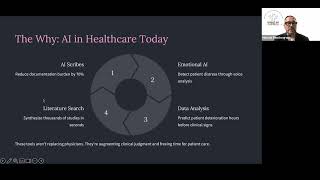
So many of you say, well, how just popular is this? So this is as of February of this year. And according to OpenAI, the chief operating officer, they receive 400 million weekly users. Weekly users. In December, Sam Altman, the CEO, said that they receive 1 billion messages per day to their ChatGPT. Think about it. 1 billion. The amount of data is extraordinary. Where are we in terms of generative AI? And I want to make already something simply understood. AI has been there for a long time. Generative AI is the one that is now more popular, and it started in 2022. And when we see the first AI wave had limited capabilities in the '80s to '90s, and then after that in the '12 to '22, we started to see more of the neural networks. It's fragile, it's expensive training data, but it's successful at narrow tasks. What we are seeing right now in the past couple of years is the seeing perhaps what we call agentic AI, where you see not only just one task, but multiple tasks done by a decision-making agent. Where is it in healthcare today? We start to see to the left-hand side scribes. This has been taken medicine by storm. If you haven't used one, I encourage you to do it. It is incredibly powerful. If we have time, I can do a demo, but I wanted you to be aware that this goes to the heart of physician burnout. A lot of us spend, and this has been documented, an average of 2 hours in our non-clinical time to take care of our notes. And yet an AI scribe that could be there takes everything, cleans it while detaching you from the computer and giving your gaze to the patient, holding their hand rather than your hands on the computer typing. To the right upper corner, you have emotional AI. And emotional AI is powerful. I showed it to some of my residents yesterday where it detects the patient distress. The words that are used and analyzes how to answer. I've used it. How do I speak to this family who is a 43-year-old mother that is dying on multiple pressors and on a ventilator, and she has a teenager and a husband at the bedside? Provide me with compelling, emotional, but authentic words that are honest to convey to them the bad news, but share with them that I care. Literature search is now beyond. It is incredible. It not only gives you within a few seconds literature search, but also insights and gaps in research. Data analysis. You can take your data and upload it to an AI, whether it's ChatGPT or otherwise, provided it's non-confidential. And it provides you with data analysis that used to take weeks and requires statistician. It can suggest to you data analysis tools and why would I use one versus the other? There is the hype and there's the reality. From the hype, we think that we hear that it's gonna replace physicians completely. It is already being used in radiology and pathology. It is not replacing physicians. However, much like EMR, 10 years later, those that don't use EMR are finding themselves much more challenged to practice these days. And so if you do not use AI at some point, it's not AI that's going to replace you. It's someone who uses AI that's going to replace you. And even the EMR, it was touted in the hype that it's going to fix medical error. It didn't. So it's not flawless. It actually is something that requires us to be in the picture. What is generative AI? And this is where I want to, once we Established the why, I want to establish the what. Generative AI is where you have a model that starts to generate the next word. And the next word is generated based on the probability of that word following the other. So I'm going to ask everybody, and you can put it on the chat if you want. If you hear me say Peanut butter and jelly. Thanks, Paul. Thanks, Mary. You just did it. And in fact, once you think about it this way, it makes perfect sense. Except this model has been trained on trillions of texts, whether it is from the paintings of the Renaissance era, or history books, or the New York Times, or philosophers, or Kerouac, or The Little Prince, whatever it is, it has all been analyzed. And now the next word is predicted based on that model. And that's what makes generative AI so powerful and yet so limited, because it's synthetic data. It's not new created data. It re-digests what's already there. There is no way that you can draft that email in that speed because generative AI generates it quickly, but it generates it over things that it already knows. So if you wanted to do it in your voice, you need to change that training by giving generative AI examples of your own email or your own CV or your own letters or your own posts on social media so that it limits the entire internet that it looked at in order to give you that answer to an internet that is more localized to you. So it started with, we have neural networks, and then we have foundation models, and then we have large language models, and then you have generative AI. I explained a little bit about how does it work, and I explained what is a language model. It means that it actually, you know, creates based on what it learned. It doesn't know it. It doesn't understand it. This is not a sentient being, but it does have a generative way of coming up with the next word or the next text. And a neural network, the details are a bit complex, but the key idea is that it's a system that can handle and generate a long range of dependencies in language. And do you know what's so exciting and funny about this is that it actually is now challenging neurocognitive science. The things we used to call intelligence is just language skills, not intelligence. So Immediately you're going to tell me, so this is not an intelligence. And I'm going to say you're absolutely right. This is not an intelligence. This is a language model. It's a generative model. It is not intelligent per se, or we should change the definition of intelligence that we had before. I'm not going to go through a lot of these things. I wanted you to be familiar with language that is specific to AI. If you direct your attention to the right upper corner, you will see that we're talking about training data, algorithms, and a model. A model has to have algorithms, and it has to have training data, which means that if you used non-fresh ingredients to make something in the kitchen, it's going to taste that way. So if you just think that your AI is all the same, think again. You must ask, what did this model get trained on? I always give a joke about a friend of mine who was having a little, you know, rainy day with the relationship with her husband, and she went to an emotional AI and asked it what to do. And the emotional AI went out and kept saying, you deserve better than this. He should know your worth. You should divorce him. And that was shocking until I asked the question, Do you know what training data was trained this model on? And it turns out that it was trained on all the Harlequin romantic novels that have this utopic view of romantic love. And of course, it's going to give you that. So you have to understand before you use a model, what was it trained on? On the left-hand side, we start to talk a lot about interpretability and explainability of AI. Those are keywords because we are now going to be seeing AI used in reports of radiology and pathology because the access to the patient portal is demanding that patients have access to their results before the physician had the chance to meet with them. And they start to panic over these results of a nodule or of growth over and so on. So the AI has to have outputs that are explainable and interpretable. The human in the loop, I put it in the center because it's such a huge thing. You cannot deploy AI without human in the loop. We're starting to now realize how much the AI model does not have place for vacuum. It doesn't have a place for I don't know. It is mandated to answer. And if it has to answer, sometimes it makes up something that wasn't there, but it looks so real that we call it lying with confidence. I wonder where they learned that from. So it's important to understand human in the loop. You can't put out an output until you actually reviewed it. To the left lower corner, you need to understand also that any AI you take, you have to understand what data was used, how was it trained, where was it tested, and how you're going to deploy it in your department or your own household, whatever that is. Because if I'm going to deploy it, I need to understand the readiness of my staff. What are some of the things that they're going to encounter? So the testing is important so that you can put some frequently asked questions. And you will know that a lot of the medical AI right now, because physicians, clinicians, Nurses, RTs, allied health professionals think that they are better than this. We are not going to trust it because AI lies. Well, it didn't stop. It's going to be— continue to be innovative and evolving, but they need data on medical in order for them to make the results much better. Without us, they'll just do it on their own and they'll use data that is not real. So That's why I keep repeating, this is the time to get trained and to get involved. Before we go anywhere, before I show you how you can improve this and put it into your life, the first thing is, if you had an intern, would you just tell them start IV antibiotics? No, you wouldn't. You will go over Here's the antibiogram of our facility. Here's what IV antibiotics options are for this particular infection. Which one would we put for this particular patient? And then you will follow up to see if they executed it the same way. So when it comes to AI, somehow we have different expectations. You must tell it a directive that is specific and that you need to follow up on it if it's not what you want by reiterating the ask. We call that prompting. When it comes to AI, we call that prompting. So the prompt is your ask, and the more specific the ask is, the better you're going to get what you want. And if it's not exactly what you want and you reiterate the prompt again, The model is learning what you want, so it will give you what you want on the second or third or fourth iteration. So how do we create a prompt? It has to be specific. You need to set the context, state the purpose, and then verify the output. I love what you asked, Dr. Yi, and I'm going to address that. The question is, how do we utilize AI without encroaching on HIPAA? This is the big question. Unfortunately, When it comes to that, your institution has to have some level of communicating with the AI vendor in order not to infringe on HIPAA. But what can you do on your own? There are ways where you can download the model into your computer, and that disconnects it from the mothership so that you can— and this is huge, not just for HIPAA, but also for banks, for scientists who have research and they don't want to share the data. You cannot trust that that data is going to be tested and not included in that AI. So what I've done in the past is I've de-identified the data, or if you cannot, then you have to have a model that is only in your unit and does not connect to anything else. There are now AIs that you can speak and they would only record in the moment until they transcribe, and then they delete everything. It doesn't go to any server. So there are ways, and it's getting better and better. But definitely looking at the privacy is one of the paramounts of what AI model do you choose. Going to the next one, I want to make sure we also incorporate the word hallucinate. And it's also a word that I don't like because it's not really hallucinating. Hallucinate. But what is hallucinate? Hallucinate now is in the Cambridge Dictionary, the word of the year 2023, where an artificial intelligence produces false information in a manner that is so trustworthy that it looks real. And so what you see here is someone who asked an output, which is a prompt at the top of this white box, and it asked for references, and the references were given, and none of these references are actually real if you check them, but they look real. So when it comes to hallucinations, they have already caused a lot of trouble. I provided you here with a tutorial that will go in depth about the, what are hallucinations in large language models. It was in the Quad AI this year. But you can see that instead, if I were to tell you confabulation, you'll understand what it means. It just makes up stuff that sounds real. And Google has lost billions after an AI chatbot made an error during a demo. ChatGPT in its evolution in 2022 to 2024 started to add, it may produce inaccurate information. And then when Gemini started to be, to add racially diverse answers, it started hallucinating even in creating Well, black Nazis in its output, and it created a huge problem for Google. That means they still did not hone in on how to strike the right balance between being diverse, but at the same time being accurate. And you see me here again putting this human in the loop. You must be the curator. No matter how you use AI, you must disclose it academically, but at the same time, you are the ultimate responsible for the output. Good prompt, tell me about sepsis. Eh, too vague, too nonspecific, no context. A good prompt is you tell it the context. As an ICU physician, I need a differential diagnosis for a 60-year-old diabetic patient with fever, hypotension, elevated lactate, state includes sepsis consideration and immediate next step. It's a specific scenario. It's a clear role, and it's a defined purpose. Why am I spending time on prompts? Because no matter what the AI you use, prompts are the absolute basic. If you use an AI that will create— I'm in AI movie-making school, and you have tools where you give a text and it gives you a video. And then you're like, wait, what? And you have to ask. It's you who gave that text. You have to learn how to prompt in order for you to learn any AI tool. It's the basic. So this is, if I were to tell you, explain to me what is a Swan-Ganz catheter? Or number 2, I want you to act as a professor in cardiology. Provide me an explanation on Swan-Ganz catheters. Even better, I want you to act as a professor in cardiology. Provide me with an explanation of Swan-Ganz catheters. Use 5th grade language level language to explain it to me. Even better, I want you to act as a professor in cardiology. Provide me with an explanation of Swan-Ganz catheter. Use 5th grade language, language to explain it to me. Organize it in 10 bullet points and in 250 characters or less. Use as many examples and analogies as you need. You can see how you can get better at using AI. If you wanted an AI, for example, to write emails for you or to put together a slide deck presentation for you, then the prompt should be, act as a professional personal statement writer. I'm going to show you some copy I've written, and your goal is to imitate it. You'll start by, you'll by just saying start. Then I'll show you an example. Then you'll say next. Then I'll show you an example. Then you'll say next. And you can only start when I say done, not before. Then you'll analyze my writing style, tone, and the style of the sample text. Finally, I'll ask you to write a new text on any given subject using exactly my writing style. And then I put in, I copy and paste emails, I copy and paste my resume, I copy and paste a personal statement before, and then I ask it to give me a personal statement exactly as you would do with a medical student. You can't just ask a medical student to do an H&P. You have to give it H&Ps that they've done before. You have to give it— this is one that I've written, I want you to write it in this style— before you can say, okay, you can go on the EMR and start to write it. This is another slide just so that you can understand what is effective prompting. And this is in healthcare. Number 1, you need to diversify your toolkit. For example, you can use Gemini and ChatGPT and something else in order— each one of them has been trained on a different model. Look at you guys. You already understand what I'm talking about. You have to reiterate. You have to send it back and forth, back and forth. So that you can create 3 or 4 versions and you can mix and match. You need to use personas. Did you know that I had fun using AI by saying, here's my business model. I want you to act like Steve Jobs. I want you to use everything on the internet that is Steve Jobs— interviews, videos, articles he's written, books. And I want you to analyze my business model as if you were Steve Jobs. People have had conversations with Beethoven. So you can have a lot of fun with it. And now we understand that there are psychological tricks. You can literally say, I'm going to be fired if you don't answer my question. So some prompting strategies. You can do one direct prompt, zero-shot. You can directly ask for an output without giving examples. It's called few-shot prompt. You can do a chain of thought. I use this a lot. I ask the model to break down the reasoning step by step of how they came up with that particular output they gave you. Or I can sometimes just explain, then respond. I ask the model to explain a concept. Once it explained the concept, then I ask it to use that explanation in order to give me what I want. So what are the opportunities in critical care? If I can predict the next word, I can give it analytics and it can predict who of my patients will do better in ARDS and who doesn't. Last SCCM, last year, not this year, there was one particular a speaker who deployed a model to analyze the vital signs of all the patients of septic shock that he treated. And they determined the subpopulation that responded to fluids within the first 15 to 30 minutes. And it was fleeting. And these patients went to join the others in needing more vasopressors. But somehow that subpopulation did better than everybody else. And now you could not see this by yourself. And once that created, now his group is focusing on that subpopulation. What's different about them? You can optimize your workflow. You can deploy scribes during your rounds. By the time you sit, you can literally start to see these notes. All you have to do is curate them and put them in your EMR. By the time you've done your rounds, you're done. It assists you with your documentation. Decision support. How many times have we like, I have no clue what this is? You can literally take a picture of that rash. And do you know what this does? AI democratizes places where you work. You could be a physician in a small access care center in a place that is 100 miles from any nearest facility. And you just need to run it by somebody, but there is nobody. So you can run that rash by AI and they can tell you, differentials. You can look at an EKG and say, I don't know if this is STEMI or not. There is now an app where you can upload a CAT scan, an MRI, an EKG, and ask, and it's gonna give it to you. And you don't need someone to tell you whether it's right or wrong. You have your own knowledge. You just need somebody to help you brainstorm with it. I work in tele-ICU. And we already have a bunch of— if I would log in and I would have 30 patients to round on, how do I prioritize them? I have a tool that already scores for me based on all of the data, vitals and labs all integrated, that gives me start with this person, then this person because they are critical. They have changed a lot in the last 20 minutes and so on and so forth. So forth. I wanna pause for a second. Any questions so far? Any comments so far? This is yours. So I want you to engage with me because I don't wanna think about what's important for you. A lot of you, if you're like me, I, we worry about the biases in healthcare, which are now documented. No one would come to you and say there's no bias in healthcare. However, if you train the same models to the AI, aren't you going to perpetuate it? It sounds a little, you know, theoretically sound, but honestly, I don't know what that means. And if there is, I mean, it's a system problem. How can I fix it? So I want to share with you this video. And to give you context, this is— before I move to the bias, this is one where AI is used for reading echoes. This is a video where someone is doing a cardiac echo and you have to wait and you start to say, oh my gosh, what's the preliminary? And when is the cardiologist going to read it? AI is already reading it. Now, is this all accurate? We don't know. We still have to have the human in the loop. But I just wanted you to see this is real-time. This is absolutely real-time. So if you're not excited, I am. Other applications in healthcare, we talked about them. Image interpretation is a big one. This is one where there's already an artificial intelligence guided ultrasound by non-experts. And what it was, if you are somewhere where you have not trained in ultrasound, but now you have an ultrasound and you are the only physician there that night and you want to know how to use it, there is an image guided This is why we call AI democratizes the access to healthcare. But the pitfalls, as I mentioned, are the bias and inequity. And we'll talk about the bias in a second. Cybersecurity, thank you for mentioning that about HIPAA and other. Overreliance, sometimes automation bias can lead to misdiagnoses. How many of us have the ability to see that EKG and it has a report? But we've grown to not trust it completely. We don't rely on it. So don't over-rely on it, on AI, because it does have the ability to appear confident. And then there are still some regulatory gaps. I cannot be from this generation if I did not talk about the carbon footprint of AI. OpenAI specifically, look. The left box is O-1, which is one of the models, the reasoning models of AI. The second one is DeepSeq and O-3, and the third one is image generation and text generation open source models. Training a single AI model generates more CO2 than 5 cars produce in their entire lifetime. I don't know about you, but I was floored when I read that. And so when they say to you there is trillions or billions that are being invested in AI and they're going to create a facility somewhere, there's only so much energy you can make. You cannot throw money at physics. This is why Deep Seek, which is from Chinese developer, when it came out and said that they used only $5 million to train it, now you ask yourself, well, hold on a second. It's cheaper, so it's scalable. It's still not great, but it's scalable. And so that's the reason why we have to understand that just because AI is this big thing doesn't mean that it's friendly to our planet. Biases in AI. I'm going to try to see if it downloaded the video. It did not download the video. When we talk about bias in AI, it's important to understand that it is all about the data. So this video was a video generating AI. And it was done in France where, much like in the US, if we use an English word that is called the projects. If you're like me and English was not your first language, the projects is an English word. It means the project. But in the US, it has stigma of socioeconomic repercussions. Similar to that in French, there is a word called banlieue. And banlieue in French language, it's just suburbs. However, banlieue in French, France, it has a connotation similar to the projects. So when people started to put their, give me a picture of a children's classroom, children are happy running around. If you add the word in the projects or in la banlieue, it would show that everything is destroyed. There's trash everywhere, and so on. If you ask, give me a wedding in France, it's beautiful, very nice setting, everybody's happy. If you put there in the projects or in banlieue, it gave you very sad, destroyed, trashed out place. And so what these people did, which is the equivalent of Uber in the US, Heetch, which is a hail riding app, they started putting in those rides postcards that you can purchase and sign and send to Midjourney. And those postcards are from La Banlieue. What they did was retrain the model with new pictures so that it turns it away from the bias it had from only the text that it was trained on. So we need to know what is the model trained at, and if it has bias, This is the way to fix the bias is retraining it. How close are we in adapting this in academia? It already has been adapted. The leaders are abroad, but also Stanford is leading the way in multiple of these implementations in academia. In fact, I want to ask a question for the, for the audience. Can you tell me when a survey was done over all countries in the world, who is the top user of AI? Which ethnicity or which country uses AI the most in the world? Give me on text or you can shout it out. What do you think? It's the Irish? What do you think? It's the Chinese? What do you think? Is New Zealand, Taiwan, India, China, China, China. I kid you not. And actually, it's a TikTok video that went viral. It's Moroccans. It's people from Morocco. I kid you not. You can verify it if you wish. But there is a way to think, yes, India was closely following, but I want you to know that what it did is it actually provided access to resources to people that didn't have it before, and it's changing the game. So are there ways to diagnose and filter biases? It's not ready for primetime. However, it's looking in the process of the neural network. At what point is there a bias? And that's— doesn't— it's not easy. And there are multiple research places where they're trying, the IT guys trying to change the process to make it a lot more faithful. I did want to share with you that it's important for us to preserve the physician-patient relationship. So transparency, Disclose it to patients and you will be surprised. Patients are accepting it a lot more than physicians. And it actually, I just read it last night, there's a study that came out comparing patients and physicians in multiple countries. And the trust of AI from physicians and/or from patients depends on the country. There are countries, for example, India and China, where patients trust it a lot more than physicians trust it. In the US, they're kind of on par with each other. Human in the loop. Please maintain your oversight on every recommendation. Consent protocol. You must have in your private practice a consent for the patients to be in the forms that they all sign to know that there is an AI scribe. Education. Both patients and staff, they need to have AI literacy. You can no longer just say AI is here, but I don't understand it. You must understand how it is inserted in your life professionally and otherwise. I wanted to show you, this is what I have in my own phone. I have AIs. These are all AIs that I use. Medical AI, DAX, for example, and Copilot are AIs that are with Nuance and Dragon. This is an AI scribe within Nuance. If you look on the right, you will find that I have one that's called Perplexity. I use it a ton. We no longer Google, we Perplexity. Perplexity has changed the game of research. It gives you a Wikipedia-style answer to your question with references. On the right, it gives you videos. On the left, it gives you images, and at the bottom, it gives you follow-up questions. It is changing the game of research. If you are using Google to find what you want, try Perplexity. You will be absolutely floored. And it also has what we call focus. So you can do a dropdown menu. You can focus it in academic or social or math or otherwise. So it changes the focus of the engine into what you want it most. But it gives you references. So hallucinations are less. And less. When we are talking about integration of AI, anything at all, and AI is also in that field, we have this curve. At first, a technology trigger. It was when OpenAI declared. Then you have a peak of inflated expectations. And that means that we expect so much of AI and it disappoints us. We then drop into the trough of disillusionment. I think this is where we are. Then you go into some enlightenment. AI can be in this, AI can be in that. And then you go into a plateau of productivity. All of us have been through it with EMR. How many of us expected so much of EMR? And then we got so disillusioned, we wanted to walk away. And then we started to define what is it good for. And now we're kind of in a productivity with the EMR. We know what it can do. And cannot do. AI is the same. So what is our path forward? Please adopt incrementally, one thing at a time. Pick one. That's what I did. I picked one. I picked Gemini. And then a week to 2 later, I added something else. And then I started comparing them. And then after that, I added Perplexity. And then I moved only to that. And full disclosure, I have been accepted in fellowship of Business AI Fellowship with Perplexity. I am also a digital health fellow, my fellowship going on with digital health with Doximity. So I want to be in that forefront. I don't want to be dictated how is this going to benefit me and my patients. Demand rigor. When you have anything that is adopted, demand rigor. Stay current and at the same time remain asking that this should be mostly for humanity. So keep it human. With that, I am going to ask now, tell me, how did you feel What do you know? What questions do you have? And how can I assist in bringing this to your life? And in the last 5 minutes, I will share my screen and do a couple of demos so that you know what AI is and how could it be used. I am known to leave people speechless, so don't feel bad.
No, I was just gonna say, um, there's so many AI apps. Uh, my challenges is knowing which one to start with. I started with the one that was put in my face, which is ChatGPT, and I've stuck with it. Um, I only use it minimally. Um, I'm kind of still on the fence. I'm a sci-fi buff, so I think of The Terminator, The Matrix. I don't know what it could do, but I'm slowly letting it enter my life.
And that's the best way to do it. And I will be answering some questions on the chat as well. And I will answer to you how indeed this is going to be best utilized in your life. The best way is indeed to do it slowly. So what I would try to do is let me share my screen and we can start. We can start by seeing how to start even today when you are wondering. There we go and share screen. Okay, so I wanna get started with AI. Where do I start? So The majority of us have a Gmail account. So I would start with that because every place that we have AI, you can click and it gives you a single sign-on. And single sign-on you can use with any email or Gmail account. So I wanted to get started with Gemini. So gemini.google.com. Here's the problem. If you have Gemini and you wanna start using your email address, well, hold on a second. This is actually AI. So if I used my Gmail account, would there not be a future time where they might actually where they might have a glitch and suddenly it's scanning all my email. Hold on. No, no, no, no, no. I'm going to start with a new Gmail address that I've never given to anybody. I did not use it for anything. It's a throwaway address, and that's the one I use all the time. I don't want it to scan who are my friends and who's my family. If there's bank account information there, absolutely not. So let's go back to Gemini. And know that I've already gotten that address. So I'm going to connect with the address I've chosen. Perfect. And now I'm in Gemini. Here it is. What I like about Google is the interface, so you can use it for whatever you want. So I'm going to say, what is his swan gans? Oh, hold on. That's not a good prompt. So I'm going to say, want you to act as a cardiologist or even renowned for interventional cardiology. What is a swan gans? No, no, no. I'm going to even say context. I am to give a presentation to my attending. More context. I am a medical student in the state of Alabama. What is a swan gans? However you make it more and more specific. Or I could say, I want you to act as a resume coach. I am applying for a job at this company, www.medicalaiacademy.com. Analyze the website. I will upload my resume. Give me critique on how to improve it. You can also analyze my LinkedIn account, and you would give the URL. Remember, it's connected to the internet. So of course. In Dr. B, California. There. Let's get started. Here it is. The focus, target audience, key themes, et cetera. Let's go to perplexity. Perplexity. Let's say I want to research. Here's what I mentioned. You can choose to ask it whatever it is that you need in terms of what is a swan gans. I'm just gonna do it this way. You know now how we, you could make it better, but we're gonna do it this way. And this is what I said. You can choose the focus, web or academic or social. So I'm going to leave it as academic. And the answer it gives you is not like up to date, is not like an article. It shows you how it's thinking about it. It gives you what it's reading, and then it's going to give us an answer. And while it's doing that, I'm going to answer other questions in the chat. With many of our trainees growing up with and developing an overreliance on AI, how would you recommend we teach them how to use AI appropriately? Teach them how to prompt. Teach them how to not rely on it and how they are ultimately responsible for the output. And normalize using AI. In rounds, ask them to pull out their phone, one uses Gemini, one uses Perplexity, one uses something else. Here's the answer. A swan gans scatterer. These are the uses. Here are all the references, risks and complications. On the right, you have a video. You can search images or search videos. You can literally generate an image so you don't use copyright images for your presentations. And then it gives you related questions. This is not in just medicine. You can use it now for finance. You can use it now for anything that you use. It's incredibly, incredibly powerful. And then one thing I would share with you, this is one of many AIs that you can use to create presentations. So I'm going to click on Create New. Again, I'm already connected. Please use a throwaway address. Mary, can you tell me what presentation you'd like to make in the next couple of minutes?
I'd like to make a presentation on healthy work environment In the critical care.
Anything specific you want to add or subtract? Do not do or do? AI is very good with limitations.
And in for advanced practice nurses and have it focused around Advanced practice nurses in critical care.
Perfect. Here we go. I want 8 slides. Again, you can make it as a webpage, a document, or a social. And here it is. Gives you the outline. Once the outline is done, You can choose the style. I'm going to choose this style and generate. This has been now just a minute. We have 1 minute left and let's hope it does it within that minute. Thank you for attending, all of you. And do share with me, how do you feel about this? As you can see, it has looked on the internet and is populating all of the slides for you. Clearly, you still have to have human on the loop. So what we're going to do is go up here. You can download it to a PowerPoint. Until you can just present it right from here. What is your thoughts? Feel free, everybody, to give us your thoughts.
Life-changing. Time Time is coming back.
That was awesome. That was great. That was fantastic. I will utilize you for a personal consult. Adam had a question. Adam, I don't know if your question was answered or not. Are you still on the call?
Yeah, I'm still on the call. Actually, no, it hasn't yet. But my main question was, so with the growing usage of AI in the medical sector, How can we, you know, mitigate specifically malicious attacks towards patient records and/or the system being utilized? And also, how do we gain or is, you know, consent needed towards patients when using critical information in the medical sector, especially with AI now?
So what is important is we're not going to solve that right now. However, if I want to use something for a patient record, I de-identify it. And nowadays you can literally just create voice and speak to it. And when you speak to it, you omit anything and just make it a general question so that it helps you answer. But you do not wish yet for any of the medical data. And that's a pro and a con. This is why these medical AIs are still not up to par yet. They have their downside because it has not been trained on medical records for that specific reason. So you still have to be the curator. And to a question whether it is that we need to take any machine learning language training for this, we did not need to take engineering for ultrasound to know how to use the ultrasound. We just need to know how to use it for our patients. And I think that I wanted to mostly conclude by saying my goal for physicians, clinicians, advanced care practitioners, nurses, allied health professionals, physical therapists, RTs, pharmacists is to give you back the most precious thing of all, time. I don't want to waste time in clerical things such as choosing the color of the slide I'm going to present. I want to focus on what I'm good at, which is the information.
Thank you so much. This is fantastic. Great primer, and I will be consulting you on this in the future. Any additional questions or comments from the audience?
Jignesh, if you can mention the code for CE, I do not have it.
I put it in the Dropbox, in the chat box. Let me know if you received it.
Okay, so there is a link with credits claiming slides, correct? Yes. Okay. It, it's still downloading because it's using my computer for Zoom. So, yes. So you need to text to the number. The number you need to text is 916-866-7913. And what you need to text is J-O R-O-T, John Rot. And that should be the CE. Thank you so much. I appreciate all of you. I appreciate that you've given me this space, and I look forward for all of us to take back our time and to be present and accounted for as they deploy this very capable but in the wrong hands would not be good for us or our patients.
Thank you so much.
Take care, everybody.
More from Hassan

ICU From Both Sides of the Bed "If you could not speak,what would you want us to know?"







