Gharsat Amal - from theory to practice. Session 1: how to approach the patient?
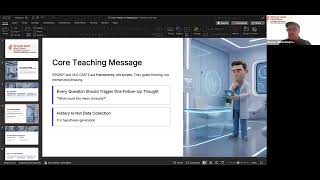
Dr. Hassan Bencheqroun teaches medical trainees how to move from textbook mnemonics like OPQRST to real patient interviews. Start with an empathetic human question, not a checklist. Listen more than you ask, and let pattern recognition guide your hypothesis.
Chapters
And let's get started with this. Excellent. Can you see my screen?
Yes.
Excellent, thank you. So, um, I understand how this works. Some people feel comfortable speaking. Some people feel comfortable maybe putting something in the chat. Some people feel that they just want to do reactions. Either way, it helps me a lot give you what you want by knowing what you want. So if you have any questions, if this is not relevant, this is content that I chose from directly from the chat, from what people have asked as questions and the sort of nervousness. And the reason why we're doing this, these sessions, is in fact for transition from theory to practice, starting clinicals. But they are starting clinicals, and you are starting clinicals in a variety of contexts. Some are starting them in, like you are hosted in a different place, Others are starting them in hospitals where there's a lot of, I call it trauma-informed medicine. Manatu ennu, I did not want to recycle videos or just print that you read from contexts that are not yours. And all of the illustrations are going to be illustrations that are cartoon, but we'll be speaking mostly about cases that you might be seeing at the bedside. I have tried to go there many times, but I haven't been able to. They canceled it last minute. They changed a variety of things. So regretfully, I have not been there, but I have listened to all my colleagues that have come back from there. So I have a little bit of an idea of what you might be seeing in hospitals. But it would be helpful if you help me with questions that are yours. So this is yours, not what I think is yours. My goal is— so whatever you have as questions helps me. The way I think about it, I'm going to try to give you a brief overview of the topic. So, how do we approach patients? So one of the things that I see is that we have sometimes patients that are quiet. Sometimes we have patients that are really traumatized and they're all over the place because they're afraid. I saw a patient who couldn't stop talking and was talking to me about stories. We are storytellers. Sometimes when you speak too much When you speak too much, sometimes you lose information in the story. So how do you redirect the patient? How do you re-concentrate and refocus the patient to tell about Who went where and what? And I want to know your symptoms. You know what, what brought you here? Pneumonia. Or I brought— they told me that I have— and then I usually ask, tell me your symptoms. Don't tell me what they told you. They want to sound smart, so they tell you what the other doctor says. The opposite is true. They wanted to test me. Another physician and what they told them. So you have to try to extract information, and you have to sound like you are not interrogating them. Environment is associated with interrogation under a regime. So they can feel like you're giving them heart and you're not interrogating them. To make a session, I felt like this was too wide. Of a topic and has too many permutations for me to just give you lessons that somebody else recorded for another university. I will repeat for those that just came in, please send questions or use the reactions for Zoom to say yes or no or thumbs up or emotion, whatever you do, because it's going to help me. To know where you are. You can use the chat. If it's hard to do it on Zoom, use the chat on WhatsApp. I have too many things open, so I will try to keep up with you. So because this is a will session, I want to tell you how I would like it to go. This is just the start, but I will be employing other things such as printing these slides and sending them as PDF, putting these sessions on YouTube. I want to ask you to keep the questions coming. I will be treating this almost like a podcast. In the next sessions, I will be trying to get guests on here in order to speak of that which is their specialty. Mumkinikun ma'ikh tisasi bil alb, ashen el EKG. Mumkinikun khutisasibi ri'a, ashen el exam and el auscultation of the lung exams. Mumkinikun khutisasima'i orthopedic for the musculoskeletal examination and the anatomy, etc. Any questions? Any comments? How does this resonate for you? Is this something you would find useful, or is this not even at all something that you will like? Do you want something different? Share with me as we move along. So the core teaching message, how do you start with a patient? That's how we start with a patient. So how do we start with the patients is Awwil shaghla. You have to start your questions as they trigger one follow-up thought. Meaning, if I ask, do you cough? I need to have something in mind about that cough. Maybe when someone tells me they have a headache, I tell them, do you cough? Then I'm thinking about viral illness. If I tell them, do you have diarrhea or abdominal pain? Same thing. Do you have viral illness? But if they tell me a headache and I tell them, do you have dizziness? Bitduhi. That means I am thinking about vertigo. I am thinking about stroke. I am thinking about the heart, meaning heart failure with low blood pressure. So every question should trigger one follow-up thought. Okay, a charlatan history is not data collection. It is a hypothesis generation. Hypothesis generation means that everything that you are thinking about has to have some hypothesis. Like I just said, it's a virus, it's a stroke, it's a bronchitis, it's something. For example, that the person has just spent last week in an area where there was smoke and they tell me that they have shortness of breath. I am thinking inhalational injury. But if they come in and they were pregnant and they tell me they have shortness of breath, Now I am thinking, is this normal for pregnancy, or is there something else like blood clots in the lung? Famine, Ali? Mahmoud, hello, Sahla. So, Emilia, Karam, Rahad, Mina, Mahmoud, just to recapitulate, this is the first session. I just started it because of what I had heard in the chat, but we will be doing this every Saturday. And please use the chat for questions, whether the chat on Zoom, well, let's chat on WhatsApp, well, just reactions from Zoom. This is being recorded and will go on my YouTube channel. I would like for you to make me any suggestion. This is for you. This is not coming from any university or anything. It is Tailored towards you. So if you want to see any changes, please let me know. Inshallah, we will give you what you need. Now, the next point I would like to make is how real clinicians actually start. So whenever you put— you take something about how to start with a patient, they give you OPQRST because it means words that remind you of how you could start. But really, we do not start with a framework. We start with a human sentence. I'm in your shoes and I see somebody, and I'm so brokenhearted because they are suffering. They're in pain. They just bled, or they just having a stroke, and I see that they cannot move their arm. They cannot speak to me. All of these things, when they have symptoms that really break my heart, what I try to do is I don't know where to start, so I'm going to start as a human. How would I ask as a human? As a human, I just listen. Let them say first what they came to say. Something like, tell me what's bothering you. Well, if someone tells me I'm in pain, I tell them, this must be stressful. Pain getting worse. So just like if this person was your friend, tell me what's been bothering you. Walk me through what's happened. Help me understand what you're experiencing. Even today, I'm telling you this. Help me understand what you're experiencing. Okay, so you start with a human question, but then you start to open. Fafi. 2 types of questions. There is the open question and there's the closed question. If someone talks too much, I start to ask yes or no question. Is, do you have pain? Do you cough? Can you walk? Do you see my fingers? So these are closed questions. Open questions is when I have a patient that is quiet. Or says a few words. That's when I say, tell me your story. What brought you here? How long have you been like this? Did this happen while you were at a function? When you walked, did you feel the same thing? So something open where they can actually have the ability to add more if they want. And you hope by repeating that you are opening the patient to speak to you. Then step 3 is actually pattern recognition. And so pattern recognition means that you are looking at what comes the same, what is repetitively the same, meaning someone who has cough, fever, sweats, and diarrhea. I see this a lot in viral illness. Even flu can give you this. COVID can give you this. For example, if I see someone telling me, I have chest pain that goes to my left shoulder and radiates to my left arm, I see this pattern. In heart pain, are they having a heart attack? For example, I see chest pain, but the chest pain is going up and down and it's not going away. And it is not associated with exercise, with exertion. Okay? I see this pattern in heartburn. So you try to look at patterns. And this is the part where sometimes it frustrates us. Patterns when he sees them, but for me, even if I see them before, I forget them. This comes with experience, so I will be asking for you to have patience with yourselves. It works best for acute symptoms like pain. Okay, so what we're going to do is the OPQRST. O is onset. How did it start? Okay, how did it start? Fi alam, kif, btada, ubadin. Quality. How is its quality? Is the other day I took my father to the hospital because of back pain. But he was telling me the back pain in his back. Well, that's not helpful. You need to tell me, Dad, where is the pain and how does it feel like? Does it feel like stabbing? Does it feel like twisting? Does it feel like you spilled hot water on it? Does it feel like burning? Does it feel like electricity? Each one of these is different. What provoked it and what made it better? Okay. Still good? Any questions? Let me check the chat so I'm not missing anything. Where is the chat? Okay, no, nothing so far. What they say? No good news is good news. Okay, so let's talk about chest pain, for example. Why do we talk about chest pain? Chest pain, cardiovascular is the first killer, okay? Worldwide, that is. For chest pain, tell me about the pain. Tell me how it started. It started while climbing the stairs, while running away from something you were afraid of. It was worse with exertion and it got better when person laid down or sat down. Okay, and then 8 out of 10. Sometimes people just don't know how to convey information. We have to help them, so we give them from 0, no pain, 10, worst pain ever, and then they tell you it's 8, it's 9, etc. Okay. In practice, in practice, the, and there's another one that's called old cards. So we saw OPQRST, but this one is old cards. Those are just to help our memory remember when we are starting. Hadil old carts, what does it do? Bitnadim al kasal maradia. Well, tashkis, tashkis, lishanan watik al HPI, which is a history of present illness. Al kasal maradia al halia. The purpose is to create a coherent story to support diagnosis and documentation. Do you remember what we said in the beginning? What we said that every question should trigger a follow-up thought, and every thought should have a history, hypothesis generation, not just data collection. So that's why we are doing in this fashion. At the end, we need to have a history. So what is the old cards? So the old cards are onset, location, and duration. Onset, location, and duration means that main— and Lost my train of thought. Um, this is 12. Onset, location, and duration. The next one is character. Character. Are they using— right? And we have to understand, is this reality or is this not? Even if this is not reality, we do not dismiss the patient because we're there to help them, but we at least anchor them in reality. Where? And they tell you, I was here, I was there, and you try to recreate an image. And as you try to recreate the image, then it's easier for them, the So, killida can either OPQRST or old cards. Hadul, frameworks. Hashan, Ikuna anna kas samaradiyya bis basb intent. So that we can start to make faradiyyats maridiyya. When can you use either/or? Those that use OPQRST, those use it quickly just so that you can have a rapid clarification. The old cards is full narrative because it also gives you the context. In which this happened. Okay, here we compare them. OPQRST, if it's in the emergency room, it's acute, it's rapid speed and danger recognition, quick triage decisions. OLDCARTS, if you have a full history and physical, if you are up on the clinic or on the wards, you need the full story. You're trying to see if this has been going on forever. So let me go back and remind you what each one is. OPQRST is onset, provocation or palliation, quality, radiation, severity, and time. Okay, and what we mean by that is— we mean by that— لَوَامِلْ مُحَفْزَ وَ الْمُخَفْفِفَةَ نَوَى�� الْعَلَمُ وَ الْتِشَارُ وَ الشِّدَّةُ تَحَيُّرْ الزَمَـ��نِ. This is to discover if this is, because it's acute, is this severe, is this dangerous? All parts, they are onset, location, duration, the character, aggravating or alleviating, radiation, timing, and severity. That means, that means, and Character. And then radiation timing and severity. Good. Now, what are the common— I don't want to call them mistakes— lessons that we learn? I will share that. I know I did that. I was sounding like a robot. Where were you? When did it start? How long did it last? From 0 to 10, which one was it? It sounds like a robot. How do you not sound like a robot? I try to sound like a human, which means I sometimes, between one question to the other, I say, I understand. It must have been hard. I've been there before. I can understand what you're going through. Well, we're going to figure this out in no time, inshallah. So these things, don't let them go. They are what makes you human beings. Asking without listening. For example, somebody tells me, just yesterday I asked, do you have any history of Heart disease in the family. And the person says to me, my father, we were very close, I loved my father, he died 10 years ago. If I don't say Allah irhamu at that moment, then I'm not listening, I'm just asking. For example, when I say, when did this pain started to this, to a pregnant woman. It started yesterday, and I know I shouldn't have been, I shouldn't have been driving, but I had to go somewhere. You understand that she feels guilty. She's afraid for her baby. So you have to reassure her. Don't worry. We will do everything we can so your baby is safe. So When you are talking, don't ask without listening. Failing to connect answer to meaning. For example, somebody tells you that they have a pain, and then in that they say something else, which is, my blood sugar has been high. And you don't connect the pain and the high blood sugar together. Into a meaning. There may be an infection or stress that raises blood sugar. And then last one is treating mnemonics like exam checklists. Mnemonics, uh, OPQRST is a mnemonic, um, so Don't treat mnemonics like exam checklist. So let's repeat this again. One of the— some of the mistakes that we make lists. The more you practice, the better you become. Okay, so can someone play with me and do a 60-second interview using OPQRST? I will have an answer if you want, Ahlan Walid. I will have answers for you if you wanted to ask me. If you don't, that's okay. Salam alaykum. Wa alaykum assalam, Ahlan Walid. Ya Afiq, type.
But I wasn't here when you take OBQ or STE. So I'm afraid I can't.
No, you can, you can. We can do anything here. This is not an exam.
This is for you. Can you give me a brief explanation? What is it?
You are in my mind. Here we are. I was about to do that. Provocation and palliation. Quality and radiation. Severity and time. Something really acute. Something that could be severe. Some, like, for example, I come in and say I passed out, I lost consciousness. Well, I tell you, I'm the crushing chest pain. So pick something and ask me along the OPQRST. Okay.
Can you choose the complaint?
Can I choose the complaint? How about if— yeah, absolutely. How about if I say my complaint is I have pain in my neck?
Okay, neck pain.
Yep.
So how does it start, or when? You feel that like your first time.
All right, so neck pain. The first time it happened to me, um, it started about 3 days ago. I woke up in the morning and I felt it right away. I don't remember any trauma. But I had a long day at work the day before.
Okay, so, uh, when do you feel it most? Like, uh, when you lift, uh, when you're asleep, or when you move?
Good question. It got worse when I turn my head to the left or look down at my phone. It feels a little better if I rest or use a warm towel on my neck, and also anti-inflammatory helped it.
Okay, so Turning your head to left and down make it worse, right?
That's correct.
Okay, so is the pain— is stable or It decreases and increases over time.
Very good. It is stable, but it is stable like a spasm. It's tight and it's an ache. It's not sharp. It's not burning.
Okay. So you have neck pain 3 days ago, getting worse when turning your head to left and down. Okay, you said that anti-inflammatory making, making you better, right?
They are.
Okay. Okay. So these anti-inflammatories, uh-huh, they— you have a prescription for that or just to take it by yourself?
It was my mom's and she gave them to me.
Okay. And they— how time did you take it? How many times?
3 times yesterday.
3 times per day?
Yes.
Okay, what the interval between them?
What's the interval? 4 hours.
Yeah, 4 hours. You asked me the pain.
If you ask me the R, S, and T I didn't see you. So the, the R is— where does it radiate and in what region is it? If you ask me that, I will tell you it stays mostly in my neck. Sometimes it goes to my right shoulder, but it does not go down my arm.
Ah, what about when you're lifting something?
What about when I lift something? Clarify.
Yes, clarify. You said that it may radiate to the shoulder, so Is it affect your functional movement? Like, you can't lift heavy something.
That's much clearer. I love that you demonstrated that. I was leaving it to the end, but you brought it up here, which is great. In our head, we are medically trained. We understand what we want to ask. But the patient doesn't. So let's pretend, let's get out of this example. Oh, Saab, what about when study? You're going to say, what about it? What do you want to know? Oh, when you study, does it make it easier? Oh, of course, does it make it easier? You only know if you actually make the question clear. Does this make sense?
Yeah, yeah, yeah. Got it.
So when you tell me, what's about when you lift something? Okay, what about if I lift something? Well, when you lift something, do you pass out? That's not the same as when you lift something, does the pain get worse? Or when you lift something, do you find that you cannot lift it? Or when you lift something, do you lift it only for a small period of time and then you drop? We need to make our questions clear.
Yes.
When I lift something, unfortunately, the pain gets worse and I have to drop it. You still have the S and the T. Severity.
Okay, severity. Didn't I ask about severity?
I don't believe so. Did he ask about severity?
The T, I think.
The T, I think I did. Did you ask me from 0 to 10, 10 being the worst, how severe is your pain? So that's how we ask about severity. And I would have answered you, it's about a 5 out of 10. It's annoying. It limits movement, but I can still function.
Okay. It's like breathing can.
So if you see the chat, I have been posting every single time we ask the question, what does it mean? And we did discuss that before by saying every question should trigger a thought. So when we go to the OPQRST that you were asking me, every question you asked, you asked me about the onset, and we said, um, that the onset is 3 days ago. I woke up in the morning and it felt I felt it right away. I don't remember trauma. It's— I had a long day before. The thought is it's acute, it's non-traumatic. You think in muscle strain, posture-related pain, less likely fracture. The next one is provocation and palliation. It gets worse when I turn my head to the left and look down. It feels a little better if I rest or use a warm towel. The anti-inflammatory helps a little bit. That means it's a movement-related pain, and it suggests musculoskeletal origin. Relief with heat and an anti-inflammatory supports this. Number 3, we asked about the quality. How— what is the quality of that pain? It's tight, it's aching, sometimes it feels like a spasm. It's not sharp, it's not burning. And here you favor a muscle, not a radiculopathy, which is a nerve pain. Then you asked me, or we talked about the severity, and I say it's about 5 out of 10. It's annoying and limits movement, but I can still function. The clinical signal, or the clinical thought process about this, is that because it's moderate in pain, it's probably not severe. And then the T is the time. Does it come and go? You asked me. And/or does it stay? And I said it's pretty constant since it started, but it's worse in the morning and after sitting at my desk for a long time. And what that means, it's postural association, which means it reinforces a mechanical etiology. So thank you for helping me demonstrate how. It sounds easy, but it's not that it's hard. It's just that it's different in our head versus in reality. And that's actually what we're doing, right? Between theory to practice. So we did the common pitfalls and learning how to do it best. We did a live demonstration. We did a role play right now. Actually, I would ask you, if you are close to each other, you have contact with each other, to role play this before you go see the patient. Why is this? This is a tradition in medicine where we do things in a trial and error, in an inconsequential situation before we take it to a situation that has consequences. So you get rid of the stress and practice it so it becomes easier on your mouth. So when you are in front of the patient, you don't have the anxiety of coming up with the words, as well as the anxiety of thoughts and the anxiety of reassurance of the patient. How do we link certain things? Well, it's a long list of linkages, but I gave you examples here, and those examples are that when something happens during exertion, and we say exertion, not exercise. And no, exercise means you were running or you were doing the gym or something for your health. Exertion is when you were carrying a suitcase, or when you were carrying your little brother, or you were, you know, holding a gas tank, or when you are carrying 3, 4 buckets of water. That's exertion. You didn't do it for exercise. You do it for exertion. And when you have pain in exertion, usually you are thinking what we call ischemia. And what that means, ischemia means circulation, circulation that is I don't know what happened. What is this? A circulation that is affected. So if your heart demands more blood and you are having pain, means that it's hurting because no blood has arrived. We see that also in our intestines. If someone has pain after eating versus before eating. If the pain goes up at night, consider malignancy, cancer, or inflammation. If the pain is relieved by leaning forward, consider a pericardial process. Those are some of the things we think about. Okay, whenever you are Taking notes, you have to— the history gives you a good note. The thing about it that I made as a mistake when I was in your shoes is the more I was asking, the more I was writing, and it felt like I was documenting everything they're saying to me, which is what I was doing. But we don't want to make it obvious. Who else does that if you are being interrogated or some place that you are in trouble? So it brings about feelings of unsafety. So you want to always act as a human being, reassurance, validation, right? And we are coming to the end. So the take-home message is that Pittsburgh mnemonics, the old cards and the PQRST. Hadul bi sadu. But they're not the goal. The goal is for that to become your own style. And the goal is to give you a story that has a theory, that hypothesis that you're going to test. Is it chest pain? Is it an infection? Is it diabetes? Is it a fracture? A focused history turns theory into action. This is not about storytelling alone. This is about generating a series of hypotheses so we can start the workup. And then in the end, practice makes perfect. You have to listen first, then you have to structure second, and in the end, you always have to think clinically. Any questions? How did that go? Does this help? Is this what you were looking for? Talk to me. Okay, well, thank you, Elit. Thank you, Mina. I appreciate it. Like I said, either typing or giving me reactions. I will take this and upload it to my YouTube channel, and I will give the um, slides, they will be into PDF. They will be uploaded on the WhatsApp as well. And if you wish to see other things, please put them there. Like I said, I will be having more guests coming the next time we get together. Our next topic is going to be the art of the one-liner. We have discussed how to ask. Now discuss how to summarize in your note or to your colleague what you heard from the patient, but in a medical story. Good. Okay. Please put it in the WhatsApp. If you don't want to put it in the big group, feel free to send it to me individually. And this, that we started and finished, is that a good time for you, or do you wish to see a different time? If I don't hear any answer, then I will assume that it's a good time for you. Okay. And was this clear? Do you want— is there something you want to see more of? You want to see less of? Okay. I will assume that the first session of Rarsat Amal of Med2Med is a success. And you let me know if there is any new topic or extension of this that you wish to see. Until then, take care. Yes, it's good. Thank you. Thank you, Mina. Thank you, Walid. This is for you. I just want to make sure you have value in this, you benefit. Thank you. Ya Allah. Assalamu alaikum. I will be posting the recording, so you will have access to the recording. You'll have access to the document. Please place on the WhatsApp Chat any questions, anything that you did not understand.
More from Hassan

ICU From Both Sides of the Bed "If you could not speak,what would you want us to know?"







