Gharsat Amal Gi system 3rd 4thyear 4 18 2026
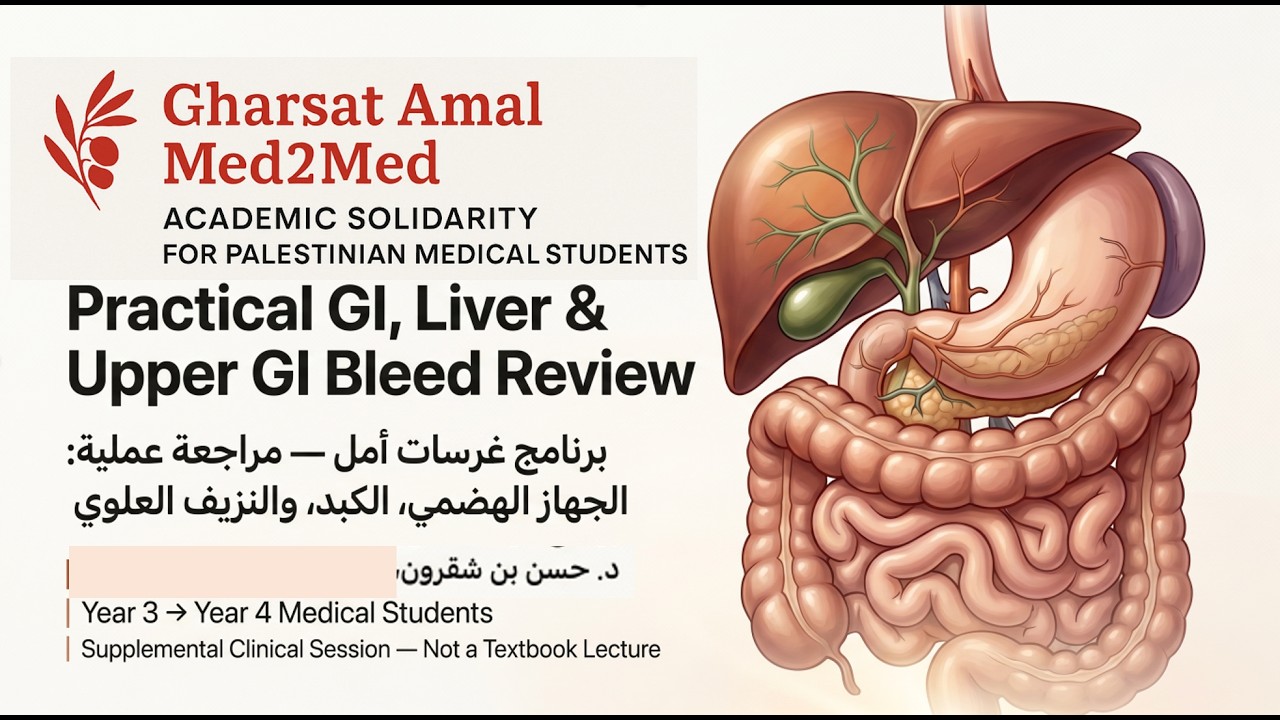
Dr. Hassan Bencheqroun teaches third and fourth-year medical students how to manage upper GI bleeding, covering portal hypertension, shock assessment, and endoscopic hemostasis. The lecture walks through variceal bleeding, pharmacologic stabilization with octreotide and blood products, and when to use clips or banding to stop the bleed.
Chapters
سلام عليكم. Okay. أهلاً أخت ضحى. We are going to wait. راح نستنى إن شاء الله. تخيل لي انو شفت ابو الادهم كمان فرح نديهم تلات ولا اربعة دقائق وبعدين نبتدي ان شاء الله ان شاء الله كله بخير وان شاء الله اللي عزوا عليك كله بخير والله يكون في عنكن We are going to start recording. Just to make sure we are starting again on Saturday. It's the 3rd years that go to 4th year. And my understanding, you know, we are studying GI system. Is this true? If you can confirm with me. I have prepared the GI system, but I want to make sure that we speak excellent. Excellent. So we have today, next, this week and next week, inshallah. And this week we will be speaking about liver and upper GI bleed and pancreas and biliary system. Please do feel Free to use the chat. لو فيكن تعطوني أسئلة to tell me a little bit of what's going on with you during the week. What are the topic? I promise I will have them ready next week, or maybe even this week. But it's very important if you can share with me شو عم تدرسوه to make it personalized to you. I know I just choose what I think. Is going on, but I don't really know for sure. Hi, we are. So I wanted to make sure that I have both Arabic and English. But if this is not helpful, please tell me, and we will remove it. What's our learning objectives today? And I want to make sure that you understand خلال الأسبوع إن شاء الله هذا الشيء اللي بندرسه راح أديكم أسئلة ونشاطات بالواتساب ليش منشان نركز إن شاء الله what we are studying that way you can have access to questions you can share with me things that you don't understand. لأنه it's sometimes very complicated. ف what we are going to talk about is the upper GI bleed. النزيف في upper GI bleed وفي lower GI bleed. How do we know which one is upper and which one is lower? We just have a patient that tells us I'm bleeding. ف how do we know؟ شغلة تانية اللي احنا بنحكي عليها إنه liver failure. The liver is very, very important. I usually joke and say the liver is like an Arab mother. She forgives and forgives and forgives and forgives until one point you cross a line and doesn't forgive anymore. فلما بنشوف liver insufficiency or failure, we can see. That the liver most of the time recovers from it until you reach a level of fibrosis, of scar tissue, and then it doesn't forgive anymore and you start to have repercussions. When someone comes in with abdominal pain, how do I start? What do I ask? That pain can be epigastric. You can see where the circle, الدائرة وين فهذا epigastric pain ولا right upper quadrant pain الجهل يمنى تحت الضلة. هدول the most important. Are there others? Of course there are, but those are the two most ones. The third thing we will talk about is portal hypertension. معناته إنه when the blood pressure goes up in the portal vein, how does it have consequences? And how do these consequences translate into symptoms? And number four, when someone comes in to see us with pancreatitis, التهاب البنكرياس، what do we take a look at for the first ten minutes? أول ما يدخل المريض على الباب كيف أعمل assessment وكيف أكون بالplan. So أول شغلة لسه نتذكر بالanatomy. We know that the GI system starts with the mouth. And you have to understand why I put the mouth there. لأنو as students, when we first start, everything is new, and we just want to go in where the problem is that we see all the time. بس العلم تعلمنا فيه. Science has taught us that when someone has very bad dental Problems. Yeah, imma rotten teeth. Yeah, imma teeth that have infections. Hadulil infections. Those people can have more severe cardiac problems. You will say, "How does one go with the other?" لأن لما بيكون عندك التهاب بال بال بال الفم هذا التهاب can give you inflammation, and that inflammation can be for the entire body. It triggers your immune system. It triggers other things. So when we compare someone who has bad dental problems, if they go to surgery before they fix that, they have higher chance of having complications for surgery. Meselen. We talk about the esophagus. The esophagus we can see in their tihab. يا إما بالreflux acid reflux. يا إما if someone is drinking alcohol. يا إما if there are any varices and we'll speak about them. We will talk about the liver and underneath the liver the gallbladder. So the liver itself has its own function. One of the functions is to create bile, and the bile then is stored مخزنة بالغلبة. So the gallbladder contracts. And pushes it whenever we have digestion. So when we have food that starts coming into the stomach, a signal goes into our body, and the gallbladder starts to push bile into the plumbing, the common bile duct, to spill into the small intestine so it mixes with the food by the time food comes from the stomach in order to digest it. Okay. بعد هيك، the stomach goes into the small intestine. We have the duodenum and we have the ileum, and then we have the colon. The colon has the ascending colon, the transverse colon, and then the descending colon. Then we have the sigmoid and we have the rectum. These are very important because if I am a gastroenterologist and you call me for a problem. Or if I'm a surgeon and you call me to open up the patient for a problem in their intestine, these are miles and miles. Where do I go? So we try as best as we can before we do something, a procedure, to narrow down where the problem is. And then, because we forgot the pancreas, the pancreas is having 2 problems. The pancreas creates enzymes. We call it the exocrine, the exocrine function. معناته إنه it spills enzymes that help us with digestion into the intestine as well, the duodenum, or endocrine, which means it spills insulin that it makes into the bloodstream in order for it To help us regulate our blood sugar. شوف حكمة الله إنه exocrine معناته إنه it's an enzyme. If that enzyme spills outside of the GI system, it will be causing damage to our insides. So it's like having detergents, or it's like having some bleach. You can't leave bleach anywhere. It has to be in a container, otherwise it starts to cause damage. And insulin, if it's spilled into our digestive system, it will be broken down. So it spills directly into the blood. That's why insulin is only injectable. You can't eat insulin. If you eat it, it's a protein that's going to be broken down into our stomach by the acid. فحكمت الله إنه each one has its own place where the GI system does it. Let's talk about portal hypertension, and have you studied the portal hypertension already? أهل البيان، أهل المرح، مونى، سهام، great to have you. اسألوني ولا جاوبوني لو سمحتوا. درستوا الportal hypertension yet؟ You can give me reactions. You can text on the chat, or you can come off mute and answer me. Yes. Okay. Portal hypertension is important. But I don't know about you. When I was in your shoes, it was very difficult for me to understand. So I put together these 2. Hadul, they are made for you. They are nowhere to be found. This is new. This is all new. And what you will find is understanding the anatomy. And the anatomy means what we have is the splenic, and meaning coming from the spleen, and the superior mesenteric vein. Are forming the portal vein. And the flow comes through the liver, out of the liver, into the hepatic vein and into the IVC. But what's important to understand is you have this anatomy circling the liver. You have to have a liver, a liver that allows circulation. Okay? فلازم يكون دورة طبيعية وموتتوقف. بس ال liver الكبد أهلاً سارة. الكبد كان لازم يكون مفتوح ما في blockage. فلما بيكون بلوكج شو بيصير إنه الدورة الدموية بترجع لورا. So you have a reflux back into trying to find other ways, alternative routes, طرق بديلة. And what it does usually there are small little small small small Blood vessels in the stomach. بس لما بيكون blockage of the circulation, they start to go through other circulation that usually is small but becomes big. And when it becomes big, the small thing become big, and we call that varices. So on the right, you see the liver. منوعدي مو هيك؟ It's bumpy. We call it nodular. If it's nodular in liver cirrhosis, تشمع الكبد. You have scars that block the flow, and that way it increases the pressure. When it increases the pressure, what it does is it goes through all of these, and you start to have. Gastric varices, you start to have esophageal varices, and then you start to have these small venules. They're called caput medusa. And then after, not just that, it starts to go even in the big intestine all the way to the rectum. So you start to have hemorrhoids. Those small vessels—they are fragile. They're not meant for this much pressure. So, FIFA of Maratil pressure goes so big that it bursts, and when it bursts, you start to have bleeding. So it bursts in the stomach or in the esophagus, and you start to have upper GI bleed. So let's go back. You have blockage for the liver. You have the normal circulation. الدورة العادية is blocked, and you have طرق بديلة going through the gastric varices, the esophageal varices formation, and that becomes very risky to have upper GI bleed. Is this life-threatening? Absolutely. لأنه هدول لما بيتفتحوا how much blood goes through the liver every beat؟ one quarter خمسة وعشرين بالمية من الكتلة الدموية خمس لترات خمسة وعشرين بالمية ربع هالخمس لترات بتروح على الكبد كل بقعة قلبية So it's a huge amount, and when it refluxes back to the other alternative, guess what's happened? Increased risk. So when someone is bleeding, how do we see this? بيجي عنا طب المريض وبيقلنا I had blood earlier come out. فأول شغلة بالنسبة لهذه هل نزيف كان بالكحة ولا بالvomits? Did you vomit blood or did you cough blood? We need to know if it comes from the lung or from the GI system. If it comes from the GI system, then we want to make sure before we start to do diagnosis. We need to do assessment. Stabilize your patient first. How do we stabilize them? We need to make sure that their pressure is normal. They did not bleed a lot in order to be unstable. شو معناته؟ What is the state of shock? Can someone tell me what is shock? We say shock a lot. We say sometimes I am in shock. بس medically speaking, إحنا أطباء بيكون عنا definition دقيقة يعني شو معناته shock؟ Shock معناته إنه your body is no longer. It's not possible. It doesn't. It's not by itself. It needs help. It cannot continue to keep. It cannot continue to keep your life going by itself. شو معنى زاليف؟ You cannot be alive, أهل إيهاب. You cannot be alive without blood pressure. You cannot be alive without heartbeat. So we check if your blood pressure goes low. Your heart rate goes high. عشان إيه لأنه we our circulation is measured by cardiac outputs. The cardiac output معناته إنه how much stroke volume, how much volume comes out of the heart every beat. If I am in a building and In the top building, I don't have water pressure. My natural pump at the bottom of the building is not strong enough to push water up to the top of the building. Same thing with the heart. If the heart cannot pump enough to send blood all the way to the tip of our fingers, all the way to the brain, all the way to itself. So it can eat itself. It it can actually have its own nutrition, its own oxygen. Not eat itself, but you know what I mean. Or it sends to the kidneys. هدول بديكن. What are the main things that we check when we have shock? When we don't have stroke volume, how do we measure the cardiac output? It is generally يعني. عمياً we we not دقيقاً بل عمياً بنقول إنه cardiac output is the product of blood pressure and heart rate. If the blood pressure goes up, goes down, heart rate goes up in order to keep the cardiac output going. Okay, so you have hypotension, you have tachycardia. The person is starting to become confused. They are pale. شحوب. Your blood pressure is not able to go to the tip of your fingers and toes, so you have cold hands and cold feet, and the person is sweating. So hadul is shock assessment. لما بيجي واحد وتشو. When you see all of this immediately, you don't have time to send diagnostics. أولاً You need to stabilize the patient. Make sure the patient is not completely comatose and forgets to breathe. Airway, breathing. You establish an IV so you can give them all that you need to do. Now, one thing that we know: I am an intensive care physician, and um um لينعاش طبي والعناية المركزة فلما بيجي عندي عيان عنده شوك أولاً بعمل له الـ IV لأنه I need to give blood, I need to give fluids. هاد الـ IV في مرات بنسأل why don't we put central IV, central line either for jugular or for femoral لأنه if you have a short IV, two of them, this is much better Than a long IV that is very big. ليش؟ لأنه the physics, long length and diameter allows you to know how much you can give at one point. If you have short IVs, 18 gauge or 20 gauge, these are very important for someone who is in shock, and you need to do them right away. ليش؟ لأنه لما بيكون عندك الضغط واطي أول ما بيحصل إنه you have compensation mechanism by your body. Your blood vessels will shut down. When they shut down, becomes very difficult to obtain an IV. So when when they come in, don't delay. Get an IV, and then you have to check for blood loss. Sometimes you don't have time. So لما بتشوف ضغط واطي Start IV fluid and send blood test for type and cross. We need to know if it's A minus, A positive, B plus, B minus, AB plus, O negative. Okay? And you start to give blood. Sometimes we give blood before we know, and we we see the shock. And then you check the creatinine, which is for the kidney. We check the PT and INR, hadul lab tests for the liver to make sure the coagulation system is intact or not. The liver helps us with coagulation, with clotting, and we send for hemoglobin, and then we call our GI doctor to make sure that we tell them when Do we do the endoscopy? في مرات الجي آي دكتور tells you I'm gonna go and do the camera endoscopy. بس you have to stabilize the patient. I can't go in when the patient is about to die. So it's a balancing act between العناية المركزة والاختصاص بجهاز الهضمي. Okay? Any questions so far? Is it understandable? Need to give me some reactions, brothers and sisters. Thank you. I need to know if I'm doing the right thing because I can't keep talking, but I will if this is helpful. Excellent. Thank you, Mara. Thank you, Doha. Yalla. So how, if you have upper GI bleed, how do we know if it's varices or something else? What is this something else? Well, there are other things. لما بتكون القرحة المعيدية gastric ulcer, you can have bleeding كيف إنه ulcer بيحفر and it digs into the stomach and it finds the gastric artery and it digs into the gastric artery and there you have huge bleeding or you can have duodenal ulcer so. The ulcers can be in the big stomach, in the big wall of the stomach. It can be at the entrance of the duodenum. It can be in the duodenum itself. So when we see ulcers, that's a non-variceal bleed. And we make sure that we give medications to turn off the acid. Okay. Yes, Ihab, great question. Great question. Sometimes, even if you do blood tests and the hemoglobin comes back, and it shows you your hemoglobin is ten or eleven, if you have active bleeding, the patient just bled. معناته إنه البلاك تيست اللي عملته متأخر لأن عملته صار لك ثلاثين دقيقة ولا عشرين دقيقة ولا ساعة. فهدة، it's a picture of an hour ago. Not now. Now you are seeing with your own eyes the person bleeding. So even if the hemoglobin isn't that low, we must give RBCs. Absolutely. Excellent point. When it's non-variceal bleed, we give proton pump inhibitor. Okay, هدول pump in proton pumps are the pumps into the stomach in the cells في الخلايا المعيدية اللي بتعين على بتعين على ضخ ال ال acid okay ف. لما بندي البروتون پامب انهيبيترز بنحبط هذا الدخل البروتيني اللي فيه الاسد so we can at least stop the damage stop the digging stop the ulceration and then بيجي ال ال الاختصاصي بالجهاز الهضمي بيعمل كاميرا وتروح الكاميرا من الفم على الإسوفagus المرئ على المعدة، and they put clips. ولا they inject epinephrine. Epinephrine ولا adrenaline. What it does is it stops the blood vessels from bleeding, and we wait until healing starts. Who are these patients? They are usually young. They take muscikinat, non-steroid anti-inflammatory. Nceds. They are smokers, or they they they they drink alcohol. Hadul are risk factors. What about the patients that have variceal bleeding? We saw that as well. We know that their liver is going to be on if we're لو عملنا لهم ultrasound بنشوف إن the liver scarred cirrhosis متشمع. What is interesting is if you have liver cirrhosis, would the liver be big or not? شو بتظنون؟ لو أعطيتكم ultrasound of the liver of someone with liver cirrhosis, and we measured the size of the liver, is it going to be big or is it going to be small? What do you think? You are correct, Ihab. Shrunken, small. So many of us, at least me— you are much smarter than me, Maraha. Exactly. When I was in that, it just— I don't know why. I don't— ask me why. That's what my brain told me, that because the liver was going to be sick, it was going to be big. It's not. It's small. Okay. What's going to be big sometimes is the spleen. I know it has a lot of blood going through it from the alternative routes, so you can find splenomegaly. You can find that the person has jaundice. ليش؟ لأن ال the liver itself is no longer working properly. So some of the bilirubin that it makes is spilling in the blood. It's not going in the right way. You start to see, because the liver doesn't create protein as it was, then you have fluid starting to seep out into the abdomen and causing ascites. So you will start to see that the liver has so much that it does. It's not just toxins filter. It makes protein, albumin. Do you know what albumin does? It acts like a magnet inside your blood vessels. It keeps fluid in. When your protein is low, you become swollen and your fluid starts to go into your abdomen. Guess what? If someone has malnourishment, does not have a problem with the liver, but they're malnourished, like children in various places around the world. Including, sadly, in Palestine as well, when they are malnourished. When your protein is low, you see children having the big belly. That's a lot of fluid because there's not enough protein to keep the fluid inside the blood vessel. Additionally, what you find is the liver, if it doesn't have albumin— albumin is the taxi that takes something from one place and takes it to another through the blood vessels. If not, you start to have a lot of enzyme reactions not working. The liver not making protein, you start to lose a lot of proteins like antibodies. So you become immune suppressed and you become very predisposed to infections. It doesn't make the proteins for the clotting system. So you start to have Fluid blood, meaning it's easy to bleed. فهذول كلون symptoms of liver cirrhosis. بدكيري causes esophageal varices with hepatomegaly. Absolutely, إيهاب. لأن بدكيري means that there's blockage in the portal vein, either clot or something else. So it makes the reflux through the liver. So now the liver grows big, not small. The liver is normal. It's— the problem is the circulation outside the liver. Great job. Great job. So even if the bleeding stops, there is a risk of rebleeding. So you have to make sure that you work Or urgently, everything you do for these patients urgent. So what do you ask the patient? Alcohol history. Do not make the assumption that someone is a saint. Ask them without judgment. What does it mean without judgment? We talked last time about how to approach patients, how to ask questions for patients. The way we ask questions, we have to become much better. We can't just like speak without filter. For example, if I were to say to you— I'm not going to choose any name that is in here. Let's call Saif. Someone, the patient's name is Saif. I will ask Saif, you don't drink, do you? No. That is a way to ask that has judgment in it. The patient is going to try To no, I don't. How do I ask? I usually ask, typically, patients that have this have some trouble with drinking alcohol in excess. I don't use the word abuse. Use the word alcohol use, not abuse. So those are words that we have to learn So that we can convey to our patient without any innuendo, without any insinuation, without any judgment inserted in our tone, without any intention. بس في مرات الطريقة اللي بنستعملها لنسأل العيان تبعنا فيها judgments. We have to check ourselves لأنه بند القسم. والقسم فيه إنه we will treat everybody the same. We will not judge anybody. We will not have any animosity towards anybody who is even someone who is against us. Okay, we are doctors before when when we have our white coats and we are in our job. بنأدي our mission. With, um, camel non-judgments. And how do we do that? In these small things. It's not the big stuff, it's the small stuff. And you will experience it yourself if you go somewhere and someone starts to say something that is against what you believe, even if it is a small joke. You wake up and say, that person is not someone I could trust. Right? So the way you ask the question is very important. So you ask the question, instead of saying, you don't drink, do you? You will say something, most patients that I have treated have difficulties, not problems, not issues, difficulties with alcohol effects in their body. Is that something that you think is happening to you? Do you see if there's any jaundice? You ask the patient, have you had black stools? Why black stools? Anybody can explain to me upper GI bleed having melena? Melena, black stools. Can you understand why there's black stools? If it's bleed, it should be red, isn't it? So if someone has Black stool versus has red stool. If it's red, it's lower GI bleed. If it's upper GI bleed, إيهاب الله ينورك. So when you speak about blood going through the stomach, through the intestines. All the way, معناته it is digested. It is oxidized. So that digestion becomes from red to black. So black stools are upper GI bleed. Red stools are lower GI bleed. Okay? This is how we orient ourselves where to look. Okay? Now someone. Could have red stools, but they have upper risk of bleeding. Who is that? Well, do you remember that in the varices we also have hemorrhoids? Sometimes the hemorrhoids bleed, so you have to check if the patient has hemorrhoids and if the red bleeding is coming from the hemorrhoids. But that doesn't mean that they don't have risk of upper GI bleed. Okay, and so what you do, you start to give blood, you start to give fluid, you start to give medications to boost the blood pressure. We call them vasopressors. For example, the best vasopressors for GI bleed is vasopressin or terlipressin. نحن ما عنا ترليبرسين in the U.S., but it is in other countries. You give octreotide so you can decrease some of these secretions that may cause the bleeding. You give proton pump inhibitors that are intravenously in an infusion continuously until you stop the bleeding. And then you call the stomach doctor to clip or to band the area of the bleeding. Fantastic. Thank you. For the interaction with the foul mire. Thank you. Okay. Now, when we are talking about the very C's, because you will find a lot of them besides alcohol, what else can cause liver cirrhosis? Well, you have liver hepatitis, hepatitis B and C. C around seven years after you start to see. Liver cirrhosis and even liver cancer. Hepatitis B takes longer, but it's the same. So just because someone has liver cirrhosis does not mean that they necessarily used something to cause their liver that, or even other things such as someone who takes a lot of acetaminophen, or in Morocco we call it paracetamol, the same medication that is for the headaches and so on. That medication, if you move past 3,000 milligrams or 3 grams a day, it can cause medication-related hepatitis and sometimes can even cause problems, okay, with the liver. So let's review. We had the esophageal varices, and those esophageal varices can cause upper GI bleed because of the gastric veins that are usually small, but they become big. You can see around the area the umbilicus vein starts to become big, and that's where you see sometimes when you examine the patient, you see in their belly a lot of veins that you can see around the area of the belly button. Okay. So keep in mind that the key collaterals can be Esophagus, rectum, and the umbilicus. The main branches are the portal vein, the splenic vein, and the superior mesenteric vein. Okay, if the pressure is low, then you need to make sure— and the heart rate is high— then you need to make sure that you give fluid, blood, and stabilize the patient with vasoactive vasopressor medications, and you give them octreotide and proton pump inhibitors and call the stomach doctor. The question that Ihab is asking is, how do we differentiate it from Mallory-Weiss syndrome? The clinical picture of the cirrhotic patient is enough. So Mallory-Weiss syndrome means that there is a tear in the esophagus from excessive vomiting. That can give you upper GI bleed. Normally, if you stop the vomiting, it heals on its own. The issue is just because you find cirrhosis doesn't mean that it's necessarily variceal bleed. So, as Ihab very judiciously pointed out. Our stomach doctor will go in with the camera and tell us if it is Mallory-Weiss versus if it is variceal bleed. You can't diagnose it any other way. There is no scan that you can do. There is no— even if you did a CAT scan and the CAT scan shows varices, you still don't know if those are the ones bleeding or if they have Mallory-Weiss syndrome. The problem is with the Mallory-Weiss is it's not as dramatic. As variceal bleed, the quantity of how much was vomited is a lot more, and it's repetitive. The Mallory Weiss, as long as you stop the vomiting, they can stop the bleeding. Okay, good question. So moving on, what about the pancreas and the biliary system? Well, how do they manifest? They manifest because you have classic pain. The pain is epigastric. But, you know, you know, when you have pain in the abdomen that moves at the bottom or the top, that's one thing. But this pain for the pancreas is— we call it transfixiating, meaning it goes inside to the back. It doesn't go around. To the back, it goes inside. That's the pancreatic pain. It radiates through and through to the back from the inside, and you they have nausea and vomiting. And then if you do the blood work, you see very high lipase levels. المشكلة إنه what is pancreatitis? The pancreas ملتهب معناته إنه do you remember when I told you The pancreas has exocrine and endocrine. Exocrine means that it makes enzymes that can break down food, but it has to be in a container so it doesn't break down other things. The problem is if the pancreas doesn't dump all of its enzyme into this tube that goes inside the common bile duct into The GI system. If it spills it outside of itself, it starts to chew your insides. If it chews your inside, it causes huge inflammation, and that inflammation can make the person go into shock. Blood pressure low, heart rate high, tachycardia, fevers. But it's a shock that is not septic, a pneumothorax infection. ما بنشوف pneumonia، ما بنشوف abscess، مفيش infection. So instead of calling it septic shock, we call it systemic inflammation. Okay? So التهاب عامي. So systemic inflammation response. This is how the body responds syndrome SIRS or SIRS. شو معناته SIRS؟ When you have everything that shows you as if there is an infection. But you can't find source of infection. We call it SIRS. The minute you find an infection, it becomes septic shock. هاد هيد الفرق بين septic shock with SIRS. No source of infection. One of the most common reasons to have SIRS is pancreatitis. بس لما يجي كل واحد confused and not able to speak, comatose, sedated. On a ventilator. How do you know? Well, what we— how we know, we send pancreatic enzymes. Sometimes we discover it even if the person does not tell us all of this because they're on the ventilator, they're sedated. How will they tell us? Okay, so always think about high lipase levels to send as labs when you have somebody that is unstable. Other reasons why you have pain. The pain in the pancreas is epigastric. The pain of the gallbladder is on the right Upper quadrant, the right upper quadrant. You have وجع تحت الضلع بجيه اليمنى وبجيكمان حرارة وجاندس هدول بيسموه شاركو ترياد and في في رينولد پنتاد تریاد is three pentad is five so you can add hypotension and confusion هدول They tell us that this is biliary system, so you can start to see that it's a liver, gallbladder, common bile duct. Something is going on there, and it's not always a blockage by a stone. ال ال المرة مش لازم يكون فيها just stone. Sometimes it's a tumor. Okay. عشان كده لما بنحكي على Somebody comes in with something. We don't talk about most likely diagnosis. We talk about differential diagnosis. El el marido o la alayana, they they they count on us to always be very thorough. We don't take shortcuts, so we make sure that we have what other list of possibilities could it be? Not just oh, I'm sure it's a gallbladder. I'm sure it's a stone. Sometimes it could be something else. For my father, unfortunately, when he had the low blood albumin and malnutrition and losing weight, something was up. And if we just thought about it as if it was just the fact that he doesn't eat much, we would have missed that he had a liver tumor. But we always keep the differential broad. Okay, the biliary anatomy. We have intrahepatic ducts. Okay, why are they important? Lofi blockage with a stone. Remember, everything that has plumbing and fluid running, if it's blocked, it refluxes back. So in the ultrasound, you will see dilatation of the intrahepatic ducts. That's sometimes what we see if you have blockage. Okay. في the gallbladder في cystic duct and then you have the common hepatic duct builds with the cystic duct and together they go into the CBD or common bile duct and that common bile duct then goes with the pancreatic duct and together they spill into the duodenum and the duodenum they connect to it into a station this is the airport or this is the The area where, and that is called the ampulla of Vater. Why is it that we talk about all this? Because sometimes you can find that a stone or tumor can be in all of these places. Okay, so when we are examining a patient, we have what I call our mind's eye, like Superman vision. We are looking at the patient and بنتخيل في الأناتومي لنشوف وينو الblockage ولا وين الproblem so we can direct our GI colleague or surgeon. فلما بيكون cystic duct stone بتدق acute cholecystitis التهاب المرة. If you have common bile duct stone, you have التهاب common bile duct called cholangitis. Or if you have pancreatic duct blockage, you have Pancreatitis. So these are some of the iltihabat li beshuf, and cholangitis or cholecystitis or pancreatitis could cause you an infection. شو ال ال the most common microbe that is living in our intestines? But when there are all of these blockages can cause trouble. Gram-negative rods. When you have E. coli, Klebsiella, all of these can cause you cholecystitis, cholangitis, so it becomes septic shock. Pancreatitis is far from the area, so it doesn't have a lot of infections. Sometimes it can cause an abscess or a phlegmon of the pancreas. I'm telling you this not to remember many of it, just to Make you see because when you go to the hospital and you see patients, it has to connect with what you're studying. Okay? How do doctors think in upper GI bleed? The first five minutes, we have to stabilize our patients. تقويم تقييم سريع بنشوف الأخطار the red flags. تاكيكارديا we see. Low blood pressure. We see the patient is completely losing consciousness, and that means the pressure is not going to the brain. Okay, so all of these are important. We have to stabilize our patient. We have— if they can't breathe on their own, we have to breathe for them. We have to put IVs and start fluids, blood, and vasoactive medications. Once we stabilize, we call our stomach doctor who goes in and sees with the endoscopy. The problem is if you are in a sandstorm, there's a lot of sand around you, you can't see when you drive, right? So this is a red storm. There's blood everywhere. So we have to somehow also help stop the bleeding with the proton pump inhibitors as well as the octreotide. Hopefully it would bring the bleeding down. So our stomach doctor, when they go with the camera, they can see where the bleeding is. And they can clip, band, or do injection of epinephrine to start, at least stop some of this. Okay, femoral rods. ممكن. So we send them to radiology, and the radiologist sometimes has to do a CAT scan and see where contrast is going out, and that's where they go and inject some glue or something. We call that embolization. you embolize the artery that's bleeding to save the life of the patient. This— all of this has to go very, very quickly. And then on top of all of this, remember, sometimes the liver doesn't help with the clotting. If it doesn't help with the clotting, we have to reverse that. If the INR is high, we have to give some medications like vitamin K, or we give fresh frozen plasma, or we give medications to try to Thicken, to thicken the blood so it stops becoming very fluid and easily bleeding. And we have to explain all of this to the family because sometimes the bleeding happens so quickly, 5 liters come out no matter how much you put in, the pump goes out and the person dies. So you have to quickly know how to speak to the family and let them know and prepare them. For what is to happen. So the best doctors are not the ones that know the most; they're the ones who act the fastest with what is available. أفضل الأطباء مش اللي بيعرفوا بس باللي تصرفوا بأسرع ما يمكن باللي عندكن. Okay? Sometimes you have to rely on your on your opinion, and sometimes you don't have confirmation. هيدا اللي بي بي to to بيأثر علينا. The Qatar. Sometimes we don't know. It's not the knowledge; it's the decision, and you have to make decision in uncertainty. You're not certain. ما متأكد. In uncertainty and under a lot of time pressure. After all of it is done, people can come in and point the finger at things you did wrong. But the problem is, did you make decision? And how? And that's what we teach you: how to make decision. In uncertainty, okay? And it's not just uncertain under time pressure. Again, the script is assess stability whenever you see me repeating something. لما بكررها لازم تعرفوا إنه هاد this is going to be repeatedly found in your career. Assess stability. ضغط النبت consciousness level. والأطراف، perfusion، immediate access، two large IV lines، blood crossmatch، CBC، all of this. And then you start to give crystalloids، fluid على بال ما يجي ال transfusion of blood. You give blood and you consider proton pump inhibitors، octreotide، antibiotics maybe. And then the definitive care is the urgent endoscopy. Or plan to send somewhere if you don't have any surgeon there, or interventional radiology. So this is number 1 case. Is this variceal or is not? We have our patient who comes in and they have tachycardia, hypotension, alcohol history, and they have ascites and splenomegaly. First things to do. ABCDE, airway, breathing, circulation. 2 IVs, blood tests to be sent, type and cross, and type and cross, and IV medications, fluids, maybe proton pump inhibitors if necessary. And you have to remember, there's a high mortality in variceal bleed, and it happens Very, very quickly. You can lose it within 5 minutes and then start to say, what just happened? So acting very fast. And if you don't know, don't worry about bothering somebody else. Don't say he's gonna yell at me or she's gonna yell at me. Trust me, let them yell at you. You will become very strong at people being annoyed with you, but you doing the right thing. But living with yourself after not taking the right action, that it's gonna stay with you for the rest of your life. And explaining to the family in simple Arabic what is happening. Case number 2, pancreatitis or cholangitis. Pancreatitis. معناته إنه 40-year-old woman comes in with severe epigastric pain and going to the back, vomiting, no fever. Initially, okay? And you find all of these with the these patients. You first need to do a CAT scan, and you need to have. You first need to do a CAT scan, and you need to have. Let me see. Make sure. Ihab was just here. There you go. So you have the triad symptoms or the pentad symptoms, and you do a CAT scan, or and as well as lipase. لأن في مرات لو you you have to remember that these tests are only a picture in time. You may take the labs, and the lipase and amylase are not elevated yet. Okay, بس the CAT scan shows you the little tab. edema and, and swelling around the pancreas. Or sometimes you do a CAT scan and it's normal, but the lipase and amylase are high, and you ask, why are they not both positive? Because you may have gotten there before the time. So if you draw the labs beforehand, or if you do the CAT scan beforehand, you may find them normal. So never close that door. Cholangitis is when you start to have jaundice and fever, and those will give you the, the triad findings. And for those, ultrasound is immediate, and it shows you the stone itself. And when you see the stone in this image, you can see this wavy thing. That's the liver. And you see those circles of black. Those are The intrahepatic ducts, when there's blockage, I told you that they start to become big. You shouldn't see them this big. Okay? And when you have that stone, ultrasound cannot go through the stone. So behind the stone, you see this black column. So that's how you know on an ultrasound image what that is. Okay? What you need to do is you need to have a stomach doctor come in and do an ERCP, retrograde cholangiography. Pankreatogram. So you put contrast there, and you see if you can actually get the stone to come out through the ARCP. And only a doctor, a stomach doctor, can do that. Okay. Now connecting this with your main curriculum, I just wanted you to know how this connected. We talked about some physiology. We talked about histology, how the liver starts to become— either it's the bile and the bilirubin, or it is the AST and ALT. So we call the AST and ALT as liver enzymes. If they are elevated, you have hepatocellular injury. When you have the bilirubin elevated, we call that cholestasis. So those labs point you which direction, what's the problem when you do liver labs. And the pancreatic enzyme tells you if the pancreas is involved in this. Okay. So I wanted to stop here. And I wanted to make sure if you have any questions for me or anything that we can discuss, we will have Some of this I will be sending for the interest of time. I want to respect your time. I will be sending as well this on LinkedIn and on the WhatsApp, the YouTube video. If you have questions, send them my way on the WhatsApp group. I will be sending you some thoughts and some exercises and case clinical cases for you To trust who all this material. Insha'Allah, next week we will do lower GI bleed and we will do other things in WhatsApp. If you have questions like Ihab was having, please send them my way. Again, this is for you. This is not brought from any textbook. This is not recycled from anywhere. هدول اللكن فاسألوني وأنا إن شاء الله أرهن الإشارة. أوكي؟ يعافيكم. Thank you مرح. إن شاء الله we interact during the week and I'll see you next week. سلام عليكم.
More from Hassan

ICU From Both Sides of the Bed "If you could not speak,what would you want us to know?"







