How to deliver serious news to patients
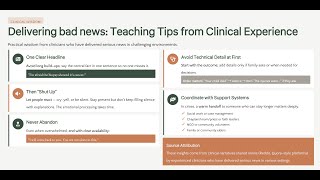
In this 2026 teaching session, Dr. Hassan Bencheqroun (MD, FCCP, MBA) guides a small group of medical students through the emotionally demanding skill of delivering serious or bad news to patients and families. He begins by sharing a personal trauma narrative—a car accident that left him injured and eroded his trust in physicians because they withheld truth—illustrating how honesty, kindness, and empathy shape patient trust. He contrasts empathy (feeling with the patient) with sympathy (feeling for the patient) and warns against the default medical jargon that creates distance. Dr. Bencheqroun introduces the SPIKES protocol (Setting, Perception, Invitation, Knowledge, Emotions, Strategy & Summary) and expands it with practical steps: preparing a safe physical environment, using plain language, delivering a “warning shot” headline, allowing silence, mirroring and validating emotions, and offering concrete next‑steps. He emphasizes the importance of self‑care for clinicians (recognizing personal distress, debriefing, rehearsing with peers, and seeking supervision) and cultural sensitivity (respecting religious practices, avoiding assumptions, involving interpreters). Throughout, learners share experiences (e.g., informing an aunt about breast cancer) and receive feedback, reinforcing concepts such as adding positive information first, observing non‑verbal cues, and documenting the conversation. The session concludes with encouragement to practice, accept imperfection, and view the physician’s role as a trusted, humane presence rather than a perfect performer.
Chapters
Good morning, everybody. Good morning. Good afternoon. Time has changed, correct? Let's see who else do we have today. And we have— let's put the chat on. Muhammad, Muhammad Kaman, Lana, Bissan. Uh, first of all, let me start by asking, how was your experience with the questions last week? I put some questions in the chat. Shukran, Bissan. What about the others? Lana, Mohammed? It's okay if you did not answer them, but if you did, it helps me to understand how do you guys Am I delivering something that helps or not? Thank you, Muhammad. Thank you, Muhammad Kaman. And we have Nofud. Excellent. Excellent. Thank you. Today is a little bit challenging, and I will tell you, I am a bit nervous about it. I will teach you a skill that is necessary in medicine. But unfortunately, it is in a context for you that is going to be twice as difficult. And that is how to deliver bad news. So there are a few examples I will give you, but it will help me if you are able to share with me your perspective. So I'm not speaking on the moon and you are on Earth. Now, let me ask, first of all, have you guys started your clinicals yet? No, not yet. Not yet. And you can put it in the chat if you want. You can speak to me like you do, Bissan. That's my preference. Or you can react. But when are you scheduled to start? Actually, it's not clear anymore. Maybe after a month. After a month, maybe. Yes, maybe more. We're going to go with this. But one of the things that was extremely difficult for me is to know how to tell someone, I'm sorry, we're going to cut out your legs. Or how to tell someone, I know you've been in an accident, but your wife who was with you died. Or you are going to tell someone, I'm sorry, but you have a condition in your lungs that's causing scar tissue. It's going to rob you of your breath. And you're going to continuously decline and not be able to even go to the bathroom without being short of breath. Until you pass away. These are very difficult to say. And when we are on the receiving end, we criticize. I can't believe he did that. I can't believe the doctor told me I have 3 months. I can't believe the doctor just said something and walked away without even giving me the dignity to stay with me for a minute. I was still processing. And that is a skill that I'm going to tell you today you are not going to process quickly. You're just not going to be able to process it quickly because it is something that you learn over time. So I'm going to start by saying What qualifies me to speak to you? You are in a context where there are bad news every day or every week. You will talk to a patient whom I don't know. You're going to say to someone that your entire family is no longer. So it's a very difficult place for me to sit. So I'm not going to even attempt to understand what is it to be in your shoes. I am going to share with you my story, and hopefully that will help you take whatever you want to take and leave what is not applicable to you. So Was I myself in a situation where I received bad news? Let me start by— I was like you in medical school. I was a few weeks from graduating, and I had my thesis defense already picked, the date. I told my family, everybody's going to travel from afar. I wanted everything to be perfect. I needed to finish all the paperwork at the university. So I had a deadline. I was running around. I needed to finish my clinicals as well. I had exams to take. Suffice it to say, it was a very stressful time. And then I got into a car, and I was the passenger along with others. I was gonna sit in the front, and I ended up sitting in the back because somebody went directly in the front and sat even though he knew that I was gonna sit there. I'm giving you details because these details are etched in my memory. And I dozed off after we took off about maybe 15 minutes in, and then I woke up with somebody screaming, and then I went into a coma. And that was an accident. The driver tried a maneuver where he was sort of passing the first car, and instead of getting back into the lane, he tried to brave the second car. And then when he got in, he tried to brave and continue to pass the third car, hoping that he would get into the lane before the car coming from the opposite side reaches him. Well, He didn't calculate, and it was a head-on collision. The car became an accordion, and the person who was in the front, where I was supposed to sit, died. And unfortunately, I carried that guilt with me for many, many years. When I ended up in the hospital, doctors came to talk to me, to say, alhamdulillah, if you're alive, look at what others— you don't even have— yes, I was disfigured. My eyes were swollen because I had a head bleed and my brain was swollen at that time. I was falling in and out of a coma. I was extremely tired because I lost a lot of blood. And the doctors came to tell me, alhamdulillah, you are doing better. We We did all of, and then I discovered later that they were discussing a fracture of my skull bone and that I had a bleed in my brain. All of that needed surgery. And they were afraid to break my heart. They were protecting my feelings. And what they ended up doing was just to tell me Everything is fine until the next day. And then they came and told me, by the way, you're going to surgery. And what that did was I lost trust. Not trust that they were good people, no. Trust that I would be told the truth. And I was in a vulnerable position. At that moment, I needed honesty. I still needed kindness. A lot of people say you need to be brutally honest. I don't know what that means, but this is not something I condone. This is not something I support. Honesty without kindness is cruelty. And we spoke last week about empathy and sympathy. And so what I wanted to share is empathy is something that doctors are afraid of. Leanna, what it means for us is to feel what the other person feels. And can you imagine feeling what the other person feels with a catastrophe happening to them? It's very difficult to try to feel that. So what you end up doing is because of that discomfort, because of how painful it feels to you to feel what the other person feels, you try to put on a distance. And what is that distance? You try to default to a language that you've trained years to use. And what that language is? Medical. And that's why we end up saying doctors hide behind their medical jargon is because we ourselves are uncomfortable. We feel that we could never understand what it must be to be on the other side. So what we do is we just deliver the news and we leave. And while we think that that is us being kind, it's not, because that means we focus on ourselves. So today's session, I got stressed out a lot about it, and then I realized I'm making it about me when it's not about me, it's about you. So instead of making it about me, and how uncomfortable it must feel to me to put myself in your shoes, I decided, let me make it about you. How nervous you must feel, how uncomfortable you must feel about learning a skill that you do not know, how nervous you must feel about stepping into the hospital and feeling that you're not 100%. Well, let me start by saying No one, absolutely no one, and I mean that from the bottom of my heart, no one is expecting you to be perfect. In fact, people embrace their doctors when they are imperfect. One of the first things that I wish people did with me when I was a patient, and now I do, is to put myself at the same eye level. And yes, sometimes that means that you have to put your knee on the floor to be at the level of your patient in the bed. You grab their hand. Yes, that means you must grab a hand that has blood in it. And yes, that means you must look in the eyes of a child. It's not about you. And that means it might trigger you. What I mean by that is I walk into rooms where people have traumatic brain injury. And I feel as if you put me back in that place where I was. And so I'm triggered in that room. But guess what I say to myself? Nobody's expecting me to be perfect. It's not about me at the moment. Imagine how you needed people, so this person needs you. If you need, step out, take a breath, and come back in. And if you're not ready, recuse yourself from the case and ask somebody else's help until you're ready. But don't walk in that room making it about you. That's what I tell myself. All the time. After many years of being a doctor, all the time. This year, I had an incredible test I went through. But before I share this test with you in the same vein so that we can take the lessons I learned and share them with you, Talk to me about you. Talk to me how— what are you going through right now as I'm sharing this with you? My head fracture, my trauma, how it must— how it made me feel, how I am taking it with me as lessons right now. Tell me about where you are right now if you want to. Are you nervous walking into hospital? Have you had the, have you had the opportunity to already tell someone some bad news?
Actually, we didn't start our clinical years now, so we wasn't So we didn't walk in the hospital until now. Okay. But I had a chance before to tell my aunt that she had breast cancer. Okay. I was so nervous at that time. Yes. But the way that I told her is like, listen, my aunt, actually, we went today to the hospital and we do like this kind of examination to you and things like this. And I started telling her the positive side, like first, for example, alhamdulillah, like there is no metastasis anywhere and things like this. Then I told her that she has breast cancer and alhamdulillah, we have solutions to it in Gaza and things like this until I drive the information to her. Alhamdulillah, it went well.
Excellent. Excellent. This is fantastic what you started with. So one of the things that you did, which is adding the positive, that's great. When you first told her, how was her reaction? Did she pause? Did she cry? Did she open her eyes? Did she look away? Did she start crying? Did she start breathing with difficulty? Did she stop breathing?
Actually, at first she was a bit nervous and didn't say a thing, just alhamdulillah. She's a bit religious, by the way. This is why. So she just said alhamdulillah and things like this. But after just a week and after starting the chemotherapy, yes, she started crying and Like, so much.
I love that you brought this. I love that you brought this. Not that I love that for your aunt, but I love that you brought this to us. One of the principles I was going to teach today is indeed this. You studied anatomy and you studied the anatomy of the heart. You know that in the heart there are several types of cells. There's the muscle cell. Yes. There is also the cells that make the valves that are different from the muscle cells. But there's also nerve cells, those cells that conduct a current from one node to the other in order to conduct electricity that would eventually lead to those muscle cells to contract. That is nervous cells that are in your heart. And they also have feelings, and they respond to trauma and to strong emotions, good and bad. So If I was to come in and see you right after you knocked your arm against the wall absentmindedly without paying attention, that place in your arm at first has a first pain that is acute but short-lived. And then after that comes the less but longer dull pain. It's almost like an ache, not a pain. So there are two stages to trauma, the first one and then the second one, much like an earthquake. When you have an earthquake, you have the first wave and then you have smaller but longer waves. So when you deliver bad news, you must make yourself available shortly after, either in minutes or in days, if you can, in order to check in. Because at first, the person hears you, but only for the first few sentences. And then their brain protects them and shuts down. If you told them steps to follow and a plan of care, and you're not going to have an ability to come back and repeat it again, write it down, give it to them in a longer-lasting format. I hope that makes sense.
Yes, yes, it's clear.
So that's one of my first things to share with you. The test that I went through this year was when one of my, one of my loved ones received bad news. That was even harder because at that time, I needed first to go through my own acknowledgement to myself as one of my loved ones having bad news. Then once I went through it, I prepared myself to go and be there for the bad news for my loved one. So this year, around, or last year, I should say, within the last year, March of last year, my father fell and started to have pain. That pain was because of what we later discovered is a herniated disc. And a herniated disc in the back is When you have, um, and what it did was it actually, and it started to cause pain, nerve pain. That pain was incredibly painful, and we took him to the hospital, but he started to be on pain medications, and he started to be sleepy all day and not eat. And then I saw him lose weight. And so I thought that it was all because he was too much in pain without the pain medications, but too sleepy to eat if he was on On pain medication. Now we are in May, June. In 3 months, he lost approximately 15, 20 kilos. And he became very, very thin. Back in the hospital, back in the nursing home, back in the hospital. And finally, in August, we repeated a CAT scan to see why he was having constipation and found out that he had a tumor in his liver. And we biopsied that tumor and it came back as cancer. And it was a cancer that was going to take him away. It was terminal cancer. And so unfortunately, I received a call from the nurse to tell me about what's going on and that they have the ambulance to take him to the nursing and rehabilitation home that afternoon. And I said, well, did the pathology come back? And the nurse said, yes. And I said, could you please read it to me? Because I did not have access to it. And the nurse read it to me. And I had stopped a meeting I was in at that time, and they're waiting for me to come back in the meeting. And I had that first moment of pain. And then I said to the nurse, I'm sorry. I thank you. I need to go. I need to speak with the doctor. And I was like sleepwalking. I didn't know what to do at that time. So I went mechanically back to that meeting, but I wasn't listening. And then I got a call from the doctor who called me and says, by the way, we received the pathology and this is what it is. And I literally just said, I'm gonna be at the hospital in 20 minutes. And I excused myself from the meeting, jumped in the car, drove down, called my family because I knew that he— they were, they were gonna call him and, and I wanted first to be there when he received the news to help him. And then once I got there, parked the car, ran up the stairs. As soon as I walked in, I saw his face and I knew the doctor came in and I couldn't believe what I heard. And he said, It's true. I'm sorry, Dad, but it is true. I wasn't gonna lie. I wasn't gonna hide behind what we do in the Arab culture, which is pretend that we didn't know, so at least we get the conversation going or get some intel about how the person feels. None of this. I'm not going to pretend. I know the last thing I wanted him to is to feel like I felt, that he couldn't trust me. To be honest with you, one of the things that is important to hear is the pain of the truth hurts once. The pain of a lie hurts every time you remember it. And a lie could be by omission, by pretending, by all of this. So you don't want to do that to the person who the only thing that they have with you is trust. Trust is a currency that our patients need us for. That's the only thing. They don't need our knowledge anymore because that knowledge now is in the internet. Everybody has access to it, especially Everybody has access to it. But what they have with you is trust. Trust that you have their good in mind and trust that you will know what to do. If you do something completely wrong that they will remember later and they no longer trust you, then they will not trust anything you tell them later over their own judgment. So I held his hand. I grabbed a chair. I sat at his eye level. And I said, I'm going to sit with you for a moment in silence. When I was on the receiving end, one of the things that hurt me the most is when people come and tell me, well, at least, well, at least you're alive. The other person died. Well, at least at the moment where I'm feeling pain, don't tell me how to feel. I don't need you to fix me. I just need to hear. I need to know you're here to hear me no matter how unreasonable, no matter how long I need, no matter if I need silence, no matter if I need to talk, to not talk, to cry, to be angry, to be unreasonable, to lash out at people, whatever it is, let me be human. And that's the thing I learned as a doctor. Most of what I need to do is just to listen. But we doctors and we Arabs do not do well with silence. So we need to do something, especially our Type A personalities full of anxiety. So what I learned to do, we said it last week, mirror and validate. Alhamdulillah, that's the first thing he said, and that's the first thing I repeated back to him. Alhamdulillah. And then he said, I don't understand. And I just said, you don't understand. You repeat what they say and sometimes turn it into a question. And he says, I don't understand the words. What does it mean? Where's the cancer? And then I said, I can tell you where the cancer is. It is in your liver. When you are traumatized, you need bits of information. You cannot go into an long explanation, and you need to sit and say to the person, I'm here, I'm happy to repeat as long as you need and as many times as you need. So this is how I wanted to share with you. I can't imagine what it must be to be in your shoes, but I can tell you what it is to be in my shoes and take with it whatever lessons you can to be in your shoes. So what we've learned so far is, awil shaghli innu, you don't tell the person everything at once and then run away. So I'm going to teach you what are some sentences to start with. And the second one is the pain of the truth is short. The pain of manipulating or lying or trying to pretend in front of someone is every time you repeat it. How many times you heard someone talk about their grandfather when they were 60 years ago, the doctor said. The words that a doctor say can stay with us for a long, long, long time. I know now that doctor who came to talk to my father, I know that I will always remember him. That's the first thing I'll remember about him because people don't remember what you said. They don't remember when you said it. They don't remember. They remember how you made them feel. And that is what you need to remember every time you deliver bad news. Any questions so far before we move to the next? How can I teach you what I know? And I sincerely appreciate Every last word that you guys say to me at the moment, because I know, I know you are in the right profession. I know it because you immediately jumped to be there emotionally with me. You felt it because you have a father. You felt it because you have people that told you about how the doctor spoke to them. So I appreciate it. My father, alhamdulillah, is now still with us. He is at the hospital, and inshallah, after this session, I'm going to visit him. He is still, you know, some days he's better, other days he's not. January 1st, and he doesn't have the ability to swallow as strongly as before. But I wanted to still celebrate him. Fakhateelo ice cream. Li anul ice cream. He is able to— it is able to melt in his mouth so it can go easily as opposed to something else. And I know some people may not be able to have ice cream. So I just wanted to share this with you, but acknowledge that not everybody has that. What may seem to be a simple thing is somebody else's luxury. So I wanted to share with you a story and where he is right now. I'm talking to him on the phone. And so I was happy to hear that he was able to pick up his phone and to call family. So, alhamdulillah, we are in a good place. He knows what he has. The ultimate physician, the ultimate doctor. We will do what we can and everything is going to be, um, um, but, uh, I want to start, um, a session. This session is going to have, um, few slides, not as many, but I will continue our, I will continue our test that I did last week with the polls and the exercise that we did with WhatsApp because I felt like some of you interacted with me. I do send you sometimes some things to read and put them on the website for those of you that don't have the ability or the internet or the chance to see what I give you. So I just wanted you to know that I try to make it in various formats so that you can interact with me. So if you have questions, some of you message me privately and I answer you privately. I just want you to know that one format of teaching is a thing of the past. This is not how I teach. I try to give various formats for each one to interact so that all of us, no matter how we learn, no matter what resources we learn, we get to where we need to get. Taib. So what are we to learn today? What our doctors expect from us are explain the, the impact. I wanted you to know that when you enter a patient's room, you have a shared story with that patient. You went through the last few years, even more, but at least the last few years since that fateful date where the destruction and displacement and war and violence happened around you. Just because you have this shared story, you cannot make it about you. And you cannot make it about that. You still have to make it about the news, and you cannot assume you understand what the other person feels. You cannot come in and say, well, me too, this happened to me. Even if you too had, la qadr Allah, the same thing as the other person, even if when I told somebody else this happened to me and they come and say, well, me too, I had trauma brain injury. This is not a competition. Are you there to be helping the person or are you there making it about you? So how do we do that? When people tell me I'm nervous about doing something, I say to them, it's like learning a chapter in medicine, or it's like learning a procedure. You will not do it right the first time. You will see somebody do it. You will try it under supervision. You will try it the second time, and then you will do it unsupervised. So when they say to you, I don't have the same knowledge or the same charisma as somebody else, I say charisma and knowledge is not innate. Mafi hada bin khili' with charisma, with charm, with knowledge. Mafi hada. All of that is rehearsed. Practiced. So we should practice delivering bad news to become good at it. Fa ana audhu billahi am khawlit ana. And AbdulRabbih, when I do something, I try to be intentional about it. If I know I'm going to deliver bad news today to somebody, before I walk in there, I write it down. I don't just type it in my phone, I write it down. I say it out loud in front of a mirror Then I say it to a friend of mine and say, can you tell me how I sound when I say it? And they say to me, well, you were a little nervous. You repeated yourself here. Your eyes looked away from me, so I figured you have something to hide. Excuse me one second. Those are the ones that that help you learn how to not try something for the first time on the day where you need it. You'll never, you would never do that with anything else. Why would you do that with people's lives? So, the protocol, there are many protocols, but I will teach you one protocol, ismo spikes. And that will teach you what are the elements. Okay? Then you need to not just focus on your reaction. How is your heart beating fast? How is your head hurting? How is your breath? No. You turn the camera on your— the other person. How are they feeling? Did they open their eyes? Did they look away? Did their Did their lips start to quiver? Did their breathing stop? Did they feel angry? Sometimes there are patients who just do the, oh, how is your, you know, exam? Did you pass it? And you're like, I just told you you had cancer and you're asking me about my exam. We call that dissociation or going numb. Okay, so sometimes if there's a family in there, you have to protect the patient from the family's reaction. The family starts to act all like, oh my God. And you're like, I understand that in our culture you're trying to send the message that you care by wailing and screaming and doing things. But my allegiance goes to the patient, my patient, not you. So if needs be, I will take you out of this room. Know that you are your patient's protection. So identify nonverbal signs or verbal signs. Maintain the safety and dignity. There is one time where I had to tell a mother that her daughter who had a heart stopped. Her heart stopped and we revived her. Unfortunately, even though her heart came back, her brain did not have oxygen for too long during that cardiac arrest and her brain was gone. She was gonna be in the coma for the rest of her life. And so I was telling a mother that And so what I did was I asked the mother, can you step outside with me for a second? No, I want to be with my daughter. You can talk to me here. And I said, I understand. Could you step out with me for a moment? And I pretended that the nurse is going to change her daughter's sheets. And can I ask you to step out with me? Now, I told you not to pretend, but in this moment, it was just a quick one. And I asked the nurse to go in so it sounds like it's happening. And I pulled her out. And then I will tell you the steps that I followed. But when I pulled her out, I put her in a stage, state where if she crumbled, which she did, she collapsed to the floor, and I collapsed to the floor with her, sat on the floor as a doctor, in my intensive care unit, didn't care how the floor was, and held her. I needed to give her that space so that she doesn't feel like she has to perform because other people are there. And you have to identify your own distress so that you do not steal the moment from others. Okay? So this is important. How do you show that you care? First one is you create a safe space and you limit the observers. If there are any weapons, sometimes you have to pay attention to them. Why? Because sometimes, oh, I don't know, I had someone who, whose child had a bad outcome because the other parent did not pay attention, stepped outside, and the child played with fire and the house burned down and the child died. And now the other parent is blaming the second parent, and I didn't want there to be anything that they could harm the person. So I have somebody else from security right outside the door. I try to interrupt loud interruptions. Every time I walk in somewhere, if there's something, a radio or TV that's loud, or somebody on the phone listening to TikTok or whatever it is that they listen to, sometimes, astaghfirullah, even if the Quran is playing loud, I reduce it. Why? Because at that moment there's enough that's going to assault the patient. The person senses that you do not want everything. But that moment, then I can make it loud if possible, if that's what they want. You ask the family's collaboration. I called my family and I gave them the news and told them not to make it about themselves because I'm going to call them this afternoon. My father is probably going to try to call them, and I wanted them to be mindful of how they react. We talked about trust and transparency. Okay? You have to be clear, honest. You do not want to hide behind language. You avoid false reassurance. That's what my doctors did. We're going to see. We'll see. Right now, everything is okay. You need to build credibility to direct communication. What I said to my father. I'm sorry, Dad. It's true. And then I went silent. Empowerment is what the example that was given to us. And the example that was given to us, I think it was Sarah, is when she told her aunt, your strength. You need to affirm the person's strength. You don't have this. You don't have that. You have God beside you. You're going to do this. And you can pull up some past coping. Remember what you went through last year. Alhamdulillah, you got through it. You're going to get through this one as well. Invite question. Please don't assume they are religious. Please don't make assumptions. I don't care if they're wearing hijab. I don't care if they're multihijeen. I don't care if— don't assume. You don't know somebody's story. You want to ask them. You want to invite them. You want to be open-minded. You want to offer them option who they want present. Do you want your family here? And you don't ask them in front of the family to create conflict later. You want to ask them if they want a lot of detail or a little detail. Should I come back later? You want to give them a sense of small control in a situation that they're not in control of anymore. You want to acknowledge the war, the occupation, the prior betrayals that may shape their distrust in systems. You want to understand the historical context. So context matters. So the SPIKES protocol is as follows. Safety, as I mentioned. Perception. Invitation. Invite them what, how they want this. Knowledge. Give them the knowledge that they need. Is this going to come back? Is this gonna require surgery? Is this go— can be— can this be treated? I told that this is not a cancer that can be treated. He is not a candidate for surgery. He's not a candidate for chemotherapy. Simple short sentences. Strategy and support and trauma and awareness. So I wanted you to know what a, a, a Spikes T or Spikes means. There are multiple other protocols that I will be putting in the chat in the next week, inshallah. The safety and the understanding is the physical environment. And then the briefing. If you are speaking to someone in a different language, you want to have an interpreter there and you want the interpreter to take time to speak to them. You want to look at the perception. This is a very important question. What is your understanding of what has happened so far? You need to pause during the conversation. So this is that you can ask them. And when they answer you and you find some misunderstanding, you try to use metaphors. This is like when you had XYZ. I am sorry, I have very serious news. Direct. Do not beat around the bush. Would you like me to explain everything or only the most important points first? When you start, you start direct. I'm afraid I have some bad news. I have no other words to explain this. It's going to be very hard to hear, but your son has died. Plain language, not multi-organ failure, not septic shock, not ST elevation MI, not gastroenteritis. Your son has died. The injuries were so severe she will not survive. You only have time to go say goodbye. Not, we revived him for 45 minutes. It's not about what you did. That comes next. You have to say he's no longer with us. We lost him. He's dead. You have to use words that are important, that make sense. Emotions and empathy. Allow silence. Stop talking. Validate the feeling. Anyone in your place will feel shock or anger. This is unbearable. There are no words that I can say. Avoid the words at least. Okay? Then give 1 or 2 steps, not 3, not 4, not 5, not a long lecture. Connect to support. I'm gonna ask my colleague to come in as well. The nurse will stay with you. I'm going to come back in 5 minutes. There are some volunteers that can stay with you. And then you start to ask, do you have a safe place to go to tonight? Is there someone you want to call? We're happy to help call them for you. Do you want— this is something I say a lot— do you want me to speak to your family so you don't have to feel like you have to perform to them or summarize? Understand that there are some normal reactions to trauma. Numbness. Emotional blunting, meaning that you just go completely out of there. You're not there anymore. Irritable. Anger. It's okay if they're angry at you. Let them. Sometimes somebody who is in trauma may have lived that trauma. I lived this with my mom last year. I lived this with my aunt last year. I lived this with my father last year, with my brother last year or last month. Hyper vigilance, meaning anything you do, you try to hold their hand, they jump or they avoid. I need, I need to go check on my, on my other son outside. This mother, I explained to you that was one of her 2 daughters and they were twins. So she needed to make sure her other twin daughter is cared for. And then when you're done with that, don't just go back directly to take care of another person when you just had yourself a trauma. Step outside, go to your friend, go to your colleague, call someone that you care about and tell them this just happened. And something that I've learned in my culture, in our culture, in the Arab culture, is sometimes we delve into the story and we forget the emotion behind the story. So when I come back at night, I would tell my family something and they'd say, oh, why? What happened? And they want to learn about the story. And I get into, well, I placed the central line. You know, a central line is something that we— and you get into these details and it takes you away from the moment of you trying to seek support. So what I do is when they ask me, how was your day? I don't just say, well, all is good. I say, Today was hard. Why? What happened? I told the mother her daughter is not coming home today. This everybody can relate to. But if you say, oh, a cardiac arrest happened and it was 45 minutes to ROSC, and after that we got this, but then we did a CAT scan and a hypoxic injury happened, you know, the brain— you delve into the story. Just focus on the emotion yourself so that you're aware of your own trauma. Now I want to pause for a moment, and we have about 5 minutes left. So I want to see how— so I went through the lecture, and I wanted to go through this small group discussion and debrief. How are you feeling? It must be very difficult to bring this stuff because you must feel for the people that you hear this about. So How do you feel now? Do you have anything to share with me before I give you some tips on how to start the conversation and how to end the conversation so you can rehearse them? Talk to me. You can give me reactions. You can tell me, I have no words. I'm just In silence, you can tell me, I don't want to talk about this. I don't like this session. Tell me. You can text. I have no words. Thank you. Sometimes that's all you need to say. And you feel then that you're honest with yourself. Muhammad, thank you. I need you to know you are not alone going through this. Every last one of us went through this, and I need you to please forgive yourself. You're not going to get it perfect. Thank you, Amira. Thank you, Emil. Thank you, Lena. I need you to understand you're not going to do it the right the first time. I understand you did not pass this yet, but I'm giving you, you need to forgive yourself for the future. I'm giving you a different method. Ma'naatu innu. You need to be ready that you're going to not do it right. And you need to be kind to yourself because if you judge yourself, you're gonna be less likely to do it right the second and the fourth and the fifth time. So remember this, be kind to yourself. Nobody's asking you to do it perfect. And people, all they expect from you is presence and humanity. They don't expect performance. They don't expect knowledge from you. So the last things I wanted to share with you is what we have talked about from my experience is I share, I have some difficult news to share with you. I think we might need to be alone with this, and people understand. They're not dumb. Your husband died from his injuries. Then shut up, deliver one clear headline. Then shut up. Let them react. Feel them. Mirror what they say. Never abandon. Do not leave without saying, what next? If you need to leave, I will come back to you. You are not alone in this. Sometimes it feels to us that the trauma is so great that these simple phrases are inadequate. They're not enough. Believe me, that's just us judging ourselves. Just say simple. Start with the outcome. Then explain the details and ask if they need more details. Then tell them, at the moment, you do not need to make decisions. I will come back in a few minutes, and then we can make decisions together. I will help you through this, and then coordinate with somebody else. Okay? So take this with you as a pocket card if you wish. Prepare safe space, interpreter, clear facts, tissues, water. Find out what you understand so far. Listen to prior trauma. Note if there are misconceptions. Ask how much detail you want. Respect preferences and cultural considerations. Give the headline, the warning shot. We need to— I think this conversation needs for us to be alone. I think we need to step out for this. I may have some difficult news. Would you like to take a moment? Do you want to call somebody for this? A warning shot, anything to prepare them. And then one clear sentence. No euphemisms. Euphemisms is when you start to explain too much and give. So you might want to understand that. Stop. Just be clear. Allow the emotion. It's okay if they are reacting. It's okay if they start to cry. It's okay if they're silent. Validate, mirror and validate. Anyone would feel the same. Anyone would feel angry. Don't feel bad about you feeling this way. It's understood. It's normal. And ground if somebody's dissociated. Grounding means we can talk about your loved one right now. I'm happy to talk to you about this later. When I told someone that his mother had a stroke, he's Wait a minute. The doctor last week, he's the one who sent us home. He shouldn't have sent us home. And I just went and said, that may be true, and I understand why you feel this way. Do you mind if we talk about your mom's stroke today? I'm happy to go back and talk about last week. So ground if somebody starts to dissociate or project. Next steps. 1 or 2 immediate steps. Steps. Connect to others to support. Safety. Do you have a safe place to be tonight? Do you have somebody you want to be with tonight? And then care for them yourself. You need to debrief with someone because you know your distress. You need to seek supervision in order for you to feel that you took care of yourself. So some of the cases, and I'm gonna put these next week, inshallah, in WhatsApp, and we're going to debrief if you wish. What are some sentences to use? How do you notify with death? How do you notify with a life-altering disability? And how do you notify with, we don't know, your loved one is too unstable to do any tests on them. So we're going to know— we won't know what's wrong. But one thing we know is it's going to take us a few days. But unfortunately, they're not in a place right now where they're going to go home with you. Okay. Very good. Anything that you wish to share with me at the moment? You stayed with me until the end. That's very, that's very good. I must say it's a, it's a rough one, and we might actually talk more about it during, and like I said, You feel free to text me if you wish in private. It's going to be hard on me giving bad news because I get emotionally involved quickly. Bisann, all of us do. And this is a strength, not a weakness. But what it does tell you is knowing that about yourself, you need to practice and be ready when you go there. And I give them the bad news, and I start to feel crying. I literally say, I am sorry, I am going to cry. Know that I feel for you. I state what I'm going through so they feel that you're there with them. There are families that are, that were not Muslim, and they said, Doctor, since you are here with us, could I please ask you? We're going to pray for our Father. Do you want to stay and pray with us? And I stay. And I feel like when I long ago before I became comfortable, I felt like, oh my gosh, they're going to pray not in a religion that is mine. I say to them, I am absolutely okay with it if you are okay with I'm in the Muslim faith. Is that all right with you? I flip it. I make it about them still. And I say, would you be okay? And they said, yes, of course. I said, then if that's the case, I'll stay and I'll pray for your loved one as well. So the— you're welcome, Amira. These things that you go through, share them. With your patients. It humanizes you. Did any one of you feel that you lacked respect for me when I started to share with you how I went through my human feelings? A lot of you fear that if you share your humanity, with the family or the patient that it lessens you. Absolutely not. They will remember the doctor even cried with us. It makes them feel that their loved one is special. It— that trauma did not go in vain. So to wrap up, I want to tell you, you are in one of the most respected traditions. This is not a job or profession, it's her tradition. You're one of the most respected traditions in the world, and finesse— they have to do a lot of efforts to do charity work or to gain good points. Ma'ala. Those are opportunities that people go and do a lot of efforts to seek that people gave us in our daily life. Fa, know that you are in a special place that Allah entrusted you, bi amana, that it's not about our knowledge. It's not about getting it right. It's not about being doctors. It's that we are entrusted with human beings, one soul at a time. And the definition of success— and I leave you with this because I admire this sentence a lot because I feel that it has a lot that is in parallel with our cultures and our system of values, etc. There is a person, a poet and a writer by the name of Ralph Waldo Emerson. And Ralph Waldo Emerson said the definition of success: to laugh often and much, to win the respect of intelligent people and the affection of children, to earn the appreciation of honest critics and endure the betrayal of false friends, to appreciate beauty, to find the best in others, to leave the world a bit better, whether by a healthy child, a garden patch, or a redeemed social condition. And this is what I say often to myself. To know even one life has breathed easier because you lived, this is to have succeeded. To know even one life has breathed easier because you have lived, this is to have succeeded. So know that what you have is a manna min ant Allah and a gift min ant Allah. Wa s-salamu alaykum wa rahmatullahi wa barakatuh.
More from Hassan

ICU From Both Sides of the Bed "If you could not speak,what would you want us to know?"







