Measuring and interpreting Vital Signs
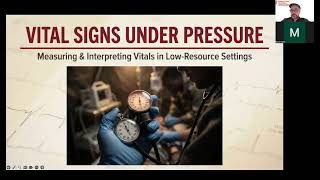
Dr. Hassan Bencheqroun teaches how to measure and interpret vital signs with minimal equipment, covering triage thresholds, manual techniques like palpation-only blood pressure, and how to recognize shock, sepsis, and hypoxia from vital-sign patterns. The session includes troubleshooting for limited tools and managing clinician stress in resource-constrained settings.
Chapters
Assalamu alaikum ya thikuna hafiyah, Ramadan Mubarak, Allah yahidu alaikum bil khair, wallahi irham shuhada al-muslimin. Let's get started. So, so far, alhamdulillah, we went through the first section of our series and what we have done so far, just to give you some overview since some of you just recently joined us. Initiative to give some sessions to complement the medical training for some of the labs and elements that were missed during some disruptions to the medical education. We have done so far how to craft a differential diagnosis and how to do a SOAP note, subjective objective assessment plan, for a patient encounter. We have started how to communicate with the patient Then after that, how to deliver serious news with a patient. Then how to present a patient in round in a structured way. After that, we talked about how to take a focused medical history depending on if it is acute or chronic. And then last week we did the art of the one-liner. So this is how to communicate and document. We are moving to the section of the general physical examination. Today we will be talking about how to take vital signs, how to measure them, and how to interpret them. When— you're not alone, many medical students are studying in low resources areas, especially with constraints in a political context. And some of what is said by your peers is usually that training is fragmented by the faculty loss, by the unsafe travel to teaching hospitals, by the inability to attend certain sessions. And there is no mentor, so you rely on remote mentors like myself. Your clinical exposure is mainly to trauma-related medicine, infectious-related medicine, and a lot of the equipment that you use may be limited, including high patient load. So sometimes to do a physical exam is difficult if you don't know what matters. So what we're going to do today is discuss how to start with the vital signs. We've already discussed how to obtain information. Today we're going to discuss how to do vital signs. There we go. And how to measure and interpret them in a low resource setting. Initially, we're going to be talking about the triage. Triage is a word that says to us we need to at least know a little bit of what is important, what is not important. Is this acute? Is this urgent? Is this critical? Can this take some time? We're going to take some 20 minutes to discuss a, how do you do the, how do you practice practicing with improvised techniques, with manual-only tools, and when do you have equipment failure, what to do. Additionally, we're going to be talking about some critical patterns like shock, sepsis. How do you do a dynamic triage? And then lastly, how do you concise communication? How do you hand over after stress? So the triage, talking about the triage, what means is we did a little bit about this with Dr. Diab a few weeks ago. And with that, what we've learned is that the vital signs, sometimes they don't need to lead you to a diagnosis. What they need you to do is, "Need I take action immediately, or can I take some more time to gather some more information from the patient?" If you compare the normal range versus the red flags column, what you see is a completely different set of signs. Now, if you go to a patient and you take your blood pressure and you take your oxygen measurements, all of them are going to be in a piece of paper for you. You write for yourself. They're not going to be read like this. So your mind is going to have to take note of these signs and find out, is this something that needs to be moved quickly to your attending physician, or you can take some time to ask more questions. Your heart rate, if it is more than 100 or 100 and definitely more than 120, then it's a red flag. If it is less than 40, and I dare say less than 50, it's a red flag. So, bradycardia or tachycardia. When you see the heart rate, that is the first thing to start worrying you. What I mean by that is sometimes that's the only thing That's not normal. Now, sometimes my medical students or residents start to worry when they see the blood pressure that is low. And absolutely, you should worry if the blood pressure is low. But if we were to look which first starts in the human body by physiology, you get to be tachycardic before you get to be hypotensive, even if it is a few minutes before. So when someone is having a crisis and you have the chance to review what happened before, a few hours before, you start to see that the heart rate has been elevated for a while. Sometimes even the heart rate has been given medications to bring it up— pardon me, to bring it down. Then the blood pressure starts to drop, the systolic blood pressure less than 90 or more than 180. For these, you need to make sure that you start some fluids to bring the blood pressure up or to bring the heart rate down. We get to be tachycardic when we are septic, when we are dehydrated, right? You get to be tachycardic when you have a fever. You also see that the patient breathes heavily, more than 24 a minute or less than 8 a minute. That means that they're not awake enough to breathe. You need to give oxygen, and you need— if they are bradypneic, which means low respiratory rate, you need to assess if you need to put them on life support, on a ventilator. The temperature, a lot of times we teach you about fevers, but we don't teach you enough about low temperature or hypothermia. Some people have hypothermia, not fevers, and it means the same physiology in terms of knowing that this is an emergency. And then desaturation, the oxygen dropping below 92%. Okay, so far so good, I hope. If you have any trouble, do not hesitate to ask. And if you are watching this off of this time, you're watching the recording, you can reach out via WhatsApp, or you can reach out via LinkedIn and Rasset Amel on LinkedIn. And you can send me a message. Pattern recognition. What is a pattern? A pattern means something that happens the same way all the time. If somebody is in septic shock, they will have a lot of things happening at the same time in the same way. For example, they will be hypotensive, They will be tachycardic. They will be febrile. They will desaturate if the sepsis is coming from pneumonia or the lungs. So, these are your triage. Once you see these red flags, one or many, then you need to call for help and you need to help your patient. When we see pattern recognition, there are 3 big patterns that you will see almost all the time. Those patterns are shock. We said shock starts with high heart rate before the blood pressure drops. Again, I'm going to tell you this. We are not designed to have a heart rate to be in the hundreds, 120s, 130s. We're not designed for that. We know that when the heart rate is that high for prolonged period of time, that means your adrenaline system, we call that your adrenergic system, is activated. And we know that no matter what it is, it's literally like seeing a fire. You do not hope that that fire is just smoke from somebody doing a barbecue. You must know that 9 times out of 10, you need to check if that fire is actually a fire. If you have this pattern of a heart rate that's elevated, and/or, not just and, or blood pressure drops, or the patient is tachypneic, you need to make sure that you elevate the legs. There's about half a liter of fluid in the legs. So, if you elevate them, that comes back to the heart until you go quickly establish an IV line and give them some fluids. And you need to make sure that that shock is not hemorrhagic. They're not bleeding from somewhere. You can look into the second pattern recognition, which is sepsis. And the sepsis is fever, heart rate, or respiratory rate elevation. You need to give them antibiotic, but antibiotics are not enough. Most of the time it's source control. What does that mean? If I have an abscess in my skin, I can put all the antibiotic creams in the world on it. If I don't open it and drain it, the infection is not gonna get better. So if you have an infection somewhere, you must treat it. If it is an appendicitis, if it is a perforated bowel, If it is whatever that might be, you can sometimes find, especially in low resource areas, that if it is a woman, that they might have not changed their hygienic elements that they have used for their period, and that can give them a septic shock. You must examine down there. If it is a child, sometimes that they might have inhaled a foreign object and that caused them a recurrent pneumonia in the lung in the same area. And if you don't look for why, you'll always think that that is because it's just a pneumonia. The third pattern is hypoxia. Maybe that's somebody who had smoked in the past and has COPD. Which means emphysema. That is the smoking damage in the lung. Maybe they have pneumonia. Maybe they have what we call an aspiration. You need to check their gag reflex. Put something in the back of their throat to see if they gag. That's a good thing. If you put something in the back of their throat and they don't gag, that means that they are at risk for stuff falling down into the lungs. We call that aspiration. Infection, pneumonia that could cause them hypoxia. But hypoxia is not just in the lungs. Sometimes hypoxia is because the patient is not breathing. Maybe they had a stroke, maybe they had a seizure. So how do you triage? What are the decisions? If you have somebody that has a high heart rate, but the blood pressure is still okay, their body is still doing the best it can to compensate for the shock. You need to prioritize making sure that they get fluids and obtaining another intravenous access. You need 2 IVs in case one of them drops. If you have the high heart rate and the blood pressure is low, that means this is much, much, much, much, much more urgent because they are losing their compensation. Their body cannot hold it together anymore. It's a decompensated shock. You need to prioritize the fluids and see if you need to give them blood. Number 3, if the patient is— the heart rate is 90, the blood pressure is still elevated. Well, it's just a delayed presentation, but honestly, the patient is still doing okay. You have time. The teaching point is the triage is dynamic. When you are the first person in the emergency room and somebody shows up, you are the first line of defense. They rely on you. Nobody likes hospitals. Remember that. When someone tells you, I'm coming here because of pain, you must ask them, how long has been the pain? And if they tell you the pain has been going on for a week, then you need to ask them, why today? If somebody is walking and stopping and walking and stopping, ask them why did they stop. Let's say that you are in fact having no thermometer. Well, then now you're relying on your hands to check if the person has a fever or not. Also document how long have you been noticing when touching them the fever has been going on. When it comes to the respiratory rate, I wouldn't rely on machines. It's just a good old-fashioned way. Imagine I was in a university hospital in the United States and my attending was making me measure manually the respiratory rate. Even in Western countries where we have the machines that do that, we rely on ourselves because our patients depend on that. Machines are not always accurate. They're most of the time accurate, but they're all— you need to always verify it. So count when you are calm and they are calm, and then for 30 minutes and multiply by 2. That's the respiratory rate. Every minute. The pulse, I would check the radial or the femoral pulse if the radial is undetectable. Make sure that you double-check the pulse in two areas so you're not getting the pulse of your own nervousness and heart beating. Any questions so far? Uhtsiham, Ramadan Mubarak, alayha idhu alaykum bil khair. Can you guys hear me well? Are you understanding so far? Give me a reaction or give me a chat or come off mute if you need to. Okay, thank you. So if you have scarce equipment, then you must use the same equipment for many patients and many doctors. And so what you do is you try as best as you can to go through everybody and record their oxygen, through everybody and record their blood pressure. Stop at the person who has a more urgent situation, like a heart rate of 120, blood pressure of, low blood pressure of 80. If your patient A has a low oxygen, 88%, patient B has a high respiratory rate and using accessory muscles, Accessory muscles are the sternocleidomastoids. They have rib retractions. You can see them breathing with difficulty and their body is just getting so tense with every breath. Rest— Patient C has a respiratory rate of 12, very low, and drowsy means he's not able to wake up. Patient D has a heart rate of elevated of 120, but the systolic blood pressure is 95. Which one is more appropriate to start start with. Your patient B is going to crash because they're using accessory muscles. That's priority. Your patient A, because they are so drowsy and the respiratory rate is low, they need to be intubated as well. Your patient A, you have an oxygen that is low. You need to ask their baseline. So you need to ask more information and you can give them oxygen to buy some time. And patient D mostly needs blood pressure and heart rate monitoring. More than the oxygen. So that gives you a triage. A triage is organizing your patient to know which one is priority so you can stabilize them. You already know from the previous session that the vital signs are your first action item. You need to stabilize the vital sign, buy you some time before you can start to do some of the information obtaining that you've done before, we've talked about before. Does this happen even on the wards, even on the medical floors? Absolutely. You have less likelihood to find people that are crashing, but it's not completely gone. They still rely on your acute sense. Any questions so far? I hope everything is well with you and your loved ones. Great, thank you, Malik. Now, sometimes in your context, you might be in a place where you do not have much. You just have one kit and you have to share it with others. Well, sometimes you do not have a stethoscope to get the blood pressure, so you use the blood pressure by palpation. Forgive me, I do not know how is your situation, so I don't know if you've been taught how to do blood pressure by palpation. Give me a thumbs up or come off mute to tell me, or put it in the chat if you have been taught how to take blood pressure by palpation only. If you have, thumbs up. I don't have any idea about taking or measuring the blood pressure by palpation. Can you explain it? Yes, I can. If that's the case, then let me find a video that will showcase that much better. Now, the one thing to know about blood pressure by palpation only, it's when you don't have a stethoscope. And when you do this, the palpation with blood pressure, with a pulse only, then it's radial most of the time. And when you do it radial, you will only get systolic blood pressure only. So the first thing that I want to show you is how to check for a radial pulse. So to feel a radial pulse, you're going to have to, to feel a radial pulse. You're going to have to put your hand, 3, only 3 fingers, and you see what the fingers are. The index, the second finger, and the third finger. Do not use your thumb. Do not use any other. And you use 3 fingers in order to increase the perception by your brain. Now, can you check the brachial pulse? Yes, that's where you check it. But because that's where the blood pressure cuff is, that's not going to help you check the blood pressure. So I just wanted you to know how to first check your pulse. Now that we know where to check the pulse. We now are going to try to go back and see the second step, which is once you find the pulse, what you are going to try is to take it by palpation. And for this, you need to feel the pulse.
How you palpate a blood pressure. The reason for palpating a blood pressure is primarily because you cannot hear or auscultate for a blood pressure.
Can you hear the sound? Yes. Beautiful.
Sometimes in the back of a noisy ambulance, this isn't possible to do. So this is one way we can at least get a portion of the blood pressure. The only thing this will represent though is the systolic. We will not get a diastolic during this procedure. First, locate the radial pulse, making sure your patient is in a comfortable seated position. Expose the arm. Place this blood pressure cuff again over the brachial artery.
I want you to notice the blood pressure cuff. This rubber tube right here has to be right over the brachial artery. Okay, you cannot put this in the back or on the side. That's not the proper placement. The blood pressure cuff has to be over the brachial artery, which, if you look at the area of the arm where it bends right here, it's right at the border. You can literally put your finger there and feel it. When you feel the pulsations here, You place this rubber tube right over it. Mafum? So that's the correct placement.
Feel for a pulse again, a radial pulse. As I pump it up, I will continue to feel it. And at the point where it goes away, I'll add about 20 or 30 millimeters of mercury and then slowly allow the air to release. At the port, at the time the pulse returns, there is my systolic, and I'm done. This is only going to give me the top number or the systolic.
Let me repeat what he did. His hands were on someone's radial. When you inflate the mepenphoch, at some point the radial pulse is going to disappear because you've compressed it. And so you start to release the air of the blood pressure cuff slowly, slowly, slowly. Your hand is there. Remember, the pulse was gone. You're feeling nothing. You release slowly, and that dial starts to come down, come down, come down, come down. And then at some point, your fingers feel it. When you feel the the first beat, look at the number where the dial is. That's your systolic blood pressure. Mafhum? Can you repeat it? Yes, you can do it a second time. But because the pulse does not give you the top and the bottom, you only get one number, which is the systolic. Bas haydi ahsan min dhalashi, right? So when you do not have a blood pressure cuff that can give you both, then you can use the blood pressure by palpation. And you can measure systolic only. You count the heart rate for 15 seconds, and then you multiply it by 4. Sometimes, honestly, I calculate the heart rate for a whole minute. But if the layman and I'm in an emergency situation, I don't have time, I just do 15 seconds and multiply it by 4. Same thing for the respiratory rate. You also cross-check. Shuma anatu cross-check. You repeat and verify that it's the same number. A little bit approximately. We're not doing math. But if it is 120 here, it'll be 118 there, 117, things like that. And then, so, when here, palpate the radial pulse while deflating the cuff. When you feel the first pulse, that's the systolic estimate. If you have one pulse ox, then you take it everywhere and you decide the order based on seeing your patient. If you see the patient completely not responsive, you need their pulse ox as well. Just because you see somebody breathing comfortably does not mean that they're not in respiratory trouble. Okay, so you confirm with the oximeter, and if the oximeter fails, make sure that the hands are not cold. If the hands are cold, then that means you don't have perfusion there. Shuman, let me ask you, and con el pulsox? To measure the oxygen with? Let me see if the chat has something. Okay. Do you have the pulse ox? I'm going to assume you have it. And the way that it works is that each arm of this pulse ox, one of them sends an ultra violet signal, UV signal, and the other area receives it. The UV light goes through my finger, picks up the oxygen hemoglobin saturation, and is received on the other end. Why am I explaining this? Because If the finger is cold and doesn't have good circulation, there will be no hemoglobin to measure, and the pulse ox will give you a false low oxygen. If you tried to do the oxygen with the blood, if you take the arterial blood gas and measure the oxygen, it'll be normal. How could that be? That's because this is just an estimate. And an estimate only works when the conditions are good. What is the condition in which that's not good? When you have low blood pressure, shock, and that means unfortunately the circulation in the fingers are not good, or it's really cold, or the pressure— person's hypothermic, temperature is low. Then the oximeter may not be the best. Okay? If you see the fingers are blue, that's an emergency. That's not good. You don't need an oximeter to tell you. If you have the person unable to complete full sentences, they speak with one word Sentences. You don't need an oximeter. They are in trouble. When you see their nose opening just to capture in any bit of air. So the equipment is good, but it does not replace your common sense. What you see, what you hear supersedes the equipment. Okay? Now, a few seconds of important cards. Number 1, when you have blood pressure in the dark, you need to palpate the brachial artery before the cuff placement. If no stethoscope, inflate 20 above the pulse disappearance, deflate slowly. The first radial pulse is the systolic blood pressure. Write immediately because our memory fails under stress. If the systolic is below 90 and the heart rate is more than 120, shout for fluids and/or blood if the patient is bleeding. Okay? You have to acknowledge something. You have to acknowledge stress. Stress makes your heart beat and your radial pulse is not good. Stress does not make you think. Stress does not make you act. So those patients came to a stressful environment. If it's stressful for them, for you, imagine how it is for them. So I'm going to give you a tip that works for me. I don't know what it is, all of you that are listening to this recording. We sometimes, when we focus on ourselves, we panic. We don't know what we're doing. We feel inadequate. But somehow, even in that moment, if you give us somebody to take care of, if it is our child, if it is the neighbor's child, if it is somebody else's child, we forget about ourselves. That's why we went to medicine in the first place, because we care. We extend help. We forget ourselves in helping others. So when you find yourself under pressure, understand the patient needs you a lot more than you need yourself at that moment. It helps you calm down by saying, this person needs me. I gotta focus. What do I know? Go back to basics: pulse, blood pressure, oxygen. Observe the patient. Reassure them. Tell them they're in good hands. Sometimes we are so focused on performing as physicians or medical students that we forget to be human. Reassure. I'm here. You're not alone. We will get you the help you need. Good job coming to seek help. You are in the right place. Hadul kelloon. Jumlat, jumal, that we could use to reassure them. And if they bring down their stress, we bring down our stress and we are able to help. Correct? Okay. Managing the uncertainty. When you are fatigued, you make errors. You take even 20 seconds. I was one day, I had a very, very stressful day. Two of my patients Both of them, their hearts stopped at the same time. I had one intern with me. I had my nurse with me, but there was nobody else. So I started to ask my team to do CPR on both of them at the same time. My mind was so blown with stress and uncertainty and inadequacy and imposter syndrome. I didn't know what to do anymore. It went on for about 10, 15 minutes. I kept saying to myself, they need you. Just slow down. Go back to basics. What are the vitals? This one is this. Okay. This one is that. Okay. I gave my team. My team was superb. They were doing what I was telling them. After about 10 minutes, that person's husband was there and he said, please stop. She wouldn't want any of this. This is not going to save her. She's 89 years old. And I said, are you sure? You are right, sir. I agree with you. She's not coming home. I'm so sorry. And so I gave him my condolences. But, Lisette, the patient next door, still CPR going. CPR, every minute you give something and you do the pulse checks, but the CPR, the chest compressions go. To my team, please continue CPR. I will be right back. Give me 30 seconds. And I stepped outside the curtain, just outside. I wasn't going away. I just stepped a few steps just for the noise to be less. And I just closed my eyes and just sent my heart to the heavens, and I said a prayer to Allah and went back. It was 30 seconds, but sometimes that's all you need to recompose, de-stress, and go back. Does this make sense, you guys? If you are, and you will, you will be stressed when you first start because everything is new to you. Make sure you have checklist. You have now a few things that are repetitive. Make them, put them in a piece of paper and repeat them. It'll help you not forget blood pressure, chest, heart rate, oxygen. Ask them how long. Ask them if the characteristics of the pain, Make a list for you, not somebody else, but you. What needs to help you? Verbalize the findings. Share the data with your team and check if you are thinking straight. And then force a 10-second pause before declaring stability. Just take 10 seconds and say to yourself, let me summarize. And then navigating moral uncertainty. You feel that, how can I save somebody's life if I don't have the right resources? There's nobody around. My attending just told me to go there and see, and he's busy or he's nowhere to be found. And I feel I'm just a medical student. How am I gonna save somebody who's bleeding? Just breathe. Go back to basics. Blood pressure. Fluids. If he's bleeding, put pressure on the bleeding to stop it. Call for help and then communicate. Document in your documentation, but also communicate with your team, with the patient, with the family. And then if there is nobody there, call them on the phone, call them on whatever method by which you can communicate. I understand, Dr. So-and-so, that you cannot come here. Can I trouble you for 10 seconds just to run something by you. Okay? So what I'd like you to do this week is I'd like you to try the blood pressure without, just with the palpation, with the 3 fingers. And try it on a friend, on somebody at home, on your neighbor, on your colleagues. Why is that? You need to try this stuff outside. Of an emergency. So during the emergency, you know what you're going to do. It comes as second nature. And then come to me in the WhatsApp and tell me that you've done it. I also want you, since this is not the real deal, just practicing, I want you to practice with the pinky, and I want you to practice with the thumb. The actors using their thumb or using one finger, you'll see the difference. If you don't have 3 fingers, you'll not feel it as good as if you felt it with the 3 fingers or the thumb. The receptors, we call them the touch receptors, the tactile receptors, are most concentrated in these 3 fingers, not in the pinky and not as much in the in the, in the thumb. Why do you think we check the blood sugar for diabetics in the thumb? That's one of the first ones you don't feel as much as the other 3. Okay, I think that this has been a very good session to discuss how to obtain the vital signs, how to center yourself, how to make checklists, how to deal with low resources, how to triage patients. We also realize that sometimes a high heart rate alone is enough to worry us. And seeking help is not giving up, it's refusing to give up. Any questions? Any comments? Feel free to give me reactions. Feel free to give me chat. We are at the end of our session, and I will be trying to make some, um, questions in the WhatsApp. I hope that you enjoy those. Okay, if no further questions, thank you, Marek. Thank you, Amal, and thank you to all of you that are listening to these recordings. This is Dr. Ben Shekron, and I will leave you to the next week. Let's meet on LinkedIn or on WhatsApp. Please take care. Salaam alaikum.
More from Hassan

ICU From Both Sides of the Bed "If you could not speak,what would you want us to know?"







