Session 4 Gharsat Amal SOAP note
Dr. Hassan Bencheqroun teaches displaced Palestinian medical students how to write SOAP notes, using a chest-pain case to show why clear documentation matters for patient safety and handoffs. He introduces AI tools for faster note drafting and outlines the CNS module curriculum, then invites students to submit questions for personalized follow-up sessions.
Chapters
Hello, Dr.
Hassanis. I'm— I can hear you.
Excellent. Can you see the screen? Excellent. We are going to wait for just a few minutes until others come in in order to start. Now, do you mind if I asked you to teach me a couple of things before everybody comes in?
No, I don't mind, but maybe my voice won't be clear enough because I'm in a public place, on a cafe, to, yeah, to attend this lecture.
No trouble. We are not recording anything. This is not official yet. This is me trying to understand the realities of my students. So I am asking if you be kind as to share with me your circumstances, where you are, how do you study, what year are you.
Yeah, of course. Um, we are at the end of our third year. Um, just a month or, uh, more than a month, maybe 14 days, uh, 40 days left us out from our 4th year beginning. We are currently studying the CNS system, and that's why I think not all— there's not a big number of students because they are a little bit busy by this module. That's it. What do you know? What do you want to know?
Is there a way to obtain your modules so that I can follow them. I have chosen the succession of topics randomly. I concur what I am teaching to what you see every week. That way it could be relevant.
Actually, we are studying online now, so we are just studying from books, watching lectures, and so on. But when we start our clinics, we are going to take like online— sorry, like real lectures at hospitals and see real patients and so on. About modules, we are about to finish them. This is our last module. We have to finish it by like 2 weeks or 3, I don't know. Because the dean didn't give us a real timeline for this. Like, we just know the time of our exam, maybe 5 days before it, or like this. Yeah, that's it. About the outline, I can send you our curriculum for university and so on. I can send you it actually. Yes, it would be just a minute. I have to, yes, just a minute. I have to search for it.
You can do it at any time. You don't have to feel obligated now.
Yeah, maybe after lecture.
After the lecture. Yeah, it will be helpful. Where are you currently? Where's home for you?
Please again.
Where's home for you?
Where is home? I'm displaced.
And where are you displaced?
Yeah, I'm from Gaza City. Displaced at Deir el-Balah, which is like a neighborhood maybe, or a village at the middle of Gaza. Because my home have been like— sorry, my home has been completely destroyed. So that's why I am displaced. Actually, we don't have electricity and internet available at every place, so we have to go to cafes and hubs to reach to internet, actually. So that's why we prefer recorded lectures than Zoom lectures.
Yeah, yeah. So, uh, that I— where I taught another lecture about clinical research, and I know that even recorded, it's best to be recorded in a platform that you guys have access to easily YouTube is much better.
Yeah, yeah. I want also to ask you about something. It's a little bit personal. I want to learn more about basic research and scientific research and so on. Can you please advise me where to start and so on?
Absolutely make that happen. Taib, next week, inshallah, what I will do is I will do an extraordinary session. I will extend this to 2 hours instead of 1 hour, and the next hour is going to be about research.
Thank you.
That good? Yeah. I think I will have a guest with me. Her and I taught this course for Palestinian students in semester. So we have the material ready. We can put it together into one instead of a whole semester. So that's great. I have a question. I have a question. Do you have any introduction or orientation or access to the Catalyst AI?
We use it actually in this study. Like, I prefer to study with AI. Like, I watch lectures, but I need to search about things. And AI is much easier to search because it gives me references and I can like go to the reference directly instead of searching about them.
Which tool do you use?
I actually use ChatGPT. I don't know if there is another tool.
There are plenty, plenty, plenty, plenty more. Plenty more. Plenty.
Really?
There are plenty more. So What I'm going to give you as a gift today, and I'm going to post it as well, is my lecture, the, for medical AI in research for Gazan students. So I'm gonna put it in the chat and you will find it inshallah. Website, lecture that I did for, um, semester. Here it is. And So this is the lecture about AI, medical research. It teaches you everything in ChatGPT. What's our— what's our—
I think this is a treasure, actually. Thank you.
So, consensus, cyberspace. I posted it there, and I will post it also in the Yes, we can. Okay, so you, you guys have access to the LinkedIn page I made for you.
Yeah.
Okay, fantastic. So you will find there any announcements that I have to do. I created that specifically for you so that I can communicate with you. Outside of just the WhatsApp group, just in case there are Rufa'akum that are not there or that haven't been able to. I will put in here, for the most part, Haydillah, the course and the limits of it, Dr. Maryam. Achir Marra, and I have identified 2 or 3 other guests that are coming. For Sharatneen, musculoskeletal, you're doing your clinicals, you're probably going to be seeing people either with amputations, fractures, Osteoarthritis, shrapnel, anything with injuries with explosion, with injury with something that fell, a building, orthopedic. So he was so happy to be able to come in. So we are squaring away a session where how can we teach you the difference between theory and practice when you see somebody. How do you ask somebody in pain? How do you examine somebody in pain? How do you know if the pain is where they tell you versus coming from someplace else? I'm trying to know well the types of the lectures that you will see here. Taïb, one last question. How was your experience with the registration and before you come to the Zoom lecture today? Was it easy? Was it complicated?
Actually, it's very easy.
Yeah. Can you tell me if this was the same for you or not? You can put it on the chat if you can't speak. You can give me reactions as well.
Hi, Dr. Yes, it was easy actually.
To be honest with you, we decided that it is better for your safety, not ours, for your safety, especially after they put it on her website. That it's best to have a registration so that people that come in are approved by us, and that when you are in this space, that you are safe and it becomes predictable. And no, uh, you're going through so much, we did not want to add this to be another place where you have to worry about who's coming because it's open to everybody. So it's open But they have to go through me approving them before they come into this space. Okay, and you've checked Christine's website where they have posed all of the, the entire program and all of the sessions?
Actually, not yet for me because I didn't reach an internet access till like before half an hour, so I didn't have enough time to love for.
Of course. I'm sorry, Bissan. Bissan, did you, uh, did you have the chance to view it? I am going to share it. Can you see my screen? Yes. So it is on academicsolidaritywithpalestine.org, exactly what we talked about. She just copied and pasted it. I gave her the images with AI and each one of them has a little and it talks about support session for medical students in Gaza, and it gives an introduction here, bil'Arabi wa lil'Injlizi, and here you have the curriculum. This is where we are today, which is January 10th, and you can follow each topic. And if you see, I am very open, if you see that you have a topic coming soon and it is very, very important that you prioritize it, then I will bring it back up. I will prioritize it. For example, I will prioritize now the neurological examination, inshallah, for next week since you're doing the CNS exam. So thank you for telling me that. Okay, and here is where you register for the Zoom. Here are the YouTube channels, and then all of the PDF materials are here as well. Um, they are— they're the ones doing this. There are two webmasters, and they're the ones doing this. So it's any questions before we start today? Where are you located?
Uh, in Jordan, um, not all our family, just me and my mom and my two brothers. It's a medical situation, actually. My brother has liver cancer.
So my two older brothers and my father And he is actually now with Allah. Year there. But then December, he got sick again and I had to take him to the hospital. And, uh, procedure. Ice cream. He can't swallow, so I needed him to have— because it was his birthday last week, so I wanted him to have something. So cake with ice cream so it can melt in his mouth instead of having to swallow it.
Yes.
Associates in Lebanon, which is National Arab American Medical Association. We're just looking for ways to help. So there are plenty specialists, plenty people that I can call on a short notice. And if you feel like you need an extra course by a specialist in that area, inshallah it will happen. Agreed? Agreed. Let us start with today. Today is going to be— may I have your permission to record? Okay, so let's see, when we are talking about today Because you have asked me, I'm starting you about AI. If you, if you did not know, AI is my specialty. So that's why I was asking. So I'm going to teach you one of many things that you can use to— before we move into the topic, and we're going to go Share screen. So sharing screen, the presentation of today, I made it with a product that is called Gamma.app. Have you ever heard of it? No.
Okay, maybe Canva is most popular, more popular than this.
Yes and no. I will teach you this one and you tell me if it is worthy of being popular or not. So, any question that you are struggling with this week? Something about the CNS. Are you struggling with the physical examination? Are you struggling with the localization of motor versus sensory? Are you struggling with the anatomy? Are you struggling with the different syndromes? What are you struggling with?
Maybe about physiology of basal ganglia.
Physiology of basal ganglia. Yes.
Yeah.
Type. So when you come to gumup.app, you have these 4 things. Generate from one line. If you just have, you want to use it like a ChatGPT, just one line. Or if you have, I don't know, I gave you a full text of something and you do not understand the text. Or you have an actual article or book or slide deck, or you just want to generate from a blank template. Usually I just use generate or paste. So I'm going to go to generate. I don't have a lot of information, and I'm going to say physiology of the basal ganglia. And of course, with AI, you want to make sure that you are as specific as possible. So, what do you want to know about the physiology of the basal ganglia? You want to know physiology of the chemistry, acetylcholine, or neurotransmitters, or neurons, or what is the physiology?
Um, direct and indirect pathway.
Direct and indirect pathways. Okay, anything else you want to add? The more the merrier. The more specific, the better. Ranim, any question? Okay, if that's what we have, we're going to be okay. So let's generate outline.
I apologize if I have to leave this meeting because my battery is dying.
I'm so sorry. I'm so sorry.
It's a very cloudy day, so I couldn't charge till now. But for sure, I'm going to see the recording. I'm very sorry. I'm very sorry.
No, no, no, no.
I'm here till my battery dies.
No problem. So I just wanted you to know it just generated here, and then you click on Generate, and now this whole outline is going to be made into slides immediately. There. Location, structure, key components, It creates even the images for you, the motor control challenge, the direct pathway facilitating the movement, the indirect pathway. Have you ever seen this before? No. In less than 1 minute. Wow, it's very useful. Okay, so I wanted you to know this tool, and this is the tool you're going to see me use a lot in order for us to generate slides. And today's slides are going to be quick and easy, and they are about soap notes. Are you familiar with soap notes?
No.
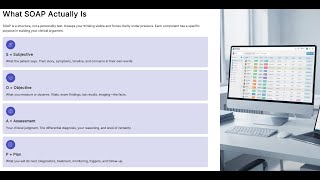
Okay, so these are the slides that generated, and I'm going to put here present mode, and we're gonna go through them. So we talked about this before, but today I wanted to over concentrate on what soap notes are. SOAP means Subjective Objective Assessment and Plan. Ablihat kallam na'ala. How to tell the story of a patient when they come and give you all sorts of things. You need to organize them, not just for you, but for the conveying of that information to others. So why SOAP notes matter? Because you have a lot of patients. You have a lot of information and you have limited time. When you are going to leave and somebody else is there and you need to what we call hand off, you need to know how to summarize in order to hand off the information because you're going home and the other person is there. And it's also a patient safety tool. Why patient safety tool? Because the patients are relying on you to give the most important information upfront. You do not want to miss the information. For example, if you just have 3 seconds, you're not going to use 3 seconds to talk about everything. You're going to have to give the most important stuff. Okay. So we have learned as medical professionals to use subjective, objective assessment and plan. That's what it is. Subjective is I have chest pain. Objective is your heart rate is 55. Your blood pressure is 144 over. I'm examining you and you are showing that you're breathing with difficulty, your abdomen is painful. Assessment, putting it all together. Here's what the summary is, and the plan is, here's what I'm going to do to make you better, and here's how I'm going to do to investigate what's wrong with you. Listen, Kimaaya.
Yes, Dr. Samad.
Okay, so This, so what is important is this is what you learn when you get to the clinicals. What we don't necessarily emphasize, and it says the secret that students learn late in— no, the whole point is the assessment. Assessment is king, and everything else stems from the assessment. The subjective and objectives are the evidence. To support the thesis, which is the assessment. And then the action steps are the consequence of that assessment. So assessment, what is your diagnosis? What is your theory? What can you put them all together in one place? For example, I have a patient who's 46 years old and she came in because her family found her confused. Abused and not herself. And when she came, we found all sorts of things wrong with her. Let me tell you, she had fever. She had influenza A positive. She had— her liver was completely abnormal. Is the flu responsible for the liver? No. The liver can cause— the flu can cause you to have some diarrhea, GI symptoms, but not the liver. Why would the liver be affected? Maybe there's something other. Then we did the ultrasound of the heart. Well, it turns out that in the ultrasound of the heart, there's a blood clot. What? Blood clots, liver, influenza, confusion. Hadun meb'ium shemabardum. Right? So when you have something like this that doesn't fit, you just list it in your assessment and then in the plan, you go into what exactly is what you're gonna do with the plan. Okay? So the way to think about the note, the note is an argument. As if you are coming to me, I'm your, let's say I am your, let's say that, you know, I'm someone who has money and you want me to give you money. You want to convince me, right? So in order to convince me, you give me arguments to support your thesis why I should give you money. Similarly, your thesis is your assessment. You need to give me arguments. What is the evidence? Well, the patient has chest pain radiating to the left shoulder, radiating to the left arm. That means I would like to run a lab test to check if the heart is the one. But at the same time, I don't want to miss that that chest could be just— that pain could be left shoulder pain. I would like to do an X-ray. So you are giving me arguments and evidence to support your thesis in order to justify your action steps. Lazim nan amillu, catheter, drain in his chest. That drain is not easy. My dad is very frail. He's diabetic. He has a lot of infections. So, tell me why. I understand the theory behind it, but tell me what is the percentage of success? What is the percentage of something goes wrong? If something goes wrong, what are you going to do about it? So in order for you To convince me of your thesis and your action step, you need to give me the subjective and objective that led you to that. Mashy? Beautiful. Who are you really writing for? Ma anatu mean ilhaa yukoon bi talla ala al soap notes? The clinician you hand off the patient to after the end of your shift. Maybe this patient goes home. In that sense, that next person has to read your notes And you have to have shared language. You speak the same thing so that he or she understands you. So if that person, patient, comes in at 3 AM and you're not there and there's no context, your note becomes the context so they don't start from the beginning. They are now on sedatives, so I can't speak to them. I don't have the subjective that they brought it in. Soap notes, context, because somebody else was there and that context was lost if they did not put it in a soap note. Attending, attending, rotating with you, needs to read your notes. And that attending, you're not the only student with them. They have other students, so they have to read multiple notes, not just yours. And so if they read multiple notes, they need to get the gist of what the summary of what you're trying to say so that they can act on it or supervise you. Okay, it's not the same yet in, in Palestine, but, um, there is a legal person who's going to read your notes and to determine if there was something missed. Okay. So who you are writing for? You're really writing for colleagues? You're writing for— so a soap note. Subjective, objective, assessment, and plan. Subjective is what the patient says. Objective is what you find in your physical exam. Assessment is when you put together all of that and you create either a diagnosis or a syndrome or an idea of a diagnosis. And then the plan is what are you going to do about it? Okay, if you want to comment, please put something in the chat or come off mute and speak directly, or you can do reactions, the Zoom reaction. Alan Yusuf. So the secret students— pardon me, who we are really writing for is the clinician who's next on shift so that you can give them what you found, the consultant, somebody you called to help, Somebody who is a, you're attending. We now have the ability for the patients to read their own records. Sometimes we make copy of the record and we give it to them because they have no access to it if they are displaced to another place. So how people write your notes. Someone who, like me, will come in after you, how do I read your note? I jump directly into the assessment and plan. First thing I read, "To start with, the patient complained for 3 days of—" I start directly with what are we talking about? Is this cardiac? Is this appendicitis? Is this meningitis? Is this orthopedic? So I start with the assessment and plan. So, "Abdul Matisou, Youssef Mohammed," Assessment is king. You have to make sure assessment is very, very important. Okay, so assessment, you have to spend a lot of time with it. And so once you write the assessment, you write it in shared language. The The subjective and the objective must support the assessment plan. So somebody who questions your reasoning, questions your reasoning, meaning what's going on? Why do you think this is the heart? The subjective and objective have to support your assessment. It is the evidence. If the assessment is weak, everything collapses. I don't know which direction you're going. If you just tell me, what is your assessment? And I answer, oh, the patient has fever and is coughing, but also vomiting and has bleeding. And then on top of this has a seizure. And then on top of this is pregnant. Well, this is not an assessment. This is just a verbal diarrhea. You have to give me an organized fashion. How do these integrate with each other in the SOAP notes? Okay, for those that just joined us today, what we are talking about is how we write a SOAP note. The best way, a SOAP note means this is how we communicate with each other. There are multiple formats. The most common one is a SOAP, and SOAP means that it is subjective, objective, assessment, and plan. Subjective is what the patient told you and what you did in your review of system. Objective is what you found in your physical examination, the imaging, the lab results. Assessment. Assessment is your clinical judgment. Summarize everything. Summarize everything, and then the plan is what you will do next. What kind of diagnosis will you do next, etc.? We mentioned that it is, that your assessment is your big thesis. This is what everybody will be discussing. Your subjective and objective is evidence for your thesis to support your thesis. If you say this is the heart, why? If you say the patient is bleeding, why? If you say this is an infection, why? And then the plan is what are you gonna do about it? How are you gonna confirm it and how are you gonna make the patient feel better? Now, what are the SOAP notes, things that you should not put in the SOAP notes? You don't put in the SOAP note things you did not ask. You don't make assumptions. Just because the patient didn't say it doesn't mean it didn't happen. The patients have not, do not have medical training. So you are the investigator. You put 2 and 2 together. Methicillin. The patient tells me, I have been coughing for 3 days. Okay. So we are talking about acute cough. And something one of my attendings taught me is instead of asking, How long have you been sick? I ask, when was the last time you were well? And it 100% of the time takes the patient by surprise. What do you mean? You mean well, well, well, well, in our Arab culture, they start telling you about when their grandparents moved from whatever. So you still have to learn how to direct the questioning. But when you flip a question on its head, sometimes you get information you did not know. And I say, for example, in our culture, we don't go necessarily by dates. In the Arab culture, we go by dates. That matter to us. For example, I say Ramadan alifat. What did you do to go? Oh, I was with my parents or I was displaced. So at that time I lived with my neighbor. And do you remember coughing at that time? Coughing? Well, oh my gosh, that's true. Huh, I forgot about that. So this is not a cough of 3 days. This has been months. Wow, Dr. Walancita. So now I just uncovered that the cough is not acute anymore. It is chronic. With landmarks. What was last time that we were all displaced? What was— where were you? When it was Ramadan? Where were you when it was Mawlid al-Hajj? Where were you when, you know, something like this? When you start to give these big dates that people know, it puts them in an emotional context and they can tell you more. But if they don't tell you something, you cannot write. If they didn't tell you that, you do not write that. Do not copy forward without verifying. We trust each other that we do everything for the right of the patient. The way that I mean something is not the way you mean something. So if I just copy everything you said without going back to the patient and verifying it, Dr. Muhammad, Best guess, okay? Well, please tell me what you felt. Don't tell me what they told you. We will get to what they told you in just a little bit. You verify. Rather than just take everything and move it forward. And I want to make sure I repeat things that are important. When you are unsure, say so. When I was in your shoes, I was intimidated by the incredible amount of information that I'm supposed to know as a doctor. I always thought I'll never make it. I always thought that I was not as good as everybody else. I always thought that I was defective. My brain was not the same. I was not like others. When that happened, what it did for me is, unfortunately, sometimes I wanted to appear confident. Don't do that. If I don't know something, I will tell the The patient, what do you mean? Tell me more. I'm not familiar with this diagnosis. Who gave you that diagnosis? I sometimes even pull my phone, connect to the internet and ask, let me see on the internet, what is that? Yeah, I know if a patient looks at you like this and you come up with the answer, they're not looking at you down because you came up with the answer. They're looking at you as resourceful. They're not looking at you as dumb. There was a moment in time where I did not want to show that I was going to look up something, so I pretend I'm going to the bathroom and then I look it up and I come back. Either way, do not play up that you know everything. Trust me, patients know. One thing happened to me. It's now been about 15 years, but I was in medical school. And I had an accident that I almost lost my life to. My head was fractured, my jaw was fractured, I was disfigured, and my brain had a concussion. Then it had a bleed. And when my friends— because I was a medical student at that time— my friends come to me to visit me, and I ask them, what's new today? And they tell me, and I could immediately say as a patient, if they're lying to me or not immediately. Yani, within 2 seconds, the way that their eyes moved, the tone, their body language, the choice of their words was extra, extra protective. Yani, it's immediate fi energy happening at that time. So I'm telling you, your patients will know if you fake certainty. Okay? Is there any questions so far? We're almost at the end, and I'm gonna want to do a little exercise with you. Thank you, Bissem. And I want to welcome everybody else. Siham, Youssef, Mohammed, somebody else as well. So nice to have you over. So, when somebody says the patient denies chest pain, I think that implies that there is chest pain and there's a negative response where we like to say things in an objective manner. So, we say no chest pain reported today, or the chest pain was not assessed during this encounter. If you forgot to say something and the patient is gone, Be honest with it and say the patient's chest pain was not assessed. Leish, the next doctor, when they come in and they see your note, chest pain was not asked last time, they will ask. Don't pretend that this was done. Subjective, what you need to include, we talked about that before, is the chief complaint. That's the patient's words. I literally sometimes put it in quotes. What brought you here today? I can't, I don't feel well. That's how I write it. Or I feel like an elephant sitting on my chest. I write that timeline as we talked about, the relevant positives and negatives, but avoid copying the entire story of the patient. Your job as a physician is to, to whatever it is relevant. Include whatever chronic history is important, but don't go into narrative tangents. For example, he felt chest pain during exertion. I don't need to say that that exertion was that he was going up the wall to try to get the cat of the neighbor that was on top of the— I don't need to know all that. All you need to know is it was during exertion. Objective is clean and defensible. The vitals, whenever you give me a vital, please give me a trend, not one number. And when you give objective, you give the actual numbers, not your qualification. This is a daily thing for me. Hey, doctor, I'm calling you because the blood pressure is low. Well, the blood pressure low, systolic of 101 is not the blood pressure low systolic of 61. So numbers matter. So give me the number and give me what was the previous one. If you're going to give me hemoglobin is 6.2, give me the previous one. If the hemoglobin is 6.2 and it was 3.2, that's great. If the hemoglobin is 6.2 and it was 9.2 before, that's not great. So you need trends. You do not just need one number. The focused exams, we found crackles in the right lower lobe, abnormal lung sounds. We have key labs and imaging with dates. You wanna avoid a full detailed examination. The assessment is where you prove that you can think. You list the problems, not the organ systems. You give a differential if you don't know. If I came up with this is a, elevation myocardial infarction, that's what I write. If I just know that it's chest pain with— on exertion in the context of fever, then I'm going to say the differential is myocarditis, pericardial ST elevation MI, pleuritic chest pain, gastroesophageal reflux. And then you connect the evidence to the diagnosis, meaning I'm gonna put in there due to the leukocytosis, opacity on the chest X-ray, And then you name the uncertainty clearly. It is unlikely to be a coronary test, but we will be sending troponins and an EKG. However, due to the fever and the high chance that this could be myocarditis, we will do X, Y, Z. So, you name the uncertainty. We're not here to cover up on each other. And then a simple assessment structure works every time. Problem, alternatives, what is your leading diagnosis, your most likely diagnosis, and what's the risk? What did you miss? Is there something that could kill the patient? Like, for example, did you miss an aortic aneurysm rupture? Right? So the plan is not a wish list. It's what you will do now, what you will monitor, what you will reassess. And what will trigger an escalation? I'm going to send these labs. While these are happening, this is diagnostics. I'm going to start pain medications and aspirin. While this is going, I'm going to monitor the blood pressure. If the blood pressure drops, I'm going to start a medication to make it better. Meanwhile, we are going to continue with therapy and diagnostics. A lot of doctors miss that. In the plan, there are two things going on: diagnostics, therapeutics. Fee marat, there are very compassionate doctors that focus mostly on treating the pain, but they forget to send diagnostics for the pain. Fee marat, very smart doctors and very clever, but they're like Sherlock Holmes. They just are enthralled with the investigation and they forget that the patient needs to be treated at least results. Okay, so the plan, diagnostics, therapeutics, who do I consult as my specialists, who feel education and follow-up. I need to educate the patient because you never know. What if in 5 minutes there is an alarm and everybody has to evacuate the hospital and the patient now has to go somewhere else to seek care? If they go to seek care somewhere else, you should have educated them on what was on your mind because they're not going to have anything other than their story. So the next doctor could pick up on where you left off. Okay. When you are in the emergency room versus when you are in the wards. In the emergency room, you have short vital signs, action first. In the ward, you have a problem list structure. So you, it's, you have more time to think. In the emergency room, it's quick. We need stabilization like we saw last week. You focus on the immediate decision-making. You focus on the assessment. There's only a one-liner, so we don't Waste time in debating a full list of things. Just emphasize of what needs to happen in the next 2 to 4 hours versus the ward. You have a little bit more time, and that includes long-term goals and discharge planning. Okay, so I wanted to— I will discuss with you. I heard today there was an interest in learning about AI. I will discuss with you at another time how AI can help, but at least let me demonstrate for you what I mean by that. So the AI that we can use today, I'm going to do this AI, but I'm telling you already that that's not the AI you have. It's another, it's one that you do not have access to, but when we do the AI for you guys, then I will show you a tool that you guys can have access to in Razzle. So the AI that helps with notes is called Scribe. A scribe is the name of the, of the, the name of the technology, not the brand. So all of the technology would be the same like this. You click on this and you just start to talk. 86-year-old female coming to the hospital because of chest pain radiating to the left shoulder and radiating to the left hand. She was walking from one place to the other because she has no vehicle to take her there. Unfortunately, she started to feel the pain. She stopped. The pain went away. She continued. As she continued, pain came back, and when it came back, she almost felt like she was fainting. She doesn't know if she has any medical history or family history, except that all her family are no longer with her because they were gone, and she doesn't know much about her own medical history. She was told she has asthma when she was a child. And she also knows that her mom used to say that she has high blood pressure. On examination, she has good air entry and movement in her lungs. She does have some pain when you touch her sternum, reproducing the pain that she came with. And she has some swelling in her lower extremities, but she speaks comfortably and the rest of her examination is normal. Blood pressure is 123 over 44. Heart rate is 53. Respiratory rate is 18. Oxygen saturation is 98% on room air. Neurologically, she's intact. She speaks in full sentences, alert and oriented times 4. At this point, the suspicion is that it is chest pain of cardiac origin, but also retrosternal pain due to reflux cannot be ruled out. And potentially a pleuritic pain from pneumonia since she says that she had what she felt as a fever a couple of days ago. We will be sending her for an imaging X-ray, and a complete blood count to see if she has leukocytosis, and we'll start her on antibiotics as well as some acetaminophen for pain medication in the meantime. We will reassess her in 2 hours to see if the electrocardiogram, the labs are more consistent with cardiac versus non-cardiac reasons for chest pain. And then you click on generating The notes, and it takes about 20 seconds. And even if you start— this is me dictating, but even if I was talking to the patients, if I was talking to the patient herself, I would actually find— here it is. It actually organized it all for you. Presented to the hospital. She experienced pain while walking. And past medical history. This is the physical examination. This is the studies assessment. Patient presents with chest pain radiating to the left shoulder. The differential diagnosis, myocardial ischemia, considering the nature of the pain. And then the plan, rule out cardiac causes, initiate chest X-ray, conducts a complete blood count, This is what we call a scribe. A scribe takes ambient conversation and organizes it. This one uses an AI in order to do that. What's good about it is I can choose various templates. This one is more for pulmonary. This one is more for critical care or even a phone encounter or a video. So when you click on that scribe, you can change that format. For example, I want to change this into a format of progress note, not a consult. It'll change it all for me. And here's— now it's in a SOAP form: subjective, objective, assessment, and plan. Any questions so far? So today we talked about soap notes. How do you summarize the case of someone who just told you all that story? We also talked about how do you do a review of system. And then last week we talked about how do you do a differential diagnosis. And we talked about it in the context of the emergency room because everything is moving fast. So Dr. Maryam, as a guest, told us that we need to stabilize the patient to think fast before we do anything. She gave us a format of the vital sign stabilization. Excellent question. Excellent question. So there are two ways that I've organized for you. The first one is— so there are two ways that I organized for you. The first one is my LinkedIn page that I created specifically for, and I'm going to put it in the chat. So for every Saturday when we do something, you will find it here. So these are the previous ones. This is the first day we started. These are the slides. And this is the YouTube recording. Second one, this is the slides. And this is the YouTube recording. Third one, this is something that I gave practice cases, the art of presenting a patient. So after the second session, this is a pre for the third session we did last week. And then on the day of, this is the slides. And then this is the video. And during then, this was a handout that our guest gave us. And today you will find me posting the slides here, the recording here. And so that's one place to find it. And then the second place to find it is academicsolidaritywithpalestine.org. Takes you to Garsat Amal. This is specifically for you. This is how you register to the Zoom. These are the past sessions on my YouTube channel. These are the materials, print material, and this is just the structure of all of the what to expect each day you come in. We are going to be going all the way to October 3rd. Some of the changes might happen if I hear that you have something different. I'm just getting to know your curriculum. Fa alu lil muqarrar hadl usbur fi CNS. So I'm going to try to move the neurological examination to next week so you can start to feel that it corresponds to what you see. Now, if you can, if you can do me a huge favor, I would love it if you shared with me your— it helps me learn about you so I can give you what you need. Where is everybody from? You can chat, you can react, or you can come off mute. Where is everybody from? And is everyone from, uh, on the, at the third year? Okay, is that correct? I feel like people joined more. This is just a small, small, small thing that we wish we could do more. It makes me feel like I'm with you and makes me send you a message. You're not alone. Walla, you're not alone. Kill you, kill you, kill you, kill you. My colleagues want to come in and help. I'm organizing a lot of specialty guests. Insha'Allah, please ask me, please ask me what you need. If I can, I will make it happen. Uh, research, how to start with research. And, uh, this is what I do. I teach, I'm a doctor, but I am also a researcher. So I will absolutely— this is the YouTube is one class that I made for your predecessors. It's about AI in clinical research. You can watch it if you want, but I will have one session next week. We'll have 2 hours instead of 1. We're going to do the first hour about this and the second hour, And what do you know about, what do you need to know about it? How do you get started about it? Okay. And I'm still getting to know you. Abdul Sami, same college? Yes. And, uh, do you have access to the WhatsApp group? Are you on this? If you are on this WhatsApp group, give me a thumbs up. Yes, Taib. Alhamdulillah. Ya Allah, alhamdulillah. As you go every day and you find something that you do not know how, please put it in the chat any day of the week. I will take it from there and I will help you by putting something together. How do you find these answers for yourselves? Not bring you a fish. I want to teach you how to fish. So if you bring me these problems, I will craft something for you to learn how to do it for yourself, so you will be independent, inshallah. And then 2 minutes left. Anything My only question is, is 3 PM or 4 PM your time better? 4 PM. Anybody else? Okay, 4 PM is good. I will post it on the WhatsApp. Thank you for teaching me. I will, and share with me as well. If you have pictures to share with them privately, it gives me a visual of how to craft something. So I was trying to do Maybe some exercises with you, things like that. So knowing about your circumstances help me personalize these things for you. So keep that in mind.
More from Hassan

ICU From Both Sides of the Bed "If you could not speak,what would you want us to know?"







