The art of the one liner
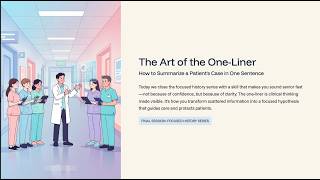
In this interactive Zoom session, Dr. Hassan Bencheqroun (Pulmonary & Critical Care, educator, AI‑board certified) guides fourth‑year medical students, including a participant from Gaza, through the concept and practice of a clinical "one‑liner" – a single‑sentence summary of a patient case. He explains why brevity is essential for effective handoffs, consultant communication, and rapid decision‑making, especially under stress or limited time. Dr. Bencheqroun outlines a structured template (age, sex, relevant background, chief complaint, time course, key positive features, key negatives, current stability, and diagnostic impression) and illustrates how to select information that influences differential diagnosis while omitting non‑essential details. He discusses red‑flag findings, the V‑I‑N (vascular‑inflammatory‑neoplastic) framework for differentials, and the danger of premature closure. The session also covers practical aspects: a curriculum built from weekly topics, a WhatsApp group, LinkedIn page, and Academic Solidarity with Palestine repository where videos, slides, and exercises are stored. Dr. Bencheqroun emphasizes adaptive phrasing for different audiences (consultant handoff, urgent vs stable patients), the iterative nature of the one‑liner as new data arrive, and strategies for skill acquisition (repetition, pocket cards, game‑like practice). The session ends with encouragement to use the provided resources, ask questions via WhatsApp, and maintain a supportive learning environment.
Chapters
Where are you at the moment, if I may ask? Just asking, um, where are you, if you feel comfortable sharing.
I'm in Gaza right now. I'm in a hub, like, avoiding internet and electricity to join the class.
Today's session is going to be light. When we need to leave the hospital and leave our patients with our colleagues, Inshallah, a new series, physical examination. Have you started your clinicals yet?
Well, that is—
okay, well, that's good. I wanted to have the most for this. And do you find that the exercises that I put in WhatsApp are useful? Good. This is the first session. Do you have any questions? Have you seen the sessions before? Do you know where to go and find the videos? No, I, I don't know. That's a very good question, and thank you for bringing it up so I do not, uh, uh, miss that. I'm going to put in the chat, um, you know the LinkedIn, right? Uh, the website. LinkedIn, and it has everything that we've discussed. Okay, I'm going to share my screen and this, and I'm going to take the address and I'm going to put it in the chats. Okay, show all posts. This is today's event. This is a question from those that attended. And then this is the last week's video. This is the event from last week. This is the event from before that, how to present on rounds. I put a little bit something in text, and then I put the video. And then if there are any other practices in self-study, I put them here. This is the session we did about the notes, how to write notes, the actual slides that you can download, video. And Oh, I put the link somewhere else. Okay, there it is. Here's Academic Solidarity with Palestine and here is Okay, and then second one is— so this is Academic Solidarity with Palestine. Our projects And you can find all of what we have done so far under clinical communication. Inshallah, the next one is going to be general physical examination, cardiovascular, respiratory, abdominal, neurological. And this is all you must accept. I thought maybe something happened and I moved it to today. But usually it is, okay. And then the second one is depending on if there are questions and so on. But normally I try to stick to the time. So if anyone, I know, if somebody has to go home because of safety issues, they have to go to family. So I try to stay between For example, if you see taking a focused medical history, slides And normally there is a video, a video. Something happened to the video. I will make sure that it is uploaded, uh, and you can see another session. And this is another session and Another session, and these are the videos. How to present, videos, how to present on rounds, how to stabilize patients in the emergency room. Okay, so you can go and check all of these at your own leisure. And when you click, for example, on this one, "Hey, delete video," it's on YouTube, and it's very easy. Okay? Fine. Are we good?... Fi... There is a colleague that just joined. Um, what is your name? There's another person. Is it Afnan? There's no pressure.
Uh, no, Afnan.
Afnan. Afnan. I want to explain, if this is your first time here, um, show who I am. Pulmonary and critical care. I am also an educator and I also handle clinical research. I'm board certified in artificial intelligence. So I tried, had Helmo Bedra, it was just asked for one session, how to move from theory to practice. When I started it, I invited everybody to join a WhatsApp group, and in that WhatsApp group I asked, tell me, what are the topics that you wish for me to tackle? And it went from 1 topic to 40 topics. And so when I saw that there's 40 topics, I actually created a curriculum, and I went from one week— each week we tackle one thing, only one thing, okay? And so we started now almost 2 months. Each week we talked about awwil sharli wahiya, tafawul ma'a al hayyaneen, al mardaa. So we tackled how to ask, how to deliver bad news, How to think through what you hear and translate it into differential diagnosis. How to deal with patients that are different personalities. For example, a patient who is quiet because they're traumatized, a patient who is upset, a patient who's sleepy, a patient who— and then sometimes you don't have time to spend with the patient. So how do you stabilize the patient before or you know more about them. And then we moved into how to write your notes, then how to present on rounds to your attending or to your colleagues. And then today, inshallah, it's how to do it in one-liner. Sometimes we are moving very fast. And we don't have time to spend on doing an entire story. So how do we choose the information that we put in a summary? Sounds good. Any questions so far?
Good.
Okay. And I will make sure that The, um, I don't know if you are on the, um, on the WhatsApp. Are you on the WhatsApp group? Do— are you aware of the WhatsApp group? If you are not, I could— I would love to add you. To make more of you and your colleagues join us. So I am glad to see you here. Sessions are for you. How did you get the Zoom, um, and how did you know about coming here? Who told you about this? Ah, you are on the group of WhatsApp. So feel free to share that with all the fourth years. I am working on creating another one for the third years. Their needs are different from yours, so they have different questions. They have the— so we are working on creating one for the third years. But for you guys, the fourth year, hadak group, feel free to share it with everybody. And I want to make sure that this is made by you, for you. So if you have questions, if you have something that you need clarifying, style of learning Allah tani, fa sfi minna illi bi tahlama bishuf dars bil visuals, fi illi bishuf dars bil kitabah, fi illi bishuf dars bil hafdh, an dar kalb. And so each one of us have our own style. I want everybody to feel welcome. I want everybody to get what they need. This is not rigid. This is not 100%. It can be modified. If there are questions, please put them on the WhatsApp. It's not a pressure, it's one of many. If you feel intimidated to put it in the group, you are more than welcome to reach out to me personally. Inshallah, I will answer you personally. So what we have here is— what we have here is— here it is— the arts of a one-liner. And that's how we summarize the patient's case in one sentence. And why is that? Because it's a skill, and like any other skill, we have to work it. So if one was to learn how to ride a bicycle, riding a bicycle, you don't learn it the first day. You learn it over several times. So just because in our culture of Arabs we tell stories, we sometimes say, it's gonna be fine, I will know what to do when I'm there. But when we are there, we find out that one, we have to learn how to present. Two, we have to get our brain to organize our thoughts. 3, we have to learn how to summarize those thoughts into an organized fashion. 4, we have to pay attention if somebody's asking us a question, so we stop talking and we start answering. So there's so many things happening all at once. If we can take one of those things and prepare for it before we are in that situation, it'll come back to us like second nature. Okay, so summarizing and presenting is that skill that I want you to try when you are at home, when you are with friends, et cetera. Okay, fa. Why is this important? This is important because we have to think in public. And thinking in public means that we have the nervousness of being in the center of attention and everybody is looking at us. So sometimes we feel a little nervous, and when we are nervous, our brain stops working, and that's when we need it to work. So a good one-liner demonstrates that your reasoning, tarikh al-tafkir, is transparent. You, mumkin innikti, to show the way you think to the attending physician, to the consultant, exactly how you are approaching the case. Sharlatania, faster teamwork. If everyone has the same one-liner, then we all know what is our goal for the same patient. Faster teamwork. It's a better differential if I have, for example, a long paragraph of 35-year-old male who who came because of cough. The cough was for 3 months. However, the cough increased in the past 3 days. 3 months ago it was dry. Now it's not dry anymore. It has consistency and thickness. It became green in the last 3 days, and so on and so forth. Yani, the narration is so long, you forget what you're doing at this. So what I would say is you have to have a better differential if you have a clear one-liner. What if I were to say to you, 35-year-old with chronic cough becoming acute in the last 3 days, X-ray is showing a right upper lobe opacity. Now you're thinking it's pneumonia or it's a tumor, and the pneumonia, maybe it's tuberculosis. We have to— al, al, al. When you have this, And then we have safer handoffs. My patients to my colleague before I leave. Okay, so clear, structured communication. Reduces the risk of critical information being lost. They do not miss the fact that, for example, the opacity is in the right upper lobe, so you have to think TB. They don't miss the fact that this is a smoker, so they can't miss the fact that this may be cancer. So these are important things we cannot miss. Thus, if the patient had a colonoscopy 10 years ago, is that important? Not in this situation. For if I miss it, It's okay. But I can't miss that the white blood cell count is elevated. I can't miss that he had blood in his sputum, hemoptysis. So easier help seeking. If you want to ask a consultant who's busy and passing by you in the hallway and you say, Dr. Zarbour, I have a patient, Okay, I have somebody on the table. I have to leave. Okay, can I just tell you there's a patient I want you to see? You don't have time to go over the narration. You just say, 35-year-old with the right upper lobe opacity. He's a smoker and he had hemoptysis. This has been going on for 3 months. Could you see him, please? You see, when you give them 80% of what they need right there, less story time, more decision-making time. Okay, to organize our thoughts, we say what is a one-liner and what is not a one-liner. Okay, what is a one-liner? A one-liner is— it's a hypothesis. Shumanat al-hypothesis. Al-hypothesis means is al-faradiyya. I am thinking about cancer in this patient. Before I say cancer and I lock myself into one most likely diagnosis, as doctors, we still have to do qa'imat al-faradiyyats. What is the list of possibilities Then I will give you the most likely. So when I am telling you that this is a patient, 35-year-old male who came in with cough and he's a smoker. If I added smoker, al-mustami'a already start to think the way I want to orient them to think, which is cancer. Okay? It's almost like you have a movie of 2 hours, but you want to do ishard al-movie. If you're going to do that, you don't have 2 hours for ishar. All you have is 10, 20 seconds. So you choose the most important information about that movie and you put it in the trailer. Right? Your one-liner is like a film. It's focused on the most important things that help with decisions. It is also a filter that highlights the diagnostic weight. For example, I put in there his 35-year-old coffin with opacity in the right upper, and he's a smoker, but there is no weight loss. So the positive is as important as the negative, and it shows me that, yes, I gave you the weight of potentially a cancer, but I also hold you back by saying, don't go all the way to cancer because there is not this, there is not that. And your clinical reasoning, just for the essentials. Just for the essentials. Okay. So if you say everything, you show nothing. The point. So what it is not. What it's not. It's not a summary of everything. It's a summary of what is important. It's not the full movie with every scene. It's just a small portion of the movie. It's also fi talabatib lam mabikuno bi harfu kifi amilu, summary. They start to dump information. Let me just speed up. I will give it to you in 10 seconds, but I will give you so much that it helps you with nothing. And the platelets and the lymphocytes and this and the COVID and the— and this and the skin and the cardiovascular and the neurologic and— no, that's not going to work. You do the hard work of summarizing and you give it to me. Then, then it's not a it's not your moment to show how incredibly intelligent or thorough, very complete, comprehensive you are. It's not. This is not the time. This is the time to show how good you are at summarizing and still keeping the important things. And it's not a list of normal findings. We do not say everything that's normal. We say something that is normal if It helps with the thought process. Same, when you are going to want to work on something, you have to practice it. It's not going to be good the first time. We did not start walking the first time we tried. We tried to stand up and we fell. If we gave up at the time, we will not be walking today. So what we're going to do is we have to work on that muscle. So what is a muscle? Well, if you choose to go with this methodology that we're learning today, it's going to go in any hospital. It doesn't matter if you're in Oxford, in Pretoria, in Johannesburg, in Kuala Lumpur, wherever you go. Ahlan Lana. So when you are sleep deprived, when you are awake, when you're not awake, when you're sleep deprived, your— this structure will keep you in the same and will keep you giving the same results. So what is the template? The template is as follows. I will share the age and the sex are very, very important. You always start: 35-year-old male, relevant background. Maybe it's important if you say, so the relevant background, you know, the circumstances in that area, geographic background. Or the job. Maybe the person works with a machine that has smoke. Maybe the work— the person works in an area where there is a lot of dust. Maybe the person works in an area where there is cold refrigeration, or there is a mold, or an area where there are pigeons in the surrounding area. Why? Because that background will inform your differential. The pigeons will inform perhaps a certain microorganisms. The smoke will inform about the lungs and so on. So the background is important. The background does not matter. You just skip it. So age, sex with relevant background presents chief complaint. What is the chief problem? Leishachieve problem, female rats, Bijilayan, al-Mustashfa, Handu, Sudar. Okay. And they come with a headache. And when we do our blood work, we find that they have a heart attack. Well, now the heart attack takes precedence. We chase the heart attack to treat it. Once we treat it, we don't just send them home. We make sure we go back to the chief problem. Hold on. Is the headache related to the heart attack? I know the heart attack is important and I know the heart attack got better, but have we fixed the problem that presented the patient to the hospital in the first place? Oh no, we did not do any imaging for his head. We did not try to do anything about that. So we have to check what's with the headache. Okay, so chief problem is not always equal to diagnosis. Most of the time it is, but Fumarate, it's not. I had a patient who was in my ICU and she was 40-some years old, and they told me, we need to take her out of the ICU, she's stable now. She came in with low potassium and we corrected the potassium. I said, great, what was the chief problem? And they said, oh, we don't know, but her potassium was low. I said, I don't think people walk around in the hospital with a sign that says my potassium is low. No one knows that. So what was it that brought them? No one knew. I had to go to the patient and say, madam, can you please tell me what brought you here? And she said, I have an abdominal discomfort. I said, it's probably more than discomfort. A discomfort does not bring people to the hospital. Muhayk, ma fi hadabi ajeeb al mustashfa. So it must have been really bad. She says yes. And I said, did we even check something about her belly to do an imaging of the belly? No. Okay. So we sent her and we found out that she was bleeding in her abdomen. Fatayello. I sent her home and we did not check that. So yes, she has a diagnosis of hypokalemia, but she had a second chief complaint, which was abdominal pain. So don't forget the chief problem. And for how long? Then what are the key features? Like I said, with the guy who was coughing, he was coughing for how long? But also, did he produce phlegm or not? How was the thickness of this phlegm? How was the color of the phlegm? Was there fever with that phlegm, et cetera? And then the key negatives. Remember I told you he's a smoker, he's this, but at the same time, he did not lose any weight. He does not have night sweats. So you give the key negatives, and then you talk about currently. Is he better? Not better? What is most consistent with? What direction did you take with your diagnosis? So I want you to take this and write it on a piece of paper and leave it in your pockets when you are doing your clinicals. So when you are going to present somebody real quick, this is a good framework to keep. Age, sex, relevant background, presenting with chief complaint for how long, key features and key negatives. Currently, what's happening? We gave antibiotics, it got better, not better. Most consistent with, and that would give you, is this good? How are we doing with this? Let me see. If you feel that you do not want to speak or you don't have the internet to speak, put it in the chat. If you cannot put in the chat, use the reactions. Either way, So I can give you what you need and not just make this a traditional lecture with you just sitting there and listening. I want you to feel like you have the ability to ask, to clarify. This is a safe space, no judgment. So each bracket element, the brackets, each bracketed element serves as a specific purpose. The age and sex provide the epidemiological context. Relevant background highlights the risk factors. A time course distinguishes— is this acute? Is this chronic? Okay. And then key features build your faradiya, your hypothesis. Okay. And then while key negatives narrow the alternatives, and stability signals urgency or non-urgency. And then the diagnostic lane shows your thinking. Where are you going with this? So what earns a spot? What belongs in your one-liner? What belongs in your one-liner is the time course. Is this sudden onset or gradual? Is it seconds, minutes, or hours? If it's seconds to minutes, it's probably it's probably vascular. If it's hours to days, it's probably inflammation or infection. If it's weeks to months, it's probably a chronic illness. Stability status. Are the patients still sick or not sick? Ma'anatu? Are they hemodynamically stable? Is their respiratory stable? These signals whether you're emergency or you're just managing, faraliya, a puzzle and seeing what's going on. The risk factors. The risk factors, humma, immune suppression, ilmenaha, and anticoagulation. Are they taking some blood thinners? Are we thinking malignancy with smoking? All of these reshape the differentials. How to do a differential? V is for vascular, I is for inflammatory, N is for neoplastic or cancer, and so on. Okay, so if you wanted to go to the video about differential, awil video, that's the one where you will see the discussion about how to create a differential. We go by category so we don't forget something. We don't want to have our head go in one direction and forget the other directions because we just want to put somebody in a thought that we have because the patient is completely complex. I say sometimes The patients do not reveal all their secrets at once. They give you something incomplete. And I joke and say your patients did not all read the textbook of medicine. Sometimes they come to you with something that is different than what you read in books, and you have to remain open-minded. Okay. And then red flag. Shuman, it's a red flag. If someone came to me because they feel their chest is not feeling right. Okay. How do you communicate with patients, especially if they use non-medical terms and you don't know what to make of it? I have pain. Well, that's clear. I have wajah. That's clear. But I have sudah. Well, I have— you don't know what to make of that. Or muhasis nafsi. Hasis nafsi ayan. Okay, what does that mean? I don't feel well. What does that mean? I don't know what to make of that. So if you want, you can go to last week's video to understand how to deal with that. Thus, if the person tells me, I don't feel well, okay. But if they say, I don't feel well, and this morning I woke up on the floor and I did not know how I got there, well, that's a red flag. We call that syncope. A syncope is like a mini death. It's a red flag. You can't just like Leave it. Hypoxia, their oxygen drops. That's big. If they don't behave like themselves, altered mental status. If the family tells you, we couldn't wake him up this morning. He's doing better now, but we couldn't wake him up this morning. Or if the blood pressure drops, all of these are red flags. Okay? So all of these are belong in your one-liner. What doesn't belong in your one-liner? You don't have to put all the medication lists, the vitamins. Well, no, but if they take antibiotics, that's important. If they take blood thinners, that's important. If they take stool softener for constipation, I don't know how important that is. So you don't put all the medication in the one-liner. Exhaustive review of system. You don't have to go through each and every system. You just put there the most important, the most important positive, the most important negative. If you remember, he did not have a weight loss, okay? Or it's headache, but he did not pass out. No syncope. Okay. We do not need to say if the normal signs, the vital signs are normal. If they're reassuring, that's it. If you say patient is stable, we understand what it means. You don't have to tell me everything about this. Biographical backstory. I do not need to know he used to live in this area. He moved in this area 2 years ago. He came here 5 days ago. He has family that lives in the north. I don't need to know this story unless it is important because someone who lives here, but last week was visiting family in the north where now I know that there has been some diarrhea going around, then I'm gonna think maybe what he has is related to gastroenteritis. So the back biographical story is not important unless A piece of it is important. Subjective descriptions: the patient is nice, I liked him, he's a joker, he is a father, he has 3 daughters. I don't need to know all that in the one-liner. You can if you're presenting the case thoroughly, but if it is a one-liner, doesn't belong there. Here's an example: chest pain. 45-year-old male with diabetes and hypertension has chest chest pain, nausea, and sweating. This is symptoms. This is not clinical thinking. There's no time course. There's no character of pain description. There's no diagnostic reasoning. I'm listening to you, and I feel like I'm going back and forth and back and forth. I can't follow your line of thinking. So I don't know if this is urgent. I don't know if the chest pain is related to the nausea. I don't know, but if I say 45-year-old man with diabetes and hypertension with 2 hours of exertional exercise, exertional substernal chest pressure radiates into the left arm with diaphoresis, no pleuritic components, hemodynamically stable, concerning for acute coronary syndrome. Now, if you're listening to me, you know exactly where I'm going with this. Yes, Femtale? Okay, let me check if you put something in the chat, making sure. So, shortness of breath, for example, 68-year-old woman with COPD, heavy smoking history, with 2 days of dyspnea and increased sputum, afebrile, no chest pain, now mildly hypoxic, This is most consistent with COPD exacerbation, but pulmonary embolism and pneumonia are still on the table. Chuftukiev? So I orient you in what I'm thinking while still leaving some things that are not yet investigated. This example demonstrates clinical maturity. You can name the lead diagnosis lane that keeps the alternative alive. 'Most consistent with' is a way to say this is a hypothesis still, okay? This is a hypothesis, and, um, it signals no premature closing. I want you to learn this is a very important word. Premature closing is a way to say, wait a minute, you're calling this pneumonia. Are you sure this is not cancer? So premature closing is when you say this is the diagnosis and you leave no room for doing anything else. Okay. Then you have the key negatives. So demographics and risks, key negatives. Time course and character, and stability and reasoning. Okay, that makes this, um, the speaker, uh, okay, this is clinical maturity. Okay. Another example: 72-year-old with end-stage renal disease, diabetes, with 1 day of fever and confusion, now hypotensive and tachycardic, concerning for septic shock, source unclear. Sometimes the one-liner needs to make sure it signifies Urgency. When a patient is unstable, the opening sentence should make the team stop and start resuscitating. Fima, Rod, we don't have time to arrive to any diagnosis or talk to differentials. We don't care. We need to stabilize the patient first. You need to lead with the now hypotensive and tachycardic. That's important because it signals the red flag. Immediate danger. You need to name the syndrome. Hakina, abel inu. When you are having more time and the patient tells you the whole story, in your mind, you are not a recorder. You're not a tape recorder. What you are is someone who translates into medicine. How do we translate? Bneijma, some of the symptoms into a syndrome. Nausea, vomiting, diarrhea, abdominal malaise, an abdominal gastroenteritis syndrome. Chest pain radiates to the left shoulder and jaw, acute coronary syndrome. Fa nakhya ala syndrome, a constellation of symptoms. Here we named septic shock. Lish, it categorizes the emergency and it tells everybody else what you're doing. Okay? And it acknowledges the fi. We leave a little bit of room for the bada'il. So here you say source is unclear. We do not know what the septic source is, but you're thinking about it, but you do not know yet. So there's still more stuff to do. Okay? You notice that we still had the background in the beginning. Because that is important. I don't care about the colon and this and that, but end-stage renal disease and diabetes, the hadul, they're going to have a direct impact on the sepsis. And as you are moving into working with your patients, well, I mean, there are they evolve as more data come in. For example, a one-liner that I will give you now is not the same as the one-liner I will give you in 6 hours. Shul fat'ah. Well, in those 6 hours, I did an EKG. In those 6 hours, I gave them fluids and the blood pressure got better. I got labs that showed WBC normal or not normal. Maybe they show anemia. Fa bintawwir al-jumla, min version 1 to 2 to 3, depending on what we have. The first version, awul marabshuf al-ayyan wa al-aryana, all we have is the history. But the second version is ba'd mashufna al-ayyan wa khadna al-history, we did examination, we have vitals. Those are things that now we're going to add in the one-liner. So the one-liner changed. Tests, they arrived. So what we do is now the third version. I understand. No problem. You can drop. Inshallah. And then the audience-aware one-liner. We have to pay attention that there is somebody who's listening, and that somebody who is listening is actually taking the context from you. If we are going to talk to a consultant, we make sure that the one-liner has the information relevant for that consultant, listeshari. And if we are going to hand off, the one-liner has to focus on what is the to-do that we want the other person to do. So, one-liner, it's an instrument. So it is a tool that changes depending on who you give it to. Okay. And as we said, we use sometimes the handoff as the one-liner. So the standard one-liner, if I'm gonna give it to somebody, I usually end it with, watch out for— we give specific risk. If the condition deteriorates because of that, to do action. So, for example, when I'm in the ICU and now it's the end of the day and I'm going to leave, I have a list for my colleague to say to them, watch out for this person, their heart rate went up to 150 during the day. I gave them a beta blocker and he responded. So if it happens, feel free to use a beta blocker. It might work. So I give them some information that might help them. Okay, then the next thing is, if it is, for example, those are some of the examples. Respiratory, watch for rising O2 needs. If the O2 drops in spite of oxygen, 6 liters, you can go to 100% oxygen and call ICU because I think at that time he may not do very well. So I give them watch out for, here's the action. They can choose a different action, but at least you tell them because you're the one who spent 12 hours with that patient. GI bleed, watch out for hemodynamic instability. If the blood pressure drops below 90 and the heart rate went up above 120, activate massive transfusion because he probably will be bleeding. So you give them what is the anticipated complication. We are almost at the end. So in the— how do you do— how do you learn the one-liner? Well, you almost like have a competition coming, so you practice the game before the competition, right? So you try to force yourself to think about exactly one sentence, include the timeline, declare sick or not sick, and maximum two negatives. And you put that all the time in front of you. And you put it on your bathroom. And every time you go and you see yourself in the mirror and you read it, you create something. So you make it a game because practice makes perfect. And you examine the diagnostic lane. Try to always end with a hypothesis. Concerning for, most consistent with, suggestive of. Those are the sentences that trigger you to give it a diagnosis. And then in closing, I want you to think about the patient as the history tells you the story, the exam tests the story, and then now you've crafted the hypothesis. Now the task is to make it into a single sentence. Okay. You need to know how to interrogate, how to test. So you have to interrogate that hypothesis. Always remain open-minded so we do not miss something just because we think it's not likely. We are in the job and the mission of caring for people. This is not something that if we we miss, we're going to pay a fine, or we're just going to lose a material. This is a human being, so we must always remain open. But you have to have one lead diagnosis. Only when it's not there do you move to the next one. So this is what we have. We have had this series of how do we check and interact with patients. How do we interrogate? How do we make sure that we show empathy? How do we announce bad news? How do we translate that into a written note? And then how do we take that note and present it verbally during rounds? And today, how do we summarize it into a one-liner? So this is how we interact with patients. The next step is going to be medical examinations, and we will explore maneuvers that help you shift your differential one way or the other. And then the one-liner is always going to be your go-to because it has a hypothesis. That hypothesis is made public. The physical exam is when you test and pressure test that hypothesis against the physical reality. Example: the nurse gave me a one-liner saying, the patient, I'm worried about their abdomen, I think something is going on, the abdomen is firm. I examined the abdomen and I said, I understand what you mean, this is not a normal abdomen. However, every time I touch it, the patient just tenses their abdomen. So that's why it feels firm. It is not firm. It's not a surgical abdomen. You can see the patient's face. He doesn't grimace in pain when you touch him. So it's not a painful abdomen. So, Yanni, how you test that in the physical examination to move one way or the other? Okay. And inshallah, we will see each other next week. Afnan, welcome back. I hope you enjoyed whatever you could see. Do you have any question for me? If you can.
No, thank you. And thank you for your efforts.
You are most welcome. Allah ya'inkum. Hadith, just small, small actions compared to what you're going through. So you know the WhatsApp group, please ask there. I have put in the in the chat, which you may not have been there. So I'm going to put again in the chat. This is the LinkedIn for Qarsat Amal, all of the stuff that happened before. This is the Academic Solidarity with Palestine as well. So you can go there, same things, just different formats. And it has all of the documents and all of the videos that we've had before. Take care of yourself, okay? And reach out if you need anything. I put exercises on the WhatsApp group just to learn, so anything that you need, don't hesitate.
Yeah, thank you.
More from Hassan

ICU From Both Sides of the Bed "If you could not speak,what would you want us to know?"







