2021 WBC Summit Day 2 Trailblazer Award: Joey Reiman

Joey Reiman receives the WBC Trailblazer Award and talks about reframing corporate social responsibility as social opportunity, the difference between mission and purpose, and what authentic leadership looks like. BCG announces 35% women in executive committee and 42% of new hires are women.
Coming up next, a Trailblazer Award winner conversation with Joey Reiman. What a joy to recognize Joey Reiman with our WBC Trailblazer Award 2021. Congratulations to you, Joey, as an implementer of change and the father of companies of purpose. Congratulations on the WBC Trailblazer Award, Joey Ryman.
Thank you, Edie. Thank you so much. It's beautiful. I'm so honored and just blown away. Thank you.
What a thrill as we look at you, Joey, for the reimagination of the corporation, the founder of New World Bright New World Studios, and as Fast Company said, one of the hundred people who will change the world. And you are and have changed the world as you have presented a greater purpose for business and with that, the father of ideation with Bright House. And clearly you have done the definitive book on companies of purpose. And we all recognize the millions of copies out and the action taken because of your sighting the importance of building the brighter brand, a greater company and a lasting legacy. With your story of purpose and with the advent of Mona Lisa smiling and your work with Brad Siegel, we honor you today.
Thank you, Edith. Thank you so much.
Could you talk through why you use instead of corporate social responsibility, corporate social opportunity?
Absolutely. Corporate social responsibility sounds punitive to me. It's actually an act of compliance after Woodrow Wilson put new laws in place that would make capitalism more distributive. This notion of building libraries, if I had a lot of money came into fashion and that was csr. The way I think about companies today with purpose is it's not a responsibility, it's an opportunity. I mean, that sounds a lot happier and it's a lot more contributory. So a company, instead of becoming one of the Fortune 500, can be now one of the fortunate 500 in that they can make the world a better place. So if you're a large company, a public company, or you're in private sector, you have the opportunity to make Earth brighter and better. And that's a gift. And it should be talked about as a gift.
And you talk about all size companies, so it may be the Fortune 500, Fortune 000, the S& P, the Russell, the new advent of B companies that are going trying to get those in investment capital to drive change and the whole world of business stepping up to show that purpose leads to greater profit. Do you want to comment?
Yes, absolutely. In the world of purpose, and by the way, there's a difference between a mission, a vision and a purpose. A mission is what I do every day. A vision is where My company is going financially or geographically, but a purpose is a why. So again, mission, what vision, where purpose, why? When you have a why, your company will expand its orbit of caring to include not just shareholders, but stakeholders. And with that expansion, we will reach out beyond the four walls of our organization to outside the four walls of our organization. Up until a few years ago, we were very focused on what was within the four walls. Now companies are focused on what's beyond the four walls. That's where purpose lives. That's where we make the contribution to society.
Joey, as you think about CEO leadership across the board of individuals such as Inder Nui, who was one of the first, and that WBC is honoring, and also whether it's Eileen Fisher and those companies and the great CEOs the WBC has that are standing up as individual leaders with their companies, as leaders, building a holistic approach for their talent, for their brands and for their communities, both us and global. Can you comment on that? Leadership?
Yes. The old leadership we used to call the boss, as in double SOB backwards. And then we called them gurus when we thought they had some very big idea. But the gurus didn't really work out because they didn't know how to run business. And then we had the predominant leadership called the General or the militant. You know, they were always talking about collateral damage. And you know, we have to take these people out, we have to be competitive. But the new leadership, the leaders you're talking about, the Ingranui's of the world, they're heroes. Heroes. And heroes are dealers in hope. They don't just sell goods and services, they sell good and service. They're not just sellers, they are healers. And Inranui, you're right, she was, I think, one of the first to step forward and talk about the expansion of caring, of really taking better care of the world, of being stewards of the world. And she really was talk about being a trailblazer. She blazed a trail for other leaders, other female leaders. And while we're on the subject of female leadership, I should say that my consultancy, my global consultancy, Bright House, was run by three women. And I have to say, forgive me all men out there, but I think a woman's guess is better than a man's certainty. Because their intuitive nature and their nurturingness and still having the power of being a captain really served us well. Increased growth every year. We ended up selling the company to the Boston Consulting Group. And those three women are still running the company.
And we're so pleased with WBC to work with BCG. Would you comment under true leadership, as with the CEOs that we're honoring at WBC for their authenticity and their action.
Right. So authenticity. It's interesting you bring that up, Edie, because when there was a study done with Gen Z, the Gen Z generation, as well as Millennials, they said that I think it was 93% would not be hired by a company unless that company had an authentic purpose. And by authentic, I mean a genuine purpose that hearkens back to their ethos, their beginnings. And Gen Z and Millennials have built in BS meters. If you're inauthentic, if you're just doing a sales mantra kind of job, they will not participate in the company. And you need, you know, the future of business is about participation and collaboration. I've often said that purpose without participation is just parchment. So we're going to have to take a look at our nomenclature, our lexicon in business to better reflect what we're actually doing. And we're doing much more than we've ever done before.
Jerry, reflect on the leaders that we're honoring and what you believe as you have built. A film with Brad Siegel called why Is Mona Lisa Smiling? But comment on the CEOs that we admire for standing up for purpose, authenticity and action.
Well, I think you've got some of the best CEOs out there on your team. I mean, we talked about. I mean, the ones that come to mind readily are BlackRock, P&G, Walmart and General Motors. But Mark Bertolini at Aetna, Albert Barilla at Pfizer, Brian Chesky at Airbnb. I mean, these are leaders who are doing things that no leader had ever done before. And they have the courage to go beyond the shores of. Of reason. Reason was great in the 18th century, but it's time that we start thinking about things that are more ethereal. The spirit of an organization, the spiritual capital. Do I have a workforce or do I have a life force? And the heroes and the people that you've recognized are leaders of a life force, not just the workforce.
And so talk about the brand new world and the production where WBC is so pleased to join with you on why is Mona Lisa Smiling?
Yes, and we are thrilled that WBC is supporting us and thrilled that you're such a believer in the story that we're telling. And. And that story is a story once again, because we've heard the story before, back in the 15th century, when we had the Renaissance and the two things that happened during the Renaissance were the end of the Black Plague. Sound familiar? And the beginning of capitalism, agrarian capitalism, brought forth by the Medici Bank. Instead of coming down on the refugees that were coming into Florence, they actually supported them. And. And those refugees, those refugees being supported by the Medici bank, were able to create shipping, painting, art, architecture, public space, Gutenberg and the printing press. And it was unprecedented explosion of creativity. Well, guess what, here we are again. We have the pandemic, and we've got all these purposeful organizations now supporting people to not just be managers, but to be leaders in their own right. And my favorite part of the film comes at the end when we find out why Leonardo da Vinci put a smile on Mona Lisa. He felt he was so merry, so excited about the end of the plague and the beginning of capitalism that he saw a new world, a brand new world. And he did something no painter had ever done in the history of humankind. Da Vinci put a smile on a woman's face. And that would be Mona Lisa. That began a revolution in creativity. And the film is about all of these CEOs coming together post Covid and once again creating a new renaissance and a brand new world.
And Joey, as WBC looks at the sea change of women joining boards close to gender parity and in the executive leadership and changing the brands with chief marketing officers and across the board with commitment to community, comment on gender and diversity. The backbone of change, leadership of purpose.
Well, I would sum it up by saying being a young woman is not a hurdle to overcome anymore, but a force to be reckoned with. And this is what we need to be, we need to understand. I've seen it in my own career. I've seen it in other companies. I've witnessed a sea change in large corporations that are now run by women who were previously run by men. And I see three kinds of revenue happening when women are in power. One is financial revenue. The other is intellectual revenue, innovation and emotional revenue. How excited am I to come to work? I mean, that's what we need. We need people waking up in the morning and jumping out of bed because they're so excited about the purpose of their company and the leadership of women.
As we close Joey, and you think about galvanizing human capital with capital. As we see companies of change and as you work with Fortune and others, what's the action?
The action is. Well, it's in your name, Edie. And I don't mean Edie. I mean collaboration. You know, collaboration is different than cooperation. If the call to action is to cooperate, then we have to do our own little bit. That's what cooperation is. But if the call to action is to collaborate, it means all of us focused on the same thing to make the world a better and more beautiful place. So collaboration trumps cooperation because it's just like in the pandemic. We've got every country working on a cure that's collaborative. We have healthline workers who are doing their own little bit which add up, and that's cooperative. So I'd say the call to action is to collaborate. And if we don't collaborate, we will evaporate.
With that and with your focus on purpose, with action, and with authenticity of sharing results, how would you close on that challenge for our future today?
Well, I would close with Mark Twain's quote, my favorite Mark Twain quote, which is the two best days of your life are the day you were born and the day you find out why. And it's no different for companies.
Once again, can we all salute Joey Reiman, the father of purpose and such a true partner with wbc. Congratulations, Joey.
Thank you, Edie. Thank you very, very much.
BCG is proud to be supporting the Women in Business Collaborative at this year's summit. The Diversity, Equity and Inclusion Initiative at BCG is near and dear to my heart as a critical component of our purpose as a company to unlock the potential of those who advance the world. The Women at BCG Group is one of the largest diversity networks at our firm today. Over the course of its 50 plus year history, women at BCG has supported monumental strides towards parity. We're excited to share BCG's contribution to WBC's 2025 and 2030 targets.
Across the board, women at BCG have been able to advance at the same level or even faster than their male colleagues. It's all about partnering in commitment and achievement for clients. BCG has shown true commitment to women leadership. The EC, which is the highest level of leadership at BCG, is now comprised of 35% of women. And to further this commitment for the future, 42% of the incoming class of new hires is one women. So it's just so. I am so proud to be part of BCG and I'm so excited to see all the energy that the women have in the firm. In fact, 79% of the women report high satisfaction with their experience and their career development at bcg. BCG is committed to helping the WBC surpass the year 2025 and 22,030 targets. Thank you.
More from Edie


The Power of Purpose & Connection – A Conversation with Edie Fraser & Jan Duplain
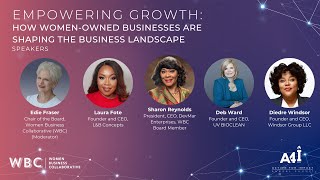
Empowering Growth: How Women-Owned Businesses Are Shaping The Business Landscape


WBC A4I 2023: CEO Excellence in Gender Equality and Diversity Awards Opening Remarks Day 2