Exceptional Women Live the Thought Leader Series Featuring Edie Fraser
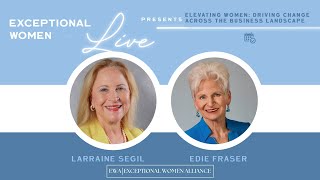
This content was created by Edie Fraser. This content was uploaded by Edie Fraser. This is a YouTube video titled "Exceptional Women Live the Thought Leader Series Featuring Edie Fraser" recorded in January 2023. It features a conversational interview between Lorraine Siegel, founder and CEO of the Exceptional Women's Alliance, and Edie Fraser, an author, entrepreneur, and CEO focused on advancing women leaders and diversity. The discussion covers Edie's background, the mission and initiatives of the Women's Business Collaborative, data-driven efforts to increase women in leadership roles, access to capital for women entrepreneurs, and advice for women advancing in their careers. The format is a live thought leader series with audience questions and interactive elements.
Welcome everyone. We have a fabulous show for you today. Truly one of the icons in women's leadership in our country today. Her name is Edie Fraser. She is an author, an entrepreneur and a CEO who has specialized in advancing best practice programs for women leaders and diversity leadership. Edie had a dream of of building a nonprofit to advance corporate and entrepreneurial women. She wanted to increase the numbers of women in the C suite, the numbers of women on boards, and women being able to raise capital. And she has done that. That is called the Women's Business Collaborative WBC. It has 76 women's business organizations who are partners with the organization. And each one of those partners focuses on elevating women in each area. Absolutely spectacular. EWA is allied with wbc and we're so proud to be one of those who are. Of course, WBC has a company initiative and they focus on talent suppliers, community and the creation of transparent data. We all need more data about how women are rising in their careers. Edie has written many books. One is called do you you're giving while you're living. Another is Women's Entrepreneurship in America. We're so fortunate to have Edie with us today and we'll hear from her in just a moment. I'm Lorraine Siegel. I'm the chair, founder and CEO of the Exceptional Women's Alliance. We enable high level women to reach their dreams. Why did I start this 501c3 foundation? Well, I never had a mentor early in my career as a lawyer and then as a CEO of multiple companies, even as a board director. I never had a guide to help me on my way. And I wanted to be sure that women who walk the road less traveled as I do would always have a network of supportive women leaders, peers who would enable them to be mentored for the rest of their life. And that's exactly what EWA does. And so, without further ado, let me introduce my amazing guest, the incredible Edie Fraser. Edie, welcome.
Thank you, Lorraine. And can we just stop and reflect on you for one second? Because as you've put together the Exceptional Women's foundation and support, you're the only organization we know that is really focused on lifetime mentoring and to, to make sure that we don't let anyone go as you recognize their leadership and look at lifting them up.
Thank you, thank you. Thank you so much for that, Didi. And we're also just so incredibly proud to be part of the wbc and we're going to hear more about that from you. But I want to go back to the beginning. How did you get involved in business? And how did you get involved in this particular mission?
LORRAINE I grew up at a time in Atlanta where I was president of my high school, as many of us were, but was so concerned about the world. And when President Kennedy said, what do you do for your country? I determined if I could get to Washington and work for the Peace Corps, that would be a miracle. And I did go to Washington. And in those days it was student government presidents that were joining the Peace Corps. And I moved up after doing a lot of college recruiting to be a desk officer for Africa. But really focused and is clearly when we look at our problems today. But when Martin Luther King was killed and Bobby Kennedy I determine I put my life for several years to work for the nation's poverty programs. And I hired an entire black team of people and realized this was the 1970. And we traveled the country from Appalachia to inner city ghettos, et cetera, but knew that we had to change. And I was lucky to know that movements were very important. And I went to Health and Human Services and I ran Health Communications and it was super anti tobacco, etc. Of building those campaigns. And in those days, then I set up my own company. A guy who was Assistant Secretary of the treasury asked if we could build a company together. We had run one of the nation's PR firms and I said yes, I would join him. And he chickened out. And there I was to really build and started around consumerism. If you take these different subjects and you really build some momentum. We ran the first grassroots campaign for the U.S. chamber of Commerce on labor law reform. And when we found it was really small companies getting hurt, then we could look at each issue and look at people. But in those days we also set up the first time that women senators got together was the Women's Senate Network, which really build the momentum and the support for getting more women in policy. And you know, today we may only have 25, 26% women in the Senate and 28% women in the House, but we know, just like we know in the corporate world and entrepreneurs when women come together and you and I were there as starting C200 or the national association of Women Business Owners and Enterprising Women. When we know when we put great women together who care more about the uplifting of others as a sisterhood, magic happens.
There's no doubt and you are the magician. And when you talk about WBC as 76 partners, it just boggles the mind about that. And in fact What I'd like to do, Edie, is we have a slide about wbc. Could we go to that and just tell us more about the Women's Business Collaborative so that we can understand this incredible organization? Let's put that slide up and see how it works. Go ahead.
What became so important was the word collaboration. So what we have is all stakeholders working to drive change. So just very, very quickly, if we look at our initiatives and you can click in any of them and see strong, transparent goals for 2025 and 2030. So the first is to get more women CEOs. And I think we know that we're stuck at about 9%, but we are increasing. And every time a woman CEO is named, we work with Catalyst, C200, Ascend, and WBC and put out social media, and we put out an annual report. And these are women running companies, public and private, above half a billion dollars and the C suite. And Lorraine, you've been working with so many women in this area. We work to get more women with P and L. But when you look at the C suite and we hold accountable to company numbers, we also look at what the roles are in the CIOs and those that have major budgets that are driving change. And we know every company and what they report on their data, publicly and privately, in terms of what their C suite and their diversity looks like in the boardroom initiative. And we have 27 groups working on that board. Groups. What we know is that it's been the fastest changing area. Many women in the C suite, if they don't move up to president and CEOs, are opting out once they get their first two boards, as you know. And we with Equilar put out a report every month. And over the last 26 months, we've been averaging about 38% women joining public boards, a third of those women of color. We name every company and we name every individual and we work together. And now look at public boards, private boards, venture capital boards.
I'm going to jump in a minute, Edie, because you have so much data coming in. And we'll go back to the slide in a few moments. How do you assimilate all that data? Because all of these organizations and groups are giving you data. Do you have a central database which you're doing data analytics on? How does that work?
It's really good questions. And Gwen Young, our chief operating officer, and our team work across the board. We work with Equilar primarily on some of the board data, but we're probably working with 40 different organizations on data. And one of the other exciting initiatives which we will release on January 26th, we've been working with the University of New Haven to look at all the DEI annual reports, ESG annual reports, and put together all the transparent data, EO data from the government on data from government contractors. But we know at least 200 companies and what their data looks like across the board, whether it's pay equity, C suite, boards of directors, or what they're committing to pay equity.
That's amazing. All right, let's go back to the slide and pick it up at Entrepreneurs, Women Entrepreneurs and Access Capital. Huge issue that we have seen and it's not getting that much better. So tell us about what you're doing in that, Edie.
Well, Again, we have 27 organizations working, and that means we have 13 million entrepreneurs in this country. And as you know, black entrepreneurs are been building two to one over. White women. Latinas are really growing, but what their key issue is is capital. So we've done several things. We're going to run a capital conference this year. And what we're looking at, clearly, we've set up with Babson University, with Wells Fargo, some courses in capital on the different kinds of capital. So what we are absolutely doing is uplifting. And we're working with several groups like the Bo Collective, which as of January has an organization of 100 black women entrepreneurs banding together to network to go for capital. So organization after organization, it's really stupendous. There's an organization with the Women Presidents organization called Women Elevating Women wew. And what they've got is hundred of minority women entrepreneurs under a million. And once they help and get the guidance to each a million, they then promote them into WPO or you and I, eventually to committee of 200. But it's always that and always the galvanizing and the support that these organizations have. And same with our women in technology, which, you know, is so huge. And diversity is across everything we do as we pull in our sisters of color and lgbtq.
Amazing. Amazing. You truly are reaching into every aspect of our world and society, which makes it absolutely the definition of inclusivity. You know, one of the things I do want to do is encourage our audience to give us some questions. And I think that there is one that came in, so let's see if we can put that up. We have a bunch of other questions, but I think one came in from our audience just a few moments ago. Susan Holliday. Hi, Susan. And thank you for your Question. What did you expect to see back in the 1970s that has not come to fruition? Are we really on track? Wow, Edie, you have a good answer for that. I know.
Hey, Susan. I think we all expected huge change, particularly on the dignity and respect and the uplifting of women and women of color. And as we've seen this friction, what we've seen is troubling in the public sector. At the same time, we've seen the private sector become much more accountable. So if we go to George Floyd and the aftermath, it was the private sector that drove the change to really look for more women of color and women on public boards. But we can't go backwards on women's rights. Women's rights are human rights. And what we are seeing is men as allies really push to build like we've never seen before in building these allies. But we thought we would go a lot faster. And we know when we band together and we work with our men of allies, we're going to get back on track.
Track.
But as we just said with Lorraine, it's reporting the data every day and honoring and celebrating those. You know, there was a report put out what BlackRock and Fidelity and State street did when they said they wouldn't invest in any company that didn't have at least one woman on the board. The impact that that made. So the call to action is that we all call on our stakeholders to stay the course and move faster together.
Absolutely. Edie, I want to go to some very specific tips because you have such a vast experience and your perspective, because of all the various groups that you look into, means that you have some very solid advice. What would be three tips, for example, that you would give to a woman who is early in her career about moving up into leadership?
What's important is to get involved early. Right. And it may be if you're in a corporation joining the erg, the employee women's network groups are getting involved in how you can network, get involved in the official mentoring program or unofficially, as Lorraine and I would suggest. But make sure that you've got the positivity and the skills that you want to really exacerbate and build your ability to make a contribution. And don't think about it as I think about it as we as you're building your team and your network and your own allies, as you truly want to make a contribution.
And within that great joy, that's fantastic advice. We have a lot of our audience who are putting up some links for us, so we'll just Put some of those up so that you can look at it. And here is a question from Theresa. Thank you, Teresa. As an executive and board Women in Technology, I am thrilled about the work WBC is doing with the Digital Directors Network. How can someone such as me and others get involved in that program?
Edie, this is a very exciting program. And wbc, because we could go to all of our allies, organization, got a grant with ddn, with the Gula foundation to train the first hundred women with cyber skills. So they either had to be on a board already that they wanted to get the cyber training and accreditation, or they needed to be in an organization with a cyber role at enough senior level that they could go on boards. So we're thrilled to have about 100. And if you see, as Gwen Young just posted, please send us an email about your background, get your resume into Gwin, and we hope to go well beyond 100. So we're grateful to the Digital Directors Network. And Gwen, thank you for our team working with so many organizations to really drive these cyber skills to boards of directors, because cyber and AI, the number one talent skill now that they're looking on for boards of directors, right?
Absolutely, Gwen, thank you so much. And Gwen is a senior executive of wbc and so we're so happy to have put up that link for you. And of course, this program is also going to become a podcast and it's also going to be on our YouTube channel, it's going to be on Amazon Music, on Apple, Spotify, so you can go back and look at the links that have come up in there in our discussion with Edie and also at that wonderful slide. Easy. Did you want to go back to the slide? Was there something else on it that you wanted to tell us about or have we conversationally talked about it already?
Well, we might just put it up very, very quickly because we want to hear from you what you're interested in. So we just got into the women in technology. We did a major report, if you go to our website, on the state of women in technology. We did that with Deloitte and 13 others. And we looked at all the way from cyber and CISO roles to data analytics and to all the roles that are growing and the desperate need to get that training, as you know. And it's not just tech companies, it's every company, as you know, is looking for that. And we also recognize the amazing entrepreneurs in technology and their quick growth and really salute all those that we see making tremendous impact. And if we look at the pay parity we are seeing more and more companies show their pay parity data and is we're working with Cindio, a woman CEO and founder who is working with hundreds of companies to disclose the pay parity and work with those companies companies to really help them make the difference in making pay parity a reality. And on that pipeline issue, we've done a major report of what do you do to help those women up the system? And then our separate initiative that we all share is building companies of purpose. And that means going across and putting all these together and showing there's just true commitment to making that difference and to stand up to leadership. And again, if you've got an interest of seeing this change, whether you're with a company or you're interested in joining our advisory council of about 450, let us know. Because it's not just about you, it is about we. Right, Lorraine?
Absolutely.
There's a task always together. And from Gwen, you can see just click in and let us know your interest. And it because everybody takes a role. All right. There was a graduate student at Pepperdine, right, Gina, that we got, Dina Dalla, who joined us, joined our advisory council as a co chair. But thank you for all you've trained at Pepperdine.
It's a wonderful school. The Grazia Dio Business School is. I'm proud to be on the board there. And it is a wonderful place for growing young minds, so to speak for a moment, Edie, about all of the things that we've done. I want to focus on a question that's just come in and hopefully our producer can put it up. It's from Neil from Seattle. And if we can get there, it is okay. So, Edie, I feel, he says, I feel like I'm being squeezed out of the job market because I'm male, 50 and white.
Your advice, Neil, it's so important to assess what your talents are and what your skills are and what your network is, because if you've got the skills and you've got the network of those that are going to be your advocates and those that might sponsor you, then you will be able to look at the right opportunities. Because as we say, men have to be part of our network and we have to be your advocates as well. So delighted to see those skill sets. Delighted to see how you want to build your network. And one thing you want to do is get to a place that is open and be authentic and to make sure you've got joy from what you do.
Yeah, very important. And I would say that One of the challenges that somebody like Neil might have right now is, yes, there seems to be a lot of focus on women and, and women of color and men of color. And we're trying to write the past into the present. And as that happens, sometimes the pendulum swings a little bit farther than we would want in one direction or the other. So I can understand that that must be a very difficult environment to be in. But as Edie said, if you build the networks and the relationships and present yourself as a collaborative leader, that is a very important skill which everybody can benefit from. Another organization, Edie and I both know is Paradigm for Parity, which is also working on trying to get parity of power and position and pay for all women and especially women of color in the marketplace. So there's so much good going on. Edie, I want to go to something very personal. You have more energy than anybody I have ever met in my life. We were recently at a C200 event in Chicago. I was running after you on the street to try and keep up. How do you do that?
Well, I think what gives it is our passion for life. And Lorraine, you do share that, right? And positive. And what we all learn is and sometimes light. Keep positive people. Get negative people out of your life as Maya Angelou said. So part of that and get some balance. Some of us also learn late in life. If we used to go to the office as I did, 7:30 in the morning, come home at 7:30 at night, we don't do that anymore. We've got to figure in how we get some exercise and how do we spend our time with our girlfriends, our friends and our networks that give us such joy as we're listening and supporting each other through great happiness and be there when we need to be when there's sadness to take them through and to keep those relationship mental health and spirit and well being so that we do see the joy in what we do. And that's so important that we can share that. I always said that my theme was to make sure I wrote five personal notes every day to put in the mail with cards. Today we can reach 25 people a day with personal notes because of social media and because of outreach and because of texting. So if we all do that, what a different world it will be. So from wbc, Lorraine, we're really grateful of the partnership. We're grateful of how many years you've been reaching out and to build the network for mentorship. So again we thank you for the partnership and we'll all do Anything to elevate and then celebrate.
Thank you. Thank you so much. We have another question that came in, a lot of questions, but we cannot take all of them. So apologies to those we have not taken. Gerry, thank you so much. Gerry Harmon. There's a very small percentage of senior women in private equity. Geri is in private equity. Avante is her company, one of the only women owned and founded private equity companies. By the way, she is one of our EWAs, as well as Susan Holiday. Given access to capital for women and people of color is significantly increased. If we have more allocators who are senior women and minorities, what are you or your partners doing to help with this?
Well, Jerry, we can't wait to talk to you because, as you know, we haven't gone forward. We're 2% still of women in private equity, as you well know, and so much less than 1% for women of color. We are so purposeful in wanting to change that number. And we're planning to do a capital conference. Not only are we doing capital conference courses that we're doing, as I mentioned, with Babson, but we're putting together, under the leadership of Judith Goldcramp from Wells Fargo and others, the first ever capital conference with all the areas of capital. So we know we've got to see that change is so important. And yet how proud we are to see women like you that have started their own private equity firms and is. We can name person after person, Lorraine, that we know, Margaret Giordis, who, as you know, was CEO of Ancestry and Mattel and now gone into private equity and put a lot of her own money into supporting women. But you and I can name 30 others. So we need to band together and make sure there is a dramatic change from the 2% to at least get 5% in the next two years. So work with us.
Right. I think it's one of the last bastions where women have not had the kind of impact that we would like them to have. So I agree with you, Edie, and Geri is the perfect person to work with, and we'll be happy to provide that introduction. So we have one other question which has come up, which is actually the Lewis from Naples, Florida, I'd love to get that one up. For those who have young daughters who are interested in business. He says he has both daughters are interested in business. What education should they get? What do you think?
Well, Lorraine, you and I would share. There is a lot of credence to an mba, right? But it's got to be the right MBA that is where the jobs and the skill sets are. Do you agree? I do, I think to learning whether it's the world of tech or finance as we talk about it. So to take those skill sets and to really look and specifically if you can get the corporate experience, why you're going to school and look at that is there's going to be a tremendous impact because business schools are finally over 50%. All right. But they've got to be the right areas where the jobs are because we just talked about cyber and AI. So what are their interests with your daughters and how do they take their interest and show the needs so that they can make a positive output and love what they do in terms of their work life?
I love it. I love it. Edie. Well, what a way to end the show. Just such a positive, upbeat, energetic comment, which is exactly what you're all about. Thank you so much, Edie, for being on our show. I hope we'll bring you back. And congratulations on all your achievement and power to you for the future as well. Thank you for being with us.
Thank you. And thanks to the sisterhood. And anyone send us an email, be on our website. We look forward. And Lorraine, you're a treasure.
Thanks. Thank you so much. Wow, what a wonderful show. Well, it was such a pleasure having Edie with us today. And so as we move forward, we're going to put together some new shows for 2023. And I want to thank you so much for being with us over the past year as we've had many of our EWA Facebook leaders with us. I always leave you with a question and the question I have for you today is what is the one thing that you think would make you be successful? Please send me an email to my email address which is up here on the screen today. And remember, as I said earlier, we're a podcast. We're on Amazon Music on Spotify and Apple on our YouTube channel. I hope to see you on all of those venues and look forward to connecting with you. Please do email me any questions that you might have. Thanks so much. Have a great week, everyone.
More from Edie
The Power of Purpose & Connection – A Conversation with Edie Fraser & Jan Duplain
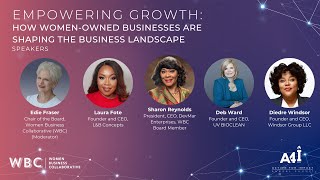
Empowering Growth: How Women-Owned Businesses Are Shaping The Business Landscape
WBC A4I 2023: CEO Excellence in Gender Equality and Diversity Awards Opening Remarks Day 2