Keynote Luncheon: Edie Fraser - UPWARD GROWTH: WOMEN FROM GROUND FLOOR TO C "SHE" SUITE AND BOARDS
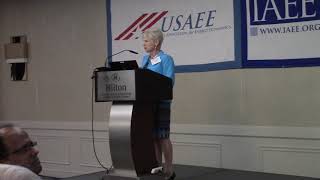
Edie Fraser's keynote (Sept 25, 2018) surveys women's progress toward corporate parity with an emphasis on the energy industry. She presents data on low female CEO representation (~5% overall; ~6% in energy), board and C-suite statistics (boards ~24% overall; utilities higher ~17–18%), pay gaps (general 80–87 cents on the dollar; STEM/tech closer to 96 cents except for black/Hispanic women), and economic upside of closing gaps ($5.87T global, $2.87T US). Fraser highlights successful utility examples, policy levers (Norway quota, California proposals, investor pressure), and mobilization efforts—mentoring/sponsorship campaigns (2.5M commitments, ~1.1M completed mentorships) and Paradigm for Parity corporate pledges (~81–83 companies). The talk includes a Q&A on culture, recruitment, work–life policies, and advancing women of color.
Agility is responding. Thank you, Linda. And to Guy and to Dave and to all of you, it's your 41st anniversary and how exciting of what you've done to vote USA EE and what you've done on a global basis as well. So first let's salute Anel Flora for what he said, because this address is going to be all about parity and the energy industry and a comparison of some of the other industry. And we say, can we get to the C suite? Where are we today and are we going to change it to the C suite? If you share that with me. So let's also look at what a joy I've had just sitting next to Linda Stump and I think you all know her and she'll be talking again this afternoon, but she's a role model for exactly what we're talking about on the data. She's now going on the board of Shell and she's going on the board of Edison International. And she just shared with me that 40% of Shell's board here are women. So, Linda, thank you for being a role model and for all in the room, us and international, for who you are and what you do, we want to say thank you also, I think, as we are in this unbelievable time. Oil price hit the high today of $81. Right. But the MeToo movement is all over the US and the world and women are running for the office in the US and around the world in numbers that we've never seen before. And we'll touch on that. So if we look at where are we across the board, just very quickly, we're stuck at about 5% of women as CEOs, and we look at the board seats, we're up to about 24% today on women across the board. And we'll compare that to the energy industry and we'll move on to talk about data. All of these slides and additional slides are available on your own website, on your own app. So we give credit to you for putting those up. One of the areas that we'll talk about where women have moved, that's extraordinary in your industry has been in CIOs and technology and we'll go through some of the data, but when we look at where women are across the board and the parity issues and generally 87, 80 cents on a dollar, if you're in a STEM job and you're in technology or engineering, you're going to be at 96 cents on a dollar, except if you're black or Hispanic. And we've got A lot of work to do. So I think that this slide shows we've got a lot of work to do in succession planning because everything is about what are we doing, men and women, to advance up. And our pipeline will show up in the C suite that we've only got about 10% in the next three years that we're pushing forward up to the executive suite.
Sweet.
Let's go to some good news. Right. So so much of what we found is that utility industry has made major strides. And you know, and you can share that. Well, we'll talk about some of those leaders. But the CC with utilities is 17.3%, which is high and the highest we're going to see in most of the other industries. What's the other good news? That utilities in The S&P 500 had 54 women CEOs or in the executive suite of 18.5%. And then the more good news is that we just talked about, we've got quite a few women as utility CEOs today. And in the oil and gas industry besides Occidental is we've seen the new president of BP America and the new president of US Operation at Shell, who Linda works with, have come on board to be women leaders. And that's 2018, and that's new. But when we look at. There are so many slides, and I think I have 10 slides that just show the impact on the GDP. So there's an impact slide that will show you that globally if we just move this marketplace, that we can impact $5.87 trillion to the next decade, 10 years against the GDP. Get that? That is extraordinary. And in the US alone, we can take that to over $2.87 trillion. So there are so many slides that will show you what will impact on the investment opportunity for this country if we just push women and women of color forward. And we were just talking about, because Linda and I were talking, seeing the studies of what happens and just really, really quickly when we talk about boards, you've seen what happens in the Scandinavian countries because they mandated and Norway is 40% and they've achieved that. What do you see in California is happening? They're mandating. It's not through yet. It could be a little extreme, but it's the first mandate in the private sector. You've seen that CalPERS in California went ahead and said they wouldn't invest unless you had one or two women on your board. Same thing happened in New York State this year. The same thing happened as we go through. And look at private investment funds of saying they would not invest in companies unless they saw women's leadership. Why is this, why is this slide so important? Because it shows that today white women are 61.7% of the workforce, but we're going down to 43% by 2060. And if you see the advent of Latinas and Hispanics and black and Asian women, they are the majority by 2060. So what are we doing? And we've got another slide. But again, what we see is only 2.3% of African American women up at that C suite and 1.2% for Latinos. I want to talk a little bit about an organization. There's so many organizations, the 30% club of getting women 30% on corporate boards. And we can tell you there are 20 other efforts and men are championing, but a particular effort called Paradigm Prepared. How many people have heard about it? Well, we want you all to go back and talk to your companies and science sign on. Edison International has signed on for sure. American Electric Power has signed on. But there are 83 companies now. This is 81. We've added two where the CEO and the chief human resource officers sign on to say we want to strive to get to parity by 2020, 30. But you don't have to get there. There are five principles. You just have to show success and you have to report internally, you don't have to report externally. So please come and see me if you want to go back to any company and make sure that that CEO is really taking on the next step. Because our goal is to get 100 companies by the end of this year. So who are the women that are CEOs and what are the changes? So what did we say? 20% of this s and P group are women. So that is more than any other industry, which is startling. I think nobody had ever put together this data to you. Tina asked me to put all this together and that's pretty exciting. And as we talked about, there have been changes, but you know, Lynn Good and Duke Energy and what she's just been through in Carolina and others. But there have been real progress. And yet only 5% women CEOs. Energy industry now has 6%. So what is the C suite look like and how do you compare to different industries? So I think you'll see that's extremely interesting. You can get copies of any of these other slides. But what we'll take through and say, how are you doing with two chief financial officers, chief legal officers, we have all this data to really share and what we do see, there's one piece of data that say the CIOs are 21%. There's another slide that says up to 35%. But if the changes are in technology, of running every part of the energy industry, isn't it great to see that we have women wanting all of that? Just very, very quickly. This slide shows the earnings gap and what we know is at the entry level, there's equality just about in every industry, but it really narrows gravely by the time you get to about 40 years old. And so, Roman, right now we're seeing that gap be at about 25%. Now, let's just look at the energy industry overall. And there are different studies. We've used 100 different sources for all the slides that we put together. So Some may not 100% agree, but I think if you look at the 6% that are the women at the top and 10% boards are about 13% on women and energy. And that CIO figure just stares out at you very, very broadly as well as the diversity. And this says basically 11% of senior executives on the oil and gas industry. So look at oil and gas. Just a minute. I think what you find is there's a huge difference. Again, that top line shows you at the entry level, there's near parity, 50%. Right. And then if you go down in the oil and gas and look on to the executive level, you get at that 24%. So now we compare you to other industries. This, this data came from the World Petroleum Council and BCG's report. And again, if we just compare more demographics at electric power generation, women consistently represent about one third of the electric power workforce. From the Department of Energy's 2018 data, this shows you that their highest percentage is many in the nuclear power field and the lower, ironically, is in solar. And this goes through and shows you that there's still about a third of the women in the general energy workforce. Now let's just compare that and we've got so many other that will take you through all kinds of energy slides and other industries. But let's just go through and talk through. We've been working to look at industry by industry and here's a report that we've done delighted to share copies, it's all online called Women in Insurance. And the bottom line is there's 60% women in the insurance industry, but the Pay disparity is $0.60 on a dollar in executive suite. So we've started and working with their entire industry to drive those changes for Women and women of color in aerospace and defense. It's pretty exciting when you see that there are three women and if you count Boeing's head of defense, four women CEOs in aerospace and defense. Many know Maryland, Houston, at Lockheed and the others. But we've got 24% of the aerospace and defense workforce, and they're working to drive change. So you can see that the energy, oil and gas is about equal with aerospace and defense, and it's 29% in manufacturing. But manufacturing has been put a lot on, pushing the numbers upward. Now in manufacturing, the national association of Manufacturers Manufacturing Institute have a big effort going called STEP to get women up the system. And the same thing, the food industry and the food technology industry puts out an annual report on compensation. There have been really striking changes in this industry. And again, the women in food technology, again, technology jobs truly impact 80% of all jobs today with some tech skills. So let's switch to that and talk about what we're seeing out there in policy and politics, because we know that it is a total mess on one hand. On the other hand is what has happened is in the last two years, 40,000 women in the United States have run for office. 40,000. That means school boards and city councils up to the Congress. Right now, I did this slide in August. There were 422 women still running for the House and the Senate. Right now it's 200. But out of the 200 is. It's extraordinary when you look at race by race and when you look at the number of women veterans that are running and the women with tech skills coming out of that system. And I think we can project. We've got this pink wave happening here, and it's happening country by country if any of you want to get the data of other countries as well. But this will have a new major impact, all right. As we really see what is transpiring. All right. And we need it in both parties. Out of the 200 women, 150 are Democrats, 50 are Republicans. So the fact is we say we just need more women and we need the men that support it. So I think what women want beyond pay equity and gender parity and capital and health care is they really want the leadership and they want the male sponsorship and mentorship and advocacy so that they can really be promoted. And you share what each, each of us, male and females, can do together to get to the parity. And yes, just the way the secretary of OECD said they've got to have child care and they've Got to have benefits. Wall Street Journal reported last week that today it's not only women, but millennials would rather have benefits than increased salaries. So we have to understand that this is changing very rapidly. So just to tell you, we started a movement, which was only four and a half years ago, to get women and girls in STEM careers because it's the technology and the engineering. And we asked anybody that would mentor companies, organizations, the government, states, other countries to put in about 20 hours a year. Mentoring, sponsorship, internships, apprenticeships are online. We have 2.5 million commitments. We thought we could get to a million by 2020. You can see how important this is and how exciting. And we've got Data on nearly 1.1 million completed mentorships, because the data will show you if you mentor, you're going to get two and a half times more likely that that woman or young girl will succeed and they're going to be much more engaged in their workforce, two times more likely. So this data is just extremely important that we see it and with a paradigm for parity. One of the five tenets is that you sponsor and I think, does everybody know the difference between sponsor and mentorship? Sponsor means that you're an advocate at the table for the job advancements. That means clearly that you're with them as an advocate on getting the next level of attainment in the workforce. So what can we do in terms of taking action? And I think you would join me in saying that we've got so much research, so it's not, not just what we're citing here, there is so much more that shows where we are, but what we need is for organizations to really get on board and for the companies to get on board and do this US and worldwide, and to begin to look at what you want to do. And the recruitment in that means talent acquisition. And just really quickly, do you know that we've got just about as many students today in the United States in community colleges as we do to four year institutions? So the tech companies, some of the energy companies and others have a new recruiting strategy of recruiting them out of two year institutions and giving them so much of workforce training there. And particularly true because of the minorities and women of color that are in there. So there are new ways, new social media ways, right? Indeed. Everybody who knows. Indeed. Right. They're recruiting. Nine million companies are working with them now to recruit online on talent. And most of the energy companies are working with them too. So recruiting and setting some goals on recruiting and then building them up the pipeline. So the mentorship and the sponsorship, building that inclusive talent and culture and getting the advocates and getting those people that are doing the recruiting out there at the universities or on the marketplace or online on your website that look like them and using the data and reports as a baseline that every company, all the organizations the government can use to really report success and is using succession planning because everyone, and for those that are thinking about retiring, what are you doing in your own succession planning? What are your companies and organizations doing? So I think I've gone to another slide, John, that shouldn't be up there right now, but let's just see the importance of what we're doing. This is John Pomper. So the importance today is it's a new environment and the number of nuclear scientists, the numbers of CIOs, and who is really making a difference is just so important to all of us. It is a real treat to see this organization, not only the US side, but the international side, saying we can make a difference. So wouldn't it be great if every single person in this room made a goal today to do one thing to advance women and women of color in your organizations to really make the difference? We have the talent as we see that is extraordinary. I'm really lucky to be associated with Diversified so Search, which is the number one executive search firm, that's the woman owned firm. But all of the executive search firms are making such a priority of this US and globally. And so it's just a delight to have the intelligence of this group, to have the research data that we've got to get our baselines in order and to commit to action. So I'm really grateful to you and to the organization. I was able to talk to the Platts Energy and S and P Global conference. And I must say that conference in New York that they had hosted had about 300 young women who all wanted to talk and minority women and those in Houston. And all they wanted to do is talk about their career steps for action. So it is time now to take what the Secretary General said and to really thank your own leadership guy, you and Dave and all those that are running this today and to say, let's do it together. I am get rid of the naysayers. What Maya Angelou said is get rid of the naysayers. Stay positive, particularly in this political environment, and let's really talk about good things and good news. And that's characteristic of, of your organization. Thank you very much. We'd like to open up for any questions or comments. All right. And Tina, do you want to start? Anyone would like to start? Yes.
So, Andrew Slaughter, in the companies where there are women leaders already in the C suite, you had a whole list of them there. Do you find that they are more proactive in building up their pipeline? Is there succession pipelines they already created, creating a more higher potential environment for the women down chain?
I think. And Linda, you could join me on this. I think we would say yes. But it means it's not only the woman at the top, it's who's on the board. They've got 40% women on board on Shell Oil. It's not only the board of directors. It's. Is it in your culture? Is it part of your talent strategy, both talent acquisition and talent advancement? Is it truly part of your culture? Because the energy industry is having so much competition out there because the Amazons and the Googles are going after some of your engineers and are going after some. So you've got to make certain that that culture is going to make a change and Deloitte's doing a good job. Okay. Who else? Linda, do you have a comment of what you've seen and what you're helping to lead?
I agree with everything you've said. I think the cultural change is affordant and, and I think we still have a ways to go in this energy business. We are still not. We're recruiting a lot, a lot of women and other ethnic diversities. I like to think of diversity in a broader sense, but we are losing too many. And it's either because it's still too hard to balance and the companies have to work at it and it could be cultural. Some places women just don't. And so it's not journey and we just have to.
It is a journey, but it's now because the competition and millennials are showing they only want a job for six months, they want the next challenge or they want out. So the importance is to really captivate and for the energy, if we've only got up to 30% average women in the energy industry and we've only got about 11% at the top, how do we want to change those numbers and how those companies are the best recruiters that have the great data that can show what a great place it is to work because you've got the numbers and you show you really embrace women and women of color and clearly the same. Tina? Yes, Amy, what policy changes do you recommend that would help women balance make better life balances as they work? Well, that's interesting. What life policies and work Life balance. So the question is, do you mandate it or are you voluntary about what you're doing? So if we look at companies like Deloitte or Accenture, they're all making it voluntary, using it as a recruitment way to go. And they are very focused on rec reaching goals. But they also know the importance of the work at home policies and they're using those policies to go. The Congress is a mess because even the Equal Pay act has not been enacted in this day and time. We are 24th against other countries in the world. I have 10 slides in other countries and where we stand. And so we are not able at the federal level and what we need to do, we can't go state by state to go through it. And so the private sector is using it as a competitive edge, hopefully the government the same. And looking let me just also mention women entrepreneurs. We've got 11 million women entrepreneurs in this country. So many are contractors to the energy industry, the Department of Energy, US and worldwide. And it is just tremendous to see the goals that are set for the hiring on most companies. And most of your energy company utilities again are very high in their goals for supplier diversity. For women it's at 5% and most utilities are surpassing that goal. So let's just mention the entrepreneurial thrust. So many corporate women are leaving to set up their own business, those at Department of Energy. But we're looking at all of that, which is why you want to make your workplace and the job potential really very exciting to get the next level. That was a great question guy. You were saying. Excuse me.
Yes, thank you very much though for very interesting subject and very interesting presentation. I have one comment which is for me a little bit shocking deviation between women and women in color. This is something which is in our country for example is never used. I mean as soon as we not starting divided the women and women of color, maybe it's starting to change the view of the men. I mean I never hear that it's men, men in color color. So it's as soon as we start to divide it to integrate it as a woman as a whole community, maybe starting to change the mindset of the people as well.
Well, it's very important on the mindset. But if we say that women of color will be the majority by 2060 and our numbers are so low, we have to men and white women have to support our women of color sisters. So that's why it is so important because there's organization after organization and there are organizations for Hispanic men and African American Men, the elc, the Hispanic association of Corporate Responsibility, to do the same thing to bring people of color up to equity. So this is all to get to equity. And we respect what you say, but it's all with love and respect for a sisterhood that we must make certain that we get those opportunities. Yes.
As I said this morning, this is my first time in America and this is my first time appearing in Women of Color.
Yes. So we agree women are women. But what we're saying is, in the corporation, in the talent, we've got to make sure that women of color get their fair share. And we're really putting, because our numbers are so low on their advancement. So we're working hard on making sure that we've got a quality. So it's important. Yes. So what would your number one piece of advice be to my three twenty something daughters who are just what would.
Be the one thing.
Did everybody hear that question? You say you have three daughters, so you have three daughters. And what would my message, our message be for them? What a tremendous time to be in this country and to really get skills, because the jobs that require, whether it's technology or engineering, the STEM area is tremendous. But also for those that may want to run for office, may want to, the opportunities today for women to be what you can be. But if you want to look at making money, then what can you be? And ask how much do you want to earn and what do you want to do to give back? So it's just extremely important that every daughter is not the same. And I also think, because you're fervent in supporting your daughter, I think what's so exciting is to see the men step up and daddy's daughters who want to see their daughters succeed in the STEM area or in some field where they feel they've got leadership, whether it's in research and academia or whether it's an energy, one of your energy centers, research centers, or whether it is to go to the corporate suite and work, work your way up to really work on something that you love. Thank you, Tina. Thank you so much.
More from Edie

The Power of Purpose & Connection – A Conversation with Edie Fraser & Jan Duplain

Empowering Growth: How Women-Owned Businesses Are Shaping The Business Landscape



WBC A4I 2023: CEO Excellence in Gender Equality and Diversity Awards Opening Remarks Day 2