On the Brink with Andi Simon | Podcast | Special Guest Edie Fraser
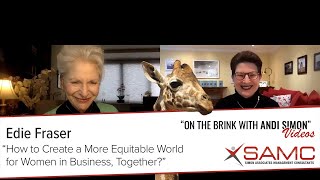
Edie Fraser talks about founding Diversity Best Practices, STEM Connector, and the Women's Business Collaborative. WBC focuses on three things: position, power, and pay. She explains how storytelling and giving drive gender equity work.
Questions this video answers
2.5 million commitments
1,000 people attended the 2020 summit
Expected 2,000 people for September 22, 2021
May 13 (year implied 2021)
Welcome to on the Brink, A fresh lens to take you and your business to new heights. Hi, I'm Andy Simon. I'm your host and your guide. And as you know, my job is to help you get off the brink, to help you see, feel, and think in new ways so that you can soar. And so I find amazing people who I want to share with you. And today I have Edie Fraser. And Edie is one of the most remarkable women I've ever had the pleasure to know or to meet. She's going to tell you about her own journey because that's always interesting to hear about it from their point of view, but a little bit about why I find Edie so amazing. So Edie now is the founder and CEO of the Women's Business Collaborative. Now, the Women's Business Collaborative is an organization I belong to with great pleasure and honor, and it's an organization that's trying to transform how women are in our business world in all kinds of ways. In the C suite, in the boards, the access to capital, and the diversity in which we're hiring people. But she'll tell you some more because this is one of those collaborations that's quite transformative. A little background. Edie was chairman and founder of STEM Connector and its Million women Mentors. She'll tell you about that. There are about 3 million women mentors now, and she's a managing director of Diversified Search. She served as vice chair of Diversified Search when she previously directed the Washington and government business. But prior to serving at Diversified Search and STEM Connector, she was founder and CEO of Diversity Best Practices, a member service for diversity practitioners, where she designed the CEO Diversity Leadership program. I think what's so in awe of Edie is that she's won 53 major leadership awards for diversity, women, STEM entrepreneurship, and philanthropy. And she's smiling. If you're looking at the video, her smile is contagious. Edie's contagious. It isn't just Edie doing things. Edie brings along the most marvelous people for us to know. And so it's truly a pleasure. Edie, thank you for coming today.
Well, all of us thank Andy Simon, who makes us think and then makes us rethink with her new book that she's got called Rethink, and it's taking us off the edge as she's written in her book, and to bring a happiness quotient to your life and to see where we can really make that balance between business happiness and personal happiness.
So, Andy, yes, I appreciate the plug. And Edie is a review of my book. I tell you for transparency's sake, but Rethink Smashing the Myths of Women in Business was sort of a catalyst for me to meet Edie. And Edie, I want you to tell our listeners about who is Edie? What is your journey? Because I could read this stuff about your awards and your passion, but you also have a deeper and longer term commitment to change. That, I think, is what our listeners are looking forward to hearing about you. Who is Edie Fraser?
Thank you, Andy. You know, my dream was to make sure that everyone would bring unity in America and the world. When I grew up and I went on five international exchange programs by the time I was 20, all over the world and I had a family of entrepreneurs. My mom and dad started Casual Corner in Atlanta. But when President Kennedy was killed, I wanted to go to Washington and I did. And I joined the Peace Corps staff and spent years in college recruiting. And then I became a desk officer for Africa and went back and forth building programs. When Martin Luther King was killed and Bobby Kennedy, I was so concerned. And I had done a study at the Peace Corps of who was joining the Peace Corps versus our poverty program in America. And we found that most student body presidents were going into the Peace Corps, but on the poverty program, no. So I said, what can we do in America? And I spent the next five years, after five years for the Peace Corps spending in our nation's poverty program. And Andy, one year I hired an all black team and I traveled to inner city ghettos, migrant camps, Appalachia and Indian reservations. 50 weeks on the road and just trying to understand the capacity to plan for communities. And that was part of the old OEO contracts for government. But it gave you an understanding of so much of what we're going through today. And clearly I ran and went and ran health care communications for the government. I joined a big national PR firm. I started my own public affairs firm because one of the guys said to me, I want to start my own firm. I want you to go with me and you start, I'll join you. He chickened out. And there I was.
That is an interesting story.
And took the issues of the day. So we took consumerism, for example, and then we took all kinds of public policy and public policy campaigns. I ran the fight for Panama Canal treaties and labor law reform and built coalitions and then was able to really think through public affairs issues that were so important to the nation, whether it's the future of energy and what we're grappling with today. Or very serious issue of diversity. So really starting the diversity best practice and building a business women's network where we ran women's conferences all over the world. But it was awakening up and is after selling that, I've started three companies. Two very successful. One because you have to learn about cash flow in the bottom line is that may have not been as successful, but then it was really on. We started STEM Connector when I was at Diversified Search, which is amazing, and Judy von Selnick has built it to such a powerhouse. And again, women helping women. I'd gotten a call from a big executive search firm to maybe come join and build their diversity practice. And I called Judy and said, what do you think? Should I go with them? And she said, no, get on the next train to Philadelphia. The next thing I knew. So part of that, again, it's always thinking of each other. Women helping women. When we started STEM connector, most CEOs didn't know what STEM was. Science, technology, engineering and math. And I have to admit, but it became quite important when we realized that the jobs in America were STEM dependent. Our future was dependent. And we built at least 100 companies. And then we said, what can we do for women and girls to make sure that those careers. It's something Andy writes about in her book Rethink in terms of not only the importance of stem, but why aren't the girls interested in STEM and computer science and science. So it was very exciting. And yes, when we kicked off eight years ago and said we can get a million women to mentor, sponsor internships, apprenticeships and online mentoring, 20 hours a year, we said we could do it. We sat there and said, how are we going to get a million? But we started working with companies, with governors, and yes, we hit 2.5 million commitments. So it was just very exciting before starting Women's Business Collaborative.
But let's talk about the Women's Business Collaborative. This came back in so many ways. I'm an anthropologist. You are. You may not have that title, but you are an observer. You went cruising through the poverty areas to learn about them, not to study them from afar. Even here, getting through the stem, you thought about a million and you got two and a half million. We don't know where we're off to, but there's something very energizing happening. But how did the Women's Business collaborative emerge? It's 18, 20 months old now and it's going gangbusters. We've got 250 members. But there's something very, I use the word contagious. Carefully here because women are talking to women who are bringing women in. It's got a big vision and it's sort of a culmination of all of the things that have been most important to you over your life. It's almost as if you're saying this is really the culmination of it all. Am I right, Andy?
Right. What I did. And I was pleased to be on six or eight boards of women's business organizations. But everybody was competing. And we took the fact that was said by the World Economic Forum it would take 117 years to get to gender equality. And we more or less said, bullshit, we're not going to be alive. What can we do now if we all came together. So if we looked back and look together and give credit to the 43 plus organizations that have come together and organized around nine initiatives. And we are driving change with the things that Andy says about the stories of the women and the data that really builds change. So we took baseline data and on each issue of women CEOs in the C suite, on corporate boards, entrepreneurs and capital, only 5% women running capital firms. And we said, what if by 2025, together, as we work on these things, we can drive change? If we become the only women business movement can we accelerate as we build a sisterhood with men? And we promise to be diverse. Because as we looked at the numbers, particularly women of color, it was blatant. If we looked at the C suite, 22% women in the C suite, 5% women running P and L. And if you dissected that only 1% women of color. We looked at boards celebrating the progress we were making and still not enough, but less than 5% women of color. We knew that we had to develop a sisterhood of bringing each other up and supporting and building win wins. So with all the organizations we represent about 2 million. But we are so focused on giving people position, power and pay. And that's clearly pay equity and celebrating with those stories. And Andy, you have interviewed so many people and their stories and uplifting them and making sure particularly this year when we hit Covid and when Black Lives Matters hit an economic crisis and we saw that what we could do to build. But we looked at it like Andy, you and I look at everything. What could be positive, what could be could we do? And clearly the private sector and even chief executives have really said enough. We are going to demand that women be on our boards and women of color. We are going to demand that black and brown executives move up and we Champion them. We're going to give more money to black and brown women owned business. And those numbers are blatant in terms of commitments. So we're all about action and we're all rethinking what those happiness quotients are. And I think, Andy, as you listen so beautifully to everyone that was so amazing that when you talk with bank of America or Humana or those companies and their CEOs and top executives for the first time were online with their top employees and employees and listen to the stories with the children and the dogs crossing their laps of what it meant to build and retain and to keep those happy and fulfilled in times of crisis.
You know, Edie, you're talking about three things I think important. One, the people listening are all about how do I change? What Edie's talking about is how do you change? Because it is not simply by force. It's by collaboration, it's by conversations, it's by building a bridge between us. The people who are engaged, see a vision, a future and want to build it together, which is so amazing because you're not twisting arms. They're almost coming to the table looking for a way to do it, even if they believe we should and we're not. How do we. And it's as if there's a gap between what they aspire to and what they're capable of because there's nothing there. So part of this is action and how do you do it? And then I'll put in a little plug because part of it is changing the story so that they can tell somebody. Let me tell you how we're doing it. At your summit, the woman from MasterCard spoke about how they were doing it for women in Africa by tying together the banks so that women could get money to support the businesses. So the how and the aspiration and the story is really a marvelous movement that takes us from we want to do something to we're not. We're competing. Let's stop competing. Let's create, let's collaborate, let's build. Let's stop talking about each other. Let's talk about what we're trying to do, which is the magical part. Am I right? Is that what we're getting?
You're 100%. And just look at what you've said, Andy, because faster. Together we will make it happen as we really aggregate, as Helen Keller said, or as Ruth Bader Ginsburg or Maya Angelou. And Amaya also told us to get rid of negative people in our life and focus on the positives. But our Ann Carnes, who you mentioned for Mastercard, who vice chairman and also leads the 30% coalition for more women on boards across the world. It is about the recognition of that collaboration and the convergence and the communications and the commitments and all of that, the convenings, as we really support one another as never in our history is our future. And it is so pertinent that you are making all of us, Andy, rethink.
Well, Edie is being very kind about promoting the book Rethink smashing your myths with women in business. The reason I wrote it, though, was to give women role models. We were working through the Simon Initiative for Entrepreneurship at Washington University that we had started. And what we found was the women needed role models. They didn't want to be Sheryl Sandberg, all of them. They really wanted somebody like Maxine Clark, who had taken an idea and built Build a Bear workshops. When Edie read the book and we were thinking about this, it is a time where women need other women that they can model themselves after, whose stories they can share, who can begin to see that they too can become. Whether it's an Andy Kramer who is an attorney, or it's a Jeanine Fipro who's starting to help women invest wisely, or Sam Radocia, who's a STEM creator, they all are role models. And I do think that the Women's Business Collaborative has exactly that same compassion. People are helping people in ways that's quite remarkable, Edie. They are reflecting your own values. And they're not competing, they're creating. They all want to help each other.
It's so delicious, isn't is, Andy? And when you talk about compassion and you talk about creativity and you think about Maxine Clara, and she called herself not CEO, but Chief Bayer.
Right?
Right. And we also talk about give back. All right. Because our life is one of giving. I wrote this book with Robin Spiceman called Do youo Giving While youe're Living? And it is so important, as we all think. And Andy, you and I are so lucky to work with Pat Shea as she's doing 100 interviews of women who are giving back, because that's what gives us joy as we find time, not only to mentor, but we found time. And it is two kinds of giving. You can give money, that's capital. But you can give human capital. And we've got to do both in our life to make our life worthwhile.
And let me add a plug here, because the science of well being has shown us that when we give acts of kindness Improve our own sense of happiness and well being. So your idea of giving while you're living isn't inconsequential because. And it isn't. It's time, it's money, it's resources, it's kindness, it's conversation, it's thinking about it from the other person and how can I be of help to you? Becomes much stronger for your own well being than anything that you can actually get. And I always love to share that because people who are not happy can easily become happy just by changing their minds, collaborating with them and giving something. So the Women's Business Collaborative is a platform for us to give to each other, but also to create something for our society that can be a multiplier well beyond any single one of us, isn't it?
It's brilliant what you just said. The women's business is a giant multiplier. And you and I are so inspired by all those joining us. And we think about the most positive people so committed to supporting others. Because if we support others, we're supporting ourselves. Right? It is a giant sisterhood. And we don't forget the brothers. Because Andy, you say that every day of all the men that are supportive, because we, we do it together. And it is clearly about change. And you and I also say it's about celebration.
Yes, it is. Don't lose that thought. Emphasize that a little bit. Because we both know that if we hug and we celebrate, we smile and we say thank you everything, the mind goes woohoo. This is really good stuff. Let's do some more of it. So all of those CEOs who we celebrate, it's not inconsequential. They think that, hey, I'm doing good stuff, aren't I? Yes, you are. Oh my goodness. So I think we probably should wrap up our conversation, save more for later and. It's okay, Edie. We're talking to friends. And the joy of our podcast is that's exactly who we have out there. So if people are interested in WBC Women's Business Collaborative, are there roles for them to play or things that they can do or ways? How do we engage them in all kinds of ways of keeping the movement going? Some thoughts to share.
Andy, thank you on the Women's Business Collaborative. We welcome all. And of course we've got a formal board and our advisory and our leaders council, but we're going to have a general way to participate. And Andy, you and I saw 1,000 people attend our 2020 summit. We expect 2,000 people for September 22nd. For 2021. You and I have decided to put together a whole revisiting summit on May 13. And it would be but again, that's putting ourselves together and is clearly we just welcome certainly go to our Women Business Collaborative website. But we're all a minute away. We all think sometimes we're too busy to take that call, but we're not too busy to listen and to support and to accelerate so that we can build our stories. And with that, we are change agents today and tomorrow.
The most interesting part is that the reception I'm getting from people, even if they're not quite sure what it is or whether they have enough time for it, is a curiosity about something that is truly iconoclastic, almost by itself different than all the rest, standing aside and above and offering hope in a fashion that's really inspirational. And I think that's the part that's so exciting. So I'll wrap. Edie, this has been such a pleasure. Thank you for joining me today. And what I'll say to all of my listeners is keep sending those emails to infodysimon.com and I'm absolutely thrilled to tell you about our event that Edie was talking about on May 13, right around mother's Day. That's called Catalyzing the Rethinking Women in Business. And we're going to have lots of leadership conversations, conversations about women in STEM diversity, how do we really build the right entrepreneurial financial foundation for women, and how do we engage and invite people to actually change. So as you listen to our podcast, I promise I will be sending out to all of you who are subscribers invitations to come join us. And then you can send those to more people because it's a time for learning, listening, and being inspired to go further, farther, faster, and do it together. And WBC is here to help. Edie, I'm going to say goodbye. Thank you all. Stay well, stay healthy and stay smiling. Bye.
Bye.
More from Edie
The Power of Purpose & Connection – A Conversation with Edie Fraser & Jan Duplain
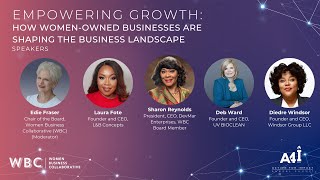
Empowering Growth: How Women-Owned Businesses Are Shaping The Business Landscape
WBC A4I 2023: CEO Excellence in Gender Equality and Diversity Awards Opening Remarks Day 2