WBCFasterTogether: The Role of Gender Equity in Companies of Purpose
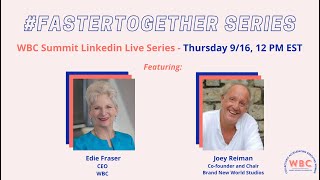
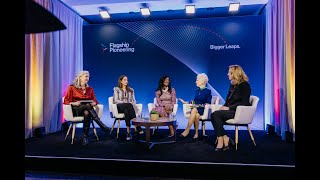
This is a recorded WBC "Faster Together" panel led by Gwen Young with Edie Fraser (WBC CEO) and Joey Reiman (author/consultant). The WBC is described as an alliance of over 55 women’s business organizations focused on nine action initiatives spanning leadership, underrepresentation, and equity (e.g., CEO leadership, women in tech, pay parity). The panel promotes the WBC Annual Summit (virtual, Sept 21–22, 2021), lists honored CEOs and trailblazers, reports over 3,000 registrants, and centers a broader argument that companies should lead with purpose (purpose + measurable action and accountability) to drive diversity, equity, and better workforce engagement—especially for women and women of color.
Questions this video answers
Over 55 women's business organizations.
September 21–22, 2021 (virtual).
Over 3,000 registrants.
Executives from BlackRock, State Street, Dow, Progressive Insurance, Walmart, Siemens, Procter & Gamble, and General Motors.
Gina Raimondo (Secretary of Commerce), Thasunda Brown Duckett (CEO of TIAA), Magic Johnson (CEO, Magic Johnson Enterprises), Indra Nooyi (former CEO of PepsiCo), Lily Ledbetter (activist/author), and Joey Reiman (founder/CEO, Brand New World Studios).
Good afternoon and welcome to the WVC series Faster Together. We are thrilled to have you here with us this afternoon. The Women Business Collaborative is an unprecedented alliance of over 55 women's business organizations collaborating together to achieve equal position, pay and power for all businesswomen. It is the first business movement dedicated to equity and diversity and is comprised of professional women and men business organizations, public and private companies and the media. Accelerating change through collaboration, advocacy, action and accountability by uniting more than 55 of the leading women's business organizations and 400 champions, the WBC activates our vast network to attain immediate and long term results around nine essential action initiatives. The first three focus on executive women's leadership in business. These are CEO leadership and sponsorship of women CEOs, women in the C Suite and Executive Leadership with P and L Responsibility and Women in the Boardroom. The next three focus on underrepresentation of women in business. These include Women Entrepreneurs and Access to Capital, Women in Capital and Finance and Women in Technology. And the final three are critical to equity for women in business. These are Diversity, Equity and Inclusion, Gender and Pay Parity and Women in the Pipeline. Thus, our work focuses on ensuring more women CEOs in the C suite and on boards and demand for gender and pay parity, increasing access to institutional capital and capital for women entrepreneurs driving more women as controllers of capital allocation parity for women in underrepresented business sectors such as technology and leveraging learning and development to drive pipeline promotions. Interwoven across every initiative is our call for inclusivity, diversity and equality for all women, including of women of color, the LGBTQIA community and disenfranchised women. Our collaboration and network is spearheaded by our board partners, Advisory and Leadership Councils. The WBC reaches millions of business leaders across the United States and the globe. The WBC is committed diversity. Our councils and Board of Directors include more than 34% people of color. It is this power of combining the collaborative approach with our women's business movement that's already creating momentum and accelerating the pace of change for business women. We are here today to talk to you about what we do, who we are and where we are going. But first we invite you to join us for our third annual Summit in September to hear how we are accelerating the pace of change. Our summit, Empowering through Gender Equity and Diversity, is scheduled to take place virtually September 21st and 22nd. The summit will recognize two key groups. The first is eight CEOs of some of the largest companies in the Fortune and Russell Indexes who are leading the charge to advance diversity, BlackRock, State Street, Dow Progressive Insurance, Walmart, Siemens, Procter and Gamble and General Motors. And we are also recognizing six trailblazers whose leadership and innovation have created new pathways to change their communities and beyond. These include the Secretary of Commerce, Gina Raimondo, Thasunda Brown Duckett, the CEO of tiaa, Magic Johnson, the CEO of Magic Johnson Enterprises, Indra Noi, the former CEO of Pepsi, Lily Ledbetter, activist and author, and Joey Ryman, here with us today, founder and CEO of Brown New World Studios. In addition, you will hear from key partners and champions and sponsors across the WBC and across industry and sectors on how to best create equal position, pay and power for all business women. This includes topics ranging from De and I to how to build better leadership across technology and healthcare sectors, to building the movement and companies of purpose. Today, we are thrilled to speak with our CEO Edie Frazier and Joey Reiman, co founder and CEO of Brand New World Studios. Joey is receiving a WBC 2021 Trailblazer Award. Welcome, Edie and Joey. And Joey, congratulations on your award.
Thank you. It's thrilling. Thank you so much. And thank you, Edie.
Thank you. So, Edie, we're less than a week away from our annual summit. Can you tell us a bit about what to expect at the summit?
Thanks, Gwen. And a warm welcome to Joey Reiman. To all of us. When you talk about inclusion and aggregation and acceleration and action, that's what we will see culminating in our WBC Summit starting on Tuesday afternoon. We have just reached over 3,000 registrants today and we hear from all the companies attending how they perceive this as a giant learning and development experience for their networks and for their associates. And we hear it from all of our organization partners, and we hear it from our advisory and leaders that we are together in unity as we collaborate to demand and to act and to drive change. And how pleased we are, Joey, that you are the essence of what was corporate social responsibility. And now you say corporate social opportunity.
Right? It's sort of like I also say that the Fortune 500 are now the Fortunate 500 because they have the opportunity to expand their orbit of caring, to include all stakeholders and make the world a better place. And congratulations to UEDE and WBC for being an incredibly purposeful organization. I mean, it's truly an honor. And I think you're providing an instructive spark of fire to so many people.
Like that spark of fire. And to all listening. I think you know that Joey, not only council CEOs has wrote the first book on companies of purpose is working on a film on companies of purpose. But he teaches at Emory University because he teaches us, as do companies every day, that our fear future depends on recruiting and retaining if we have companies of purpose. So, Joey.
Yes. Well, let me start with my favorite quote throughout my entire life, which was from Mark Twain, and it sort of sums up the power of purpose. Mark Twain said, the two most important days of your life are the day you're born and the day you find out why. And my purpose is to help people find out why and to have organizations focus not on their missions, which is what I do, not on their vision, which is where I'm going, but on their purpose, which is why I am here. And it has to be a lot more about than just money. It has to be about meaning. It has to be about purpose, not just profit. And there's a whole slew of new nomenclature that goes along with that, which I'm thrilled that companies are now using. And one of my favorite is that favorites is that companies are now moving to focusing not just on income, but outcome. What is the outcome of my purpose in this world? And then the income will follow.
Joey, expand on that because it is so exciting to hear that from the CEOs that we're honoring. But as we honor CEO Indra Nui, who was one of the first companies that said we'll get more profit if we lead with purpose.
That's right. She was the first. And it was a woman being Indra Neui, I should point this out. Who was the first one to step up and say there's something bigger than hierarchies. We have networks. There's something bigger than controlling. What we need to do is be experimenting. We need to be experimenting, not just planning. And she's the one who also talked about that something was much bigger than the brand. It was called the stand. What do I stand for? So all of a sudden, we see now this sea change where we are going from the goal in my company to the role in society. And anybody in business knows that the market sizing of of society is bigger than the market sizing of your company. So I'm thrilled that we're moving from shareholder to stakeholder. But the bottom line is the biggest sea change of all is that we're moving from just a focus on life of our business to the business of life. And that's where business, that's where religion tried, that's where government tried. But I think business is up at bat now, and we're ready for It. I mean, there isn't a company I know that isn't either dabbling in purpose or taking tremendous action. And by the way, Edie, that's really important. The action part, purpose without participation is just parchment. And that's what lots of companies are learning who feel like, oh, it's a perfunctory to have this purpose. I'll hire someone to write a purpose, but they don't do anything with it.
Joey, you've been working with Fortune. We've been seeing the Business Roundtable come out with statements of companies of purpose, as they did on Black Lives Matter. And we've been seeing the CEOs that we're honoring at the summit, passionate of how the purpose goes back and relates to their employees and their suppliers and their communities in an integrated strategy. Tell us about that.
Well, first of all, that's the meaning of a collaboration. What I love about your name so much, not just Edith Frazier, but the collaborative is that's very different than cooperating. Cooperating is where everybody's got some one job that nobody else has and they're trying to work together. Collaboration is where everybody is coalesced around this central construct of purpose, and everybody is rowing in the same direction. And that's incredibly powerful. The result of that is the workforce turns into a life force. And you can't have anything better than a life force in your company. And what purpose does so beautifully is that once it's coalesced around, you're all coalesced around purpose. It creates an alignment. And alignment leads to my favorite new word in this new world, which is advocacy. We all become advocates of what we stand for. And in a sense, we become the marketing department, the authentic marketing department of the company. And by the way, that's important because millennials and gen Z, over 90% want to know what the purpose of a company is before they sign up with that company. That's wonderful. And boomers like myself, I've renamed them kaboomers because they've assessed and masked all this stuff throughout their lives, and it goes kaboom. They now want purpose, too. So we've got two thirds of this country focused on purpose. I was just at a grocery store the other day and I saw a sign where they were selling peas, and it said peas with purpose. So I think we've done our job.
And talk about that, because we just had Procter and Gamble talk about building their brand of purpose, as we said with PepsiCo. So where do you see that tied to about marketing? Once they've done the action and they're pushing results.
Well, I've told the CEO of P& G that for me, P and G stands for purpose and growth. That's what P and G stands for. Because in a way, and Mark Pritchard would say the same thing, they're a force for good and a force for growth. And they have been one of the most incredibly powerful and remarkable companies to embrace purpose and use it as the engine to that drive strategy. If you think about it, what they did for young girls around the Always campaign, when they ran that, it was run like a girl. They found out, and I worked with them on this, that girls during puberty, there's a window there where we can instill confidence in them. And if you miss the window, they never are optimized. So that learning will change. Women actually will propel women to do, to optimize themselves along the lines of excellence for generations to come.
And blackrock, Larry, Gwen Young and I want to make sure that we are standing up for the big change, and particularly women of color after Black Lives Matter. And what you and Gwen said is it's not statements. It is really about action.
That's right.
With accountability. All right, so what is our now message on the diversity and inclusion space as it's integrated into companies of purpose? What do you think?
I think it begins in grammar school. You know, the great psychologist Erik Erickson found that kids around 6 and 7 years old start thinking about what their sense of direction is, what their meaning in life is. That's unreal. So we need to start educating earlier and providing examples earlier, even in grammar school, so that our kids grow up so that they measure themselves based on diversity, cultural inclusivity. And that's where it begins. It begins with not so many dolls and more fire trucks. You know, I mean, it's not. It's unreal how we create in the beginning. We are creating the women of the future. And if they understand how powerful they can be, how nurturing they can be, how matriarchal they can be, then the patriarchal model will start to diminish. And I think the patriarchal model is, is really a dinosaur, antiquated, and it's nowhere near as supple, vulnerable, caring and emotional as a matriarchal model.
And I think we want to celebrate that the companies are taking particularly black and brown and diversity so seriously, looking at succession planning, looking at changing the numbers, making a commitment and giving the bonuses with a component of what they've done about both changing, of moving up women of Color, people of color, along with gender and making sure they're really creating that purpose. So I wonder if you have a final statement on that. And we'll turn back to Gwen.
Yeah, I think we have to create a culture of women who are valued. You know, somebody asked me the other day, what does that mean? I said, it means that you care about another woman. They said, well, what's caring? And I said, caring is to have a deep understanding of that woman in service of her growth. That's the definition. So we need to adopt that definition of caring and revisit employee, as you said, employee benefits and minimize, you know, it's been a tough, this tough year. We have to minimize meetings. I figured out that zoom leads to gloom. I mean, people are zooming left and right 24 7. It's crazy. So we have to minimize meetings. We have to provide external support. And again, and this is my message, final message, be caring. And know that caring is not opening the door for somebody or sending flowers. Caring is having a deep, deep understanding of another human being in service of.
Their growth, not my growth, the integration of that strategy. Joey, as we're seeing, not only the diversity reports put out about the talent achievements for women of color and people of color, but their contributions to HBCUs and to others as we've never seen in this society.
So that's so true, Edie. And I want to underscore that contribution part purpose is made up of two factors, my intention and my contribution. If I have intention without contribution, that's called impotence. If I have contribution without intention, that's called blindness. You need both.
And back to Gwen Young, WBC coo. Gwen.
Thank you, Edie. And thank you, Joey. It's been great to speak about how we're building this movement and accelerating progress towards diversity and equity and leadership and corporate purpose. So to hear more from our experts, thought leaders, to understand the data, understand the tools and best practices that are driving gender equity imperity, please register for our WBC Annual summit. You can find all the information on the WBC website wbcollaborative.org under our Events tab. We can have a Hop in link which you're seeing in your browser. We cannot wait to have you there. So that's all we have time for today. We'd like to thank all of you for joining us. I'd like to give again a thank you and a welcome to Joey Reiman and thank you to Edie Frazier for today. Invite your followers and friends to join us. And remember, register for the Summit. Join the WBC and follow the progress of the movement by following us on social media BCCollaborative on Twitter, LinkedIn and Instagram. Have a great Thursday.
It.
More from Edie
The Power of Purpose & Connection – A Conversation with Edie Fraser & Jan Duplain
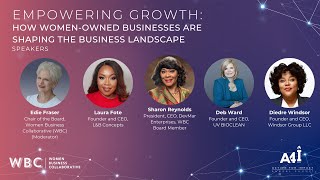
Empowering Growth: How Women-Owned Businesses Are Shaping The Business Landscape


WBC A4I 2023: CEO Excellence in Gender Equality and Diversity Awards Opening Remarks Day 2