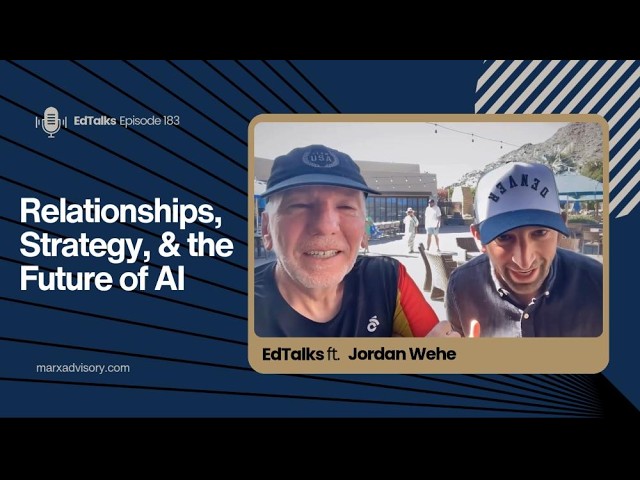
Jordan Wehe argues that chasing quarterly targets and demographic profiles misses the point. Build relationships with your best customers instead, focus on their actual problems, and use AI as a tool humans orchestrate, not a standalone solution.
Chapters
Hey, it's Ed and Jordan again with Ed Talks. We've had several in this series already, so you already know Jordan, but say hey, Jordan.
Hey everybody.
Jordan, you must be from Denver.
How'd you know? What gave it away?
There's nothing like Colorado. Our family, when we first came to the United States, settled in Colorado. So you all actually stayed.
We stayed. And I like to wear this hat because it, it, it reminds me that I turned the perspective upside down.
Yeah. Yeah. Love that. So we want to talk today about relationship because we've been talking a lot about marketing and chief marketing officers. And one of the things we also see in the industry, both in healthcare and other industries like what you're in, is maybe not enough focus on the relationship, more about the immediate sale, which I get, right? We have quarterly results, we're trying to meet expectations. So a lot of pressure to make sales. But in that process, I think sometimes we ruin relationships. And Jordan, I just want to start off with one quick story and then get your take on it. But I recall This one guy, I'm going to call him out. His name is Mark Stello. He's still around. And he's the ultimate example of this where he was a salesperson for us. This was going way back early in my career and he wasn't getting the sale, but he stuck with us, right? For years, Mark was, we used some of his products, but he wasn't getting the big, big deal. And for years he acted as if he had the big, big deal with us. He just showed us immense respect. He showed us immense, uh, as I put it, love, attention. And about 5 years later, we went to market for a big deal and guess who got the big deal? Mark, Mark and his company. And had he been obstinate or what a traditional maybe marketing sales program may have been like and forgot about us, probably wouldn't have gotten the deal.
No.
So it really pays to think long-term and have a relationship. So Before I go on, because I could talk a lot about this topic, just get your perspective on the importance of these type of relationships.
I, yeah, it's so important. I, I'm a marketer. So I think in terms of net promoter score, NPS is what we call it in the industry. You know, on a scale of 1 to 10, how would you rate your experience? 9 to 10 promoter, 7 to 8 neutral, 1 to 6 detractor. And what I find really interesting in the results of net promoter scores is not only do promoters promote your business.
Yeah.
Hey, I love working with Ed. Hey, I love working with Jordan. You know, definitely get internet from Jade. Those types of things, but they're also the most likely to forgive.
Yeah.
To forgive. You know, we're not perfect. We're gonna make service failures, but they're the ones who are most likely to say, you know what, Jade is great 99% of the time.
Yeah.
Ed is great 99.9% of the time.
Yeah.
And this is just a fluke.
Yeah. Well, maybe for me it's 90%, but, but yeah, I, I, I think back actually to scripture. It talks about love. Um, love is really about covering a multitude of sins. And I think about that in terms of relationships too. Like relationships cover a multitude of sins because we will make mistakes. And if you have a good relationship with your client or prospect, it'll really pay off. It'll pay dividends. So I, I just think here, we're actually at JW Marriott and Camel— the Camelback in Scottsdale. And we had a service failure when we showed up. I was bragging how great this place is because I come here quite a bit. And sure enough, we couldn't get in. You know, the door was busted, nothing worked. Security came, they couldn't get in. And for some reason, the GM was in the, in the cart, like with one of the security people. Bob. Yeah. His name's Bob. And, and he felt horrible and I was telling him, yeah, this is, and we had a nephew with a grandnephew with us as well. And so he wanted to make up for it. So we were like, uh, he's like, what do y'all want to do? We're like, hey, we're hungry. So we, he treated us to a really nice meal.
Yeah. The signature lunch. Yeah. Yeah. It was amazing.
And then we came back and we got a new room and it was all, everything was ready. Our luggage was in there and And that, that was a great— this is all about relationships, right? We would not dish, you know, that experience. We actually talk about it in a positive way, even though it was negative.
Yeah. You know, 3 years from now, I'm not gonna remember the door not working.
Right.
What I am gonna remember is, hey, Bob did really, really great at knowing our names. Yeah. Understanding why we were here, knowing that no one wants to start their vacation with the door broken.
Yeah. Right.
Right. And then making sure that we could reset quickly. And move forward.
Yeah. So as a marketer and in sales, I just always encourage everyone to really think long-term about these relationships because maybe that person that is not an ICP, ideal customer profile, but maybe someday they will be, or maybe they are your ICP, but they're not buying right now, or they bought from a competitor. It's okay. Don't ignore them. And I've seen that happen a lot. I've seen it happen a lot to me. I was a buyer for over 20 years at various Uh, health systems. And I saw that happening. Like, they would just, you know, turn away and treat me like, you know, I had Ebola or something.
Yeah.
And, and so I, and then I felt like, man, I never want to do business with them. And sure enough, I can give you examples, the counterexample to the Marcella one. And so it's really important that you treat everyone like a human and, and treat them as if one day maybe they will be a customer.
Yeah. Yeah. I like what Dan Peep says. Dan Peep, very famous author on sales marketing. He says, I'm not looking to get someone to buy a car today. I'm looking for them to buy their next car from me.
Yeah, exactly. Yeah, I love that. And I want to talk about, you know, stop targeting people and start targeting pain, because what I found out, and I'm sort of new to this in the last few years, where I've always been very familiar in helping chief marketing officers, like within health systems, but now I'm doing that with vendors on the vendor community. And, you know, I was chief digital officer for Tech Mahindra for many years. And then CEO of a healthcare consulting firm. And so I was working very closely with CMOs and again today with many, many CMOs. And we're always talk— we're always like fixated on ICPs, ideal customer profile or personas. And now we're kind of thinking, hmm, maybe that time has passed. Maybe we should be looking at it differently. What do you think?
Yeah, I think you should still use those ICPs, those personas. That's not a problem. The problem is though, is we're, we're losing Um, we're, we're misdirecting our focus.
Yeah.
Not on actually the person, but the problem the person faces.
Right.
I think about this like if I was on a run and I ran up on, you know, somebody and they were in a ditch, I'm not gonna start talking to them about my comp— my company values.
Right.
Oh, by the way, I, uh, integrity, honesty. That does not help them get out of the ditch.
Right?
What I need to do is help them become the hero of their own story and get them out of the ditch. And so maybe I want to talk about how I have a ladder. Yeah. And a ladder can help them get out of the ditch. And maybe I talk to them about water and I can make sure they don't die of heatstroke.
Right.
We're in the Arizona desert right now. So I'm thinking about that or an umbrella or something that make the pain of being in a ditch less painful.
Yeah. Yeah. No, I, I agree with that. And the other thing that I always think about is sometimes we get so fixated on that ICP, that ideal customer profile or persona, that I think we lose a lot of opportunity because people change. Um, sometimes our, the parameters that we put on, like it has to be a, a revenue of this many or a bed size of this many or whatever the profile might be, that we miss a lot of opportunities.
Yeah.
So we get like too specialized maybe, and, and we, we miss the, The other opportunities that lie out there if we would just broaden our scope a little bit.
Yeah, I mean, the marketing term you're referring to is called niching down.
Yeah.
So like, you'll hear this a lot in marketing circles, like niche down, like understand your niche. That's a good thing to do, but you actually need to problem up.
Yeah.
You need to figure out what problems you're solving for in that niche and then bring that to the top of your messaging so that you can bring people through the funnel and they can make a purchase decision and move through the journey with you helping them solving their pain.
Yeah, makes total sense. And then I, I always try to get everyone too to think long-term. So maybe short-term they don't fit that persona, but people move on, people change, or those companies change or their needs change or the, the hospital needs change. And they indeed may now be your ideal customer, but you overlooked them because they didn't fit your parameters. And so I think that shortsightedness oftentimes hurts us.
Yeah. Figure out, I think what it is, is like figure out what problem you're solving for.
Yeah.
And if there's not a real problem, you need to move on.
Yeah. It's always great to get Jordan's perspective because, uh, he has MBA out of DU, Denver University, and just a great marketer and won, you've won a bunch of marketing awards actually outside of healthcare. You've won a bunch of awards.
I have. Yeah. I've been really grateful. I have a great team, but my expertise is taking small companies and making them really famous.
Yeah.
So that's what I've done. I took my small family company. And made it an international, uh, sensation in the industry. We're very well known now because we're a David and Goliath story. We're taking on these huge giants.
Yeah.
So here's the topic. Is AI a bubble?
Man.
We hear all the time about AI companies or companies claiming to be AI companies, but what value are they actually bringing to the table?
Right. Yeah. Are we overhyped? And I always think about the hype cycle, right? And I think we're, You think we're at the top of the hype cycle coming down or still climbing up?
I think we're still climbing up.
We are too.
Yeah. You know, I see LinkedIn is like the epitome of AI hype cycle because everyone's using ChatGPT to write their posts.
Yeah.
And it all sounds the same and it almost makes LinkedIn unbearable.
Yeah.
Now.
I gotta speak to my friends on LinkedIn. It's obvious who's using AI and who isn't. Stop. If you are, please, please stop. It's Very easy to identify. And frankly, it kind of turns me off. And it's the same with companies that are just using AI as a front and not really using it to truly transform.
Right. I mean, it's that the basic principle of marketing is authenticity. Like, be authentic to who you are. And there's great brands that have done that. There's also brands that haven't done that. I think of Bud Light, for example, who hired that Dylan dude and their entire customer base Revolted against them and alienated them. That's what people are using AI right now for, and they're alienating people who they've built trust with over the years.
Yeah, yeah, yeah, yeah, totally, totally with you on that. Yeah, and I have great hope for AI. This is the hard part of the conversation for me, is that especially in healthcare, and Jordan actually knows healthcare quite a bit too because of some early career stuff that we were able to do together. Well, we've talked about before, so we won't go back there, but I have great hope that it truly will transform, and I've seen a lot of great benefits so far. And as you know, Simran and I, his godmother, uh, wrote a book together recently called The AI Empowered Patient. And so we're seeing progress already. Uh, but yeah, are we, are we still climbing that hype cycle? That's the big, big one.
Yeah. I mean, I think AI right now is like the, the best use case right now is like chatbots, unfortunately.
Yeah.
Which was, it's not a new technology. We've been having chat on websites and software programs for what, 20 years?
Yeah, it's been a while.
I mean, maybe it has better indexing or database lookups, but I would really like to see AI be integrated at a platform level to deliver actual results for the end user.
Yeah.
Like, what's your ideal use case?
Yeah, I agree. Right now, it reminds me, for those who've been around in the healthcare industry for a while, it's probably like that in other industries where you had a lot of point solutions. And then it was a terrible experience for both the customer as well as the companies To have all these different point solutions to try to integrate them and things like that. And I see that today. It's like everyone's got the best AI solution for X and Y and Z, but they don't talk to each other. Or if they do, it takes a lot of knitting to put it together. And I think we really need to get to a platform, like an orchestration, if you will, of these AI capabilities. And I think that's when it really, the acceleration will like go out of the, out of the country, out of Europe, out of, you know what I'm saying?
Yeah.
Yeah. Yeah.
So that agentic AI, now you brought that up, right? I envision a future where like we're running, uh, or we're orchestrating agents to all accomplish similar tasks for that end user experience. But right now there's, like you were saying, this side, Agent A, Agent B, Agent C, but they're all doing their own thing and they're not integrated.
Yeah. I get approached all the time with companies, startups, where they want some advice and I'm always happy to share advice with people and they have a great, great point solution. But it'll never get wide adoption because it just creates ultimately a bad user experience. Again, both for the clinician or the enterprise, as well as the patient and their family, because who wants to go into 20 different apps to get cared for, right? We want sort of like one platform. And I think, like we're saying, we're sort of still climbing the hype cycle and we're going to go into this trough of disillusionment when people realize, wait, I can't, I don't wanna have all these different apps that I have to use. And then ultimately, we'll have a platform emerge that will bring everything together and enable these great experiences.
Yeah, I hope so. I really hope that's the case. So is AI a bubble, Ed?
Boy, that's a hard one. I wouldn't say a bubble, no. So I'll say no. Oh, I'll make a hard no. It is not a bubble, but we're definitely early stages and It will, we will see the promise of AI in the next several years, but it won't be tomorrow.
Yeah. Yeah. I think—
So are we in a bubble?
Uh, yes, I'm leaning more towards a yes right now. Yeah, that I'm very optimistic. I think we could use AI to do a lot of great things and accomplish more with less. And, you know, all the promises of AI, right? But actual intelligence, as Steve Wozniak said in his most recent address, is going to be way more important than artificial intelligence.
Yeah.
And how to leverage actual human intelligence to orchestrate all the AI agents together and bring them together to create harmony for the end user and for the user experience.
Yeah, I love that. I think that's a good way to end. Actual intelligence.
More from Edward


EdTalks | Episode 185 | The Power of Executive Storytelling | Clifton Blue Parker



EdTalks | Episode 184 | What If Being a Misfit Is Your Superpower? | Kevin Johnson