7 Limiting Beliefs Holding Back Video Agencies in 2025
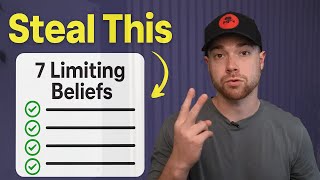
YouTube video by Master Filmmaker (Eric Deeran) summarizing the top seven limiting beliefs seen across ~10,000 sales calls with video business/agency owners. The speaker lists and explains seven common mindset barriers—overinvesting in craft over systems, framing creativity vs profitability as mutually exclusive, blaming oneself for lack of leads, believing harder solo effort substitutes for systems, identifying as a freelancer rather than an agency, expecting marketing/sales to feel easy, and tying self-worth to every lost client—and offers reframing and systems-focused remedies.
Chapters
Our company, master filmmaker, has Talked to over 10,000 video business owners, booked 10,000 calls with different video business owners, video agency owners, and in today's video, I have compiled, with the help of ChatGPT, a list of the top seven limiting beliefs that video business owners and video agency owners have that's keeping them stuck in their video business. And if you're wondering how I did that, well, transparently what I did is I simply just took the transcripts of those 10,000 calls and I uploaded those into ChatGPT and I said, hey, give me a list of the top seven top limiting beliefs that video business owners have. And I made a note, and I have my own notes on this. So I'm gonna be looking over here and giving you guys those top seven limiting beliefs. We're gonna be talking about that today. So limiting belief number one is if I just keep refining my craft, the business will come. This is one of the biggest limiting beliefs, and this is why it's number one. And to be honest with you, making better work doesn't get you more clients. I see. And because we've talked to, I haven't personally talked to 10,000 people. I have a sales team of people that talk to or have talked to 10,000 people. But what we see is people think, well, if I just get better at, I just keep making better work, like, the clients will come. And some of the most talented people we talk to are often some of the most broke people. And that's where the mindset or the stigma or stereotype of starving artists came from in the beginning. Because you're really good, but you don't know how to actually monetize that skill and make money from it. And so if you're in that head space of like, hey, if I just make better content or if I just refine my craft, I'm gonna get more work. And that may get you a couple referrals, but it's not gonna help you actually grow the business. Cause the business's systems and its automations, and it's one part fitting into another part. It's not about how beautiful the pieces of content that you create are. Now this leads me into limiting belief number two. I have to choose between being creative and being profitable. If I choose to run a business, then my business is just gonna be this inputs equals outputs, boring cog machine. And this is one of the other big ones we get. And ultimately, it doesn't have to be that way. You can have a business that creates amazing content, but also is super profitable. It's not a one or the other type situation. It also doesn't mean that you're a sellout. I think a lot of creative people sometimes think, oh, if I monetize this, if I put prices on this, if I do it this way, like I'm going to become a sellout. And building a profitable business for you and your family is not becoming a sellout. I mean, if it is, then maybe we need to redefine what the word sellout or the phrase sellout actually means. But it's not selling out. What it means is it's you're actually giving yourself space to be creative now. Like, you're not putting yourself in a position where you're like, I am starving for my last dollar and I have to take any job that comes my way because I literally don't have enough money to pay my bills. It puts you in a place when you have abundance and you have enough money coming in, you can actually be more creative. It's why people say when you're bored, you can be more creative because you have the space to actually think. And when you have money coming in and retainers coming in and a consistent system bringing you leads and calls, you can actually sit back and relax and say, let me actually think about what I want to create, not what I need to create. The third one we get is if I don't have leads, it's a me problem. And that's not necessarily the case. You can't tie your self worth to how well your business is doing. It just means you don't have the right systems or the right processes or whatever built into the business. It means you don't have the right blueprint or the right cheat code. Right. Or the right process to follow. Like you could dig a hole with a shovel or you could dig a hole with a backhoe. Like if you're digging a hole with a shovel and then you're looking over at people who are digging holes with backhoes, you're going to look at yourself and be like, it's me. Like I must be the problem. It's like, no, it's just the tools that you're using are not the right tools for the job. And it's the same thing with getting leads. Like relying on referrals and word of mouth and, and, you know, clients to send you other people is just the wrong tool for the job to actually grow to the point that you want to grow to. It's not you, it's. It's the systems that you don't have. So don't tie your self worth to the, you know, inability to get leads or build your business because it just means you don't have the right tools. And the good thing about that is you can actually fix that problem. You can get the right tools, you can get the right systems, you can learn the right skills to get to where you want to be. It doesn't have to be that way. The fourth limiting belief that we have is I can get this on my own if I just try harder. I can't tell you how many times we hear this. People will say, even though I've been doing this for two years on my own, if I just keep pushing harder, then, you know, I'm going to figure it out. And I'll go back to the example of digging a hole with a shovel versus a backhoe. And the shovel is if I just keep digging harder, I'll get there versus, let me switch to using a different tool and use a backhoe to actually start scooping out dirt, right? You could try really hard, but. But working harder in the business doesn't mean you're gonna get better results. And that's the unfortunate truth about it. You have to be working hard with the right system. And when you're grinding it out with referrals, when you're grinding it out with more calls, when you're cold calling people, as opposed to just like setting up an inbound ad system, having people book on your calendar, you could work ten times as hard as me, but if I have an inbound system and you don't, I'm gonna get 10 times the output as you, even though you're working 10 times as hard as me. And so I can do 10 times less work, get 10 times more of an outcome. So simply because I'm using the right tools and I have the right system set up and that's running ads, getting people to reach out to me, not me reaching out to them, right? Having people with intent reach out to me. Not cold calling, cold, emailing, DMing them on Instagram, looking desperate, looking needy. Like when you have a system where people are just raising their hand, expressing interest, and saying, hey, I'm interested in working with you, then you have a system that can scale and you have a system that you're not pulling your hair out every single time you need to talk to somebody because they already raised their hand and said, hey, I want to talk to you. Limiting belief number five. I'm just a freelancer. Why would anyone pay me monthly this identity shift is what's blocking you from actually getting more retainers and scaling your business. And so if you're in a place where you're like, I'm just a freelancer, you have to switch the mindset. You are not a freelancer. You are a video agency that's going to help somebody create content, grow their business. And you are an agent. You have to think of yourself as the trusted consultant. You're somebody who's consulting them on the media that you're going to create for their business to help them actually grow their business. So you have to think of yourself that way. And when you change the identity, you, you change into a place where you can actually charge for retainers. Limiting belief. Number six, marketing and sales should feel easy and organic. And if it's hard, it means it's salesy. And systems just feel so salesy. And here's the problem with this one, the problem with this one is that it has the assumption that everything should be easy in your business. So when it's not easy, you give up. And we see this too many times, like running a business is not easy. Sometimes you're going to be met with resistance. And typically the more resistance that you have, the more likely you should be on that path. Because most people will take the easy route. They're gonna be lazy with their marketing, lazy with their sales. They're not gonna. Objection. Handle people on the call. They're not gonna go deep and try to actually uncover pain points in the call like, because they feel like as a creative that's salesy. When in reality, if you truly believe that you can help somebody with your content, you will do everything in your power to help them get to that outcome and get them to become a client with you. It's only when you kind of half ass or don't really believe in your product or your services. When you're like, I'm not gonna really push that person. I'm not really gonna like make the effort to, to close them or help them overcome their beliefs or help them understand why this actually is a fit for them. And when you get into that mindset, it puts you in a position where you're like, I don't really believe in what I'm selling. You're going to have resistance. It's always going to be more resistance than you think it will be. That's just the way it is. And so you have to put yourself in this mindset where like, hey, if I'm getting resistance, it just means I need to push a little bit. Harder or I need to change up my strategy or I need to look at the way I'm doing things right. It doesn't mean that it should always feel easy and organic all the time. That's just not how life is. It's not realistic. And finally, limiting belief number seven is if I don't close this client or this project, then it means I'm not good enough. And this ties back to one of our other limiting beliefs. But you can't put yourself in a position where your self worth and I personally struggled with this when I first started. I'll be honest with you guys. You can't be in a position where like your personal self worth is tied to whether or not you close the deal, if a client leaves you or if a client doesn't close with you. It doesn't always mean it's a personal thing. It usually doesn't mean it's personal. It just usually means that there's something that went wrong within the sales conversation, the client delivery. And you want to take an objective approach to looking at that and saying what could we have done better here? How could we have displayed our value better? How could we have, you know, mapped out the client journey so it was more seamless? You have to approach business as a non emotional game and as you know, creatives and people who are very emotional and get inspired with passion, which is an emotion, it is very difficult to sometimes turn that part off your brain and you have to, to be successful, to be a successful business operator. I personally struggle with this in the beginning where I'm like, I get so emotional with every single client and you know, it just, it, it wrecks me internally. It's very emotionally draining. You have to get to a place where it's logical and if a client leaves you or if a client doesn't close, you say okay, what, what specifically led to that decision? What are the logical points that caused that issue? And then how do we just fix those problems? Because at the end of the day, business is just a, it's a theory of constraints. It's like what is the problem? What is constrained? How do we alleviate that and, and get flow through the business? And that's ultimately what it comes down to. So hopefully you guys enjoyed this. These are the top seven limiting beliefs that we have seen over 10,000 plus calls that we've had with video agency owners. So hopefully this helps you. And if you want to learn more about what we do at Master Filmmaker, go ahead and book a call below and we'll let you know if this is a fit, if we can actually help. And if not, keep enjoying the free YouTube videos. We'll see you in the next one.









