Breakdown: Scaled Video Agency From $70K/mo To $208K/mo in 4 Months
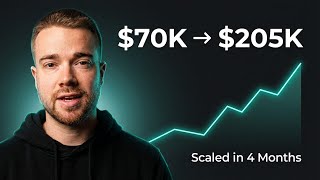
Eric Deeran shows how Hassan's video agency scaled from $70K to $208K monthly in four months by installing proper ad tracking with Hiros, filtering Facebook leads with conditional logic, doubling prices, replacing underperforming sales reps, and carefully increasing ad spend while targeting $300 per booked call.
Questions this video answers
Scaled from ~$70K/month to $186K/month (in ~90 days); then ~205–208K in September (month).
Hiros.
About 40% qualified / 60% unqualified (before changes); target stated ~85% qualified / 15% unqualified.
About $300 per booked call (target to hover around this number).
Prices were doubled in August/September, with plans to double again in October.
Chapters
Today's video, we're going to be talking about how we helped one of our clients, Hassan, hit 186k in one month. And that was in August. And now in September, which it's October, at the time of this recording, he hit a total of 208 to 205k in revenue. And this is inside of his video agency. So in today's video, we're going to be breaking down exactly what we did step by step, getting into the nitty gritty of how we did this and how you can do this as well, so you can take some nuggets from it. So let's jump over to the iPad. I'm going to break this down for you guys. So this, this is Hassan. He scaled from 70k a month to when he started with us, all the way up to 186k a month in 90 days. And then this was in August right here. And then in September, this is his monthly revenue. He hit around 208 to 205k right here in the month of September. And so I'm gonna break it down on what we actually did, how this worked, and how you can start implementing this into your video agency as well. But hopefully this is helpful. Hopefully this, you guys get some gems from this video. So, number one, when he came to us, and Hasan's worked with other coaches, other people in the space, and everybody has value to add, but there were some key issues that he was running into when he was trying to scale to 200, 250amonth. So, number one, we had to implement tracking. So they had some tracking. But before he had no tracking for ads, we had no sort of attribution of where the leads were coming from, what sort of journey they were going through, how that looked. So we implemented something called Hiros into his tracking so we could start seeing where everything was coming from, so we can make sure that we're getting him the best possible results with the ad dollars that he is paying for. And so Hasan came to us, he was already running some ads, but they were not working very well. And when I dove deeper into the quality of what was happening in the ads, the main issue was that he wasn't getting good quality. So, like, typically we're looking for an 85% qualified lead to a 25% or 15% unqualified lead. If we look at the total of the amount of leads. So if you get a hundred leads, 85 of them should be qualified and 15 of them should be unqualified. Iffy, you're never gonna get 100%. That's just not how it works. But for him, he was getting like 40% qualified, 60% unqualified. So he was getting a lot of bad quality leads. And that was a big issue for him. So what we did is, and then we were also looking at it. His sales team was burning out because they were talking to a bunch of unqualified people that couldn't afford their packages. And so they were just kind of churning through tons and tons of volume and not really getting anywhere very quickly. And they were kind of spinning their wheels at 70k ish a month. And so what we did is we implemented a full tracking software. We used something called Hire with him, we looked at where everything was coming from. And then we basically, and I'll talk about this in the next point, we basically got him better leads and better lead flow with optimized conditional logic within his ads. So we basically said if somebody is this person, kick them out. If somebody is this person, let them continue and continue to book a call with his team. Now the next thing we did is once we did that, his close rate actually went up because they were talking to more qualified leads and they needed less calls to hit higher amounts of revenue. So going into our next point, the next thing we did is we actually implemented conditional logic. They had no conditional logic on the lead form. So we implemented conditional logic into the lead form so he could get better quality results and then we could train the pixel on better quality leads. Because at the end of the day, Meta's pixel is a machine learning algo. So it's a machine learning algorithm. So whatever you're feeding the pixel here is what you're going to get more of in the ads. And so if you're not feeding it good quality data, then you're not going to get good quality data back. So you can't let any, anybody who becomes a lead hit your pixel because then it muddies the pixel and makes it look really, really bad. Right? And then it goes after lower quality people because it just wants to get you the cheapest quality result on ads, if that makes sense. So what they were doing is they were running an ad to a form to a call, and they were letting everybody in, Joe Schmo come in and just book a call. And this is the problem with what I see a lot of other coaches teaching nothing against them is they'll teach DM ads, right? But the problem with DM ads is you have no way to filter the right quality person through and you can't get any sort of leverage on higher quality leads because you can't filter people out. Anybody can DM you when you, when you run a DM ad. And that's why I don't prefer that. His old coach, I'm not going to say who it was, suggested that kind of ad running, which I just don't prefer. So then we switched him to a Facebook lead form and then we basically put conditional logic into the lead form to get them better quality results. And that way we can filter out people who don't, who aren't good quality from hitting the Pixel and, and scheduling a call with him. Right, so this is what that looks like. So basically we do a ad to a. But we have conditional logic questions in here that filter people out if they answer a certain question. So let's say like you don't want to work someone who is making less than 30k a month. We can say, how much are you making? 0 to 30, 30 to 60, 100 to 200, whatever. Right. If they select 0 to 30, they get DQ'd right here. And they don't even get to submit the form. And it doesn't, it doesn't send this data back to the Pixel. Now if they do complete the form and they answer all the questions and they are qualified, they're allowed to schedule a call and, and that increases our close rate because we're talking to more quality people. And then they, we send this data back to the Pixel to optimize here and then this becomes just a positive feedback loop where you only get good quality. You send that back to the pixel and you do that over and over and over again. So that fixed his lead flow which got them a higher close rate. But then the next problem, and before I move on, I guess that the main thing this helped with is it increased his call efficiency and increased his average deal value. So because he was talking to better prospects, they would close quicker and for more money because they were better people. And I think a really good point that I want to stress is like the quality of your business is determined by the quality of your customers. And if you have shitty customers, you're going to have a shitty business even if you do everything right. I was talking to one of Hasan's not competitors, but they're based in Canada. I won't say who it was, but this company specifically, they only charge 2,000amonth for their social media content services and they work with literally 100 clients a month to hit 180k a month, which is a lot, that is a lot of clients. They pump out 1500 to 2000 videos per month. And so they have to get really good at systems because they're working with all these clients, but none of the clients are really high ticket clients. They're all kind of like low tiered clients who are, they're just not the best types of people and it makes their job super hard. And so like remember this, and this is going to go into our next point. But like the quality of your business is determined by the quality of the clients that you work with. And so by just simply increasing the quality in the lead form, we got better efficiency and increased his average deal value from there. And that means less calls to make more money, which is great. Now this is the big thing I was talking about before is we raised prices and so they, Hasan was running into an issue where they had too many clients paying too little, which caused operational constraints. Which means if you have a bunch of clients not paying you a lot of money, you don't make a ton of margin on it, you don't make a ton of money, you can't hire a players, you can't hire the right people. And so you're kind of stuck in this loop where you have these operational constraints because you're basically just serving everybody and anybody. And then also client results suffer because you're having to serve all these different types of people. And so what we did is we just simply doubled his prices. We're actually doubling the prices again in October to help him get even further in monthly revenue to hopefully hit 300, 400 this month. 300 400k this month by simply doubling the prices again and, and basically filtering harder on the lead form to get even better quality across the line. Now when we doubled this in August, September, he got less clients but they paid more and he had more pay in fulls up front. And so previously he was getting a of pay plans. They were getting a lot of people who put no money down. And then his average cash per close was very, very low because people would only pay like the first month of a six month agreement. Now that we have better quality, more people are paying in full for those six month agreements, which is huge because if you can get more, more cash up front, it makes it a lot easier to scale the business because you're getting paid, you know, 40k pay in fulls. I know last week he had a 40k pay in full. Someone literally just paid 40k on a card. And I would ask you, as a video agency owner, is like, when was the last time you had a client just pay you upfront? And like, if it doesn't happen that often, there's a problem within your process to do that. So we raised prices. Number four, we fixed his sales team. When he came on, we audited a lot of his sales team's calls. And there was one person in particular who just was not good. He was not a good rep. And nothing against this guy, I won't say who it is, but this person on his team was just not, not skilled for the job. There was a lot of issues with the framing in the call, the discovery, the pitch, and it just, it really, really hurt him because he wasn't closing enough deals. And so we cut this underperformer, we fired this person, and then we replaced them with higher, higher skilled salespeople and the close rate went up. Right. You have to have really good people on your team. And then finally we just increased ad spend. And so now that we fix those other precursor things, we increase the ad spend. You can't increase the ad spend until you fix the foundations within the business. And so we simply, we increased ad spend. And really all you're doing when you're doing this is you're looking at what is your cash per booked call. So let's say that you do $100,000. If I can draw today $100,000 in a month, and you take 20 calls to do that. If we do the math on that, we simply do $100,000 divided by 20. That means your average cash per call in this situation is $5,000. So every time you book a call, you make $5,000. Now that doesn't mean you close every single call. It just means the total amount of revenue divided by how many calls you booked. Right? And so that's $5,000, $5,000 per call. So then if I spend $300 per booked call, what I make in the business is the delta, delta between these two numbers. Does that make sense? Like, like you have to look at these numbers and like he did not know these numbers before he came on. And most people don't know these numbers, which is why they can't scale. You have to know what does it cost you to book a call and then how much do you make per call? And we want this number to be as high as possible, this cash per booked call number. So that's super, super key. So then once we know these numbers are good, then we simply increase ad spend and make sure that this cost per call holds within KPI. And so we want to make sure that we still hover around the $300 cost per call, which we are. And we're continuously increasing ad spend every single day to $1,000 a day, $2,000 a day, $3,000 a day, $4,000 a day. And then as long as the sales team can handle the call capacity, then we can continue to scale. And then once you reach call capacity with your closers, you hire another closer. We train them, we ramp them up to KPI, and we do that. Rinse, repeat, rinse, repeat, rinse, repeat. This is how you do $1 million a month. It's how you do $500,000 a month. And it's how Hasan did $200,000 a month last month. So hopefully this is helpful for you guys. If you want to learn more about how we can help master filmmaker do this for you. And you have a business, video agency or creative agency or studio and you want our help, just click the link below. Schedule a call with our team. We are not cheap, I will say that right off the bat. But we do get our clients results and hopefully this is helpful. We'll see in the next one.









