Building A $40K/Mo Video Business For A Stranger In 9 Minutes
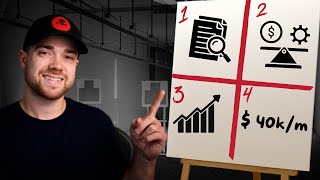
Eric Deeran presents a case study of a client, Brandon, who moved from a full-time job to running a retainer-based video business that reached ~$40K/month. Eric explains the three core steps he used: (1) craft high-ticket retainer offers (3-month $12k and 6-month $22k packages, pitched as pay-in-full), (2) generate qualified leads via targeted Facebook/Meta ads plus organic social content and a funnel with conditional lead-form logic, and (3) optimize sales (qualification, a 62% close rate reported) and then focus on ascension/retention to maximize LTV and scale. The video includes concrete ad metrics, pricing, and operational tactics and ends with a CTA to book a call.
Questions this video answers
January 2025
55 leads
27,000 people reached
61,000 views
$35.70 per lead
Chapters
I took this creator from $0 a month with a full time job to over $40,000 a month. And in this video I'm going to show you exactly what I did and exactly how I did it. Now if you're new here and you don't know me, my name is Eric Diren. I work with creatives and video business owners to help them scale their business and actually make more money doing something that they love. And in today's video I'm going to break down exactly what I did and exactly how I did it. So then hopefully you can get value from this and implement this in your own video business to help scale your video business to whatever height you want to get to. So this is Brandon, one of my clients. He works specifically with home service companies and he came to me. Well, Eric, I want to grow my business, but I'm in a full time job. I don't know how to get out of that and make enough money to actually leave the full time job so I can grow the business. So the first thing we did, stage one per se, what I did with him is we actually crafted an offer, right? So we figured out now who exactly are we going to be going after. And in this situation he was working with home service companies. So I said let's go ahead and double down on home service companies and go all in on that specifically. And at the time he was doing a lot of one off projects and a lot of projects where it was like he'd do one little video for them and then he would bounce, he would do an another video for them and then he would bounce. Right? And he, he just didn't have any sort of consistency within the business. So what I did is I said, okay Brandon, let's sit down and let's actually put together retainer based packages. And the reason we want to do retainer based packages is because it helps us with revenue retention. And essentially what this means is it's just a fancy way of saying how can I get my clients to pay me once and then pay me over and over and over and over again so then when I get a client, I don't have to keep worrying about getting more clients. I get the client, I keep them and I keep them for a very long time. Which is why a retainer model, honestly one of the best models you can have as a video business owner because you don't have to keep chasing new clients, you have a consistent bed of clients that has a consistent bed of income for your video business to where you don't have to keep chasing people every single month. So now that we rebranded him to retainers, I said let's do two different options, let's do a three month and let's do a six month. And so, and these are just the tentative prices. Right now we're actually working on upping these prices because his close rate is so high. But I'm going to get to that in just a minute. Essentially the three month is a 12k package and we include social content, branding content, and then he films some ads for them as well as. And so that's over the course of three months and it's dripped out to them over that time. And then the 6 month is a 22k and we do the same thing, it's just for a longer time period. Longer period of time. Right. So this, these are the two packages we came up with. And the way we pitch it is we don't say 4k a month here, which would be, you know, that's, that's pretty much what this is. We pitch it as, hey, we have two different options. We have a six month and we have a 12 month. And the reason we pitch it that way is because we want to, we want to pitch them the pay in full prices, the PIF prices. Now the reason we do this is because we want them to almost gasp at these prices and say, oh my gosh, like 22k or oh my gosh, 12k or whatever it may be. And then we can always work our way down to doing lower price like a monthly option or some other option that fits more within their budgetary constraints. But if we start at the monthly, then we have nowhere to go after that, right? So if I say like, hey, it's 4k a month, if for some reason they can't afford that, then I have nowhere to go from there because I've already dropped down to my lowest price. Whereas when I start here, I can go lower as I need to and chunk down to monthly pricing if that's what they actually need. Now that we have the offer actually drilled down now it's how do we get in front of more home service companies that doesn't involve word of mouth, referrals, networking events, a bunch of things that are unscalable. Right? So now that we have who we're going after, we have what we're selling them and we have the price of what we're selling them. Now it's just a matter of, of getting in front of these people and starting to pitch this offer on a Zoom call. So that leads us to our next stage, and that is lead generation here. And so let me pull this up here. This is our lead generation. So we decided to run Facebook and meta ads, and this is something that we exclusively help our clients with. And so we tested a bunch of ads. We figured out which ones worked, and then of the ones that worked, we doubled down on that. This is just this month so far. So January to date, when I'm recording This video, it's January 2025. We got 55 leads. We reached 27,000 people. We got about 61,000 views. Our cost per result or cost per lead was about $35.70, and we spent about $1900. And this $1900 turned into 40K right here. Now let's dive into what the actual ad looked like. So this is Brandon's ad. This is the ad that. The exact one that you're seeing the stats for above. So we call out the target market up here. So we say contractors and home service pros in the DMV area, right? And then we call out pain points. We say SEO Angie's List. And Thumbtack is keeping your cash low and making it harder to grow than it should be. So the only reason he knows these pain points is because he only works with this market specifically. And I think this is something that a lot of people get wrong when they're running their video businesses. They have their niche. They have five different niches. But the problem is you don't really get good enough to understand exactly what problem you're solving for each niche. And the benefit of doing this is we know exactly what problem we're solving for for this specific avatar in this specific niche, which is what makes us deadly. And it makes the ads work a lot better than if you're just like really vague and really broad, right? And then he goes into, like, what his system actually is with video production and how he uses that to get them more leads and how it gets them appointments, booking directly on their calendar. And in the video ad, he basically goes into, he's. It's funny, he's like laying on the floor. He has like all these home service type things around them. A drill, a saw, a hammer. And he basically is just mapping out their pain points, saying, hey, do you ever feel like you're struggling with leads? You're tired of Angie's List, SEO X, Y, Z. And we go into all the pain points of what the actual problem problems they're running into are, and then we go through that in the ad. And that was ended up being our winning ad here. Now, after we got that winning ad, basically what we did is it goes to two different places here. So number one, it goes to what we call a Facebook lead form. This is just when you capture the lead on Facebook and we can basically build in conditional logic within the form. And so it goes to a Facebook lead form. But then the secondary thing that happens is what happens when people see his ad here is they go ahead and click on his. Prof. And then they end up going to his Instagram or Facebook. And so one of the ancillary things that we did is have him post organic content on his Instagram, on his Facebook, just talking about the pain points of his market and offering value around the subjects that his market was asking about, right? So how to get more leads, how to create content. And so he was making that content. So then when people would come to his Instagram as an ancillary thing, they would see this content and then they would end up going into his link in bio, which took them back to the funnel here. Now, when you actually go through the Facebook lead form, what happens is, is they go through the Facebook lead form and then we have conditional logic based on questions that we set around income, around if they're the right avatar, around all of the different things that makes a perfect customer, perfect customer to us. And we have conditional logic. So basically, if they select the wrong answers, they go to the unqualified lead section and they get filtered out and it doesn't go into the CRM and he, his team isn't able to contact that lead. Now, if they do answer the right questions, then they go into the qualified lead sequence and his team is able to either book the call or they're able to book the call for themselves and SelfBook and then get onto his calendar to talk to him about working with him, obviously. Right. And so when we did this, we were able to actually increase his close rate here because we had this. And they would get on the call and then a certain amount of those would turn into clients. Now, in this case, he's about a 62% close rate, which is honestly fairly high. And so when I see a close rate that's above 30, 40%, it typically means that the price point's not high enough. So what we're going to be doing with his price points here is, and I'm just talking, talking through this with you guys full time, real time. But what we're gonna do with his price points is we're actually gonna up these price points and keep upping them until we get to a point where this close rate is closer to like 30% to 40%. Because ultimately we don't want a super high close rate. Cause that means that our prices are too low, too many people are saying yes, right. And it's just too easy for them to get into our system. And then it just becomes more operationally complex because we have so many clients. And. And we're not charging as much as we should be. Right. For those clients. But that's essentially the name of the game there. And then the next stage that we're gonna be working with him on is then ascension and retention. So this means, like after somebody's three months or six months, what percentage of those people then renew for another three or six months? This is what we call maximizing our ltv. And LTV means lifetime value. So if I can renew them for another six months, then given these price points here, it's 22k times two. Then that client, instead of 22k, becomes a 44k client. Right. And the other metric we look at is cac. So this is cost of acquisition cost to acquire a customer. And so let's say, hypothetically, it costs us $1,000 to get a 22k client. Well, then if I can turn this client into a 44k, then I just doubled my money and the cost of acquisition. The CAC here didn't actually change. And this is ultimately what's going to allow us and Brandon to scale to 100k a month and beyond is when we max out that LTV and we have clients who are worth 66k, 80k, 100k, because then we don't need as many of those to hit 100k a month. So hopefully this was helpful for you guys. Shameless Plug. If you want our help actually doing this for your video business, and you want our help growing your video business, and maybe you want to get to 40k a month, then go ahead and click the link below, let us know you know what kind of challenges you're running into. Book a call with our team. We're happy to talk. See if we can actually help in the first place. And with that being said, enjoy the video, enjoy the videos on the channel, and we'll see you in the next video.









