How To Scale Your Fulfillment In Your Video Agency
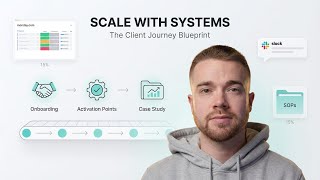
YouTube talk explaining how to scale fulfillment in a video production agency by productizing the client journey, defining activation points, and building a repeatable tech stack and pod structure. Recommends mapping a conveyor-belt client journey (onboarding → activation points → case study → renewal/upsell), using Monday.com for templated project boards and Slack channels per client, and creating SOPs per role so teams can be plugged into modular pods to scale.
Chapters
What's going on, guys? A little bit of a different video today. But I did this for one of our clients and he was, he thought it was super helpful. So I figured I'd make a little YouTube video on this, on the fulfillment process, more highlighting that around what the client journey looks like, what our onboarding looks like, what our activation points look like. Like, how do you actually scale? This individual I was talking to, they were doing a decent amount of revenue every single month, anywhere between 50 to 60k a month. But the main problem they were having is they just couldn't spend scale, right? They had leads, they had calls, they had people coming in, but they didn't know how to actually scale the fulfillment side. So in today's video, I'm going to walk you through what that actually looks like. Just going to be a raw, real video of me going through what we've learned over the past five, six years. So hopefully you can take some, some advice from that. And I definitely don't know everything. Still figuring things out as I go. But this is just what I've learned over the past couple of years. So number one, when we're doing these video packages, we want to have 70 to 80% gross profit margins. That means after we pay the team, after we pay all those people, we want to be left with 70 to 80%. Right? And so the way we do that is we kind of got to, we got to back into that, right? So number one, when we come in, right, marketing, sales, we're not going to cover this. I have other videos that cover what we do on marketing and sales ads to a form to a sales call, right? And then sales call to a close. You have a sales manager setter closer. This is as you're starting to scale up to like 50, 60, 100, 200, 300k a month. But then on the fulfillment side, once they close them, they get kicked over to onboarding, right? So client journey, this needs to be mapped out. If you don't have this already, like, let's say you're someone who's at 50, 60, maybe 70k a month. Excuse me. You have to have the client journey mapped out to where it's like a conveyor belt. So it's like when somebody comes in, they land in your client journey. And it's like a choreographed dance to where when somebody comes in, it's like, okay, great, here's the next thing we're gonna do. Great, here's the next thing we're gonna do. And it's. There's no Guesswork, it's the exact same thing every single time. Now as far as tech stack for that excus, we're typically building that out in like something like Monday.com to where it's like month one, month two, month three, if you have like a three month retainer that you're selling to your clients. And then within each one of those months we have, okay, step one, onboarding, right? Step two, get the scripts done. Step three, build out the actual, the, the shot list, right? Step four, send the videographer out to shoot the content. Step five and you get the point, right? And so you're building that out with month one, month two, month three. If you're selling like six month packages, then it's month one through six. Um, fairly simple there, right? So that's typically what we're looking to do within the actual client journey to where we have a templated out fulfillment process. Now what this means essentially is when you hire a CSM client success manager, they don't have to guess on what the next thing to do is. Now, within the actual client journey you have a couple different things, right? We build in like an onboarding call. It's typically the first call that we're having. Then we do some sort of a three point activation point system, right? So it's like activation points. The best way to understand this is just like we, when somebody gets and hits that activation point, it makes them more likely to renew with you, give you a case study, be a happy client, whatever it may be, right? So for the sake of this argument, let's say activation point number one is they record their content or you get the scripts done, right? So get the scripts done. That's activation point number one. Activation point number two is. Okay, great. Now that we've done that, we've just filmed the content. That's activation point number two. Activation point number three is. Okay, awesome. Now we've edited and delivered the content and, and got the content distributed on all platforms, whatever the actual, you know, whatever your delivery services, right? Those are the three activation points. The CSM's job is to do client comms, renewals, upsells, case studies, project management, right? So the CSM is trying to drag them from onboarding to activation point number one. Activation point number two, Activation point number three. And we're dragging them from each point here and then eventually getting a case study once we achieve some sort of measurable result. Now the key thing here is you need to build the case study into the client journey, right? So a lot of you guys are not getting case studies. I talked to a lot of video business owners doing fifty to a hundred K a month and you guys are not getting any sort of case studies like a recorded case study with your client. I cannot tell you how valuable that is because you can take that, you can kick it back to marketing, you can kick it back to sales. And so that's going to help you with your marketing, your sales because you can kick that back over to these people, right? And then after that the CSM is trying to renew them, ascend them and, and max out the LTV or the client lifetime value, right? So somebody comes in, they sign a 20k three month package with you, you drag them from activation point 1, 2, 3, you get an amazing case study and then you say, hey, you know, are you interested in continuing with us for six months to a year, whatever that may be right? Now another big thing that we do that I noticed a lot of people don't do is we do all of our client comms and we have all of our clients for their clients, do all their client comms in Slack. So like the way it would work is like you'd have like a private Slack channel per client. So like to give you an example here, let's say you have this right here. You'd have like client number one channel and then you would just do, you just duplicate this for every new client. And then inside of each channel you'd have your csm, your videographer, your social media manager, your editor, and then whoever the, the onboarding person was like the closer, right? And so you have each one of those, it's like a big group chat for every single client. The reason this is super key is, is because when you do this right, it's like a big group chat tour. You don't have to be involved. The biggest thing I hated for so long is we did emails, we did text messages, clients would call me. Like we keep all of our stuff. We say respond to us in the channel. If you don't respond to us in the channel, we won't see it, we won't respond. The only way we communicate with you is within this channel. That way your fulfillment system because becomes actually productized and actually scalable, right? Like if I got a hundred new clients, all I'd have to do is is be like cool, let's just make a channel for each one guys. Great. And then here's all of our clients, boom, boom. And it becomes infinitely scalable as long as you have the people to service them. Now same Thing here with the actual people that you're hiring, right? So each CSM is going to have a capacity like for the amount of clients that they can actually take on. A videographer is going to have capacity for the amount of clients they can take on. An editor is going to have capacity for the amount of clients that they can take on. A social media manager, same thing, right? So we like to think of it in like a pod structure and before we go into that, a big thing that a lot of people. So number one, the client journey is going to be productized, right? This has to be productized. It has to become a service that is a product where it is the same thing every single time for every single client. Right? Now to make that easier, we need to build out SOPs or standard operating procedures per person. So like very simple, don't over complicate it. Like Google Doc csm. Here's what you're going to do. Client comms. Here's how to communicate with the clients in their channel. Loom video on how to do it. How to do a renewal. Here's how to do a renewal in the Google Doc. Here's a loom video of me doing a renewal as an example. Upsells. Here's how to do an upsell. Here's a loom video of me doing an upsell. Case study. Here's the questions to ask in the case study. Use something like Riverside FM and record the case study, right? That's it. It's like you're just. And then project management. Here's how to like drag each client from each stage in the Monday board, right? And move them along the actual stages. Now we have templates, systems, all this stuff built out for the clients that I actually work with. But this is how you'd go about it, right? You'd build a Google do. You'd make loom videos on each thing. And then you'd basically be like, okay, this is our SOP CSM manager. Here's, you know, go through this, get up, get up to speed. Let me know if you have any questions, right? Same thing with videographer, right? Make an SOP Google Doc. Here's the gear you need on every shoot. Here's the shot list for a brand video. Here's the shot list for testimonial video. Here's the shot list for xyz. And we're just building that out to where it becomes a template. Same thing with Editor, Editor, sop. You know, here's the file structure we use. Here's how to do the file structure. Here's how to edit a brand video. Here's how to edit testimonial video. Do a loom video of you editing a brand video. Like, just do it live or have your. Your main editor do that, right? Same thing with social Media Manager. You're just building out the sop. Now a lot of people are like, well, how do I scale? Well, if, you know, let's say you get to 50 clients, right? You just make a new pod, guys. Like, it's not crazy. You just take this and you have another pod. So now you have two CSMs, two videographers, two editors, two social media managers, and it becomes a modular system. Oh, okay. Now we have 300 clients. Great. Let's just copy this and done. Another, like another pot of people, right? And so that's how you actually scale. And then each client gets a channel. Each client gets a dedicated Monday board. So let's take this, right? So client Monday board. And this is like how the Monday board's just basically like a big checklist, right? So it's like step one through 100 of how you do it. You know, how we go through our process, and then we're just building that out. So then it's like, okay, cool. Each client gets a Monday board. Each client gets this boom. And then it just becomes scalable as long as you have the people that you can plug in. And remember, it's easy to plug the people in here because you've already built the. The sop. And think of the SOP as like a. Like a course. It's like an internal course on how to be a videographer at your media company. It's an internal course on how to be an editor at your media company. It's an internal course on how to be a csm, Your media company, right? It's the same thing every single time. And then you're building out those processes. So hopefully this gives you a little bit more of, like, insight. I just wanted to build out and show you how we build out our fulfillment systems. Because there's some companies we talk to where, like, getting more clients isn't the issue. It's more. So how do I actually fulfill on those clients? How do I build a POD structure with each one of my. My people that I work with, right? The team members within the company. And then how do I build out, like, a tech stack that actually scales? Because I hate emails. I hate clients emailing me all the time. I hate doing all that stuff. Just put it in a channel all the comms are in one. All the all the actual things are in one Monday board, so hopefully this makes sense. Let me know if you have any questions. Shameless Plug if you want to learn about how we can actually help you build this out, should be a link below schedule demo or just keep enjoying the free value and we'll see you in the next one.









