FactoryOps in Action: Making AI (actually) work on the factory floor
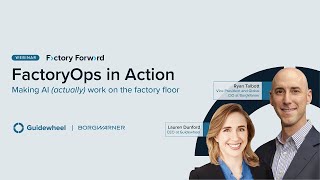
A 30-minute webinar interview (May 6, 2025) where Lauren Dunford interviews Ryan Talbot (Global CIO, BorgWarner) about how to make AI deliver real business value on the factory floor. Key messages: start with business problems not technology, pilot small and move fast to capture measurable dollar impact, deconstruct large problems (e.g., inventory) into data-backed use cases, invest at least as much in change management as in technology, and build incrementally (‘build with bricks, we don't pour concrete’).
Chapters
Wonderful. Well, thank you all so much. We already have a great crew here, so I think we're going to dive right in. This should be an absolute blast of a half hour. We have Ryan Talbot, Vice president and global CIO of BorgWarner, one of the most thoughtful people I have interacted with around this topic of making AI actually work on the factory floor. And we have a half hour to dive into. Lots of questions. I'll just enter or kick us off with a few housekeeping things. Everybody listening. If you have questions, this can be very interactive, so feel free to submit them if you wouldn't mind submitting them using the Q and A function. What that will allow is that people listening can like the questions and we can then prioritize the ones that have the most interest from the audience. Fear not, I have plenty to take us through, so no need to submit questions, but if you do and use Q and A, that's great. And then afterwards folks will get a recording. And our number one goal is make this useful to you. So submit questions and have a lot of fun. And Ryan, I'll turn it over to you before I start asking you lots of things about your experience to just do a quick introduction if you wouldn't mind, for the audience.
Sure. Well, it's Lauren. Thanks so much for having me today. I loved being able to get to learn about yourself and know you for some time now. Right. And love everything that you're doing at Guide Wheel and beyond. So it's great to be joining you here today and hope to share some insights. So Ryan Talbot, the global CIO and vice president, Borg Warner, for those that don't know us, We're a Fortune 200 organization that provides products really into the automotive, into mobility markets. So hope to talk a lot about what we're doing in our organization. We have plants scattered throughout the world. Right. And in all different regions in different sizes. Right. So can certainly try to talk about what we're doing at our sites and hopefully provide some applicability to you.
Incredible. And Ryan, I'll just dive right in with the first question tied to the topic of this whole thing, which is anything you have to share in terms of what works or what doesn't to make AI actually work on the factory floor.
Yeah, let's.
Or how do you actually get started? I guess.
Yeah, how do you think get started. So here's what I think. You're probably going to hear me reiterate a few points as we go through this discussion. I think that are key and for maybe this audience to think about.
I would say, number one, we have nor, and I think nor is our organization taking a look at kind of the. And I'm going to age myself here. The old field of dreams. Kevin Costner. Right. You know, build it and they will come. That's not the way that we've approached. Right. We approach the way that we think about AI, the way that we think about the rest of our technology in a way that drives solutions that are really applicable to our business at a point in time. Right. We're not trying to build something. Right. We're trying to set the frameworks, the architectures of what do we need to do. But, but our belief is that we really have to start small, we have to pilot and then we have to accelerate and move fast. And all of this has to be focused around how you are delivering business value. I think to me this is the absolute key, right. That gets lost in the conversations around data, around AI. The way that you move. We do not approach AI is the answer. So tell me what the problem is. We approach it from a different perspective. It's very much like we want to understand what the business context is, the business, business problem and what we're doing. What are we trying to solve, how is it going to help our business? Right. In true, true financial terms. And then we determine where the pilots and how do we start to scale from there.
Yeah, fantastic. So it sounds like you're starting with what value will this drive and using that to prioritize any examples you have of that. Or I can also take us into the next set of questions.
Sure. I mean, I think we, you know, I would say at least to start with. Right. That we do. Let me explain one thing. We do not have a separate AI strategy and data strategies and IT strategies and go through. We have a business strategy and our job from technology perspective is to help deliver on that business strategy. Right. To help drive efficiency within our plans, to help grow revenue, to take a look at how do we control and manage costs, make it better for our customers and for our employees. So we constantly think about those things. When we think about the technology solutions that we're providing. When it comes to our plants, I think a lot of in the way that we run, we have a very decentralized structure. Each plant needs is different from what another one needs. So we do not come in with these large. Everything is not a large scale enterprise solution. We make sure that solutions that we're bringing work within our ecosystem. They're architected in the appropriate way. But what's a need in China is not necessarily the same need as something that's running in one of our plants in Mexico or in Germany or Poland. Right. So we kind of have to think about it differently. So, you know, just, I mean, a few of the examples, obviously robotics, right. And what that's starting to bring into the ecosystem. How do you start to think about, you know, from shop floor perspective, Just the basics, reducing scrap, reducing inventory. Starting to take a look at how can you reduce down times, how can you improve cycle times and change over machines. Right. So taking a look at these problems that they're dealing with on the shop floor and not coming in with some big overarching enterprise solution, but something that's focused on how do I deconstruct that problem, Figure out something specific we could solve, Solve it and then start to expand.
Yes. Could not love it more. Let's start by actually solving some things and getting some wins on the board. When you look at kind of the opportunities that exist in terms of business value, also the challenges of things like data security, data quality, how things are actually going to work for folks on the plant floor, what are you seeing? As you mentioned, maybe a couple of them. But how are you assessing what are the most realistic opportunities right now?
You know, I mean, if you think about right, when it moved from, you know, a project base to a product base and. Right. And we started to talk about agile and we talked about everything. What did we talk about? We always talk about, you work on the things that deliver the highest business value. Right. So you know, when you think about plans and you think about some of the challenges that you have, I'm going to narrow into this a little bit. But you start to think about some of these challenges. Right? Let's use inventory as an example. A plan says I want to reduce my on hand inventory. There's no AI solution that is just going to magically help you reduce inventory. Right. You have to start to take a look and you have to take a look at what your ordering processes are, what are your safety stocks looking at, what are your inventory turns looking like? Right. What's the defect rate you're getting from your partners and your vendors? Right. So there's a whole cast of what you have to look at. And so this is where you can't take these massive, huge problems and start to go through. You've really got to take them and deconstruct and say, hey, the first thing I'm going to work on is that how can I start to use AI to maybe give me better information based on ordering history, shipping history, of what actual safety stocks need to look like, not just taking somebody typing numbers they think are right based on experience into an Excel spreadsheet and then utilizing that. Right. So what we try to do is we start to, we take these problems where they have the most tied to them that we can. We then work to deconstruct those down to be able to say what can we actually start with? Where do we have data that we could actually start with? And if the answer is we don't have the data, then to be frank, we're probably not going to start with that problem. Right. And the same thing as well. If the requirement is, well, I've got to be pulling tons of data out of an ERP that's going to take me a year to implement or something or MES system or a SCADA system or those are longer term problems you got to try to solve. You have to start with what you have, that's as good data. Where can you make improvements to it over time and then start to utilize what you have? But I think when I talk about this, Lauren, what this audience I think has to keep in mind is in our point of view, speed is more important than the hundred percent. Just to be frank, I would rather get 50% of the value in one or two days than I would wait three months or six months for the hypothetical 100% of value, which probably you're never ever going to achieve anyway. Right. Because it's going to be different in the end. So I would rather get value fast. Right. Be delivering that to the plan and work to expand from there.
Yeah, that just resonates so strongly. I love that point. I also, not everyone thinks that way in terms of speed. When you think about why you would rather have 50% of the value now versus a theoretical 100% later, how do you think about that trade off and what goes on behind the scenes for you to be so high conviction about that?
I guess maybe, maybe it's just experience, but to me, I guess I would say something around that. You know the saying, right. The proof is in the pudding we talk about sometimes is all. I dislike theory. Right. I like material results. Right. And so when we start to talk about the pilots that we're running, I want to see real dollars. Right. I want. And that's what, and that's what I think the business expects of us as technology leaders. Right. They want us to speak in their terms. They want to see results in their terms. Right. So, you know, I think, I think a of the challenge that I'm seeing in the overall AI space right now is that a lot of what we're seeing is around cost avoidance. Right. Number one, which in the end ends up being hypothetical. And you never see those dollars into the P and L. Right. So I think the ability, as we start to transition into AI to deliver real dollars and savings down to the bottom line and frankly, some of this may include resource cuts in the future. Right. I mean, this is robotics, this is automation, this is. Right. That you know, you want to be able to do more with less. And so I think as you, as you start to think about these topics, right. I think this is where you've got to be really dollar value focused. Right. And to me, I would much rather start. And again, if the hypothetical value I'm just making up is $100,000, I would rather go and get 20,000, that $20 thousand of that value tomorrow and start getting that and start achieving that instead of waiting for some point in the future that maybe I'm going to achieve this 100 grand.
Yeah, yeah. So thank you so much for digging in on that because what I've noticed is the longer someone has been actually rolling the plant floor and actually making change and measuring dollar value, the more and more they think like you and the more and more it's, hey, I want to prove this first and measure dollars in the bottom line and hard savings, not soft savings. Theoretically amazing. And just for everyone listening who might have joined a little bit late, we're talking with Brian Talbot, CEO at Borg Warner. Incredibly thoughtful about applying AI. And people are already submitting questions. If you have questions, submit via Q and A and then people can upvote them. Already got some really good data.
Next question. And this one I think you're going to have fascinating thoughts on as well. We talked a little bit about how you prioritize, which challenges you start solving dollar value, where the data might exist. There's then that whole question of the how you get the solution out and used. No tool does anything if people aren't using it. That change management and organizational readiness side is complex every day. And you deal with a unique environment of a decentralized organization as well. How do you think about change management overall? Decentralized manufacturing organizations, Any learning of what works or what doesn't in that area?
Yeah, sure. I think there's the things that we can control and the things we can control. I'm not going to be able to go and convince our plants that they need to buy all new equipment on their shop floors or to spend hundreds of thousands or millions of dollars putting sensors onto existing equipment, right? To be able to do they. They're not going to make those types of investments unless they know there's clear dollars that are coming to them. So I think we start with the static that in our plants at least we have to go through and we have to say our plans are plans as they are today, right? Some of them are brand new and beautiful and you know, these super clean factories and there's others that they're hardcore manufacturing facilities, right. That you know, no room for AGVs running on the shop floor, et cetera. So I think we take our kind of say these are the plans and our corporate functions. I don't want to leave those out, right? Any of our overall global business functions that we have, right? We take a look and we say, so what is fixed and what is not fixed? And I think when we think about change, there's primarily two things I guess that we would think about. I would say number one to this group is that again, the solution is not AI. What is the problem, right? I think we come back to this and we say, okay, first off, let's really think about value stream mapping. I don't think there's enough value stream mapping to take a look because the last thing you want to do is drive automation and AI into a process that is not refined, right? So we actually have to do more with our teams. When we're thinking about the business process, they're operating finance, HR operations, right? We start to think about, right? How do we think about optimizing what those processes are from a value stream mapping, what's truly delivering value within that process, what's not, where should we just automate? Where could we use more advanced tools like AI? But I think the second thing, I'm not going to take credit for this. You know, I heard this from somebody else, but I thought it was great, was that they said, you know, one of the hardest things for people to understand is that for every dollar that you spend on technology, you are going to spend at least a dollar on change management. And I think there's a ridiculous amount of truth in that, right? That how you work with those individual stakeholders to get them to think. Because again, you are literally talking about people's jobs and they are naturally protective of them. They're naturally protective of the people that they have working for them. I think a lot of plans, as you talk about resources, right? That their first thought isn't necessarily to remove. The first thought is, well, how could I have them do something else? But that's fine. Those are their decisions. But you're giving them the, you know, adopting the ability to do that. So, you know, so I see one of the questions in the chat, you know, is around tooling and, you know, AI powering on the shop floor. Again, I think we look at a specific problem. When you figure out of multiple lines that we have running at a plant, maybe where is there a newer line that we can pull more data off of? Right. Or how do we interject into, into that line something that's AI beneficial? Right. I mean, it could be something again for robotics and starting to use basic AI. It could be visual inspection that we start to do. So again, I, I think what we're trying to do is figuring out how do we take that line of static. The people and the processes are variable. Right. So we kind of take the machines the way that they are and you say, okay, do I have to interject or can I interject something that's of value into it? And then the people I have to work on. Right. How do I optimize the processes that they're running? How do I help their understanding and knowledge that they have the capability to do it? Or do we have to help them?
Yeah, yeah, super. And gosh, I love what you shared about. For every $1 you spend on technology, you should expect to spend at least a dollar on.
Any advice. For folks on the line who are thinking, oh wow, that really resonates for any technology investment, I'll set aside the dollar or more for change management. How have you found successful ways to spend for change management or leverage tools for that or. I know you've also. My team was present at your pitch day and absolutely loved it. They said it was one of the best organized events of that kind they'd ever been to. So you've done some really creative things on the how you invest in thoughtful change management and engaging folks across the organization as well. Anything you want to share on that front.
I would say to start with at least, since there's probably a lot of technology people on these calls. Right. I think it's easier to say. It's harder to do, to really talk in those business terms. You have got to understand the problems that you are trying to solve and the problem is not building a better, cleaner data lake. I'm sorry, it's not to implement this super cool gen AI that I can get a nice response off using rag models to be able to pull in my internal data. That's not the problem. The problem is what are you, you know, what that. What is the business dealing with to help their operations run more effectively? I mean, in the end, this is all about. I'm just gonna. Frank. It's all about making money and saving money. That's all that this stuff is about. So I think what we do is we align with our business teams around what is it specifically that you are trying to solve. And I will tell you, there is a lot of times that we have had solutions at our organization that, to be frank, the ideas are great, but the juice is not worth the squeeze. I'm never going to get the financial benefit out of the investment that I have to make. And in the end, it just comes down to return on invested capital. That's all that this is. So, again, I think you've got to think about how do you really solve whatever it is that the business has? How do you start to show that return of whatever that it is? But that's why I'm saying the speed matters, because there's a cost of having dollars now in comparison to getting those dollars in six months from now. So I think it just comes back to that change management. And once I align the people on.
I would say the overall problem, right. What is the value of that problem, then it's really easy to get people focused on wanting to solve it. Right. But if I try to get them aligned about a technology solution, you're never going to get them to align. So I think you got to start with the what's the dollars? What's the problem that I'm trying to solve? You then align them to, here's the options that you have from a technology standpoint. And then you get down again. How do I start with the smallest thing that I can actually show that there's value? So that way the plans start to say, right. Or anybody throughout the business saying, wow, I actually see the dollars now. I get it now. Okay, now what do I do next? And it's really interesting dynamic because it goes from you having to nudge and push and challenge a little bit to it to start to be a pool. And it's interesting for these plants that we're working with that we're starting to see that the pool is starting to come in in a more intense way. Are you saying the same thing, Lauren? I mean, you're out a lot of these companies and you see some of the challenges of change and people.
This is why this conversation, why I have A big smile on my face. We see this so much and it's all about getting the flywheel going and starting with small, easy things, driving dollars to the bottom line, measuring success and then building from there. And that's when the team starts to pull. I think also what we really advise is that leadership sets the tone for how those early wins are recognized. If someone starts by getting a baseline and sees, oh, I have an opportunity to drive a big impact through starting my shifts on time and leadership goes, oh, bad, bad. Why were you not starting your shifts on time? That just sets off a negative spiral. It has to be, oh, wow, what a great opportunity. Congrats on the improvement that you've just driven. Now how can we replicate that? And I have based on that and feel free to take this question or not. So I'll toss it your way and you can decide or not. Sometimes I think what we see is in manufacturing historically, the plants that have done really well have then been asked to keep doing well and do even better and have resources kind of taken away. Hey, you were really good at reducing costs. Now your budget is decreased. And that's of course not, not everywhere. But do you have kind of leadership guidelines for how you support improvements in being a self perpetuating flywheel or any thoughts on that? And again, I have, I have a next question if you want to. I know that wasn't on our.
No, no, no, no, no, no. But that's, but that's fair. I think it's, I think we want to get to that point. I don't know that we've gotten fully into the self funding. Right. Of these programs yet, just to be frank, because we're in a lot of prototypes. You know what I'll add to that is, you know, like, like we talked about, right. You and you said about change. I think there, there has to be change coming from the top and change coming from the bottom. Right. And you've got to, you've got to kind of continually meet at different levels of what that is. So, you know, I think the way that we have tried to do this is like. So as an example, you talked about that we ran a pitch day, right. So we brought in, you know, a dozen or so different startups, said, and I think the key is those are ones that we're working with and they may just be working at one plant, right. So as an example, right. I mean, you know, we're working with you, we're working with your organization and guidewood, right. A couple of different of our plants that we're doing. But what we're doing is then we're giving that exposure of what we're doing at those plants out to the other plants and they're finding an interest and where there may be something that guidewill doesn't do. Right. In this, in this broad span of AI, right Then we're sharing those ideas. So the sharing of knowledge has been incredibly important. And then. And what's happening is we start to see this that's creating a momentum because the plants are really excited to share what dollars that they're actually achieving what the achievements are with others. And it creates a little bit of like a internal competition in a way for what they're doing. So I think the bottom line is, and I'm not. I hear a lot, I will say in my, in my sphere, I hear a lot of talk about the hundreds and hundreds of pilots that people are running. How amazing of what they've taken stuff to production. Don't get me wrong, we're doing a lot of that. Right. Of what we're doing. I think in the end, go again. I mean there was just the headline in the Wall Street Journal a couple weeks ago that, you know, is AI having a value delivery problem? And I think that comes back to right again that organizations are right, maybe not narrow enough in what they have to do and focused doing pilots. And I think the key is scaling fast. Right. For audio tracking that far.
Yeah. Incredible. And I love the emphasis on speed and valuing speed in a very concrete return on invested capital. Time frame of money, time value of money sense. Next question is around how you think about technology foundations. I think there's a belief out there that if you don't have a details, mes, scada, you know, Data Lake, all the kind of most advanced technology already that you're behind or won't be able to leverage AI. How do you think about technology readiness across such a diverse and decentralized portfolio?
I think with, you know, depending again on your AI use case. Right. Some of that information may be valuable. But to be frank, I don't know. I think you've got a lot of. You could think about Industry 4 and digitization. Right. And using some of those, you know, MES and SCADA systems. But it's true feeds for AI being able to go through and make decisions. I don't know that again that, that there's that many organizations that have these absolute pristine SCADA and MES systems. Right. Or everybody is challenged with data. Right. And the challenge with AI is that you know that we all know that we clean data, but no organization is going to sit there and say, I'm going to spend the next three years cleaning my data and developing business processes to be able to support that. So I think what we do again is we come back to. So from an architecture standpoint, we make sure that the architecture is there for us to be able to build on and scale from, from both in AI and the other line data repositories that we have that do that, right? So we've got a good clean architecture that we could work from. And then we start to work with the business teams, right? So we kind of have a filter that we go through, right? So we start to gather ideas, we start to go through, we determine what if there's a business value, if there's non business value, we're cutting it off before we do any more analysis. Then we're getting into the data that we have and we start to say, do you actually have the data to be able to solve the problem? And I think a lot of times, like, you know what, what we're seeing is that, let's say that you've got a part coming down the line, right? And at the, you know, you have some quality check at the end of the line. What I think we see a challenge is, is that, you know, whether it be mes get us whatever those are, right? That as you get to the end, you can take a look then and the AI can interpret and can start to say, well, hey, I knew this was a bad part. And with these different variables, it's going to create a bad part. But the question is, how do you do that at point in time and identify the variables? How do you take into account all the things that are going on in the plant, humidity that may affect the glue drying in a specific way or doing something? All of this has to be read in. And so it's just massive amounts of data. But I think that's why, again, I just, I don't know how to go. How many times go back to this. It's just, let me start with what I have and then I can start to add to it to say how I could make solving this problem even more valuable to the business. Right. And as they do that, then they're gonna start to take the basics as table stakes and they're gonna start to look at this more advanced stuff as really delivering the value. So at least that's how we've tried to approach it.
Yeah, incredible. I'll sneak in one last question and then we'll start going to the Q and A. And if anyone else wants to be submitting Q and A as we go, that's. I'll just toss a catch all in here, Ryan, of industry trends, kind of broader readiness that you're seeing, digital maturity across industries. Anything else you want to add on trends? You're seeing, things you've observed about where we are today or best practices to make this technology actually work for manufacturing and for these teams.
I would.
I would dare to say that the marketing right now is ahead of the delivery in the people that I meet with. I don't think there are very few organizations that I see that are groundbreakingly ahead, right. Aside from maybe some of the tech companies that are working on those latest and greatest things. But I think tons and tons of companies, this has come so fast in the market. Everybody's trying to prototype, everybody's trying to work through. So I don't think that people have to have a fear of necessarily currently being behind, but I think they need to have a fear as they move ahead that they could get behind quickly right of where their competitors are going to be. So I do think they have to think about that. But when it, but when it comes down to it, I do think that most organizations are in the same spot, regardless if they name a head of AI, if they name a head that they're still working through, they're still building out their models, they're still trying to go through. So I think again, when we come back to maybe this data topic, right, And I see a question in the chat about this, how do we prepare the data and the processes? I think, at least for us, I think the way that we try to do is again, we first try to work. I think we're doing a couple things. We're trying to work with the business groups to understand their problem. We're trying to figure out if anybody else has solved those problems, and we're trying to advertise what has been done, and we're trying to advertise to them the importance. But truly, until it becomes a problem that they have to solve, a lot of groups are not proactively out there and doing it right. So I think what we're trying to do is we're trying to help advise them on where we think they should make investments into regarding the cleanliness of the data and the way that they work. But we can't necessarily force them to do it. But if they want to solve those problems, they're going to take the initiative to do it on their own. So I think that's just the way that again that we've tried to be approaching this. The other things that are super exciting to me though, so as much as maybe sound pessimistic where people are, I think there's huge potential. I mean the two biggest things I think when you start to really think about robotics and what it's going to do and AI truly feeding in and cobots operating the shop floor next to people. Right. And that's starting to take more and more I think is huge opportunity. And I think of course Agentic, one of the biggest challenge that you have is.
At least for us that just AI hasn't been able to take that next action to be able to actually see it automatically make that. And that's where Agentic is going to start to make all the difference in how we do that. And we are. We're barely into the first bat on the first inning on some of this. Right. So I think there's going to be a lot more to see in to come apart that. And those would be the biggest things we'd be interested in.
Yeah, incredible. I know we're two minutes from time. Anything else you want to add for the questions? I see a comment around the upfront investment in AI as well. Anything you want to add on those questions or last words?
This is why I think this is. This comes back to. I really like this question about this. I will tell you we are really cautious about the investments that we make up front. This is why go prototype something with the least dollar value that you can work with these partners. I mean Guidewell is a great partner of ours. Right. We've got other great partners that we work with. Right. And right. We're figuring out how do we make those incremental investments to show the dollar. But when you can show that there's a 3x return on the money you' that you started with or even if it's a one to one, people are going to say there's a value here and they're willing to make those capital investments. But from a technology leaders perspective, if you're approaching organization asking for big, huge investments on this, I would be really cautious. And I personally challenge my teams to constantly figure out how could we start smaller? Smaller that requires the least amount of investment.
Our head of analytics has a great statement, right. That we build with bricks, we don't pour concrete. And I think that's just kind of an interesting thing for us to think about. Right. That like, you know, grab that first paver and you start to build out the patio. Don't call in the Cullen cement truck to pour your entire, you know, patio all at once. And I think that reduces the dollar value you need to make an investment and you start seeing the value of operating it.
Oh, I love that. We build with bricks, we don't pour concrete. Amazing, Ryan. I know we're at time. For everyone listening, Ryan Talbot, CEO of Warren Warner. Absolutely. Such a great discussion. Thank you for the thoughtfulness, the insights. I found this super useful. I can only imagine how useful it was to people watching and listening. Brian, thank you.
Thank you so much. Lauren, great to partner with you. Thanks everyone for attending.
Thanks all. See you.
More from Lauren


From Davos to the Factory Floor: Lauren Dunford’s Guidewheel Journey | Culture Talks
Lauren Dunford of Guidewheel on Data-Driven Efficiency, Sustainable Factories, and Finding Champions