Maximizing Machine Runtime: Get Real-time Visibility in Days
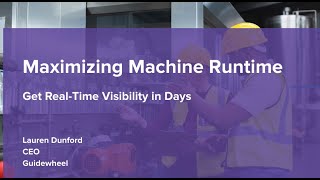
Lauren Dunford explains how sensors and cloud software give manufacturers real-time visibility into aging factory equipment in days. Many plants lose up to 20% of runtime to changeovers and setups. Low-cost sensors deployed in minutes per machine surface quick wins like operator competition and maintenance alerts.
Questions this video answers
March 16, 2022
Up to about 20% of runtime (commonly cited)
20+ years (average equipment age cited)
~$100 per hour (example used for ROI calculation)
Over 70 manufacturers with over 120 plants across five countries
Chapters
Hi, I'm Matt Natove, Executive Editor of Plastics Technology Magazine and welcome to another plastics technology webinar presented today by Guidewheel in San Francisco. Today's topic is Maximizing Machine Runtime. Get real time visibility in days. It is presented by Lauren Dunford of Guidewheel. Lauren is the CEO and co founder of the company, which is a global software company on a mission to empower all the world's factories to reach sustainable peak performance with the plug and play cloud powered factory Ops platform. Lauren has an MBA from Stanford University and a dozen years of experience in supply chain and operations. She and her team currently work with over 70 manufacturers with over 120 plants across five countries to reduce lost production time and increase throughput and perform better and better over time. Before Lauren gets started, I would note that if questions occur to you during the presentation, type them into your questions box at the bottom of the pane on the right of your screen. And now I'll turn the webinar over to Lauren.
Terrific. Thanks Matt. In terms of today's goal, we want to share a couple of new ways that manufacturers have been maximizing their runtime and driving other key metrics, both those immediate quick wins and over the longer term. Wanted to start with a quick intro. You got some from Matt, but as you mentioned, Guidewheel is a factory ops platform used by many manufacturers in the plastics and packaging space with a focus on plastics including Chromacolor. Pretty impackaging other names you recognize and many others. So this is our bread and butter in terms of today's agenda. We'll start with the problem and why it exists. It has been hard to maxim runtime in the past. What's changed and what's now possible in terms of those quick wins and that journey over time with lots of very concrete examples of what that journey can and has looked like for many other manufacturers as well. Welcome any questions at the end. So if you send those in in the meantime, excited to address them at the end as well. To start with the problem, most manufacturers care a lot about runtime on equipment because every bit of time that that equipment is running is products you can be making and selling, revenue you can be bringing in from your existing assets. But most folks are losing actually up to 20% of that runtime. Sometimes that's a catastrophic breakdown, but it's actually far more frequently the human stuff, whether it's setups or changeovers. Fred is changing over a machine from product A to product B. Forgot the material for product B has to run to the back of the plant, grab a forklift and boom, you've lost 40 minutes then and there. And those kinds of human things add up to a very big cost, which we'll talk about in financial terms later. But in terms of losing up to 20% of the time, obviously that's a very meaningful and real impact on the business and something that the biggest manufacturers in the world spend huge amounts of money and bring in troops of consultants to tunnel into every machine PLC and build very complex systems to track and try to fix. But Most, and that's 99% of manufacturers on the planet, are managing much more manually. You might recognize clipboards like this or have Excel spreadsheets that you're wrestling with, or some machines with visibility, some without. And this is really the world that most of us are living in for why this is still true and why so much is still manual. Of course, whether you have one plant or many, you're probably running many different processes at a time. Whether it's extrusion, blow molding, injection, blow molding, palletizing, odds are you're doing a lot of different things to raw, raw material before it becomes product that's ready for you to sell. And so what that means is there are a variety of different processes with machines that might come from different manufacturers. And because these are big and expensive pieces of equipment, there's typically no one year where it makes sense to scrap all of your old equipment and buy completely brand new machines. So odds are you're probably buying a new machine if one breaks, or you're buying a new machine if you need to add capacity in a certain area of the business. But you're not buying all brand new machines all at once. And what we often find as well is that most manufacturers are often buying second or third hand, because that's typically a pretty darn good deal. So when you look around any one of your plants, or if you have one plant look around in general, odds are you're seeing a variety of different ages, makes and models of machines even within each process, and that many of those machines are quite old. The average age of equipment here in the US is 20 plus years and increasing. So a lot of these pieces of equipment, odds are, may not be able to connect to our cloud, let alone in a way that's consistent and easy for your team to use.
And these pieces of equipment are being run every single day by humans. So everyone from your operators to your maintenance technician to your plant manager, to your CEO and COO may be operating in an environment of constant human error and Things going wrong within all of that, having everything tracked very manually on, whether it's clipboards like this or massive Excel spreadsheets, even within very professionally run organizations.
And what this creates is we're in an environment now where the pressure and uncertainty and global competition and supply chain disruption are creating a really challenging environment. Labor raw material supply chain. And within that environment, because most teams are operating with those different processes, makes models, ages of equipment all being run by humans. They're stuck guessing, firefighting and losing time and money on those machines. One last human example here that might resonate with your experience as well on this kind of human, human pain of the problem. Regional VP of Ops gets a call that an important machine is down, says, hey, no problem, it's an easy fix. I know that machine, just jiggle it a couple of times, elbow it. That machine, I know it'll get back up and running. It works up and running. And then his blood pressure skyrockets because he learns that by the time he got the call, that machine had been down already for 24 hours straight. The operator didn't notice at first. The shift handed over. The plant manager came in, tried to find the maintenance technician who knew that machine played phone tag for a few hours. And at the end of the day, that's 24 hours of runtime just lost that you can never get back again. A tenth of the revenue from that particular plant from something that should have been a 30 second fix. So this is something where it's daily painful and frustrating and all of that guessing, firefighting and losing that time and money is adding up as well to large amounts of potential revenue and profit left on the table. We'll be sharing this after the webinar, in case it's helpful to you to run the numbers for yourself. But typically in an environment like we're in right now, especially in the plastics and packaging space, the more you can be running your equipment, the more product you can be selling and the more revenue you can be bringing in from that existing equipment. So when we look at low lift, high return opportunities that drive straight to the bottom line, that lost production time is a really big one for most manufacturers that we work with. To give a sample of what that looks like for many folks that we see, and we'll share this afterwards for you to run the numbers yourself. You lose conservatively 100 bucks per hour of lost production time in revenue you could be making from not running that key piece of equipment. This, of course, we're applying to the key bottleneck machines within your Operation. Say you run three shifts a day, eight hours per shift. Here this has five, but it just might as easily be seven for you at a gross margin of, let's say, 25%. To plug something in there, you can plug in your own numbers with whether it's 20 or 15 or 30 key machines per factory and a couple of plants. Here we have five within the operation. If you're running right now at around 60 or 65% runtime, which is typical for folks when they're starting out. Of course, it depends on your exact operation, so be flexible for you to use the numbers that work for you. If you can increase that just to 70 or 75%, that's typically many millions of dollars of. Because this incorporates margin profit straight to the bottom line with progressively more profit and contribution margin from getting those hours back once you're already at higher uptime for that equipment. So if this is helpful to you to calculate for your own operation, typically what we see is being able to sell into that open capacity if you're in an environment where that additional runtime can translate into profit, is one of the single lowest lift, highest return interventions that most manufacturers can make.
This, though, has been a problem that has not been solved for years. Just clicked share there instead of slideshow. You know, this problem exists for a reason. It has historically been incredibly hard to solve. So despite that pain, despite the money left on the table, the only systems that had been available in the past were extremely heavyweight and inaccessible, except to a few. What's possible now, and what I'm excited to share specific examples of today is how a very new category of solution has become possible. Cloud computing, sensors, mobile devices, all of those have become infinitely more accessible. They are everywhere and infinitely more powerful. And what that's opened up is very different levels of ease of getting visibility as well as much more powerful systems in terms of putting that visibility to use and actually driving impacts for the bottom line. With factory ops, what we start with is by using plug and play sensors to have your team go from guessing constantly what's happening with the machines to knowing with certainty what any machine across the operation, new or old, any maker model is doing every second of the time. Go from firefighting constantly and being on that back foot to having the right escalating, systematic alerts, getting knowledge out of people's heads and out of phone tag or pagers or texts and into a consistent and dependable system, and going from knowing you're losing money and time on those machines, but not being able to pinpoint or drive the impact to address it to not only being able to pinpoint exactly where the highest return opportunities to get that time and money back are, but also visibly with your team, prioritize the 80, 20 those highest return opportunities. So as a team, you're able to prioritize your limited time and resources where it'll have the greatest impact to get that time and money back.
In terms of what this looks like, not only is it able to get those results in a much faster and easier way, it's also possible now for this journey to not be all or nothing. Either you invest in a really heavy weight and yes, or you're using spreadsheets and clipboards instead. It's now very easy to get complete visibility and we'll talk about the examples of both how that can happen and what the team can do with that visibility. Because no one wants data, you want results on the ground. It's then possible to layer on additional value at the pace that works for you. Crawl, walk, run is something a lot of the partners we work with talk about. We like to say walk, run, fly, but however you put it, it means being able to start with that visibility and quick wins, really prioritize your team's time, then go into a run of proactive knowledge transfer, taking information out of just being locked in people's heads and into that consistent and dependable system. Get that 80, 20 of where should you be focusing your time and be on that journey of continuous improvement in a way that empowers your full team? And then lastly, at whatever pace is right for you and your team to layer on, whether it's full oee, whether it's sustainability initiatives that tie to your C suite, or whether it's starting to get much more predictive and smarter and smarter behind the scenes. There's then that opportunity to continually layer on and walk, run, fly over time. What I'm going to do right now is share a bunch of actual, just really concrete stories from folks that we've worked with, with the visuals of how this has looked in the system so you can get a sense of what this actually feels like and looks like. And I'll start with just the value of having across any machine, make, model, age across all of your plants and all of your equipment, consistent visibility into that machine activity. And the way we do that here at Guide Wheel is we use clip on sensors to translate the electrical heartbeat, the current draw of a machine into second by second, not only its runtime, downtime or idle time, but also the speed at which it's operating here you can see a blow molding machine for example, running on load. Every microstop becomes crystal clear. Boom. This machine is down. Sends that right alert. The VP of Ops doesn't have to get alerted. This can be fixed by the right person in real time. And here you can easily see at a glance the differences between changeovers and different length there. So what I'll actually do is share how many teams are using that first stage of consistently getting visibility into their machine to actually provoke some really friendly competition first among operators in terms of reducing unplanned downtime and then across multiple plants as well. What this looks like is this screen is showing for the last 24 hours across any machines I want. You can tell any make, model or age of machine can get into the system just as consistently across all of my plants or areas of my operation. I can actually give my team color coded visibility. They can see here exactly how much that machine was running. It's a shared source of truth where everyone knows this isn't a number that someone wrote in or a boast someone is making about how they performed, but they can also see at a glance the numbers subtracting out of course, plan downtime if you like. And what we heard from a customer the other day was it's simply putting this up for the full team. Sometimes people put it up on a screen. This particular group was actually just printing it out and sticking it on a cork board that was in the main room. So operators would at the change of shift be eagerly coming up to this board, seeing how they had performed relative to each other the night before and actually being able to have a fun competition around a metric that really matters for the business, of course in a very friendly way. But that cork board being something everyone passes by, the VP of Bob's the CEO and really being able to recognize operators who are doing a tremendously great job with that shared and easy to interpret visibility. This is also something where across plants what we see is that when there are many plants competing together, there will often be a little competition among regions or plants on Here's a dashboard showing comparison. Red, yellow, green, how are you doing relative to each other? And that friendly competition, especially when it's tied to something as meaningful for the business as decreasing loss production time, has really resulted in some fun improvements and.
Tracked case studies over time.
The other thing that we've seen is being able to get the information coming proactively to the right people has been very helpful as well. So another kind of story here is we had a group that was going from in shift handoffs much more informally conveying information about the previous shift's performance. What that would result in is sometimes supervisors are coming in and getting real surprised by what they're walking into. Never know quite what to anticipate and that can be very stressful coming into the plant and not knowing what happened the night before or what you're encountering. What teams are now doing is setting up reports that will send the key information, whether it's uptime, any issues, oee for the past day at the right time for people to walk in and know exactly what they're anticipating. So whether it's a daily shift report, daily scrum report, having that come in and being able to see as a team exactly what you're walking into and actually get ahead of the game has both decreased stress among those teams and of course helped them enter the day proactively and really improve those metrics that matter as well.
Last example of kind of gathering the team together around specific data and this is an example actually from a multi plant group where they were divided into regions and VP of Ops running one particular region, used to gather with his team on a weekly basis and spend up to two hours on the phone going through tabs and tabs of spreadsheets trying to reconcile how the different plants were doing, understand how it could improve. And what they're doing now is they're able to pull up, whether it's the last 30 days or last 60 days, all of the information that they need across all of their plants at a glance and drill down into that information so that they're now spending 45 minutes max across that group, gone from two hours to 45 minutes and they're able to see and have those conversations in a really grounded way and have seen up to 15% increases in runtime across those plant groups as well. So a really dramatic change from especially for groups that are operating across geographies, being able to have at a glance all of those consistent, trusted sources of information about both how they're doing relative to previously and where there might be opportunities to improve. This is also something where in an environment where labor is consistently scarce, management talent can be really hard to find. Being able to leverage great managers or leaders across multiple geographies with that kind of visibility has also been a very big change for some of the customers that we've worked with.
Last piece here, not just on visibility, but on engagement at the plant floor level and cross training. Especially in this environment where labor we have Sometimes new folks coming in on the floor who haven't necessarily worked the machines before. I just zoomed in on this blow molding machine and you can see at a glance the difference here between this longer changeover and this shorter one. And the ability to use visuals like this. Say this, you know this changeover. Changeover is run by Luke. This one is run by Eric. The ability to sit down with Luke and Eric and say, Luke, your changeover is double as long as Eric's. For your business, that might be 20 minutes versus 45. For another business it might be 1 hour versus 6 hours. And have Luke actually share what he's doing during that time. Compare that to hearing what Eric is doing and learn some of those simple things. Whether it's having the material right next to you, whether it's prepping, some of the things that you're going to do in advance, whether it's simply prioritizing during that time. This is not the time to go grab a coffee or go chat in the break room. Sharing some of those insights can be very simple and straightforward. When you can see where the bright spots are Eric's fast changeovers compared to areas where retraining might be helpful. And when you can see that information across shifts that might not otherwise talk with each other or across geographies where there are similar machines and some operators that are doing a tremendous job on their changeovers, others that might be doing a tremendous job on their quality and cross train and share that information in a very visual and easy way across plants. So I hope those examples aren't too detailed. Just wanted to share in terms of how we see that walk journey of just getting the visibility, having that baseline across machines, team members and plants can really open up a lot of possibility for very quick wins. And is now a matter of clipping those sensors on is minutes, plugging them in, a couple minutes more in a day you can have visibility across your complete plant. In a couple of days you could have visibility across five to 10 plants and up from there. This is now much easier to be able to get because of those changes in technology and something where there is very low hanging fruit for high impact for your business.
Wanted to now share a couple of examples of that run stage where you go from first just having the complete visibility, getting those quick wins to starting to layer on a little more proactive knowledge transfer, getting information about what needs to happen with machines out of people's heads and into that consistent dependable system of whether it's 8020 analysis of where to focus or whether it's alerting and having that automatically escalate and how those continuous improvement processes start to look layered on top of simply the visibility.
And that's where the first thing I wanted to touch on is alerts. This goes back to that painful example of the machine where it's a very simple fix. Could have, if the right person got the right prompt at that moment, been something that didn't need to escalate even to the plant manager, let alone the VP of Ops or cause those kinds of delays for a customer. That kind of information is now very easy to put into systems like guide wheel so that you can actually have a machine, whether it's down or idle, send proactively. And this isn't coming from the machine, it's coming from the platform in the background. Send that alert to the right person in the right escalating way and then escalate further if it hasn't yet been addressed. So this is something where these alerts can come by SMS or email. And specific examples here that will typically be good use cases is both, you know, if a critical machine is down or that's your key bottleneck, never should that machine be down. Making sure the person who should be notified gets that alert right away. Also being able to know if a machine is overloaded. For example, if a machine is starting to demonstrate a different pattern of its heartbeat, its electrical heartbeat, than it usually would actually having that alert, go straight to the maintenance team. So they might be able to take a quick look at that right away. Another really good example of how we've seen alerts be used and getting examples factory share every day of whether it's a compressor or a chiller or a key extruder, there being real ways where they've been able to be much more proactive in addressing problems before that results in a quality problem or a breakdown or something that really grants the operation to a halt. So these proactive alerts can be very, very helpful and starting to turn phone tag or texts or very manual processes into something where you can see the systems, it can be consistent across plants and you can get ahead of those challenges rather than having to react on the back foot and be firefighting.
The other thing, it's one thing to get alerted, it's another thing to bring context from the plant floor about what's happening with your machines into a consistent system where your team can prioritize it. So here's an example of the kinds of alert. Here's an example of a text alert that a grinder has been down. And the way that whether it's operators on a tablet, supervisors, there are lots of different ways for that context to come in. But making it very simple for the color coded downtime code. Of course these are custom to your machines to actually get associated with what's happening with the machine. And combine that automatic visibility into what the machine is doing with the context from the plant floor is now because of the cloud, much more easy and possible than it ever has been before. And this is something where the guide wheel system in the background, many customers will have that play the the stopwatch function. So the automatic system is tracking the exact duration of any changeover or downtime or problem with the machine. And then the context is coming in from operators or supervisors or plant managers on what did that mean? So that as a team you can actually roll up your top causes of downtime and see exactly where those problems are happening.
An example of this would be an example I heard just the other day of an operator that was on the night shift noticing that when he pulled up his Pareto of the duration of problems, he was really losing a lot of time to jams a machine for his machine. So he had been entering that data in a system like this, pulling up that Pareto and seeing, gosh, this is my number one cause I didn't even realize these things were happening on and off. But I didn't realize how much time that was costing me. Let me take a look at the day shift and see that they actually have no problem with jam to the chute. So this night shift operator, Brian saw this being a problem, went to the day shift and said how come Brent to the day shift operator, the same machine, you aren't suffering from this problem. And learned that there was actually a really simple fix. In this case, what the day shift operator was doing was making a couple of changes to how he was loading the machine that resulted in jams not being a problem at all. Now the night shift operator was able to easily adopt that and within a week was no longer seeing that same jam problem being an issue. So that visibility making it surface what the biggest problems are so that it makes sense then to see where those are a problem and find those bright spots, make those simple fixes through a little bit more visual analysis of the data.
Similar example, but with a different one is this kind of Pareto of 80:20 where am I losing? Whether it's the most time and minutes or the biggest frequency of stoppages or issues on my machines can also be much more helpful. When you can drill down and not just see, I click here on changeover and see exactly where I lost the time. But also when you really start to drill down and see where are those issues happening? Are they happening on certain machines more than others? And an example here was I heard a couple of weeks ago about a plant where they had been seeing a lot of burn line issues. So this had become a major issue for them. But it was happening so one off on that plant floor that at first they were just like, you know, okay, this is a problem, but we don't know what to do about it. Then what happened was they actually filtered down. So I filtered down here to those burn line tags and when I see which machine it's happening on, I just clicked over. It's only happening on extruder 2. It's the only machine where all of those burn line incidents are happening. So they were able to actually drill down and say, this is not a plant wide issue across all of our 10, 15 extruders. It's really just extruder two. We can now deep dive. And they ended up pulling out the screws from that extruder, seeing they actually had burn in the barrel and being able to fix it right away because of using the data to drill in on from where we're losing all of that time. Where is that issue really happening?
Last example here. There's also a kind of benefit to being able to see, you know, not just where are our issues, but where might we have issues that we don't even know about being tagged yet. And here's an extruder that looks just gorgeous, you know, running on load, very perfect. And I was hearing from a plant manager that they actually saw and zeroed in on an extruder that looked too Perfect, it had 100% downtime for too many days. And they realized, oh no, that's actually meaning that that machine isn't being cleaned. Which means if it's not being cleaned, this machine that has beautiful runtime might actually be producing bad parts. So that was using the data of running too much. And of course I can set up an alert for this. In just the same way, being able to prompt a conversation with the operator around the importance of cleaning. Similarly, you can imagine having that data prompt a conversation around the importance of preventive maintenance and being able to proactively flag when some of those preventive measures aren't being taken. In this case, they actually discovered that that machine had just started producing bad parts. They were able to catch it right away because of seeing that that key event of cleaning hadn't happened and prevent that kind of quality problem from entering in or impacting a customer. So all of that gets a little bit more into this run area of not just getting the baseline of visibility and very quick clear wins, but actually being able to bring in the context and understanding from the plant floor layer that on top of the consistent visibility and get to a place where you're bringing in that knowledge and proactively using it as a team to prioritize where your team's time and energy can drive the most impact as part of a continuous improvement process.
This last area now we've talked about the walk of the quick visibility, the run of bringing in that context and getting that continuous improvement going. I'll share a couple of examples here of at whatever pace it makes sense for your team the kinds of things that are now possible to do over time to really get into that fly mode. And one of those of course is getting into full oee. So being able to pull in not just that runtime piece, if your machines are running, you're much more likely to win. But of course not only do microstops matter, so do things like the machine speed, total production quality, etc. That's where systems like guide meal and a factory ops visibility can pull in from your ERP or from your existing system and push out to get that production. Visibility and quality visibility not only combined in a nice visual so that your team can use it to make improvements, but also increasingly get those predictive as well. The system actually learns based on the automatic data coming in from the machines and what it's pulling from other systems to get even more predictive on that full OEE piece. Not where most factors want to start. Most folks want to start first with runtime because that's the 8020. But over time, being able to look to full OEE is something that most of the manufacturers we speak with want to see at some point in the future and where the system lets them layer that on at exactly the moment that they want. And this is an example where we've actually seen customers just make tremendous improvements with that full OEE visibility in the system. An example going from 41% OEE to now, well over 70%. Obviously that's the gold standard metric to be tracking. The impact of 41% to 70 plus percent is massive for the business. And those are the kinds of improvements where at that fly level, the impact to the business can just be greater and greater and of course increasing over time. The last thing on this OEE area is where we see there being tremendous value here, is not only being able to analyze and drill down by machine, by operator, sort, by manager, et cetera, and really being able to tie performance to visuals that everyone at every level can understand. It's also being able to see in that visual the consistent kind of where can we improve across runtime, performance and quality all in the same green, yellow, red type visual structure where it's comparing actuals to target and making that very clear across the team where we're doing great and where are we not yet doing great. Everyone loves to win the shift, win the day, win the week, and having that very visual system and the ability of course to be able to tie it to how did I and how did my team do? Very, very helpful. Last thing here on the fly area, and this is something where it really has been enabled by those changes in sensor technology, cloud computing, et cetera, is that it's now possible not just to have visibility into your production equipment in a system that the production team is using, but actually you can bring in the auxiliary equipment and your utilities into that same system as well, with the same escalating system of alerts and the same color coded visibility for your team. So whether it's chillers or pumps, conveyors or compressors, being able to have the same team wide visibility and ability to just zoom in like I did, set up those same alerts if a compressor is down, and actually be able to bring together your maintenance team and your production team around that same easy visual has been very helpful to see the impact of as well, of course that, you know, utilities and auxiliary equipment have huge impacts sometimes on whether it's quality or total production, being able to have them be part of the system can make a big difference. And then the last piece in that same area being that especially as sustainability increases in importance, whether it's at the C suite level or overall, this same type of system across production equipment, utilities, et cetera, actually brings in, because it's using the electrical heartbeat of the machine, a flow energy management system that can tie for a lot of customers to their sustainability and their ESG goals. And that's of course once you have a system being used, operator, supervisor, plant manager, VP of Ops, CEO, all across those levels, starting to layer on that sustainability impact is part of the fly, usually not what people start with, but can be a real mover and shaker for the business as well in this world that we're living in.
And then the last piece here is when you think about not just the day to day improvements and ability to keep moving that needle and keep improving oee sustainability, runtime, etc. But also the ability to match what you're selling and demand for your products to where there's capacity among your plants or the platforms you're selling, or the machine types you have, you can start to get very, very smart about how to, by geography, by capacity, match those things and gain a very strong competitive advantage for your operation. So being able to see across those plants, being able to easily in real time, compare and make those decisions, can let you not just be able to sell in and meet a demand for a product of existing exactly the right moment, nail that on time delivery, really sell into that capacity that you have and gain a strength from speed. It can also, of course, by being able to get the most out of your plants and match those things, help quite a bit in terms of competitive advantage on cost as well, with the benefit that because this is all cloud based, like we were talking about, the system behind the scenes is getting smarter and smarter and smarter, not just on your business and your machines, but in general and overall. So your power in terms of your ability to improve and compete is just increasing and supported by technology that's actually getting smarter and smarter with you and your team as well. So to go back there, you know, we talked about that complete visibility, the quick wins you can get at the walk level, that proactive knowledge transfer, alerting, focusing on that 80, 20 at the run level level, and then in this fly layer crawl, walk, run, walk, run, fly, being able to layer on whether it's OEE predictive, alerting, matching capacity to demand, or that sustainability side, layering on those pieces at the pace that's right with your team and not having to just say all or nothing, but really being able to start small and scale is pretty transparent, transformative in its impact in terms of what we've seen. So in terms of last key takeaways before I close and open up to questions.
The change here that's happened with falling sensor costs, improvements in cloud computing power, and improvements in the fact that everyone is holding a very powerful computer in their laptop as well as their smartphone and tablets, is that real time visibility is just light years more accessible through factory ops than it ever has been historically. What that creates is because you can have complete visibility across that patchwork of different processes, machine types, makes, models, agents. You can actually find so many quick wins within your existing machines and your existing team, which are critical in this moment when labor and talent are so scarce so that complete visibility just creating huge opportunities for quick wins. And then from that baseline, teams being then able to layer on and progress at their pace into technology that gets smarter and smarter with them over time and layers on where they want to go next from OEE through to capacity and demand matching. And I'll stop there and open it up to any and all questions. And goes without saying, we are always eager to learn from what your experience is, what your key challenges you're facing are, and always eager, of course, to continue to develop solutions that meet you where you're at and have the best impact possible.
Great. Thank you, Lauren. I think that's been a very impressive demonstration that this kind of machine visibility not only tells you what's going on, it actually makes you a better manufacturer at the same time. Now, in terms of questions, we have one interesting one. Can you use a PLC that's already installed on the machine with your system?
Yeah, great question. If you have machines that already have PLCs, what we've built is a system that can take in data through APIs as well as push it out and make it accessible through APIs. So happy to connect and take a look at the specific PLCs that you have. The platform we've built though is sensor agnostics. So over time the vision is that it can take in not only from the diversity of sensors that are available, but also potentially connect into those PLCs. I'd have to know the specific example there, but always happy to take a look if you have an example you'd like to share.
Okay. How do your customers find using the platform for the first time? Is it as easy as falling off a log or does it take some learning or what?
Falling off a log is a great example. I would hope it's a little, maybe as easy, but hopefully less painful than falling off a log. Definitely very visual and easy. Has been our experience. So typically we give trainings and include support, but many times folks won't take advantage of that. They'll say, I'm all good. This is intuitive. I know exactly how I'm going to fit this into my business. And the neat thing is that's often at every level. So that might be an operator or supervisor who looks at the red, yellow, green and intuitively understands. Or it might be a CEO who at the level of that executive dashboard, intuitively looks at the red, yellow, green and can use it from the start. The system is really built to be that intuitive and easy, although not the pain pain of Falling off a log is not ever our goal.
Well, I can get wet anyway. Yeah.
Will Guide Wheel provide any reminders or anything for preventive maintenance?
Yeah, definitely. So the same alerts that alert you if a machine is starting to struggle or show a pattern that indicates it might be having a problem or be overloaded and can alert you to there being a problem within that machine that requires maintenance can also be set up so that those alerts can trigger if the machine has been running for too long and might be at the point where it needs preventive maintenance as well. Those alerts are really flexible in terms of how they can be set up, whether you want them to come via an SMS or email. All of those alerts are kind of built to serve the typical use cases of alerting you when something's wrong and also alerting you when something should be happening for that machine.
Okay. I mean, you did show how one can outfit multiple plants this way. Does it make any difference if the plants aren't all in the same country?
Great question. Not at all. The neat thing is, and just one of the things I had hoped to convey in this is technology has improved so much with the cloud that it is just as easy to clip on two machines that are 200ft from one another as to install in plants across some of our customers. We have plants in four different countries, five countries, even across a single customer, and they can just click into that same dropdown and pull up a plan in Mexico, Canada, Ireland. Just as easy as easily as pulling up two extruders 200ft from one another.
Okay, yeah, so you did spend some time talking about extruders and blow molding machines. What about injection molding machines?
Yeah, I should have done a more diverse group of machines because we certainly have, you know, thousands in the system and lots of injection molding machines, lots of thermoforming machines, as well as pretty much any other machine that you can think of. Odds are we've got it in the system. So, yes, definitely works well on injection molding machines and within the plastics and packaging space. If you have a certain machine, odds are we've got it in the system.
Okay, and how would a user measure their ROI for this system?
Yeah, great question. So that will go back actually to that handout. Let me see if I can pull, pull it up in case this is helpful. So for roi, you know, the first thing, I'll go into a little more detail since someone asked the question, the way we tend to think about it is, first of all, are you Constrained by the capacity of the plant. If you can produce more, can you sell more or are you constrained by sales? Are you looking to reduce the cost of production? So we start with those two choices. Is it about driving more revenue from your existing equipment or reducing costs of operating that equipment? Most in the plastics and packaging space that we're seeing right now because of the economy at this moment are actually capacity constrained. So the way we look at ROI is how much more production and profits can you get from your same costs from implementing a system like Guide Wheel where you've got that visibility? And of course there are all these benefits in terms of talent and labor and optimizing. We tend to not even look at all of those. In terms of the simplest possible way of calculating roi. We tend to look at it from a perspective of if you've gone from 70% to 75% or more, usually 65% to 75%, what does that translate into in terms of dollars, not just in terms of revenue, but to the bottom line. And this calculator of course, updated with whatever the relevant numbers for you might be and we've shared it as an Excel so you can plug in your assumptions and see what pops out. Make any updates to the calculations that you want and see exactly how that's being calculated. This is the typical metric we would use to just think about the scale of potential roi, which is usually compared to the accessibility of these systems. Total cost, thinking about installation, cost of everything, etc. That cost has decreased much as well that typically it's a pretty darn good ROI relative to all the investments, including.
You mentioned capacity constraints being an issue today, but labor constraints are another huge issue. Does Guide Wheel have anything to offer in a solution there?
Yeah, lots of things. So labor is the topic on everyone's mind right now. A bunch of different ways that great visibility can play straight into labor as a constraint. First is, you know, attracting and retaining great labor, having the right systems to be able to, whether it's being able to pick your kids up but still know that you'll be alerted if the machine is down, a lot of that can play into just being an attractive place to work, of course. And if you have some great managers on your team, being able to leverage their talent, whether it's management talent, maintenance knowledge and details of the machines, whether it's actually process improvement knowledge, having cloud based visibility, whether it's guidewall or another system to leverage that talent and have them have data driven conversations where they're pulling up that detail with the Teams that they're working on can actually make really amazing talent. Double your tripoli, leveraged across your organization, organization as well. So that's an area where of course we see the system play in. And the last one, and there are lots more, so I'm just touching on kind of the ones that are coming to mind if anyone wants to nerd out on this more, always happy to, but the last one is just cheer. You know, sometimes your machines aren't running because you don't have people to run them. It's, you know, you don't have enough operators to be able to run that third shift or run that machine. And in that case, that same Pareto analysis of where are we losing time and money on our machines can actually play a role as well, where being able to see that tag of no operator, actually one that we have here in the system and how much time and money you're losing due to that area is something that a number of manufacturers we work with have actually used to make deals driven decisions around how to fill those gaps in very creative ways. Being able to see the exact financial impact and then make trade offs based on that, whether it's across plants or across machines, has actually helped them address that issue as well of just not having the labor to run machines.
You've pointed out that sometimes people don't always know where they're losing effective uptime in general. What would you say is the most common cause of downtime that you've discovered among your customers?
Yeah, changeover in setups nearly always. Those are, you know, probably low hanging fruit most folks on this call know about already. But being able to zero in on exactly where you're losing the most time from the changeover, that someone is running a lot faster than another person, or a setup process that is optimized in some places but not in others, those are just huge levers for the business. Not just in terms of the time that folks are losing and can get back, but also in terms of the impact of being able to run really tight changeovers in terms of responsiveness to customers running a really lean operation. So many benefits there from as a business being able to dial in those changeovers and those that times.
All right, excellent. Well, I, I think we've gotten to the bottom of the questions pile for now. But if, if you have anyone out there thinks of any questions that you'd like to ask, I'm sure you can get to Lauren by email and she'd be happy to to answer them. So I want to thank everyone for their questions. And I want to thank Lauren for every I find a convincing presentation.
And I might also mention that we did an article on Guide Wheel that appeared in our December 2021 issue which summarizes the points that Lauren made. So you might want to refer to that. You can find it on our website. Just search under Guide Wheel. And so thanks again to our audience and to Lauren for attending today's Plastics Technology webinar. I hope hope it was valuable for you and gives you some ideas on how to improve your company's efficiency and competitiveness. This webinar has been recorded and will be available by tomorrow or even sooner on our website www.ptonline.com webinars within a couple of hours. You should also get an email with a link to the recording. The next Plastics Technology webinar will be on March 22nd at 11am on Optimizing Process Manufacturing with Artificial Intelligence, presented by Neil analytics discussing how Microsoft Project Bonsai brings artificial intelligence from the research lab to the manufacturing floor. And for details on other upcoming webinars, do look under the webinars tab on our website ptonline.com and I would advise you that registration is still open for for PT Expo 2022, a plastic show sponsored by Plastics Technology and other gardener publications for March 29 to 31 at the Ronald S. Stevens Convention center in Rosemont, Illinois near Chicago's O' Hare Airport. We've already got well over 200, I think 30 exhibitors signed up, so check it out@plasticsstechnology.com Plasticstechnologyexpo.com will be the first in person major plastic show in North America since 2018 and the first in the Midwest since 2009. So thank you to everyone and good afternoon.
More from Lauren


From Davos to the Factory Floor: Lauren Dunford’s Guidewheel Journey | Culture Talks
Lauren Dunford of Guidewheel on Data-Driven Efficiency, Sustainable Factories, and Finding Champions