Evergreen equity is a debt-free home ownership model that caps gains but protects against losses, unlike mortgages that use leverage to amplify both. With a $400,000 home example, Ownify breaks even in 30 months with zero appreciation versus 10-11 years with a mortgage, but mortgages pull ahead around 3% annual appreciation.
Chapters
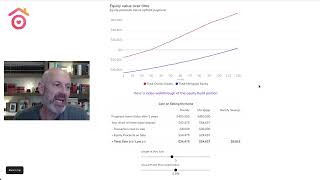
Alright, I wanted to explain evergreen equity and how Equity Build works with Ownify versus a mortgage. This is a really important point to understand, and I think one that takes a little while to wrap your head around. Ownify is an equity-based path, meaning there's no debt, there's no leverage. And leverage is something that, you know, as a mortgage borrower, I think we all understand leverage is great when home prices go up. Because the balance that you owe to the bank on your mortgage loan, the principal balance, doesn't change. In fact, you buy it down over time through principal repayment. However, leverage can also work in the opposite direction, especially for a low down payment mortgage when home values fall. And we've seen that in 2008, 2009 when a lot of the country had negative equity, meaning their homes were underwater. So with a mortgage, you have this effect of leverage on the one hand amplifying your gain, on the other hand also amplifying your loss. So there's this variance in a mortgage transaction through leverage in, you know, how you make or lose money. With Ownify, you don't have that variance because there's no leverage in this transaction for the consumer, which means that on the upside, as home values gain, the customer participates in that appreciation pro rata to their equity holdings. And if home values fall, the customer participates also pro rata, but the customer can never be underwater. They can't lose all of the value they've accumulated. And so in a way, what Ownify does is it puts guardrails on the equity accumulation of the customer. There's a cap on the upside, and there's also a floor on the downside. So we're protecting the downside. In return for the customer sharing the upside. And we call that evergreen equity because it really means that the equity that the customer builds is evergreen. It cannot go to zero. It cannot be negative. Unless a customer really terminates early and is subject to that relisting fee. So what that means in practicality is something that you can play through and run different scenarios on using the calculator on our website. So what you see on the screen here is the homebuyer's tool. It's on our website and you can plug in any number of different scenarios. What I've put in here kind of as a starter scenario is assuming we buy a $400,000 home and it's a side-by-side comparison of Ownify compared to a mortgage transaction. The mortgage transaction here is using the current rates. It's assuming that you put 10% down. It's assuming that we have a 680 FICO with loan level price adjustments for 90% loan-to-value, and the, the FICO score. And what we're assuming here is that the customer holds the home or stays in the home for 5 years. So the length of stay is 5 years, and both of these are things you can change. And to start with, and I just want to illustrate the concept here, we're plugging in zero home price appreciation. So we're assuming that home prices stay flat over 5 years. Highly unlikely that that happens. Realistically, they go up by some marginal amount. They might go down. So what I want you to pay attention to is how these two lines and these two numbers here change. The red line is the equity value that the customer builds after all the transactions with Ownify. The blue line is the equity value of the same transaction with the mortgage, again, after all the transaction costs. And so With 0% home price appreciation, you can quickly see that both start negative. And that's really because transaction costs do take a chunk out of the equity on day 1. If you buy a home and you try to sell it the next day, you lose money. We all know that. Um, but as you hold the home over time, right, right around month 30, you start breaking even with Ownify. And with the mortgage, if home prices don't appreciate, you start breaking even right around just shy of year 10, right? 110, 115 months. And that's— that makes sense because it does take about 5 years to buy down 7% of principal with a standard 30-year fixed-rate mortgage. And if home prices don't appreciate, it takes you a lot longer, including the, you know, transaction costs on sale. So what happens as home prices appreciate is that the blue line— let's see if that— if I can make this work. There you go. The blue line and the red line converge. And that makes sense because, again, the blue line is the mortgage-based equity path. The red line is the Ownify-based equity path. And they start crossing over right around 3%, which is the kind of the long-run average of home price appreciation in the United States. And once you go much past that, the blue line starts outperforming the red line pretty quickly. So what does that mean? Well, not a surprise, leverage, which is a mortgage-based transaction— leverage works really well on the way up. So if you know that home prices are going to appreciate 5%, you should really stretch into a mortgage and put down as little as possible and ride that wave. And that's been what every realtor has told every customer since time immemorial. Now the reality is that sometimes home prices go down, and that's really where evergreen equity comes into play. And where the Ownify model has some real benefits. So let's see what happens as we move home prices into the negative range, right? So now at -1 and -2, you very quickly see how these lines diverge pretty rapidly. The Ownify line stays positive. The mortgage line never goes back to positive. In fact, it just keeps digging further and further. And the reason for that is again that, you know, you buy a home and you have a fixed mortgage balance, but the value of the home kind of decreases, decreases, decreases every year, even if it's only -1% each year. Obviously, you now have an asset that has depreciated. You still owe the bank whatever mortgage balance you had in the beginning, right? And that gap, that negative equity, really starts eating into, you know, into your wallet. And that's been one of the challenges, quite frankly, for folks in 2008, 2009 as they got out of the housing crisis. So if you look at, you know, at negative 1, negative 2, you're now at negative equity, the mortgage $10,000 underwater, $10,000 underwater, negative 3, $26,000 underwater, $41,000, and so on and so forth. And so interestingly, the Ownify equity value obviously goes down as you change from 0 to -1, -2, -3, but it goes down by a relatively small amount. And the reason for that is the magic of dollar cost averaging and not having leverage. So really what Ownify does with this structure, it gives the customer a way to build equity that is protected in both, on both sides, right? On the one hand, it's capped. On the upside. And on the downside, it is also capped. So really we have two guardrails here, as I mentioned earlier, where the customer is effectively buying downside protection by giving, giving up upside potential, right? You're sharing the upside of home price appreciation with a pool of investors in a pro rata fashion. And in return, those same investors are protecting your downside. So again, if you run the range here with Ownify, -5% home price appreciation, the, the total equity gain is still $30,000. All the way up to 5%, you're now at $39,000. So your range is $30,000 to $39,000, while with the mortgage, that range can be negative $56,000 all the way to $127,000. So obviously, that's the impact of leverage, and I encourage you to really play with this and understand it deeply because it is one of the core constructs of equity-based financing rather than debt-based financing. Which is this notion of, you know, sharing the upside in return for protecting the downside. And again, that makes sense for consumers early on in their careers, for consumers without a whole lot of savings, for consumers with good income but not a lot of down payment, right? It's a risk mitigation mechanism, and it allows them to get into the market, allows them to pick a home, allows them to build equity, without incurring the risk of a 98% LTV mortgage or even a 100% LTV mortgage. Again, this is one of the core constructs, super important to understand. Please ping me, watch the other explainer and educational videos, or ping any one of our concierges to discuss this in more detail. Thank you for watching.