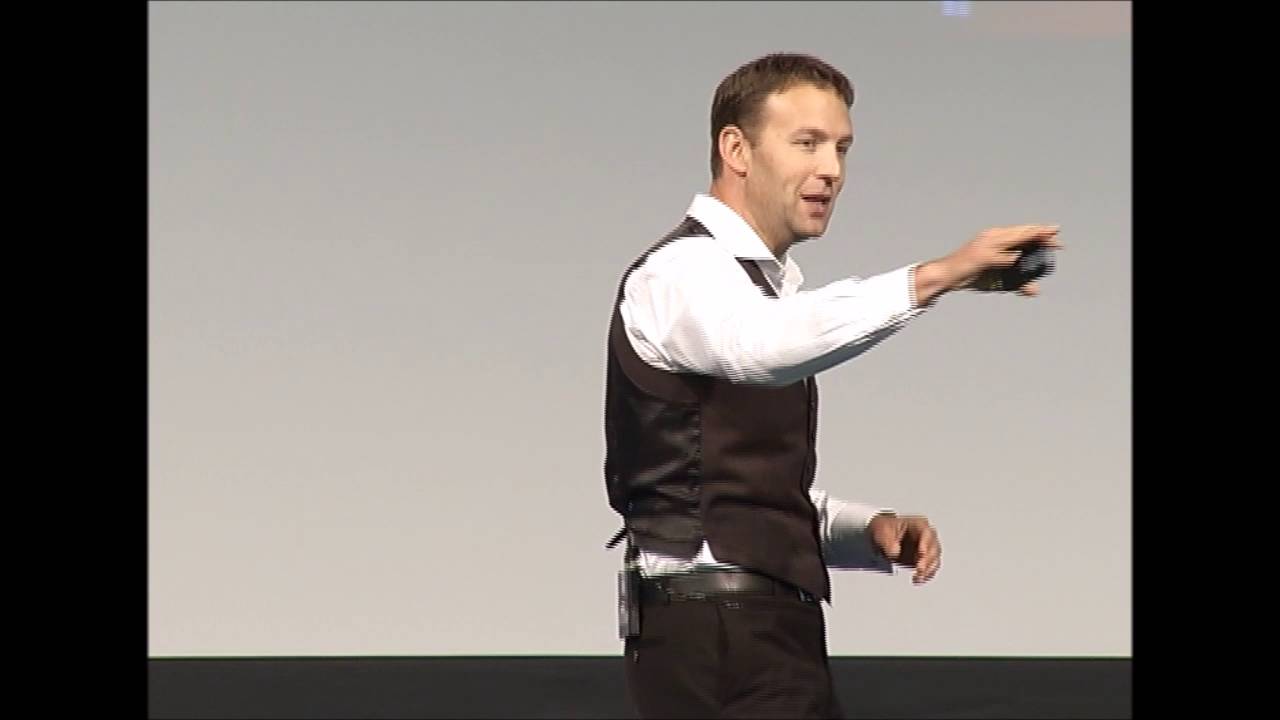
A speaker argues that external motivation fails and true drive comes from within. He maps a continuum from avoiding failure to pursuing success, showing how context shifts people between these states. Michael Jordan's missed shots and Lance Armstrong's cheating illustrate how failure-avoidance breeds mediocrity and unethical behavior.
Chapters
Thank you. I might speak without the mic, is that okay? Can you guys— I can project loud enough for everyone to hear me? Fantastic. Right, so my job tonight is going to be to motivate all of you. Hooray! More red? Yes. I was kinda hoping I wasn't gonna have to put the pictures up to show you, you know. But let's think about it. How am I gonna motivate you? Right? How am I gonna motivate anybody to really do something, to get them to do something? So I've got a couple of pictures and let's see if any of these kind of images work for any of you. So, with a bit of luck, there's the first one. Right? So for those of you who can't see it over there, there's a reasonably fit, Reasonably fit young lady who's in a push-up position and she's saying, the harder you work, the harder it is to surrender. Is that working for anyone? Yeah, fear of failure. Yes, we've got fear of failure. So that would work? Yeah. Alright, but I've got some people over there going, no, that's not it. No. Some people are already hating that photo as it is. Have another glass of wine, you'll be fine. Alright, so that one's not working for you. What about if we use some wording? We'll go, You know, is your 100% really 100%? Don't sell yourself short, guys. No? Tacky. I've put a lot of work and time and effort into this. Tacky. Okay. Fair enough. I've got some more. Don't worry, we'll get this. What about some sticky notes that will go and make things happen? Sticky notes, nice and good? Sticky notes. Love the sticky note? So we've got a few who like the sticky note and we've got a few who are kind of going, just get those things away from me. Alright, we're almost there. What about that one? So if you can't see it, it's the guy from Family Guy, and underneath him he's got exercise, feel the burn, and he's got a flame underneath him. So putting a flame underneath any of you, is that gonna work? No. Alright, you guys are paying me for this. Alright, I think I've got one more. I don't think this is gonna work either. So another saying. Be everything you can be. So how many of you are thinking that? Yes! And that's kind of what I want— and that's sort of the way I want to talk to you about this concept, is that we all think of motivation and when we try to motivate people and we think of all these behaviours that we do to actually try and see if we can motivate somebody to do something. And so we use variations of this. I'm not saying you guys use this, but just think of your own, the types of motivating type behaviors that we use. And you know what? Some of it works, some of it doesn't. But the question is, is it sustainable? Right? When you do something for somebody and you try to motivate them to do something, is that actually sustainable? Do they maintain that behavior when you disappear? No. No. And that's the problem we face. We all think that we're rational. We all think that we respond appropriately. And if you provide somebody with the most logical, rational reasoning, then we will all act in the same way. Isn't that true? Mm-hmm. Yeah, of course it is. You know what the problem is? Who's the CEO? From that picture there, who's the CEO? Who's more likely to make the Who decision? would we assume is the CEO? The big guy. What's really interesting is when they've done studies on looking at both the perception and the reality of the world, is that that's the person people pick for the CEO. In fact, Fortune 500 out of the US, the average height of a CEO is 6 foot 2. Right? Now, now the question is, is that because they were tall because they got it and therefore got the job, or they got the job and then just grew? I don't know. But the challenge is that we have all these perceptions. So the way we view the world makes it very difficult for us as managers and leaders to then say, how am I going to actually motivate and drive performance in others? Particularly when it comes down to the way we predict performance as well. So it's really fascinating. And the research behind this is not great. But unfortunately, it's true. And what we find is that when people are in We have certain population groups who, when they achieve success, gets attributed to luck. And that's the really interesting thing about our world. But even more interesting is when you have people who are in incongruent roles and they perform poorly, what we find the research tells us is that we actually rate these types of people harsher than we would somebody who is in a Dare I say, more gender equitable or gender congruent role. Now, it's not right, obviously, but it's kind of what we do. We make assumptions, we jump to conclusions. So when we're trying to motivate people, it becomes really, really difficult because what's going to work for us is not necessarily going to work for everybody else. And then we sometimes sit back and scratch our head and go, why is that not working? Why have I told this person this, or I did that, and I can't understand? Or it worked for a little bit and then it kind of— It's not working. Went away. Alright, so coming up next is gonna be 5 pictures. You've got about 5 seconds to pick the person who you want to be your leader, assuming you had to pick a new manager. Alright? Ready? There's the 5. So have a quick look. For those of you over there, just get a sneaky view in. 4. 4, alright. Alright, who you gonna pick, sir? Who's going to be your new boss? The rotund gentleman on the left. The rotund gentleman on the left? Very interesting. And why? Why? Just to be difficult. Just to be difficult? Who are you going to pick? I picked the skier. Yeah? You picked the skier? Alright, I'll put it back up now so we can see. Yeah, why have you picked the skier? They look so fun. They look like they could be a fun boss? Alright, guys over there, who have you picked? The skiers. The skiers? Alright, so hands up for who of you picked the skiers as your leaders. Cool. Why? Guys, give us some reasons. Why did you pick the CEO? I like her. She's active. Yeah, cool. Probably a good boss. Maybe. Never know. Alright, so anyone pick the mum? Right, you picked the mum. How come you picked the mum? Multiskilled. Clearly can multiskill. If you've got kids, you can have a speak with her. Yeah, who else picked the mum? Yourself? For that reason that she's very, um, she's smiling, kids are happy, and she's highly organised. Alright, cool. Of course, who picked this young man over here? Anyone? No. Didn't get a gig? No, not to be trusted. No, not to be trusted? Oh, see, now that's interesting. Why not? So of the group, he's the wealthiest. There's something about the smile. Something about the smile, but we made a decision like that, didn't we? Yeah? So anyone pick these 2 guys over here? One of dual managers? Yeah, one of them? The one on the left. The one on the left? Alright, anyone else? No. So the point is, it's not about who you pick, it's just thinking about the way your brains have actually worked and the way you've done that. So for those of you who didn't pick Janine Ayres, she launched Loose Juice and, you know, made a couple of mil out of that. Fortunately, none of you picked the billionaire gambler. So that was a good one. Not sure about you, mate, your boss is Alan Bond at the moment. And so anyone who picked these 2 over here, those are the 2 brothers that came up with Seek. So they— seek.com. And look, if you could all report in to me tomorrow, that'd be fantastic. And we should be fined, but apparently no one's going to listen to me because you all seem to be happy for me to be here. But the point I want to make around this is that So, we make all these decisions really, really quickly. And so when we start to think about this concept of motivation, to me a couple of questions start to come to mind. You know, the questions are, well, what actually motivates you? You know, and it's just a bit of a self-reflection, but to think, well, what does motivate me? You know, and all of you will come up with different things. You'll all think about motivation in a different way. You're gonna go, well, I'm motivated by whatever it is. And I'm motivated by this, but I'm not motivated by that. And I'm not motivated by this. You know, then start thinking about, well, who's the type of person that motivates you? Where does it come from? Is it always a leader? Can it be a peer? You know, can it be a, you know, a celebrity? Could it be a politician? I don't know, right? Maybe not. But really think about, okay, well, who does actually motivate me? And then let's expand it a bit more. Well, how do you like to be motivated? What style kind of works for you? And we start to now realize that we're all really, really, really different. And so do we really think we can actually motivate somebody to do anything? Yeah. So who's actually doing the motivating? Ourselves. Ourselves. Absolutely. And that's the key to all of this, is that the only person The only person who can motivate you to do anything is you. Now what do we then do as leaders? If somebody, if the individual's got to be doing the motivating themselves, what does that leave us as a role to do? I know you're all eating, so I'll answer the question for you. Our role is to provide that inspiration. We've got to give them something to reasons and then allow the individual to drive themselves. But we need to understand the way motivation works. Now, a lot of the theory out there talks about motivation from the perspective of positive and negative. So, you know the old theory, if I provide you with positive reinforcement, what are you gonna do? You'll do the task again. If I give you some negative reinforcement, what are you likely to do? Avoid it. You're likely to avoid it. But let's be honest, hands up who's had a speeding ticket? Right? Keep your hands up if you've got a second speeding ticket. Clearly it's not working. Right? So the challenge we face is that these negative and positive reinforcements, the carrot and the stick that we've often talked about, I don't think necessarily hold true today. And what I'd encourage you to think about is trying to understand what the motivational mindset is by your people and to some degree yourself. I And think that's a really good point. it's a very simple concept, but it's got some interesting challenges that go into it. Because my argument is that if we can understand the motivational mindset, we really will understand the way we can inspire others and the way we can understand how to get individuals to actually achieve their full potential. And it's a simple one. It's a simple continuum. On one side of the continuum is what we call motivation to avoid failure. And on the other side is motivation to succeed. Now here's what's really interesting is that we're all both and at different times and the different context causes us to shift from one side of the continuum to another. So I'll put it in another format so it makes sense for you guys. Who likes public speaking? Who'd like to come up here and join me? I do. Oh, cool. 1, 2, so we've got sort of 2 and a half hands So I'm not making the assumption that the rest of you would be doing anything else rather than getting up there to public speak. Yeah? Fair enough? Okay. Who though speaks to their teams? Who doesn't mind getting up in front of their teams and talking to their teams? Yeah. Okay, so clearly there's not a problem with talking, is there? It's not a problem with communicating. It's not an issue around Expressing yourself. But something changes when we change the context from talking to my teams to standing up here in front of a group of 70-odd people to talk to them. What's happening is we're shifting along that mindset. When we're with our teams, we're motivated to succeed because we're happy to, to accept what's going on. But to put you up in a situation like this where everyone's evaluating you, we might shift. Into that motivation to avoid failure. A couple of little insights to it and then I'll bring this to a close. Here's kind of what the world looks like to us. When we're in this motivation to achieve, to succeed mindset, we're striving for our personal bests. We're task-focused. We're very planned. We're very process-focused, ethical and moral, and we want to display mastery over the task. And the reason for that is that failure is not seen as a good thing. So when we're in that environment where failure isn't seen as a negative, this mindset can really come out and flourish. When failure is presented, we do a couple of things. We redirect our effort and intensity. We increase our focus. This is a big one. We put our hands up and go, I made a mistake and here's what I'm gonna do about it. Has anyone ever made a mistake? Yeah. Yeah. Cool. And you all got sacked over it, you got criticized over it, Pulled out in front of the, you know, at the front and stoned and shamed and you made the— yeah? Okay, that's only the executives. What about the rest of us? That's me. Right? Ownership of error is not an issue, yet some of us fear it. When we're in that mindset, we become so fearful that we could actually put our hand up and say, I've done something wrong. In my experience, those who put their hand up and go, yep, I've made the mistake. Now I'm gonna learn from it and demonstrate my learning. It's very rare that you then still get the negative reinforcement coming around that. And we refocus our intensity. I've got one of my favourite quotes. It's by a guy by the name of Michael Jordan. And I'll read it out to you because I love the quote. This guy was a champion basketballer. And his quote goes, I've missed more than 9,000 shots in my career. That's a lot. I've lost almost 300 games. 26 times I've been trusted to take the game-winning shot and missed. I've failed over and over and over again, and that's why I succeed. Right? And that's that, you know, that's to me, that just captures that mindset, that motivational mindset of wanting to succeed. On the flip side, when we shift unfortunately into this motivation to avoid failure mindset, we're absolutely driven by the negative effects of failure. Evaluation of ourselves by ourselves or by others. So it's either self-driven or it's way external. And we see some interesting characteristics. People want to win at any cost. They want to display mastery over others and superiority over others. Why? Because if I can show that you're going down, then I'm going to be the one that's, that's up the top. I'm going to be winning. But then on the flip side, they'll often strive for mediocrity. Now that seems contradictory. Why on one hand would you wanna display mastery of the task when you're in this mindset? Or strive for mediocrity? And I wrote a book a little while ago, so there's a book in it for somebody who can give me a good answer. Come on, that should be motivation to succeed. Have a try. What do you reckon? 'Cause it's not a giant. Sorry? 'Cause it's not a giant, it's like mediocrity. Do you think so? If I'm motivated to avoid failure, why would I strive for mediocrity? If you strive for the top, you know you might not reach it, so you will be seen to fail. Absolutely. So if you come in just under the radar, nobody ever questions you, nobody ever challenges you, nobody ever says anything, and you avoid this mindset playing out, right? And unfortunately, When you're in that mindset, you lose your team focus. Where it gets— She gets a book. She gets a book, absolutely. You get it tomorrow, come and make sure you remind me. Alright, unfortunately when you're in this mindset and you perceive failure, here's where it gets interesting. These are the individuals, and we all probably caught ourselves doing this, where all of a sudden we start to blame, justify, defend, and deny. It's everybody else's fault, that's why there's this failure potentially happening. We cheat. Now, I come from a sporting background. Many of you would know that. And so it's really fascinating to see some individuals, particularly in that world, as to how the lengths they would go to cheat. Heard of Ben Johnson? Lance Armstrong. Give me this bloke. There, right? I'll go back. I'll come back to Lance in a second because it's a really interesting mindset. There was a successful individual who became so fearful of failing that he chose to cheat. Now, if I'd done this presentation 4 years ago and said to you, Lance Armstrong is the poster boy of this particular mindset, what would you have all said? Not a chance. Not a chance. And that's the problem, and that's the challenge with this process, is that you don't know which mindset your individual is that you're you're dealing with. So depending on where they're at will very much dictate what will and won't work, and therefore your role can't be to motivate them, it can only be to inspire them and allow them to drive. You know, this one that's really fascinating, I love laying this out, and I've warned my kids they're never allowed to use this one, the preempting of failure. Do you remember back at school or at university, you're walking into an exam and you're freaking How many of out? you have ever had a student come up to you and say, I haven't studied for this one. Yeah? What did they say when they failed? Told you so. Told you so. Yeah, I would. What do they say though when they succeed? I'm a freaking genius. Right? Complete display of superiority. And that's the thing we face. So, you know, back to old Lance. The challenge for all of you guys is trying to understand which mindset your individuals are in. But to do that, first of all, is to really think about where are you? What makes you shift? If you can understand that for yourself and recognize there are certain contexts that make you shift, you'll start to get a better insight into where you are so that, you know, hopefully you can start thinking about how do we actually, and how do you as a group, inspire others? Give them the reason and let them And so with that, guys, I'll bring it to a close. Thanks for listening. Thank you. And I'll see a whole lot of you tomorrow clearly inspired to work, so I'm not going to have to do any motivating. So thanks a lot, guys. Enjoy the rest of your dinner, and don't drink too much tonight.