13 Reasons Your Business Needs a Task Management System
This is a YouTube video titled "13 Reasons Your Business Needs a Task Management System" created on August 2, 2024. The content likely discusses the benefits and importance of implementing a task management system in a business context. No conversational elements or multiple speakers are indicated in the excerpt or metadata.
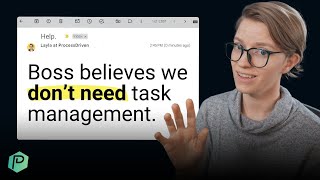
SA we'll be starting here in about a minute. If you're watching on the replay, feel free to skip ahead. We will be starting at 30 after if you're joining me live. Foreign hello and welcome to the live stream. Today we're going to be talking about our boss's hot takes and not the ones you're thinking of. I'm talking about the hot take that we have here on the thumbnail that our boss believes we don't need a task management system. During this live stream, I want to deconstruct why we might feel this way about our task management system and hopefully by the end of this, convince you why you might actually need a task management system and when you do that, how you can actually do so to make it really effective for your team. Now I want to just start off with a quick hello to the folks here in the chat because I saw a comment come in right during our pre show from Charlie that perfectly captures kind of the theme we're going to be covering during the live. So Charlie shares Boss doesn't care about task management because it's faster to just do things from memory. Charlie, I'm so glad you put this comment here because this is the exact scenario that inspired this entire live and we're going to be digging into this claim and how to maybe unpack it throughout this entire live. So let's go in to our little whiteboard for today and we're going to talk about the journey to discovering you need task management. Now, for most of us, the realization that, hey, task management might be helpful is things like TikTok videos or YouTube videos or an advertisement or someone says, hey, you must use this task management software. And somewhere along the line someone on the team starts to question, hmm, do I need that? And they start going through this rabbit hole of what the heck is task management to begin with? When you go through that rabbit hole, you pretty quickly learn that task management systems are agreed upon methods for fulfilling promises. They're useful for any human doing any work that has consequence. Okay, so when you start going down this curiosity rabbit hole, we start to establish this definition of fulfilling our promises is a task management system. It's our method of accomplishing what we say we're going to do. The components of this system are usually a person, some kind of thing we want to accomplish, or a task, a deadline or a date, and a way of notifying others that that thing has gotten done right. We all kind of know what this is by now. There is no question that people need this in their world. Because almost all of us are doing something useful that has consequence, right? If we're doing something useful that has consequences, we need some kind of system to make sure we actually do that. Doing things that have consequence that you actually want to make good on your promises for. So if you have promises, people, consequence, you probably are going to need this structure. So let's dig into this a little bit more. You might be thinking at this point, okay, well, you know, I do things, I work with people, but come on, software, I could just use my notebook. I don't need all this bells and whistles. I can again, just memorize things. Well, let's talk about the software side. And for the rest of this presentation, I want to break down the reasons why the software layer specifically will make your life a whole lot easier that you may or may not realize. Right now we're going to start off with reducing inputs. I've got three different categories though. Let me just back up for a second. The three categories of value that a system can bring to you. Sorry, a software can bring to you is reducing the inputs, reducing the cost, time, labor, all that stuff. It can also help reduce the outputs, or, sorry, increase the outputs, meaning you can do more with the time that you put in, the energy you put in. And it also allows you to reduce risks, those external factors. So we've got three different layers of help we can get and three different ways that you might be able to add some value into your organization by using a task management software. And by the way, if you're in a situation where you are trying to convince your boss of this, this is the section that you'd want to share. Okay, so let's dig into this. The first area where we can go about reducing inputs looks something like this. These are five benefits of a task management system and software that help you reduce your costs. The very first one is quicker communication. So let's just go into a scenario without task management existing. It's actually one we featured here on this channel quite a few times. Let's just take the scenario where we are trying to figure out what is going on. We're trying to talk about a deadline that is important to us. We might say, hey, you remember John? You know John, the one that we're working with on project three one, two. Yeah, can we adjust the deadline on John? Because I actually need to do something else first. That conversation would then be something you'd have on the phone or in a meeting with other people on your team to coordinate about changing a Promise. Because if there's one thing we know about humans is that, you know, we need to change things sometimes. We can't always make good on our. Our estimates. You know, things change. And so we need to communicate that before we have a task management software. This is going to be a conversation that might take five to 10 minutes, but after a task management software is in place, we're able to do this in just one minute. We're able to just write a comment saying, can we adjust this deadline? Or we're able to simply adjust the deadline rather than having to reiterate all of the context you remember, John, you remember what we're talking about. Project 312, not Project 213. We don't have to reiterate all that context. Instead, we just say the thing we're asking to say without all the backstory. So we're basically trying to be a little bit more focused with our time and save energy on each interaction. So if you have 10 interactions a day with other people on your team about projects and you're communicating about anything that you're doing, this is an opportunity for you to save time on every interaction, for every single person. So rather than having to say, oh, do you remember that YouTube video we're filming? No, no, no, not that one, the other one. No, no, the other, other one. Oh, no, you could skip all of that and just leave a comment saying, can I change this deadline? Which is a huge time saver on collaboration. It adds more clarity to the process as well. The next one we have here is about real time updates. I'm going to let this refresh for a second because it seems like every time we go live, something is funky with it. But real time updates is the second benefit. Here we go. Before you have a task management software to figure out where things are at, you need to have a conversation. For example, where do we stand on that thumbnail? Where is it? Did we make it? Do we not? That takes time. It also has switching costs, meaning you're pulling somebody out of what they're actually doing, which is actually productive, to ask them this question about things they already did. Many folks I know use this kind of interaction as the purpose of a meeting. A meeting that might be 15 minutes every day or 30 minutes every week. The whole meeting is just there to say, what did you do? Wouldn't it be great if you didn't have to ask? You didn't have to interrupt someone's productivity to ask how they were productive in the past. We can do that just by Adding in a task management software. Instead of having to have this conversation, we can just look in the relevant spot and see, ah, there's where the thumbnail's at. And we can instead use our conversations we have with other people to, you know, actually have conversations with people. Talk about things that are more meaningful than status reports, solve problems, brainstorm, come up with inventive new future plans. Use the human interaction time to actually interact with humans rather than just report back on data. That kind of instant status update which will save you a ton of time. Just as a rough estimate, I put on here about five minutes per interaction per day per person in a video you'll see on the channel soon. We estimated that if you take about five minutes interacting with every person on your team, that can easily add up to about an eighth of each workday being lost to just checking in on status quo. So that is our next piece Now, Real time updates. Here is one that if you are using a non software, maybe you're using a notebook or a whiteboard, you might say, well, it's kind of the same, it's getting updated in real time and you're not completely wrong. But the speed and convenience of having things updated from each person's personal workstation where they can update it on their phone or from their computer and you can see it from yours without having to walk over to that whiteboard or walk over to that notebook or walk over to the pegboard and figure out where things are at. That is the convenience that we add into this. So so far we've got two similar pieces here. We're basically eliminating communication that doesn't need to happen and replacing it with something a little bit more convenient. Let's go to the next one here, which is reducing pointless pressure. This is a little bit more of an emotional one. One of the costs you may not realize you're facing in your business is this. Ah, gotta pick the kids up at three. Can't forget to get the order out at 2:30. Wait, was it two? Better do it at two. It might have been three. Ah, I actually need to remind John about the draft. I need tomorrow. This narration, this verbal anxiety is the manifestation of relying on your memory to run your business. So not only is your memory being used for your life and your person and your kids and the things going on in your real world that matter, no, you also are letting your business or your job live rent free in your brain as well. And you only have one brain, you only have one memory, you have only so much you can Memorize. And in this before scenario, sure, we've got our kids in here that we got to think about, but the whole rest of our brain power is being focused on work because we can't turn it off. Because if we turn it off, we could forget what would happen if we flipped this? And rather than using, say, 80% of our active memory to remember things for work and worrying about forgetting those things, we could instead just say, ah, all right, my task list looks good. This is everything. Turn the brain off, turn off work mode. Gotta go pick up the kids. And doing this every single workday. This is a transition not just of reduced time, because, yes, it would save us time, but this is also a way to reduce stress, reduce those moments where you have to remember to not forget something. Can anyone relate to that? Maybe it's just me. You know, you know the situations where you're marking a text unread so you don't forget to respond to it later? You remember. Remind yourself with a reminder on your phone to check the email that you saw the other day. This kind of memory burden that we're bringing, especially folks who are parents or otherwise have an ex, you know, a lot of excitement in life, this is a pressure that we don't need to spend in this way. Now, I went over three so far. We've got two more we to do. Just a quick check on the chat. How are you guys feeling with this so far then? It's resonating. I know. For me, the pointless pressure is the thing I felt the most before establishing a task management structure. But maybe for you it's the communication piece. If any of these are connecting, just let me know in the chat. Now I'm going to move on to two additional pieces here. Two additional ways we can reduce the cost of operating and fulfilling our promises. The fourth tip here is eliminating miscommunication. And there are four different categories here. When we speak with humans, we are prone to say one thing, hear another thing, retain another thing, and then feel another thing. So there's like four, five, six different layers of communication happening until Musk figures out a way for the brain transfer chips to work. This is just going to be the reality of working with other humans. But when we introduce recording our thoughts, writing things down, we actually allow ourselves to be more intentional about what we share with other people. So let me show you how this could look. Situations that are done purely verbally tend to cause problems like this. I thought you were doing it. Well, you thought I was doing it. This is a very common One for teams where everybody maintains their own task management system. You know, one person might have a notion database, another person might have a checklist, another person might use a whiteboard. And so each person is keeping their own independent records of what they think is their job and what they think someone else is doing. And so at the end of the day, if something is missed, you don't realize it until the deadline is missed. I thought you were going to schedule the live stream. I thought you were going to schedule the live stream. Wait, none of us scheduled the live stream. We can't find out until it's a big problem and it's far too late to fix it. That is something that is entirely preventable by sharing that information with one another, which is what happens by just using a task management system where everybody can see the shared list. Second thing, double work. This is a particularly painful one for folks inside smaller teams where you don't have a lot of time to spare. As it stands, you're stretched pretty thin, but you really definitely cannot afford to have two people working on the same team thing. Again, they might have their own task management system. One person's working on the live stream, the other person's also thought they were working on the live stream. You end up paying for double work, double cost, duplication of efforts because it wasn't clear who was the actual owner of something. When you're speaking verbally and you say, ha, yeah, we. We really need to get that live stream scheduled. We. Oh, okay, so I'll do it and you'll do it. Then we end up with double work. Yes, we can try our best to communicate super clearly and always remember to clarify who is the owner of each task. But when it comes to verbal conversations, it's very hard to be 100% perfect. It's a lot easier to use a structure or a spreadsheet or something like that where it prompts you to say, who owns this task? Who's responsible for this? Fill in one value. It's a lot easier than just trusting that again, you're going to memorize to clarify ownership. Next piece. I don't remember you assigning that. Did I say Tuesday? Did I say Wednesday? Both of these are examples of misaligned expectations. And if any of you have ever worked with clients, you know that this is usually a big deal for service providers, but it's also a big deal for manager and direct report relationships. I think it's the hermosis who talk about the idea of leadership, really being in charge of accountability, holding people to account. It is a lot easier to hold people to account when they know what they're being held accountable for. And when everything is verbal, it's very hard to what you're actually supposed to be held accountable for. I mean, how, how can you really come back after these. Oh, I don't remember you assigning me that. Well, I thought you did. Can you prove it? No, I can't because we just had a conversation. I say Tuesday. I thought you said Wednesday. Again, you can't prove it because everything is verbal. And they're only working to one type of learner, one type of direct report, someone who's very good with aural communication. And that is not most of us. Most of us are a little bit more visual. So these are some of the ways so far that we can reduce costs by using a task management system. Let's move on to the next one, which is my personal favorite, automating accountability. So again, Chief Accountability Officer, get that mindset in here. Before you have a task management system, you might spend 30 minutes just checking in on whether people fulfilled their promises. This kind of ties into status updates. But you might be having a 30 minute meeting with your direct report, just asking them, hey, did you do all your work last week? Are you sure? Okay, sure. And you just have to take things at their word. You have to waste time talking about it. And if you know there isn't some truth there, you have no way real of know. You have no real way of knowing because there's not a documented truth that you both agree on. Because everything is floating in people's memories which are changing shape over time. Because our memories are not meant to store information long term. And this is just a really difficult way to actually hold people accountable. So after a task management system is in place, we can change this relationship by instead saying, hey, looks like we have no overdues this week. See you next week. Replacing a 30 minute conversation with about 2 minutes of checking people's history inside your task management system and just moving on to bigger things. Again, focusing our time with people on actual human interaction rather than data checking. It's funny to me that a lot of folks when they're resisting a task management system, their reason for dismissing it is because they're afraid it's going to take too much time to write down the task. But if you look at these five things I just outlined to you, I can guarantee you that these things more than outweigh the amount of time it would take to write down take out the trash assigned to Alex and putting it inside a task management system. That is a lot faster than going through asking Alex if he took out the trash, making sure Alex did take out the trash, confirming that Alex knew he's in charge of taking out the trash, and you're not in charge of taking, like, all of that stuff takes way, way, way longer than just writing something down. Especially when you can repeat those things in the future so you don't have to write them down ever again. Okay, I want to go on to the other side of this equation, because it's not just about reducing the costs. You can also increase the output and reduce risks. Is there a question we have here in the chat? Just to check in before we move on, let's see. How can we systemize our task management process? It has many nuances. So process A is different than client X, and process B is different for client Y. Awesome. So in this case, it sounds like B. You're already sold on the value of capturing what you do. So when it comes to actually putting pieces into your system, when there's fluctuation, there are two ways to go about it. You either start templating for each variation, or you build a process that's built for wiggle room. So just like we talked about, capturing tasks to take out the trash. Well, maybe sometimes there's trash, sometimes there's recycling, sometimes there's compost. Sometimes, you know, it might change for a client or for a trash week. I could just say reframe my task to the outcome I want to achieve. Make sure all rubbish is at the street. So that could be all forms of rubbish, and I could have that be my task. Making these general containers and trusting that your people understand how to accomplish that outcome is a nice way to step around areas where you want to be really specific, but you can't be because there's variation each time. In the the trash example, which I know is very simple, I trust that my team, or in this case, my husband, is capable of figuring out what rubbish needs to go to the street. And so that's where I do rely on that working memory. But I don't need to rely on him to memorize when that needs to happen. And that's really where the task management system can help us when it comes to fulfilling our promises. Again, back to just this visual here. What you're talking about, B, is really the nuances of how do we define and systemize what you're doing? That's like a kind of a phase two. In the general view, we want to Just make sure we know who's doing it, when are we doing it, and then we can start getting more sophisticated from there. What are some examples of a bad task management system? Yeah, usually a bad task management system looks like, well, symptoms. Let's go to symptoms first. Symptoms of a bad task management system are you're not fulfilling your promises. Like that's, that's the real stakes of the game. Because this whole system is about fulfilling promises that matter to you at a timeline that matters to other people typically. So if you're not fulfilling your promises and you're feeling bad about it, it's probably a sign that you're fundamental system is not working. If you're starting a lot of things and not finishing them, that's also usually a sign of a bad system. It's not that you're the problem typically. That's because you're starting too many things or starting the wrong things. Number three, if you're doing things, you're finishing them. But then you look back and you're like, wow, I just kind of spent way too long on the wrong thing. I should have been doing this instead. All of these pieces are symptoms of a poor task management system. On the system level of just strategically, how do you approach this? It's not as good as it could be. We have a video coming out on Shiny Object Syndrome, or maybe it just came out, I'm not sure. But that talks more about building that overall system. Other things, Charlie, would be some of the symptoms we talked about on the actual software space. So if you're having a lot of communication about things that are just data, if you're having finger pointing, if people feel like it's not clear what they own, those are symptoms that there's a failure on the software layer of the piece and probably more that you could dig into. But happy to go into any further nuances or scenarios that anyone has here as well. All right, let's keep going here and let's go into outputs. Because it's not just about reducing cost, although you will significantly reduce those inputs. That effort, you can also increase the outputs. So let's talk about some of the bonuses that come with using a task management system that you're not paying more for, but you are getting more out of, the very first one is the ability to spot improvements. Now, I know this one sounds a little woo woo, but stick with me here. It's actually a pretty awesome benefit. Here's a quote. I noticed CX is collecting testimonials every Friday. Could marketing get alerted of the best ones so we can add them to our website on Monday. So our customer team is doing something. Our marketing team could be involved with that and we could turn that into a flywheel for the business. This ability to see patterns of behavior is something that humans are really good at using to innovate. We are pretty crappy as humans, generally speaking at innovating based on things we cannot see. It's one of the reasons why on this channel we talk a lot about process mapping, writing down what you do in a physical format. Because just by writing down what you do, you will typically be able to find ways to do it better. Now that process mapping stuff is great if you make the time to do it, but wouldn't it be even better, such as in this case here, that if you wouldn't have to make any time that just by doing your work, the very nature of going in, doing your work every day you are exposed through kind of like a collision. You just happen to stumble upon things that could be made better because rather than your work just be floating in your head or in Susie's head or in Mark's head, it's actually visual so you can spot the inefficiencies in how Sam is working. On feedback surveys, you can spot the opportunities for using AI when Sarah's answering FAQs. You can identify the opportunities to create flywheels between customer and marketing because you're able to actually see what your teammates and what your business is working on. This is a huge opportunity and a great way to generate new ideas for how to improve other parts of your business. Whether it's improving, reducing inputs, reducing risk, or again finding just bigger moves for the business. Second piece, free lazy training. Woohoo. No. Best thing about training is when you don't have to do it. That's what most business owners believe and I think in this case we actually have an advantage in doing so. When you use a task management system because you are able to see what other people are working on, you are able to have training happen without putting any effort towards it. For example, Suzy's out of the office. Hey Mariah, could you cover for Suzy for today? Mariah would be able to look right at what Suzy's task list is or what Susie has typically done on Tuesdays or Fridays and take over on take over Susie's responsibilities. Mariah doesn't need to have a four hour shadow session with Susie. I certainly don't need to spend multiple hours trying to capture and figure out what the heck does Suzy do. All day. No, the training is built right in to the fact that we write down what we do, when we do it and who does it. And like Bea talked about earlier, if we really want to be on the cutting edge, we start talking about how we start writing down how to accomplish that thing. So not just, you know, take out the trash on Wednesday by Alex, but also here's how we take out the trash. Here's the method, here's where it goes, here's how we sort it, whatever. Definitely more consequential on the business side, but the example still lasts. Training without hours of your time. If anybody here is a business owner. Charlie, I know you said you we were joking that you might be the boss here, but if anyone here is a business owner, just do a quick math of the value of an hour of your time. If you do not have a captured task management system and your Susie suddenly cannot come to work, she texts you at 4am feeling sick, can't come in, gets in a, you know, some kind of crisis where she just immediately needs to be removed from your business. If you need to figure out what Susie was doing, figure out how to do Suzy stuff when Susie stuff happens and give it to somebody else, I would bet you that takes a lot longer. I'm talking hours probably as opposed to if everything was inside a task management system. You are future proofed and people can just look at that task list without your involvement, potentially saving you, I would say two to four hours every time this happens. And we all know the value of especially a business owner's time and the strain that comes with stepping into the weeds like that. So if anyone here is risk motivated or fear motivated that lazy training benefit there is a nice one. Now, lazy training isn't just great for those of us who are lazy and need training. It's also valuable for anybody who is an equity owner in the business. Now this is a bit of an obvious one and maybe more on the owner side than the manager side, but businesses are assets, right? They're entities we're creating. For many folks here, you might be trying to sell your business or get a loan based on the value of your business or, or, or, or in many cases the team that you are building, you're trying to build up the value of the entity. Regardless of whether the team members you have today move on and start their own things in the future, you want the entity you're building to have value. Which scenario do you think is a more valuable business? The H Vac company where it's a team of 10 and each person on that company knows how to run the business, but everything's in their head. Or the H Vac company with 10 people, where all the people are great, but they also have a recorded manual of every single thing that they do, how they do it and when they do it to make sure that their customers are consistently happy. Which business would you rather acquire? Which business would you give a higher valuation? Which business would you give the loan to? This difference between. Between having human memory as the asset that you're renting for your business that will go away as soon as those humans go away, or having value that you own in the business that the business owns, almost like a leviathan. That is the difference between capturing knowledge, in this case tasks and not last piece on the output side, the free things you get at no additional cost for you. Let's talk about reports recording. This one is for the operations nerds out there. Just a quick check. Do we have any operations people in the house or is everyone here an owner? Let me know in the chat. But if you're an operations nerd or a finance nerd, you might appreciate that just by the simple act of tracking your tasks, you've unlocked a rich array of reporting that you will never otherwise be able to accomplish just by surveying people or hoping that folks, timesheets or self reported action steps were correct. These reports could include where time is spent. Is it on marketing? Is it on ops? What specific tasks? What specific clients? How profitable was that client? We'll be able to track how many mistakes happen and which department in our business is contributing to the most mistakes. What kinds of mistakes tend to happen? No way to track that when you're just doing the task. But when you take that additional step to write down the mistake in this case, all of a sudden you have this ability to report built right in with no additional time needed. Next hours work versus hours build profitability. Audit trails. I don't know if you ever worked with a customer where you know they change their mind. You're on a call with them, they change their mind. Or they come to your shop and you know, they say ah, I need this instead of that. If you are operating on a memory based business, you run your business based on memory, then you better hope you remember exactly where that client changed their mind, when, how, and hope that you have someone to to verify that that's true. If you use a task management system in some way, just by creating that task, you have documentation built in. Kind of like lawyers say, the person with the Most documentation wins. Yeah, it's kind of the same when it comes to business. Documenting this knowledge as a habit means you don't have to go out of your way to keep track of change orders. It's just something you always do. And awesome. B, we have one operations nerd in the house. Love it. Moving on to our next one here, receipt of seeing messages. For a lot of folks, we, when we verbally delegate tasks, we say, hey, read the new, new employee handbook. We tell people to do things, we hope that they do it, and we move on. We don't have a way to really know did they do it. Can we confirm in writing that we sent them that information that they signed off on the employee handbook? Without a lot of double checking and emails back and forth, we have no way of knowing. But when you record your tasks, you have receipts built into almost every software out there that, hey, the message was received, it was seen, reminders were sent, all without you lifting a finger. These kinds of reporting benefits, which allow you to understand where your costs are, where your opportunities are, are built in effortlessly to every task management software out there. So that is reducing inputs and increasing outputs. Those are the two categories of benefits that are just built right in when you build out your task management system. But I figured because we're just going to be a little bit extra today, why not also talk about some of the risks we can reduce here as well. And for anyone who's joining us late, I should clarify this whole question of, you know, do we need a task management system? How do I convince my boss that we need it? This was actually a question that came in from a client. And so I'm hoping that some of these arguments and points will help persuade other bosses out there who are struggling to see the value in writing down work when it would be faster to just do the task. That's what we're talking about today. So feel free to add any questions you have in the chat because this is all a question driven episode. But let's dive back in to reduce risks. So some ways that we can reduce risk by having a task management software. Here are four of them. Number one, establish a shared convention for collaboration. So before it might be, oh, no, I did do that idea. I just didn't track it or tell anyone. Was I not supposed to work on that very hard in order to actually work together? When every person has a different task management system, that's what we're getting at here. So one person might start a lot of ideas and not finish them. The other Person might finish a lot of ideas, but they're the wrong ideas. We all, every one of us, have our default wiring around task management systems, probably because of how we went to school as kids, what we learned in college and high school. And for many of us, the way we have learned to manage tasks is not actually helpful to us. We have some predisposition. Maybe it's based on your, you know, how quick start you are, but it's not perfect. It's certainly not perfect. And so whether you're someone who starts a lot of ideas and doesn't finish them, gets overwhelmed by all of the ideas you could do and starts none of them, finishes too many ideas that are the wrong thing or any variation in between. One great way to raise yourself up to be a higher level of yourself, to operate more efficiently and more thoughtfully, is to share, to share what you're actually doing. And that happens just by making a task management system, you are physically showing people, here's what I'm working on, here's how I'm working on it. That gives your manager teeth opportunities to help coach you, to help you become more balanced in how you manage your tasks. It also gives you an opportunity to coach others, to identify, ah, you know, Bob really has a tendency to start a lot of ideas and not finish them. Let me help him with that. Let me help, you know, execute some of these great ideas and so on and so forth. This is how we're opening up coaching conversations by making this very personal system of task management and making it visual enough that again, we can start getting that coaching feedback and start to establish a convention like this one. Here is how we manage tasks at Process Driven. Here's our approach. Here's how we keep ideas from not being done unless they're worth doing. Here's how we focus our team. When we are unfocused as an individual, it's an individual cost. But when a business is unfocused, when a business is unclear as to what should be worked on next, it is an enormous cost. It's very expensive and you don't make a lot of progress for it. And you can hurt your profitability for it as well. So why not establish that convention that allows everybody to meet their promises, Especially if fulfilling your promises is a core value of your business. Next, reducing risk rather than person dependence. Let's build process dependence. So this is another angle on the memory liability piece. So before we had a task management software, it might sound something like this. Hey, Chuck, Sorry, I know you're on vacation, right Now. But I just have a quick question about how we go about invoicing people. What's the problem with this? Besides that this is not how phones look anymore. The problem with this is Chuck is on vacation. Leave him alone. He needs a vacation. Why is it that in order to operate our business, we are reliant on humans to be available every second of the day? I mean, I'm assuming you want your business to be able to operate for 100 years, 200 years. Maybe you wanted to operate seven days a week. Maybe you want it to. You want your business delivering a good experience every day. You don't want your business necessarily to go on four weeks of vacation a month or more month a year, do you? But at the same time, it is reasonable to expect that during the summer you might have four weeks of vacation of one person leaves for two months, one leaves for one month or one week, you are going to have that absence happening. Why would you want your business to be, you know, say you have a team of four and one person's on vacation. Why would you want your business to be 75% functional when that happens? Seems silly. The only solution to get back to 100% is to call that person on vacation or not let them go on vacation or be okay with compromise. Quality. That's terrible. We don't need that. What would happen if our business could be at 100% capacity even when two people are not here anymore? That's what starts to happen when we record what we do, how we do it and when we do it and who does it. So our alternative here is rather than calling people on vacation, being unable to leave, being unable to be dependent independent of an individual leaving or being on vacation. Just read the sop, read the standard operating procedure, tell people, here's how you do the thing again, putting that value and dependence on the process, the value in the business rather than putting all of our value in the worst possible states. Space to store long term information the human brain. All right, let's keep moving on here. We've got two more pieces. The next risk we can reduce with having a task management system is the ability to forecast and far more accurately than just relying on your human memory before task management system. You might find yourself in meetings asking, hey, how's your capacity? Can we add a client in January again? Conversations risk afterwards we can just check the report and make a decision based on data. The reason this reduces your risk is because the worst thing you can possibly do is ask someone who's a chronic over committer and people pleaser. Hey, can you take on another client because you know what they're going to say. Yeah, yeah, sure. Now you've just enabled a position where your business is over capacity. So you have too many clients then you can support and deliver a quality of service to. That's going to hurt the business reputation over a lot over time. Probably going to result in missed deadlines, definitely going to reduce and increase or result in increased stress. You have enabled the destruction in some ways of your business reputation and stress levels. Just because rather than trusting data and observed behaviors and facts to make decisions about the future, you've relied on one person's subjective opinion about their, their, their future forecast when that person is probably operating on a week to week or day to day basis. They're not even thinking that far ahead yet. Rather than just relying on a one, you know, one question, let's do a balance. Let's have data to say, hey, I can tell based on how long projects typically take us the number of tasks it typically requires to deliver a web design project. Based on that, we have capacity to do two web design projects at a time. I see this project is on track to end at this date, so we can start the other one on this date. I'll put a little buffer in there. Does that work for you? All of a sudden we're reframing this and rather than putting all of the burden on a person to accurately predict which humans based on that, we have capacity to do two web design projects at a time. I see this project is on track to end at this date, so we can start the other one on this date. I'll put a little buffer in there. Does that work for you? All of a sudden we're reframing this and rather than putting all of the burden on a person to accurately predict which humans aren't great at doing, accurately predicting how we're going to feel in three months, we instead make our decisions based on facts of what we know our business can successfully deliver in a time period based on actual capacity and numbers. Again, something that is only possible when we start tracking information. So check, report, make decision, avoid being over capacity and under delivering. Avoid being under capacity and hurting your profitability. Final piece, most important piece, reducing mistakes. And then we'll go into some Q and A guys. So if you have any questions, go ahead and put them in the chat. We'll do some Q and A. I've got a few points here at the end and then we'll go into that. But final area here is reducing mistakes. When you have a task management system, a mistake happens in isolation. And isolation is a very good word for it because odds are, I know for me, when I've been on teams where there was no task management system, I made a mistake. Gosh, maybe my manager notices. Hopefully she doesn't. And I just scramble. I work my butt off to try to get that mistake done. Maybe if I feel brave, I'll mention it to somebody after I fixed it. But, you know, the whole incentive system is around making sure that mistake is unnoticed by anybody. Right, because that's what a good employee does. What would happen if we reframe that? What if rather than mistakes being something that we want to sweep under the rug and hide, mistakes are things that we expect to happen. In fact, we encourage the tracking of them because we view mistakes as opportunities to improve which fun fact they are. They're the best possible data you can get on how your business can be stronger in the future from an operations lens. So instead of this kind of flow, we start reporting on mistakes when they happen. We put them in a task management system. Just by putting them there, we get those benefits of reporting we talked about before. And we can then say, hey, Here are the 93 mistakes that have happened this year. How can we prevent these in the future? The conversation transitions. And this is actually something here at ProcessDriven we do do on every single issue task independently. And also at the roundup at the end of each quarter, we also recommend it to clients because using your mistakes to create preventative actions to prevent that particular problem in the future is a brilliant way to make sure you're solving for real problems and making your business stronger, which you cannot do if you're not able to see these patterns. You know, we've had issues, or not issues, but situations here at ProcessDriven where we've had, say a link is broken, okay. And we've had. I'm going to call it the Charlie's Charlie response. Sorry, Charlie, keep calling you out. But we have the Charlie response of I don't need to write down that the link is broken. I'm just going to fix the link. Okay? So someone this. This actually happen. Someone would just go in, they change the broken link, problem solved. Right. They would never write it anywhere. Even though we have a task management system. They would default to the Charlie response because it's a very natural human response. Then what would happen? Well, team member number two would notice the broken link. Hmm, weird. Team member number two would make the same decision to go in Just change the link without tracking it. Hmm, strange. Team member number three would then also go in and see a broken link in another page and realize, okay, gotta fix it. Fixes it right there. It's not until the third person who goes in there fixes it and makes sure to create a task do we come to realize that the links being broken aren't a matter of just a broken link. It's actually a pattern of behavior. The issue is caused by some downstream result of like the domain being broken. Something big had gone wrong and it impacted all of these links. But because each person was so focused on the convenience of solving this one symptom, they saw and didn't see the value in tracking it. We weren't able to discover the pattern. It took us maybe days to discover the pattern of behavior when we really could have discovered it in just that first interaction if someone had logged it. But when we keep our mistakes in secret, we have no opportunity to see when symptoms might be the symptoms of a larger problem. We deprive ourselves of that awareness because we're keeping things in secrecy. So that is kind of a real world example of it that maybe some of you can relate to when it comes to puzzles in your own business. Another one, just give you one more because why not? Is like client questions, client asked about, oh, how do I use this thing you teach? If you don't realize that 10 people are asking that same questions, how can you improve the way you teach that thing in the future? All right, so reducing mistakes and overall improvement. Now, I've got some three final thoughts here, but I want to open up to some questions before we do. Are there any questions at this point? No questions. Once. Twice. Oh, one. Hey, Charlie, I'm glad you don't mind me picking on you today. Is it better to consolidate task management into one system? To rule them all, or to handle tasks based on the medium, Submissive for emails, business management system for operations, and so on. If you're watching this live stream from the perspective of you have never had a task management system before and this is the wild west for you, you've never shared one with your team. Maybe you have a notebook for yourself or sticky notes and that's about it, I would start off with one just because it'll be easier to build the habit with less complexity. So start off with one. If you're going to pick one, I would typically suggest a business management or work management system. Just a simple way to track tasks. No fancy nuances or databases. Just here's the task here's who's going to do it by when. There we go. Over time though, I think as a team matures and you get comfortable with that, you can use that system. I think a lot of teams will end up adopting some more purpose built areas because they're very comfortable using the system. They're now skilled enough in that practice. That's an easy enough habit for them that making the habit a little bit more complex isn't going to make or break it. So we can then say, hey team, if it's a task, put it in ClickUp or smartsuite or whatever it might be that you use. And if it's not a task, if it's an email, put it in missive. We can start to make those kinds of rules to make the system more complex and more purpose built. But it's not something I would go into just from the beginning because I think it can be a little overwhelming for folks. But that's exactly what we do here as well. Awesome. Great. All right, now I have some final thoughts here. If you guys have questions, please feel free to put them in the chat. Happy to answer them here, but three final thoughts. The purchase alone doesn't make a system. Okay, so we've talked about at the beginning of the stream a system versus a software, how they're different things. The system is how you're doing things. The the overall methodology, which could include software but could also not. The software is the place you actually put the system. That's where it makes it visual. Right? Just buying a software without thinking about your system isn't going to do anything except cost you money. You don't need to buy a new fancy software. It's like you don't need to buy shoes to go to the gym. You don't need to buy a new pair of sneakers to go to the gym. Shoes you have will work just fine. And in the same way, buying new gym clothes is not going to get you to the gym. All it is is going to give you more gym clothes. If that motivates you, by all means. But it's not in and of itself a solution to actually make your task management structure work, you need to set it up properly and use it fully. So we have a free resource I'll mention here in the chat, but the snapshot so we have a quiz you can use to actually assess how thoroughly you are using your task management structure and your overall systemization. It's a free quiz, but it's a good benchmark to just let you know, especially on this task execution front, how thoroughly are you actually using the system you have? For so many people, they have a software that they are hardly utilizing and then they're thinking, oh, God, asana doesn't work, when in reality you are not working Asana. And yes, the software can make a small difference. But onto this next point here, the software itself rarely makes a significant difference. If you have a working system inside of todoist, by all means stick with todoist. Switching to ClickUp or to notion is not going to transform how you track things. In my experience, the software component is about 20% of the value. Yes, it can be very pretty, 20%. If it makes it aesthetically pleasing to you, it might be worth it. But kind of like the workout clothes you choose to work out in, the real value is the workout. In this case, it is the system you have for how you do things. And then the software just enables you to do more with that so you can have more transparency. And all those benefits are more visual. But which software you choose is not going to make a huge difference in terms of your productivity or any of the results we've talked about here. Last one, and this is an important one for folks who are going through a migration and experience some pushback from their teams, reliance on software generates the value. Now, this sounds like a contradiction to what I just said, but stick with me here. You are not going to experience all of these benefits I've talked about. Go into some of these here, right? Went through what, ten different ones here. You are not going to experience all of these. The minute you set up your task management software, it's not going to be there just from default. You have to set it up, right? And even once you set it up, even if you follow the snapshot here, you work with us at ProcessDriven to set up your task management structure. You've got it all cooking. It's still alone. Not going to generate this value because there's one missing piece. Reliance here is a metaphor. I'm going to try to stick with you here. To help explain why this reliance matters, I want you to picture yourself snorkeling. Now, I've never really snorkeled. I've gone once and I think, think just once. And it scared me. I was very scared to snorkel. I had like the little mask on and it was like, you know, the thing, the tube that sticks out above the water. And the whole point of snorkeling is that you can breathe through this tube while you're underwater. How cool you probably knew that I, I didn't at the time. So I'm going into the snorkeling thing terrified. And what I noticed myself doing is because I was so unfamiliar with the snorkeling apparatus, I held my breath, I was underwater, had a snorkel on. But rather than breathing through the tube that was set up to allow me to be like a fish, I was too used to the easy way, right? The convenient way of breathing normally. But I held my breath underwater and I came up for air and I was like, everyone was still under with their snorkels on. Because other people had quickly developed a reliance on the snorkel. They're actually using it, they're breathing through it, and so they're able to do more than I am. But I can sit here and say to you, well, I don't need to snorkel. I can hold my breath and go underwater. It's easier. It saves me so much time. I don't need to put the snorkel on, I don't need to buy a snorkel. I just swim underwater. Maybe, maybe I even practice a lot so I can hold my breath for a long time. Do you see the similarities here? When it comes to task management systems, it's like a snorkel. Your memory is your oxygen. I could have a really good memory, I could hold my breath for a long time, and I could probably go underwater for a fair amount. Keep up with some of the snorkelers. It saves me time to just memorize things. But if I embrace this equipment that is purpose built to make this part of my life easier, I don't have to become someone who can hold my breath for minutes at a time. Instead, I can just trust the tool. The equipment will help me do that, use it, start being reliant on that. And once I actually trust it and not just hold my breath, I can stand your water. Instead of two minutes at a time memorizing, you know, 20 things at a time, I can hold my breath for infinitely, you know, I can be underwater for an hour. I can memorize, you know, equivalent. I can manage 350 tasks in my business. That is the difference. It's a snorkel. I don't know if this metaphor makes any sense to you guys, but to me this is a pretty good summary of the balance of this. So if you are implementing a new software plan on two months for someone to feel comfortable using the software daily, at about two months, your average user will feel comfortable using it. That's just What I've found working with folks on migrations, at three months, pretty much everybody will be comfortable. Maybe not loving it, but they'll be comfortable. At that three month mark, it is like me holding my breath under the water. I know how to use the snorkel. I'm using it technically, but I'm still holding my breath. So is at that mark, two to three months. Should I say that the snorkel doesn't work because I can operate without it? No, give it time. Six months in to a new software. When we actually trust that that structure is there, then that reliance is probably built on average. Right. Six months or so. By 12 months, we'll be snorkeling so long, we can't imagine ever holding our breath again. Maybe we'll start scuba diving at that point, but that is the transition we have. So if you are someone who's going through, like the client who originally asked this question, you're going through a migration, your team's using the new software and you leave and all of a sudden they stop using that software and you're questioning, man, does the software still have value? Do all these benefits that Layla just went through, do they still matter to us? Maybe we're just so good that we don't need it. Relax. Because you're still in a position where your team is holding their breath instead of actually snorkeling. Doesn't matter that the snorkel equipment is on them. They're not using it yet. They're not relying on it yet. And. And until they rely on it, they'll never extend past their own memory. And right now, in this moment where you notice no difference when you stopped using network management software, the reason you notice no difference is because they weren't using it, they weren't trusting it, they weren't relying on it. So anyway, there's my little rant here. And we'll just put that snorkeling up. Let's answer some questions here. Curated productivity asks, how do I build a task tracking habits in. In isolation? I feel like I would benefit from the accountability of a whole team tracking task. But we're not there yet. And I find it difficult to be consistent. That's fair. And for whoever the, you know, the team that you work on, I think this is a great point to raise with them. Not that I'll still give you an answer, but I would encourage you to talk about this with people because odds are you're not the only one feeling this way. You're not the only one who's seeing some of these benefits and thinking, wow, that would be nice, actually. I'd love to not have to worry about all this. And sometimes just that conversation can get other people snorkeling with you, which makes it a lot easier to feel comfortable snorkeling. But on the personal note, can you make a system that's just built for you and a software that's just built for you? You absolutely can. It is less you lose out on some of these values because you're not able to collaborate, but you still get the benefits of, you know, reducing the amount of memory you have to use, reducing that stress, reducing that pressure. But you do not get, you know, the extra added bonuses of being able to collaborate with other people, get status updates, all those other pieces you kind of miss out on. So I think as an individual, I would say you can probably get about half the benefits of a system. You can build these habits in yourself, but you miss out on the ability to be coached, the ability to communicate, and the ability to work together, which is where task management systems really go above and beyond. So definitely do it if it's just you and you think it would help you give it a shot. But I would, I would definitely second your vote of having full team buy in as well, because that's where the real that's where it becomes ridiculously valuable and why I made this video and yes, dropped the mic B Because I think any team out there, you know, three people or more, even two people or more, any team out there, the value that you stand to gain by actually documenting what you do and sharing it, like curated productivity is curating in their corner of the Internet. That is the value that you stand to gain is so ridiculously high that if you are still on the fence of it, maybe you just don't like to be efficient. Like you just want to throw away money. If that's your case, sure. But in other cases the arguments are pretty clear that any entity that's looking to actually fulfill their promises together will benefit from this kind of work being done together. Imagine that. All right, that's it for my snorkel parties for today. It doesn't look like we have any other questions in this stream, so please just a quick reminder, check out the snapshot. We have links here. If you want to assess how fully your task management system today is functioning, not only will it evaluate you on task management, but also some other nerdy areas of operations to help you evaluate how systemize your business is overall. And thanks so much for watching this live stream. This is a little bit different. If you enjoyed it, leave me a comment on the video like and subscribe while you're down there. This was a bit of an experiment for us, but if you like videos and, you know, casual rambling streams like this and long metaphors about scuba diving and snorkeling, happy to produce more. So thanks so much for watching and until next time, enjoy the process. Bye bye bye bye bye bye.










