#157: Why Agencies Struggle to Scale (and How to Fix It)
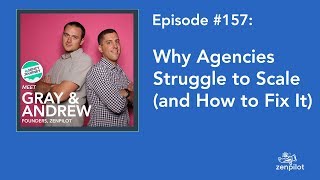
Podcast episode (#157) where hosts Andrew and Demer (Zenpilot, formerly Guava Box) discuss why agencies struggle to scale — founder bottlenecks, processes stuck in people’s heads, and the difficulty of scaling growth and delivery simultaneously. They present a three‑phase remedy (clarify offer and unite core team; prioritize and implement processes, systems and operational rhythms; build focused growth/sales tactics including discovery projects) packaged as the Zenpilot Agency Accelerator, and invite listeners to zenpilot.com for free training or a strategy session.
Chapters
All right, welcome back to episode number 157 of the Agency Journey podcast. This week you've got Andrew and I here once again, and we're going to be talking through. So a couple weeks ago, we shared about our rebrand from doing Bound to Zenpilot, and we talked about the journey to get to that point. And so today we're kind of picking up. And this is part two with part of why did we make the switch? Not from an internal perspective, but from an external perspective. Why are we rebranding and repositioning the business then? Also, what exactly is Zenpilot now? Because that comes up all the time. Zenpilot is not a very literal name here. Dimmer. It's not Bob Jones Plumbing, Bob speaking. So let's jump into that here. And what I want to do is kind of start off from your perspective, Demer, with the problems, the initial problem we were trying to solve and what that problem, like, what we've learned about that problem that agency owners run into.
Yeah, I think the core and like, what set us on the whole journey from the early days at Guava Box is, is how do owners make the transition of, like, having stuff trapped in their head or having, like, even just a core team? Like, say you've got five people in your team who are just like your core group things hum, because all of those people are involved. But there's like, this. There's an uncertainty there because if you want to go on vacation for a week, you can't because you're the bottleneck. If your head strategist takes a job at another agency and they get sniped, like, that's a huge derailment for you. And so it's like, how do we make this transition from having processes and procedures stuck in the minds of our team to having a system in place, a system that we can home and run and get better with time rather than, like, when you're. When you don't have this stuff in place. Like, the more clients you bring on, it's like you're a truck stuck in the mud. Like, the more you press the gas, the deeper the ruts you're digging. But how do you build an agency that's the opposite. That, like, the more clients you bring in, the more team members you bring in, the stronger things get. Like, the more the system hums and runs in that state. So, like, that was our vision. That's what we wanted to build at Guavabox. That's what set us out on the whole journey to build. Do Inbound is build a tool that solves this problem. Well, 950 agencies later, we found out that the tool is not nearly as important as the process that you follow. So.
Right, that's definitely true. And we've seen so many times, look, the things that you just mentioned with the vulnerabilities, you don't really think about until you get to them. As far as having someone get taken from your agency, we talked with Remington Bag from Impulse Creative about that and so many other people. And I think the reason that you don't, early on, you're not a large enough agency or successful enough that anyone would think to look at your agency. So obviously you're kind of like, we were immune to that. And then all of a sudden, as you start to grow, realize, oh, now that we've established our name and our brand a little bit more, it's not all just gravy that comes along with that. There's also now you're the agency that people want to take people from and come in and make an offer to take your people. And so I think you need to be aware that this isn't like, well, that won't happen to us. I have heard about that happening to other agencies. But, like, that we're different. Just like every business owner, you're not different. You will run into these problems at some point.
I think it's like there's. Agency owners are like a cook in a restaurant that has six pots on the boil at any given time, and they're only paying attention to the one that is boiling so fast that, like, the water's kicking out. Like it's landing on the burner, like fires are sparking up. So you've got, as the owner, like, you think, oh, these other five pots, they're fine. But what you don't see is, like, beneath that lid, like, the water's heating up in there, right? Like, steam's coming out the sides. And that is your team. Like, your team, when they walk in, like, they've got a different mindset than you do as an owner. You know, like, you and I, like, we can balance a lot. Like, we can pull off one hat, put on another really quickly because we want the business to survive.
Like, right.
I was on a sales call with an agency owner in Australia. He's up at 5:30 in the morning because he wants to talk about these types of problems with us. Like, that's commitment. You're not going to get a team member to do that. You know, most times because they've Got a different set of priorities. So if you're trying to juggle all this stuff as an owner, you get to a point where you feel the strings start to tighten, and that's that point where, like, is something going to fall through the cracks here? Like, what happens if that strategist does walk away? Like, that keeps you up at night. Like, that's your business walking out the door. And that's, I think, one of the biggest lessons that I've learned over these years, Gray, working with agencies, is that the people in the room, how they solve the client problems, that's the business. You know, it's not. It's not like we do these lists of deliverables, but it's like you get. You sign up a client, you say, okay, now it's time to deliver. Like, this is where the rubber meets the road. How are we going to make those promises that we made in the sales process a reality for that client? Like, do we really want to help them grow? Are we committed to this thing? And then how much are we willing to invest in protecting this agency that delivers these outcomes that we just sold? And when you, like you just said, like, when that first person walks away, like, that's when it hits you in the gut. You're like, dang, like, I'm insanely vulnerable right now. Most people don't even realize the risk that they're bearing because of this stuff.
I think almost nobody goes into an agency for the first time, at least, with any kind of realistic understanding of what it's like to try and balance. Well, first off, any understanding of a lot of it. If you're in our situation, probably most people go in a little bit more eyes wide open than we did when we do it. Hey, this would be fun. We've got a skill set that could work, and we like to work together.
Three blind mice.
But an understanding of the realistic challenge of trying to scale growth and delivery at the same time, we think about. It's easy to look at a business model like the marketplace model. And maybe it's just because I've heard so many pitches for marketplace models that I'm just a little bit more skeptical. Unless there's some really big differentiator now. But it's easy for me to look at that and see the challenge of, like, well, you need to somehow scale your demand side at the exact same time that you're scaling supply. If you're going to have a viable marketplace, if you're going to be a valuable marketplace to anybody here, you have the Same problem in the agency space, where it's not that you just have enough supply as demand gets uncovered, but you need to create that demand and go find those clients. That's a full time and a half job. And then you need to deliver all that stuff and to try and manage that and put that all together. And then you're doing all this with very low budget, with, you know, all the other challenges that get put on top. But I think scaling those two things together, the fact that you need to do that isn't something that. Because most of the times it starts out as one or a very small team of people, co founders, starting off an agency and they can deliver all the work themselves. And so it's like, we can sell as much. We don't have any. There's no, there's no utilization right now. So we can sell as much as we want. And then all of a sudden you get over that initial, like, we sold some stuff, now it's time to onboard people. Now we've got a scale, a whole delivery side of the business at the same time that we keep selling. Because now we need to justify bringing on these additional expenses. Yeah, how, like, how are the best agencies solving that problem? And not like way down the road, but how are people getting over that hump? Or how should they get over that hump?
Yeah, there's like, there's two pieces there. There's demand, there's just growth, and then there's delivery. Those two things, I think when I came into this, I thought of them as like two separate silos. But now we see this over and over again. They're like your growth, your delivery, your operations. Those are the three pillars of your agency. And some agencies have two of those things aligned really well. Like they've got delivery and operations down. Like the owner's an implementer. Like, they've got a tight checklist, tight process, like beautiful design. Their clients are super happy, the three that they have, but they can't scale that because like their growth section is like way out of whack. Or you could mix and match any of those three together. What you need to grow a successful agency that's not relying on any individual person is like synergy between those three. So that your growth, your ops, your delivery, like they're all humming together. And the way that I see that happening is aligning the vision that sits on top. And that's the thing that no one talks about, because everyone talks about, like, what are the tactics that you are using to drive new leads? Like you need to do, you know, this type of LinkedIn outreach or you need to set up these kind of lead nurturing emails, or you need to go to these events to find the people. Those are all tactical things. Or that's on the other side. Like these are the Facebook ads you need to run. Like these are the campaigns you need to run to get the fastest results. Like all that stuff has its place, but it's completely out of line if you think about that before you think about who are you trying to help? Number one, what's the costly pain that they have? Like what's the outcome that they're striving for? Like what's the thing that keeps them up at night? Because when you're talking to an owner or you're talking to an owner of a potential client, they couldn't give a rip about your Facebook ads. It couldn't give a rip about your ebooks, your blog posts. How sweet HubSpot is. Like they don't care. They don't care. They want to grow. And whatever growth looks like for that company, that could be higher cart value of its e comm, it could be a higher close rate for their salespeople, it could be more leads on the plate for their inside team. Whatever it is for that company, that's their desired outcome. So who are you trying to help? What's that desired outcome? And then how do you help them? You know like there's from the process side of things, this is where we saw so many people drop the ball. Getting do inbound setup is they try to document processes for absolutely everything and it goes one or two ways. One, they spend forever templating stuff and they never actually go to market with it. Or two, they get overwhelmed and they say I need to do this someday but today I got to get this ass done. So I'm just going to throw this in here like this and I'll do it tomorrow. Tomorrow never freaking comes because they missed that third piece. Like the specific scoped solution to the costly pain for the person you're trying to help. When you narrow your focus down as a team to that, that's when you become world class. Like that's when you can start building a system that can hum without you. But if you don't, you're trying to document processes, that's like just, I mean go to digital market or go to HubSpot blog. Like there's thousands of processes that you could template, right? But you only need like 50 of them or like 40 of them like to really run a solid business. So that's, that's what so many people are missing. And that's, that's what's so frustrating for us running the side.
Right. We see it relatively often if you're going through and working with an agency and what. And you want to see what they have because some people come in and would say, well I already have all these processes documented. We don't have. And you ask about how many and try and do some analysis of what they actually have documented and to see people who have. And we made this mistake at Guava Box too. We didn't document like we did get most of our high impact things, but we didn't get all of our highest impact processes documented. And so you see these document lists where it's like here's how to set up Google Authorship on a website back in the day. Well that's. You're going to do that like once for every client and it's about 10 minutes to go do something like that. Like this really doesn't take that much time and it happens very infrequently and the client doesn't care about it and the impact is pretty marginal. Why did you spend time documenting that versus prioritizing what you document and getting building a focus list so that you don't get overwhelmed. There's a clear. Here's where we start with the highest impact items and move down to the list. So with all these pains and we can go on and on about the pains. I mean you've got that the agencies who always feel like they're like the pot analogy I think is a good one where like I'm going to go focus on this. And that's why you've got the stair step approach to growth that's super common for the agencies who do grow. There's always going to be some level of stair steps because you can only focus on one thing at a time. But the very high stair steps are the ups and downs. We focused on sales and we grew revenue and then we had to try and deliver it all. So we put sales on hold and so we finally caught up to delivery and we would have liked to start growing in here, but we had to keep going because now we had to restart the sales process and then we get back up and then we oversell and then we've got to come back and now we're losing clients. Like the scaling piece is hard and it's just juggling back and forth between the different pots. So let's talk here because we could Ramble on for a long time about what we are doing at Zenpilot to solve not all of those problems, but like our specific solution for people.
Yeah. After working with all these folks and what's cool about running, doing that was a process and project management software. So we're behind the scenes with folks seeing how the system runs and we see the same problems coming up over and over and over again. And so what we've done is we've got a three phase process boiled down to take you from this kind of state of chaos where you're not sure which pot is going to boil next. Like so many plates spinning, something's going to fall through the cracks. And you can be a five person agency and have this problem, or you could be a 20 person agency and have this problem. Like there's a misconception out there that if you're big, you've got your S together and that is false. There are some big names out there that if you go behind the scenes, like you don't want to see that kitchen man. Like it's crazy. So if you're small and looking at the big guys, don't think that they've got it all together. And if you're big, looking at other folks, like these are common problems. Like these are things that are hard for entrepreneurs to implement. Which is why, like why we build a program that walks you through it step by step because it's not rocket science. But if you focus on the right things at the right time, in the right order, it can transform your business. So we start up at the top, which is like, what is your solution? What is your offer? Get your team united around those things. There's three phases to that process of honing in on exactly who are you going to help? What's their costly pain? How are you going to help them? And figuring out as a team, what's the agency going to look like to get us there? Because until you've got synergy on that core team, it's just top down. As an owner, it's your responsibility to unite the core team around you, whatever that core team looks like in your agency, so that everyone around that table is like marching to the beat at the same drum. Because if you just come in and say, here's what we're doing guys, go do it, go make it happen. Like they've got no skin in the game at that point. The best way to activate your team and unite your team is to get them to feel like, I'm heard here, like I my Opinion matters. Like, now I'm ready to go. Essentially strap up and go to war. Go to battle with these guys. Like, let's do this thing. That's our first phase. Our second phase is when we get into processes, systems and rhythms, which is like what most people perceive as the problem we start first with. Like you mentioned, what's your deliverable menu? Prioritize that thing, order that thing so that it's all. You have it on one sheet of paper. What deliverables do you use most frequently to get your. To get your clients the maximum results? What deliverables do you need to prune? Do you no longer offer as a team because you're not good at them? What should you be outsourcing to other people or just tell the clients to forget about? Then it's moving in and templating out. Like, what? How do we do these processes? Running them inside of a project management tool inside our program. You get an amazing project management tool loaded with templates. Like, we cut that learning curve down because we've got all the processes as a baseline for you. Then we move into the implementation piece, which is how does the team now run the system that's been documented, those key rhythms to get everyone to buy into this thing over and over again. Because processes aren't something you're like, oh, I documented them, now slide them up on the shelf. Like, check that box. No, like, processes need to live where work is done, folks. And you need to bring the team back into these core rhythms every single day, every single week, every single quarter, twice a year, to keep the system running. So we hit on that there. And the third phase is the growth phase. Like, how do we craft a clear message that resonates with the costly pain that the prospect has? How do we shorten the sales process? How do we lead in with a discovery project that's a small term commitment that leverages the risk on our shoulders rather than making the client assume the risk of trusting you enough to sign up for a year or six months worth of work when they just met you last week? That last piece of the process, the game plan piece, is so sick. Like, we had a student come in a couple weeks ago, she had never sold one before, sold one for 12 grand, just like that. So that's like instant cash flow into the agency. And. And you get to demonstrate your stuff. Like you've got this whole system figured out now. Now you get to go behind the scenes, show your clients as a vendor, not as a salesperson, what they're going to be doing. So those are our three phases. Like, after working with all these folks, we've got a unique experience that Craig, because, like, we've started and scaled the agency, we've built a software tool from the ground up, and we've consulted with all these agencies, we've interviewed all these folks here in the podcast. Like, we've got all this information swirling. This is just condensing all of these lessons learned down into one process for agencies to follow. Right.
I don't think you mentioned the name. We're calling it the Agency Accelerator. So the Zen Pilot Agency Accelerator. That's what, that's what you want to. You want to keep your eye. So if you're struggling with those pains right now, if that sounds familiar.
The.
Program is definitely at least worth your time to go check out. Depending on where you're at in the journey and what the immediate pains are, separate from that, you've got some different issues. It may not be a fit, but it's certainly worth your time to go learn more about it.
Yeah.
So head to the website, check it out. We've got, probably the best place to go would be our. Our agency training. Free agency training right now. Zenpilot.com freetraining we're gonna throw something else in there.
Andrew, I was just gonna say, yeah, if you want to, like, see a video of this whole thing broken down, like, how do these phases work? How do I roll through it and everything? Zenpilot.com, there's a button there in the hero section. You can check out that video, but the end of the video, like, you can apply for a strategy session, and there all you do is you answer some questions about your business. We get on the phone together and we say, okay, in light of this process, in light of where you are, like, does this make sense? And we walk through that. Like, those calls are so much fun because we get to, like, dissect the business. I can, like, interject, like, here's some things you want to pay attention to right now. Like, here's, you know, some things that might be holding you back, you don't even see yet. Like, sometimes just a third party can change everything there. But we get to walk through that. And if it makes sense, we're going to share with you what the program looks like, what it costs, all that stuff. If it doesn't, last thing we want is a bad fit in our program. Like, we're not, we're not in the mood for bad fit clients. Like, we're very bought into only helping people we can help. So that's a no risk call. And Greg and I aren't really pushy salesy guys. We just want to help you grow. And sometimes investing money and working with someone who has a proven process is the best way to grow. And if that is the case, we're going to show you that for sure.
Well, here at some point, if folks are interested, we may do another podcast episode. Just getting into how we deliver that. And I think that that might be interesting because I've talked to a lot of agencies who are interested in. This is a classic. The agencies are constantly looking for something new and something different to do, but in some cases it's a good fit. But are interested in how do I build out, how do I take some of what I've learned and package it up and productize it more? So that question comes up pretty frequently, like, how is what you have structured? And is there some way that we take that and apply that to. So aside from understanding how the program works itself, there's plenty of agencies who are curious about how that gets put together. So definitely we may tackle that. Is there anything else that you wanted to throw in here in this podcast episode before we wrap up?
No, that's the, that's the flow right there. That's where we're heading. You're gonna hear a lot more about that. Push those problems. Like, this is the core of the pain. And our heart is to help agency owners really build a business that they love. Not look down the road in 10 years and realize they've invested so much time, energy, resources, family, sacrifice, time with family, sacrifice, personal time, sacrifice revenue to build a business that they don't like. So our mission and vision is to help agency owners like you build a business that you love, that operates how you want to operate. That's going to be different for everybody. And that's the point. So this is our, this is our three phase process to make that dream a reality for you.
Yeah, this is not go do exactly what XYZ agency did. This is apply the same successful principles that all the XYZ agencies who've been able to achieve similar goals have applied, which is, I think we all pretty much have a shared goal of I'd like to increase revenue and I'd like to or I'd like to increase profit margin and I'd like to have happy clients and I'd like to have a team that doesn't hate each other and there's a healthy culture there. So those core tenants are all in place and that's part of the program. If you have different goals for many of those things, don't bother checking it out. But as far as what specifically the outcomes are, what does that look like for your life as an owner? What does that look like for the team size or the types of clients who you work with, or the types of services you deliver? Those are the pieces that are on you to take the time to define, and those need to be crystal clear if you want to actually achieve those goals at some point in time.
Amen. So if you guys are interested in learning more about any of this stuff, head over to zenpilot.com you can check out the exact process that we use. I've got a video there that walks through everything. You can check it out there. If you have not yet, hit us up on itunes or Stitcher Wherever you get your podcast, subscribe to the podcast. Gray and I just recorded season 313 of the podcast yesterday, and it's going to be rolling out here next. And let's just say we're fired up about this. It's going to be awesome. We got some goodies coming down the road for you guys as podcast listeners, so pay attention to some exciting announcements coming out in season 13. That's going to be awesome. Until next time, folks. Keep rocking.










