6 Myths on Building Systems in Your Business
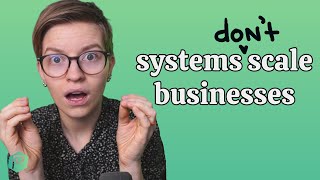
Six misconceptions about building business systems, debunked. You don't need expensive software, a big team, or to remove your personality from the work. The speaker walks through what actually works.
Foreign. I think we made it in without them noticing in the secret setting and with the help of a little bit of doodles here, we're going to be breaking down each of these lies in this video that will ultimately save you money, save you time, and help you see through the bullshit that marketers are trying to feed you around your business systems. Oh, and be sure to stay to the end on this one, not only because I'm going to be periodically crawling around on my floor, but because one of these myths is so sneaky that it's even infiltrate process driven my team here itself. So stay till the end. Let's go. And because just talking at you is way too boring, I'm actually going to be pulling you over here to my magical whiteboard where Layla in the past has actually drawn some demonstrations for each of these and you and I are going to play a little game together where we try to remember what Layla in the past was trying to doodle. Okay, let's go. Mistake number one is okay, nope, this one I actually remember. Mistake number one is thinking that to be systemized you need to have fancy software. Especially in my niche doing the intersection between process and platform and people, a lot of emphasis is put here on this platform perspective. Is it ClickUp? Is it SmartSuite? Is it Integromat? Is it zapier? Is it textexpander? Is it is. And when it comes to systemization, marketers realize that you care about business process, you care about calm, you care about having things work. And so when marketers are trying to sell you their software, whatever it is, they'll attach this phrase about systemization to it. When that happens again and again and again, it's pretty normal to think, okay, I need that software in order to be systemized. But that's actually not true. I professionally help people systemize their teams. And I'm telling you as someone who does that using software, you don't need the software to do it. You don't need an SOP documentation software, you don't need a fancy HR A T S system, you don't need a fancy task manager. While all of those things help, you can systemize your business using a clipboard and a whiteboard and some printed pieces of papers. I've seen it done and I've seen it succeed. However, it tends to be easier to use software. But to layer the lies on here, if you are going to use software and make your life easier, it doesn't have to be fancy stuff. You do not need a dedicated software for Training your employees and for managing tasks and for onboarding people and for training people and for SOPs and blah, blah, blah. You don't need a fancy software for each of these pieces. You can get away with one generalist software doing all of these things in the same way. On smaller businesses, you might have one person doing a few different jobs. You don't have a team of 100. You have a team of 10 each doing 10 things. Similarly, with your software, you do not need to spend a lot of money to systemize. You can spend zero money on software or a nominal amount and get the same results. Don't get me wrong. I love seeing software companies educate people about process. We've got some great brands out there doing some great work, but because of their incentives and what they're trying to sell, it often means they are preaching the power of process with the caveat that you need to use their fancy software to do it. And that is simply not true. All right, we good on that one? Yeah. Okay, let's go to the next one. What do we have? Layla from the past doodled that you need to do yoga, that this is starting to look a little bit not rated for tv. Oh. Oh, Okay. I see. Okay. The second myth is that being process driven means you need to be super organized in all aspects of life. And if I move my microphone so you can actually hear me, this is a lie. It's actually something I just talked about with a team member the morning of me filming this video. This is an important myth to get down because this keeps people from even trying to systemize their business. It's. It's a lie, but we believe it. It basically says being process driven is a personality trait. It's something you are or you aren't. You're organized or you're not. You're this or you're that. And if there's one thing we've learned in the last few years when it comes to labels and identity, it's that they can change. Right? You don't have to be super woke to realize these days that people and things can change. They can be a little flu. So just because you are not organized in your personal life, that you don't have a meticulous calendar of all of your family birthdays does not mean you can't be organized at work. In fact, most people I know who are extremely systematic when it comes to their work are extremely not systematic when it comes to their personal life. It's how they balance it out. As a helpful example of this, Leila from my past probably can do to this. I'm a great example. So I am someone who I think at least tries her best to define being process driven in the work environment. But despite that, when it comes to my personal life, I have a battle with the spoon drawer. When it comes to putting utensils and forks and spoons away, I put them back a different way every time. It infuriates my husband because he is someone who will do things the same way. He is actually, by his nature, far more systematic than I am. I, by default, just given to my own devices, tend to be a lot more chaotic. And the funny thing about that, in work, we manifest entirely differently. At work, I really use all my willpower on being very organized. I've seen the power of it. So I put my effort into being consistent and organized and writing things down. Even though it wasn't my natural tendency, it was a skill I had to build. Meanwhile, my husband is really great at remembering things, doing things the same way every time. He's very methodical, carpenter, brain, you know, tradesman. However, he gets stressed out by long task lists or long lists of overdues at work. It's actually why I created a video that I just did on the channel recently about how to manage overdue tasks. It was actually inspired by him. It was a challenge he used to have when working at ProcessDriven. Me, on the other hand, I kind of thrive on that. I love the chaos of having a billion tasks going at once and a million plates to spin. I don't know why it's just me. So, two important takeaways from the story. Thank God for Alex, because otherwise our household would be a mess. And number two, there is no right personality type to be process driven. It's just a priority you choose to have. You have a finite amount of willpower every day. You choose what you want to spend it on to change who your default person is. I choose to spend mine on becoming organized at work because it has done wonders for my productivity. You can choose to spend it on something else. But realize that process driven is an option. It's not something that you're just wired for. It's a skill you build. And I think I'm probably a good example of that as this is not my natural tendency either. It's a pursuit I'm on. Next up is number three, and this is one that has been a little close to home lately. Number three is the lie that if you are process driven, you never make mistakes. Yeah, as much as I wish this Were true. It's simply not being process driven. Is being driven by process. Look at that. English finally making sense for once. That does not mean you have absolute control over every situation, that you are God amongst men and you never make a mistake. No. Instead, it means you operate more like a firefighter and actually, let me try to doodle this. I'm sure this will be hilarious. All right, Leila, go ahead. Try to. Try to draw a fireman. Yeah. Okay, this is bad. Pretend that's a fireman. So just a fun fact, my sister, when I was younger, she was a junior firefighter. And I don't really know anything about that other than firefighters practice putting on their outfit things. And I'm sure they're not called outfits. I am sorry, firefighters, for butchering this. But anyway, they practice putting on their protective gear, so that way in the case of an emergency, they can react very quickly. I love this visual because when I think of process driven, this is what I always think of. There's this cliche in small business ownership that you don't want to be a firefighter. Constantly putting out fires in your business because of emergencies. And I get where that's coming from. But when you think of it like this, being a firefighter is actually kind of the best thing you could be. You're prepared for anything. Maybe you don't want to be doing that all the time, but you're ready. If there's anybody who's well suited to put out a fire, it's a firefighter, Right? Yeah. When it comes to being process driven, I kind of view it the same way. It's not about never having an issue happen. It's about hopefully preventing issues whenever they're preventable. And secondly, having a plan in place when shit hits the fan, which it will, because life happens. You can't control everything. In the moment you try to, you go insane. One thing I find really helpful to think about when it comes to this one is to remember the definition of stress. It means when something happens that causes pressure and you don't know how to respond to it, you feel stress. If you have a plan of how to resolve each action, you're not going to devolve distress in high pressure moments. Instead, you can actually act without being caught up in emotions or plans. All right, I've got a few more tips here for number four. I don't remember what it is, so let's just try to guess it off the doodle. Okay, what do we got? Tip number four is about pancakes with toast. Mickey Mouse mental Illness. Ah, okay, okay, okay. Creativity. I was kind of close there with the one. So the fourth myth is that if you're process driven, you cannot possibly be creative. That's because operations people are typically. What the heck is happening in here? No, no, check. Same people that are saying this is a video. Talking about myths. We're trying to keep it secret. I was hoping you wouldn't find out, but apparently that didn't work. They're not saying you're not creative. Yeah, okay. Yeah. They're just saying it's a common. It's just a common. It's just a common perception. Okay. I am so sorry. Damn right. Weird YouTube watching phone ass videos in the dark like a weirdo. What was that? Who, me? I. Chuck wasn't up to nothing. I was just thanking the YouTube lords for giving us our daily subscribe. Yep, nothing creative happening over here. Back to your boring video. Yep, keep it. Keep it boring, you know. Yeah. Anyway, to give an example of how you can be organized and also a little creative, let's think about an artist who stretches their canvas. Just because you stretch your canvas the same way every time before you start painting, does that mean you're not creative? Or say you're drawing on a whiteboard and rather than making up your own pigments and paints using, you know, dead animal blood, because that's the first thing that comes to mind, you instead pick up a marker and start writing based on that. Does that mean you're not creative because you use something that's already there and pretty locked in by somebody else's process? No. Just like if you use the same warm up routine before you go on an athletic event or do the same vocal drills before going to a musical performance, you're not not creative. You're just prepared. When done right, process should enable you to be more creative by controlling everything that doesn't need your brainpower or creativity, making all those little decision fade away so you can focus all of your energy on the stuff that requires your creativity. Which might mean the whiteboard, the weird characters with strong opinions, or the paint you're putting on the canvas. Sure, Process has our more uptight cousins over in Quality Assurance, but as a whole, the process space is a creative one built around what you view to be important, and it certainly does not minimize your creativity in any way. Speaking of minimizing, one thing that is said to never be minimized when you are working in process is money. Sorry, the microphone just overshot a little bit there. There's a myth that in order to be Systemized, you need to spend all of your money on gurus and books. And this is pretty similar to our first myth. There it is. I kind of already harped on this when I talked about software earlier, but leave it to say you can do all of the systemization stuff that people talk about or preach about or tout the powers of yourself. You absolutely can. You are a smart human, otherwise you wouldn't be watching this video Shameless Plug. But you absolutely can accomplish all of this. Now, would your journey systemizing go a little bit faster if you could learn from somebody else's mistakes and not have to reinvent the wheel? Sure. In all seriousness though, there is a big gap in the market between YouTube videos and books that are usually just trying to sell you something else and never actually give you the answer, and the high end consultant that will charge 2550, 100 plus K each year for them to come in and teach you the right way, often with questionable delivery on that promise. So basically your options in the market right now are lots of time, no cost and no support, or little time, lots of cost and no support. Those are kind of our two extremes. And that gap that exists in the market between these two extremes is actually why I created ProcessDriven, why this channel exists, why you and I get to chat every week. It's because so many small teams, lean teams, startups, businesses in the middle don't necessarily want to invest 50k in somebody to tell them to write the recipes. And they don't necessarily want to just watch hundreds of thousands of YouTube videos or read tons of books and try to guess what they should do. They need support without having to give away their entire profit for the year in order to do it. And in case you're not aware, that's actually the program we host here at ProcessDriven, just shameless plug. We're opening our program in just a few weeks. I'm looking at my watch. There's no freaking watch on here. I don't know why I'm looking at it. We're going to be opening the doors in March, just not long after you see this video to our program where we guide people through how to build a foundation of process to their business so that your business can run on autopilot, so you can have processes written down. And best of all, we've been doing it for years. We've rebuilt the program five different times, served over 1700 clients and teams and everything inside that program. We also use each here at ProcessDriven, making sure that this program works and gets teams results, and I'm really happy to say it has. So if some of these myths hit home, just know that that's an option. And I do have the link in the description below in case you'd like to join us because we only open a few times each year and I'd love to see you in there. Anyway, let's move it along. Myth number six is that you only need to worry about systemization or processes if you are scaling your business or selling it. Um, nope, nope. For just so many reasons. No, sure, building your business process will be helpful. If you sell your business, it's cool to be able to prove that you have the instructions that allow your business to run without you. It will also be helpful if you're trying to scale up, meaning exponentially increase the volume of what you're doing without necessarily increasing the internal components. But for 99% of people, these are not the best reasons to build process. I'm convinced that somewhere along the line somebody said the phrase scale with systems or scaling up systems or something like that. I don't know if that's actually a thing, so hopefully it's not. Someone said that somewhere and then everyone just started repeating it because it has a nice little alliteration. I'm a sucker for alliteration, so I get it. But it is not true. This issue is so common that it's actually something I've seen in every new marketing hire I have made here at ProcessDriven. And hey, if you're considering joining our team in the future, our careers page is below. But keep this in mind. They'll sit down with the best of intentions to write an email or a social post, and they'll write the tagline scale up your operations with process driven. And I know why they're saying it. It's because this lie is so popular. But there is no one to one correlation between organizing your business and scaling your business up, doing 10 times as much volume, selling to 30 times as many clients. That kind of exponential scale is rare and is much more likely to be a reflection of the type of business you are running and how you are marketing it, than whether you have your processes documented or not. But again, processes can help. If you are trying to scale, sure, have those things written down before you. 10x might be helpful, but it's not necessary. Rather than just propagating these cliches that are often shared by software companies for whom this is the only reality they know is to think about process as a tool that can be used for any end game. Some common ones might include hiring for the first time, working fewer hours, automating more of your business, stepping back and hiring a CEO so you can be something else or leave the business, being able to take time off, maybe an emergency, maybe a family vacation, just being able to leave at a moment's notice, improving your business's asset value so you can get a better loan from the Small Business Administration to have a risk mitigation plan in case of some kind of catastrophe so your business can run if you were to suddenly die. That's an option. And all of these options are in addition to selling or scaling or becoming a soulless organization that forces their employees to pee into cups rather than actually get bathroom breaks because you want to maximize efficiency. All of these are ways to use process to further your goals. And those goals go far beyond just selling or scaling. Anytime you want the benefit of consistency, predictability, clear instructions for how work gets done, which will be pretty much any day in your existence as a business owner or leader, you would want to have process. It is not an exclusive luxury that you need to have. If you are a VC funded startup that's looking to sell sell the business in the future. That is just silly. If there's one truth you take away from this video, it's that any organization, any person can become processdriven with a little bit of work. Whether you want to watch some of our videos to get through that journey or you just want to work with us to make the learning curve a lot faster, I am super grateful to you for sticking with me throughout this weird video. And please do like subscribe Comment if you want to work with us at ProcessDriven, remember to check the link in the description below to figure out how to work with us down here. Yes. Goodbye. We gotta get out of here. How many times do we have to do this? Oh my gosh. I think this bit would be a lot more effective if my office wasn't like 60 square feet. I forget what I was about to say.










