#AgencyVision: Kill Your Broken Agency Business Model Before It Kills You
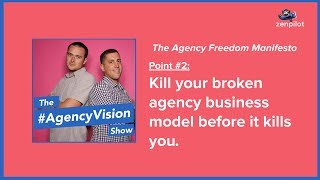
Andrew and Gray argue the traditional agency model is broken and propose the "agency freedom model" instead. They discuss how to scale without burning out, manage client risk, and build a business that actually gives owners freedom instead of trapping them.
What is up, everybody? Welcome to another episode of the Agency Vision Show. This is Andrew, and I'm so excited to talk to you today. Today, Gray and I are going to be digging into point number two on the Agency Freedom Manifesto. And point number two is kill your broken agency business model before it kills you. Gray. Welcome, brother Andrew.
This. This is maybe my favorite point in the entire manifesto. It's also a little bit of a controversial point, but I'm super excited to dive into this one because we've seen like, we talked about yesterday a little bit. I mean, we've seen really good people burned out, like actually burned out by the business model that really can have severe consequences up to and including death. People listen, I laughed. I laughed right after that, but it.
Escalated pretty quickly there, buddy.
Sure did. No, this one's a good topic to dive into. And I know you typed up some notes. I have a lot of thoughts on this one as far as. But I think the right place to start is just start with, why is this a point? Like what's what, Maybe just defining the model that we're attacking here.
Yeah. And I think it's an assumption that most people make that if I have an agency, this is how we need to operate. And so when they try to fix issues, they totally breeze past this and they don't give it any critical thought. So today we want to talk about the traditional agency business model and how it is fundamentally broken and how that is the core root of a lot of the challenges that you're seeing today as you try to scale your agency. It's kind of the assumptions that are made inside of natively in the traditional agency business model. And to just to define it at the beginning. This is what we are identifying as the traditional agency business model. The client asks you to do something and you do it for them. If you boil it down to the bare essentials, that's what it is. Where the client is in the leadership role, you are in the fulfillment role. You can pretty it up, you can put process around it to make you feel more comfortable. But at the end of the day, if the client is issuing you a request and you and your team are delivering on that request and going back to them and sharing it with them. That is the traditional agency business model.
And.
And before I go any further, Greg, would you add anything to that?
Only that the model itself is not a bad model. If you want to be a freelancer, you know, like you want to be an outsourced contractor, maybe even a small team of outsourced contractors, like there are people who have a specific skill set, they get hired, that get told by clients what to do, that make a whole lot of money and live life the way they want to live life doing it. I think the problem is that this model doesn't scale well into a larger business. If you're trying to build a business worth more in terms of monetary value and also that provides a certain quality of life, this is a terrible model to continue to scale. And that was the mistake that we made when we were starting Guavabox, was we took the model that seemed very attractive at the beginning, but we had a vision to grow it. And the model does doesn't grow. And that's why there's all these headaches, because the more things that you add into it, there's too many variables that you don't control and that you're simply responding to. That makes it a very chaotic place to live.
Yeah, I think chaos is kind of the root of the issue here. So if we boil it down and say, like, where does the chaos come from? It really lives on two sides. On one side of the equation you have all the different types of clients that you're working with. Now, from a systems and a process standpoint, I call those the inputs like the clients come into your world, you've got clients on one side. And the traditional agency business model is typically run by people who we call digital. Yes, men. So the client comes to you, they say, hey, here's what we want to do. You say, yes, we do that. Even if you and your team have never tackled that thing before, you say, absolutely, we'll figure out a way to go make that happen. And so you're working with all of these different types of clients on one side and then you flip the other side and you've got the internal operations of the agency. And so this is all the services you offer, the deliverables that you create, the stuff that you do, what you create as a team is over here. And you've got dual access complexity here, where every single client looks different and each of those different looking clients is receiving a different set of deliverables, a different set of services. And this dual access of complexity creates a complex mechanism that cannot be systematized. That's why when we were scaling do inbound, trying to help agency owners document processes and systems, people hit a roadblock here because they're fundamentally trying to document or try to capture processes that don't exist. Because you've got this dual access complexity going on where every client looks different and, and every service that you're doing for those client looks different or the collection of those services that you're doing for those clients look different. Every situation that you encounter as a team is unique. And the problem here is when you've got different, unique situations, what does that require the owner to muddle in and try to solve the issue at the end of the day? So that's kind of a snapshot of the broken agency business model that we're talking about here.
That chaos is like the root behind our name Zen pilot. Like Zen, like we're putting you, we're trying to bring a framework that allows you to lead the way, to follow a flight plan, to go from chaos to clarity to a calmer state of living. And the lack of clarity is like, that's at the root of all this. You don't have any clarity when you're a digital. Yes. MAN on well, I guess you follow it all the way, but most people don't because they realize at some point there's got to be a limit. So there's some set of services that we will say no to. But those lines have, in the traditional model that we're attacking here, those lines are arbitrarily set, not really chosen by you. Like, well, we're a web shop, so we don't touch anything offline. We're a digital agency. But there's no clarity around here is an ideal fit client for us. There's no clarity on what we will do and what we won't touch. There's some things that are clearly off limits, some things that are definitely something that we will do. And then there's this whole world of things that are like, well, we could probably figure that out. And depending on how desperate we are on that given day, we'll either say yes or say hold off or say no.
Yeah.
And that lack of clarity just kills the, you know, at some point that leads to an energy draining culture that is really hard even with great people to overcome on a day to day basis.
So the, like the rate limiting factor here is the people, right? Like who is going in to solve these complex situations that the clients are encountering is when every single client looks different. That means that every situation of those clients face the goals that those clients have, the KPIs that define success for those clients, the types of clients that the types of customers that your clients are working with. All of those are variables. All of that whole atmosphere needs to be absorbed and, and learned by the agency in the new spot. And the funny thing is how many people, us included back in the early days, wear that as a feather in their cap. That I can come in and learn your industry fast and I can apply what we know to your industry. But really at the end of the day, like, that does a massive disservice to the client. Because if you've never worked with that type of buyer before, with their buyers, like, what, what expertise do you bring to the table at that point? Like, so you can, so you can put together a Facebook ad campaign or so you can optimize a website for different keywords. Like, if you don't know how their buyers behave and like, what their entrenched goals are, what their entrenched misbeliefs are, like, stuff that you can break down and unpack, like, what real value do you bring at the end of the day there? So really like boiling it down and figuring out who do we help and getting clarity there is the first step to kind of untangling this ball. Because the complexity you're talking about comes because the owner or the leader of the team, like the account manager, needs to come in, unravel the situation, figure out what's going on, put the strategy together, communicate that strategy, the client, communicate that strategy to the team, make sure that strategy is implemented and followed through step by step that that strategy actually sees results. Even though you're kind of rolling the dice because you've never been in this exact environment before, so you're testing on client time and client dollars and usually doing stuff that the client asked you to do. Just think about the risk you're bearing right here. Let's take a step back. The risk load on the agency owner is out of sight. Like, first of all, you're the one who's hiring the talent, you're the one who's hiring the team. The client can fire you in an instant. You're bearing the risk of the team. The they are putting together the strategy. So they're the ones like putting the flight plan together. You have the marketing knowledge, but they're telling you what to do and you're going out there and you're doing it for them. But third, you are graded on results. So if the campaign, if the project doesn't perform up to snuff, who's getting fired? Are they going to go fire themselves? I don't think so. Like, they're firing the agency here. So you bear all of the risk in the equation. And I think a lot of agency owners do that blindly. Like they don't realize how much risk they're bearing there. And by doing whatever the client asks them to do, like, they're inviting all that complexity. And so it's the owner or it's the account manager, if you've got a bigger team that's responsible for going in there and sorting through all that muck and all of that mire. But there are systems that those people follow, but those are insanely complex systems that are baked into, like, they're deep in that individual talent. So the owner has so much capacity. Like, you get up to eight, 10 clients, like, you can kind of pull this off as an owner. But when you try to go up beyond that, even some people getting to that point, like, that's way too much complexity for one person to bring on. So maybe you've got two or three, like, knock it out of the park. Account managers that are doing this right now, and they're the ones going in and solving these complex problems. And that's how agencies get big. Like, they just have. They invest in talent and that's like the meat of what they do. And that's how they scale it. That's what you want to do. Like, fantastic, good for you. But you're bearing a lot of risk there because what happens when that account manager walks out the door, goes, starts their own shop, or another agency plucks them? Like, now the current account management team, or you as the owner, need to pull back in that, like, figure out, what is this complex environment? What are we solving for? Like, what's the plan? Let's execute that plan, let's follow through. It's like it. All that, all that stuff just builds and builds and builds. So.
Yeah, what you said there about that's one of the reasons that the turnover and the go start your own. The agency environment is one. It's the one I'm most familiar with. But compared to other industries, the number of agencies that get started by someone who worked at another agency is so high. Someone's got experience already doing this, and they figure out I'm getting asked to go solve all this stuff anyways. There's not a huge compelling reason for me to stay here and do this. If I'm going to go solve it, I'll go solve it for myself and go do it. So there certainly is the risk of people leaving, but, yeah, it's just hard. And the point there that you're making in terms of how you're bearing the risk and everything, this is all part of this whole point, is part of two things. One Is there's this whole mindset that we have that's part of the manifesto of building assets. And so when you're just figuring stuff out on the client side, a lot of this comes from, I'm trying to make enough money to keep going. I will say yes because of fear. Most of this is driven by fear. But when you're just struggling to go grab stuff and learn it on the fly, it's very challenging to build any kind of assets. One of the things that popped into my mind as you were talking was we see this happen so much where there are so few assets built in agencies. One of the upsides to the agency business model is it takes virtually no capital to start. There's very low startup costs. But one of the downsides is because it's not because there are no startup costs, there's no funding in many cases, or very little funding. Because there's no funding, there's this desperation to go make money. And because of this desperation and fear of not making money, that leads to compromises very quickly or just not rational thinking throughout the whole process. So anyways, I know we've gone pretty deep into what is wrong with this model. What would the free agency look like? Yeah, the freer agency.
Yeah. So if the, if the traditional agency business model is broken, like, what's the solution here? If the answer to this is the agency freedom model, this what this does. If we think back to that, to that picture of we've got clients on one hand and every one of those clients look different, and we've got our services on the other hand, and every one of those services look different. Some agencies will standardize the service side and they'll say, every single client that comes with us, we're going to do this service like we do Facebook for E commerce, and that's it. We work on all kinds of different e commerce companies and that system is going to operate more effectively than if both of these sides are different and rolling. And some people do it another way. They say we're going to only work with manufacturing companies, but we'll be a full service, do whatever they ask us to do. So they've standardized the inputs, the type of clients that they work with, but the services are still kind of rolling here. What the agency freedom model does is it flips the script. Instead of positioning around what you do or around the type of people that you do anything for, you focus on solving one I1 you serve one ideal fit client and help them solve their most costly problem. You, you start there Like a winning business is going to be customer centric. Look at Amazon, look at Uber. Like, they obsess over shortening the customer's path to value. They want to make an outstanding customer experience at all costs. And for Amazon, like, even at, even at the cost of like harming their distributors. Like, they'll, they'll make it a better customer experience. Look at Netflix, they scale because they put the customer at the center of everything and they make the whole experience, like, extremely enjoyable for the customer. So instead of positioning your agency around the services that you provide, you position your agency around the problems that you solve for a very specific group of people that doesn't just say, oh, we only service manufacturers, oh, we only service healthcare companies like you. This is different for every agency. And it's a, it's baked into our process that we walk folks through. But you get very specific on who is the ideal fit client that we help. First of all, we start with them and then we say, okay, what's the costly problem that they're stuck with? We had clarity on that. And then as owners, we come back and we say, now that we know who we help and what their problem is, if that ideal fit client showed up tomorrow, what would we do for them? Like, if we had complete control, what would we do? What's the journey that we would walk them on? And we map that journey out. You can see this. If you want to see this as an illustration, you go to zenpilot.com model zenpilot.com model and see the agency freedom model laid out there for you in detail. But this beginning piece, and if, when you go to that graphic, you'll see it in blue zenpilot.com model this is the piece that most people breeze past because they think it's assumed or like you were saying, gray, like they don't want to take the risk because of the cash flow pinch. But the agencies that get super specific on this phase are the ones that differentiate and build a business that can deliver the freedom that they're looking for. And what is so cool about this piece is you standardize both the inputs, which is like the type of clients you work with, and what you do for them. That's the services that you offer. And when you've got those two pieces standardized, you've got a business that can scale, you've got a business that can actually deliver you freedom. And it's going to be the business that's going to allow you to thrive both sides of the business standardized. And when you start in the positioning piece and you position to an ideal fit client that serves that has a costly problem. Now you can charge a premium for what you're doing. And so instead of going into each client and solving new problems every single day, you're pouring your creative energy into honing and improving this vehicle that helps this type of client solve this one costly problem. And the way it's structured is you're getting paid for your strategy, so it shortens your sales process. You're getting paid for your build out, so you can, you can actually get everything set up the way you want it to get set up, instead of the client telling you, oh, we want to do this, then we want to do that, then we want to do this. And you never get the whole system set up the way you want it to. And then thirdly, you get paid recurring revenue with these clients as a part of this model. So when you think about what do I want this agency to do for me, which is where it needs to start. And you can go back to the episode yesterday where we talked about your business is meant to serve you, not vice versa. That's where we start everything. Because if the business isn't serving you as the owner, you're not in a spot to deliver real value to your clients. You're not in a spot to deliver real value to your team, which is what you need to be doing. At the end of the day, both of those things need to happen for a thriving agency to take place. When you get clarity on these two things and you standardize this flow, you unlock freedom for you. And it's a beautiful thing.
Man, that's awesome. I don't have a whole lot else to add. That's the key. Freedom to do your best work comes from freedom. Like most truths. I think I said this to you ahead of time. It's paradoxical. And your freedom to do your best work comes when the team understands the parameters within which you do that work and focus their efforts in that specific scope. When you say ideal fit client, what we mean by ideal fit clients, to define that term for people too, is the ideal fit client type. So not a single client, but a single type of client. Someone that meets that specific profile. I just combined meets and fits into Mitts. Word of the day, Mitts. Go grab your baseball mitts. Let's play a little catch. Thanks for tuning in.
Nice. So, guys, today we dug into Manifest Agency Freedom Manifesto point number two. If you want to learn more about the Agency Freedom Manifesto, go to zenpilot. Com Manifesto. And if you want to learn more about the agency freedom model that we dug into here today, head over to zenpilot. Com model. Check it all out right there, guys, and we'll talk to you next time.










