#AgencyVision: The Agency Freedom Manifesto
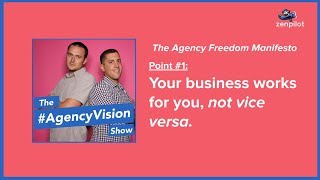
This is a YouTube video titled "#AgencyVision: The Agency Freedom Manifesto" created on June 26, 2019. It features a discussion between Andrew Gazdecki and Gray Mackenzie about the Agency Freedom Manifesto, focusing on how agency owners can build businesses that serve them rather than enslave them. The conversation covers mindset shifts, business ownership, client selection, and the importance of treating the business as an asset to achieve freedom and flexibility. The video is part of a series unpacking the manifesto's points to help agency owners improve their businesses.
What's up, everyone? Welcome to the Agency Vision Show. It's been a while since we've been here, but Gray and I are super excited today to share with you guys something that we've been working on very hard behind the scenes in the trenches. I'm excited to share the agency the Agency Freedom Manifesto with everyone here today. So what we're going to do is we're going to give you guys an overview of what is the manifesto, how does it impact you as an agency owner? And then we're going to dig into the very first point of the manifesto here on the call today. So, Gray, as we kick things off, man, welcome.
Thanks, sir. What's going on, everybody?
Excited to have you here on Agency vision show. In 30 seconds, could you sum up the need why there is a need for the Agency Freedom Manifesto?
No, I cannot sum it up in 30 seconds. I apologize, Andrew. No, I'm just kidding. I don't have a 30 second summary written. However, there is a major pain out there, which is we've got all these high quality people trying to run marketing agencies or digital agencies. They're not all marketing, but many of them are marketing focused. They are people who feel a mission. Well, like they're on their mission or impact minded. They want to impact the world for good in a lot of different ways. And the avenue that they choose to do it, the model they wind up following largely by default, not always by choice, is broken and causes them to minimize the impact or not to lose the ability to maximize the impact that they could have. And so you and I both feel very strongly that there's a better way to do this whole agency thing. And that is the need for why you and I wrote this manifesto and why we just need to think intentionally about what we're building and how we're building it.
Yeah, every phone call I have with agency owners, I see these pains come out. People come to us because they're looking for help with building systems, setting up processes like getting more organized, getting out of client work. And after you have, you know, over 1300 of these conversations, like, you begin to see trends and see things come up over and over again. And you see people making the same mistakes over and over again. And it's not their fault. It's. We made the same mistakes ourselves. Some of the best business owners we've had on the podcast have made the same mistakes themselves in the past. It's the broken business model that's causing a lot of these issues. And so what we're going to Dig into here today is what to do about it. How can you build a business that serves you as the owner and allows you the freedom, the flexibility to live life the way you want it to be lived? For some people, you just want to be in the business, and that's cool, that's good for you. For other people, you might want to be spend your time as CEO and manage the company. Other people might want to spend their time like nurturing and developing the team and hiring new talent. It's going to be different for everyone. And that's what's so cool about the model, is you can build what you want to build, and you don't need to be a slave to the business. You don't need to be a slave to needy clients. You don't need to be stuck in a constant state of overwhelm and panic, like there's a better way out there to build your agency. And so I'm excited to get into it today, dude.
Yeah, I'm excited. You sent over a couple notes in Slack, which, by the way, after we wrote the manifesto, actually, I purchased it maybe before, but I did not start reading. Doesn't have to be crazy at work. If you've read this book already, drop a little comment here, assuming you're insiders tuned in. But the guys who started Basecamp is what they're most well known for. David and Jason writing about what they want to get out of their business and the type of business that they want to have. And their vision is so different from many other people. But it's funny to me that I said Slack because they are big on choosing asynchronous communication or synchronous whenever possible. And there's all these big words and different ways of trying to organize work and stuff. But all that is just, I feel like so many topics like, what tool do you use? Slack, or do you use formally hipchat, or do you use Microsoft Teams? Or there's all these things that we spend our time busy doing that are like ignoring the root issue. So as I was looking at your notes in Slack, I was like, this is great that we're diving into the root issue here and not going up, up the. Up the tree until we. Until we figure out where this all starts.
Amen, dude. So the Agency Freedom Manifesto. Point number one. Can you lead us off? What is it?
Point number one. Let's see if I can do this from memory. Just kidding. Obviously memorizes your business works for you or should work for you. Your business works for you. Not vice versa. That is the fundamental principle of the Agency Freedom Manifesto.
Yeah. So if we dig into that, the business should be outside of yourself. Like a lot of entrepreneurs have a hard time breaking the business apart from who they are personally. And so what we want to think about here is the business. It's not just you doing something for someone. It's not you and your team doing something for someone else. The business is. It stands alone. It is its own thing. And at first, this might just be a mindset for you. You might be the one in the chair pulling all the levers at the beginning, and that's okay. It can be a hard balance. But when you make the perspective shift. I was talking with someone this morning about this. When you make this perspective shift from here's what I can do for you, and you hire me to do that, too. Here's what I know. Here's how I can help you. Here's the business that we've built that leverages this knowledge and expertise to help you get where you're trying to go. When you make that shift, you're much better equipped to make decisions. So that's like the first point under this is like, the business works for you. It's not just like, you're not the victim here. It's not your client's fault it doesn't work.
It's.
It's not your team's fault it doesn't work. If something's wrong and it doesn't feel right, you can fix it. It's your fault the business works for you. You're not sitting here passive like you're in a job, just like, stuck with a crappy boss. If you have a bad client, fire them. If you want a better client, hire a new one. You know, you have your hands on the wheel and you can steer the ship. So if you don't like the way it feels, you got to do something about it. Because remember, you're sitting on a vehicle that's designed in its best form to serve you. A lot of times it doesn't. A lot of times it wants to suck you in, put the handcuffs on you. But the reality is your business should serve you. It should work for you, not vice versa.
I think we go so quickly from the mindset early on in something. Well, for you and I coming out of college and jumping right into starting an agency of a certain amount of pride that I can do this thing well. Or the business is tied to who you are, and you want to be responsible and be a key cog in the machine that you're building, then it's funny how quickly that can change, I guess, for everybody. Your mileage may vary, could be different length of time, but how quickly it goes from, like, yeah, I should be, like, a key cog in this. I do want the business to kind of rely on me, to be like, man, I don't want the business to rely on me. Last week in the agency accelerator program, talking to an agency owner who just came back for a couple weeks over in Europe, and. And just describing the team's reaction when he came back and everything had run really smoothly while he was out. And, like, the jokes of, are you really needed anymore? And just, like, to younger Gray, I realize I'm not that old. But to early agency life Gray, I would have been like, oh, man, I guess I'm not that necessary. And now I'd be like, hallelujah. That's so exciting when things can operate without you. And there is a difference between who you like, the identity of you personally, and the identity of the business being separate from you. So I totally agree. The business needs to exist outside of you.
Yeah. So, I mean, I think as entrepreneurs, we need to start here with questions like, what do you want out of your life? And, like, start here at this fundamental level. Like, what are you trying to do here? Who do you want to be as a person in your family, in your community, to your team? Because you have your hands on the wheel? And this is. This is kind of. As we were writing this, like this, the truth of this came to the forefront of my mind that there's no excuses here. Like, if the business truly works for you and you're the captain of the ship, like, there's no other way, no other spot to point the finger. Like, if we're. If something's not working, it's our fault, and we need to get to the bottom of that. And it could be one of our team members is in charge of it, or it could be that a client is causing an issue. But at the end of the day, like, the buck stops with us as the business owner. So what do you want out of your life? Where do you want to be? Who do you want to be? Because your business is where you spend the majority of your time. So what you do here should reinforce that vision for yourself, for your family, for your community. And if your hands are on the wheel, you've got to take ownership of that, and that's hard. That takes work. It takes work not just on the business, but it's going to take work on yourself, continuing to invest in yourself, continuing to pull yourself up, sharpen your pencil every single day so that you're ready to go to work as a kind of a better version of yourself than you were yesterday. Because you're committed to moving things in this direction. When you stop pointing fingers and start taking ownership, big things can happen.
Boy, I had that reinforced to me this year. Not in my own business per se, but, but in baseball, it doesn't matter whose fault it is, it's still your responsibility. When you're the head coach. Might not be your fault, but it's definitely your responsibility. And if you want it fixed, you got to get the momentum turned around and headed in the right direction. And a lot of it does start, I mean, all of it, I think, starts internally, like yourself first. And then I want this to be a calm headed, focused, mission oriented team and culture. Like that's got to start with me first.
I think that it flows down from that, is that not all revenue is good revenue. Like to just work with a client that doesn't fit like the mission of your business, it doesn't drive that forward. If you're doing stuff for that client that doesn't align with where you want the business to be or if that vibe or the cultural effects of working with a toxic client, if that's not creating the type of workplace you want to be, you've got to do something there. But the work that you do there, like what you say yes to, I guess, is like the fundamental issue here. It's not just clients, but it could be team members, it could be the services you decide to deliver. It could be the people you work with and like the friends that you bring into your circle. Like the things that you say yes to. Not everything is good. Like you've got to be wary of what you bring into your world because you want to think of your business as an asset. An asset isn't just something that you leave out in the yard overnight and let it get dusty. You've got to treat it well. If you've got something of value, you're going to treat that in high regard and you're going to go to great lengths to protect it. But a lot of agency owners, they don't view their business as an asset at all. And so they'll do anything that they'll squeeze the life out of it. They'll throw anything into it, Work with any type of client, do any type of service, whatever they need to do to just make some money. But at the End of the day, like the assets getting trashed, there's nothing there. It winds up just being a wreck on the side of the road. So thinking of your business as an asset and like, how do we build and grow and improve and nurture this thing that is outside of myself so that it can serve me rather than me being stuck inside of it all the time? Treat it like an asset because that's what it truly is. That's what it has the opportunity to be if you'll give it that kind of attention.
Yeah, I think that's a great point. That reminds me of a couple of different podcast episodes. I've listened to you lately. I've actually got the business of expertise sitting over on my table. David Baker and he and Blair Enz on their two Bob's podcast here recently. We're going through growth and reasons why an agency should grow or not grow. And David's pretty anti. Well, extremely anti growth just for the sake of growth. And like, what are the real legitimate reasons to stay smaller? What are the real legitimate reasons to grow? Going back to, like, the business exists to serve you, it's supposed to work for you. Like, what are your actual goals? Was the goal to grow or was it not? And then I was re listening here to Derek Sivers on Tim Ferriss podcast and talking about the offers that he got to purchase or invest in CD Baby, which is an awesome startup name, and just talking about how his mission early on he sold it 10 years in for $22 million and walked away. So it was a good exit when he got there. But his mission early on, when he got that his mission was already being fulfilled and he was happy with where things were, so he just ignored it regardless of what could have come in. So, um, but so often in the agency space, like how many times has there been that, yes, I. You get the conflicted feeling in your gut and if you talk to your team, most of them would be anti taking on this revenue based on what they know about the project scope so far. But you're like, I know this client's gonna be a pain in the neck. This isn't really what we do. But we can, we could definitely figure it out. We could probably produce better results than them not doing anything and their money would be really nice to have. Like, how many times have we talked to agencies and have we been in that situation where it's like, oh yeah, we'd take that on. I'm very glad to be away from that.
It's not a healthy place to be because, yeah, those little yeses, they add up and it starts to chip away at what you're trying to build. And I think it's a slow drip that fills the bucket to drowning level when the owner wakes up one day and doesn't know, you know, how can this thing ever operate without me? How can I ever take a vacation without, you know, I was talking to a guy this morning again who's like, who's got his phone with him all the time. Like, work doesn't leave him, even if he's trying to spend time with the family. Like, work is still there. He still needs to be present. Maybe you've even set up and hired people, but you still get pulled back into the business because you're held captive by it. The business is there to serve you. If you take the right steps, follow the right model, you can put that business to work for you. That is point one in the Agency Freedom Manifesto. There are nine additional points which Gray and I are going to be unpacking here on the show in the group. If you're not in Agency Journey Insiders yet, you need to head over to agencyjourneyinsiders.com and join the free Facebook group. There's an awesome community of awesome agency owners there from all over the world who are on the same journey trying to build a business that works for them. So head over there if you're not a member of the group yet. If you want to learn more about the manifesto, just head over to zenpilot.com manifesto. You can see all 10 points there and here on the show. Gray and I are going to be digging deep here over the next few episodes and unpacking each of these points and how it can help you build the agency that gives you the freedom you've been looking for. Sound good, bud?
I am on board. If I do my math correctly, 1 +9 equals 10 points to the Agency Freedom Manifesto. So I'm excited to deep dive into the rest of these.
All right, thank you guys for tuning in here. Drop your comments below. If you've got questions, thoughts, feedback, whatever it is, we'd love to hear from you and we'll talk to you on the next episode.










