AI in Agency Ops Roundtable w/ Paris Childress, Ian Garlic, Chris DuBois, Ali Schwanke, Jeff Cypher
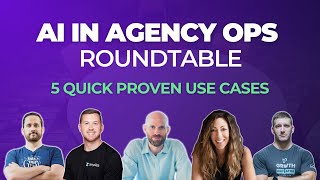
Paris Childress, Ian Garlic, Chris DuBois, Ali Schwanke, and Jeff Seifer discuss how agencies use AI for onboarding, content from customer transcripts, and ClickUp automation. They show how to speed up strategy work without losing the human touch that clients actually pay for.
Questions this video answers
AI in Agency Ops Roundtable (Zenpilot)
May 15, 2024
Paris Childress (Hop Online), Ian Garlic (Video Case Story), Chris DuBois (Dynamic Agency OS), Ali Schwanke (Simple Strat), Jeff Seifer (Zenpilot); host: Jakub (Kuba) Greizar
Approximately 90 minutes
Chapters
Okay, we're rolling. Everything works correctly. We should have maybe even 200 people joining us here today. That's how many signed up. They're all rolling in. Give us a couple minutes here for everybody to join in. Hello. Hello. Test out the chat. Okay. Oh, I should actually test out the chat first and foremost. And raise. I did not turn on the chat, did I, Jeff? Can you do that as a. As a host? Let people in the chat?
It does not.
Attendees can chat with everyone. Panelists can chat with everyone. It's all open now. Use the chat. Let us know that it works, everyone. And when the room fills in a little bit, we will begin. Thank you, Nicole. Thank you, Morgan. Nice to see you. Ian's here. Oh, wait, that's that. Yeah, that's one of our speakers. That makes sense. Hello. Mark from Nottingham, uk. Awesome. Awesome. Okay, just a minute or so, and we'll get this show on the road. Hope everybody's doing fine. Definitely let us know where you're coming in from and that you can see and hear us. Okay. Yeah, I think we'll just wait till 01 and start delivering the goods here. Jeff Seifer saying hi from Pittsburgh, Pennsylvania. Okay. Okay. Tuning in. Tuning in. Jeff somehow makes it to all of our webinars. I don't know how that happens. Gotcha. All right, all right. I bet some more people are gonna join in just a second, but I'm gonna let everything start here. Let me just take a deep breath and. Hello, hello, hello, everyone, and welcome to today's AI and Agency Operations Roundtable. So stoked to see you all here today. We've got an amazing event lined up today. I been thinking about it all week, and honestly, like I always say, before these things, the hard part is over, because the wait is over. And it's time to do this, everyone. So let's get quickly through the intro and then straight to our presentations. Today's speaker on the call with me here are Paris Childress, CEO at Hop Online. Paris, say hi. Okay. Paris said hi, but he was muted. Classic. Okay. Ian Garlic, CEO at Video Case Story. Let us know you're here.
I'm here. Hello.
Awesome. Chris Dubois, founder of Dynamic Agency os.
Hello, everyone.
Yeah, hello, hello. Ali Schwanke, CEO at Simple Strat.
Yeah. Excited to be here.
Awesome. And Jeff Seifer, productivity professor and head of growth at Zenpilot. Jeff, you here?
Yes, I think so.
Okay. Yes, I think you are. I think you are. And your humble host for today. Hi, I'm Jakub Greizar. All of my friends Call me Kuba. So you all can call me Kuba too. And let's get this started. So I've got a little bit of a two minute something to let everybody into today's topic as a bit of an introduction. So first. Oh right, housekeeping. Some people might have questions. Let's start with that. So first of all, don't be shy in the chat. I don't think we have that problem exactly, but if anybody hasn't left a message in the chat yet, let us know. You can see and hear us and where you're coming from and your favorite AI tool, let us know. Let's keep the chat lively. Don't be shy. Second, a word of warning. This webinar will be around 90 minutes, so maybe a little bit longer than what you're used to. So you know, brew some coffee or tea. I don't know. Sometimes I do it that I put on a webinar and put my laptop on the table and do some ironing or laundry or stuff like that. If you do that, you can do that. As long as you get the insights, we're all happy. And next, about the Q and A. It'll be a little bit different this time around. If you've attended our previous webinars the Q and A. First of all, any questions you might have, please leave them in the Q and A section on Zoom. The chat will probably move quite fast, so if you want your question answered, put it in the Q and a. That's one second. The speaker slots are pretty tight today. Only 13 minutes per speaker, so there might not be a lot of time for spoken Q and A, so to speak. So brace yourself that the speakers might get back to you by typing out their answer in the Q and A. Or you know, you might connect on LinkedIn afterwards and just resolve your questions off the call. And last but definitely not least, because this is the one question that invariably comes up the recording. There will be a recording. I'll share it via email either tomorrow or at the latest. You'll get it on Monday, so don't worry about that. You'll be able to relive all the wonderful moments we're about to have here today. Last but not least, don't forget to follow Zenpilot and myself. And first and foremost, our speakers here today for for more insights to follow up on these conversations and more good stuff. Now I get to my little two minute something so I wanted to like. Lately I've been binging some content. Not B2B agency ops content, but what you're seeing on the screen here today. If anybody knows what that is, leave a message in the chat. I won't wait too long for the answer. Has anybody played this? Does anybody know this? Mario 64? That's right, that's Super Mario 64. But what you're seeing is not regular gameplay. This is speed running gameplay. So this is what speedrunners do to get the fastest times in the world for completing Super Mario 64. What they do is they use glitches. So you've got two examples of glitches here. I cannot explain to you how they work, but they are really hard to pull off. But they save time if you want to speedrun. So Super Mario 64, you have to use the glitches. If you want to be at the top of the ranking, the fastest and best and most efficient in the world at Super Mario 64, you have to use the glitches. And every time a new glitch or warp or optimization is found, it is a big discovery. It's celebrated by the community. And everybody implements this in their process of completing Super Mario 64. Now, how does that connect to agency operations? I'm so glad you asked. Agency ops is, in some respects like speedrunning. The fastest speed runs require you to use glitches, otherwise you're going to fall behind. You'll never be at the top of the leaderboard. Well, to have the fastest operations in this day and age, you have to use AI, because AI is the cheat code. It will let you skip certain parts of certain processes. And if others are using those skips, those glitches, however you want to call them, and you're not, you're going to fall behind. So you attending this event here today is you learning about all the skips that the speakers here today have found so that you can move up in the ranking. So I hope that metaphor made sense for y'. All. Now, before we get to the presentations, I'm going to do a very brief brought to you by section. So this whole event is brought to you by Zenpilot. Now, a lot of you probably know about us, but for those of you who don't, we are here to help you diagnose and fix and actually resolve for good a simple set of problems. That's workload, visibility, any project management issues you might have, building productive, profitable and healthy teams, streamlining your workflows and making sure that work work is visible, predictable. You've got templates and processes in place. Everybody knows what they need to do at the beginning of Each day. All that and much more, we help you resolve by streamlining your operations in ClickUp. So working with us, you can build a whole custom ClickUp system designed for you. And this is actually something that a lot of people get wrong. Zenpilot itself is not a SaaS product. We use ClickUp, but we help you set it up the best way for your particular type of business. And what becomes possible with the Zen Pilot system, as we like to call it, is something like this. You get a view of everything that's happening across your agency in minute detail in terms of utilization and profitability. So this what you're seeing, right, right here is zenpilot profitability reporting. And it allows you to see, categorized by service line, by account manager, by client, where your agency is making money, where it might be losing money, where you're most profitable, where you're most efficient. This becomes possible when you dial in your processes using ClickUp. So of course I won't spend much time on this here today, but look up Zenpilot profitably reporting if you want to know more. And just because some of you might be dropping off at some point during the call, I wanted to share our offer here for you today. Jeff Seifer here on the call with us is offering some free ClickUp strategy sessions, limited availability. But if you go to zenpilot.com ClickUp strategy session, you'll be able to have a one on one with Jeff. He'll have a look at your ClickUp setup and recommend some best practices for you. Quick look at the chat Morgan Harris is saying can confirm Zenpilot are the goats when it comes to ClickUp expertise. Coming from you, Morgan, that means a lot. Thank you. Thank you. And that was it. It when it comes to a little bit of brought to you by section here for y'.
All.
Now let's talk about the speaking order. In case you were wondering or you came, I don't know, specifically for one of the presentations, they're all going to be killer. But the speaking order for today is Paris is going to go first, then Ayan, then Chris, then Ali, and Jeff Seifer is last because we're nice and gracious hosts like that. So one last look at the chat, if there's any. Okay, Jeff dropped the link to the strategy session if you want to book that in the chat. That's very nice, Jeff. And that should be visible to everyone. And if there aren't any questions or technical issues, we are free to proceed with our first presentation. So I would like to invite to the stage so to speak virtually, Paris Childress from Hop Online. Paris, are you coming through?
Yep, I'm here.
Okay, awesome. So we'll move on to the first presentation with Paris and everybody. Enjoy today's roundtable. I'm super stoked that you're here. And yeah, let's make this a lively one. Paris, you want to screen share, feel free to do so. I'm stopping mine. Okay, let's get the show on the road.
All right, here we go. Just you all let me know please, when that comes up. All good.
Looks great.
All right, well, hi everybody out there. Thank you for having me to Zenpilot and Cuba especially. Our partnership has been great and this presentation is really going to deep dive into one of our favorite and most common AI use cases as an agency. And it is tailored for other agencies. And I'm assuming most of the listeners out there are agency owners or operators. So let's get right into it. First, what is this Persona messaging matrix? Why do we do it? How do we do it better and faster now with chat GPT? And then I want to discuss how this fits and where this fits into our client onboarding journey, how it's changed the client onboarding journey and future considerations for where it might move in that onboarding journey. So to start off with, I think you all know this, but core messaging is really the foundation for all good marketing. And normally there is a an upfront discussion about Personas and most of you all know what that means. But what we're really trying to do here is to solve the pain points of our clients Personas. And ultimately what we want to do is we want to boil that down into messages that align with those pain points. So those messages hopefully will speak to the USPs of our clients and they will map to the pain points of those clients Personas relative to the services and solutions that they're offering. And on top of this core Persona messaging foundation, then you can build concepts for campaigns. You can build out creative in terms of headlines and copy and images and video and everything else. Then you can get into channel distribution and then do a lot of testing and scaling. But all of that rests on this solid foundation of having great messaging. So this is the. The quick two step prompt for how we do this now in ChatGPT. So you all are probably familiar with the role and the goal framework of prompting and we do start with that. So I'm using an example of our own agency here and I say that your role is the head of marketing and a digital marketing agency. That primarily works with software, SaaS and fast growing tech companies. Your goal is to create clearly defined Persona segments, each with unique descriptions and pain points. Place all of your results in a table and then basically we're going to copy paste that into Google sheets and we get a nice table like this where we have each of the different Persona types with a brief description about those different Personas, their primary goals and the pain points. And chatgpt here gave me a little bit of a bonus with a solutions offered which I didn't really ask for, but at first blush this is pretty okay. And the the quality of this is going to vary based on the situation and the context and the type of client that you have. And you may need to run through this a few times and massage it and tweak the prompts before you get something that you like. But this is step one and then step two or prompt number two. Following that would be to specify this now to your client. So prompt number two goes now visit, hop online, hopped on online. Get an understanding of what the company does. Now, given the company's unique selling propositions and competitive positioning, create one core message that solves each Persona and sub Persona, if that exists. Each Persona's pain point. This message will be the foundation for marketing campaigns aimed at that Persona. So add the result to the table above and map each message to the respective Persona. And then we're going to get a new and more complex table that looks more like this. And we now have added the four message over here. And when I look at this, I can see, all right, we've got Personas, a SaaS, product marketer or product manager. And the message there seems to be about user retention, lead nurturing programs, B2B sales director. It's about reducing acquisition costs, integrating with the CRM. That makes sense. A tech company, CMO is, is more focused on driving lead generation. Startup CEO is about acceleration. And they're not, they're not as intimately knowledgeable about marketing. IT services provider, that's a little bit of a questionable Persona. But they're also worried a lot about client retention. So now really, in a matter of minutes, I've built a messaging framework that can serve as the foundation for all the different campaigns, both paid and non paid, that I want to run. So from this I can create headlines and ad copy, I can start working on images, I can start planning out a content editorial calendar for organic and for SEO. So, so from here we can pivot in a lot of directions. But this is the foundation and this is something that ChatGPT does so fast and so efficiently that before this it used to take us, in some cases it would take us several hours and it would be delivered over the course of two to four weeks to the client. So now I'd like to talk about actually where this all fits in the client onboarding journey. So here is our typical client onboarding journey. It starts with outreaching. This would assume that we're doing outbound marketing, but we're, we're sending messages to people to try to get their attention, to try to get them to come onto a discovery call. Then they come on that discovery call that will typically, if it goes well, would lead to a proposal. We have another call and we present the proposal. If they, if they say yes, we close and we win that deal. We move to the first milestone as a kickoff call. And then we have the strategy phase, which is usually the first phase of the project. It's strategy and discovery. And up until now that is where this Persona messaging matrix concept has lived. And because before we can launch or build any campaigns, we need to understand really who are the primary Personas, what are their pain points, how do we solve them? And typically this strategy phase is something that we have charged a real premium for because it's very valuable and a lot of times it's built on surveys and direct interviews with our clients, customers, lots and lots of time spent researching online. So this is a profitable service and we usually are charging for this right up front at the start. And then after that we have retainer services that are typically monthly. Now what's changing with this AI driven or chat GPT produced Persona messaging matrix is that it's shifting to the left. And right now we are presenting this at, at the kickoff call mostly to surprise and delight our new client and to impress them and to try to reduce the, the buyer's remorse that they're probably feeling right after hiring us. And you can see that the strategy phase then shrinks a little bit and it even gets a little bit murkier to the, to the point where we're wondering now what, what is still included in this strategy phase? Do we still charge for it as a project before we get into the retainer phase? Or how do we handle this? And then you could actually take it a step further because if it's now going to be something that is free. So we've effectively cannibalized what was a revenue generating service now making it free, why don't we just move it even further left in this life cycle, we could we could showcase this in the proposal to try to improve our win rates. We could actually show this in the discovery call to impress the new prospect and to give them something that, you know, that is way above and beyond what typically happens in a first discovery call. Or even we can use this now in our outreach. We can shoot bloom videos of us doing this and building out Persona messaging matrices for prospects and we can use that to actually get people to agree to a discovery call. So this is where I'm going to leave it because I don't really have the final answer. But it is interesting because what AI is doing by simplifying and expediting a lot of the strategy work that we're doing as an agency, we're really asking the question now, should we give this away for free because we can do it so much faster and if we're giving it away for free, then how do we use it strategically to improve our client acquisition or our win rates or something else in the onboarding process? And what we're probably planning to do next is to shift this all the way to the left and to arm our SDRs with this for outreach. And that's really it for my presentation. I hope we have a couple of minutes for Q and A and I'll check the comments. I'd love to connect with you all. Here is my LinkedIn and if we do have a couple of minutes, I'd love to take some questions.
We do. We do have a couple of minutes. Thank you for the presentation. Really insightful. To be honest, it gives even me personally a lot to think about. We got some questions to the tune of Are you going to be sharing the presentation? Can we include that in the follow up email? Absolutely. Is that a yes? Okay. Awesome. And there's one here in the Q and A section from Ryan Wright that we should have time for. Let me read it out to you in case anybody's listening to the recording. I suppose that one's ability to use one's industry knowledge and modify all of these different prompt outputs is more important than ever in today's consulting or agency world. Now is that true?
I think it's true today. I don't necessarily think that being a ninja prompt engineer is going to be a really sustainable career competitive advantage in in the next two, three, five years. I think that the prompting is going to become a lot simpler as natural language more and more takes over and as the models get better. But today probably yes. I mean the ability to to craft really good prompts is a competitive advantage. In working with AI, I would say, okay, awesome.
And there's one more, and I think we'll call it. It's that. Because I am here, is already ready to jump in from. From Luis is how I would read that much of the thinking around AI and agencies is that strategy is where people will continue to add value. Do we really want to seed that?
Yeah, great question. I do think strategy is where agencies will continue and marketing leaders will continue to add value. But the strategy process can also be greatly assisted by AI. I would never put something like this directly in front of a client without really, really vetting it first. And you still have to check for hallucinations. And in a lot of cases, just the common sense test. Did they get this right? And in a lot of cases, we're not presenting this as a final strategy. It's really a conversation starter as well to try to draw the client into a discussion, into a strategy discussion that give them insights that they may not have even known about about their own business. So strategy is still very much controlled and dictated by. By us human marketers. And I think it always will be.
Okay, awesome. Okay, awesome. Thank you for those additional insights and for all the rest. We can move this to the. To the chat. By the way, people using the chat, remember to check whether you're sending your messages to everyone or to the hosts and panelists. You might want one or the other, depending on your case. And so thank you, Paris, so much for the presentation. I'll let you go, but feel free to stay in the chat. Definitely. Ayan, before you go on, can you tick off Ryan's question as done in the Q and A? Thank you. Awesome. Awesome. Okay, and then our next speaker. I don't want to spend too, too much time on the space between the talks. Our next speaker. I'm resetting the timer. Is Ayan Garlic from Video Case Story. Ayan, take it away.
Thank you.
Thank you.
Thank you. Thanks, everyone, for being here. Paris, that was great. And I think that's a good segue into what I'm going to talk about today. Let me pull this up here. So I'm assuming everyone can see my screen and see here, make sure.
All right.
Can you guys see it? Can I get a yes?
Yep, yep.
All right, Cool. Awesome. All right. Hey, Lauren, how's it going? So, you know, first of all, we'll talk about the number one marketing skill of the future, but if you want any of this stuff, feel free to email me@ionvideocase story.com just put AI stuff and I'll send you over because I'm going to go over some of the tools that we use. But this is one of the top tools I use on a daily basis. And at the, this is the bottom of my iPhone screen and on there I have otter and obviously ChatGPT. Now I, I don't love ChatGPT for a lot of the stuff, but the fact that I can walk around and talk to it and think through it. So I go on walks in the morning and work through some of my problems with chat GBT back and forth. So I'm feeding it, feeding it, feeding it. And one of the best things you can do, and this is something I did at the beginning of the year and I think many agency owners are missing, is their vision. What's the vision for your agency? And it is absolutely critical to have a clear vision. And what's nice with ChatGPT is actually now that's Internet based, you can say, hey, I want to use the vivid vision method that based on Cameron Harold's book Vivid Vision, or you can use the Vision, the Vision Traction Organizer by Gina Wickman and can talk through it. So it's important thing for you all to be doing. I know we all love the crazy content. We'll get into some of the content things. But the other thing you can do is as you want to talk through it as well, use Otter or one of these recording tools that'll enable you to transcribe it. And we're talking a little bit about content generation in that way. But I love doing this because one of the things we do is we don't realize how much walking improves our thinking. So you can take the, the AI with you right on your walk and get out of your head and get out of, out of really, you know, thinking through this too much. So using personal coaching and evolving your vision. And so one of the things that we focus on obviously is customer stories. So this is an internal tool that we use called the Video K Story Tackle Box. And the reason I call that is most people don't keep when we start with this, people like, oh yeah, I have customer stories. I'm like, where are they? Like, I don't know. And eventually it became this analysis tool. So on the head of it, when we go through and talk through a customer story, this is ours. And Gina Wickman, founder of Eos is one of our clients and we, we can have a single place for the stories because the number one tool, the one number one marketing skill, and I firmly believe this and, and in his book, Chris Lockhead and his book Snow Leopard talks about it. The number one marketing skill of the future is understanding the customer. You know, we were talking about understanding the brand or everything. It's really going to be understanding the customer in a deep way. So we take this and we go through connection, conflict, process ahead of time, talk through the clients, and then we create questions and we interview them. Well, what we can do now is we go in and we have this other tool called the case story Investigation. We break down that interview in the transcript. Yes, we make videos and we have a whole plan of videos, but we break down the transcript, too. So once we break down the transcripts, we also can take it now and use that story and kind of like what Paris was talking about, like who the people are. We've got their connection, who they are, what their problems are. Specifically, what's the process that we use to help them, where their first big wins? What's their transformation that you input? And you should be doing this with all your great stories, but now you can take and put that into a quad along with the transcript. So we go here. Now I have an entire transcript, right, of Gino Wickman talking about working with us. And I can input this in a cloud. And now what I do is I, you know, when we make the YouTube videos and make the different videos, I'm. I say, hey, what are the keywords that he would be searching for? What are the key terms that, you know, what are the tags that really would line up with his searches? And then as I start to generate content too, I might say, you know, what are some of the other things that he would want to know at this moment? It makes me a list of content. And so we can start to now make that content. Now, I would not have chat GPT completely making that content, obviously, but you can start to make it now for your agency. Of the best things I do now is I have that list of content and I can go back to the otter and have go for a walk and talk through that content, right? Talk through that piece. So I'm getting a little bit of exercise. I'm thinking through it. I'm not stuck in front of the computer. And I can talk through that content, write it up. And now what I do is obviously have it massaged in something like Claude, I love someone said, Claude, opus is awesome.
It is.
It's so much better. And you can put so much more content into it. So you can put these long transcripts in it. And so what I do now is massage that content and then I put it back into the piece with Gino's transcript and everything I have in here. So all these tools, right, These pieces here and his transcript and I take that piece of content that I wrote, I said I'll ask it questions. Will this be intriguing to Gino? Will he read this? How could I improve it? And I ask it to ask me questions to clarify even further. One things I definitely do is ask me questions one at a time, up to five because otherwise it just gives you a big list of questions and it's overwhelming. And this is something that you can do in house or constantly evolve. So now we can build out more, even a Persona, but the next level of Persona, right, which is actual interviews of the client so they can get the client voice and the customer voice. And and now I can, once I do get that content done, I can pop back in here and grab actual hooks of someone like Gino talking through it. So hopefully, you know, once we make that content now we can put embed the story into it. Because I like with us making so much chat GPT driven content, the only thing that's going to really differentiate it is stories. Now this comes back to YouTube. I definitely think YouTube is the second, I mean it's the second biggest search engine, right? But one of the things I think that's going to happen is YouTube is going to start segmenting out AI content. It's going to say this is AI generated content. This is not. I think Google will do do it too. But I think there'll be a level of trust because we don't know if this is, you know, a deep fake or anything like that. So I believe that in the future we that will happen and it'll affect the algorithm. So planning out the videos to not be too AI content heavy will be huge. And yeah, you're supposed to market right now if it's AI generated or not. I think YouTube is going to have an algorithm for it, right? And you know, the video, what pieces are of it. And I do feel that people are migrating more and more to YouTube for that, especially as we're making all this massive content with ChatGPT. So you're going to have authentic content, you can have the stories, you can have the integration and now start to optimize it because now we get more of those tags and we can see what's working on YouTube and what's getting those views and what's driving us and have it say I want to make more videos like this that once Again, Gina Wickman would watch and it'll give you a list of more content. And you, as an agency can start creating this or, you know, obviously you can shoot your client and make videos with them and do like, interview style. That's what we do. But one of the other things, too, that I really see as the like as moving forward with the vision is integrating now my client's vision, but also the vision of their future story into my vision. Because I believe that, you know, we talk so much about vision, but it's usually our vision. It's not. What I think Dan Sullivan talks about is who do you want to be a hero to and what's the story of you being the hero to this person? And the more we can integrate that into our marketing, into our clients marketing, we're going to have a clearer vision of where we want to go, but also create better content and inspire our team. So I see this is where we're going with this. And I know I talked pretty fast. I want to get through it. I want to be able to answer any questions. But if you want to know anything about our process of collecting stories and doing the transcripts and how we make these videos, make lots of videos. You can get video testimonials and land the big fish. It's on Amazon. It's like 99 cents. And if you want any of this stuff, obviously you can email me, but let's. That's it for I. I did it pretty quick. I said I'd talk fast. That was faster than I thought I was going to, but.
Fit in the limit. You fit in the limit. Don't worry. We have got one question so far, and I think around three and a half minutes for the rest of your slots. So let me read the question from Adam.
Awesome.
I'd be really interested to hear your answer. Do you think with the tsunami of AI LinkedIn content, that personal branding via video will cut through more?
I believe so. And I think the algorithms are going to start to pick up on it. I think they have to, right? Otherwise it'll feel like AI bots talking to AI bots and we will know that as humans, it will feel slightly off. I think eventually it could feel not slightly off or not at that point yet.
I feel that. I think public speaking is one of the big skills for the future because text content is going to be so much more suspicious. Okay, we're going to mark this as answered. We have an extra minute. Oh, okay. Another question popped up just now. Ryan's asking if all that Ian said is true. This then isn't a new agency model and offering going to be AI informed. Market research on the customer combined with unique POV consulting. What's your take on that?
Oh, 100%. I think that the customer journey will evolve, you know, and you're good as agencies. Your clients will evolve and you'll evolve who you work with. So you'll work with bigger and bigger clients. You'll have a deeper, deeper knowledge base of their stories. And I do feel as we have this collection of a bunch of different client stories, especially if you're niched, you're going to have this a massive amount of data, story driven data that has a lot of nuance, as much if not more than actual data like your, your traditional click throughs, etc. So it's going to make for better content, better storytelling and information because when we do that story right, we can do deep dives into what they want. And I didn't even talk about like additional services. Like when we look at stories, I do this manually. I'm like, you know, this person really is asking for this service, do you do this? And they're like, no. And they're like, I've had that with so many clients. So I do feel that this is a new agency model that's coming in, but it's not really. Because you know, if you guys are familiar with Rick Cesare, he's been on the Garth Market show a bunch of times. He founded what's it called, George Foreman Grill.
Right.
He starts all of his billion dollar infomercials with listening to the customer and it's just his knowledge that really lands it. So hopefully that helps.
Okay, awesome, awesome. And Ryan, thank you for the question. This really resonates in the sense that it's a better time than ever to collect real interviews with your clients. Go in depth. And then we probably all know the principle for AI garbage in, garbage out. But the client interviews, they're gold. And if you put gold in, you might get gold out. Awesome answer. Done. Thank you. With 30 seconds to spare, that'll be Ian. Thank you so much for your insights and your presentation and let's keep things moving. Next up on the Docker, let me reset the timer for you, Chris. There is Chris Dubois, Dynamic Agency os. You got your screen share. Okay, time starts now. Take it away.
Okay, so I'm actually going to focus more on some mindset pieces to this. Um, so there will be some tactical stuff, but if I say anything that resonates, throw that in the chat. So That I can, I can know what's actually landing here. But we're going to talk about how to avoid your agency essentially being automated out of existence thanks to to AI. But to start, I gotta do talk about the AI agency paradox. Okay? So you need to use AI to be competitive, right? But an overreliance misuse will have you replaceable. And right now literally every agency on earth is trying to fit AI into every everything that they are doing. But you need to be able to find that line so that you know where it is like before this kind of breaks you. And we're going to get into that like, look, this is just a small number of some of the tools that you guys are probably using, right? Everyone is probably using some of these for multiple stages of work with their clients. You know, we have the best of intentions for doing this, but a lot of agencies right now are automating their jobs away.
Right.
I have spoken to three different agencies this month who are fired by their clients because I could do the same work. That's a problem, right? I assume, I think it's safe to assume that nobody wants to be replaced by AI. Okay? But if that's the case, then finding ways to embrace AI can't be the goal. Finding ways to embrace humanity while leveraging AI needs to be right. The tools don't make us the way we think about the problem does. And so if AI is driving down the value of tactics and deliverables because anyone at any company can do it, we, which I mean really. Right. Just because they can do that work doesn't mean they're doing the right work.
Right.
They don't have the same expertise that you have from seeing the same problem over and over. So how do we stay kind of ahead of this and on the right side of automation so that we don't just break ourselves? We need to lean into our team's expertise. Your team, and you're included in this, right? As agency owners, you are part of that team. You get to see problems probably 10 times as frequently as an in house marketer. And when you see those problems so frequently, you start to see the patterns. You learn what needs to happen for a result because you understand the problem just so deeply. But to see those patterns, you still have to be doing the work that lets you see them so that you can like manipulate them kind of work with them. Right. If we automate everything, then we develop nothing. That's a huge issue when agencies are trying to automate everything. And now you've got no strategic skills that actually differentiate you from all of your competition, right? So let's, let's talk about how we can make that happen. First, we need to get into the efficiency, innovation. Continuum sounds super complex. It's not. Here we have a continuum on one side efficiency, other side, innovation. Your agency is going to be somewhere on this continuum. Like, you get to choose where. On the efficiency side, you're just trying to, you know, you gotta make sure you have super tight processes. You're trying to turn it into more of like a factory like setup where you just go, go, go. On the innovation side, you're thinking more just artistically, right? And it's like, no, we need to make this one thing really perfect. We're gonna spend a lot of time on just that one thing. You get to choose where on this, your agency fits. Where do you want to accept risk, right, with your own processes. And so if you are too innovative and not efficient now, your profit margin is going to drop, right? Because the team is just taking too long to get everything done. If you are too efficient and not innovative now, your results are going to go down because you're not doing as much creative, like strategic thinking and you're kind of putting yourself in that replaceable camp because someone else is going to come in and just do it. And so you got to figure out where that is for you and where you want to move to with everything going on.
Now.
There are tons of tools that we can use AI for, right? People are trying to use AI to automate things across this entire continuum. So, like, what's, what's the big deal here, right? If we can automate it, why not? Also, if you look at the left side, all of these tools, everyone's probably tried to automate some of these things, right? The left side, you got like 90% AI involvement versus the right side, you're talking probably like 10% where like everyone here is probably is using a meeting tool to create their notes and get that out to, to your clients, to whoever, after a meeting, and you're getting nearly 100% accuracy. But if we talk about content creation, strategy development, how much more time do you need to spend working in that? Okay, this, it doesn't work that like, that way to get you that result because you can't automate innovation. Innovation requires creative thought. So we need to reframe how we look at using AI within our agencies. We don't want to 10x our output, we want to 10x our outcomes. So if your agency, and this is, there's someone, someone in the group we got like 100 plus people. At some point, I don't know, I can't see the numbers anymore. But if you're an agency that thinks 10xing your output right now is all you need to do. So you got this plug and play offer, right, that gets results. I would argue that it's only a matter of time before someone just copies what you're doing. And now you are replaceable.
Right.
If your offer is that simple to execute, that's a problem. To deliver amazing outcomes for all our clients, we need to be really thinking about how we're thinking so that we can strategically work through problems, find the best solution. And really in order to do that right, we need to ask, how can I use AI as leverage to spend more time being innovative? We need to use AI to maximize our efficiencies, to free up more time for team members to be creative. Thus, we have the order of automation with AI. Now, all of these zones are separated by the level of creative thought working from the outermost circle going in. Right. So level three, a lot more thought. Level one, more. In order to identify which processes we want to start with, I'm actually going to recommend giving a shout out to Zen Pilot.
Right.
Host STEM Pilot has this process prioritization framework. I don't know if you guys call it a framework. I'm calling it a framework. So you're stuck with it. Now you're breaking all of your task, like listing out every process, right. And then running them through a couple different questions. What's the frequency? Documentation needs pain. Give it a score, 1 to 5. Those tally up into a final score. And that number is going to tell you which processes need to be prioritized. And so you set that up, now you got your huge list. I'm adding one more layer to this which includes organizing by the level of creative thought. So we're going to move all of those processes into different rings so we know exactly where to start. As we're automating zone one, call it the intern. These are tasks with minimal creative thought. Right. All of those things are just super easy to get done. The less the need for human creative thought, the easier this is to automate. And so, and like everyone has done some of these. Like, I think these are all no brainers. Everyone's probably doing it right now. What's nice about this is that these also remove the risk of human error.
Right.
A lot of these are just there's some menial tasks, people aren't really paying attention. I found One study which I'm going to get the number typical failure rates in businesses using common work practices range from 10 to 30 errors per hundred opportunities. That's a lot of errors that just from humans being involved. We don't need to be involved because it's that like just simple plug and play of a task that we're not even paying attention to the details. Let's automate it. Let's save ourselves some time on that front as well.
Right.
So that's zone one. Zone two, the assistant tasks with just moderate creative thought. Now we're starting to do things where they really are working side by side with us more. But we're still like they work for us.
Right.
It's, it's not a direct comparison yet. Good example here for project tracking. So I have one client, they're using ClickUp. So shout out to ClickUp there. There you go. Zenpilot as well. We're Anytime a task is created, it pushes that task into a tool called Motion. Motion is an AI calendar tool based on the due date, the priority level, all these other little details. It's now going to organize someone's work schedule to so that they can get to the task where it actually fits on their calendar. Someone plugs in a meeting like midday, that's okay. It's going to reorganize everything for you. So now I can like an entire team can just sit down at their computer and they know exactly what tasks to work on. They don't have to spend any time thinking about that. They just focus on the highest priority task that is needed to kind of unblock the rest of the project. And it just has to get done now. Right. So we're saving some of that brain space so they can do other things. That's an example of this one. Now the partner, we're working a little closer. These are like high creative thought. Still can't do all these things on its own. But it can really help you with figuring this stuff out. Take content creation for example. You can have AI help you with the content, brief the outlines and even writing like portions of the content with you. But you need to be doing this with the idea that any time that is freed up by using AI here is put back into the content that you're working on.
Right.
So now you're not just producing more content, you're producing really kick ass content that's going to win for your client.
Right.
I can guarantee you your client does not care if you are producing four blog posts or eight blog posts. If you are able to get the same result, right? We want to 10x the outcome, not the output. And now question someone's probably asked is why not just work on all of them at once? That's because you need to prioritize these things. Because if you are starting with content strategy, you know, any of these higher level decision making and your team is still having to go do those menial tasks, right? You are wasting your time. Your team is differentiated by the work they're able to do and the strategic thinking that they can do. So you are wasting time by not having them be creative and work on those creative tasks. And the core element of any service based business is the experience delivered by the team. That means the deeper, I don't know if you can go deeper than a core element. But the team, the people on your team are what are those who are delivering that experience, right? They need to be able to have as much time as humanly possible to think creatively, to be the strategic experts that they can be, because that's what's going to set you apart from everyone else. So we need to use AI to enable our teams to deliver that best experience. And if you can use AI correctly, not only does your team get, you know, 10x the reps in just by being an agency, they also get time back now to bring that innovation that can only come from humans actually putting in this work. Okay, 11 and a half minutes. That's pretty good.
That is pretty good. And we've got one question. Love the slides. You know, that was very dynamic on the visual side. So thanks for that. We have got another question from Ryan. It's about the continuum. It's an interesting one. If it happens to have an academic or philosophical origin point. Where does the efficiency, innovation, continuum come from? Is today's mention of it completely unique and original or does it come from somewhere originally?
That is a good question. I made it up years ago, but that doesn't mean it didn't exist somewhere else. And I just, my brain said, oh, you made this. So, yeah, I thought I was doing it. I saw, when I was running an agency, I saw those as competing ideas. We can spend more time working on being efficient, but we're going to have to sacrifice some of the innovation that our team could be having. And so it was like, okay, well where am I comfortable right now with my team to be able to say, all right, hey, right now guys, we need to get more efficient so that we can hit, you know, make some more, pay the bills and all of this. And that's Yeah, I think that was the where it came from.
Awesome. Yeah. All I'm going to say based on what's coming through is as a content person, as a speaker, it seems like this part of your material here today resonated especially well. So post about it on LinkedIn or something.
Awesome.
Okay, thank you.
Yeah, feel free. Connect with me on, on LinkedIn.
Chris is a good follow. Love your post. Okay, thank you, Chris.
Thank you.
Let you go and you know, you can engage in the chat if you have a moment. And next up on the docket is Ali Schwanke from Simple Strat. I'm starting your timer, Ali. Don't stress too much. But yeah, take it away.
Sounds good. Well, I am just over the moon with all the stuff that's been shared so far, but I think for me, one of the biggest things that I look at AI. So we've been talking about the use of it in your agency, whether or not it's going to be rendering you obsolete. And for me, so much of the use of AI actually comes down to how we use it to better communicate and manage clients, which is the bulk of what agency services and deliverables. Deliverables are all about. So there's a common joke that, like, what would make agencies far more maybe fun and streamlined to work in would be less clients. Our clients are actually what make us money. So when we're talking about managing personalities and we're managing processes, there's a couple of things I have a couple of things that I tend to think about, and that is knowing the right questions to ask, knowing how to ask them and how that person might respond. So in addition to coming up with strategy that I loved what Paris said, I'm just going to run through. I'm a very practical person, so I'm going to run through some exercises actually in ChatGPT right now inside of my window that I will use and I, I like prompts, but I tend to use ChatGPT as my like brainstorming person. Just kind of like I did as well. So I'm going to share this screen before I jump into that. I'm going to show real quick if you haven't, if we haven't connected yet, real quick, there's a couple of places that you may want to go and that is we're the host of HubSpot hacks over here on YouTube. So if you happen to be a HubSpot user, we use a lot of those tools. And then I'll be sharing some videos about this process over on my YouTube channel called Marketing Deconstructed. So head over there and subscribe. But the first thing I want to show you here is this is so this is a way that I talk to ChatGPT and again, this is my go to tool. I have it on my phone as well. Kind of like I, and I use it like I was laying in bed last night and actually like working on this and I thought, here's, here's how I'm going to ask this prompt and I'm going to say, we're a marketing agency. We're new to engaging a client. I don't even spell all my words correctly. Like literally. I'm just using this top of mind and running through how this might shake out. So I'm saying the client recently purchased HubSpot. We're. They're not really sure what to do with it and they want, they hired us because they know of the potential. Now in a lot of agency situations, I'm going to stop sharing for a second. In a lot of agency situations, clients, they come to us and they trust us because of the potential and because of the opportunity. And the management of expectations actually is a thing that either goes really well or tanks the entire project. So if you haven't worked in a client agency environment or you're one of those people that's visionary and your client tends to be very, very, very detail oriented, managing that, figuring out those personalities can be a challenge. So the prompt that I put in there that kind of shakes us out a little bit further for our team is they get most of their business by this referral and we're engaging with them for this strategy. Really, for the first time, using a tool like HubSpot, knowing they're new to this and new to working with an agency, what are some potential roadblocks that may come up and, and how can we mitigate those in advance? So when I'm looking at the types of things that are coming up, I'm seeing misaligned expectations, lack of marketing knowledge, integration with existing processes. Again, these aren't things that we don't think of when we're thinking of client strategy and client management. But the reason I bring them up in this way is every single piece of content that you're creating as an agency, in addition to the education that you provide to your audience in attracting prospects, you can also use that content to educate and create a better experience for your clients. And if that happens, they should be willing to continue to work with you and also uncover new opportunities. As time goes on. So with this, I'm looking at misaligned expectations. So how can we solve this with a piece of content? This might be something I would take and say, great, this is a misaligned expectations. And then I would say, fantastic. I like number one, misaligned expectations. I'll spell right here. How might we address this with a piece of content in their onboarding, And I simply ask questions like this. So this will help our teams kind of go through this and say, here are some ideas for content. A welcome video. Do we have a welcome video? No. Okay, if we did, here's what we would do. Do we have a roadmap? This helps me as the person who's a little bit more removed from our processes. I'm involved with a lot of our clients. But right now, I'm in a place where I'm actually looking over the process, saying, how is it going? And why are our clients stuck? And if I'm seeing that, let's say, three or four clients right now have. Have ghosted on us, what. What might be the reasons that someone's ghosting? I can take those transcripts. I'm going to stop this for a second. I can actually take those transcripts of those calls, throw them in AI and actually say, can you analyze these three calls? Are there common denominators here that we're seeing that are causing a client to ghost us or not? Follow up, and we might find things like, oh, you know what? These specific people on your team running the client calls are not actually setting a next meeting in the meeting. Okay. I would have never done that or realized that had I not gone through this sort of mitigation process. So when I talked to Kuba, I didn't know that. That you were called Kuba. But when I talked to him in advance, what I was finding out is that a lot of times, again, agencies and managing the process, it's like, the tools are good, the marketing's good, but it's the client piece that we struggle with. So this is one thing that I really, really find valuable.
And.
And I'll talk to it. And just. If you do a postmortem, again, postmortems plus AI, sticking that into this process and saying, how do we improve this in the future? And if you're overwhelmed by all the ideas, ask Chad. Great. Out of all these things, here's our scenario. Paint the picture. What is the single most important thing we should do right now? And again, it's not always accurate, but it does get you out of your own brain into a place where you can think about this strategically as an owner and not in a place where you're actually having to, you know, uncover individual questions from clients. So that's step number one. Step number two is I will use a lot of the meeting notes. So I'm just going to share a couple of tools that I really like. I'm a big fan of Sybil. This happens to be a tool that we use that there's a lot of meeting note takers out there. My biggest piece of advice for everyone using meeting note takers is find out what's possible and build your process around it. Learn how to open a call, learn how to ask questions, learn how to point out action items. But Sybil is actually a sales specific software. So it's listening for sentiment, it's listening for are they bought in on next steps. So this is for a. We're doing a collaborated video over on our HubSpot hacks channel with a technology and we've got next steps. This is pretty standard for most of the meeting note tools that we use these days. But this is what I really love when we're using a tool like Sybil. It pulls out the pain points and the interests. And what I'm doing from an efficiency standpoint is I'm using this, I'm copying this, or I can go up here and just copy all. I'm throwing that in the HubSpot record. And then when we're doing the knowledge transfer from our specific team over to our HubSpot consultants or the sales or cross selling, whatever it is, I've got the knowledge transfer in a way that's not just like, here's my interpretation, but here are the pain points. And then furthermore, this gives us again additional things to run through AI to ask for content, ideas and that sort of thing. So this is really powerful. And then the last piece, I was going to tell Makeup that in addition to risk mitigation here, really creating SOPs like SOPs, again, I'm very practical. So when we talked about what to do as an agency with operations, SOPs are huge. So we're a big fan of Loom. Love, love, love Loom. Cannot imagine running a remote company without it. This is a very quick, I think sometimes we get in our heads as far as like, oh, I have to create this like really great sop or I've created a loom. And so that's it. Now we've got the process. Well, what happens when Your loom is 40 minutes long, which this One's not, but I do have a 40 minute long loom on how to set up our entire webinar process. So I won't demo that now but what I did is I recorded it the whole time that I'm doing it and I just kind of talk to myself as I'm doing it. And then loom gives you the transcript which we can go ahead and take that here. If I take that back over to Chat GPT and say, you know, here is a transcript of a video instruction about how to set up and run our clients referral gift card process using this info. Please write out a short instruction list that we can pair this video with in our SOPs and I throw the transcript in there and again it's just going to give me a short overview of a simplified instruction checklist. So this again, when I've used this I've noticed that there's sometimes too many details in it. So it'll come back, you know, we don't need to tell people how to fill out the form. But if I'm just taking this and I'm throwing this into a notion template, the notion template then has these details. I delete what I don't need and we're 85% of the way to a 100% perfect process. Which to be honest, as an agency owner, an 85% process is better than a 100% process that never gets fully finished. So these two things alone I'll, I'll actually go back to my loom library. Like I have hundreds, 871 looms. Like this is probably the biggest thing that I use all of the time. And then now that we've got AI built into that. So this is an email that I had sent to, to a client. I've got a transcript here. If I wanted to pull it out and write an email, I could easily do that as well. So teaching your team how to use those tools together. I, as an early adopter of technology have been flabbergasted when I share something and I realized that like I'm doing something that other people didn't even really know they could do. So I tend to start to realize like if I show this to my team and show them how I'm using it, then sometimes people will share back with me. And that knowledge transfer I think is, is one of those like simple but powerful things you can do. So again, those are three really powerful things from operations and SOPs and risk mitigation that I would highly recommend taking a look at.
All Righty. Let me just pop in here for a second. Thanks so much for the presentation. The chat was very lively during this one, but I didn't want to reach out. We have three minutes on the clock left. Did we have any questions regarding what Tim is saying? Outstanding. Awesome. Awesome. Yes. This one was really cool. I'm still kind of digesting all of that. Especially I was excited for you to present about the kind of anticipating risks in advance piece of it because I haven't used it as that kind of use case yet. Okay, last call for questions. If you have any for Allie, definitely, you know, connect with her. Also off the call, if you want to dig deeper into this or. And if you're not subscribed to HubSpot hacks or marketing deconstructed yet on YouTube, I really recommend it.
Thanks.
Okay, thank you, Ali. Awesome presentation. And speaking of YouTube, here's Jeff Seifer. All right.
Yeah, I just want to give a quick shout out to Ali for typing on the screen in front of, like, a hundred people. If you've ever done that before in front of, like, clients or anything, it's very difficult. Typing is easy until you do it in front of people. That's always really hard. So really good job, Ali, for that. And I'm going to build off her presentation a little bit. So I'm excited about this. Go ahead and start my timer, because as people know, if you've seen any of webinars with me on it, I talk a lot and Kuba always has to kind of reel me back in. So, Kuba, start the timer and let's get this thing going.
Jeff, you get 13 minutes just like everyone else. And thank you, Ali, again. Okay, she popped off. Popped out of the video. Starting now. And good luck.
All right, the timer's at 2. I have till 2:13, so let's go. But no, this has been an awesome roundtable. Super excited about all that we've kind of learned. I've been sitting here learning a ton from all these different speakers, so I hope all of you have. If you'd like to see us do this again, please let us know because we'd love to bring in different people as well as maybe the same people do another roundtable just like this. But I'm excited to talk a little about a little bit about streamlining your operations with AI. Obviously, for those that know of Zenpilot, what we do is we lead agencies through the last project management implementation they're ever going to need. We partner with ClickUp in this process. That's our technology provider of choice. And there's a lot of amazing AI functionalities in ClickUp as well that I want to walk you through, how to best utilize those and really how you can build out processes and workflows inside of ClickUp as well. Because that's going to be really the most important step when it comes to streamlining your operations. So a lot of agencies, just to set the picture, jump into a project management system and they expect it to solve all of their problems. Oftentimes they see all the features and everything. It seems like they're going to get really good visibility, their team's going to be more productive. And although that can happen if you don't actually go and build out sort of your workflows and your processes that you do as a business, there's a chance that that's going to fall short. So at zenpilot, that's what we do. A big step in this is actually, which I'm going to show you, is designing your workflows and then building process to that, which is sort of the sops that Ali was talking about. We want to make sure those are designed as well and connected to the actual tasks in your project management system. So oftentimes people don't take this step of building out their workflows because it takes time. It takes time to build sort of the system of how you operate. And so people, as they grow their agency, they sort of forget about the fact that, hey, if I want to delegate any work to people, I need to make sure I actually have tasks in the system for them to do. Just imagine if you as the agency owner get hit by an earthquake, hurricane or whatever, and a meteor, as my old coworker used to say, and you're no longer in existence. Or will the agency still run without you if you don't have everything in your head out into a system, Oftentimes that's not the case. So we want to make sure that you are super scalable. And for that we need to build out our workflows and our processes here inside of our project management system. So the final solution of what these would look like, I'll give you a quick example and then I'll show you how I'm actually building it with AI is if I come here to this list, essentially what I want is a parent task, which that's sort of the deliverable. So all the things that you do, like podcasts, case studies, landing pages, infographics, whatever you do as an agency, think about now what the steps are those Individual steps that each member of your team is going to need to do to actually complete that deliverable. So for a podcast, we don't want to just have one task and assign this to a bunch of different people because that's how things slip through the cracks. We want to make sure we have all the tasks in here to complete that deliverable. So, yes, if you have a ton of different processes and sort of deliverables that you do for clients, this can take a lot of time. As Chris mentioned earlier on, you need to prioritize. You can't do everything all at once. Prioritize what's the most important and start working on that first. But I want to walk through a quick exercise of what you can do to actually get these built out with ClickUp AI. So what I'm going to do first, my first step again is naming that deliverable. What do I actually want to do? This one is going to be for a blog post. And so I have a couple prompts written out for me to actually build this. So again, step one, designing our workflows. So if I want to actually get this built. And again, AI is not going to be sort of the source of truth for you, and it's not going to be the final solution, but again, it's going to help you sort of get a few steps there to help you just speed up this process. So a prompt that I have already built out because I'm not brave like Ally, and I don't want to write all this out on the screen because I get probably mess it up. But as you can see here, what I'm starting off with is act as if you are a marketing professional in designing workflows and processes for your marketing agency. So let's kind of tell AI what it's going to be just to make it a little bit smarter there after that. What I'm saying is the first workflow you need to build is for writing a blog post for a customer. So I want to get that sort of mindset in there. Again, I'm not a prompt professional or anything, but this is sort of a good process that I followed by to actually get good outputs from here. Next, what I want to say is, can you Please write out 20 different subtasks? Again, it's important to have a specific number in there for how many you want. 20, 25, whatever. Again, you might have to merge some of these if it gets a little bit too granular. I'm going to say can you Please write out 20 different subtasks? For a blog post process, they should only include the tasks needed and not all of the descriptions. Sometimes if I put this in there, it's going to give me a lot of descriptions on how to do that. Right now all I want is just the tasks. Cause I'm going to turn those into subtasks in a minute. So I want to kind of give it a beginning and an end as well for this. So I always say the first subtask should focus on the strategy and the last subtask should be about publishing the blog. Please also include multiple rounds of revisions, which is super important if you have that baked into your workflows. And then I also like to give it an example as well because I find I'm going to get a better output if I give it that example. So what I'm going to do now is I'm actually going to copy this. And as you can see here, I have multiple rounds of revision and everything sort of built into this process. But I'm going to copy this and I'm actually going to go right back to that task here for the blog post. And the cool part, cool part about ClickUp AI is I can come here and I can actually use slash commands. If you've ever used ClickUp, it's very easy to go find ClickUp Brain ClickUp AI right there. And so now the prompt is loaded for me and I can come here command V and I have everything written out and all I'm going to do is go ahead and click Send and then it's going to generate for me the different steps that I'm going to need. Hopefully it follows sort of my framework where there's multiple rounds of revision. As we can see, we have the round ones in here, we have the round twos. And now I'm going to get the 20 steps that I need to complete this blog post. And so now what I can do is I can click insert. And again there's my different steps that I'm going to need. There's a chance that again, this is not going to be your final solution. You might have to kind of adjust these a little bit. But now what I'm able to do is I can come here and I can actually copy all of these. And the cool part about ClickUp now is it's going to recognize the multiple tasks. So what I'm going to do, I'm going to do Command V, create 20 different tasks, and now I have my blog post workflow all built out for me. Once that loads here with all the different subtasks. So again, so that's sort of the first step that you're going to do. You're probably going to realize that maybe some of these can be moved into one task as opposed to a bunch of ones, because we don't want this to be too granular. So you'll find a happy medium here. Essentially at Zenpa, how we always reference each of these tasks, it's always one user in one sitting. We don't like to exceed four hours because we want tasks that someone can complete on the same day. Like we want the due date to be the do date. That's super important. It's going to help just with clarity and visibility and also just helping the team have a good sort of workload and capacity view in the future. There's a lot of different steps that you're going to want to do with this as well. After that, obviously you're going to want to add due dates, you're going to want to add time estimates, additional custom fields. And again, this isn't necessarily just ClickUp. Like this is something that could be done in any project management system. You always just want to make sure that you have granular steps to actually complete this deliverable because each of these steps is going to be assigned to a different person and it's going to help us pass work back and forth. So that's really step one. Again, get these workflows built out inside of ClickUp. You can save this as a template as well. If I come here templates and save as a template to get this and sort of use it over and over and over again. But again, that's really the first step and how we sort of build out those workflows just a little bit faster after that. And I won't spend too much time on that because I know of time restraints. But once you actually get the workflows, the next big step is going to be actually building the processes or those SOP documents that Ali was talking about. Because you want to have the what it is, but you also want to have the how to do it, because you want to have the task that's going to be assigned to that person. But if you're trying to bring new people onto the team, or maybe even someone that's been on your team for a while. As an agency owner, the reason your agency is successful is because you have a lot of expertise, you're good at what you do. It's grown because of that. And you want to make sure that that knowledge gets to the rest of the team. So as Ali was saying, what you are able to do is if you want to build an SOP, I wouldn't recommend you go and just build an SOP in side of Claude or ChatGPT. You always want to use a loom or some video first record yourself doing that specific step or the whole sort of workflow like a webinar and take that transcript and use it to prompt again either ClickUp AI, we love to use Claude or Chat gbt. Sometimes chat GPT is limited on the amount of transcript that you can actually fit in there. But you want to make sure and I'll show you an example here. Again, I have a loom video that I recorded. I follow the same process that Ali did where I actually copied this transcript and just fed it directly into ClickUp AI. And with that then I can get like the whole structure. I have the loom video if they want to watch that, but I also have all the step by step instructions in case they're not don't have the time to watch that video. So again, you want to use those transcripts inside of your prompts and also have a good prop with that too. So tell the AI what you want it to do. This is the task that I'm doing and so that's going to kind of mimic all the steps that you just put in here. So step two would be then creating that SOP document, which that SOP document can also live inside of ClickUp. And then what you would do is you would just link that SOP document directly into these tasks to make sure that the how to the process is living where the work gets done. So if I come to define blog post objectives and strategy, the SOP is going to be linked directly into this task. So someone being assigned to this is going to be able to go directly to that SOP document that you just created so that the process again is living where the work gets done. And that's really what's going to help make your team much more productive, is by having that directly there. Because you can have an SOP document wherever you want, whether it's in Google, whether it's in ClickUp, whether it's in Guru. But as long as if it's disconnected from the work that's actually happening, it's just going to collect dust. You want to make sure it's in your project management system, either linked to it or living in it so that people can easily find it. So now really the outcome of this is after you get all the processes Built here inside of ClickUp or whatever project management system you're using. And I come here. And again, this is a ClickUp example, just because we do love ClickUp, but I can come here to my delivery space and I'm using all of my process templates. So if I have a meta campaign here, I have all the subtasks listed out just like that, a blog post there, all the subtasks are listed out, they're all assigned and everything. And the cool part about ClickUp AI is a big pain point in a lot of different systems. And what people are looking for is visibility at the high level of progress and how the team is doing, how a certain deliverable is like, is it on timeline? Are we behind timeline? Is it stuck in the client hands? So what we are able to do is if we get all of that work in one place just like this, I can come up here and I can add a column and I can add in an AI progress updates, which this is using ClickUp AI, let's just call this summary. I can add, adjust this to either be an AI summary or progress updates. I can choose whether I'm getting updates from the last 24 hours, 30 days and also adjust the format here. And then I can go ahead and create that field inside of ClickUp and all of these projects, all these deliverables that we're working on, I can come over here and get a really, really nice summary of what is happening. So if the team communicates in one place, they have a single source of truth for all that work. I can come here and know exactly what's happening. Jeff Cipher updated the strategy document with changes requested by Dwight. And if there are a bunch of updates, you get a really nice sort of progress view directly in that field. So really cool ways to use AI. In addition, a couple other things inside of ClickUp which I find is sort of great visibility here is the ability to write standups as well. So either standups or getting team updates. So if my team is myself and Alex, I want to see what we've all been working on in the last 24 hours, last seven days or whatever. I can go ahead and generate and get sort of all the work in one place for my team and myself to see. So again, the main points here are build those processes and create a single source of truth. Because the more single source of truth you can create, the easier it is to get visibility and get sort of all of this to see how the team is doing, how projects are progressing and all of that. And I know, I'm at 13 minutes. I just saw Kuba come on. So with that, Kubal, pass it over to you. But again, thanks everyone for joining in on this session. Super fun to talk about AI.
Yes, it was. Thank you. And you made it, Jeff. You made it in the time limit. Congratulations.
Yeah, barely.
Okay, going to stop the timer here now. We're at the end of all the speaker slots, so if there is a question or two for Jeff, I will allow it. Although not currently seeing anything in the Q and A, I'm going to do as I set up the rest of my presentation. I'm going to do a going once and a going twice. And Andy said, this is fantastic. Mark said, thanks, Jeff. Thank you all for letting us know what resonates and what helps you achieve your goals at your respective agencies and businesses. And sold in the sense of. Okay, we'll close the Q and A here. We're an hour and 14 minutes into the webinar and people, quite a few people are still with us here, which I am super happy. Did something just pop in the Q and A there? Okay, okay, Just this one. Stacey is asking, what is the best way to clean up old items? And click up to Free Mindspace. You'll get this one, Jeff, but no more. And then we'll go to the summary and goodbyes.
Sorry, what was that?
What was the question again? What is the best way to clean up old items in ClickUp? Capital Old. It's a free mind space to clean.
Up old items in ClickUp. I guess it's just if there are tasks that you need to do, it's just batch it together and get it done or. Yeah, you don't want tasks to disappear there. So sometimes people have a junk drawer or we can help kind of clean it out as well. But if you have a task that need to be done, either delegate those or come in and just batch it in one day and just get to work. Because they need to be done. They need to be done.
I guess you do have to process them. All right, we'll leave the answer at that. Definitely reach out to Jeff or book that session if you want to talk a little bit more. And actually, that's what I'm going to get to next. So first and foremost, thank you and congratulations to all of our speakers here today. I'm going to show this slide one more time so we can connect with our speakers, reach out to them if you need assistance from them or you have questions about what they presented. This was such a huge event. I learned a lot and the feedback in the chat has been awesome. So thank you so much, especially to our speakers and to everyone who attended one last round through our goodies here. So we do still have a few booking slots. Quite a few people already booked with Jeff, which is awesome. If you want a free ClickUp strategy session, we're offering these for a limited time so you get to meet Jeff on a call. I would use that opportunity if I were you. Next up, if you prefer, if you're shy on calls or something, you can go to zenpilot.com resources we've got the ultimate guide to ClickUp, which is over 50 pages. Free ebook for now, so grab it. We've got specialized video trainings, some templates, some ClickUp templates that we also offer for free. And you can also check out our product section for more specialized templates that are investment. But you can do eos in ClickUp for example, using our model that we use every day, tried and tested. So that's one of the possibilities there. And of course if you want the easy button for your agency operations, if you want to dial all of this in and create ultimate visibility and clarity like I mentioned to what everybody's doing, what's coming up, whether you're at capacity over capacity, under capacity, and also building up to profitability and utilization reporting. So to see profitability per service line, per client, your account managers, how they're managing their budget. This all starts with zenpile.com call to meet directly with our sales team, get a deeper consultation into the state of your project management setup and if we can help you achieve a huge ROI on dialing in your operations. Last but definitely not least, if you want to hear more from yours truly, I run the Zenpilot newsletter, First Class operations. I would love to have you there because then you'll be the first to hear about our upcoming events like this. This one I can definitely call success. I think more roundtables are in the cards for the future. Other than that, we often run ClickUp webinars or webinars about integrating ClickUp and other tools. We ran a ClickUp+ Slack webinar, ClickUp+ HubSpot webinar and a bunch more other things.
And that is the end of our.
Presentation, the end of the roundtable that we had for you here today. Just going to check the chat one last time. Yeah, John is saying thanks for a great webinar. Thank you so much John. Mark is saying they booked a session. Awesome. Awesome to see that. And yeah, well this is everything we had for you today. Thanks so much for joining us. Don't forget to follow us on Pilot for more good stuff. Once again, a huge thank you and congratulations to all of our speakers. And we'll see you on our next event very, very soon.
Thanks, everybody.
Bye, everyone. Yeah, gonna find the button to end this. I don't wanna. It was fun, but. Okay. Bye, everyone. Bye.










