Building a T-Shaped Agency and Transformational Leadership with Remington Begg
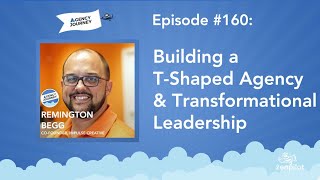
Remington Begg discusses building Impulse Creative into a T-shaped agency, covering growth strategies, keeping employees, restructuring management, and SEO tactics. He explains why domain transitions matter and how to scale content production without burning out your team.
All right, welcome to episode number 160 of Agency Journey this week, as you can tell from the video, if you're watching the video, if you're not listening to the podcast audio version, Got Remington Begg from Impulse Creative back on the podcast. How you doing?
I'm doing great. I'm doing great.
Well, so we talked two and a half years ago.
Yeah.
So that's the beginning of 2016, I guess, for. I always forget to timestamp things, not realizing. Everybody listens the moment this comes out. I don't know what's wrong with some people.
Come on, people.
But we talked a lot about your story and Impulse and building the team and some of the things that you had. So I thought what we could do is maybe we go in medias race and we go kind of start with where you guys are today, hear a little bit of what you're all about, because you've pivoted the business a little. I mean, the agency is still kind of the agency, but you're offering different services than where you were at two and a half years ago. So maybe we start with what you're doing today and kind of state of the agency and go back to how some things have changed.
Yeah. So actually, this podcast, that podcast episode was a pretty defining moment, not just because it was on your podcast, but because of a. It was one of those things that I couldn't ignore about talking about that. I had it all figured out, so I'll get back to that in a little bit. But Today we've got 14 people working in Impulse Creative. I used to look at that as a notch in a belt, and it's not to me anymore. So that's a big difference. But as we look at the agency, we made a pretty dramatic shift over the past probably 18 months that we decided that we really needed to focus and differentiate. Everyone else talks about differentiation, like, oh, let's go down a certain industry path or something like that. And what we wanted to do was come across more platform agnostic and really talk about results rather than being just dedicated to one tool. And at the same time, we learned a lot of lessons over the years previous. So now today, Impulse is, you know, we center around this compass. And the idea of the compass is that you need design, development, marketing, and sales in order to really define your brand. And they all have to be speaking the same language. And so we've got experts in each one of those areas and facets that can drive the results needed to help people grow their companies. And so we look at brand being the cornerstone of a company's growth. And so we've really defined our messaging a lot better. We've learned a lot of lessons in the past, and I had a great opportunity to press the reset button so we can get more into that later.
So you said design, development, marketing, and sales. Those are the four.
Yep. The four pillars. Yep.
Okay.
Yep.
Cool. So. And you've got people service there, but that's a model that isn't familiar to most companies.
Right.
Clients. So how does that. During the sales process, or they come to you for help, how much are you leaning on that and explaining that? Are they buying in or is that. Do they just see that as this is what the agency thinks is important? And if they get us the right design and development, that works for us.
Yeah. So I think it's a mix. The good news is I'm not in the sales process as much anymore, which means that things actually move faster. But the big thing that has, you know, that's really worked is there's more and more opportunities for interruption, you know, in the consumer company relationship. And at the same time, there all these different messages that companies put out. And as companies are putting out all these different messages, their consistency is really what defines success, and that's brand. And so when we're talking about design, what it looks like, development, what it feels like, content, how we speak about it, where we're targeting, all that stuff has to be on the same rails, otherwise you might as well be 14 different companies by refining that message. Dharmesh talked about it last year at Inbound about aligning all the vectors, and he was talking about people, but really by utilizing an agency or at least having the standards that you need as a company, we force that upon our clients in a very friendly way, but it aligns all the vectors in their messaging, visually, contextually, and of course, the user experience, too. And so they don't usually come for that, but after they've talked to us a little bit, they're like, holy crap. Yeah, I do have completely different header photos or I don't have the same bio picture anywhere. You know, it's a very precise thing. So a lot of times you get that oh, shit moment, and it's like, yes, we got it.
So, I mean, my assumption is pretty much everybody would lump design and development under marketing.
Sure.
What's kind of unique about that and pulling that out and saying this needs to be consistent across the entire, at least front half of the customer experience and presumably across the entire customer experience is you're not just saying like the cliche of hey, marketing and sales need to come together and now you've got a growth team or you've got a revenue team or what? It's not just that you've got these two things, but you're pulling in some other pieces and saying like all these need to be working in conjunction, which is a cool different, it's a different approach than what I've seen other people who try and pull the two pull marketing and sales together do. And I think that might provide some extra leverage to you guys.
Yeah. And then on the other side, and we'll get into the website redesign and the whole process about restructuring our message. One of the things, you know, everyone talks, especially this year at Inbound, it was all about the customer. Right. And everyone talks about customer centric marketing. They have for years, but no one actually does it or pays attention to the data. And so, you know, we realized that people came in and talked to us about website design and didn't really talk to us about inbound marketing. We like, we like force fed them. Inbound marketing is what they needed because we believe what we believe. And it's not that inbound marketing is not what they need, but in some cases they may need some, you know, some outbound tactic and inbound flavor, if you will. So we focused and made a major shift where we broke up all the little pieces of what's delivered in an inbound, like in an inbound strategy. And now we have, I think we're up to almost 60 different service offerings that are on our website. And so everyone's like, holy crap, how do you keep track of all of that? And it's like you do that every day. Like you're doing social, you're doing SEO. Well, you should be. You know, you're doing all of these things. We broke it up so that people understood all the different pieces and how we, how we pick and choose strategies in order to help people grow.
So let me ask this because you talked about like getting focused and niching down.
Yeah.
But you're offering different services. So the horizontal specialization, maybe as a piece, but maybe isn't. We can get into what's what services you have. But across 60, most people say it's not, you're not necessarily, if you're platform agnostic and you've got six different services, maybe you're not horizontally specialized.
Sure.
Depending. I feel like, yeah, it probably gets over polarized where it's like either you're specialized and you do one thing or you're not specialized and you do more than one thing. It's like, well, there's some scale here between like totally whatever happens and completely making it up on the fly, which is we offer every single service under the sun and then all the way down to.
Right, right.
But then, so are you specializing? Are you working in verticals?
So, so we're, we work really well with people that want, they want intentional growth. And what I mean by intentional growth is they have an actual goal that they want to accomplish. They want to know how they should get there and over a certain time. And I know that, you know, especially with this wa growth agencies that are going to be coming now, you know, like a lot of them kind of pitch that. But you can't throw someone into an inbound retainer that's four blogs a month and five social posts and you know, 47, you know, $4,700 a pay per click in order to drive a drive that result, it has to be customized, but yet people still have like two packages or three packages, you know, on their site. So I like to think of us more as a T shaped agency. So we're really, really focused on making sure that that brand is consistent. And then we, then we branch off and make sure the communication is consistent across all these different facets to a point where that consistency really accelerates growth, you know. And so what we're doing right now is we. One of the other lessons is our agency was kind of the red headed stepchild from a marketing point of view. We've really put in like what's the best retainer that we want to sell? Like how much effort and time would we want someone to pay us for? And essentially what we're doing is we're using our own website this year and our own marketing initiatives this year to show someone what's possible. And so that's the fun part of the case study as we're going forward.
Yeah, that's awesome. Okay, well, there's a lot we could dive into there because we talk a lot about specialization and niching and how you figure that out and the T shaped approaches, something different. So I'm glad that you shared that.
Yeah.
But let's go back in time here. You said the podcast we did or that like that time and having that conversation was kind of a defining moment for you. What did you. What, what is that? Tell me more about that.
Yeah, yeah. So. So as agencies, you know, I've seen a lot of different graphics. I think it's entrepreneurship in general. But like, you have like, I'm doing awesome, I suck, I'm doing awesome, I suck. And like. Or it's like this spaghetti plot of success rather than that straight line that everyone feels like it. We actually, on our podcast Way Finding Growth yesterday, we were talking about how, you know, it's like you're a one night wonder. Like, you figured this all out in one night because someone just discovered you. But at the same time, you know, we've owned the agency. This is going on 11 years now. So a lot of times people are like, Holy crap, 11 years. And you know, that usually is, that usually follows a question of, you know, how did you get where you are today? And I'm like, well, it took 11 years and they're a year and a half in and they're like, oh, you've got it all figured out. The assumption is, oh, I've got nine more years. You know, so there's burnout and all that. But one of the things, the defining moment for me is we were on a really great growth trajectory. Like, painful looking back, but, but on a really great growth trajectory. A couple years ago, we got some really great clients that came on. We had larger retainers, we had staff that seemed well motivated in the areas that we wanted them to be. And, and I, that podcast was how to, how to keep and retain employees, right? And I was like, I got this all figured out now. I got a sobering realization that between when we recorded that episode and when it was actually posted, that that was not the case, but we still went through and published it. And, and you know, everything that I said in there was, was true. Like, there's nothing wrong there. But the big thing that I, I came to realize, and it was in every presentation I've done since when I'm talking to other agencies is like, this is how we're doing it. And then an asterisk, like, we're still testing this too, right? Because, like, there's a lot of people, like business, especially nowadays, especially in the agency area, changes so quickly. Like, we're talking about conversational marketing and chatbots this year. And two years ago, if I told you that chatbots would be something you'd think about, you'd be like, whatever, like, you know, death to the humans. Like, that's not going to happen. And now it's, now it's driving serious results for people. So as things are developing and changing that quickly, you know, I look back at my business two years ago and it's like a completely different organization. And so when we think about the, you know, caring about your employees and measuring retention and, and trying to understand how to grow 300% year over year. Growth is not something that you want to advertise because that, that's like, you know, that. That rocket that's going up and then suddenly it's going to run out of gas. And so essentially that's what happened to us. We, we had a little bit of a poaching issue. We had people that were, that decided to jump on ship with other agencies. Other agencies were targeting some of our people because we're really good at training people. And, and so that, that put me into a really dark time personally for, for about six, six or eight months because I got bitter. I was super pissed. We lost a bunch of clients and disclosure there. I'm actually glad, looking back, that we lost those clients because there's no way we could have serviced them the way that they needed to be serviced by losing. It was almost, I think it was 70% of our employees all left in between when we recorded that podcast and when it actually published. So that being on the Internet means it's true. And it's one of those things. I think I've listened to that single episode probably three or four times since, and it's like, remember how confident you were with that? Where were you wrong and where did things go? So that was a great tool for me. But. But as we move forward today, a lot of the things that I realized is I was going for what everyone else told me. My management structure needed to be within the organization. And so I listened to a couple other agencies the exact same scenario that I realized that people listening that were probably like, oh, Remington's made it, and all these issues. And I realized that just because the Kunos and the impacts and whatever the other agency names are of the world are doing in a certain way doesn't mean that that's going to be success for me. And so that was a, that was a huge lesson personally. But the other side was like, from a management structure perspective, we went very horizontal in our management structure. So it's my wife and myself and I would rather, I would rather focus on building people who are accountable for their own actions across the board and then moving to a quasi POD structure, like more teams around things and then, and then having shared accountability, right? So we have shared accountability for success, we have shared accountability for failure. But it's the idea that, you know, there isn't someone at a management level who can taint or poison the well if you don't know what's going on. And so I don't spend as much time with each person as, you know, as I had in the past because there was someone else managing them. But now the ability and how we've structured it is like I go for every other week, I go for a walk with every single person virtually or in house. And when I say virtually, like walking around the neighborhood on zoom on my phone or actually in real life, right now it's super hot outside, so we tried to do those in the morning. But, you know, but really focusing on the relationship side of the employment transaction, not just the work side. And. And that's something that was completely missing out of last year's or two years ago is podc, as I was talking about how to keep them. And it was only. It was really just tactics where, you know, the other side of it is, is the human side. You want to know what's going on in their life because the outside influences in their life are going to affect the inside influences in the agency 100%.
Do you think in that story. There's so much in that story that I think is here and just understand, let's. And nobody actually has all their stuff together.
No, no, no, no.
We're all just figuring it out. And the reward this conversation. A bunch with people at Inbound a couple weeks ago.
Yep.
The reward for getting this right in business or in anything else is more complexity. Like things don't get easier. It's just that the scale and the size of the problems change.
Snowball just increases. Yeah, right.
So, yes, business is a momentum game. And there are big parts of that that are very positive where you get more clients, you make those clients happy, you get more referrals than if you only make one client happy. But the flip side is that when things don't go well and things are not always going to go well and you need to build in time and margin for things that don't go well, the snowball works in the opposite direction. I'm curious to know. After having gone through that, you kind of hear both sides of it. There's some people who believe like you build really strong relationships with people, you train them super well and you have a career path and they'll be loyal and stick with your. With your organization. There's other people who believe this is just the way that the market is. Like, things change so quickly in the space. People not necessarily at the core, but on the surface change very quickly now because they're exposed to so many More influences than maybe they were at times in the past because of the technology that we have. And you just need to be prepared for someone to jump anytime and understand that you will have exceptions. But the average life cycle of a team member is somewhere between two and five years. And depending if you're in the fast food industry, that's seven months. And if you're in a different industry, maybe that's 10 years. But it's not what it was. Where regardless, people were sticking with you for a long period of time. Do you fall lean one way or the other in that, like, has your mindset on that changed after?
So. So I would say half of the people that left left because of the poaching. The other half that left left because of the perception of where there's smoke, there's fire. And I got bitter, right? So. So it. That comes down from the top. And actually Ryan on my team, who's. Who's been with me the longest now, he was here during a lot of that. He actually came up to me. Candor is one of our core values. And he came up to me and was like, hey, man, like, you just get it together, right? And it's true because, you know, like, we have a lot of nautical references at impulse and, you know, the captain of the ship needs to make sure that everyone needs to know the captain knows where he's going. And so that's a personal thing. But from a company perspective, you know, you got to have those goals too. And I think that a lot of that is because there's a disconnection, a disconnection between management or the boss or the agency personnel that causes people to not feel appreciated or not know that they matter. And so I think if you maintain that, that helps. And for asterisks, we're still testing this, right? But the big thing there is that there's this opportunity to learn more. And I actually saw a tweet by Mike Volpe about it was, you know, he's a CEO now instead of a cmo. And like someone tweeted and was like. Or emailed him and he was like, are you an asshole now? Right? So there's this context that owners are assholes. And I bring it back and talk to. Talked to my team quite a bit about it, and I've had conversations is. So there's 14 people in my organization, so that's 13 people other than me. And if I want to talk to every single person each day about an issue, they've got eight hours or more of time. To hang out and be thinking about things. But I don't have, I don't have an hour that I could spend with each person because of how much time is available in the day. So I've changed how I operate day to day by coming in at like 4:30 in the morning to get my stuff done before 9 so that I can serve the rest of the team during the day. But on the flip side of that, you know, they need the CEO. Like the question about what the CEO does or the question about we ask for transparency in everyone's job, but the CEOs and management don't typically share what's going on in their lives, their lives or their business. Right. So like if they, if they're having issues or they, if they're not effective communicators, that causes as much of an issue as anyone else. So to answer your question, yes, I think that there's an issue with people jumping from job to job. But I think that we also have a generation of people that more so now than ever, one, see that the grass may be greener on the other side because of social media and other connections. And then two, you know, the opportunities are endless. Like it used to be local, your local radius was where you could find a job. And now we've got half of our team is remote. So, you know, it's just one of those things that I think we have to pivot and adjust to. But it really comes down to understanding there's human connection.
Right, right. Both of those are very important. And the other thing you see more today, I wasn't around 20 years ago in the workplace, but from talking to people, the thing that I see as being very different. And we've had this happen to us in a short 7 year, 8 year journey or whatever. But if you build those strong relationships, there will be cases where people leave who maybe were the right people but wanted another opportunity, an opportunity for people to return. Like there should still be, I think, the reason to, I mean it's just, are you transactional or are you looking to be a transformational leader?
And right.
If you're transactional, the odds of those people coming back, like the way that you're going to respond to that. And there's obviously the human nature of you feel like as the entrepreneur, you always feel like you're the one who gets left behind. You're never the one who gets to leave because it's your ship. You're always the one that gets left behind. And almost nobody's prepared for that. When they get into entrepreneurship.
Right. Well, and that's what we wear on our backs. I mean, that's why we do it. Right. But we forget that once things get crazy busy. I love that term, transformational leadership. So that's, that was in the past, probably in the past 12 months. That's been a really huge thing for me is I went to. It was another agency mastermind group and it was a lot of like, you know, the Simonson act. Power of why. Like, but forget your company. Right? So it's like talk about your why, but I don't want you to mention your company. It was something that was really powerful. And one of the big things was I want to make and impact with every interaction I have with my team. And what I want is to be the defining moment in the success of everyone in the organization. That is a huge shift from where I was, you know, three years ago, because it was, I want, it was transactional. It was. If I, if I treat everyone great and I do, I do insurance and I do this and I do that, how everything all ties in. It works really well. And, and that pivot really changes. So getting, allowing someone to come back to the agency is 100% a thing that it's safe. But you have to be an effective communicator because if you're like, hey, I'm leaving in two weeks, I tell the entire team, two week notice is a minimum. Two week notice does not enable the agency for success. One, you have to talk about the fact that you're thinking about leaving. And two, you have to be open and not fear your job to have that conversation. And, and in a lot of cases, you know, it's. I've had those conversations with a couple of team members where I look back in the history and I'm like, oh yeah, they would have been gone if I treated it the same way that I did before. So knock on wood. Hashtag learning all the time. Yep. Right. We're. Don't, don't take anything I say with face value and just run with it, but start thinking about how it can impact your business for sure.
So let's switch gears here a little bit. We'll go all the way from kind of high level management stuff and story to technical tactical because this has come up a couple different times and we're going through it right now as, as we're rebranding from Demon Bounties and Pilot.
Yep.
So you guys didn't rebrand, but you did switch URLs. When, when was this? Was this the beginning of 2017, this was.
What are we in right now? We're 2018. So we did it December. December 20, 2, 0. Yeah, yeah, we did it December of 2017. So December 20, because I wanted it to over two week period before we got started with the new year, I wanted to make sure we had all of our stuff figured out.
So I should have looked this up. It was Choose Impulse before, right?
Correct. Now it's Impulse Creative. Yeah. So I purchased. I've been fighting for the domain since we. Since we named the company in 2012 it was available. I did some searches on a couple different websites. Someone snagged it out from under me within like 30 minutes. And so when it started out as a $15 domain, it ended up being almost a $3,000 domain. And so as we're building up, as we're building up the company and we're seeing some really great results, we were like, you know, this is an investment we need. So I've owned the domain for two and a half years and I have been scared to do anything with it other than hook up emails because I didn't want to screw up the momentum we had. And so what we're talking about right now is switching your domain. I did a whole heck of a lot of research and I'm a data nerd, so I'm trying to understand use cases and there's not a lot of really good information out there around what it takes to choose a domain. And Google doesn't really share too much. But some of the key takeaways that I did from my research and through looking and again, my research that I looked at. So do your own due diligence. But when I did, it was it's not so much domain authority as it is website authority. And so when you think about that, you've got to make sure just like call forwarding with phones, like if you change from one phone number to another, we want to make sure that people who call the original number get forwarded to the next one. That's probably one of the biggest issues that I had uncovered and I had known about is making sure you have 301 redirects and you update all of your links. Then we went into the website redesign almost as if it was a rebrand. And so what I mean by that is the structure of our pages and the structure like the things we talked about. HubSpot was probably 80% of the language that we had on there and was a lot of how HubSpot talks about things. Inbound marketing, for instance. And like it was just all inbound. And I think we had our core site, not including blogs, was probably 15 pages, right? So the blogs and stuff were a major thing and it was also on a sub domain. So we had blog.chooseimpulse.com and then we had chooseimpulse.com which was the main site. Those core pages that we had, you know, we're a little bit more scattered. We were like, oh, we need this page, we have to build this page. And like, the keyword strategy around that page was very much singular. The, you know, the title tags, the content really kind of sucked. And so what we did is we. The. When I came to the team, I was like, we need a brand new website. We looked at the site and I said, I don't want any existing content on this website at all. Like the logo is the only thing that's allowed to come across. And so we completely rethought the entire site. We looked at, we rebuilt the sitemap from the ground up. And essentially what we did is Screaming Frog is an amazing tool. If you're transitioning between websites and any clients that we come in contact with, we do a full inventory of every single page in there that is on the Internet publicly. And so spreadsheets become your friend because you want to make sure that every old page now has a new destination or especially if you're switching URLs, it's going to a new place and also gives you an opportunity to audit every single one of those pages. So including blogs, we had 729 pages that we had to make sure that the IP or the authority transitioned over to. And of those pages, we realized that there are some pages we didn't want. And then of course with the services we added a whole heck of a lot more. So we did a lot of research on the keywords, obviously making sure that they are up to date. And for the record, I found notes back when we built out the site and I think inbound marketing research 1200 times a month. And now it's ridiculous. So when you're thinking about the shoe cobbler shoes scenario there, we built this website based off of what we knew of inbound marketing way back when. And the only thing we had going for us was time. So that one horrified me because we've got all this time and Google's looking at this domain and we're like, what is going to happen? And then on the flip side, we're switching over to this new domain and so we I basically made a checklist. It was making sure that every single page carries over the keywords that we were ranking for with authority. Making sure that those pages that we were eliminating were driving to areas, not just pages, but areas on the pages that had that same authority. So for instance, using anchor tags and adding those into your redirects. So if we're talking about inbound marketing, for instance, but inbound marketing is halfway down on a page, like literally telling Google where on the page that information is so that Google doesn't have to do as much info. And then we went through and set up all those redirects. We wrote all the content based on the criteria. And the criteria was essentially, These are the 13 or 14 keywords that we are holding some serious rank for that are driving leads and driving traffic. These are like our holy grail. And so by paying attention to the stats on those and like making sure that everything was working, we went through and there was probably another hundred or so keywords that we were monitoring. And I'm not talking about like using the HubSpot Keyword tool, which you can't use anymore anyways. I'm talking about literally doing a search and then having a VPN and doing another search of each of the keywords and actually measuring yourself how far down on searches you are. And then we also did some keyword analysis around those keywords in regards to today, how much is it searched and how long is the average page content? So the average page content was probably one of the defining reasons why this worked out really well. Because we're telling Google that we're moving and we want to tell Google we're moving to something better. And so if they look at a page that is 200 words when the average is now 700, and then we move them to a 200 word page, they're like, this isn't better. And that's where I believe you could start to lose some authority. So what we did is we made sure that we were one and a half times whatever the average was for all of our content, which adds a lot of extra time and effort. And along with that, we made sure that every single one of those pages had a redirect and that every internal link on the site was updated. And that's the kicker here. So if you change your domain, but yet all of the links, or a majority of the links that are in your site link to your old domain, you're diluting that keyword authority. And what you're doing is you're telling Google I Just switched my domain. But I'm not actually going to make anything better on my site. So what we did is we went through literally find and replace. Screaming Frog is really great for indexing and then identifying anything that has the old domain. And we had to go through 700 blogs and update links manually in every single one of those blogs to the new URLs after we did the redirects. So the user would never have known the difference because it would have redirected. But Google is going to go, oh, everything is updated. Like, this is fantastic. And so we have seen a 100% increase in traffic since we did the move. We moved the blog from a sub domain to a subfolder, so it's slash blog now. And in general, we're trending up between 15 and 20% month over month on organic traffic. So we actually have zero paid traffic right now. My initiative is to try and get to the entire rest of the year without having to pay for a single visit. And yeah, so just check your redirects, make sure that you update all the links so that they're pointing to the right direction and make sure that you're mindful of the keywords you are ranking for and you make sure that that authority is there with the new destinations.
Right. Wow, you broke it down. Kind of like you thought about this before.
I was scared. I was scared. Everyone's like, why are you white faced when we flip the switch? I was like, because I think this will work.
Not sure. That's one of the, one of the moments in life where you're like one of the few moments where you regret all the work that went into blogging. When you have to go through 700 blog posts and yeah, manually change up all these legs. That's funny. Well, good. Well, I appreciate you breaking it down. I know you guys have a case study on it as well, so we'll make sure we link up that in the show notes. So before I let you go here, you guys are putting out a lot of content right now.
Yes.
So let's just talk quickly about the resources that are out there so people know what's available. You mentioned the podcast Wayfinding Growth.
Yep, yep. Wayfinding Growth. So you can go to wayfindinggrowth.com that'll forward you through to the section on our website that has the podcast. We've got Inbound Film we just launched this past week, which is Video resources. George B. Thomas is now on my team. He's been on my team for about six months now. He's heading up his passion project essentially that he wants to build out this crazy video resource about anything you can do about video with business. Then we also have Sprocket Talk, which is anything HubSpot related. Our objective is to beat HubSpot out with announcements via video and telling you about them. George is doing quite well with that and it's working so well that we're actually bringing the rest of the team into some of these. So you'll see a bunch of new faces. But you can check that out by going to sprockettalk.com and then yeah, impulse is impulsecreative.com so we've got our blog and I do a daily conversational marketing tutorial Drift. And every once in a while I come in on Sprocket Talk and we'll do one with HubSpot as the tool starts to mature. So we are putting out 85 videos a month right now and about 23, 23 articles. Oh, and that's the other thing with the redesign. Every single page on our blog has a. Or on our website has a video. So like every page has a video on it that talks about the services in that video or in that page.
Right.
Wow. Yeah. 279 videos now are live on our site.
That's awesome. So you're listening, you're watching. Be inspired, not overwhelmed by that. That sounds like an awful lot of content to put out.
Sure. Oh, and the people doing it, there is four people handling that content in addition to their normal jobs. So no one is strictly dedicated to it. It's just a little bit of a discipline. And the videos, for the record, only take about 14 and a half minutes for us to produce and publish.
That's another podcast episode for us to pull in you or George at some point and just walk through the workflow. That'd be awesome. Well, great. Well, I appreciate you coming on sharing if you didn't catch it, if you completely zoned out during our SEO session there. Impulsecreative.com is the. Is the URL to go find Impulse and learn more about Remington. Anywhere else you'd suggest for people to.
Yes.
To go track you down.
So please don't email me. Emails, emails. In the vein of my existence on Messenger, Remington Bag on Twitter emmingtonbag. You can, you can tweet me, message me, direct message me if you have any questions about where you're at, what's going on, or you just need another.










