Building Your Creative Fingerprint: Four Ways to Communicate with Your Audience Through Storytelling
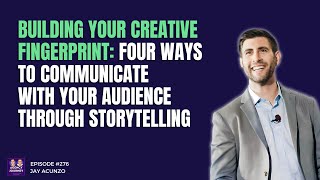
Jay Acunzo, founder of Creator Kitchen, talks about how storytellers build a distinctive voice. He breaks down four ways to connect with your audience through stories that feel like they came from you, not a template.
All right, welcome back to Agency Journey. This is your host, Gray MacKenzie from Zenpilot. And this week, I've got the pleasure of bringing on Jay Acunzo. Jay is the founder of Creator Kitchen, which we're going to be talking about more and more throughout the podcast. Here today, we'll talk about the membership program, his work with his podcast, unthinkable. A whole bunch of awesome experiences in the background, from being at HubSpot to NextView to ESPN in the startup space, in the VC space. You're all over the place, Jay. So we'll talk about all that, but really, you're an excellent storyteller, like one of the best storytellers that I know. And so I'm excited to dig into and learn from you here today around that theme. But welcome to the podcast. I appreciate you being here.
Thanks. I really appreciate it.
You have on the. I should have actually looked up what page this is on, but you've got a couple of things on there. From Jesse Cole with the Savannah Bananas.
Yeah. Yeah.
So I've been on, like, multiple wait lists. At some point, I will make it to a Savannah Bananas game. Hard to get.
Hard to get tickets.
Yeah. Have you been?
I have not, no. And, you know, the context for people listening is there. They started as a minor league team. They minor league baseball team. I would say that they're known as the world's most entertaining baseball team today. And Jesse Cole in his yellow tuxedo and yellow top hat is the sort of chief banana. They go hard at the banana puns. But he's kind of the P.T. barnum of baseball right now, and he's on a mission to make baseball more fun, which I really appreciate. I love baseball. I'm a huge fan. Started as a sports journalist, wrote about baseball in my senior thesis as an English literature major back in college. And a lot of baseball purists don't love what they're up to, but I can see. I see the forest. And I think what they're building is really important. I love it.
I think there's so many quirky things that they do. I have this conversation probably like a couple times a month where people ask me, I grew up playing baseball, coach high school baseball, and have been around that for a while. And I would describe myself in most aspects as a purist, but, man, I love the, hey, let's get people excited about it, and then, hey, we can expose them to the. To the whole sport of baseball. How did you get connected with Jesse?
So I run a podcast called Unthinkable and we just crossed 200 episodes. And the premise of the show is unconventional choices made by creative people and, and the remarkable things they make as a result. And the agenda of the show related to the premise, of course. But the mission is to help people question best practices and conventional wisdom and trust themselves more. It's ultimately a show about. And even the COVID art evokes this. Now we just did a refresh, which I'm really excited about. But the trusting of yourself and your intuition and your craft more than best practices and blueprints and. But that word unconventional. It's hard not to notice the Savannah bananas because a lot of people who either pitch me or who we notice just in planning, we look under the hood and there's nothing real there. They're just pulling a stunt that's pretty hollow to then try and trick you into selling something or coerce you into doing something or, you know, they're self aggrandizing and they're pulling a stunt to get attention. What Jesse's doing is very mission driven, very craft driven and quality focused. And so while he's not necessarily himself a content creator, although I guess he would consider himself one. He is. Yeah, I shouldn't say that he is. He's written multiple books. You know, they're very, very highly followed on TikTok and elsewhere. They have more followers on TikTok than any major league team. Now, if you don't know baseball, that is. I literally almost said this without meaning the pun, Gray. I almost said that is bananas.
Yeah.
So that is wild that a minor league team that almost nobody usually ever cares about except for the people right around the stadium would have more followers on any social platform, let alone, I think, you know, most of them that involve video anyway, then a major league team, then the New York Yankees, my team. So what they're doing is exceptional. And I honestly just reached out to him, I said, listen, this is the show and you know, I have a way, I like to pitch the show to people. And he agreed to come on and he showed up to the audio only interview wearing his yellow tux and yellow top hat and we did this amazing interview together, which by the way was full of interruptions. I think I had a big package delivered to the door and I had to apologize and excuse myself halfway through. And you know, I have a beagle who barks all the time and I think he was going crazy. Jesse was very gracious and appreciative and after the interview went live or the, the I shouldn't Say, the interview, but the story went live. You know, we do a lot of post production on the show, narrative sound, music, all this stuff. And he sent me a video and he was like, that was the most well produced pie. Sent it to my dad, I sent it to members of the team. And he was, it was great. So can't get a better testimonial than the P.T. barnum of baseball shooting a video while standing at his home field in a yellow tuxedo and top hat. So, yes, on my website, wherever you find my show, you find a video testimonial from the great Jesse Cole.
That's amazing, an awesome story. So I want to give you, I want to tee you up to tell another story, which is you're doing sports journalism. That's kind of. It sounds like a big passion going through college. And then you kind of wind up in the tech space. And now today, here we are. You mentioned one of the things that you're up to with the podcast. What's the story arc from this English lit major to today.
I mean, today I can say it with confidence and clarity, like, I, I am on a mission to help people make what matters to their careers, to their companies, and to their communities. There is just so much copycat thinking out there. And AI is just pushing the. We shouldn't say AI, we should say generative AI because AI is much different as a whole. But generative AI is pushing the value of commodity content to zero. But I think it's pretty much always been close to zero to create things that anyone could create. And the only way to win there is you got to shout louder, hype harder, run faster, rank higher. Because I can get this anywhere. And you happen to be anywhere. You know, it's this transaction, this very hollow approach to content. And as a sports journalist, I wanted to tell stories like Jesse's. I wanted to tell stories that were feature focused, that were human focused. Because I saw sports as this awesome, like, microcosm of humanity. I mean, I was inspired growing up by Rick Riley, who wrote the back page column on Sports Illustrated in the print edition, or Bill Simmons when he came on the scene, moving from a Boston area sports blogger, the Boston sports guy, to becoming just the sports guy on a subsection of ESPN.com known as page two at the time, to one of the biggest columnists on the planet there to then spinning out and, well, first running Grantland under ESPN and then the Ringer, two different sites that uphold what I would call, like, colloquial intelligence. Like, it's Your smartest friend at the bar or over coffee. Very accessible, very fun. Like tone of voice. Forward while getting romantic about what they cover while covering it like a fan would. And I love that about both of them, and especially Simmons. You know, I'm not alone. Very popular writers, the both of them. So I kind of came up with this lens of like, when I get into the workforce after college, I want to write like that. And so I did everything in my power to do that. Internships at Print Papers, worked for the Hartford Current, the biggest state paper in Connecticut. Interned at espn. When I graduated, I got a job at Google in sales because Print was not doing well. It was 2008 and I ended up in ad sales and Cray, I gotta tell you, I was miserable. It was a very valuable moment, very valuable lesson that like, just because everybody thinks a brand is great to work for, it doesn't mean it's great for you. We go about our days, especially as students who are about to enter the workforce. But I think all of us as professionals experience this too. Kind of writing someone else's script. And I had not yet learned how to write my own. But I switched from Google to a tiny little startup into content marketing and I have not looked back. So in house roles or independent work like writing books, giving speeches, making shows, and now running a membership for quality and craft driven storytellers and content creators. The only way I can summarize all of that is I am on a mission to help people make what matters. Because there's a lot of stuff out there that is being shipped at high volumes that doesn't.
What's the. So you said two things that like, I'm just trying to square my head. One is make what matters, but who it matters to. You know, you mentioned your community, kind of your audience, like external. But earlier you said follow your gut, don't do like unconventional is the. Is the theme here. And so is your underlying thesis that we have a better intuition for what people. What matters to people than them getting lost and following best practices or how do you connect those two ideas?
I think, I mean this is happening in the world right now. There's a very bright line dividing types of communicators, content creators. On the one hand you have people who think the job is to create content and on the other you have the people who know the job is to create connection. And I want more people to be on that side. The content is for connection. You know, it's not about 10xing your volume 10x the speed it's about creating things that have an impact. And so we're getting so obsessed with being visible that we've forgotten the job is to be memorable. Like, reach is how many see it, but resonance is how much they care. And no amount of reach guarantees that people will care. Like, we need to master this discrete skill, which is to resonate with others. Because when we resonate with others, they take actions. So whether you're like me and you love talking about creativity as an ideal, or you're a cold, hard, calculating capitalist or anyone in between, to master the skill of resonating with other people, which is a masterable skill. It is. A craft is good for business and good for you and those receiving your work. So when I talk about things like your intuition or craft or quality, I'm looking hard at that divide and I'm saying, okay, the object of our work is to connect, is to resonate, to inspire reflection and action in others with our words. How do we do that? Well, first we have to master our craft. Whether you're a writer, public speaker, a podcaster, all the above, a multimedia creator, a marketer, whatever you're doing, there's a craft to it. And unfortunately, I think a lot of us have over indexed on one narrow interpretation of craft, which is process. That's like the workflow techniques and tools that you use to guide the work. And unfortunately, increasingly, you are not guiding the work. It is the workflow that someone said, do it this way because I'm the guru, I'm the best practice giver, and they are guiding your work, or the tool is guiding your work, which is even more dangerous. So but that's still just a narrow view. It's the process, it requires you the least. The workflow techniques and tools that you use to guide the work. There's two other elements that we forget are part of our mastery of craft, which is our posture and our practice. So really quick definitions on both. Your posture is how you see yourself and the world. It is your confidence, it is your quirks. It is the messy bag of humanity that you haul with you to anything you create. And when we create, I think all of us would admit we affect the work somehow. But historically, we just left that to chance. We can do that no longer. What is your personal vision for the work, for where you're leading your audience? Are you a leader? Like visionaries don't have some gift and nor are they some like hollow guru like tweeting out fortune cookies. Visionaries are people who have vision. So what's yours what is your vision for where this is all going for your audience? Where are you taking us away from? Because that's what leaders do, move us away from something. And where are you taking us towards? What's the mountain peak in the distance that you're marching us towards? So being having a posture is not just puffing yourself up. It's you have a vision. You, you see yourself and the world and the work that you put out into it in a certain way. Another way of phrasing this, it's your creative fingerprints. Can you get that all over the work? If I white label it, it's unmistakably your own. That's powerful. That's how you have impact. The other is is practice. Now, do you do this consistently? Is it more than just a stunt or a one off thing? Is it more than the big story on the agency homepage? Is it more than a big story to a bunch of prospective clients in a room? Is it every Friday I ship. Why? Because it's Friday. I have a practice. I'm getting better and better and better. I'm honing my craft. Not just the process, but also my posture, because I have a practice. And when you do that, when you throw yourself into the practice of it all, what happens is you develop a process that's more tailored to you. So the thing we start with and obsess over process, what's the best practice? How do we actually execute it? And that's really what we're looking for. Not best practice, but best process. When we are obsessed over that, we're obsessing over something that honestly could be a byproduct of you just bringing your posture to the practice consistently. Right. Like my writing process is honed based on years and years and years of shipping every single week, Multiple times per week, actually. And I have a better process than I could prescribe to anybody else for my own purposes. And it brings out work that only I can do. So anyways, I think the point is we're losing sight of the fact that the job is not to create content. The job is to create connection. The depth of the connection that you have is the most important thing you can build. With an audience, with clients, with prospective clients, with partners, with team, with friends, with family. Doesn't matter with people. And the way we do that is to learn, to resonate. It's a craft you can learn. But if you keep interpreting craft as process, that's the thing that requires you the least. And thanks to all this technology being developed right now, very soon you might not be required. And that's what has me worried.
That's awesome. I've got two threads I want to pull on from that. The first one is how do I, as an agency owner get better at resonating and building that connection?
I think you can start very small. Like when you're telling stories, a lot of people think you have to be someone who does what I do, or you have to have a massive audience, or you have to have something groundbreaking that you've lived through or found. And so you get a lot of kind of hollow storytelling attempts. You know, you repurpose a Steve Jobs story for the millionth time. Where are you in all that? Or you tell your end to end biography and align is your own hero's journey. That's pretty limiting. Even if you had something groundbreaking happen to you, there's a lot of biases there that are unrelatable in the minds of your audience. But if you think about like, there are four ways you could communicate, each with like an ascending array of power in this order, it starts to get more concrete. So the 4R one, like, let's say you wanted to teach. A really easy example is let's say you want to teach other people to take more risks. And you also love to skydive. Like, the hesitancy we feel is. I'm not going to pull from my love of skydiving, by the way, this is a real example. This is from Brian. I should shout him out. This is from Brian Piper, who's a member of the Creator Kitchen. He's a higher ed marketing leader and a speaker and an author co authored Epic Content with Joe Polizzi. So Brian is a part of this membership that I'm running. And Brian, I talk a lot and he's like, you know, I really love skydiving and I teach marketers how to create better content and develop better experiences through data. But I never really. I don't think people would care about skydiving. You're right, they might not. They don't care about you when you tell a story. They care about themselves. Like, your personal stories are not about you. They're about the thing you're there to say, which is of use to others. So what you do when you don't use anything from your own lived experience is you just hand out instruction, just flat advice and prescription. It's like six simple ways to take more risks in your work. Everybody knows the importance of taking risks. You become more innovative, you learn, you learn through failure, blah, blah, blah. Well, today Here are six techniques. It's like, that's not good enough. It's not powerful. That's not going to resonate enough. So that's instruction. It's flat advice or prescription. There's no story. The second way to do it, which is where I think people get stuck, is story as illustration. Now, as a speaker, I have a lot of stories that I've collected over the years that I can tell on stages or elsewhere that are about other people. But as everybody communicates publicly in some fashion, agency owners are a great example. Pulling from your personal experience is useful too, but it's pretty limiting. Useful but limiting. To use your example, your life, your work as illustration. It's an example or a case study. I did it this way. You should do it this way. I did it, and you can, too. And here's how I did it. It was my blueprint. Now it's yours again. So. So back to Brian. Like, Brian works at higher ed. He'd be like, I'm teaching a bunch of higher ed marketers, and I want to tell you how I, at my University of Rochester, how I approach data. And now you can, too. Lots and lots of problems, lots of biases that are, you know, related to the person and also related to the people receiving your work. Very simple example of that would be, I talk to an executive who worked for a Fortune 500 brand, had a lot of speaking gigs, and when he left that company, he was complaining to me that his gigs had dried up. And I said, I that's because you keep telling the story of your own success at that brand. You're using your story as illustration as a case study. But the longer you go, the longer it has been since you worked there, the less timely and relevant that is. And also the different types of audiences you're trying to reach, they may not have worked there. They might see a white straight male and go, not gonna. Too much privilege. Like, I'm not. I'm dealing with more friction in my life or whatever. So illustration is using your own story as an example or a case study. It's the next two things that we want to get to as storytellers, metaphor and allegory. And they're related, but there are some differences. So metaphor is just using something you experienced, a moment, a memory of a hobby you have, even a trauma you might have gone through to create a quick comparison. You're telling them. So Brian might go like, so, hey, I'm a big skydiver. And in skydiving, you know, you have to take the leap, you have to leap out of the plane. So in our work we need to take the leap. We have to embrace risk. Okay, so two things about that. So one is that is a very useful storytelling device to get somebody into the larger point, but you still need to make the larger point. And you might have missed somebody with that quick analogy, or rather metaphor. But two, and this is really, really dangerous is we start pulling from our lives, but we pulled the obvious things. We haven't interrogated our experience like a writer, a storyteller, a journalist. The job is to interrogate the lived experience. So with Brian, he goes take the leap. I don't need to know that you skydive to know that. Yeah, skydivers make the leap. And so that's a good metaphor for me making. It's too obvious. There's not much power there. It's not that memorable, it's not that profound. You haven't really helped me that much, like change way I see or think or execute. So you can hunt for something not obvious. So for Brian, he might go, okay, so I skydive a lot. And there's this moment that you might not know unless you lived it. But when you leap out of the plane, which is the moment most people think about whether you skydive or not, there's a second moment, like let's say you're tandem diving and the person strapped to your back will tap you on the shoulder. That's your cue to open up your limbs so you can fall, better fall, safety, fall, honestly, in a more enjoyable way. So it's not enough when you skydive to just make the leap. There's something else you got to do after that, right, to have a successful time of it. Well, in our work, it's not enough to make the leap. You have to be open to what happens once you do. Because if you're just closed off to new possibilities, even if you've decided to make the leap to quit the jobs to do the new thing, if you're clinging to what came before back in the plane of conventional wisdom here, well, you're not going to have a successful time of it, you're not going to enjoy it, not going to be open to what happens. Right, so that's a more. That's a non obvious metaphor pulled from something personal to, to Brian, and I won't belabor the point. But lastly, the allegory. The difference is it's not a comparison to arrive at a lesson, it's a story to arrive at a lesson. So you still have that punchline I just gave you. But for Brian, he would detail his 500th jump and he flew to Arizona and he met these characters. There's a sense of character and setting and chronology and some tension. You sort of raise the stakes with like how he was feeling, was he nervous? Describe that. Did he have open ended questions? List them. It's much more of a tale to arrive at the lesson than a quick comparison. So you're showing rather than telling. So really quickly all four. Again, you can give out instruction, which is flat prescription without story. You can share illustration, which if you pull from your own life that that is useful but rather limiting of. It's an example that looks like what my audience wants to do. It's a case study. You can offer metaphor, which is a comparison, to arrive at a lesson, or you can offer allegory, which is a story, to arrive at a lesson. And those four things have ascending orders of power when we communicate. Whether you're communicating about something that you love, but you find the lesson others could care about, or you're talking about somebody you found and someone you observed, but either way you're communicating with a lot more power. And I think that, Matt, I think that's how we resonate. Don't just think about the volume of your work, think about its power.
Yeah, that's awesome. That's a great breakdown, I think, to try and take that. And you know, and that applies everywhere. I think obviously we think of that in a sales context or marketing context. Let's go tell a story. But that applies to how you're recruiting for your team and how you're leading an internal team and how you're communicating on a day to day basis with. Yeah, 100% with everybody.
Yeah, it could be very performative. I kind of just performed it myself. Right. Or it could be very kind of like stripped down, you know, like in a sales interaction or client interaction. You're like, yeah, like, I totally hear your objection. I mean, this is what we adore in the movies or on tv. Like well written scripts will do this and I don't see it showing up enough in our lives. But it's like, yeah, like, point taken, you know, very important client that remind me. So I'm a skydiver. Right. And then you tell a quick story and you get good at this. Like as an author, you take your stories with you on the road, like literally onto stages. But also virtually when you do things like this and you have a short bag of stories that go, a small bag that you can dip into. And I think like every professional communicator, which, if you're a business owner, that's part of the job and certainly if you're an agency owner. But I think every communicator would benefit from having like a short list of stories that each have slightly different purposes to them that we know how to tell different ways. And the only way that happens is if we decide to do it. Like, no one is going to ask you while interviewing you for your expertise. Can you tell me about, like, how should marketers seek to grow demand for their client services business? You know, how can owners of agencies grow pipeline? And if I may please respond in personal story Gray. Like, no one's going to say that. You just have to decide to. And our favorite storytellers, our favorite thinkers, our favorite communicators, they just do it and we just take it for granted. It's like, because they're amazing or we don't even notice that they do it, but we're like, wow. We walk away going. Gray is awesome. Like, you really taught me a ton of stuff. But the reason was, is because you decided to show up as a storyteller and to try and inspire people to reflect on something or even maybe take an action. And so that's on us to decide to do that.
I want to talk about some examples of who's done this well, and I think basically, like, where can people go who want to go who want to do this more? So following your work, I think is a great example. I think the creator kitchen is a natural. Hey, here's an avenue to go. I remember 2014 seeing Seth Godin talk in person for the first time. And he had, I don't know how many slides he went through, probably 50 or 60. But what was different was there were no words on any slide. Everything was a picture. And he has a perfectly crafted story for every. Here's this totally random graphic that has no connection to the prior one. If you just looked at him. But he's, he's such a master storyteller and I was such a powerful, like, still a memorable moment here nine years later. Who are some other folks or brands who are doing this?
Well, I mean, I follow mostly people who are not marketers because I don't want to anchor to things that look like at all similar to my work. But mostly I think the best in the world are not marketers. Now I make a lot of podcasts for I coach and have a membership. That's my business. And so the coaching clients I have are authors and business owners and speakers and, you know, people that have a body of work and they're looking to create like that really awesome special project, a podcast, a speech, you know, just their overall creative platform and personal brand. And what's so interesting is when we talk, almost never is Acme Inc. Coming up as like the model for our shows, you know what I mean? Because there's people who've been doing it longer, people have been doing it differently. So I try to break out of the echo chamber and follow people that I like. So storytellers that I like and learn from, and they're not prescribing how to tell stories, although the first one does, but they're more like the people I look at and then try to steal what they're doing and learn how they do it. So Ann Handley, she's the first one to mention, if you're in marketing, you probably have encountered Anne's work, but she has an amazing newsletter called Total Anarchy where she writes about writing, she writes about storytelling. You know, I have a newsletter which is free as well. The difference between Ann's and mine is Ann is looking to help you get started with things that look like the mechanics of writing. And then she adds a layer of quirkiness and soul to it. What I'm trying to do is within your content. How do you use, like, the stuff Ann is teaching you to connect on the receiving end to your audience. So, like, the name of my newsletter is Playing Favorites. How do you ensure that others consider you among their favorites for whatever purpose you share, you serve? So that's. We kind of have similar overlaps. We're buddies and we see eye to eye a lot. She's very much focused on writing. Her great book. Everybody Writes is a must read. So Anna someone I look at Mike Birbiglia, who's a comedian, but he's a comedian who tells stories. He has, he has this awesome way of getting right up to the edge of being a little too sentimental, but not tipping over towards the trite. And I love stories like that where he puts me in the feels, but I'm not like, oh, this is too over the top for me. And he also speaks in arcs, like he has a one man show or several actually you can find on Netflix where it's an arc of a story, but he takes tangents to these other bits. And I'm like, okay, I can learn from his structure, from his model for how to tell a story. You know, arguably my favorite storyteller of all Time is Anthony Bourdain. And it's because I think he was able to sit with people who were just going through their routines and ask simple questions, be genuinely curious, bring his personality to it, but not have to prove to you, like, look, I'm funny, or, look, I'm interesting, which is a lot of interviewers do that on their shows. And he would ask these simple questions of people doing simple things and just reveal these foundational ideas and profound meaning and moving stories, like, from the seemingly day to day of somebody else's life. And so you were there because you're like, I'm going to Mexico with Bourdain.
Cool.
But he's talking to, you know, a family over dinner.
What's.
What's more mundane than that? And yet you're gawking at the screen because you're learning, you're inspired, you're seeing all these things. So I think, in part, that was his magic when he was with us, so I learned from him. So those are three people that loom large. And, you know, I think that's the more important thing in my life anyway, is not people who prescribe how to do it, but trying to learn, like. Like, not what works, but why it works. Why did that opening moment of that thing move me? And we don't do this as business owners. We should be. You know, we do it about marketing and services and how do you construct the business model, all that stuff. We should be doing this about how others communicate when we feel moved, because that's what we're trying to do with others. Why did you feel moved? And not one big overriding lesson, but, like, okay, in the first moments of that interaction, what happened? The first moment or the middle moment of this story, what happened? And trying to rip out that lesson and apply it to our work. And the more we do that, it's not like we're going to transform overnight, but bit by bit, and this is where the practice matters. You start to find what's working for you or all these touchstones to go to mentally to create. You start to make it your own. And eventually people say to you, like, man, Gray, your show is incredible. Like, you move me every single time. Or wow. On that stage or in that pitch or in that email, like, it was great. So awesome. And I forwarded it to all my friends. You know, that's what we want. I don't think we study the folks who do that to us often enough, especially outside of our echo chamber. But, like, they. They're the masters.
Yeah. I Wonder if you disagree with this. That I think, nope, you're wrong. Yes, absolutely disagree.
Did I do it?
You passed the test. Early in our careers, is there an element of just copying the. Like, looking for the best practices, copying and to try to learn the mechanics. That's a natural part of our evolution. And then is your call, really. Hey, folks, your past, like, you got some of the mechanics down. That's great that you understand how to write the seven secrets to, you know, weight loss or what. Like, you've done that eight times now. You've. You understand how to do it. It's time to bring your soul out a little bit more. Or is it. Or are you actually saying, hey, from the very beginning, kind of trust your gut and go with it.
I just think, inescapably, we're inspired by things that inspire us. Like, so I can't say what that is for you, you know, and I think, like, there are ways to take it further. You know, you might say, I want to write a book, and so I'm going to copy so and so who writes great books? Or who wrote that one book I loved? And if that's your first moment trying to do so, and for some hollow, transactional aim, people are going to tell you haven't found a way to inject life into it. Like, that only you can bring. And so, like, an exercise you can do way before that is something called copy work, which is literally like, I'm going to take a favorite passage and word for word, hand write that passage. That's it. Because you're kind of seeing exactly how that awesome writer that you love writes. Like, you're really going through this physical motion to create what they created, in a sense. Obviously, there's a lot of intentionality and backstory and context is missing, but at least the final output you're copying. And that's important because it gives you a distant flavor for what it's like to write like that. You know, it's like, that's why I love side projects. Not side hustles, not side businesses. Things that have no commercial aim, but affect the things and improve the things that do. Again, the practice. I created a bunch of podcasts on the side. I've written blogs on the side since 2005. And a lot of it, especially early on, you can tell, like, I'm aping Bill Simmons, I'm aping Rick Riley. I'm mimicking the things that, you know, catch me on a more sarcastic, cynical screed inside of something I'm writing. And you're like, okay, he's spending more time with Bourdain's show. You know, there's. There's things that I can look at in my own body of work to be like, oh, right, I was really consuming this for a time. So there's the osmosis of it all. But then there's also the application of it, which is there are exercises you can do, or at least if you have a practice, you can try to approximate your heroes. And I think, like, we need to give ourselves permission to do that. And instead of looking for, like, what is the. The answer and some absolute for who I should steal from or how I should steal from them, we have to give ourselves permission to just muck around, to just be bad for a while, to find ourselves, like, to keep beating the horse. I suppose the thing that scares me most about Generative AI is not that creators get replaced. There's actually two things. There's one very small thing and one kind of existential thing. The small thing that worries me, which is still very, very potent in how I afraid I am of it, is that people are using the tool assistively. That's fine. But they're using it to skip the part which is messy, and then they become like a, you know, a poor man's version of an editor. The messy part is where you find your best phrasing. It's where you take a left when you thought you'd go right, and you find something amazing. Down that path, you figure out how to inject your own stories, metaphors, allegories. You come up with a little pithy turn of phrase that becomes something people tweet back at you. You sharpen your ideas and your thinking. It's. It's not just that your thinking gets better. It is. It's where it happens, but it's also that it's where you find yourself and all the things that make the writing uniquely yours, which makes it worth doing, which makes it actually effective for your business, because it could come from no one else. They affect you like no one else. They'll stick with you against the odds. You know, they can declare, oh, you know, there's a lot of agencies out there. They're my favorite. I know that one's bigger. I know that one claims that they. You know, they do all the things. Spoiler alert. Like, I think 99% of agencies are like, what do you do? Oh, we do everything. Okay, cool. Yeah. Move right along. Anyways, problem for a different day. Forget all that stuff. If you just wanted the Tone of voice of an Anne Handley, or the masterful interview skills of an Anthony Bourdain, or narration skills of a Bourdain or the humor of a Mike Birbiglia. That stuff is found when they were slogging through the suck themselves. They didn't say, someone else deliver me ingredients and a recipe, somebody else hand me a mess of clay. They went and just gathered up a bunch of stuff and mucked about for a while. So that's a very narrow thing I'm worried about. And the extrapolation of this is that, how do I want to say this? The problem is not that AI will replace creators or that bots will replace creators. The problem is that creators are acting like bots.
Yeah, makes sense. So how they cannot act like bots. What is the creator kitchen? And where did that, where did this come from?
Yeah, so it's a membership to push yourself creatively. It's focused on creators who consider themselves quality obsessed and craft driven and they want to be effective storytellers. And it's a membership I co founded with author Melanie Diesel, who's also in the marketing space. Known each other for years. She worked at like the New York Times and Time Inc. And HuffPost and, you know, I came out of Google and ESPN and HubSpot. Then we became independent creators for quite a while. And it's just so obvious to both of us that after you create stuff, and creating stuff is no longer the problem, creating remarkable stuff is the game. You want resonance, you want that passionate outpouring and support of your work and evangelism of it, word of mouth to grow your work for free. So it's a place to grow creatively along with other elite creators. And we treat it like an open gym. So the way we come at this is there's a lot of things you're going to be working on and there's a lot of ways you might want to work on it. But for a period of shared focus time, we emphasize in our work, not in the kitchen, but in our actual creative work as members. One powerful skill which we consider personal and transferable, it can only come from you. And it'll be different, it'll manifest differently with everybody, and it applies everywhere you show up. So, like telling personal stories is where the current kitchen focus is, which is why I was talking about Brian Piper and telling stories about skydiving to create better, more unique work and the output of whether you're in the kitchen or not, focusing on these creative skills that are personal and transferable. Is that you end up creating things that could only come from you. Right. You're not yet another. You're the only in the way you communicate, the way you create, the way you inspire and tell stories. And so far, it's going well. We launched it this year. We have people like Amanda natividad, who's the VP of marketing at SparkToro. She's a member. Jenny Blake, who's a bestselling author and a podcaster with 2 million downloads. Former Google mate of mine, like, she's in there, you know, and there's people who have been professionals for a while, but they're just kind of starting the creator journey. And it's really rewarding to see how many people don't just want to ship hollow stuff into the world. They have something meaningful they want to say, and they're trying to find a way to say it confidently and consistently so that they have an impact. They're not just trying to push pixels. They're trying to have an impact.
Yeah, that's awesome. All right, I'm watching the clock. We've got two minutes left, and I got to get you out of here in time. I wanted to go back to this one, and I was saving this because I was going to cut this if we didn't have time. But If I've got 90 seconds of.
Your time, I can go over if you want to.
Your. Your podcast. Like, you love these super highly produced narrative style podcasts that seem like a ton of work. I've been dying to try one and do it at some point in time, but you're editing it, you're cutting stuff up, you're adding music and effects and, you know, doing all this stuff. What is your process for doing that? Who. Who's involved? What does the process piece look like?
Sure, sure, I'm happy to answer that. So I work with producer Alana Nevins on that, you know, and the way it works is we are very clear on our premise. It all flows from the premise. On any show, this is the case. Your decisions get faster and more aligned and more effective if you actually have a premise, not a generic topic like talking topics with experts. We're here on the marketing show today. It is what's different when a listener comes along for the journey, where are you leading us? Like, it's not just your topics. It's your topics plus your hook. So we know that unthinkable is about these unconventional choices that creators make which cause them to resonate. And so we know where we're starting with that, every time we then think about our episodes, we're like, what's a question or a challenge or a concept or heuristic that we either want to explore or we know our audience struggles with and we'd like to explore on their behalf or who is somebody that has done something that approximates the feel of that premise? And then we're going to assign afterwards the more narrow theme question, whatever. So we're enrolling guests not because of who they are, but because they help advance this journey towards this mountain peak in the distance. And then eventually I'll write the book about, you know, resonance is the train we're on right now. So that helps us make faster choices. That's where it begins. It's clarity on your premise. It is specific. It is also defensible. You can own the idea outright. Nobody else can. And if you hold it up to a competitor, show people go, yeah, we don't do that. It's not. We actually get the practical. No, no, no, no. Your competitor would want to say they do that too, even if you disagree. So it's. No, we do this. This is what we explore. We explode one favorite project of a famous writer and have them describe it. Other writing shows would say, yeah, we don't do that. It's more about their bio. Great. You have a premise. From there, what we do is Alana and I decide, do we have the story? It's about Gray. Great. Do we have the theme question or heuristic that advances our journey towards the premise? Yes. Gray is here to talk about how to confront writer's block or something like that, and has a story to tell. And do we have a sound or a style we want to experiment with or play with? Yes. Okay. We're actually going to surround Gray with voices from our audience or voices from members in the creator kitchen who are explaining their own struggles with writer's block. And we're going to sort of surround Gray in the edit with those voices because that'll be evocative of what the listener is thinking. Fantastic. So we have clarity on that. Alana will go and do some research on who you are, on who, what you've done, etc. And then what we're looking for is in the edit, I'm literally going to pull this up right now. It's. We have. The most important document is our episode rundown. So the episode rundown, it basically just says, these are the five blocks of the show that we're going to hit every time. So Alana's research fits under one of these blocks. My interview goes in this order. Our edit is informed by this, and we will break from it and innovate and play. But for the most part, this is what we're saying. A block. What's the conventional approach? So I talked to Rishikesh Hirway, who hosts the podcast Song Exploder, very famous podcast in music. He takes one track with a famous musician like Madonna and has Madonna not tell her whole story. Why wouldn't you do that? It's Madonna, not Rishikesh. She's gonna bring him a song that's meaningful and talk about how it was made. So what's the conventional approach? Well, he's a podcaster. He's surrounded by people that do long form, unedited interviews. So we're gonna build up the conventional approach to seem inescapably either just ubiquitous or ubiquitous and preferred. That's A block, B block. What did they do that was unconventional, unthinkable, if you just see it from the outside? Well, Rishikesh Airway did his podcast this way, and here's why. It's so hard, and here's why it was so new and different and risky and blah, blah, blah. Okay, it seems unthinkable. C block. Why did they do that? Because it's only unthinkable from the outside looking in, when you hear their story, sounds smart, strategic, like, inescapably, in your shoes, Gray, you would do it this way. So C block is why? Why do they do it that way? Why was it actually better or smarter or safer, even in their shoes, to do it the seemingly unthinkable way? And the lesson here is, of course, they trusted themselves not to be rogue, not to be rebellious, but because there was something about their own situation, their person, their audience, their resources, whatever, that dictated that maybe we should all think this way and not blindly follow the blueprints. Right? So that's C block. And then D and E. Are you're the listeners going, oh, this is interesting. I appreciate what Gray is saying, and I want to think like Ray. How do they get here anyway? D block is the typical lead for most interviews. The backstory, the bio. Who is this person? How do they get to the point where they could do this with confidence and clarity? And then E is kind of what I call exit velocity. Can we end with something really important about making what matters most? We send you off hopefully feeling inspired. So we have this rundown which informs the prep, the production, the interview, and post, and it makes it a lot easier to decide oh, let's break from it in this coherent way this time around. Now, I'd be lying if I said I am not a Monolac. I do a lot of stuff. I'm trying to make a show that's like Radiolab or Reply all, but with, like, 1 16th of the resources. Right. It's a hard show to make, but I get to make fewer things that have a greater impact every time out. And so I'm not sure I would do it any other way.
That is super cool. I'm glad I asked that question. I appreciate you willing to be. Or being willing to go a little bit over here and explain that. Yeah, I think designing. So identifying that premise and kind of, hey, what's the. What's the arc happening first? And then building into that. And I'm assuming in your interview you may take it in that same order, but you still would have some. Because of the editing that you do on the back end, you still have some flexibility in terms of how you actually get to those answers completely.
Like, if you were to sort of take, like, the chronology of the interview and then, like, compare it to the playback of the final edit, you would spot that, like, oh, Gray said this at minute 34, but in the actual edit, that's minute two. Right. Because maybe I remembered something and I followed back up. Or it's just I pursued interestingness for a time. Like, it's not a rigid approach. It's not. I'm reading questions. I am pursuing interestingness in the moment, trying to get the story. But the most important thing you can do as a storyteller, you know, I think the phrase is as a person, you want to have strong beliefs, slightly held, something like that. As a podcaster, as a storyteller, you want to have a clear structure, loosely held.
Sure.
In other words, like, I'm going to try to tell the story. I think the story was going to be in my head. But you presented something to me that was way more valuable or worth following, and I'll pursue that. And because we do that editing, and I'm not alone on the show, Alana is not a. She's not an audio chop shop. I could rant all day about what people in business think a producer does, but she does know how to do that, and she does a lot of that for the show. But her main kind of value and the reason I have her on retainer is, and all producers are worth their weight in gold in this regard is she can see the code of the Matrix and understand, like, what needs to get cut. What needs to get rearranged. I'm incapable of moving from a 60 minute interview to our target of 35 minutes now that I've stated that is our new goal for her. Everything she's sending me from an interview is less than 35 minutes because she knows I'm going to add voiceover too. I can't do that. Like she's got a real taste and skill to like conceptually edit, not just manipulate a waveform. So I want to be clear. Like I am not doing this alone. I have for many years. I learned what she is doing but she does it better than me.
Yeah. That's amazing.
I own story and she owns a get out of your way level of editing.
That's awesome. Jay. This has been awesome. I really appreciate appreciate making time here today for folks who want to check out Creator Kitchen the unthinkable podcast the newsletter where's the best place is that the personal site is the best place.
J everything runs through J kunzo.com I mean if you are ready for membership we welcome@creator kitchen.com but typically people like to hang out with me a little bit first. That's my free newsletter or podcast are both completely free and you can find them near the top of jacundo. Com Amazing.
You crush it. Jay, thanks for joining us today.
Thank you. Appreciate the time.










