CRM Adoption and Utilization | HubSpot Admins HUG | November 29, 2022
This is a YouTube video titled "CRM Adoption and Utilization | HubSpot Admins HUG | November 29, 2022" featuring a presentation and discussion led by Doug Davidoff with hosting by Debbie. The content is a detailed talk on strategies, challenges, and best practices for maximizing CRM adoption and utilization in sales and business operations. It covers topics such as platform decisions, system design, data architecture, user experience, and ongoing CRM management. The session includes a Q&A segment and is aimed at professionals interested in improving CRM effectiveness within their organizations.
Hello everyone and welcome to the session today on Low Stress Guide to Maximizing CRM Adoption and Utilization. My name is Debbie. I'll be your host for today. And without further ado, I'm just going to leave the stage to Doug and you know, let's get this party started over to you, Doug.
Let's rock. Let's rock and roll. Thank you, Debbie. Hi everybody. Welcome to a topic that is, that is near and dear to my heart. CRM adoption and utilization. Now, I don't know how many old timers are here. I'd love to see everyone put in the chat, what was the first CRM that you ever used? And I'm going to challenge everybody because I think I can beat you all. Oh, I see an act on there, I want to know act for what? Because I go back to act for dos, we see act netsuite. So I go back, way, way, way to, to, to the days where there wasn't even Windows yet. So I've seen a lot of things that have happened as it comes to CRM adoption. And if, if I remember correctly, I'm pretty sure that I do. The top selling technology application in the 1990s was CRM. Believe it or not. I'm not sure that there's been a decade that it hasn't been the top selling technology application. And it's really interesting because for easily 30 years CRM has dominated the conversation around automation Salesforce implementation. And I don't mean Salesforce from a CRM standpoint, I mean implementing around Salesforce's performance. And for those that have been around this whole time, I think you would agree with me, the underlying nature of the conversation really hasn't changed that much. The same problems exist. You know, one of the things I always like to talk about when I'm working with clients or prospects is, you know, your CRM is only as good as it's being used. And so the question that I've asked and that my company Imagine has asked for a sustained period of time is if the technology keeps getting better, why isn't the problem solved? And just to give you a little bit of background as to, you know, why am I here talking about this? And over the last roughly 15 months, we've been involved directly in more than 100 CRM implementations. We've done this with sales organizations with as few as three salespeople to as many as 350 salespeople and probably just about everything in between. So we've seen the good, the bad and the ugly over the course of our lifetime, we've been involved in multiple hundreds of CRM implementations. And you know, one of the things that I've learned, and this doesn't apply just to CRM, but it certainly applies to CRM, and that is that there's a chasm that exists between the strategy of an organization and its execution, and more specifically between the intent that any strategy or initiative has and ultimately the results that they experience. And there's probably no better exhibit A for this than technology in general and CRM specifically. What's wrong with tech? What's happening? A couple years ago, Gartner did research, as they're known to do, and what they found is that on average companies were spending Approximately just under $5,000 more per rep per year on technology. What were they getting for it? What was the impact on sales conversion rates? Unfortunately, not surprisingly, negative impact on sales conversion rates. So as we think about the money that's being spent on technology, the time, the effort that's being spent on CRM, businesses are finding themselves still in the same basic conundrum that they found themselves for the last 30 years. You know, really. And, and I think it's unfortunate, it's unfortunate for all of us that are the recipients of the hundreds of thought list emails that I know we all see in too many cases. The only thing that technology and CRM has really changed is the volume that businesses are able to do things at. And that volume has enabled businesses to mask underlying weaknesses. As we're beginning to see an economic shift, those weaknesses are getting exposed. So really it forces us to go to a really fundamental question, and that is why do CRM implementations fail? And depending upon what research you look at, the failure rate is anywhere between 50 and 70%. Matter of fact, Forrester several years ago had a great article about CRM, basically referring to it as welcome to the, to the giant white elephant in the room. Why do CRM implementations fail? And what we're going to find is that the underlying reason is that we're building Frankenstein systems. Now, I don't mean just within the CRM, and there's certainly truth with that. I'm talking about the system, the broader system outside of the CRM. You know, the moment you touch CRM, the moment you touch any type of sales technology, you're involved in automation and you're also involved in change management. When you change the technology, you're looking to change the behavior. And so the first thing that we need to understand that is creating these Frankenstein systems is that small misalignments when Applied, get magnified. We all have a desire to keep things simple. As a matter of fact, I would say by far the number one request that I get when we start talking to somebody about new CRM, implementing a CRM, or any of those things is, look, I just want to keep this really simple. And I get that the difficulty is, or the mistake is that what we're keeping simple is the design and the implementation. And I'll get to this a little bit more later. What that's doing is it's pushing all of the complexity, all of the misalignment to the point of execution and. And realize that as companies are spending more on technology, which fundamentally is designed to increase productivity. Take a look at the trend over the last 20 years of the average time salespeople spend actually selling. The latest research that I saw from last year from CSO is the typical salesperson spends right now about 31% of their time actually selling. In the early 2000s, that number was about 43, 44%. We've seen a consistent decrease in that key productivity metric of how much time am I actually doing the job that I was hired to do? Despite the investment in technology, first cause is small, miscellaneous. The second is what I like to refer to as the whirlwind. Well, what's the whirlwind? The whirlwind is our day job. We've all got a job to do. And if you're in sales, your job is to hit a number. And by the way, I have seen people go on a President's Club trip because they beat their number but did not adopt the way they were supposed to. I have yet to see one sales rep make President's club because, well, 70% of their number. But they use the CRM better than anybody else in the organization. One of the next mistakes that we make is we bring CRM in, thinking of it as the solution, and we change too much too fast. The whirlwind is the inertia of what we have to get done on a daily basis. Take that into account. When we implement a new technology, the very reason that we made that change fails to appear. We actually create more of the problem that we're trying to solve. The third underlying reason why CRM fails, what leads to these Frankenstein systems that we're all living in, is the difference between theory and the real world. Look, I love this process. I love talking about strategy because it is a nice, wonderful, clean environment. Everything maps cleanly. It's beautiful. Unfortunately, to quote the great philosopher Mike Tyson, everyone's got a plan until they get punched in the mouth. You see, the interesting thing about sales and sales and marketing is it's the only open in business. And what does open loop system mean? It means we only control a portion of the system, right. And if we're spot on with what our plan is tomorrow, everything's changing. Our customers changing, the economy's changing, our competitors are changing.
Right.
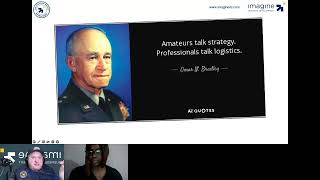
We never operate in an environment where things stay the same. Systems aren't built to support the ongoing changes and iterations that are necessary. They're not built the flexibility and the dynamic components that lead to effective and successful sales success outcomes. See, it really comes down to what I like to call plumbing. The reason our CRM aren't being adopted aren't being utilized, the reason that we're not getting the results that we're seeking is because we've got bad plumbing and it's got a tremendous cost on our to operate especially in the more difficult environment that we find ourselves in today's and probably will be for the next 12 to 18 months. This is why revenue operations in general and CRM specifically continue such a hot topic. Serious Decisions finds that when you don't have best practices in place, when you're not optimized, it's got a 19% drag on growth and a 15% drag on profitability. Research from profit acquisition growth costs, I'm sorry is growing at 33% per year. Now, now again, remember, why are we investing in technology? We're investing in technology to bring down the cost of growth, yet all too often we're just adding more and more to it. And one of my statistics, 98% of MQLs never result in a sale. And by the way, that's not necessarily bad, that's not necessarily a bug. But we've got to be able to plan for it. We've got to build it into the design of the system so that we can drive the types of behaviors and the types of actions that lead to the outcomes and results. As general Omar Bradley has said. One of my favorite quotes of all time. Amateurs talk strategy, professionals talk logistics. If sales performance is a top issue for you, if is viewed as a core means to achieve that performance, you better be thinking sticks that drive the outcomes. Let's go back to the point that I made a little bit earlier. The idea keep things simple, which I'm all for. What you've got to ask is what do you want to keep simple? To keep the implementation simple, or is the goal to keep the experience simple would fall into the latter category. We want the user's experience to be simple. We want it to be easy. We want it to be effort. And this is why about two and a half years ago I created a principle that I call the inverse friction principle. Friction principle states that the ease or effortlessness of a user's experience has an inverse relationship to the complexity a system that makes the experience so easy or effortless. Let me put that in a simpler way. It's things easy. Now, if you've ever designed any software, you know that, right? You know how hard it is thought has to be put into designing and executing the software so that the user's experience can be intuitive, easy. Why are we not taking the exact same approach to how we're implementing that technology? Our people. And that is why if you ever talk to anybody at my company, if you ever talk to anybody at Imagine and you talk technology, you will find that we live by a prime directive whenever we touch technology. And that directive is the business technology. The technology should never dictate the business process. And I'll tell you the thing, the magical superpower of CRM is it finds its way into the driver's seat. And when it's in the driver's seat, that's when have realize people do not adopt CRM. Let me repeat that. People do CRM. They do not adopt technology. What they adopt are process people. This process people adopt behaviors. The technology comes with it. Done right, the technology and accelerates. But if the focus isn't on the underlying business process are going to be unpredictable at best and most likely damaging. So a CRM in place right now or you're thinking about implementing new CRM. If you are looking to improve and enhance the utilization and the results that CRM enables, talk about five of the early that you're in trouble. And the first one is probably really going to make you think things. That's so obvious. We never stop and think about it when we talk about increasing the adoption of CRM. What is CRM? We use to describe so many things that it doesn't really mean anything anymore right at its base. What is CRM? All a CRM is, is a database that you keep information about customers. Now I add that it's a multi object relational database. But, but technically and by the way, I some people wrote Excel as their first CRM. Candidly, Excel is a CRM if you are keeping the information about your customers and what's happening in Excel, it is your customer relationship management database.
Right?
When, when we're looking at CRM in the real world, we're looking for something far more than that. We're looking for reporting, we're looking for insights, we're looking for productivity, we're looking for acceleration. Don't stop at we need CRM. Don't say we've got a CRM problem. Define what that is. Define what you're trying to address with CRM and you'll find yourself well on the way to the path of getting greater adoption, greater utilization, or at least finding what the real barriers are to that adoption and to that utilization. These are the four most dangerous words when talking about CRM implementation. And and I have lost count how many times I hear them. The four most dangerous words are all we need is.
Right.
Remember, that takes us right back to the inverse friction principle when we're think all I need is a place that will store the information so that everyone can see what's going on. The right hand will know what the left hand is doing. We'll know who our customers are, what, what contacts, et cetera, et cetera, et cetera. Again, we, we've implemented 100 CRM implementations in the last 15 months. Probably half of them started with some level of CRM requirements documentation that we looked at. And I just want to let you know that this the the most advanced CRM requirement documentation that I've seen from a technological standpoint. Those requirements were met in the early 2000s. CRM has created that single point customer source of truth from a technical level for more than 20 years. Why is it still the top issue in customer facing technology? Well, well, the reason is we're not getting to the area where it really matters. You see, we look at CRM far too often as a technology issue or a technology problem. We look at it as a technology solution. Right when when we talk to companies about implementing new CRM or really implementing any CRM, one of the first things we caution them is never refer to it to their teams as a technology initiative or as a CRM initiative. The moment you refer to it, the moment you define it as a technology issue, you're going to create the static. You're going to get in the way of trying to get the behaviors that you're looking for. You should always look at CRM as a performance initiative. It's a sales performance initiative. It's a lead management performance initiative. It's a service success performance initiative. Susan Scott probably said it better than anybody else that I've ever heard. And that is the problem named is the problem solved? If you think of CRM as a technology issue. You're going to name it as a technology problem and you're going to solve a technology problem. And I can solve lots of technology problems by the way. I have unfortunately been involved in implementations that have been abject failures. But the implementation was good, the technology was good, all the work that was done was right, it was quality, it just didn't drive the business process. And that's why whenever we think about CRM or any technology, we caution people, don't buy technology, hire it, define the job to be done. And yeah, we get geeky sometimes. We'll literally create job descriptions for the technology. Think about the spend that you're going to have. If you know sales organization, 25, 50, 100, 500 people, think about the spend that you're going to have on an annual basis to, for the technology, directly to support the technology. Yet we, we spend more time defining the job description of an entry level employee that's going to be doing the same thing that other people are doing than we spend defining the job to be done by critical elements that are going to impact everybody like technology. And then we get surprised that it's not producing the results that we're looking for. You see, CRM is always has been and always will be a business performance issue. The CRM needs to be owned by the business unit, not the IT department. Now that does not mean it has no role. Of course it has a role, but when it owns, doesn't live with the problems that need to be solved. And you're going to solve a technology problem rather than a business problem.
Right?
The business unit needs to own it, both to drive the focus of IT, but to also own the consequences of it. One of the ways that I know that we're off on the wrong path is the CRM's coming out of it's budget. Now look, I get it. If the CRM's coming out of it's budget and I'm in it, you bet your, you know what, I'm going to be involved, right? The CRM should be coming out of sales, marketing, customer success. It should be coming out of that budget. It should be coming out of that budget every bit as much as the people that those business units hire comes out of them. They should be responsible for the inputs, the outputs, they should have P L responsibility for that technology so that the right priorities are placed, the right trade offs are managed to deliver the outcomes that we're looking for. P L, profit and loss responsibility. So that's how we know that we're off on the wrong foot as it relates to implementing CRM. Let's now talk about how are we going to overcome the barriers to CRM adoption and utilization. And this is why I love Rev ops, right? This is a framework that we started putting together about three and a half years ago because candidly, I just got sick and tired about people talking about alignment, because everyone talked about alignment. And we've been talking about alignment for about as long as we've been talking about CRM. And no one could actually explain to me what it looked like. And one of the things that I'm a big, big fan of is I like to look at the companies that are producing consistent success and see what is it that they're doing that's different than what the others are doing? And even more importantly, what is it that they're not doing that others are doing? And what I found was this framework began to emerge. Now, I'm not saying that necessarily the companies that were successful were thinking about this framework as they did it, but if you remember that chasm that I talked about between the strategy of an organization and its execution and performance, what we found was these companies had built a bridge from strategy to execution. So that strategy fed to execution and execution fed back to strategy. The bridge comprised the structure of the organization, which is a combination of the system design, the tools, which almost always involved the tech stack and the scoreboard. How are we keeping score? By the way, if you ever wonder how important score is to the behavior and performance of any group of people, just watch a bunch of 12 year olds play any game before and after someone says, hey everybody, let's keep score. The structure is the invisible hand that drives behavior. The soft side of it is called culture. Structure drove the approach, the mo, the playbooks, the processes and the methodologies. Structure and approach. That is the playground of revenue operations. That is why revenue operations is growing at the rate that it's growing. It's that realization that structure and approach is the bridge from strategy to execution. And all you have to do is look at the core of structure and approach and you see tech and CRM staring you smack dab in the eyes, right? As goes your CRM today, so goes the underlying system and performance of the organization. So what are the five critical success factors to implementing strong CRM to drive the behaviors and the performance that you seek in your organization? The first is you need to make a platform decision before you make an applications decision. The second component is understand and pay attention to the design of the system to the system design that your CRM and people are working in. The third is data architecture. And holy cow, tell me how good the data architecture is, I'll be able to tell you where they are on, on a performance standpoint. And by the way, if you don't have strong system design, you're not going to have strong data architecture. Fourth is ease of use, and the fifth is always be launching your CRM. Let's get into the details. The first critical success factor, the most obvious example of a platform decision is are you Android or iOS right now? Think about this for a moment. Technically, we're buying a phone, but before we ever buy a phone, we're buying a platform. What does that mean? Well, if I choose Android or I choose iOS, there are 100 decisions that are made, right? I never make them, I'm not even aware of them. But the experience and what's happening is radically changed. By choosing Android or iOS before I even get to the phone, before the application is relevant, the decision I make about my platform is going to drive so much of my experience right now. Some people make the decision purposefully. They think about which platform, some don't think about it at all, and they end up stuck in it. And let me tell you, and by the way, I am not making the judgment of is Android better than iOS? Is iOS better than Android? You know what? They're each better for some, worse for others. But there's nothing worse than being on an Android platform and wanting an iOS experience, except maybe being on an iOS platform and wanting an Android experience. So let's talk about this as it relates to CRM. What you're going to find is you're going to make fundamentally a platform decision. Are you going to go with a horizontal platform or a vertical platform? What does that mean? Well, basically, what a horizontal.
Seems like we lost Doug there. I think we'll just give him a couple of minutes for him to join us again. But, wow, he's been dropping so many gems. Okay, we have him back. All right, you're back, Doug.
See, this was all designed just to build a little bit more suspense for everybody. Alrighty. So what I had said, you're going to go with a horizontal platform or a vertical platform? A horizontal platform is basically you're bringing together multiple applications. Now, typically, your CRM has a. There is a centricity to it, but what a horizontal platform is going to do is you're going to have multiple databases. There are going to be multiple applications. Now, the upside to a horizontal platform is it can Create a much more customized experience for you.
Right.
You can identify individual applications and bring them together. So every application that you're using is specific and purposeful and chosen.
Right.
The downside to it is it's going to be more complicated. Managing those databases is going to involve ongoing action and activity. And candidly, what it means is that it is going to have a much bigger involvement. Because managing the technology is a key element for a horizontal platform. A vertical platform really looks at your CRM as the center. Everything emanates from the CRM. And the CRM is then driving your marketing motions, your sales motions, your customer management motions, and then utilizing APIs and other elements of integration, you're able to bring in other applications. One of the things that you're going to find in a horizontal platform is more often than not you're going to work in the specific application. So if you think about a horizontal platform, you're building on a horizontal platform. With a vertical platform, you're working in it. So the other applications that you're working, you bring them into the CRM. What one's right for you. I can tell you that all things being equal, a vertical platform unquestionably is more streamlined. I am. One of the rules that I live by in, in managing technology is the fewer databases the better.
Right.
So this is really operating on, on one primary database. It enables greater cross communication and in a simpler way, it is more business line oriented. So if you think about a platform decision, you're managing everything, and I'm oversimplifying this a little bit, but you're managing everything in kind of a point to point. A vertical platform, you're taking more of a hub based approach. What, what's the right choice for you? Well, if building on is important and you have the IT resources, a horizontal platform might be the right one for you. A horizontal platform is very IT centric. Now remember, the CRM still needs to be owned by the business unit, right? So it does mean an allocation of resources from IT to the business unit, which again becomes another thing that you've got to manage.
Right.
As I mentioned earlier, you're building on a horizontal platform. And if what you need is custom, right. It has to be built specifically to your specifications because you've got unique requirements. Horizontal platform is likely going to be the direction you need to go. You're going to need to manage that because it will be more complicated. Vertical platforms are business use centric. You work in them rather than building on them. You are for the most part configuring rather than customizing. And a vertical platform does provide a much more streamlined experience. So how do you know which one is the right one for you? Well, if a horizontal platform is the right choice for you, there will be very clear signals in the jobs that you define that demonstrate the need for a horizontal platform. If it's not clear you need a horizontal platform, you're, you're likely, your vertical platform is highly likely the right platform decision that you're going to make. Now, when you choose which platform, that's when you begin to look at the specific technology, right? So the moment you choose which direction you're going on, a hundred other decisions are made. And what I find, and it's the first mistake made when people purchase CRM, is they purchase the CRM first and then, well, for the most part, they never really think about the platform decision, but if they do, they think about it afterwards. Think about platform first, application second. Any sailors in the audience? Any boaters? If you're a boater, you, you understand the danger of friction not managed, right? Friction is like a barnacle on a boat. And here's the thing that's the most dangerous thing about friction. It's the most dangerous thing about barnacles. A little bit here, a little bit there, doesn't make any difference. And look, I'm guilty of it. As a matter of fact, I had to live with the consequence of it two weeks ago. I didn't build the template before I started sending out the emails, so I copied the email from a previous email, forgot to, forgot that I had put the company's name and something specific to them in there, pasted that in, sent it out and had a big old whoopsie moment, right? And why did I do that? Well, because, you know, to go through, it was a busy day. I had just iterated a new thing that was working out really well. You know what, I'll get around to that later. Hey, let's do this, right? It was easier to just send out the email than it was to build the system, right? But the danger is those barnacles build up and build up and build up, and as we generate more and more and more friction, we create more and more quicksand. Hey, we're the, we're the HubSpot admin user group here. We know the flywheel. For as long as business has been around, we have basically been stuck with only being able to manage one part of the flywheel. Increase force. The, the battle cry of business for the last 20 years has been do more, do it better do it faster, do it with less. We've hit the point of diminishing returns there. System design is looking at the underlying elements behind that so that we can reduce the friction that creates drag. And by reducing the friction, what I refer to as the negative friction, we increase the rate of the flywheel without having to expend more resources, more energy, more effort. But it requires us to look at things through the lens of the system and the underlying business process.
Right?
We all run a theater operation, right? We've got our customers that we want to delight. We delight them with our front stage experience. What is the front stage experience? Anything that touches the customer or that the customer sees is front stage. Now I will tell you, over the last five years, I have seen real progress towards reducing the front stage friction. The difficulty is while the front stage gets all the spotlight, it really only accounts for about a quarter of the real friction that slows us down. It only accounts for about a quarter of the real friction that prevent salespeople from spending more of their time selling. The real friction is happening in the backstage, all those things that are directly supporting the ability to sell. I remember when I first got into sales, I was told if you're not talking to a customer or preparing for the conversation you're about to have with a customer prospect, you're not working.
Right.
Because I was hired to be in sales, right? Backstage are all those things that enable us to be doing our front stage. And the support processes are the things that connect so that our ongoing business can operate effectively. So what is system design? It's the ongoing process of making trade offs and adjustments that are necessary to align everything going on so that we can maximize our value creation within the constraints that that exist. Overly technical here a little bit. The main thing I want to get across, and this is the second biggest reason that I see CRM implementations fail, is we keep trying to find, quote unquote the right way or we try, we, we end up addressing whoever's complaining the loudest. There is no when you get to the real stuff that makes a difference. There is no right decision. There's a trade off. When you make a choice, it's going to be good for one direction, not as good for a different direction. Let's go back to platform. I remember when I first got into real estate, I was a real estate agent for a brief period of time. I showed somebody, I think it was six, seven houses. The first time I showed them, I said, okay, so what do you think? Which one do you like? And they never forget what they said. Well, we really like the, the backyard of the second house, but the kitchen of the fourth house was great and the bedrooms are the first house. And I was like, yeah, okay. Well, unfortunately I can't, I can't pull that. You only get to choose one, right? We've got to make trade offs. System design is the process. It's the strategy behind the trade offs that are getting made. And what makes it especially fun is those trade offs are done while we're executing. And there's four components to good system design. The first is a comprehensive holistic understanding of the situations, inputs, stakeholders and objectives. What is it? Who's involved? How's it, how's it being done? What's the problem? We then move to the hypothesis stage. This is a divergent approach to thinking. This is where we break things apart, establish theories about the problem, potentially the solution. What are we going to test? That moves to the analysis stage. We break down further to ensure that we're addressing the causes, not just the symptoms. And we're considering the various upstream, side stream and downstream impacts. That's how we make sure we don't get stuck in the whack a mole game game. And the synthesis stage brings it all together to and into the systems that we're operating in so that the users are able to continue to move forward. They're operating in an environment of transformation, but never feeling like they're under constant change because their stability. This four step process is designed against three trade offs. The first trade off is feasibility. How hard will this be? Viability. How sustainable? Sure, we can do it. Can we do it again and again? And how disruptive will it be? We're always trading off against the feasibility, the viability and the desirability within the constraints of our organization. So as we take this and apply it to the CRM and we talk about defining the job description of the CRM, there's five components to this. Define the job, define the competition. How is it being done? Now prioritize the responsibilities, define the criteria to achieve the job and what are the outcomes. And here's an example of what user stories look like. I'm pretty sure we'll be sharing the deck. If we're not sharing the deck, just let me know and we will share the deck. Alrighty. That's system design. Let's move to the third part. Database architecture. This is what every user is thinking when they touch the CRM. Don't make me think. And the thing that causes people to think first and Foremost, the underlying structure of the data. So what is data architecture? How can we understand it in, in its simplest forms? Now, if you are a data scientist, if you are a database architect, you are going to probably hate me because I'm about to butcher this. But I'm going to provide a very simple construct to think about how you want your data structured. There are two components to your database architecture. Objects and fields or properties. What is an object? An object is a database. For all practical purposes it is a database, right? So contacts, companies, deals, those are all different objects. The way to think about an object, the most effective way I found to think about an object is an object represents an entity, right? So if what we're talking about is a different entity, it's a different thing, then it should have its own object. A field or a property is data or information. The object sets the structure.
Right.
It sets the walls right. Every good house has rooms. What makes a room a room? The walls between them. That's what the object is. Fields are properties. Their first segmentation. And the most important lesson I've learned when it comes to managing database. If I just been paying more attention when I watched Ghostbusters, I would not have had to learn from experience. Don't cross the streams. What does that mean? Don't make an object a property. Don't make a property an object. What are some common objects? Companies, contacts, deals, opportunities, tickets, Properties, by the way, properties, meaning in the real estate context of properties, products, vendors, sites, locations, those are examples of objects, properties, the data components beneath them. Here's what good object orientation will enable you to do. It enables you to pivot the orientation of your entities so that you can get truly a 360 degree view. You can look at your business, you can look at your environment through whatever lens is needed so that you can develop the insights that drive behaviors. It enables you to set up and structure your CRM so that it truly becomes a command center. Whatever the pulse of my business is, whatever the job that needs to be done by the individual using it, the CRM can be configured and structured so that it is designed for their use. That's why data architecture matters. And when data architecture is isn't right, then you'll never get to the reason that CRM does or does not get utilized. And I want to share this with you. Adoption is not enough. Adoption is forced. What's the definition of adoption? Most definitions of adoption are they log into the system X times in a period. Adoption is inconsistent. And by the way, you can at least theoretically Mandate adoption and you can enforce it. But there is only one way to get utilization. And the only way you get utilization is when the juice is worth the squeeze. What does that mean? It means when using the CRM, when my job uses. Using the CRM is easier than when not using it. Simple as that. If it's easier to use it, I'm going to use it. And if it's easier not to, I'm not to. My favorite question, why did you not use the CRM? Because it was easier not to.
Right.
Let's go back to friction, by the way, because friction gets a bad name. Because some people hear what I said and they think it's all about eliminate friction. Here's what I want to do. I want to add friction to the things I don't want people to do or to the places where I want people to slow down. And I want to take friction away from the things that I want them to do that maybe aren't as natural or they're not as used to. Now when we think about utilization, we get into a term that I call activation.
Right?
Activation is can I really count on the data that's in there? And the three things that kill activation. The three things that kill a well designed CRM, but again doesn't drive the performance are offline conversations, emails and notes. So how do you solve for the deadly sins? A single interface, Every time a user touches another interface or every time a user has to go into another application. Adoption. And the adoption and utilization half cycle drops by one. We want a single place where people are working. The second thing is we want to find ways to get adoption without them using it. That's why integrating email is such a powerful tool. That's why the telephony connections and click to dial and all that is so powerful. Now I'm using the system without using it. And the third is bring the system to the user. You see, the fundamental implementation flaw with CRM is we keep forcing the salesperson, the rep, the marketer to change their flow to adopt the CRM rather than designing the CRM to work within the user's flow. But to do that, we have to map the business process. It's not enough just to say new business, you know, new existing prospect. We've got to define the steps. You see, implementing CRM is software. We've got to define and map what are the business processes. Whenever I see an adoption issue, whenever I see a conflict and I get brought in, a lot of times we say we get brought in a lot of Times to come in and fix piece of technology that's not working the way it's supposed to. 95%. Actually, probably more than 95% of the time. What we find is it's not a tech issue, it's a business process issue. It's an ambiguity, a gap, a conflict that wasn't accounted for.
Right.
Or we've mapped the business process, but then we start changing things, never accounting for it within the mapping and we get out of sync. What we've got to do is we've got to make it easy to use, which means we need to understand that users today we are in reactive loops. We are in such a reactive loop that when we think we're being proactive, more often than not we're still being reactive. And this is where technology can be so powerful. Stop making me think about where I need to go and make it easy for me to identify who are the people that I want to be talking to, what are the plays that I want to run? How do I turn latent data? There's nothing that kills me more than all the amazing data in these emails that there's no simple, easy way to turn it into actionable insight for the system. We need to build context so that I can get to the right information at the right time in the right way without having to think. We need to take advantage of all of the data and insight lying in our system and let the system do the thinking for me. Why do I need to think about what to send? Why can't the system do that and make it easy for me to go back, to know what's going on, to communicate flawlessly, seamlessly, to stay on course. That's what builds utilization, that's what drives ROI. That's what leads to business performance. And the fifth element is always be launching your CRM. If you've got less than 20 people using your CRM, you should be launching your CRM two times per year. If you've got 20 to 50 reps using it, you should be launching at least three times per year. If you've Got more than 50 reps, you should be launching your CRM four times per year. You see, we think about execution and one of the difficulties is we tend to think of execution as being in one place. I did not invent this. This is combined by some work done by Jeffrey Moore and McKinsey on zones of execution. But what we have identified, what we've def mind is three zones of execution. Going over this simply, we've got our, our long term Zone, what we call the transformation zone, that's all about vision. That's becoming the organization, that's becoming the company that we want to be. And we all know about the performance zone. Now we define the performance zone as the next 90 days, right? That's the day job. That's I got to hit my number, I got to meet my objectives. But the difficulty, and I see this, especially with small and mid market companies, is we identify a problem and we go into fix it mode. As a matter of fact, we brag about it, we talk about how agile we are. It takes big companies forever to change something, but we change it instantaneously. I used to brag about that too. And then I started seeing the havoc and the exhaustion it built into the people responsible for executing because everything was always changing, right? And the CRM was never set. And by the way, it also became old. This is another power place for revenue operations. It's what we call the enablement zone. It's that 90 day to one year period, right? It's where the vision gets staged, operationalized, systemized, optimized. So it gets fed into the performance zone so that we're in a constant state of iteration, but we're never changing too much at one time, allowing us to stay flexible, to truly be agile, to make the adjustments that we need to make to stay on course. Many years ago I was taught that planes on average are off course 98% of the time. They go through constant tweaks staying on course. That's what the zones of execution approach does. By the way, one of the other things that this does is it creates the ability to bring the new. We all get excited when there's something new for us. What the relaunch does is it fits very much like the product launch does for marketing. It's four CRM Christmases per year is the way I talk about it with sales teams. So there's always something to look forward to, there's always something to try out. The system never gets old. Those are the five keys to driving CRM adoption. We got a couple minutes left. If anyone has any questions, would love to be able to respond there.
There's just one question in the Q and A, Doug.
Oh, there's a Q and A. Where's the. Oh, where's.
Yeah, there's a tab for the Q and A there. So Tim is asking, there was a slide that you shared earlier. He said how up to date was the data of the average sales rep spending? Was it like a decade ago or more recent?
Sorry, that data was 2019. So that was 2019 relative to 2017.
Right, excellent. Have we got any more questions? By the way, Doug, you were just dropping gems back to back. That was super insightful. I loved every single second of it.
Cool. Thank you.
All right, well thank you everybody.
Thanks for joining us.
Any questions? Questions? A lot of thanks, Doug. All right, thank you Dana. Thanks Matt, thanks Kenneth, thanks Jen, thanks Chris, Paul, thank you. Yeah, yeah, excellent.
All right, well Debbie, thanks so much for hosting.
Thank you so much.
If anyone has any questions, you can feel free to send me an email. Get me on Twitter UG Davidoff. Happy to help and looking forward to the to the next talk.
All right, excellent. Thank you so much, Doug and thanks everyone for coming. Have a great day. Bye.










