Developing a Flexible Business Strategy with Remington Begg
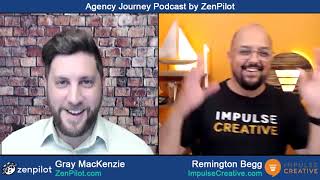
Remington Begg from Impulse Creative talks agency business models, retainer versus project revenue, and how to productize services. He covers team structure, hiring challenges, and the tools that help agencies scale without burning out their people.
Welcome to the Agency Journey podcast, where we connect with agency leaders to uncover the hidden systems and processes that drive their success. Now let's dive into today's show. Hey, as we're diving into today's episode of Agency Journey, let me tell you real quickly about our sponsor, Aribi. Aribi is a super cool on one marketing analytics tool. They've got Google Analytics squarely in their sites right now. And I can remember setting up Google Analytics as a sophomore in college and thinking this was just the coolest platform. And as it's matured, it's still super powerful, but it's become so complex to deal with. And Aribi has a value prop totally aside from this. But what I absolutely love about my experience plugging Aribi into zenpilot.com is I didn't have to mess around with setting up what events I wanted to capture and tracking all my changes. And if I messed up a view, then it would. It would delete all the data that I had. I just plugged it in, it crawled it captured all our. All of our events, made it super easy to see our funnel, and it just works. I love being able to see, for example, how many people read the definitive guide to click up for agencies, a blog post that I wrote, I don't know, six months ago. See where those folks come from, how that influences the buying process, the funnel, the way that it works out. So super excited to have Aribi as a sponsor. You can check it out. Go to Aribi IO AgencyJourney. It's all one word. If you spin up a free trial there, use the coupon code. AgencyJourney. Same thing, all one word. That'll give you 20% off any plan, which is super generous of them. And remember, they can track all of our conversions, so check them out. That's a reb IO. We appreciate their sponsorship. Let's get on with the episode. All right. Welcome into another episode of Agency Journey. I'm Gray Mackenzie. This week I've got the privilege of bringing on Remington Bag from Impulse Creative. Remington. You're the first person officially to other than myself and Andrew, who's been on the podcast three times now.
Yeah, yeah. Hopefully it's a good thing.
It's a good thing. We talked way back in 2016. So it's been five, a little over five years since we first had Jan. Then again little right around three years ago in 2018, we were talking about your, like, model of the T shaped agency.
Yep.
And. And then you guys have continued to evolve a lot in and grow a Lot you and the Impulse crew. When you say impulse, do you just say impulse if you're talking about it internally or do you say Impulse Creative?
Technically, internally we call it Impulse Creative, but for friends we can call it Impulse.
Okay, Impulse Creative it is. I'll program that into the brain. Impulsecreative.com is the site. You guys have built a ton of cool stuff. You've got cool tooling for agencies that we'll talk about as well. But the last time that we spoke with you, you'd gone through a big transition. Now, three years later, go figure out you've also transitioned a lot. So here's the place that I want to start though, because there's a million different threads to pull on. If you go to the solutions dropdown right now on impulsecreative.com, you've got revenue engine, brand engine and technical engine. You talk about what's what. So RevOps has become. I don't know who was talking about RevOps in 2018, but that's become a super common. This is like the new market.
Yeah. Yeah.
So tell me a little bit about the way that you're packaging services right now and how you guys have shifted the business.
Yeah. So last year, last year was a year of quiet reflection. I don't even think it was quiet. I think it was a lot of people screaming and reflecting at the same time. But the. We had made a plan in January of last year, January 2020, to really kind of shift into this next phase of being a little bit more growth, growth centric in regards to trying to help a company beyond marketing. You know, a lot of agencies are trying to do it with like sales enablement and you know, but we're, we noticed that the people that were doing it really well, we're friends with people like Imagine business Development. Doug Davidoff. Right. He came from a sales point of view and he was, he was doing it really well, like leading into marketing. But talk to a lot of people are having a lot of problems from marketing bleeding into the rest. And because it's a different meant it's a different mental game when we start thinking about revenue operations or operations in general. And it's a different expectation. And so in January we started like reflecting on what's working well for the agency, what isn't working well for the agency. Where have we had the most fun in the past 12 months? Where would we like to have more fun in the next 12 months? And that was the beginning conversation on it. And we were like, we really want to think Bigger picture. We do really well when we have more context in the company. And that was the start of it. February happened and we're like, huh? And then we got to kind of test that we had two large projects that we were working on. One was marketing only and one was this more rev ops mindset focused. One, and it was the day after the stock market tanked. The marketing one's like, peace, we're done. You can keep your money. And the other one was like, we really need help. We need to transition our company. We really need to focus on this digital transformation. Impulse is going to be. Now I'm doing it. Impulse Creative is going to be pivotal in helping us achieve this. And that was like a big flag for me on huh. We just had this conversation a couple months ago and now this is like happening in real time. And the subsequent months, that project executed beautifully. We lost about 20% or so of our retainer based revenue. And we made some pretty considerable bobs and weaves, both on a product basis from a project basis in regards to how we address the market. And then in May completely flipped the outside facing story for Impulse Creative. Right. It was no longer slow, calculated and. Right. It was fast momentum expertise. Right. And it was because people needed to bob and weave and they didn't want to take 14 months to Bob.
Right.
Right. Because we didn't know how long things were going. So. So we made that shift and then noticed that we started seeing this wind of even in all the uncertainty, this wind of different questions in the sales process and different overall flows. And it was pretty interesting because it was just messaging change on the outside mostly that had.
So. Well, there, there's a lot there. So have you. Allow me ask a couple different questions. One is, how much of the business prior to this was retainer based? And is that, is it still primarily retainer based?
Yeah. So we have never done the blind HubSpot playbook of 90% retainer. That's dangerous. I think 90% of anything is dangerous. We very. We've tried to be between 60 and 65% retainer, 40, 35 to 40% project based. And that has allowed for us to have an engine that could keep up if we needed to like fill the tank or slow down depending on like the bobs and weaves. So we had. We were. We were around 65% in March. First quarter was really great for us the previous year in 2020. So that also helped. We had a pretty good growth trajectory until things slowed down in April. But with the retainers leaving There's a lot of tiny projects that. That started flowing in of, oh, like I need a website. Like the fact that we're having this conversation in 2021 and people still say, oh, I need a website, because they don't have one. It was happening a lot. And then the operational stuff was pretty huge. Like, we don't. We never had a CRM and now our salespeople can't go out and do things. How do we track it? No one can come to the office, whatever those things are. Project. The project area of the business was a savior in that point.
We just had Todd Taskey on the podcast here a couple episodes ago. Mergers and acquisitions for agencies. And we went pretty far into that one. From a PE perspective, looking at acquiring a business, I want to see as much retainer revenue as possible. I don't know if we ever covered that on the podcast at all. But why you're saying we don't want to. We're intentionally not having the highest percentage possible. Retaining. There's a couple thoughts that come to mind right away. One is obviously you're. If those aren't managed well, that's where agencies get into a lot of trouble, is a retainer becomes a blank, you know, a blank area to go lose money.
Yep.
The other one is team turnover. So if you've got somebody leave and all of a sudden you're understaffed, but you're committed to being understaffed for six more months. That's a tough situation to be in.
Right. Which is current state.
But what am I missing that? Are those the primary reasons? What are the primary reasons that you've got and where does that ratio come from?
Yeah, so ratios come from more of a. You know, we've had the agency since 2007, so it's. I think it's one of those things where we've been up around 80, we've been down around 40. You know, ultimately we want to have retainers covering enough of payroll and expenses to allow for us to do stretch and have some capacities to bring stuff on. I think a big thing. If you're 90% retainer and you have 10 people and you lose one person, you're in trouble. And so having some flexibility from a contractual obligation to your clients is really valuable. Um, knock on wood. If we lost someone, we could have some, some one or two or partial person cover for some kind of piece of the pie, you know, from a retainer standpoint too. Make it so the client experience doesn't really get faltered. Um, I learned a Big lesson. Way back when, the first time that we talked, um, we talked about agency poaching and stuff and that was a big area because we lost a lot of talent and a lot of it was around the retainer side of the business and we lost a lot of it and couldn't really do anything about it. And the I think as we start to look at those numbers, if you can show, this is my opinion, if you can show ongoing pipeline and show that you have this well oiled machine that can generate those projects and keep that revenue running and also have the same thing on the retainer side, I think anyone that looks at your P and L for acquisitions or otherwise is going to realize that there's two machines running quite efficiently. Profitability, super important. But I think knowing the numbers is really big too. And then this year those percentages now have a third. I say a smaller cousin is the product side of the business that we're incorporating.
I want to get to the product side before we get there.
Yeah.
If I come in right now, what am I? Am I starting with a paid assessment? Am I? And this is obviously you're saying, hey, there's variability here between projects and whatever else is that split. Mostly the front end is projects. Some of those convert to retainers or some people are going directly to retainers. Other people are just meant to be projects.
Funny, it's almost been like a pendulum swing over the past 18 months. Not necessarily us changing policy as much as it's the market changing. No one wanted to commit to anything that was longer than a week last year. And now we find almost the inverse. They're like, I have budget, I need to make sure that I have the budget allocated for it. We're always discovery first. So you could say, hey, I want to pay for a $10,000 retainer over the next 12 months. Month one is always going to be communicated as and will be hopefully very detailed in regards to. It's going to be a discovery phase and maybe some execution if there's like low hanging fruit. But we've got got some more, we've got some more technically advanced or smarter clients coming in. Right. Maybe they don't have the team that they used to have and they need some help with executing. And we historically haven't had that in the past where they're like, hey, inbound marketing is really cool. You should try it and let's build a plan now. It's what are you trying to accomplish? What dials can we turn in order to get the biggest return on Effort. And so those conversations have changed. And then now more recently, I've been in the hot seat for sales. We're having these conversations where the problem's already diagnosed. It's which path is the right path to go. And I think that agencies get stuck in one ways, the right way. When the answer is actually there's a hundred ways to do this the right way, which one's the best way. Right. And kind of looking at it that way. So we're a little bit more flexible. I'd say right now probably 30% of the clients come in they're diagnostic or discovery only. Most of them are coming in like, yeah, we just want to commit to moving forward. This is our problem.
So with a more flexible approach then staffing for that is always the challenge. How do we do that? So are you going to structure that as say we've got an account manager or a strategist, they're the quarterback, in which case you get a. You get kind of, kind of premium skill set who can diagnose and say, here's the right plan for you. And then a team of specialists to implement. Yeah, what's this? What's the team structure?
So I'm put a disclaimer in here like I usually do on these, just because I'm sharing. This is, this is how I'm doing it, not how you should do it. So Julie and Audrey are my two directors. Audrey runs the brand and DevOps side of the business. Julie runs the RevOps services side. Rev ops and gross services side of the business. The on the RevOps and gross service side of the business is usually two and a half points of contact at any given time. Helps with redundancy. And then relatively similar on the project side as well. So when we come in and we're doing the discovery and the diagnostics, some of that burden is coming from the sales side. And then the director or strategist level is helping with the initial goal posts. And then it's kind of a team effort in regards to defining and putting together the scopes from there.
Makes sense. Cool. The product side is super interesting. I've seen a bunch of this stuff pop up. Talk to folks who used different components of what you've built. Yeah, I've used. I posted a job on Jobs Sprocket Talk, the job board that you guys put up. So tell me, let's start high level just in terms of products. What's the approach? Where did that come from? And then we'll go into the specifics of the different suite. The Products in the suite that you have.
Yeah. So this I, I commanded the team or talked to the team and like put goal posts up that we want to figure out a way market agencies are going to love this. I wanted to tell a. I wanted to tell our team we need to find ways to cut our costs in half and increase our prop and double our profits at the same time. Those are opposing forces. It forces you to rethink how things are done, why they're done. Like, why are we, why are we doing it this way? Because we have, like, we tell people, like, marketing's not the way you've always done it. It's something different. Yet as marketers, we have a playbook that we play every single time. Right? So we came in and we started asking ourselves, like, how do we make it so that we can be more nimble, we can drive more value and we can fight that whole hour by hour cost. Right. And for us, it was productizing our service delivery. Like, we've talked a lot historically about how, like documenting processes that need more than three steps. It kind of fits the mold in that regard. So I couldn't find a job board to post like, I miss inbound.org like that OG like, let me put it up and let's have people like, know what's up. And we, when we started looking at the effort, we're like, wow, this doesn't exist in the marketplace. And I threw it up and $10 for 30 days in the job posting so I can offset some of my HubSpot costs because it's all built on HubSpot. Nothing crazy. It's not they're supposed to be making money. It's proving a use case and then it's showing kind of the what's possible. But we have other products like our theme evolve theme, which is like a. It's more of a framework than it is a theme. Is technically a theme in HubSpot, but has all the pieces that we would use as the bedrock foundations for what we build at impulse. Allows for quicker time to develop or time to build cheaper, right? Everyone's like, oh no, it's cheaper. Like, yeah, it's cheaper. Why would someone pay us to build this huge house when they're only going to live in one room? Or like, let's get it up and moving. And so that came. That came at the fruit of the COVID year. But then we started building more specialized things like Hub LMS. And Hub LMS is a learning management system on HubSpot 100% and we deployed that and that has had an extravagant response. I think some great timing in regards to. Oh crap. I need to onboard customers and employees and stuff without being able to see them in real life to now we have, you know, as HubSpot's releasing these features, we've got more and more capabilities that are available, building out these productized offerings that allow for us to deploy a framework or a foundation and then customize rather than rebuild from the ground up. We don't have the talent to spend a hundred hours on developing a software all over again. Why not just tell the client that we won't rebuild it all over again, that we have the expertise of it and then we'll, we'll throw some polish on it and make it theirs. This is working out really well for us. So this year we'll probably end up probably 20% of our revenue will be product based. Wow. And then that enables both retainer business and also our service business.
Right, right. That makes a lot of sense. What's the company OS product?
Yeah, so company OS is a framework that we built that is leveraging HubSpot's CRM objects. So deals, tickets, deals tickets, contacts, companies, you know, as the standard ones. But Then also now HubSpot CMS Enterprise has, you know, has the functionality to allow for custom objects where we can put whatever we want in. And that's been really great. So we're like for impulse, we have a services object where that's the portal that the client goes into. We deployed in the HubSpot App Marketplace a PRM or partner relationship management software. We're having huge response to that. People are like, wait, I don't have to pay 10, $15,000 a month for like a fully featured PRM system. I could just live on HubSpot and be automated. What? Like, it's just like people are kind of not thinking that way. So right now we have an Academy version that allows for a lot of the feature set. We're going to be publicly announcing, announcing that here in the next couple of weeks. Similar functionality to even what HubSpot has in regards to sharing certifications and different lesson types and stuff. And then we have just the company OS itself as a framework for us to be able to build these dashboards. So we have like deal rooms, company custom quote templates, all sorts of things. It's almost like a Swiss army knife in regards to. I want my salespeople to be able to see a map of all the locations of their deals based on where they are. No problem.
Right?
You know we can start pulling that data in automatically. So it just enables sales to do or enables the teams to do and deliver more efficiently and at the same time should enable the customers to have a more pleasant experience. Which is really to the nature of revops in general. It's optimizing and increasing efficiency.
That's great. I would imagine there's an element to there. Going back to our guava box days, we didn't ever go super deep into the HubSpot templates but build out some basic things that had little pieces of functionality that other HubSpot stuff didn't have by nature. And that led to a number of deals from folks who found us because they went searching for a specific template, found ours, purchased it. This is great. Now we'd love to customize it and it was a great lead gen machine more than an actual front end revenue generator.
Yeah.
So specifically building out like company OS building stuff that you maximize if you're an enterprise client, probably gets you in front of the types of folks you'd love to be in front of.
Right.
As well.
And it's solving and it's addressing a problem. You know, everyone past, past people have said like niche down, like hard. Right. I know a lot of people that niche down really hard to restaurant that don't exist anymore or niche down really hard for travel and are just really struggling right now. I learned that lesson in the last recession that like yeah sure, niche down and focus but, but understand like have, have something else. We're taking that niche down effect into like subject matter pain points and figuring out where we need to go. So like oh we heard the same, the same pain. Like how could we optimize for that? How could we deploy a solution that doesn't take six to eight months to deploy, takes two to three weeks to deploy. Like there, you know that, that triangle or saw it along a long time ago on a back of a truck. It was like fast, better, cheaper, like pick two and you had to pick the two that were connected. Like we can start to optimize for a third point if we're doing it smarter. From a company standpoint, sure it's not as expensive, but if we can deploy it quick, you know the solution is accepted and it's easier to support systemized. So yeah, a lot of fun.
It's every developer's favorite thing that says you can have it fast, good or cheap. Like you pick two of them and when you get laser focused on one specific type of problem, it makes it way easier. You're building Something reusable that allows you to say good does not always equal custom. I think developers love it because in their mind, good most of the time is analogous to custom, but it's really not custom. It's every solve that same problem a ton of times over. And if you, if you can and have, then you're able to deliver on all three. All three vectors, which is cool.
A hundred percent.
Give us a couple of the. We'll include these in the show notes too, but in case people are listening and want to check it out right now aren't on the show notes. Company OS. So the job board is jobs.sprocket talk.com.
Yep.
How about Hub LMS and Company OS?
Yeah, Hub LMS, we just bought the dot com, so it's Hub LMS.com and then we have companyos.impulsecreative.com or you could search for Company OS in HubSpot App Marketplace and you can see the video for the PRM system.
That's awesome. Yeah. I'm curious about how you guys are managing. You've got all this different stuff that you can do. You've got tech, you've got the services, you've got the retainers and a lot of it, I would imagine. We've talked about some of it, but there's a lot of it flows together. The same customer at different points in their journey should be in one bucket or another two buckets at the same time or all three buckets at the same time. I'm curious about how you have that set up in terms of who's running the account, how your accounts team can get people to a point where, hey, here's the next product in the suite that you ought to consider looking at, or here's the next piece in the relationship. Have you designed for the. And I don't, you know, if you ask me in our business right now, like the biggest revenue, if you came in from the outside. And we're to optimize our revenue. Yeah, we've got all these customers, we're helping them streamline their processes, we're helping them get launched in ClickUp and we're just scraping the service in terms of what we can do or the surface in terms of what we can do on the backend, helping them scale and optimize that experience for them. So you guys may be farther along, you might be in the same place that we are, but how is that designed right now?
Yeah, so we have. We have our own company on us, which helps. So we've got an area of the business that we've been toying with. But it was very heavy sprocket talk. Now we're calling it Learning Ops, where George and Dan on the team are. Their job is teaching how to use HubSpot, but then also onboarding customers. We have the project and the rev ops teams. Right. And those, all of them are running off of similar playbooks in regards to. They all come into the system. The dashboard is ours. The dashboard that the client gets to see shows their services. And based on what they purchased, it also shows related content and also shows related services. So we are thinking more like a software rather than a service base. And so there's this like, oh, I didn't know you did that. Just naturally that happens a lot of times. Not. We're still deploying and finishing this up for some. Some segments of our company as well. But, you know, the onboarding side, like, they start the calls with the share of the screen that shows all of the stuff that we can do or have done, which is really helpful as well. And so that's a little bit more a natural flow. I think that as we start to think through some of these things, we're having more engaging conversations because the products are solving the pains that a lot of our customers have or have had. So it's a natural. Oh, I want to know more about that. And it comes across as a pain relief rather than a pain point because it's. I don't want to have to think about doing that. That sounds like it'll hurt rather than, oh, it's already figured out. And so we've been trying. And we've got another wave of slight adjustments to our messaging to kind of reinforce that. But to answer your question directly, from a UI standpoint, we're trying to incorporate and introduce content, but also introduce services as well. That just makes sense. Yeah.
Okay. You're putting it in front of people. I'm doing everything I can right now to dummy proof a lot of our stuff. So one of the things I want to connect with you about Off Air is Avoma and how you're using it. And so we'll take a tool like Avoma that we've been using for a couple of months here, interview agencies who are using it. If it's. If it's like, hey, this is the best tool for this specific use case, find out what agencies are doing, what are they doing best, what's worked for us, and we'll put together some training and then that'll get involved included in our process library. That we're giving to agencies and rolling out. And so then the tech stack that we want agencies using or would recommend, hey, if you're looking to solve this problem, here's the tool that we've seen work best and has seen work the best across other agencies. We can give it there. And so instead of me having to remember to tell somebody or our entire team needing to know every single in and out of every tool, it's all a centralized database there. People can should know about it. There should be training. But so I love the way that you're approaching that. That makes a lot of sense. And I think agencies, there's a huge opportunity for optimization there in agencies. We got all these other resources. We're doing the same thing with service partners. Here's you're telling me about the accounting and bookkeeping firm or that basically your CFO type partner. How do we take those recommendations and put them in? Hey, if you're an agency looking to solve these problems, here's the service partners that we don't touch the sales side. You should talk to Joey Gilkey at Sales Driven Agency or whoever those recommendations are. So I love that approach that you guys are taking.
So I think what's interesting about what you were just saying was from a resource standpoint, that's where like the lms huge for us for onboarding employees too. So we just brought on three developers within a three week period of each other. We brought them all on. It's a lot of change for a 15 to 18 person agency. Right. We built out a curriculum for them in regards to like this is how we do it. This is our current standard process. This is all the pieces. We deployed it in our own internal lms. It's there and now it's real. Even before we were like how do we prefer to code? Is it camel case? Is it using dashes like whatever those things are, right. And all of a sudden it's like it's more stringent. That part's worked out great. But what I love about what you just said around the partners is and I was just on a call with Alex Glenn from Partner Programs and one of the things I talked about is like will that a partner? And then we'll bring in and ask them to do a demo and have it recorded, but then call out the things that are like compelling use cases, that time savings, having that and not having to go back through and do that demo and making it more async is more valuable than a lot of times the services that we offer in Regards to the client doing something. Because I think everyone's like, oh, they're competing against other agencies. No, we're actually competing against doing nothing.
Right.
And that doing nothing is much more comfortable. I can sit on the couch and do nothing versus like actually doing and focusing on an area. So like having the plan exuding the confidence, but then also having a resource that is like silver platter. I mean, that's how Amazon's winning. Right. And so I think that we could, as agencies, we can take that book and weave that ribbon throughout pretty easily if we stopped and think for sure.
I'm bringing up one other thing which is around the team side. So you're hiring right now? I want to say it's impulsecreative.com career.
Correct.
And I remember seeing that you've got like a growth marketer role. I think there's an inbound marketing role, content side of things. In terms of who you're recruiting. Maybe you can share the roles real quickly. We can give a shout out to those, the specific roles right now. And obviously when this goes live, that may be slightly different than we're probably going to check it out three weeks, three weeks ahead of time. So check out the URL to see what the opportunities are and then curious about what you found the best results. Outside of japs.sprocket.com? where else are you finding people?
So hiring's hard right now. We're a remote agency. We've been. We were mostly remote for several years. And we're. We're not just competing. Like being remote was a level up in January of 2020. Being remote is a requirement now in. Was it June 2021? Now I don't know how it's June. I feel like it should be February, but. But that's another story. So. So that was, that was a big shift we had. It's easily taken twice as long to hire with the same tactical ways and reasons and same brand exposure that we've had historically. It's easily taken twice as long, which means twice as expensive, which means like there's downstream effects to that. So putting that out to everyone, it's hard. So you have to figure out how do we define step? Like step out. Like, look at your employer, BL employer brand. Like how well is it working? Are you going to compete against Gartner or HubSpot for that matter or any of these larger like SaaS companies? You're going to have to figure out ways to stand out. We're real big on. We have human as the acronym for our guiding principles and helpful understanding, Meticulous, Authentic and noteworthy as like the key. The key tenants of the individual. Putting that out in the universe has been really helpful because people are like, oh yeah, I really, I don't like that about this part of my organization. I want to be around people that are. Or vice versa. It's a great way for us to measure. But going back to the actual position. So we're hiring a UX designer. We are. We have already hired one. We want to bring on a second. We are toying with the idea of bringing on another salesperson. It's probably going to be June as of this recording. It's probably going to be at least four to six weeks till we make a decision on that one. And then we are hiring for a content marketer. Primary focus is copywriting and also strong SEO chops is preferred. And then we're hiring a senior growth marketer for Impulse Creative. They would be the marketer that advertises us. We are their only clients. They will not touch client work other than client interviews. And the big tenet there is we don't want them to follow a playbook. We want them to create a playbook. And that's probably one of the harder parts is marketers are really good at following playbooks. We're bleeding edge. I'm not supposed to say that. I'm supposed to say we're cutting edge. But our approach to things is not the same as normal. It's not same as what's out. So it's not an easy job. But it's a, it's a huge opportunity. Um, and we've got so many things in the hopper. It's a matter of getting the megaphone out and putting it in the right direction and then going. So we're. We're stoked about that one. Me personally am. Cause that'll take some lift off of me.
Right.
And yeah. Impulsecreative.com careers. Check us out. Hit me up on LinkedIn. Whatever you want. Carrier pigeon.
That's right. Awesome.
Yeah.
Well, we're. We're at time. I would love to. There's a bunch more to. To pull you in. So that'll be. That'll be part four here. We'll continue the Remington bag. But Remington, this has been a blast to have you on. Thank you for coming on again. Any other. Any other shout outs that you want to give here as we're wrapping up? Any other places we mentioned, the website mentioned the careers page. Any other places to point people?
Just hit me up on Twitter or or even Facebook messenger at Remington Beg. Please don't email me exactly. Just hit me up on either of those. Happy to answer any questions. We're pretty open book especially awesome.
Thanks Remington.
Thanks for listening to the Agency Journey podcast.
Visit agencyjourneyinsiders.com to join the podcast community and be sure to subscribe for future episodes.










