Email Marketing Best Practices With Chase Dimond
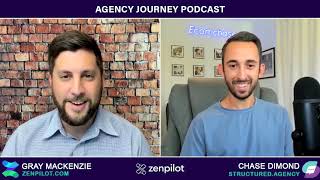
Chase Dimond talks about building an email marketing agency, the acquisition strategy that led to growth, and the tools and courses he's created. He covers how to scale email marketing operations and what works in e-commerce.
Welcome to the Agency Journey podcast, where we connect with agency leaders to uncover the hidden systems and processes that drive their success. Now, let's dive into today's show.
All right. Welcome into another episode of Agency Journey. This is Gray McKenzie from Zen Pilot. And this week, I've got the pleasure of bringing on Chase diamond, the podcast. We're going to be digging into all things email marketing today. Chase, welcome to the podcast, man.
Hey, thanks for having me. How are you?
I am doing great and I've been looking forward. I've had a full day of calls. We were just talking about. I'm catching up from Labor Day weekend. You're doing the same, but this is one of the ones that I've been looking forward to all day to dig into your story. You're prolific. I feel like I'm seeing you all over the Internet these days, but especially in my Twitter scrolling.
Sweet, but I'm specifically targeting you. I don't think anyone else has seen this targeting.
It's just me. I appreciate that. What's the background? How did you get into email marketing?
Yeah. So long story short, at 13 years old, diagnosed with Crohn's disease, was sick for the entirety of a year. Really? That's a lack of awareness of this disease. So after finally feeling better, figuring out that I had Crohn's disease at 14, I took it upon myself to learn guerrilla marketing to raise awareness and fundraising for this disease. One of the channels that I leveraged was just emailing friends and families and kind of promoting this. I was also doing things like messenger and calling people's houses and doing restaurant fundraisers and whatnot. So email kind of was just this thing that kind of allowed me to share my story that was pretty personal in a one to one way. And then, you know, fast forward to college. I was working six, eight, you know, 10 different jobs and internships to pay my tuition, and I was manually sending emails one by one. And I just remember this moment of, like, this software engineer kind of happened to walk by my desk and was like, dude, why the heck are you copying and pasting all day? Like, that's so inefficient. Like, why don't you automate and scale this through ESPs, email service providers, and, you know, why don't you do it this way? And this guy, while I was in college, just taught me how to, like, make email in a way that was personal, but do it in a way that was one to many. So long winded. That's kind of how I got into it. After I graduated college, I built an email platform that connected students on college campuses to other in their classroom. You know, use it as an acquisition tool, use it as a retention tool. And email has just really been at the core of everything that I've done ever since.
What's the. I'm going to dig into. Definitely is not the lead in that story, but it sounds like you were working way through school. What was. I had many people come on and talk about how they were paying their tuition through college, but that's a. I've got to tie into that story personally as well. Is that like what was driving the paying for college?
Yes, I think, I think it was a lot of things, but yeah, that was the main thing. I tried to go into this school that was close to me. I live in Orange County, California, it was called Chapman University. I tried to go in there but I just could not afford it. We weren't able to get any financial aid. I didn't want to take a loan. So I went to the local state school for six months and I was like, screw it, I'm going to find a way to go there. Let's do it. I started just working jobs, internships and I had at one point think three different jobs and internships and one I was making like commissions on sales and I was doing decently. Another I was making like 25 bucks an hour as like a college student. So I was stoked. I thought I had a bunch of money but every month between rent and everything I basically would like, you know, go back to zero. And at the end of it I graduated with some debt and I paid it off after my first job. So yeah, the hustle, the grind, the kind of creativity really came from like the necessity of wanting to.
So I want to kind of give people an overview of what you're up to today outside of being all over social. Well, that's a piece of what you're doing, but you're also involved in an agency. Maybe give us the lay of the land between courses, the agency, everything that you've got going on.
Yeah, it's definitely a lot as we were talking about before, but I'm a partner at an E commerce marketing agency called Structured and we have about 70 to 75 full time employees working about 150e commerce brands. I run specifically the retention side of the team which is about 50 to 60 people, about 100 clients across email and SMS. Email is really kind of my bread and butter, my focus. SMS is kind of something we added more recently and brought in kind of an expert to run that specific team in that channel. But outside of that, we also do paid social and kind of creative for top of Funnel. So it's been a whirlwind, you know, knock on wood, fingers crossed. You know, lucky for us, you know, this past year and a half has been pretty good. Obviously I know for a lot of folks it hasn't. So obviously mindful when I say that. But just yeah, the past year in terms of social and everything, it's been a major kind of growth and acceleration year and we work specifically with 7 to 9 figure E commerce brands.
Yep. And then on the course front, when did you launch your first course?
So I launched. Well, actually I always kind of forgot to talk about this, but I launched a course with Founder magazine like two or three years ago and that's kind of like what put me in some ways on the map and kind of allowed me to understand like this whole business of selling info, which is kind of something that was foreign and strange and weird and it kind of still is, but it's kind of cool and it's exciting because it allows you to help more people than you can in a one to one way. But for me, myself, like the main course that I have right now that I launched was around October of last year, so give or take about a. About a year ago. And it kind of stemmed from a few different things. One was I was having to update our internal documentation, documentation kind of resources for our agency as we were scaling. It wasn't something where like we could start hand holding everyone that came in. We knew at some point or the other we were going to have to have just like libraries and templates and courses. And I wasn't really happy truthfully with a lot of the courses available on the market or else I would have saved myself a lot of time and effort and aggravation and just kind of tucked that and said, hey, go take this and run with it. I guess fortunately in hindsight those weren't available and we wanted to do things very specifically and we were very focused on Klaviyo as a platform. So built the course, planned and just intended it to be internal. There happened to be this thread or this conversation on Twitter where someone was like, hey, we need an E commerce email marketing course. And then someone tagged me saying, hey Chase, would you do one? I'm like, I don't really know. I'm building something internally but I want it to be internal. And then it kind of just sparked from there where I was like, wow, like there's a lot of demand now on Twitter for this course. People keep tagging me, like, maybe I just make this, you know, a wide kind of available to the public as well. That kind of stemmed from it. So that's course one about October of 2020. And I've since launched a few other kind of mini kind of supplemental products as well.
Okay, that's awesome. So you've got. The main course is the E commerce email marketing course, right. Does it have a different name?
No, that's. That's it. I've done a really bad job with the names. I literally, I love it. Just call it that one cool thing. Hopefully saying this doesn't get me outranked, but I rank number one on Google right now. If someone looks on E commerce email marketing course, which is kind of cool. So I didn't intend for that. It was kind of like a byproduct of just having a very cookie cutter standard name because I couldn't think of anything more creative. That's my main course. Yeah.
Okay, that makes sense. So this course, I've heard about this course, this is one of the reasons that I reached out to have you on podcast was heard about the course for multiple agencies who we worked with in the E Comm space. Actually, you mentioned we were talking earlier, Michael Lucifetsky and Troy Ossenoffit at Juice. They're just on the podcast here recently as well. But if anyone's interested in checking out the course, it's Chase diamond and diamond iS-I-M o n d.podia.com is the link. Obviously, we'll have that stuff in the show notes as well. So from an agency perspective, as you guys are growing, you said there's four partners right now?
Yeah, yeah, exactly.
Okay, makes sense. And then in terms of the last year, I assume there's been a ton of growth here. I mean, everyone, especially in Ecom, every agency has done well in the last 18 months, which is, as you mentioned, kind of weird to say or, you know, like it's. There's some circles where you feel a little bit awkward bringing that up or it's just uncomfortable other people. There's been a lot of suffering that's gone along with it, but it's been a great. There's no denying it's been a great opportunity for agencies. At the same time, in terms of growth for you guys as an agency right now, what are some of the priorities that are on your plate?
Yeah, it's a couple things. So myself and a partner about three And a half years ago, specifically started an agency doing E commerce email marketing. And one of my good buddies who also had an agency in the paid social space, his name's Nick Shackelford, we've been friends for over 15 years. He was actually the one that got me into E commerce. He was doing his full paid social thing. And we just kind of saw like the writing in the wall of the future of like brands aren't going to want to work with 12 different agencies, right? They're not going to have an agency for influencers and for paid and for creative and for email and for sms, right? So we wanted to do kind of some consolidation. So that way it's like, hey, we're not going to offer every single service, but we're going to offer a few of the core services and do it really, really well. We actually merged our agencies about a year, year and a half ago and that's kind of what opened up the ability for us to kind of service more folks. So that was like that merger kind of acquisition that we did together. And our focus now has actually been acquiring and kind of finding other agencies to absorb just because there's so much talent out there. And most of the talent right now either A, runs their own agency or B, is internal somewhere, right? And it's kind of hard to attract the internal people onto the agency side. And it's hard to get these small agencies or medium agencies have great people, you know, to come work for you because they're super good. So for, for us in terms of growth, it we're trying to grow through some acquisitions and whatnot. We recently acquired an agency that primarily focuses on Snapchat. So while we do paid social, we only primarily did Facebook and Instagram. We acquired them and we're now trying to buy like CRO shops and more email shops. So we're really trying to grow that way. Another weird thing that we never intended to do as we kind of scale the team is we brought in like an internal head of HR kind of recruiter, which is kind of a strange thing. My little brother does recruiting. So we found recruiter through a recruiter, which was like very meta. So that's kind of some of the things that we're focused on. We also have like a couple month wait list right now for new clients, which I think is like a blessing and a curse. It's a blessing because, you know, we're fortunate to have the business and by telling people we have a waitlist, you know, it kind of created more demand than we Thought which allowed us to keep raising prices. It also allows us to make sure that we are scaling with quality in mind. So by telling people, hey, we've got a two to three month wait list, we're able to make sure we have everything in place. We have our ducks in a row to hire to onboard and whatnot. The bad side, right, is like we're probably leaving six, you know, low six figures a month, MRR kind of on the table by not being able to onboard it. But I guess that goes with the territory.
Right. In terms of acquisitions, what are some of the things that make but an ideal target for you right now you mentioned some complementary services like CRO and then some overlapping services with more email, which I assume is a bandwidth play.
Exactly, yeah.
What are some of the things you're looking for?
So it depends. Like we're still kind of ironing out. We've done one acquisition outside that, the merger that we did initially and we're trying to make a couple others. We're really trying to find that right. Kind of piece of the puzzle for each entrepreneur, each owner. We've had a lot of conversations, probably talked to a dozen and a half agencies and different people want different things. Right. I think also too, people's understanding of what like an acquisition actually means is very skewed. People think like they're going to get 100% of the cash up front, they're going to be able to walk away. And it's like, well, you know, if you could find that deal, let us know. We would be willing to submit our hat into it as well. We really want people that are kind of fast growing, typically doing the low end, probably about $20,000 a month in Ebitda and probably on the higher end they're maybe doing like 60 to 80 thousand dollars a month in EBITDA. Right. Anything over that maybe is a little bit too big in terms of like what people expect. But typically it's like people that are anywhere from like three to like kind of 10 or 15 type people. It's kind of like the sweet spot that we're finding. And it's kind of a mix of like we're trying to buy ebitda, trying to buy some book of business, although that's not necessarily the motivation because we have, fortunately the book of Business. We're really looking for like more of like the Aqua Hire. We're looking for the talent, we're looking for people and even different geographies. Right. So most of our businesses here in the States, we do have Some, you know, penetration into the uk. We're also looking for some folks that have UK and other kind of global audience for new clients. And also the ability for us to be more of like a 24, 7 shop. And if we have people on different time zones, that allows us to service people at any given point in time.
Yeah, that makes a lot of sense. So if you're taking agencies doing, let's say, quarter of a million to maybe top end, closer to a million in ebitda, most of the times those exits would look like something from 2, 2 and a half x on the, on the lowest end, 5, 6 x at the very highest end. But it sounds like what you're structuring is I'm assuming you'd have, maybe there's some cash involved, but probably you're also finding people who are interested in being part of a bigger bite down the road in a, in a future exit. So there's a equity component to that as well.
Yeah, so. So it's, it is some cash. Right. Like, transparently, we're not paying, you know, hundreds and thousands of millions of dollars upfront. Like we're paying, you know, in the, in the five figures, typically depending on the size up front. And then, you know, we're basically allowing them to have some kind of, I guess, ongoing commission or not based off of performance. Right. So on a monthly, quarterly, annual basis, they have certain targets and that they can hit those. They're more or less getting like a commission or like a bonus. And then there's, you know, I don't know if equity or stock or shares is the right word, but there is some kind of upside on, on the back end. If we do get acquired, which is our ultimate goal, we are trying to sell our agency in the next two to four years, and we're really trying to get to like that low 8 figure in terms of EBITDA, just because the multiples there, what we're talking to and what we're seeing and just skyrocket, you know, without giving the specific number, we're like, in the low, we'll do like a low to mid kind of seven figures in terms of EBITDA this year. We're hoping to do like mid next year. And then we're hoping to do like, you know, high, mid, and then you know, actually hit that eight figures in the next like two to four years type thing. So. So yeah, it's a different kind of package depending on where people are at and what they're. They're looking for.
Right. Well, this is a hot topic. So I appreciate you entertaining, entertaining the conversation. I want to go back to the course for a second. The course seems like an awesome way to distribute what you've learned, what you've accumulated and the lessons that you've experienced over the years. Does it play a role at all in client acquisition from an agency perspective? Obviously I'm seeing it from, hey, here's other agencies who've gone through and they get the advantage of getting to see what you've built. But I, I'm assuming there's also in house marketers or folks who are trying to do it on their own. They get in, they realize how much goes into this and maybe there's a pipeline there.
Yeah, absolutely. A couple thoughts on the course of things that I didn't think were going to happen, that happened. One is when I created it, I actually thought it was going to be specifically for brands. I never actually even thought that like other agencies or freelancers were going to buy it. I'd say about half, if not more than half of the buyers of it are freelancers and agency for whatever reason. Like that surprised me initially and in hindsight I think it makes sense. It's been agencies that either do email, that want to make sure that they're doing it right, or want to use it as training as well, or agencies that have been dealing with top of the funnel issues because of iOS 14, 14.5 that want to diversify services or kind of completely switch services. That was kind of one surprise. And within that group, right. Like that's kind of like a feeding pool for people that want to work for us, for people that want to get acquired. Right. So that's that sliver in that piece. But to answer and address what you're saying, yeah, people have either purchased the course, gone through and been like, hey, I set up some of it, it's working, but I don't have time to do the rest of it. Can I hire you? Or some people have just seen it, haven't purchased it, and be like, hey, you know, instead of paying for the course, can I just hire you? Like, do you have an agency as well? But those are kind of some of the things that I didn't expect would happen and people were giving me notes and feedback and asking for new modules and like I actually never even thought about that. Right. So it really is such a great two way thing where I'm constantly updating content, going to be making some changes and updates based on the iOS 15 stuff coming up. And it's just really been a great way for me to learn as well, which is kind of an interesting thing I never thought would happen.
Yep. And then you are. One of the things we haven't really talked about though is the fact that you're also running a podcast right now. E Commerce Opportunity Podcast. Is that right?
Yep.
How did that come about and what's the kind of give us the quick gist of what that podcast looks like.
Yeah, podcast is something I wanted to do for a super long time and it was something that I kind of just was like, hey, during everything that's happening right now, there's no better time to just do it. Like I'm either just going to do it or it's never going to happen. And the thesis and the goal of the podcast was just like I would have conversations with folks like yourself or other people and be like, man, I wish we recorded that either for our own personal knowledge, for our team, or even the ability to share it with other people. That was kind of like the goal of it. And you know, I've just, I think finished season one. I had like 35 or 40 episodes where I was really interviewing marketers and founders within E Commerce about like what they're doing, what the opportunity is, what's working, how do you get clients, you know, where do you think the next opportunity is for service providers? Right. I think the, the heyday of like being a Facebook agency is probably over. Obviously there's still money there, there's still people doing well there. That's not what I'm saying. But I think, you know, when I talk to people like my business partner Nick Shackelford, it's like, man, if I know what I do now, I would probably have done something like email or sms. Right. So just kind of exploring those opportunities. And then for season two, I'm planning on bringing on like a co host and making it a little bit more like my first million where it's a little bit more off the cusp conversational ideas and less. More like interview and more kind of like back and forth conversation and us just like spitballing. So I'm planning on doing season two in that coming weeks or coming months. It's a little bit more like, I don't want to say not prepared, but a little bit more raw.
Yep. This is the first, my first million shout out on the podcast. But so I also listen all the back and forth between Sam and Sean and so I think it's cool. What if you go that route? Are you going to keep it focused in the marketing space, spitballing ideas or where do you want to go with it? I'm assuming if you're keeping the name, obviously it's somewhat focused in the E commerce space, but what are your thoughts there?
Yeah, definitely, definitely E Comm focused. Most of my interest and knowledge and expertise is on marketing, but, you know, depending on the co hosts I bring and depending on who we even interview from time to time, I kind of want to explore things like what the heck is happening with shipping and logistics, like, where's the area and opportunity and interest there? What's the landscape look like? Right. So I really want to focus on E commerce. I'd probably say 80% of it will be marketing focus and then 20 might just be like current events and hot topics of like, how does someone fix, like this ecosystem of like packages getting so delayed and, you know, is there any infrastructure more. More things like that?
Yeah. That's awesome. I love it. So I've got two last questions for you here that I want to buy. You first is you and Nick are both very prolific on social media in terms of content production. Is that the biggest driver of pipeline for the agencies right now or are there other BV channels that have worked really well for you guys?
Yeah, I think our content creation is probably number one. And then close second would be partner referrals or client referrals. So my biggest channel is Twitter. And just in terms of audience reach, I'm getting millions of impressions a month, which is just insane, I think. I think that's one. And then other platforms, right? Coming on podcasts, speaking at events, hosting events, things like that. And then outside that, at this point right now, with 150 clients that we have, we have like this kind of breed in this kind of entrepreneur type where they start one business, it reaches seven, eight figures, and then they start a second business, right? We have some entrepreneurs that, since we started with them three, three and a half years ago, they own three, five brands, right? So they're a client of ours on three or five brands. However many have. We have other clients that are really active on social that for whatever reason, like for example, Chris Mead and Greg Mead, prosnet, Those guys shout us out, it feels like once a month. I don't know if they have a reminder that goes off every month or if we do something cool and they just like to share about us. But like those guys post about us, right? Like now you have like this wave and this visibility of folks that are building action sports or lifestyle sports or some kind of games. That are reaching out. So clients, referrals and content is really the big two.
You guys have an intentional referral strategy in place?
Yes and no. Yeah, we do pay out every single month, 10% of the retainer to referral partners. It's always something that we try to pay out pretty timely, like within 24 to 72 hours of receiving it. I think people really appreciate that. So it's kind of something that we didn't intentionally build or we didn't put a lot of work into it. But as it started happening, we're like, okay, wow. So we've even, like, in our CRM, have a spot that says, where did this source come from? Just that way we don't forget about referral partners. Because at one point we were growing quickly. I think for a couple of months we forgot to even, like, track who it was and we're like, oh, shoot. And we obviously had to backdate all that. Right. So we definitely made a lot of mistakes. It wasn't something that was like, intentional initially, but as we caught wind of it, we're like, and this is a super viable channel. Like, we'll pay 10% all day long. Because the quality of the clients that it attracts is really high. When people that are like the clients that we already have are sharing our stuff, we bring in more of the people that already vibe with us and work with us and gel with us.
Right. Totally unrelated. Have you played Crossnet?
Yeah, I have. My. My wife hated the fact that I left it up in our front yard for like, weeks on weeks and weeks. So those guys are coming up with a bunch of new games and they send me all the stuff first because I've got three younger brothers and we just love to beat each other up and play sports and do this, that, and the other. So we're always giving them tons of feedback.
That's awesome that I've seen it played and I have yet to play it. So I'd love to grab it for your kids.
I think your family would love it.
They 100% would. Yeah. Second. So my original second question was we. We talk a lot about tools on the podcast. Are there one or two, any lesser known tools that you are loving or nerding out on right now or that are kind of core to the business, but the agencies might not. You know, probably some people have heard of it, but it's not. Not Google Workspace or Dropbox.
Yeah, I think this is a big one. But on the design side, for emails, our team loves Figma. I think it's a big one, but I don't know if people talk about it much or not. We used to use like Photoshop and Canva and Sketch and some like Illustrator. And we've moved over to Figma and our team really loves that for actually building design, sharing it across, you know, tons of workspaces. That's one, you know, other ones that we're building. Like, again, I'm a little bit biased on this one, so I might not say it, but on the reporting side, you know, there's a lot of tools that we were using that were expensive and we've been actually building our own custom tool. But there's a couple off the shelf that I've been advising and working with, trying to help them just build something. One's called Triple Whale. Again, obviously working with them and advising them, but that's kind of been an interesting one that I actually liked before I started helping them. Just because reporting is typically expensive and it's hard. We are building our own custom tool, so we are using them a little bit and we're trying to kind of configure things our own way. And it's been really expensive and really hard because we predominantly use Klaviyo and their APIs. You know, obviously I love them, but their API has been super tough to work with. So big ones are really the big one. Outside that we use all the, you know, the slack, the, you know. Oh, I guess one that is big. But we love is Notion. We use Notion for all of our project management. Like, we are obsessed with it. We have someone literally dedicated full time to like making our Notion calendars and boards and everything updated. We're trying to like automate some stuff. We were using ClickUp, we were using Trello, we were using all those things. I'm personally in love with Notion. It's insane.
Yeah, that's awesome. Um, cool. We'll link those up. Figma, I just closed it out before we started here. We're working on some stuff and Triple Whale is. Try Triple Whale.com I believe. So.
Yeah. Get one of those.
Okay, cool. Well, I'll double check it and make sure that we get that in the show notes. This is awesome. So chase folks who want to follow you, I think you're pretty simple on Twitter, right? I'll let you share your Twitter handle and then anywhere else you'd want to point folks here.
Yeah, Twitter would be great. My handle is ecomchase Diamond. No A in diamond, just D I M O N D. And there's a bunch of links like in my bio on there for the free newsletter, the podcast, the YouTube, the courses. So follow me on Twitter and the link in my bio will have everything.
Awesome. Jason, I appreciate you coming on man. This has been really fun.
Yeah, thanks for having me.
Thanks for listening to the Agency Journey podcast.
Visit agencyjourneyinsiders.com to join the podcast community community and be sure to subscribe for future episodes. You.










