Help you with HubSpot you say?
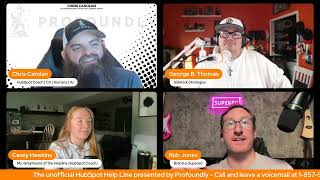
George B. Thomas, Rob, Casey Hawkins and Chris walk through HubSpot's new calling features: transcripts, power dialer, and agent answering. They explain why call transcripts matter for AI workflows, how to align sales and marketing with lead status triggers, and why a system audit should start with people and culture before touching data or workflows.
Chapters
Hello, you've reached the HubSpot Helpline. Helpline.
Help behind helpline helpline.
It's Rob, it's George, it's Casey and Kyle. Come with a problem and leave with a smile. Every Friday at 3. Come and join us as we help you with HubSpot. Open up your LinkedIn. Just make sure you call in and leave a voicemail about HubSpot. Make your Friday divine with the HubSpot helpline.
George is off camera, but hello and welcome to the HubSpot Helpline. It's Rob, it's George, it's Casey, it's Chris. This is the HubSpot call in show that you just can't miss. I'm Kyle Jepson, or at least trying to honor him with this orange hat. We've got George, our very magnanimous and alliterative, happy, humble, helpful human. In the top right, we have a man whose first and last name only need the middle name of Moss to be a Christmas song. And we have Casey Hawkins, greyhound of the helpline who is altruistic and ubiquitous. How are we doing today guys?
Better now, thank you.
This weekend.
So I, I was doing fine, Rob. And so you called me out on camera immediately because I was trying to answer a text that someone just texted me during that groovy music.
I. The intent was not to call you out, buddy. It was just you're the first person I saw and you weren't even there. I wondered if I was hallucinating all of this. Speaking of hallucinating, let's jump right into the new Neo scandal. Just kidding, Chris. I know you said we had numerous voicemails to dive into today, so in honor of being lean and efficient with our helpful time, you know what?
We got no voicemails. Actually I did have a very fun conversation earlier with the people who have been made it possible for us to do calls and voicemails in HubSpot. So me and my buddy Zach Hushin today we unboxed all of the new calling features with Sarah hall and Francis Dichu from the Calling product team at HubSpot. And that was a good time. And that's coming from somebody who does not ever like to talk on the phone. Really?
And Chris, if somebody's watching this and they're wondering where they can go to watch said piece of content that you just talked about, where would you direct them?
To my LinkedIn profile. Could you could find the recording? Sarah also just shared it as a post and it is up on the, uh, let's unbox HubSpot blog over on Profoundly website. So yeah, already got the uh, the recap up. Getting, getting better at that part.
There we go.
In spots. In spots. I'm picking my spots.
Yeah, beautiful. Gotta pick the battles.
Unboxing of all the new stuff. Give, give us a quick breakdown for people that you just referenced the sources. Why should they go check it out? Now we know where they can go look at it, but why should they dive into it?
Getting your call transcripts into HubSpot is one of the most powerful things you can do I think right now for any business. She also attempted to show off customer agent responding to a phone call. Couldn't get it to work live of course, but all the settings were there and I can see they've already got some people using it in terms of off hours support, being able to call in and have an agent there to answer. So that the power dialer was a big deal that came out this year. But yeah, the ease of transcripts and being able to pick out words that you like and that you want to keep track of. And then like I just got an email from HubSpot like all right, your report's ready based on the words that you want to track. It's like, wow, there's some, some power there. But you got to get your transcripts in there folks, so.
Gotta get them in there. Yeah, I wanted to ask a, an odd question partly because of what you just said and I feel, to me it feels like it's been missing up until this point. But you all do several, if not 5 to 10 to 20 shows, unboxings, other ways that you're helping people throughout the week. And since Chris keeps getting our phone number wrong, thus the no voicemails in the, in the scrolling thing. I just wanted him to look. It's probably right that you could probably go back through your head on the. To quote George, the happiest, humblest help, the most helpful you've been to somebody else throughout the week. I feel like us going back through stuff that you just did earlier in a live session or whatnot is almost defeatist. But sharing those stories of what. What are people coming to you for on your. In your normal day to day weekly lives and what are you talking about helping them with. And Casey is pushing the button. I thought you were sideways raising your hand.
No, it was the buzzer. I was trying to get the buzzer.
Casey.
Yes, I actually I had a conversation this afternoon. A. I was talking to someone who works at as a HubSpot developer and it was. People were Talking about, you know, marketing and sales teams using HubSpot. And specifically like when marketing teams are in HubSpot, sales teams are in a different platform like Salesforce. And he asked me, how does it work? Like how do, how, how do, how does marketing get anyone to sales? And it's an interesting conversation. And I told him honestly, it doesn't always work, but in the best of times, there is some sort of trigger that this human should go over to sales, that we want a salesperson to follow up with them for whatever reason. We can all fight on what that means, but whatever. If they're in Salesforce, usually the Salesforce integration is set up. So then the contact or lead is created in Salesforce. They enter a queue. That's the easy part. What he also asked me is the return to marketing. And that's the part that I don't see a lot of teams succeeding in because often we send them to sales, whatever happens to them, and then they drop out of marketing because they've gone to sales and marketing has like done their job. And I think that's the piece most teams miss. If you don't have some way of saying bad timing, you know, they're still, they're still in your audience, but they're not moving forward with the sale. That doesn't mean we don't care about them anymore.
You mean, wait a second, you mean marketing can do more than just generate leads? I don't believe it.
This is mind blowing. Yeah, I mean, I don't care about them anymore.
First of all, I teach what you just said doesn't normally exist to like every single one of my clients. Like, and, and what's, what's interesting to me is like one, there has to be a defined trigger. I don't give a crap what you call it. Marketing qualified, sales qualified. I do actually care what you call it, but more importantly, I care what your team calls it. There should be a trigger that when these things happen, page views, lead score, hand raise, whatever this is, set trigger, boom. What Casey said to sales, there should also be a trigger when it goes awry. We need a 30 day nurture, 60 day nurture, 90 day nurture just not a good fit right now. And literally what I've taught many companies to do is modify lead status to have a bad fit or a 30, 60, 90 day nurture in lead status so that marketing can build a nurture workflow for 30 days. 60 days, 90 days or longer if it's just a bad fit and literally can like get them back in the systems that they were out of and direct messaging that they should be getting based on where they're at thus far. And that part, by the way, if you're in marketing, have HubSpot, have workflows, have content actually relatively easy.
What would some examples of this be?
But let's, that, let's confirm the trigger that's coming back from Salesforce to HubSpot.
George yeah, yeah.
That makes sense. I think that's where I was being. Obviously I was having a little fun with this, the statement I made. But a lot, especially in the cases where Salesforce is the system of record, it's like, all right, marketing, you did your job, you've got the contacts over here now. Like we don't, we haven't even asked you to do anything else for the company. A lot of, a lot of companies are in that position and it like they gotta want to ask the marketing team after the person is not a good fit and not qualified or needs the nurture. It's like, hey marketing team, like get these people back in, in the flow.
Can you imagine in any other industry or like not even industry, any like other world scenario where oh my God, by the way, this is not towards you, Rob. This is not towards you, Chris. This is not towards you. Casey. I have been in this industry since 2012 and kind of citantrally as developer designer for an agency. But, but HubSpot World 2012 and the amount of times I've heard that we need to align or not align or at least get them to play nice together for sales and marketing, is that nauseating. I just want to throw up every time I hear it at this point. Like work well with other humans, work well with AI. Build a system that goes in both directions. Understand that it isn't about you, it's about the human that you're trying to help. And like actually take the time to fricking care about the words that are coming out of my mouth. Like here's the thing, just because you sell them something and the end, the conversation we're having right now is like in marketing goes, hey, let's celebrate, we're done. There's cross sales, there's upsells, there's more education. They're like HubSpot knowledge articles. Like how many of us, how many of us hit Google and look up knowledge articles or other blog articles because now we're using a tool or doing a thing because we bought a thing. And if your organization doesn't have like that other element or item that is Helping not only sales and service, but you, the marketer and the human. Like, what are you doing? Okay.
This is my point of leadership. This is my point to leadership, because let's say maybe I have been in that position where I'm using HubSpot and I get buy in for HubSpot and, like, come in and do digital marketing. Chris and I learn all the things about HubSpot that we could do, and then I go to the rest of the organization, including sales, like, hey, guys, what. How can marketing, like, do for you? Like, what can we do for you? More leads, please. Anything else? No, that's it. Nothing else? Okay. All right.
See, that's where the conversation stops, which is a shame, because here's the thing. If I go up to my wife and I'll be like, hey, what can I do for you today? You know what? She's typically gonna say this, this, and this. And by the way, honey, what can I do to make your day easier? See, the problem is marketing is taught to be, like, subservient. Oh, hi, sales team. The people with a budget, the people that don't get fired. But we do when actually hits the fan, like, we've no sales. We're gonna drive you leads. That's absolutely fine. But here's like, a couple things that we would love to see from you based on us doing what you'd like us to do. Can we all agree.
That's it? That, I mean, can we just agree on what's. What's happened? Like, current state, Right? Like what? Like, tell us what's happening over there. Sales. Are people realizing that we have content or videos or are they watching videos? Do you know that we have videos? Because that was, you know, the challenge I had is that I was like, okay, I get it. You want leads. I've been asked to do digital marketing, which includes content and videos and doing these things in other ways. And since you can't really do that behind the scenes, it looks like you're doing that instead of what sales is asking you to do.
But you mentioned pushing them back over to marketing, and George is trying to reel him back in here.
He's.
He. We have not started off making him very happy.
Listen, I started this way this morning, Rob. This has nothing to do. Like, I came out the gate on fire. I don't know what's wrong with me today. But, like, we hit the AI show and I was like, just. I felt like WWE body slamming people, like, immediately in the morning.
Was it your 23? Was it your 23? Inbound talk or 24. Inbound talk. That was about marketing and sales alignment.
23. 24 I think was about pillar page. No, no, actually it might have been 22, Chris. Because I've got like that and then I've got like pillar page strategy and then like AI. And then this year was superhuman framework.
So it was 23 because I was there in person and it's one of those things like I think for even 20 years there's been misalignment of marketing and sales and we've never figured it out and like how many times like your presentation back then was. So it should be simple. But this gets back to what we were talking about earlier today.
Yeah.
Companies are not good at communication.
Yeah.
And if you cannot communicate effectively, you cannot have unified systems and teams and all this stuff that we're saying is possible with HubSpot.
Yeah.
Is that just a hesitancy to get into the details and nuance? Because what I'm trying to add George mentioned like in what if this were in any other industry or any other walk of life? So stories. I understand things better through a metaphor. So pushing them back into a 30, 60, 90 day nurture makes a lot of sense for me. I'll. I'll throw you back in 2012, George. I was in college and there was these shoes that I bought because everybody else had them called toms, I believe.
Yeah. Buy a pair, give a pair.
I did not know that. So like maybe this is a situation where that context would be helpful. Buy a pair, give a pair. I bought a pair. Didn't know you could do that. And I just wanted to look cool because everybody else had them. Yeah, I was technically already a customer. And so at this time, after having information after the fact where I can buy another pair of shoes for pretty cheap and be charitable and give like customers also can become more loyal or more towards like the evangelist stage if you, if you will go to that area with information and campaigns and nurtures and whatnot after they've already purchased. So it's not. Maybe, maybe that's an odd example, but there's tons of reasons to be able to push people that either maybe the timing was off, maybe the budget was off, maybe the GEO was off, maybe there's some closed loss reason that you could then figure out whether they're a customer who was ill informed and just buying and making a selection of your product or somebody who legitimately wasn't a good fit at the time. The point I'm trying to make or ask is like Those seem like legitimate examples of the reasons sales and marketing would need to have those types of more in depth conversations and create clarity around why they're doing it.
Yeah, yeah, yes, those, those are good situations. But can I gotta unpack my brain because like it's exploding right now. One, you would have to care and if you care, your goal changes. Let me explain marketing, by the way. I want everybody that's listening this or watch this and yes, I do want you to email me LinkedIn, slack pigeon, carrier pigeon smoke signals. I want you to go into your HubSpot portal and I want you to do segmentation by life cycle stage stage evangelist.
All right?
Now with that said, here is what happens. Marketing's goal is sales qualified and I'm done. Sales goal is closed one and I'm done until I can do an upsell cross sell or a new sale and I go to closed one and I'm done. Organizations would be able to align themselves better if their goal was life cycle stage evangelist. We're gonna be the dopest damn humans until the humans we help actually talk to other humans and become evangelists at life cycle stage in our HubSpot portal. Like the world would then start. I'm telling you right now, I will solve world hunger. And sales and marketing teams will still be misaligned. What is what? What?
Well, let's take it to our commercial break from our sponsor Profoundly, while George gets his brain back in his head. Man, that was good. Yeah.
I mean if you want help from other humans. Yeah. Check out Profoundly. I do think that's where like there's a piece in the, in the Reddit mailbag today that I think supports the underlying problem that makes this really hard to solve. So four hours ago from none of you business. 02, what's your advice? Let's say you've just landed a new HubSpot role at a company. You've been asked to carry out a system audit to understand how HubSpot is currently being used, what's working well, and where improvements are needed. Where would you start? What areas would you focus on? Not HubSpot data, workflows, pipelines, integrations, or reporting. And how would you approach the audit overall to make sure you get a clear picture of the system's health and performance? I'd love to hear how other HubSpotters and CRM professionals tackle this.
Well, none of none of you business too. You picked a hell of a team of people to ask. Casey, you, what is that face?
Which one is missing from that list of Areas you would focus on first.
Can you show it? I'm so bad.
Yes. To mention that list again. It is data workflows, pipelines, integrations, and reporting.
I mean, what else is there? I mean, there's a lot of things.
What is not on the list? That is the correct answer.
Oh. Make sure you get a clear picture.
Put me in, coach.
I'm also a visual learner. Give me a second.
Thank you. Rob, you and I.
Hint, hint. This is a layup for George V. Thomas.
Oh, well, like Personas, There's a lot of. Too stressful. You give George the quizzes. I'm not the quiz person. I don't do well under pressure. I do the demos. That's how this works. Chris.
Oh, my God.
Yeah. This is what I get for asking the product person.
Why was he. I don't know. There's a lot of things with it.
Every HubSpot audit starts with the humans using the tool process platform.
That's what I was gonna say.
I need a minute.
And we've got two significant answers that don't touch on that. And it's just like, yeah, of course we're not gonna solve this problem. We can't even get like. And this. I. I fully point the finger at SAS for this because SAS has suggested the product, the apps, the tools. You just need to look at this stuff and then just figure out what's wrong. Clearly, that has not been the answer, but it continues. It's tough. It's insidious.
I am going to wait for George to calm down a minute. That was just. Let the record show. That was the funniest moment this show's had in my. Probably ever. So, Chris, I'm gonna need that clip for sure. I'm gonna need that clip for sure. But while. While George recovers and while Casey is. Is looking for other answers that are not human. Why. Why would that make sense if you had nothing, if you knew nothing about HubSpot, why would starting with the humans make the most sense? And. And I'll take a stab at it here is because all of these. Maybe not. Yes. Integrations. If you start with those and the humans who are inputting and using the systems are still making error or still not trained or not up to speed. You're going to have to redo that anyway. So starting with the humans, the users of the product, the tool makes the most sense logically. Again, not knowing anything about HubSpot. Am I off there? Is that kind of the thought? Chris, Casey, George.
You got to have the context of what the business is doing with HubSpot. And this is where I've been guilty of this this year. It's like you get focused on problem solving, right. And then three weeks in, I ask, is HubSpot required for any business process? And when the answer is no. What none of. And nothing in HubSpot, like, is of any meaning at that point. Right. Which means you have to go outside of HubSpot to figure out what's going on and then come back into HubSpot.
So I, I'll just. Real quick. I know you're about to.
Yeah.
Take us back to another lesson, which I'm looking forward to.
I'm gonna be calm.
Okay. I'll.
I'll.
I will continue. What, filibustering. I'll continue providing more context. I'm going to give. What is it none of your business or. Yeah, none of your. None of you business. The benefit of the doubt here. And just assume that maybe the context was provided to them and that was done and they're diving in again. To me, it seems they didn't state that in the. In the question, but to me, it seems like future proofing and doing, like, root cause analysis is kind of what you're alluding to here also. Like, you can start with the results and fixing that, but if it's not, if there isn't human context, and if you're not assisting them, not only are you not solving the root cause of what could be a terrible portal and set up, but you're not future proofing to prevent mistakes, the same mistakes from being made again in short order, probably.
Okay, why are we even having to explain this, Rob?
Because humans are humans. So let me. Let's go out of HubSpot for a second. My wife and I have this thing after almost 24. Well, it'll be 25 next March. 25 years of marriage. She'll start to express feelings about something, and I'll look at her and literally go, listen or fix it. And she'll say, listen. Sweet. Okay, If. If I, if she says fix it, heads are gonna roll. Here's the thing. I. I can tell you with almost exact certainty that the, that the person, not whatever the person we're talking about now, but most people are hired into an organization and they're like, thanks, welcome to the team. Good luck. And they go into their office, see the nodding of heads. I just want everybody to rewind this later and watch the nodding of heads that just happened. Good luck. Welcome to the team. And they go into their office and they Start to do a HubSpot audit or start to look at HubSpot. I say start with the humans because one I can find real quickly who my people who are advocates of the tool and have been using it and ask them questions of what is what they love about it, what they wish was better about it, what is broken about it. I also quickly can find my detractors and I can find out why they're not buying in. And now when I actually start to make changes and I've listened to both sides, it's not like this new guy came in and started changing stuff. It's this new guy came in, he actually had conversations with all of us and he's actually molding this into something we care about. And that would allow me, because I now have a human relationship with the humans, to get the buy in that I need that now I can go in and do the HubSpot portal audit based off the actual context and information that I got from the people who were using it when I didn't even, I wasn't even there or not using it when I wasn't even there. That's why I say start with humans. They're also going to tell you more about HubSpot, but also more about the processes. And that's what HubSpot's bill for is to build the processes that makes their life easier. And as soon as they know that you're in their corner to make their life easier, you're going to be like E.F. hutton, everybody's going to be listening, like, okay.
I will ask a follow up, more of a challenge. And it's again not to. So you come through the, the screen and kill me or, or your dog attacks me remotely. You've been doing this since 2012, right? And there's a wealth of knowledge and experience that I'm literally surrounded by right now. Do you think you, you would be able to go and start, not start with the humans? I know you wouldn't do this, but just as a hypothetical, do you think you'd be able to go in after evaluating and thousands upon thousands of instances over the years and be able to briefly audit the, the areas they were mentioning? And this, by the way, if you're just tuning in now, this is a Reddit mailbag post that said where should I start? Integrations, reporting dashboards. And George has, I don't know if he had aneurysm, but he, he is, he is on one, which is good question is, do you think you'd be able to go and look at that and then make a business case to the humans. Basically predicting, Look, I'd say 50 to 60% of the org doesn't use it at all right now. And the people here, the users in the system, are your best people. Do you think you'd be able to almost reverse engineer that case to get buy in? Not saying that the way you mentioned doing it first was wrong, but it feels like you could. Just looking at the setup, just looking at the usage, just looking at the data, say, it's worse than you thought. Here's what I can predict about the humans because of the setup.
There's some key factors of the way that you ask this that is going to make me answer in the way that I'm going to answer. You said, I've been doing this since 2012. Most mere mortals have not been doing this since 2012. What that means is I know HubSpot like the back of my hand. I say that humbly, like, it is very hard to be a generalist in HubSpot. And I'm even getting the point where I don't know if I can keep up with everything, but I am trying my darndest. Yes, I believe I could go into a portal. You give me an org chart. I look at the people who haven't logged in. Or what's real fun is the people who have been automatically deactivated from the HubSpot account, because that's a feature now. And I go, well, they're not using it. They're detractors. They're not bought in. Let's mark those down on a list. And I can see from an audit log all the people when they actually were logging in and how many times they logged in during a day. Those are my heroes. These are the people who are in the trenches. So I could do the separation of the two different types of humans, but that only gets me so far because I don't know why they're the detractors and I don't know why they're the heroes. But I can start to look at. Are there age differences between these two groups of people? Are there any. Is there any other thing that I can align, like it's ones or AES1 or BDS1 are FYZK. What like I could. But I can start to do some of that. But I still go back to that's. That's lightweight for maybe then at least bracing myself for the future conversations that would have to happen with all of those humans anyway.
Yeah, that's fair. What you're saying, like, kids, don't try this at home. I. I've been doing this for a long time. You wouldn't recommend it, but, like, should again in the hypothetical, it's like, yeah, I could start to have some context if that. If I were forced to do it or if.
If you've been working in HubSpot three to five years in an agency scenario or multiple organizations, you may be able to do what I just said. Well, no, I'll add in Superpower, and you're good with humans, and you're a great communicator, and, you know the power of questions. Like, But I would say, like.
Can.
I find a friend?
Because I don't. I want to be careful because I don't think I'm all that. And I don't want somebody to create a limiting belief off of something they hear me say in an episode where I'm, like, super passionate about, like, it has to start with the humans. But Rob is making me reverse engineer at least a little micro piece that I could do before, like, going to my native stance of humans. So, like, yes, you might be able to, but I'm telling you, the. The easier way, the path less traveled is talk to your dang humans in your organization.
Can I phone a friend on this one, Rob?
Yes.
Okay. One. Yeah, I think he's just calling in.
Oh.
That. Yeah, you can go in. And even the best of the best can probably, like, see signals all over the place. And this is what, like, people who are asking for help want this to be true. They're like, please, can you just come in and give us suggestions and get it cleaned up without us having to say anything else? And it's like, no, because even if we do, you won't know what to do with the advice. If we were to put any effort into cleanup, your team is just going to keep using it and then make it dirty again. Like, there's so many gotchas in thinking that you can do this without talking to the humans. And that was my approach in organizations. I was like, all right, I'm going to bring in HubSpot because everything's complex. I haven't learned organizational politics, but I know HubSpot's the right answer for what this company is asking me to do in terms of building digital marketing from scratch and making it easier for teams to work together. Like, this is the system. But instead of go the hard route, how do I use HubSpot as the way that makes the organization change? And it didn't work. It doesn't work because HubSpot and whatever tools are being used are not the reason that the organization is in the position it is in. Whether they're successful or failing or growing, whatever. It's the humans and the way that they work, the way that they work together or don't, the way they work with customers or don't. So it's just much faster and safer to just talk to the humans first. And I would say, as a final point, if that's not an option, like, do something else. Like. Like find another. Like, do not fall into this trap.
Yeah. Starting with the. Starting with that. I think it gives you a more realistic outlook and expectation. My. My son is 7. He took a standardized test recently which would. We got the numbers back, and, man, you. I think it's between 300 and 700, and he got like a 3. He barely even wrote his name right. So just looking at the output is like, we need a tutor. We need. We got some problems here. Knowing that talking to the teacher and talking to the humans was the approach I took first, because I was like, and I know my son. I know he's smarter than that. And he. We figured out, had struggles not only with, like, pencil grip and whatnot, so he's. He has some ot, but the. The interface with which the test or exam was given is something that he had anxiety about and didn't like. That was the problem. And so just using your example, starting with the humans, talking to the teacher, being like, hey, we saw this. What's. What's going on? The problem. I'll even back myself up. What we thought was a massive problem that we're going to have to take a bunch of steps to fix was just immediately quashed because we did start with the humans.
Yeah, there we go. That's a whole nother podcast episode that we could do is like, kids, school and the school system. But that's not why we're here today.
No. No, not at all.
Speaking of those humans, hopefully Casey comes back.
She's here.
She is. I'm interested in the conversation that you had with Trisha yesterday about why even if we're talking to those humans, it can be hard to find the right things to say to get them to change their behavior. Specifically, I think your conversation was about getting sales reps to trust that getting their call transcripts into HubSpot are a good use of their time.
Yeah. So Trish and I have been unboxing a lot of the new HubSpot AI tools, and a lot of them are really Cool. And I get really excited about them and then I go to implement them in portals of my clients and they require call transcripts. And I don't think I have any clients that have their call transcripts all reliably syncing with HubSpot.
Wow.
The closest I have is I have one client that uses gong. But long story short, those actually get synced as notes, not transcripts. So those don't even. I can't leverage those either. That's a whole nother tale for another day. And a lot of this comes down to sales teams not wanting to sync their data in HubSpot. Sometimes it's a like, I mean, I still work with sales teams that don't want to log anything in HubSpot. So, like, George took a seat.
He's on one today. Why would sales teams not want to log their. Why would that be an objection or a blocker?
Hang on. I sat down because I want Casey to finish, but Casey, when you're finished, I. I do have something that I want to say, but I want you to finish what you're talking about.
Can I. I just want to make one clarification. Sorry. Because I was talking to Tricia the day before where she was like, you guys had somebody from Ask Elephant on, right?
Correct.
And what we're seeing right now in HubSpot is that there's lots of people that, that are syncing their calls and their meetings. But it's a link to the transcript or that transcript is not coming into HubSpot. So if I were a salesperson, especially if I'm used to that life where I go to the fathom or I go to the other system to leverage that transcript, I would struggle to say, why do I need to also have that in HubSpot. Now I think that's a part of this conversation too.
That is now you're saying you have to switch what you're using or switch your process or whatever. But to go to, like, people who don't want their call transcripts, I mean, I have one client in particular that I'm thinking of who I really like to leverage a lot of these tools with. But they have a fairly what we would consider like old school sales team. A very like, these are my. This is my book of business. You can't see it kind of style and framework and culture at the end of the day.
So let me say two things. One, for any of you that are watching this or listening this, you want your transcripts in HubSpot because your transcripts are data. You've lived for years where data was input into a form, input into a field, and it was structured data, but now there's like non structured data that's transcripts and that's data in there that the BREEZE assistant can use to make your prep for the next call way easier and, and pull in things that you can tell it to look for and listen to and like even create properties based on like. That was a whole update, like maybe last week. Anyway, where I immediately wanted to go and why I sat down is because culture and psychological safety, like, and secret sauce. Let me just put those things out, those three things out there. One, if you have created a culture where your salespeople feel like they can't work together to create the dopest experience and the best process, then the culture is flawed and broken. If they don't have the psychological safety to understand that their stuff is safe, they're safe and everybody's trying to win and get to that same place together. There are, it's flawed and it's broken. And if you think that your sales process has secret sauce because you're selfish enough to only worry about your wallet and not the entire organization and everybody having a job tomorrow because I don't know, the whole world saying AI is coming for it, then it's flawed and it's broken. Be human, work as a team, Build a culture that people want to get as much information in to make their process easier and the experience better. Bottom line.
Yeah. And one thing we talked about a lot on the actual like live was that I think there are people out there, my parents included, probably who think that, yeah, AI is coming for jobs. AI, you know, and that's making them like clench these things even closer. When in reality there are ways to have AI help make your job easier, make things better. The example we talked about on the call, one of my clients, the, the people I work directly with, two sales guys, I was talking to them about syncing their transcripts in HubSpot. They have to get it involved. It's a whole like thing, whatever. But I was explaining to them how like, it's great this, that. And he said to me, he was like, yeah, Casey, you send a call, follow up every week. You just use your transcript, right? And AI writes it. And I was like, yeah. And I said, it's crazy to me to think about how much time I used to spend on call follow ups. I, I would spend entire days, like just right. Like I would have my call days and then I would have my call follow up Days and now it just happens. And the sales rep said to me, he was like, yeah, or people like me just don't send follow ups at all. And I was like, so AI is not taking your job, guys, doing the job, the pieces of your job you're not doing.
Can I, can I tell a story? This is my phone for any of you that are watching versus listening. I got a text earlier today from my 76, 77 year old stepfather and it's a YouTube video and it says AI just killed video production. To which I then, by the way, I want you to think about that. Like this is not, he's not AI efficient. He's not like worried about using AI, but he's searching and he's learning because his son does these things. And so he sends me this thing and my answer to him, I'm just gonna read. I said I would say if used correctly, it can augment humans to do it better. But I'll watch this over the weekend. Thanks for sharing. How are you doing? He then texts me back, I'm doing okay for an old man clown emoji, by the way, which I started to giggle when he did that. But then he goes, this other thing I'm watching blew my mind. They're talking about some massive changes to our lives and how they're going to be capable of changing or combining this mechanism with living tissue and chromosomes via AI. Now, now he has no need or reason, but he is embracing what the, what the. And I said to him, crazy stuff for sure. Feels like we live in the future versus live in today. And, and so I want you to think about how even somebody who is retired, even somebody who like, they're molding their mind and they're paying attention and they're educating and growing and an understanding of what the world is capable of. And, and you, Casey, are sharing a great example of you're capable to have follow ups quicker. Not only that you're better or you can have better follow ups quicker. And the fact that we have organizations or humans inside of organizations that are like, oh yeah, I just, I, I don't follow up. And again, nothing to this human. But if I separate this human from where my brain goes, I think of character, integrity, purpose, passion, persistence, love for those that you work with and love that you love of those that you're actually creating the experience for. Like, if I'm not following up, me personally, I'm talking about George B. Thomas. Now if I'm not following up, I probably need to go find a new job. Because I must not like what I'm doing. And again, nothing towards, I'm just saying blanket statements here. People can agree with me. They can send hate mail to Chris at I don't care, whichever, whatever.
Well, I think that's where we're finding a lot of people that maybe don't follow up because it takes longer than 5 minutes or 10 minutes or 15 minutes when they want to. And they've got the next meeting coming up, they've got to hit their call list and they're put in a position to feel like they can't take that time. But I think what this uncovers is like, we just need to get better at speaking to the actual pains. Like they're not asking to have time saved. I don't think they're asking to say, can you make my job easier? Like, everyone I've met, they're willing to go through a certain amount of pain and take as much time as they feel like is necessary if they know what's going to happen on the other side because they've been doing it for 20 years and that's how they close deals. But if we can ask it, instead of what are you not doing that you would like to be doing. Like, we have to figure out how to success, how to make it, how to give them a believable answer to, you can do this more. Right? Because I think we're, we gotta unpack the SAS baggage at the same time where it's like, oh yeah, you can do a hundred more of these things and 10 more of these things and 10x the dollars that you make. Like they're, they're done with that game. They don't believe any of that stuff anymore.
I mean that's context too. But I like the reframe of. Don't think of it about saving. What, what else could you be doing? Like, Casey just mentioned I had call days and I had call follow up days. Wouldn't you like to have five called that? You know, like, what could you be replacing that with? George, you said something I don't even know two months ago that you said you hit them with one of these. Like, come here, leaned in and you said, if you don't take anything else away from this, hear this. And it was basically, you need to learn how to learn. Like learn how to have an enjoyment of learning. I think that's a big part of it too is like, AI is this big scary thing that's going to. We're in the future now in year 3000. And as much of the training is built into that. And as easy as it's intended to make people's lives, people are just not fans of learning. I love testing. I love school. I love education. I love being on here with you guys. I like new things like that to a point. Common Core Math. You know, referencing my son earlier, not a fan of that. But do you think that having to relearn or learn new skills is part of that? To where they just dismiss it and say, I don't care, I won't follow up, or I'll just keep making it harder on myself because of a reluctance to like pursue learning.
So I'm gonna take this in a direction and Chris can shut me down if he wants to, but I think it's because we as humans are really good at getting stuck in the default. I've always done it this way. This way works. It's not broke, don't fix it. Which is crazy because if it wasn't broken, we didn't have to fix it. We'd still be riding horses and like using the like loom to like weave our. Anyway, like we, we very easily get stuck in this default and therefore we're not willing or want to challenge. Well, what is, what if the default is holding me back to this 10 sales that I'm right now excited about. But if I broke the default, I could actually make 20. The default gives me a day where I'm doing follow up calls. But if I broke my default, could that call up follow up day be a half day off? Like, and so to get there, to get to that though, you have to have this growth mindset and you have to enjoy just the idea of learning something new every day. I have this philosophy where I'm always trying to break my default because I'm trying to become 1% better each and every day. What can I learn today that I didn't know yesterday that changes the OS system in my brain to actually be able to navigate, think about, talk, and share with the things that are happening. And, and so you gotta, you gotta grab these mindsets of I don't want to live in the default. I always want to challenge myself. I want to learn more. I want to be curious, I want to be creative. And I want to bring that not only to my life, because work, life, balance is I want to bring it to life and work because by the way, both of those are one thing. Rob. Here's the thing I gotta throw in here though. I effing hate school. I effing hate tests. That's not necessarily learning. That's memorizing. So if you have this concept that you don't like to learn because you're correlating to school, then knock it off. Because learning is not memorizing. Learning is learning. And if you start there, then what I'm talking about might get easier.
Working the default.
Yes, Casey. Did the, did the gentleman from Ask Elephant offer any additional insights? Because he was an SDR himself, right?
Correct. Yeah. I mean, he shared examples of how he's using AI and for him, it's mostly about. Make being more present because you don't have to use AI because you don't have to do all those tedious things like updating CRM records and things like that. When you're not taking notes. Taking notes, updating your CRM manually. When you're not doing all of that, you. You have the chance to, like, be more of a human. And that was kind of the.
Oh, yeah.
Be present. Yeah.
I mean, can, can I. I'll shut up one second, Casey, because I want you to go. You have to love where you're at to want to be present in it. Go ahead, Casey.
So, yeah. So Mike Flask Elephant said, like, he. Most salespeople are extroverts. If you're not an extrovert and you're a salesperson, you're probably unhappy being a salesperson. But he's like, I like being on calls. I like that part of my job. I don't like the part where I'm manually typing things into HubSpot and trying to find that property and this and that. So when he's not bogged down with, like, the administrative as much administration. Administrative tasks, then he's happier, which means he's happier on calls. And he can take more calls also, obviously.
Yeah, I mean, I, I hate labels. God, I don't want to go there. Never mind. I hate labels, but never mind.
Yeah, I was just gonna say introvert. Extrovert. Note taking or not. I, I, Maybe I'm weird. I enjoy. No, I was a cognitive behavioral therapist for seven years at an inpatient facility. My job was listening and taking notes, and I actually felt like that helped me be more human and capture more of the essence of what they were saying.
They.
There is nothing more powerful than, than you than almost replaying or quoting somebody and using their words. If I say, George. Yeah, George, he's cool guy. He's a hoodie hat. He's a HubSpot expert. But if I say his mission is to get 1% better every day, by breaking the default and to be and to help happy, humble, helpful humans. That's your quote. Like, that's what you say you're. There's going to be more resonance and more interest there. It'd be the same for Chris with like, oh, we're gonna do X, Y and Z versus. I think we should put value first. Bam. Ears perk up. It's low threshold. It's, it's his language. So there's, there's English and then there's quotations of people's language. I know this is kind of a tangent here, but the whole note taking thing, I actually would prefer to do both and, and check the validity of both. Like, having the AI is helpful, but that's how I choose to be present in a call, is taking notes and being, you know, an active listener. Yeah, George, I feel like I should give you a hug today.
I, I, I. Well, what I love about what you said is you were, you used the word essence. And when you think about essence, it should lead you to empathy. And when essence leads you to empathy, it leads you to caring, which leads you to love. Loving the thing that you do, loving the person you're doing it for, loving the like. And, and if we're going to be present, if we're going to be human, we've got to be able to tie into the love of those things. And so, like, it feels like we're talking about these fragmented pieces, but I swear to God, for everything that is holy, like right now, this is a very cohesive and actually very powerful conversation that if you forget that this was about a HubSpot help hotline and just look at it through the lens of how do I be a better human in my life and work? This episode might change your life. Like, we're, we're. Here's the thing, we're talking about deep level things you want to know. Another problem that I want to talk about earlier is most humans want to stay surface level, and it drives me nuts. Get into the ditches. Get into the ditches. Like, that's where the real stuff is. That's where the good stuff is. Quit being surface level. Quit trying to choose the easy way. When you do what is easy, life will be hard. When you do what hard, life will be easy.
Sending you a virtual hug. I know we're coming up on time. Chris, any closing thoughts?
That's why it's hard for me to not go deep. Like, this is a HubSpot helpline. Most of the things that get in the way of HubSpot working are outside of HubSpot. So hopefully, I think I know we added some value to some people's lives today. We would love feedback. There's been more of that happening on LinkedIn. I feel like people are calling each other out for being helpful. That means the world to us. It can very easily feel like you're shouting into the void sometimes, but we know more and more every day that people are out there listening. But we still love to hear from you, so don't hesitate to reach out.
Would love to hear from you, specifically Cameron Collins. Just remember to break the default learn something new, get 1% better every day. Thanks for watching the human HubSpot Helpline and we'll see you this time next Friday.
Hello, you've reached the HubSpot Helpline.
Help behind Helpline.
Helpline.
It's Rob, it's George, it's Casey and Kyle. Come with a problem and leave with a smile every Friday at 3. Come and join us as we help you with HubSpot. Up and up your link in, just make sure you call in and leave a voicemail about HubSpot. Make your Friday divine with the HubSpot Helpline.










