How Agencies Can Implement Sales Enablement
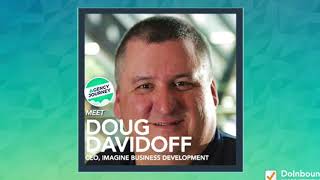
Andrew Demski and Doug Davidoff discuss how marketing agencies can implement sales enablement to align their sales and marketing teams. They explore why agencies struggle to define their expertise and how focusing on core strengths drives better client outcomes and business growth.
Hey, there. Welcome back to Agency Journey. This is Andrew, and in this episode, I'm chatting with Doug Davidoff, and we're talking all things sales enablement and how the sales enablement movement impacts marketing agencies today. And the big question is this. Should you spend your time figuring out how to do all aspects of the funnel, or should you focus on one particular area where you are world class? Doug definitely has an opinion on this, and we dive into it in this interview. How do you build an agency that allows you to live the dream that you have for yourself, for your family, for your community, for your team, while at the same time helping your clients knock it out of the park and doing it all profitably? These are the big questions that we tackle here on the Agency Journey podcast. I am your host, Andrew Demski. Now let's get to it. All right, Doug, welcome back to Agency Journey. So excited to have you here. Can you kick us off first, just for anyone who hasn't caught the last episode where you were on, introduce yourself, share a little bit about your story and how you got to where you are today.
Well, Andrew, thank you for having me back. It's always nice when you're invited for the first time, but it's really special when you actually get invited back. So I really appreciate that.
You did something right. Man.
There you go. Exactly. Or at least I'm crazy enough one of the two. Yeah. So I run a firm, Imagine Business Development. We do inbound marketing, sales development, design, sale, playbook. So we're kind of. I always feel arrogant and somewhat egotistical when I say this, but we're really at that leading edge of addressing the full funnel and being what is dubbed the full funnel agency. And so we've been doing that for about the last three years.
Awesome.
We were doing sales enablement before sales enablement was cool, I guess, is what I'm trying to say.
Yeah. How did you bring. How did you kind of connect those dots between sales enablement and inbound? And how did. How did that kind of process, like, I'm thinking, like the learning experience of that translate to clients.
So we're an inbound agency totally by accident. And, you know, it's funny because I actually, I speak a lot, and I speak more on marketing than I do on sales. And I kind of laugh at that because, you know, 20 years ago, 10 years ago, if someone had told me that I would be known in marketing circles, I would have laughed. So I started Imagine in 2004, and actually the name of the company was Imagine Sales Advisory and we worked with companies on strategy, sales training, sales process, sales structure, sales coaching. So we didn't use the term, but we were a bottom Funnel Co. Around 2010, 2011. We were just seeing things not working more and more and more and challenges emerging. And it's fascinating because I took a step back then to just say, hey, okay, what's going on? This ain't right. This ain't working the way it's supposed to. And then since I did that step back, two huge research studies came out. One is the challenger research that got embodied in the challenger sale, and the other is the research done from Google on the zero moment of truth. But basically what we realized was, was that the problems that we were trying to solve at the bottom of the funnel were being caused by what was or was not happening at the top and the middle of the funnel. And so I realized if I wanted to solve the bottom of the funnel problem, I had to work with my clients to address the top of the funnel. Back then, I didn't call it that. I said, we got to fix the lead generation problem if we're going to fix the sales problem. We began to address the lead generation problem. That let us. We had been doing inbound marketing. I didn't know it at the time. I didn't know that's what we were doing was being called. I actually started blogging in 2005. And so we were doing that and we realized that the same approach that we were taking because we were not experiencing the problems that our clients were in solving the lead generation problem, that led us to begin to provide inbound marketing services. And we became an inbound marketing agency. That then led to us adding sales development. And we had always had a bias of that sales perspective. And so for us, it wasn't so much that we connected the dots of inbound marketing to sales or sales enablement. It was more along the lines of we came from that place. And as we. It was two things. As we did more on the inbound marketing side, we saw more and more about the chasm that exists between awareness and lead generation and sales ready, which is what sales enablement is all really geared to bridge. The second thing is actually we were talking about it before the show started. I'm a baseball guy. I coached baseball and I'm a data guy. Needless to say, I'm a huge fan of Moneyball. And really, if you take a look at the idea of Moneyball in sports, because now it applies to far more than just baseball. But if you look at the idea of Moneyball in sports, the equivalent of Moneyball is sales enablement. And so those things were really very natural for us in terms of how we brought things to bear. The funny thing is, while, and I should probably be careful saying this because we get a lot of revenue here, while we get more revenue from inbound marketing side, that's still the area that's the least natural to us.
Gotcha. You're just, you, you come from that. I mean, it's good to have that like, as you're kind of pulling stuff towards your, your core strength as an agency. How is that like where we are today in the agency space? More and more people talking about sales enablement, where you guys have kind of come from that space from the beginning. What do you, what do you see as you're working with prospects who've maybe worked with other agencies or you're just talking to other agency folks? What do you see is like the biggest weakness from folks who are really strong on the inbound side but weak on the, on the sales enablement side? Kind of. What are some common things that you're seeing them missing as you look out?
Well, that's a fascinating question. I was, I was ready for a whole bunch of these questions. I wasn't quite ready for that one. That's why I like being on the show. I think that the biggest problem that I see is that there is this idea that the grass is greener on the other side. If you look at a lot of the inbound agency environment that's moving and pushing to sales enablement and sales services, and let's remember that that's actually a small piece of the marketing agency environment. It really is the HubSpot infused inbound agency that built their business and built their offerings around this idea of we're going to help you execute, quote unquote, inbound marketing. Even a subset of digital per se, when you look at them, there's this. It's funny because we used to be in this world used to be in pursuit of the billable hour. And then someone said, hey, forget hours, let's go to retainers. And now everyone's in pursuit of the retainer. And there's two myths that I've seen that are happening. The first myth is bigger retainers are better. Now that's not always false, but it is oftentimes false. And then the second myth is sales has bigger budget than marketing now, sales has certainly bigger impact. And if you're on the sales side, there's influence that you can exert that doesn't exist elsewhere. What's interesting is the marketing side of the business has always had a services component to it. Marketing departments have always had budget items for outside services. From the beginning of Don Draper, you use an outside firm to buy ads, things like that. So it was always kind of built in. Sales doesn't have that. Naturally, sales budget goes to headcount, goes to technology, and then it depends whose budget trade shows comes from. That is the predominant aspect of sales budget. And what's interesting is when sales gets more budget, their predisposition is to hire more headcount. And you might look at the sales budget and go, wow, the sales budget is bigger than the marketing budget. And so, hey, let me get to the sales side, because there's a bigger budget, I can get bigger retainers. But the sales side is not used to working with outside services. Right. And so I think one of the things that gets pushed is that the grass is greener on the other side. And so, you know, in any market that you're in, and Lord knows, the inbound marketing world and the. The digital marketing, the demand generation world, in total, whether you're looking at the industry. I'm sorry, whether you're looking at the agency environment or the technology environment, we're in the midst of a whole new ecosystem emerging. That leads to a lot of chaos. People are running around trying to find their place. It's funny, I was talking with a friend about this just last night because we were talking about some business ideas and what we're planning doing in 2018. We're good with each other because we always talk about the challenges. And I finally said, I've yet to find the business that I can build that will make a lot of money and not present any challenges. I mean, I keep looking for it, but I can't find it. And so we get presented with this challenge, and there's this impulse, I think, to pivot. Hey, let's move to here. Hey, let's find that there, because that'll be better. And so I think the biggest weakness is that too often agencies are defining themselves by what they're not, as opposed to defining themselves by what they are and saying, how can I be the best at what I am?
Yeah, how has that asking yourself that question changed the way you look at 2018 versus the way 2016, 2017 went down?
Wow. It's had a huge impact. We've changed a lot of the people. We changed a lot of the structure and the approach. And about two months ago, we've been working on it for about. For about the last five months. But two months ago, right after Inbound, we announced our official change. One of the things that happens when new markets emerge is everyone's running for. It's just a big land grab. If we think about it, roughly six or seven years ago, there was really no such thing as inbound marketing. I know HubSpot existed and they had their book and there were some agencies that were beginning to emerge, but. But basically nobody was doing it. And so agencies ran out and said, we can help you do this. They were backed by a tremendous tailwind of what HubSpot was doing, of how the world was changing. It was this new thing and everyone just grabbed land and everyone was trying to be, in a lot of ways, everything to everybody. And you see this in the agency environment and you see this in the technology environment. I mean, you can just look at Chief Martek went from 100 something in 2011 pieces of technology to now he only lists the top 5,000. He doesn't even list all the technology logos on his map. And so you have this massive run fragmentation. Everybody's running along and everyone's trying to be a little bit of everything to everybody. One of the things that I got a little bit of business theoretician in those environments, as they mature, they begin to settle into certain. In certain ways, there are certain aspects of predictability to how an industry is going to emerge and how it matures. One of the things that happens is. And actually, David Baker talks about this great book, by the way. If any agency leader is listening to this, his book, the Business of Expertise. I was actually on a cruise when I read it. It was, you know, I had multiple, oh, shit moments like, wow, that's spot on and everything. So, you know, one of the things he says is, you know, if you're an expert, are you getting paid significantly more than your competitors? Not a little bit more, but it's significantly more. And he said, because if you're an expert and you're not getting paid significantly more, then you're not an expert. Right? You might tell yourself you're an expert. Yeah, but experts get paid more. And so I read that, and I literally, I still remember sitting on the land, chair, cocktail in hand as I'm reading it. And I said to my wife, we're raising our prices when we get back. And so one of the other things that happens, and he talks about this in the book, is that expertise sorts itself in terms of vertical expertise and horizontal expertise. If you think Years ago to where the whole marketing agency emerged. We had advertising agencies, the don drapers, the McCann whatevers. I forget the name of the different agencies on the show, but at one time there were hundreds and thousands of agencies promising to be everything to everybody. Then what happened was you began to get certain agencies that specialized in managing the entire process and they became the agency of record. Now, these other agencies still had a role. They became, for lack of a better word, subcontractors or partners or things to that agency of record. And they were brought on for what I refer to and what Baker referred to as vertical expertise. And so one of the challenges that exists in sales and marketing in general, in small and mid sized and mid market businesses, and I would say even in larger businesses, there is a chasm. Not only is there a chasm between sales and marketing, there is a chasm between the role of sales and marketing and the executive level and strategy. Strategy doesn't speak the language of execution, and execution doesn't speak the language of strategy. Then when you bring the unique aspect about sales and marketing, I hope I'm not going to too much business school on you here. No, that's good.
Keep going.
When you bring the components of sales and marketing, what makes sales and marketing unique in business is that it is an open loop system, whereas every other aspect of a business is closed loop, meaning that the business has full control over it. I control my financial process, I control my operating process, I control my human resources process. In sales and marketing, I only control a part of the process. The market has a significant amount of control in the other part of the process. Norman Schwarzkopf, following the first Persian Gulf conflict, following an op that went bad, when asked, well, why did that happen? He responded, in wartime, the enemy gets a vote. The great philosopher Mike Tyson once said, everybody has a plan until they get punched in the face. That's what happens in sales and marketing, is we have our plan and then we go to the market and then frankly, we get punched in the face. And it's about adjust, adjust, adjust. You've got all these crazy things that are going on that brings about this whole dynamic level between everything that leads to a whole lot of chaos. If you look at how sales and marketing gets managed, typically it gets managed from a silo perspective. Sales and marketing, that alone is silo. Within marketing, we have social media management, we have this, we have brand, we create all these things that create silos. Very few people actually look at revenue generation or customer acquisition from a holistic perspective, even traditionally. And that's why there's always been a huge amount of inefficiency in the process. Whereas if you look at this as a complex manufacturing process, it begins to make sense. If you look at the companies that are truly at the leading edge of growth, who are really scaling and doing so with a level of predictability, you're going to see that they have somebody, sometimes they have the title, sometimes they have something else. But one of the things that made HubSpot such a powerful force was Mike Volpe. And Mike wasn't just a great marketer. Mike understood the entire revenue generation process. And so when he and Mark Roberge worked together, Mike understood sales, Mike understood what had to happen. Marc understood marketing. They approached it from a holistic perspective. They were really at the leading edge of creating this role that is now beginning to be referred to as the Chief Revenue Officer, that person responsible for aligning all of these aspects so that that complex manufacturing process both is optimized within its verticals, but also that it works together in a holistic fashion. That's job one of the chief revenue officers. Job two of the chief Revenue officer is to manage the alignment between strategy and execution and execution and strategy. And if you look at any complex environment, you're going to see that this happens in technology. You get platforms and apps, erps and apps. You have Salesforce is a platform, HubSpot has shared that they want to become a platform and that becomes this organizing principle. You can look at construction, you have general contractors, horizontal expertise, subcontractors, vertical expertise. All those things happen. And what we realized was there's this huge missing piece. There is nobody filling the role, there's nobody addressing that role of that horizontal expertise in the small mid market space as it relates to demand generation and customer acquisition.
Yeah. So you're seeing that gap sitting right at the bottom of the funnel, figuring out how do we kind of bridge this gap here and continue to iterate through things? Once you've, I mean you, you see that on the marketing side of things for sure. It's like just you see challenges, you, you get punched in the face, you iterate, you try new things and just kind of keeping that cyclical approach up, applying that full funnel, it's actually a.
Little bit different than that because it's not about being at the bottom of the funnel and it's almost not even about being at the top of the funnel. It's like being all around the funnel. And so what I mean for this, what I mean about this is like take a look at email Marketing, right? Fundamental flaw with email marketing. What does everybody solve for in their email marketing strategy?
Open rates.
They solve open rates and click rates, Right, right. Open rates and click rates. I mean, most of them open rates. And if you're really advanced, you pay attention to click rates. But, but guess what? I don't care about open rates or click rates. Open rates and click rates are vanity metrics. We solve for traffic. Right? But, but traffic doesn't mean anything because like I, I could turn my blog, I could drive a whole lot more traffic because I should start, you know, I could write blogs geared for salespeople. But salespeople aren't my market per se. They're not the people that we're trying to directly influence, if you will. So I could look great driving traffic, but I'm not really solving the right thing because I'm not carrying that piece of traffic all the way through. What we're looking to do is to solve again, it's the Moneyball approach, right? Paul D. Podesta realized we needed to win baseball games and we didn't have enough money to do it the traditional way. And by the way, all money lets you do is to be stupid because you can just buy really expensive players or you can just blast things out and go, hey, we'll make it up in volume, right? And so the Oakland A's were like the small mid market businesses that I work with and like the agencies that I am and that my friends are. And so what he said is, okay, we need to win games, but we don't control the win, right? Because you can do all the right things and lose and all the wrong things and win. What he did was he determined what was the thing that had the greatest impact on increasing the probability of winning. And what he realized was it was runs. The more runs we score, the more the more games we'll win, right? And they actually had it down to a science. If we score between these number of runs and this number of runs, this is the probability of us making the playoffs.
Nice.
They had it for each section. Now, up to this point, the really, like the really smart people in baseball, they solved for hits. We want the guy that gets the most hits. And you might look at that as total hits or you might look at that as batting average. And people spent all kinds of money to run down people with hits, right? And what D. Podesta, and I'm oversimplifying this, but what D. Podesta realized was hits don't mean runs, getting on base means runs. And all Of a sudden, this absolutely boring thing that nobody pays attention to of walks became this tremendous, you know, had this tremendous value. We lived for years by the. You know, Babe Ruth struck out thousands of times, but set a record for home runs. If you don't strike out, you can't hit a home run. Okay, all things invalid. What they all realized was something that. I actually haven't talked about this in a really long time. Another thing that they realized was all outs are not created equal. People who strike out a lot have less value than people who make outs by contact. Because what they realized was productive outs, meaning outs where a positive outcome occurred. So a runner advanced or something like that. Productive outs were nearly as valuable as hits. Right. And so, by the way, it totally changed how we managed baseball games when I was in college. If we had more time, I could get into that. So what happened was Paul D. Podesta, with Billy Beane, played that role of Chief Revenue Officer, looking to solve for the full thing. Okay, let's make sure we've got all the individual parts working, but let's also make sure that they are working together so that we're moving to that end run. Now, there's nothing wrong with saying we're going to do these posts because they drive traffic and traffic drives domain authority, and domain authority helps with everything else. Okay, great. But then let's make sure that we're actually testing those assumptions and let's see where those things are happening. If you think about how much data there is and how much stuff there is to pay attention to, you can't do it. If you're writing the blog post, you can't have the big picture focus on the analytics of what's happening and seeing this connection to that connection. That's what I mean by bringing. There's a vertical expertise of content of CTAs. I know some people, they spend hours, as they should, on how do you design a cta? What color should we use? Let's use this shade. Let's use that shade. There's a tremendous amount of value there. But those people who are great at that, when they're being asked to do something else, that's a fundamentally different process. They become very average at best. And what happens is they end up doing a poor job of both.
Yeah. So when you look at this kind of new area of expertise here, this global view, is this something that you see agencies needing to kind of find a partner to help them visualize this and that they should specialize on, you know, conversion optimization or content Creation or is this something that agencies should try to bring in and expand their current book of services to kind of add this perspective?
So I'm going to share, because what I could say might sound self serving. I'm going to share what David Baker said about this because we had been working on this whole CRO idea before. I read Baker's book and then I'm on the cruise and I'm reading Baker's book and I go, yeah, okay, raise prices. But here was the real oh shit moment. He made it very clear it is a lot easier to grow a business, it is a lot easier to be an expert, and it is a lot easier to monetize that expertise on vertical expertise. He all but said, if you go with horizontal expertise, you're almost foolish. And there's a whole bunch of reasons why. And you can read his book if you want to know more about that. So horizontal expertise, you should only go to horizontal expertise if you need to go to horizontal expertise. Now there needs to be horizontal expertise because there is beginning to be a movement and I'm seeing it away from agencies. There's an agency fatigue. There's a side of how our prospects are looking from their experience and what they're seeing. And there's so much of this cookie cutter crap. I hope I can say the podcast, they're just getting turned off by it. As a matter of fact, part of our job, the toughest part of our job since we began to reposition, is to communicate really early and up front. We're not an agency. We might do agency things, but we're not an agency. That's a challenge that's happening. And so this is what's going to make agencies, their world's going to get harder and harder if this horizontal expertise doesn't emerge. Because if it doesn't emerge, the companies are going to build it internally, which is going to commoditize agencies further. What I am saying is what. And by the way, Jim Collins in the book Good to Great, what he basically said the thesis of good to great was look at all the things that you do and ask yourself, what are you good at and what are you great at? The companies that became great and earned disproportionate rewards as a result of that were the ones who stopped doing what they were good at to focus only at what they're great at. And so what we realized was we are great at where sales and marketing mean. We are great at putting together that holistic strategy and seeing where things connect and people should Hire us as inbound marketing because. Because when it comes to doing inbound marketing that impacts sales, we're better than anybody. But the truth was, if what you want was inbound marketing, we're not the best. I could list five or 10 agencies that I know that are better than us right off the top of my head. And I would say to some prospects, hey, if you're looking for somebody who's going to do content, if you're looking for somebody who's going to build your blog, who's going to design your website, we do growth driven design. If you want somebody to do growth driven design, that's not why you hire us. Yeah, that's not where we're great at. That's not where we're the best. And there are other people that are better than us at that. But the thing that I see that all these companies that are better at us at doing those things, they're all trying to do the things that I'm better than they are. And it sucks up resources and it creates complexity and it does all these things. And that's where I'm saying what an agency should do is say, where are we the best at? Because I've said this for years, there's two types of companies in the world. You're either the best or you're me too. And the problem is that years ago, me too was okay, you could build a nice business as a me too company. You didn't really have to be the best. Everyone's talking about artificial intelligence taking stuff away. I feel bad for SEO consultants because artificial intelligence is going to make 97% of them totally irrelevant. You know, the 3% that it's not going to make irrelevant.
What's that?
The best. Yeah, right. The ones who are the best at applying it for a specific purpose. Artificial intelligence is going to make them even better. Right. And so I see some people who work, you know, they're amazing at putting content together when the strategy is clear. They're amazing at driving conversion. They're amazing at doing these things. They're not amazing at strategy. They're not amazing at getting companies to reconceive who they are or to drive those types of change. And they keep trying to run to do that. I'll tell you right off the bat, we want to partner with agencies. We want to put the best team together for a client to achieve a result. Our problem is we haven't been able to find an agency to partner with because every agency that we talk to wants to be all things to all people. And it's like, well, wait a second, that doesn't solve the problem for us. That doesn't give us a superior proposition to be able to go in at that doesn't drive what that result is. Right. That we're looking for. And so that's the big weakness in the market that I see.
I'm curious around. I mean, you mentioned the agency of record early on, and they're the ones that could kind of bring forth the expertise to kind of bring all these different pieces together. Do you see that kind of a model shaking up the digital community here? Like, how? I'm just curious. Like, from a client's perspective, this could easily get super confusing. So just from your opinion, how do you foresee a streamline of focused expertise flowing to the client?
So here's the thing that's interesting. The agency of record, if you think about it theoretically, and I know that there's some agency records out there that are crap, so please, I understand that execution can sometimes be different than theory. The purpose of the agency of record is to manage the complexity for the customer. The agency of record is the expert in the customer's business. Right? And the agency of record has the deep understanding to have the conversations with the people who have high levels of expertise. It's like, look, if you talk to a CEO or a VP of sales or, hell, for the most part, if you talk to a real VP of marketing and you get into what really matters about SEO, what really is going to drive the difference? Within five minutes, they can't even hear you anymore because you've gotten so arcane, so detailed and obtuse that they just can't even handle it. Yep, Right. And so, you know, they say, tell to me like I'm a six year old, right? Because. Because they don't have the time or the ability or the desire. They got too many things that they're dealing with. They've got, you know, all this stuff to understand that debt. And so what the agency of record does is they're the ones who speak to the customer in the customer's language. They're the ones that manage those details. Then when they have the conversations with that, with that vertical expert, they have expertise there so they can embrace the conversation. They understand that this little nuance, which sounds like a really small thing, actually has a huge impact and changes both the worth and the cost of what you're doing. The truth of the matter is, if you take a look at most agencies that want to get paid more, their problem isn't that they're not providing a broad enough set of services. The problem is that their client you. What they do.
Yes. Amen.
Somebody who understands content understands you got to pay a lot for great content. But the client says, well, I want a great blog for $70. Hell, they don't even want to pay $70. I don't understand why, you know, I paid you a thousand dollars to write four blog posts. Why haven't I gotten, you know, they can't understand that. Right? And so here's the, like, here's the great thing. Most agencies, you shouldn't even deal with it. If we start partnering the right way, they're wholly different disciplines. You guys get better and better. And I say, you guys, it's really we. But we get better at where we're great, you get better at where you're great. We match up, and that's where we become really unbeatable, you know, opportunities. You partner in some cases with somebody like us or I'm sure somebody's going to begin to create something along the lines of what we do. But the other thing that it also does is it makes you far more valuable to larger companies. Yeah, because when you're going to the larger company, they've got people in place, they're like, well, we don't need everything. We need somebody who can rock and roll this piece for this result. And you're like, hey, yep, we got that. It's plug and play. Because you've got the expertise and we've got the deep expertise. You recognize the impact of that a whole lot faster. That agency of record was created because companies finally said, you know what? I can't deal with all of this stuff. It's way too complex. I don't have time. I'm going to hire you. You manage them, by the way. It's been this way for years in IT services. IBM started providing services to Fortune 500 companies where they became the IT department. It was an IBM employee who managed and procured different technologies which included, by the way, at times, companies selling to a company where IBM was the IT department and they were selling a competitive technology to what IBM had. And the IBM technology department bought the competitive product because it solved the problem better. Because they realized that if we're in this role, we've got to deliver to the client. Right? FedEx is supply chain for half of the Fortune 100. That's their real business. And they. People who compete with FedEx partner with FedEx in those situations because FedEx provides that capability to the company. The level of complexity that we're dealing with today is just far, far too great for any non mega company to be able to handle on their own. The big problem with the small mid market is they don't have the capacity to build it in house and nobody is providing it to them from the outside. And they're beginning to throw up their hands and just say, okay, forget it. We're going to look for the next, you know, for the next exciting thing. And frankly, what's happening while that. While all that's going on is Amazon and AI are figuring out how to disrupt everybody.
Yeah, crazy world, man. There's. If we need to cut. We need to wrap this up here.
Yeah, I know.
If there's.
I told you, I geek out of this, man. I said we could be talking for hours.
This is good though. If there's anyone who's hearing this and their ears are buzzing and they're like, yes, I agree. I want to focus on this specific area and they want to reach out and chat with you. Doug, what's the best way someone can get in touch?
Send me an email. Douglas.Davidoff imagine llc.com Tweet me at Doug Davidoff. Fill out a form on my website, send a pigeon, whatever the case may be. Here's one. I just want to get one final thought out because I've heard a whole lot of people saying you have to move north. You have to move to sales services if you want bigger retainers. That's not true. What you have to do is move to where you're great at. And I promise you, I know it for a fact. If you're great at what you do and there's a commercial application for it, the money follows. Be great at it. And then you don't have to worry about competition anymore.
Amen, Doug. That's a great way to wrap it up. Well done, man. Thanks so much for coming on. We appreciate it.
Want more great episodes like this one? Hey, I'm Gray MacKenzie, a host here on Agency Journey. I don't know about you, but sometimes I get a little overwhelmed when I find a new podcast. There are so many great episodes and great guests, it's hard to know which ones to listen to first. That's why we put together a list of the top 10 most downloaded episodes of Agency Journey.
And you can get a copy of.
That list plus all of our notes and takeaways just by texting the word doinbound to 44222. Again, that's do inbound, all one word to 44222. Standard text rights apply. You don't want to miss these great episodes. Text DO inbound to 442-Now.










