How Rebuild Your Agency into One You Love with James Robert Lay
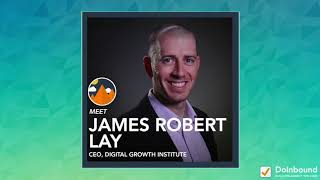
James Robert Lay talks about rebuilding his inbound marketing agency, Digital Growth Institute, and refocusing on financial services clients. He discusses how to grow an agency by narrowing your niche and building training programs around what you know.
Foreign welcome to Inbound Agency Journey.
This is the show where inbound agency.
Leaders share the strategies, shortcomings, and successes they've experienced in their journey toward building their dream agency. Now, here are your hosts, Andrew and Gray.
All right, welcome back to this week's episode of Inbound Agency Journey. This week. This is Gray, by the way, and I'm here with my man, James Robert Lay. And James Robert, before I get into and give away the agency name, A, welcome to the podcast. And B, let's start with. And you know what? I'm going to give it away. I'm going to let you take it from there. So, Digital Growth Institute, I'm really excited to talk about the focus that you have and the story that you have. So why don't you give us the background and then we'll kind of run through some of the highlights of your story of where Digital Growth Institute came from, dgi and then your personal story, how those two are intertwined.
Yeah. So thanks for having me on today, man. I appreciate it. I'm excited just to share where I've been so that. And where we're going, not for myself, but if I can just help other people avoid making the mistakes that I've made, shorten their time to success, that's really what I want to do today. So the background.
Yes. Well, first of all, let's start here. You sent me over in a note and you and I've chatted before, but 2002, a girl wasn't a real big fan of your punk rock band.
Yeah, punk rock. Perfect balance, man. So growing up, I was. I was kind of a bit of a nerd. I played in the orchestra and I played the viola. And when I graduated high school, I was like, I want a band. So I started this band, punk rock band and emo punk. And there was this girl.
So you weren't playing the viola, I take it? No, I'm trying to picture how those would go together.
Yeah. And believe it or not, actually had Liberty Spikes. And so this I did. I did. And now if I could get that hair back, I would. I would. But. So, yeah, so there's this girl and she set me down in the library one day and we were studying, and she said, you know, your band, you're not really that good. You really kind of suck. And I said, okay. And I like this girl. And I wanted to impress this girl, and I obviously wasn't impressing her with the band and the music. Actually wrote a song for her, too. And so she said, you're not very good. You suck. I was like, okay, well, what should I do? She said, just do something with your life. And so I was like, okay. So I was taking a web design class. So I quit my band, sold off, pawned my band equipment off, and I started this web design company. This was back in 2002, February 11, 2002, and got a DBA, started working with like some local businesses. Probably like two years later, got into the financial services space and really started to experience some pretty quick growth. And so 2002, 2006, ended up actually marrying that girl. And so it all worked out. It does, it does. And so we're now got the girl, got some beautiful kids and still have the business. And it's been a journey along that way, but it's been a learning experience, both good and bad. And it's one of those things that I don't believe yet you can really fail. I believe that you can only learn from your experiences, apply them now, if you don't apply them, if you don't learn, that's failure. But it's hard. And sometimes it does take a swipe at your confidence, but it just takes courage to get back into it. And you just have to keep pressing forward. And it's helpful when you have someone standing behind you who loves you and is there for you.
I can attest to that.
Yeah. And it's one of those. If I didn't have that support, both from my wife, but then also just my kids and then the people here at this office and the clients, we have to work together to keep everyone moving forward together.
Yeah, no, that's definitely true. I think if you just own the choices that you make, take responsibility for that and what comes from that. I agree. You're just kind of figuring out, literally.
Become like a full service agency and we just weren't staffed for it appropriately. I was bringing people in, they're good people, but bringing people in to just almost fill a seat, do a job. And it was like you had to keep. You had to get work so that you could pay these people. And it was just this never ending vicious cycle. It wasn't really well planned or thought out. And so David came in, he said, like, look, let's just go back to the, like, literally ground zero and like, start over. Yeah, start over. And that was scary, man, because at that time, you know, I had 10 years behind me of quote unquote experience, but it wasn't the deep level experience that I knew deep down inside that I wanted to have. So That I could help this industry, financial services, who is really still rooted in legacy systems, legacy thinking, transform themselves. And so that was a really, really hard, kind of like, very, very low period of my life personally. But, you know, having those people behind me to support me, having David come in and say, hey, there's a better future ahead, but it's your choice that you're gonna make. And so I was like, you know what? Family or the business? And that's really what it had come down to. My wife was like, it's a family or the business. And I said, you know what? It's going to be the family, but we're going to have to reinvent this business so that it can be built for. Because I was traveling and that was, you could say, pretty much lost. And so, yeah, so 10 years in 2012, 2013, we went in, we refocused, and we went really deep back into the financial services, but on a mission to simplify digital marketing so that banks and credit unions can continue to grow from good to great. And the reason that we did that was because we know that money impacts everyone's life. And banks and credit unions, we believe, have an opportunity to help people transform their lives because there's just about 50% of people are still living paycheck to PayCheck, and about 3/4 of people in the US today have reported financial stress in the last month. We're willing to help them overcome those challenges.
Right. Well, I think that just kind of walking through the valley that you went through, the challenge of that. I think that's a good point and something that a lot of people listening are going to resonate with. Just everything on the outside might be going, well, you're getting new business, but inside it's just chaos and it's not worth it in the long term. So I think that's helpful to hear, just to hear the stories of, like, other people have gone through that and there is a way out. And the way out obviously brought in David Baker. He's been on the podcast before and he's a great resource. There's a lot of great resources to help people with this. But as far as the action steps that you guys took, obviously you're doubling down on one specific industry you're doubling down on. You talked about, like, simplifying digital marketing. What are the. So is it also were you getting rid of certain clients only, like, focusing in your marketing? Were you simplifying the service package that you were offering? Like, what are the specific pieces, I guess, that you did that came out of the whole refocus activity.
Yeah. So, you know, we had to get rid of clients who were no longer a good fit for what we were looking to do. And that caused a lot of conflict. When you get rid of clients, then you also have to shrink your staff down, which that causes a lot of conflict. And then you come back in and you have, because you don't have all of this quote unquote responsibility that allows for reflection, that allows for clarity. And you can then start to say, okay, where can we provide the most value for. For the financial services market at the time? And we really quickly discovered there was really three paths, Ford. And we said, you know what? It's going to be built around training. Because we're finding that when financial institutions or any industry really, who is stuck in legacy thinking, legacy systems, they just simply don't know what they don't know. And they're really held back by three fears. It's fear of the unknown, first and foremost, then it's fear of change, and then it's fear of failure. And we believe that for to help a client, to help an industry move forward, we have to address each one of those fears in a very methodical order. And so to help address that fear of the unknown, that's where training comes into play. The next area of this is obviously planning, helping them to assess their situation, provide them with clarity and confidence that a clear path forward. And then we have the third is to help prevent that fear of failure, to help them overcome that fear of failure. That's where we move into more of what we call transformation or implementation. And we're guiding them through the implementation of that plan. We look at that at a very methodical, step by step for us, it all comes down to developing intellectual property ip. I think you guys talk about game plans, we talk about a digital growth blueprint because it allows us to focus on nine specific areas. And when you have that focus, you can go really, really deep. And it's almost like peeling the layers of an onion back. So you look at these nine different areas and you think, oh man, we've got this figured out. No, you don't. You just could keep going deeper and deeper and deep and then you can apply that knowledge through these three different programs, training, planning and transformation. And they all just feed continuously and play off of each other there.
So what you were just laying out there was that in addition to some other things, you guys really identified an exact client journey that you were going to take people through. And what does this need. What's the process we need to take people through in order to get them the results that they need? And a lot of times creative agencies, agencies in this space. And I talk to agencies all the time on demos or onboardings or folks who. Or just completely outside the realm of do inbound. Just talking with folks in the agency space and we're. So there's a tendency because it's a lot of creative people think like we can't. Like process is almost like a dirty word to a lot of people thinking that if I follow a process like I'm just going to get the same result time after time without realizing like process is exactly what you need to deliver the right results for people. And it's not going to be a stale. The process can be consistent and the output can be very, very different or very targeted for what you're looking for. So I think that's, that's a helpful point. Just how you walk through, how you guys have this whole process structured and client journey built out from the beginning.
Yeah, the process does. It helps. Whenever we're talking with someone and they present with some challenges, it allows us to say, look, we understand where you're at. You're not alone. This is what we're recommending based upon your situation. And then this is how we've actually applied this thinking for others. So it almost gives them confidence from the very beginning because they're frustrated, they're overwhelmed. Particularly when it comes to things like digital marketing, digital growth, inbound marketing in an industry that is, that is kind of rooted around legacy thinking and systems. Where do I begin? What do I need to do? And sometimes if you start talking about like, well, you need to do all this stuff, it's just cognitive dissonance. It's information overload and that increases that fear. And when you start to say, you know what, let's just start, let's just start here, let's just give you some basic education information, awareness of what the opportunities are before we even start talking about building anything that says, okay, I can do this. So it's really a step by step approach and you're just guiding someone from this area of overwhelm and concern. Say, you know what, there is a better future over here.
Yep. One of the things I wanted to kind of dig into was around the training piece and like the front end of your client engagements for a couple reasons. One, the onboarding thing just comes up in I guess a combination. Sales is a super popular agency struggle and then onboarding and I think a Lot of times the reason those two get emphasized the most, obviously that sets up everything, that sets up everything that your agency does for success. But two is if you lose people there, you don't ever get to the far end of things where we're talking about client retention and stuff like that. And the game plan training that we've developed that's been super popular and super helpful for agencies to go through and just kind of have here's the process for how we do it. But then I look at other agencies who've done this really well with a different take on it. At the end of the day, a lot of the pieces, there's overlap, but what you do is highly specific for your audience and the whole method that you have. Can you walk us through what that training looks like, how do you sell that and then how do you deliver that front end of the engagement?
So I'll kind of take a step back of where, how we got to the point to where we're at today. So I knew very early on that training was going to be critical in at least just giving them the awareness to get the buy in, to commit, to move into an actual transformation or implementation engagement. They just trying to sell that was just, is just too big, too much. So we actually started doing, we took our blueprint and we broke it up and we have like nine different training modules. We started doing training in person at our offices in Houston and those were typically held over about a one to two day event. We did that started three years ago. A couple lessons learned that if someone wants to go down the same path, don't do this at a hotel, it's just too much money and do this. Just rent some space for the day. I think Regis has a really great. You can rent a conference room for the day. But, but start small because when we started doing these training programs, we actually developed curriculum for three different training programs and it's just too much focus. Just focus on one thing. We then took that, we got some feedback and we said, you know what? People wanted to come and it was like drinking from a fire hose because it was just so much new knowledge and insight. They're gaining a ton of value. But then they'd go back and it's like, well, what do I do next? And so we could, let's. How can we refine this process? We also had people say they want to come, but they just didn't have the travel budgets to come spend two days with us. So, okay, so where we're at today is we've taken the same content. And this is the kind of, the beauty of this is you develop all of this and you can just keep repurposing, repackaging. So when you develop training material, it's an asset that I believe has a very long shelf life and that you can begin to monetize this. But you're providing value and because of your value, that's what people are paying you for. So now we have the online training program. The way that we're doing this is we're running it basically bi weekly sessions. And so it's instead of drinking from a fire hose over a two day period, we've broken this up into three, three, four week semesters. And so semester one, you have one week of classroom and it's online delivery. And then the next week, for those who want to pay a little bit more of a premium, we offer group coaching. And so you supplement or complement the classroom with that group coaching to dive a little bit deeper into these four or five student challenges and issues just for them. And so what we're seeing is even through this delivery model, they're getting a ton of value. It's at a much more digestible pace. But some are still coming back and saying, you know what, this makes a lot more sense. We have a lot more hope and optimism for the future. But can you come back and help us actually do a formalized assessment for our situation to where you can give us recommendations just for us. And so that just helps to keep this. I don't really like to sell, I just like to help first. That helps us just continue to guide them through this journey because they have to self actualize what will provide them with the most value. And that's one of the reasons I like when doing a discovery call, I just listen and focus the conversation on this prospect and then I say, you know what, based upon what you shared with me, I recommend a training program or I recommend a planning program. I never ever recommend we just start moving into transformation or implementation and that makes we get off that call and like, does this make sense? Yeah, it makes a lot of sense. So that's kind of how we walk someone through this very, very long journey. And it is, it is a very long journey. I'm very clear up front, this is going to be 12, 18, 24 months for you to move through these different steps. Because if you move any faster than that, you're going to get frustrated.
That was, you just kind of preempted the next question I had, which was because so many agencies Are, you know, we need cash today. I want to sell the project. Regardless of whether I know exactly what needs to happen or not. Obviously that's not the recipe for. We'd all say, yeah, it's not the recipe for success in the long run. But to walk people kind of slowly through the process at their pace or, or to go at the right pace for them. What does. So how long is somebody typically in. Is there like an average of how long someone goes through training before they're jumping into the next pieces in the. In the process?
So it really just depends on what type of training program that they're involved with. Because, for example, our training program can be really delivered three different ways. We have kind of like this online delivery with coaching that we're doing now. We've done the on sites here at our offices in Houston where we only bring. We only bring in about eight to 10 people. We even keep those small. So it allows for a lot of facilitation and dialogue. Or we can actually take that and go on site and do training with a client. So how long it really takes, it just depends on what that delivery model or methodology looks like. So it could be two days on the short end or six months. It's kind of how we're doing the online delivery program now.
Cool. Okay, that's really helpful. Well, so I've got two more questions here before we wrap up. And the first one is from where you guys are at right now, I phrase this question different ways, but always like to ask people like either what's something you're struggling with now or what's an area for improvement or just kind of a area of potential moving forward that you're trying to move into.
So the area of opportunity that I'm looking at today is just managing growth in a much more positive way. We've really struck a nerve with the financial services space. We're. We're providing it a lot of value. And I can just see we're booked out now probably two to three months ahead, which is a nice quote unquote problem to have. But at the same time I'd like to kind of shorten that just a little bit. You had asked about cash flow. I've been there. I know the challenges shrink things down. If you have to do things right, don't grow fast, grow smart. Because when you grow fast, you don't have to a strong foundation. Things are going to start to crumble and fall like it did before for me. And so now it's like, okay, we're at this precipice, we've created some demand, we're delivering, we're creating results. But now it's okay. We have to grow the right way. And so I have found value always since engaging with David Baker, was it four or five years ago now I have continuously, almost every year, worked with an outside coach, advisor in some shape, form or capacity. I wish I would have done that from the very beginning because that just helps to shorten your learning curve. But I mean, for us, it's looking at where we've been, where we're at, where we're looking to go. And if someone said, well, what do you do? And it's like, I would probably define really four things. We're probably researchers first continuously are just looking, being very curious. We even do our own research projects here for, for this industry. We're education trainers, teachers second, we're planners third, and then we're advisors fourth. And as I said before, each one of these feeds off. And had you asked me that question five or ten years ago, I said we're creative people, we're web people. And no, we're not. We're researchers and we're educators. We're teachers first. And that has to be what it is.
There are so many agencies who are struggling now because the only position that they have is we're really good at web design, we're really good at ppc, we're really good at the individual tactical services, which are all. One is like, you won't always. It takes a huge commitment to always be the best at that or be really good at that. But two is it's just so commoditized and not focus to those are pieces that you need to do. But all four of those things, you know, researching, educating and teaching, planning and advising, those are all more strategic functions than they are tactical functions. And I think that that's the step up that a lot of agencies are struggling to make. That's cool to hear kind of how you guys have done that and approached that.
It's this idea of education. Why I believe this is even more important is because as we continue to grow our team, we have to teach our thinking. We have to teach our perspective to two new team members. And so once again, there's just another way to repurpose the content that we're using to help facilitate growth with clients. We can do the same thing. I want to take a good person and empower them and make them a great person and allow them to work within what strategic coach they call their Unique ability. And so that's why I keep coming back to this education component. It's such a key area for where we're at today and I think where we're going to be for the next 50 to 75 years.
Yeah, that's awesome. Last question for you. This one is so we just talked about strategy. Now we're going to go down to the tactical level, the nitty gritty level, which is around tools. You have one or two kind of lesser known or they don't have to be lesser known, but tools that you're a big fan of that you use on a daily basis.
So two, there's a tool called Workflowy and it's like a list platform to where I can just go in and make lists of lists and just dive down deep. It's where I keep all my notes.
Okay, nice. Is that a Chrome extension or is it a separate or both?
I'm not sure if it has a Chrome extension. I just keep a tab open in my browser and then it's also. I have it also on my phone to where I think for me, if I can get an idea out of my head and just put it somewhere, I can just move on regardless if I actually come back to it.
Yep. Creative space.
Yeah. So I use workflowy for that. And then because I speak a lot different industry events, I use another platform called KeepVid where I can take YouTube videos, get those videos, download them because conference centers don't always have the best WI fi and so I just keep everything downloaded and keep it local. And Keybit allows me to do that so I can add some humanity back into my presentations.
Right. That's awesome. Well, James Robert, this has been and we will have to do a part two at some point. There's a lot that we could have gotten into that we kind of bring over here. But really appreciate you coming on and sharing. Why don't you just for folks, all the links and everything, we'll include all those in the show notes. But is the best website any places you direct people other than digitalgrowth.com to either follow what you're doing or connect with you?
Yeah. Twitter rwlay or just Google me. LinkedIn is probably the other best place to connect with me.
Awesome. Well, thanks so much for coming on and spending time with us here today.
Great man, thanks for having me.










