How the EOS Helped Benj Miller from Syrup Go From Freelancer to Business Owner
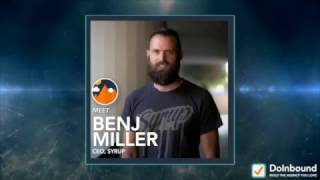
Benj Miller built Syrup Marketing from freelance work into a full business using the Entrepreneurial Operating System. He merged with another company, created software called Traction IO to help EOS users, and shares how systems let him stop doing all the work himself.
All right, welcome into Inbound Agency Journey. This week I have the pleasure of bringing on Benj Miller from syrup marketing down in the ATL onto the podcast. Benj. You guys are in Atlanta, right?
Yep. Right in the heart of Buckethead.
Nice. So we were just chatting before we. Before we started recording. And you grew up out in Ohio in a little bit north of Dayton. What drew you down to Atlanta?
Long story. But growing up in Dayton, my wife and I got married there. We were young. We were 20 years old, and we both knew, even when we were dating that we were both. We had to get out of there. So for us, it meant big city. And growing up in the Midwest, that meant Chicago or New York. And my wife got a job. She was a collegiate volleyball player. She got a job at Northwestern. We were headed up there. We were looking for a place to live. I had gotten a job. We went in to meet the coaches. I hadn't met the coaches she was going to be working with. They told us that day that they were on a plane down to Auburn and likely going to take that job. And what would it look like if we went with them?
Wow.
And my wife and I stepped out into the hall to discuss, and I said, where is Auburn?
Yes.
And when she said Alabama, it was like, literally like, nothing could be more opposite of Chicago or New York. So we did it. We did two years in Auburn. The second year we were there, I started doing a lot of consulting work for an agency in Atlanta that I eventually, when her gig was done at Auburn, I took a full time position with them.
Okay, wow. That's quite the transition story. So what led to. Just. So I mentioned, obviously, syrup marketing.
Yeah.
How did that all come about?
Yeah. So I worked for that agency for two years, and I always had a little bit of a. I don't know if it's genetic or what, but I wanted to really run my own company, do my own thing, have. Have the independence to build something. I wasn't extremely visionary in terms of running, you know, what is. What is running a company look like? It was more just wanting to do my own thing. And so I went out on my own after a little bit of a clash and I quit, you're fired. Conversation with my boss. And I just went out and went out on my own, and it just kind of slowly grew over time. And next thing I knew, I had a couple employees. Next thing I know, I had a few more. 2009, we grew a bunch, so like 300% that year. So when you're small Those numbers seem big. But that was followed by, you know, when you grow fast and you don't know what you're doing. As the saying goes, revenue covers a multitude of sins. And so when we had to make a strategic decision to part ways with our biggest channel partner at the end of that year, and in doing so, I didn't really understand the weight of that decision in terms of what it meant for the business. And so we were. I was really slow to make any changes to overhead staffing. You know, you can't ramp up sales as quick as that was declining. So it was really a train wreck. So me personally and the business kind of the first quarter, 2/4 of 2010, were just really kind of in despair, like, what are we doing here? And with the business, I realized that I had three options. I could shut it down, go get a job like a normal person. I could take it back to, you know, a couple people, shop 2, 3, 4, 5 people, and, you know, just have an easy kind of lifestyle business, just do my thing, basically be a freelancer with some people supporting my weaknesses around me. Or I could learn what it looks like to run a business. And through that journey, getting a coach, reading a million books, you know, I fell in love with business for what it is. And since then, I've kind of been crazy about that and worked to kind of backfill my roles in terms of the craft of branding and marketing. While I do still do a decent amount on the branding side. So that's how that company's name was. Ispeak. One of the issues that we ran into is we'd create these amazing brands for companies and we would look to deliver them to the client. They'd kind of look at us with the blank stare in the face saying, what do we do with this? How do we leverage this? How do we take this to market? How do we whatever. So we tried to serve them in house, but we weren't built for that. We tried some outside partners that didn't really ever deliver as promised. And finally I met up with a guy named Craig Guffey, and he had a very similar vision, philosophy. It was very much around the funnel marketing that in our world, the funnel doesn't stop when you close a deal. The funnel's just halfway done. So once you get them through that, you've still got another half of the funnel to deliver on. And we shared that. We shared a similar passion for small businesses that don't get the necessarily the resources or the quality that big brands can afford to get. So we created SYRP together, and nine months in, SYRP was rocking and kind of needed some additional horsepower and started to realize the same type of issues that we had realized that I speak from the flip side, which was they'd close a client that might have a good product or service, but their brand was just kind of unmarketable, might be too strong, but you're just not going to have any fun. It's not going to be compelling. You're not going to draw in people with uncompelling brands. So they would send them to over us. It just made sense to put the two together. So nine months into that, we put the two companies together, and now we're two and a half years into growing that as a combined agency. So I speaks dead of syrup. And we are branding and marketing under one shop. Very, very systematic. We have a very, you know, we don't do retainers, we don't do much custom work. It's really all. We have a product that we deliver to our clients in a way that we do it, that makes us very cost effective, very efficient, and then we can do some project work on top of that for those clients, because there's always additional needs, but there's a base that, like, you know, if it's just not what you need, then we're not what you need. So go find somebody else. Wow, there's a million shops. There are.
Wow, what a story. So you and Craig are having merged stuff. How would you say that you guys fit? So one of the. One of the things that led me to you and that I wanted to hit on here today was we've talked a lot about the entrepreneurial operating system, the eos, on the podcast recently, and are starting to really kind of dive deep into that. And I know that that's something that you've gotten into and we'll kind of get into that background. But when you think of you and Craig, how do you guys kind of fit into that model where they, like, there's the visionary and the integrator and your skill sets kind of complement each other. Yeah.
So, yeah, perfect question, perfect segue, because when we did that merger, that is when I got. We spent the money on an implementer with eos, right. To kind of make the merger happen successfully. And I don't know how it would have gone without it because I don't have a good comparable, but it made it just so clear as to what we had to do, who was going to do what in what seat. So I fell in love eos as A methodology and philosophy and we implement it really, really hard at syrup. So it left. I'm still the visionary. Craig runs the kind of the marketing delivery piece of the business. We're blessed with an amazing integrator that is very, very strong on the finance side. So he fills out a couple seats and believe it or not, for a finance guy, he can sell really well too. So, you know, we don't, we're not typical. Like we never do pitches or spec work or anything like that. So really it's just a needs conversation and you know, this is where you're at. This is what we do, how we deliver the results that we have. And if it's a fit, it's a fit. So selling is a little different. But yeah, it's been a really good three man team to make that whole thing happen. And of course there's other players. We've got a senior leadership team of six.
Okay, so when you guys are merging and you bring in an EOS implementer who was already. Were you already into eos? It was Craig in EOS or how did that come about?
So back two years previous to bringing in eos, I had an implementer show up at my door, sit down with me, gave me the binder and the book. And he was underwhelming. Probably just an age personality thing. But, you know, when you run a business, you get lots of people that show up at your door wanting to sell you something and their widget's always the greatest. And that was kind of how I felt about it. So I took the book. I literally, I didn't even skim it. I literally like kind of flipped the pages through. It felt like, you know what, I've read all this and all these other books and I threw it on Jason, our president's desk, and I said, read this and tell me if there's anything interesting. And he came back and there were one or two nuggets and that was that. So I have a peer group, so big, big shout out plug for peer groups. And mine is not industry specific, just 12, actually 16 guys now. They're all, you know, small business guys here in the area. And I was sitting at a session with one of them and he was showing me some stuff and I was like, what is this? Where? How are you doing all this? And he started telling me all about it and he was telling me in a way that it was obvious that this had made a giant impact to his business. And here I am going, well, you know, I heard all this two years ago. What did I miss? So I went back, picked up the book and I remember thinking, I know all this, I don't do all of this. And so that was when Jason and I looked into it and we had, when we looked into it, we quickly realized that a good friend of ours had become an implementer within those two years. And he had, he was with a company previous called Profit Works. And we had had him to speak at some like town hall kind of events that we had put on. Just an awesome guy. And with him doing it with my buddy saying it was awesome, the credibility was there. So we jumped in.
Wow, that's quite the journey. It's funny just how everyone's paths kind of go there. And what you said that stuck out to me most was just like, I know all this, but I don't do all this right. And that seems to be the repeated theme is it's not all these new ideas that are coming together, it's just actually an achievable system to make it happen. Yeah, I think that's powerful. So in terms of how you guys are operating on the EOS right now and running the business, is there anything. This is a question that I've started asking a couple of people who've been running EOS for a while. And just so you know, Benj, the background here is we discovered it at the end of 2015 and started implementing it here full scale in 2016. So we just finished up our first calendar year and coming up on our first, I guess our fifth quarter of eos. So asking folks who've been running it for longer, are there any pieces of the EOS system that you guys have discarded or changed substantially or is it pretty much run by the book? How anything that stick out to you in that way?
Well, okay, so I'm gonna fail to be political in my answer to that.
Yes, that's what we want.
You know, EOS has this term that they call pure and they love that they love in this idealistic world that companies run pure. And the more I've gotten into EOS and now I'm probably get to this part of the story, but I'm connected to some of the top implementers around the world and in conversations with them daily, I've got two of the world class implementers that are on that I'm partnered up with in a company, I've got 10 of the top producers in an advisory board. So I'm seeing how this happens in real life. So there's the book and then there's the Real life. And the implementers, there's a lot of them that do implement pure. But the reality is that companies find the way that it works for them. Sometimes that's good and sometimes it's not. Sometimes it's lazy, sometimes it's optimization. So there's small little tweaks. For example, when we put an issue on the issue list, we have a matrix going back to Stephen Covey that's like urgent and important. And based on that matrix, we rate the issue, the person that brings it from a one to a five. If it's a one, it's not urgent, it's not important. If it's a five, it's urgent and important. So that small little tweak, putting a number in front of the issue, saves us tons of time in prioritizing issues. We work fives first, right? In terms of the system as a whole, I don't think I've discarded anything, I'll tell you. Of the six key components that they have, I think that there's two components that the book, and thus everything that they put out, are pretty weak. The first is marketing. The marketing component, which I'm talking to a bunch of marketers here, so everybody probably agrees that it's pretty shallow. It's not even a 101 level help for a company, which is, okay, there's a bunch of other books on that, but companies are left to figure it out. And I think that's really what serp's been driven to do is create the marketing operating system. We don't call it that, but it's the equivalent to what EOS has done, where any company can kind of plug in this system and it will work. 80, 20 rule for 80% of the companies out there. The other component that I don't think that they do justice to is the process component. So the book basically says, you know, have a process document, it document 80% of the processes or 20% of the processes that get 80% of the work, and then make sure everybody follows the process. I just gave you the entire chapter right there. Again, not super helpful. So I've come in contact with this company called Process Triage out of Kansas City, and they operate almost identically to an EOS model they've got. The guy that founded it is an ex Ranger who in the army learned how to triage issues. And the way he would do it is he would walk in and the team that actually executed. So this didn't come from a leadership team, but the team that was actually executing a process, they get in the room. And he has a methodology to help you map out your entire process. And then he's got different colored sticky notes and everybody goes up, puts little sticky notes by different points in the process to indicate where there's issues or where it could be optimized or even automated. And from that, and this is why it's a perfect complement to eos. Out of that, you decide what is the quickest return on investment. So what are the things we could fix that have the biggest impact? And then you prioritize those by. They're basically big, which is the equivalent of a rock, or they're small, which is the equivalent of a to do. And they get assigned to a person. So it's this perfect complement to how you address it and fix it already exists within eos. But how you identify those issues and rocks within the process, he has a beautiful methodology for.
Wow, you said process triage, I feel like. Is that Rosie?
Yeah, yeah.
Okay. I just came across that not that long ago and I'm sure I've got it bookmarked somewhere to go back and look at. So that's cool to hear you recommend that. And that's definitely something to look into more. Wow. So I think that's really helpful just to hear, I mean, hearing from people's experience. And I think that honestly, the marketing side of things, I think you're exactly right in terms of. That's probably the biggest out of the six components there, probably the biggest weakness from the eos. And I think that one of the reasons that that's not holding in the marketing agency space, where it's really starting to take off, people don't necessarily need that. Hopefully they don't need that component quite as much. So it really isn't as big of a weakness in that application, which has been kind of interesting to see and. And learn from people as we go.
Yeah. We can grasp the other stuff and don't have the need there. Yeah.
Right. So, Benj, you mentioned kind of talking about some of the implementers and folks you're working with and mentioned the other company that you have going on. Now, I know you've got a couple of different things in the works, but with traction, T R A X I O N I O. Do I have that right?
Yes.
And we'll make sure that anything we mention here goes in the. Goes in the show notes as well. If you're listening and driving or not at a place to look it up right now. But tell us a little bit about traction and then let's kind of dig into what the vision is there.
Yeah. So like I said, when I found eos, I thought it was a beautiful methodology and philosophy, but I found the lack of technology just mystifying. Like I didn't even have a compartment in my brain to understand how that was a thing. And our implementer left us with a shared spreadsheet which I've now learned is better than most git. But I still found that the fact that we're supposed to have all this accountability and measurables and there's a lot of, there's a lot of data and a lot of work to do. EOs. Right. And I just thought it was silly. So I started building an application to manage EOS within my company and again going back to my peer group, by this time we have probably five or six. Now it's probably up to eight or 10 of the guys in that 16 person peer group running EOS. But they all had the same problem and wanted to use the technology that I was using. So that means that you have to go back and write it for multi tenant to be SaaS. So it's taken some time, it's been quite the journey. But along the way got in contact with Chris White and Mark Abbott who are implementers out of Florida, really awesome guys. And they were about to go down a similar path. So we had a little bit of a head start and a little bit of a team and they had a lot of influence within the market, within the implementer community and a lot of experience that I didn't have. They had an implementer view where I had a company owner view, which was very complimentary. We needed both. And so we teamed up, we've rewritten the platform, we got the advisory board of implementers. Like I mentioned, they actually got our brand new product two days ago. They're playing with it for about two weeks and then we're gonna slowly allow their clients to come on at first just for kind of a slow, controlled release. But we're really, really excited about the product and all it is is helping you manage the concept of EOS and roll it out to your entire company. So multiple teams. You've got the accountability chart, you've got all the measurables that are tied to people, that are tied to seats with the roles and responsibility. You've got a meeting mode that'll give you the agenda and keep you on time and allow you to record all the data of headlines and, and rocks and issues and cascading messages and rate the meeting, give you Some analytics back on where you always run over in meetings or who never gets their to do's done. And then we've got some cool places that we're going with it. So, you know, the ability for me to see all of my TO DOS or all of my rocks across multiple teams to be able to do some data visualization on the scorecards. We just. Our roadmap is like exciting and infinite, but so we're still ramping up additional developers, we're still building out a team, got awesome girl running client success, doing kind of white glove onboarding for the moment. But we're really excited about this business.
That is awesome. And actually the way that I found you guys initially was by searching and searching probably mid 2016 for any kind of software because like you, it was just kind of mind blowing that there was nothing out there.
Yeah.
When so much of what happens here should be tracked on, there's just no way to do it without that. And we'd kind of repurposed our product to inbound to run EOS inside of it. And we still are running meetings and a bunch of things in there. But I found traction, I think through some forum and got in touch and played around with it. So by the time this episode goes live, at least a handful of of people, implementers, clients will be on the platform. I know I'm kind of catching you off guard here. Is there anywhere and we can update this in the show notes as we get there? Is there anywhere other than just Traction IO that people should go if they want to see the latest version of the product?
No, that's it. But I'll give your users an easy way in. If they want to email Christine Traction IO and mention Do Inbound, then I'll put them to the front of the wait list.
Awesome, that'd be great. And is it C H R I S T I N E. That's it. Okay, awesome. Cool. We'll make sure that we include that as well and appreciate that. Yeah, I'm really excited to see it out there. We'd actually built out and it talked about, hey, do we need to build out either a different tool or how do we integrate this into Do Inbound? And it actually built out like a little Chrome extension that we just used internally off our own database that would manage our rocks and issues with a little bit of vision and stuff like that. And then we're super excited to find someone else is building this already. So I'm really excited to see it.
Yeah, yeah.
Benj, I know that we've been online here for 25 minutes already and don't want to bug you for a whole lot longer. I could ask questions forever, but one of the questions that I like to ask people and kind of wrap up with is a personal question. And it's just about obviously in your case you've got syrup going, you've got a couple other things going on in addition to traction. And so it's kind of a like morning routine type question in terms of what sets you up for success for the day. So this is kind of a mix of what is your normal morning look like plus what does your ideal morning look like? Are there any habits or routines that you do on a daily basis that kind of set you up for success?
Yeah, that's a tricky one for me because. So I'm married and I have four kids so I don't necessarily get to control what my mornings look like. But my wife and I have figured this out. She has to get to the gym in the morning to have a functional day. So to do that some days she gets a up at 4:30 and she'll have a minute to herself and then get to the gym. Two days a week she doesn't. So two days a week I leave the house about 6:30, 6:15 and get to the office and just do as much work as I can before people start showing up. And then two days a week she has to get home, she goes to the gym a little bit later. So I can't leave till 7:15, which actually takes me a lot longer in Atlanta traffic. And then one day a week I work from home. I stopped eating breakfast, so breakfast is not part of that. I try not to eat until about 10 o', clock, kind of an intermittent fasting type thing. And I, you know the weirdest thing, I was a coffee drinker until around Christmas I got the flu and I literally have just not wanted coffee since. So that was a weird thing. So I totally switched to decaf. And I drink decaf tea when I'm having a craving for some something warm in my throat. So that's out. So no, I mean I get up and I shower. I've got a devotional that I get via email every morning. It's one of two like subscription emails that I'll make sure that I read every day. The rest of them are hit and miss. And so that's it, that's my morning. It's nothing special other than get up at it really early. But I also quit early. So on the flip side, I leave the office at 3:45 almost every day and hit the gym and I'm done.
I love that. The two subscriptions that you get and read in your inbox every day. Will you share those?
Yeah, sure. So I use, I believe it's 365-promises.com if I have it right. And it literally is every day one promise from the Bible. But they throw it up on just a picture of nature, which just I can connect to. So they take the promise, they put it on an image. So right in my inbox I've got a big nature image with a verse on top of it. And I just take time to read that, reflect it. There's been a couple times I've memorized it, a couple times that I've gone back and read the chapter before or after to get more context. But it gives me something to ground my day in. And then I always have a worked in with that. I've got a verse I'm working on memorizing. And then depending on the day of the week, I've got a different kind of crew of people that I'm praying for and through and with. And then the second one I tend to get about lunchtime. And it's totally the opposite of that. It's called the Hustle. It's kind of a new. It's almost a new take on journalism or news, which I don't consume very much of at all. So this is pretty much my only consistent outlet. And it's. It's kind of tech meets culture. Not much politics, not much sports. Yeah, tech culture. It's written in a. In a very almost conversational tone versus trying to be a polish. You feel like somebody's writing just giving you their thoughts. So it's much more of like a blog feel publication than a big thing. But the content's just really strong.
Cool. Hey, those are great recommendations. It's always, always interesting to hear what drives people and what routines they need and benefit from. So I appreciate you being willing to share and taking the time out of your day to come on the podcast and talk with us today. Benj. We'll Obviously link up syrupmarketing.com traction IO is there anything else that you would recommend to people to check out or any place that you would want to connect with them?
No, that's good. I mean, people, I'm easy to find. So if you hit up either of those, you can get over to my LinkedIn if you're curious. All the other stuff I'm involved in, so either one of those is great.
Awesome.
Well, if you hit up either of those, you can get over to my LinkedIn if you're curious. All the other stuff I'm involved in. So that. That's. Yeah, either one of those is great.
Awesome. Well, Benj, thanks so much for your time. We really appreciate it.
Yeah, thank you.










