How to Build Profitable Agency Partnerships with Charlie Gaudet
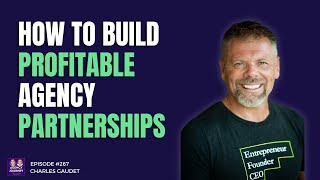
Charlie Gaudet, CEO of Predictable Profits, talks with Gray McKenzie about building agency partnerships that actually make money. He covers partnership models that scale, why writing a book builds authority and brings in leads, and how to grow sustainably without burning out.
All right, welcome back to Agency Journey. My name is Gray McKenzie from Zenpilot. This week I've got the pleasure of bringing on Charlie Gaudette from Predictable Profits. He is the CEO there. We'll talk about what it is, what it looks like, how he's working and serving agencies and among these overall mix of clients. But Charlie, thanks for being here. Welcome to the podcast.
It's a pleasure, my man. Thank you for having me.
Can you, um, give us kind of a quick summary? I love the name Predictable Profits. You know, you got the, you got the dot com. So you were in early. What is Predictable Profits?
So, you know, it's a, that's a great question. I think for many agencies and many entrepreneurs, this idea of growth is just really appealing and sexy. And you know, as you may already know, Gray, we've taken many companies over the Inc. 5000 fastest growing companies list. And that's what a lot of people want. But what they don't realize is that's only step one. The Inc. The Kauffman foundation ran a study and they found that 66% of companies within five to eight years of getting listed on the Inc. 5000 fastest growing companies list either shrunk in size, went out of business, or disadvantageously sold. And ultimately they realized that and, and I realized that growth isn't the ultimate goal, that it's sustainable growth. That's really what Predictable Profits is about. It's not only how do you get on that growth practice, but how do you maintain that year after year, month after month and so forth? And that's really what Predictable Profits is all about.
Yeah, you took a little bit, I think the model that you have in terms of coaches working with clients, like how does, how does the actual working relationship play out with Predictable profits clients?
So another really great question. We work with some of the smartest, hardest working entrepreneurs on the planet. We specialize in seven and eight figure companies. So it requires a totally different skill set than when you're working with either startup or even very early seven figures. And there's a number of different frameworks that we use to create those predictable profits and sustainable growth. But ultimately we're focused on three core areas. We call it the OSI method. How do we optimize what you're currently doing so you do more of what's already working well and less of what's not? And then we can systematize it, and we systematize it so that you, you're getting things done with a lot less effort and with consistency and A limiting variation. And then we go to innovation and create new firsts. Now that's sort of like, that's the, the underbelly and the foundation behind why we've been able to achieve so many extraordinary results. But for the average listener, they're saying, man, well, that's not really all that sexy. And I totally get it. And the framework that really tends to excite a lot more people is what we. It comes in three steps. It's setup, sales, and then scale. And when you look at setup and you look at sales, setup is all about how do you create, capture and nurture demand. Sales is how do you qualify, convert, and then continue to sell people. Again, if you have those two things, but you don't have the scale, which is about, you know, having the right team, the right Systems, the right KPIs and so forth, right data to make decisions. You have a company that's far too dependent on you or far too dependent on certain people. If you have this setup and you've got really, really good setup, you have really, really strong marketing and you have really good scale, but your sales is a little bit off. What you tend to notice is that you've got a lot more cycles of feast and famine. If you've got sales that are really dialed in and scale, but you know, you don't have your setup dialed in, you know, then you know, your, your company's, you know, it's just not growing fast enough and so forth. So that tends to resonate with a lot more people, especially if they're asking themselves, why is my company not growing any faster? Where some months are feast or famine, how do we bring more predictability on the revenue of the third one is just the company's too dependent on me. How do we scale? And that's where 19 out of 20 agencies will look back and be like, man, you know what? All three of those are pretty much relevant to me.
Right. Right. I think both frameworks, I think OSI and the setup, sales and scale, both frameworks are helpful. I think what's cool about your, your businesses, you get to see just a lot. I mean, similar to our business, I get to see a lot of agencies. You don't exclusively work with agencies, so you got even a wider bucket out there. But when you think of the agencies who you're working with, and obviously we got at least one shared client who's had a ton of success working with you, not that there's other agencies that. There's only one agency that I know for sure is Worthless. That made it sound like we've got a whole pile of agencies and one is head to go. But what is, what, what are the commonalities in terms of like, what are the growth opportunities agencies are leaving on the table and need to get right? Or is there a commonality that you see between the folks who you're looking at and talking to inside of that framework where it's like, hey, here's the, you know, here's kind of the quick wins, the low hanging fruit.
If, if you had a guess right now, what would, how would you say the vast majority of agencies are getting all their business right now? From what channel?
It's all referral and word of mouth, right?
Word of mouth and referrals. And it's very, Would you agree that it's very, very difficult to scale word of mouth and referrals 100%?
Yeah.
And so right off the bat, when we talk, when we talked about that model, the setup, the scale and sales, when we talked about that model, the setup is oftentimes a huge opportunity because their entire agency is dependent on word of mouth and referrals. And then when we look at what about the sales side, more often than not you find out that the CEO or the founder is responsible for the vast majority of the sales. That means that if the founder wants to go off on vacation, sales are going to come to a screeching halt because the founder is the only one that can close. And then, you know, on the scale side, they tend to be doing fairly well for the most part on the scale side, in that they have a team, a team is doing really, really well and so forth. But there's sometimes challenges in terms of as a company and the agency grows larger, they lose the line of sight, meaning that the CEO, suddenly you bring in so many clients, you don't know all your clients on a first name basis, you don't know all your clients problems, you're not able to see what the deliverability is like. And so you begin to see different fires pop up and that there's variation in deliverability and so forth and it causes other issues. So skill or you don't hold your team to a certain KPI. And with agencies we notice that there is a massive imbalance in utilization rate, especially in remote agencies where people are coming as part of the team and they just think that, you know, as long as I'm busy, my job's safe. And so they record a lot of busy time, but they're not operating as efficiently as they otherwise should. And there's waste all over the place. So I mean, there's so many opportunities. But I would say the biggest starts with word of mouth and referrals. You just can't fill a pipeline alone with scale on that.
So when you're talking to that agency, this isn't the problem that we solve at all. We're solving the flip side. But I have those conversations a lot with agency owners. Is the approach, hey, figure out what, uh, what come, you know, you're an SEO agency. Maybe SEO is the game. SEO is challenging for agencies. Cause there are a lot of agencies who are focused on SEO, but there's still plenty of opportunity. Um, you know, if you're a paid social shop, you know, you should run your own ads. Like, is it, look at your, look at the combination of your skill set and the market that you're serving and where they live and that's your growth strategy, or is it like even simpler than that and you think, hey, you know, cold outreach, there's one specific platform or a couple specific platforms that most agencies should probably try first as they're transitioning out of being reliant on word of mouth referrals fully.
Great question. So one of the first places that we'll go is actually to figure out what's your niche and your unique advantage. And I say that because, Gray, the moment we start looking at building in scalable marketing and sales strategies, you know, we're reaching out to a larger audience. And even if we're doing outbound and we're sending out one communication at a time, if I'm too generic, it's going to fall on deaf ears. Because your inbox, my bet, I mean, you're a busy, popular guy. You probably get over 100 solicitation emails in your inbox every single day. And out of the hundred ninety five of them are all saying the same thing. And so it's like going to a baseball game. If you're in a baseball game, you know, everything that you hear sounds like just a dull roar. It's all the same thing. Everybody's yelling something slightly different, but it just sounds like the same thing, right? It's just, you know, everything sounds the same. But now imagine I'm ten rows behind you and I yell, great. Do you hear that? You do hear that, right? I just cut through all the noise speaking specifically to you. And so the first step is, what's your niche? Now? We work with an agency several years ago, about six years ago thereabouts, they're doing, you know, just under a Million. About a million a year thereabouts. They worked with all sorts of people. They work with Coca Cola, they work with Red Bull, and they just happen to work with a whole bunch of attorneys. So we said, look, let's. You're reaching out to everybody here. Let's look at some of your best clients. Where does 80% of your revenue come from? Where did about 80% of your profits? Where do they come from? Where do you get the best results? It came to the fact that they work with attorneys. Attorneys deliver the best. So it's like, okay, you're. We're never in the business specifically of what it is that you deliver. So you're never really in the business of SEO. You're never really in the business of video marketing. You're never in the business of ppc. What are you in the business of? And he's like, well, looking at the testimonials and the case studies and whatnot, really in the business of helping our clients increase case study case values. Awesome. And so we can quantify that. So we said, hey, you know what, let's position this as you're the company that helps attorneys increase case values by somewhere around two to 10 times. And then using that as the nucleus behind the operation, that created a foundation that allowed for massive scale. And he took his company within, I think it was within three years, from just around that 1 million mark to 20. Just over 24. It was 24.1 million. And now he's over double that, you know, six years later. So all of that started with creating that niche. Now, if I may kind of jump into one thing, just to answer another question, when we talk about creating scalable marketing and sales strategies, you may end up talking to another coach that just so happens to be an expert in. In paid or an expert in webinars, or an expert and all this stuff. And, you know, it's like, you know, let's go ahead and do this. But when we actually looked at it and we said, what is the best, most efficient way to help an agency owner scale, we realized that there's a sequence of events. Paid media actually comes towards the latter. We want to do outbound first, because when, look, when you look at paid media, for example, paid media, we've got to, you know, we got to create the ads that are going to, you know, click. We've got to understand the audience that we're refining the keywords, a landing page that's going to convert. So we have to make sure we test and get the right offer. Then Once they fill the information, the sequences that are actually going to get people on the phone and so forth. So there's so many different parts. Your cost of acquisition initially for that is going to be massive. And the time for you to open up that funnel and get it flowing quickly is a lot. But if we were going to do an Outbound campaign in one week, you can start driving those calls. But Outbound has changed dramatically over the years. As I mentioned earlier, we're hired to work with some of the smartest, brightest people on the planet. They expect us to have all the answers. And in 2018, outbound, the way everybody knew it, stopped working. You just can't go to Zoom Info, download thousands of names, download them an email software program, close your eyes, crossed your fingers and be like, come on, please. And it works. That doesn't work. You just can't go to LinkedIn, buy a bot, hit, you know, start, you know, and all of a sudden get all these appointments. Like that worked, you know, several years ago. It's not working right now. So Outbound has taken a totally different structure and a totally different animal to get it working. But you dial it in and you do it right. You should be setting about one to three appointments every single day, which might not sound like a lot, but if you, even if you did one appointment a day and you average that over a week, that's five appointments, five appointments. If you can't convert, you know, 30% of those, you know, then you've got another opportunity on the, on the sales side.
Well, you got to jump ahead and answer like the second half of the question or the second half of the answer around the channels, I think, is super helpful. One of the common, I think, justifications or reasons for Outbound, first justification sounds like it's a. It's not true. And the truth is you just get a lot of rapid feedback on your messaging. Find out pretty quickly. Are people hitting reply? Are they just sending back, I hate you. Never email me again? You know, like, the messaging is just not. You're going to need some, some component of that regardless of volume or regardless of, of how good the messaging is. But if that's at, you know, 60% of replies you're getting, then the messaging is not right. The audience is right. There's some, some mismatch and how you're sharing what you do. Go back to the positioning piece that you started with.
The thing is, is if you want to succeed in Outbound today, you can't look at yourself as, you know, the, you know, the, the frontline person and the in the army that's just kind of blasting away out in the woods, hoping to eventually, you know, kill an enemy combatant. You have to look at yourself as a special forces sniper. And so, you know, be really specific. It's about, you know, quality, not quantity. And you know that while that sounds really cliche, you know, especially if you're a 7, 8 figure agency, you have more opportunity available to you right now than you already know. The people who are visiting your high intent pages, your services pages, your testimonials pages, as an example, there are tools and resources available that even if they don't submit their information, you can capture that information. I can say, you know what? Gray mackenzie from Zen Pilot was visiting my services page. He spent 3 minutes and 30 seconds reading all the content. I'm going to reach out to him right now, you know, so there's an opportunity that I can go ahead and I can reach out to you. There's opportunities where you could do market research reports and deliver, you know, real value to people and so engage in a conversation differently and so many other ways. Outbound is not a strategy. Outbound is a category, just like inbound is a category and there's all bunch of strategies. So outbound is a category too. You hear people say outbound doesn't work. Well, yeah, if you're doing a LinkedIn bot or the way you've done it in the past, of course it doesn't work. It's only a category. There's so many different strategies and when they dig down into it, they realize, okay, yeah, maybe it does work.
There's a lot of opportunity there. I want to talk a little bit about your growth at. At predictable profits. You be curious to like the. So what I've seen from you so far is a really dialed in, pretty sophisticated approach to partnerships.
Yeah.
And I assume that drives a big chunk of the business. I assume there's an element as well that is inbound. And through the podcast and the marketing materials and all the stuff that you guys put out in the book and all the, all the different pieces and marketing assets that you have out there. Why or where did this. I don't feel like on the other side of it. It feels like there's a heart for partnerships. But where did the approach that you've taken to partnerships come from?
So believe it or not, actually started when I was 23, 24 years old. So I was at the time building a real estate development company and I found myself in over a million Dollars in debt. And I was paying double digit interest rates on that debt. And I really didn't know what I was doing at the time. Believe it or not, I, I bought this track of lands. I knew I had to build a road and neighborhoods and the whole deal. And I, I didn't know what I was doing. So I went to Barnes and Noble to read. Like, how do you, like what am I supposed to do? What's the first step? What's the second step? And I, and I built an entire development from one book that I got at Barnes and Nobles. Now the. But along with that, I didn't know what I didn't know. And because it was, I was in a situation where I needed to make money. I looked at how people would buy a house for me and then they would all of a sudden buy so many other things. They would buy furniture, they would buy fans, plumbing, accessories, you know, like high end fixtures and alarm services and whatnot. And I stopped and I thought about it and I was like, why can't I have all these buyers? So I started going to all these other vendors and I said, hey, if I could negotiate a preferred deal for my buyers, whether you give them a discount or a bonus, and I sent them over to you, would you give me a small percentage of the commission? And for most of these people, they're like, wow, never even heard that before. So yeah, no problem, let's go ahead and let's do it. So I formed all these relationships with anybody. And anything from driveway seal coating companies to this is back in the day when plasma TVs were big, like plasma TVs, home theater alarm companies, you know it, you name it, I formed relationships with these people. And then before long, I was getting tens of thousands of dollars every single month that was being sent to me over and over and over again. And I didn't think I was doing anything different until one day the principal of a big accounting law firm out in Boston showed up unannounced on my doorstep, knocking on the door and he says, hey you, you know, you know, they, the principal of a big Boston accounting company knocked on my door and he says, charlie, we need to talk. And you know, I'm like, oh my God, my, my heart's pounding out of my chest. I let him in. He sits down at our breakfast table and he says, what are you doing? I said, what do you mean? And he said, you've bought your property for a fair market value. You're selling it for fair market value, but you have one of the highest profit margins in the entire industry. And I can't figure out what the heck you're doing. And when I told him about these partnerships, he's like, oh, my gosh, that is amazing. And then from there, I started looking at all these other ways that we can form partnerships, and then in the business now, with predictable profits, looking at ways to form partnerships that are what we call triple wind. So it'd be totally different if it was, hey, Gray, let's form a partnership. And we'll form a partnership. You send me all your clients, and I'm going to go ahead and give you a commission. Because what that does is that means that, you know, I win, I get a client. You win because you get a commission, but your client loses because they didn't get anything special out of the deal. And then there's questions about, did you only refer them to me because you have some sort of, like, you know, commission relationship or whatever that might be. So instead it's like, well, how do we do this so that everybody wins? How do we do this in a way so that your clients get an advantage that nobody else gets? And your. And so all of that kind of works out. So it's a triple win, and everybody wins at the end of the day. And when you form these partnerships, and this is a beautiful thing, like, we've got partnerships with some of the largest business media organizations in the world, and they send tons and tons and tons of deals our way. And when that happens, you make one sale, and that one sale predictably brings you. It could be dozens or even hundreds of opportunities every single month. And partnerships are an extraordinary way to shortcut the buying cycle. Because I'm going to give you a little bit of verbal format and pardon me for this, because now I'm getting all geeked out. But, you know, the average person today is looking at 27 different sources of information before making a buying decision. 27 different sources. You know, we used to think that the buying funnel was a straight path from top of funnel all the way down to bottom funnel, yet that that whole model was generated in the late 1800s, the reality is that it's a lot more messier. They cycle through this exploration and evaluation 27 times before finally making a buying decision. When you have a partnership that says, hey, look, we've properly vetted these people so we can align ourselves with them, we recommend you checking them out now. No, you've built a moat around yourself. And they're like, you know what? Hey, if Gray says these guys are Good. I like gray. I've trusted Gray. Then I'm going to go ahead and I'm going to do some business with them. And when you can form that type of partnership with other vendors, super, super powerful way to grow and scale your company.
I had no idea about the backstory with all the partnerships. That's an awesome, our first, first introduction initiation into the power of partnerships. But it shows up in, in what you're doing now. And so I think just to put some kind of meat on the bones around what that triple win looks like for people, we talked about an example of, hey, you know, if like as a client benefit, every one of your clients gets this, you know, consulting session or free coaching session or whatever, what are some ways or can be real world. Like your example I think is a great model. But I'm thinking as a listener thinking about this, how can I envision that? Or what are the types of partnerships that would make sense in an agency space? Have you seen anybody do that really? Well, are there any ideas that seem like this is a no brainer? Why does this email marketing agency not have a direct relationship with this Facebook ads agency and have some kind of benefit like that? Are there any examples or ideas that you have there?
Yeah, we have a client, extraordinary website developer, does real high end type projects and he aligns himself with other companies like branding agencies. And the branding agency is like, look, you know, we can go ahead and we can build an awesome brand, but now you have to go ahead and you've got to revamp your website. But if you've ever noticed, if you, if you've ever built a house before, you have the architect that creates these wonderful plans and you hand them to the builder. But then the architect and the, in the client have shared a vision. The builder and the client, he, they're trying to convey the vision, but there's always little hiccups and things that come in the way. And so in this particular case he's like, look, we have a relationship. The website guy was like, we have a relationship with the branding agency and so we'll work behind the scenes at no additional cost to you to make sure that everything is seamless, that you get the website exactly as it's laid out, that the branding agency signs off on it, it's perfect and blah, blah. And so it's a very efficient, easy, seamless, headache free type of experience, ongoing. And then you can have SEO agencies that partner with PR agencies. You know, where the PR agency goes to SEO agency and says, look, you know you can only get so far with the backlinks that you get on these different blogs. But what if I could get you backlinks on cnn, New York Times and so forth? How much more powerful would that help you get better rankings? Wow, that's awesome. Let's go ahead and do this. Or you look at, you know, pay per click companies. Pay per click companies oftentimes SEO and pay per click, they're the same one, but let's say they're different for a minute. SEO and pay per click companies, they're both in the business of traffic and the SEO company can share data with the pay per click company that can then make sure the pay per click company is more efficient and vice versa. Or you have a lot of web companies, small web web agencies that get these opportunities to build, you know, websites that might have 2 million SKUs in one example with another client, but they're not set up to handle a company with two, you know, an opportunity. So in the past they just let them go. But what if they found a partnership with an other agency that is set up to do these 2 million SKUs and then all they are is the project manager in, in that relationship and so make it seamless. There's so many opportunities that agencies can have to partner with each other and other companies.
Those are great examples.
I'm going to give you one interesting part though.
Hit me.
Where, where a problem often exists when you try to form a partnership is to say, hey Gray, here's the deal. Why don't you refer people to me? And that would be awesome. I'll give you a commission and woohoo, we'll high five and we'll celebrate and we'll dance Kumbaya around the fire and everything will be great. But those relationships don't last too long initially. And because you're busy building your business and there's always these concerns about, you know, it's not the commission is nice, but it's more important to me that my clients get a good experience and so forth. But if you change it around a little bit and you go, you know, what if I want to partner with you? Gray, as an example, I said, what are the KPIs that are most important to you? And you might say something like retention is really important to me. It's really important to me that my clients are, you know, that they feel like they're, they're growing and so forth or whatever that might be, or the NPS score. So if you want to partner with another company, find out what KPIs are most important to them and then see how you can make a meaningful difference into those KPIs. And that's how you go from I'm just an affiliate to now I'm a pillar within their organization.
There's a lot, there's a lot to dig into there. I think figuring out how you find the partnerships. There's so many partnership opportunities. How do you find and prioritize the ones that are most impactful for the business? I mean there's a lot of different out. And so I think your point is super well taken that the short term. No, shoot me 10% of this client's revenue for one of the. That's kind of as far as it goes. But there's no real the business integration or impact beyond it. Those are easy to set up, but you know, maybe 2% of those actually do any meaningful traffic or any. And there's any activity happening there six months later. And I've experienced that firsthand for sure. And then the, the more meaningful relationships, there's almost always totally, you know, a deeper level of integration between businesses where, I mean, I think the most powerful ones are the ones where folks have felt the other, the other end of that of the service. And there's a lot of opportunities for that. We've got a client who's great.
Awesome.
Marketing agency has been around for the last 11 years or whatever and have been. We're friends for a while. They became a client and you know, it's easy. They know everything that we do. So when we look at, hey, we need an agency to help with a specific project, it's like, hey, you guys already know all the ins and outs of what Zenpilot's all about. It's much easier to go work with an agency who experienced it. That's not going to be every case in partnerships, but the cases where it is possible for helpful. I wanted to mention the book before we wrap up and I know we're, we're 10 on time, so I'll get you out of here intentionally. But talk to me about the book. What was that process like? What's the what's the experience been like potion?
So I wrote a book called the Predictable Profits Playbook. And it's funny, the reason why I wrote the book actually was way back in the day listening to Dan Kennedy, who's one of the, you know, original marketers. And he brought up a good point and he said, look, if you think about the most influential people in the world, dead or alive, there are two things that you're going to see they have in common. Number one, they're public speakers. And number two, they either have written a book themselves or they have one written about them. And I thought about that and I'm like, wow. Actually that's true. You know, even, you know, Jesus Christ as the Bible and was a public speaker, you know, and you know, Richard Branson speaks on stage all the time and he's got a book and it doesn't matter. Warren Buffett, same thing. Anybody you can think about all these people, you know, and so I'm like, wow. So I always knew that that's true. You know, even, you know, Jesus Christ as the Bible and was a public speaker, you know, and you know, Richard Branson speaks on stage all the time and he's got a book and it doesn't matter. Warren Buffett, same thing. Anybody you can think about all these people, you know. And so I'm like, wow. So I always knew that it was something that I needed to do and so I went ahead and I created a book. I, you know, in the spirit of, of transparency, I hired a ghostwriter and I hired a ghostwriter that would interview me and pull all my content out of me, then went through the editor and I ended up publishing on a hybrid. So even though I did have an agent that would be willing to publish it on a, on a traditional platform, the agent actually suggested it would probably be best for me to, to control it and do more of a hybrid self publishing because the purpose was not to get rich off the book. The purpose was to use it as a means of almost pre selling, for that matter. So when somebody reads the book, they read the book and they, they're like, oh, I now understand and I'm indoctrinated in the ways that you think and then it helps to convert into clients. There are so many times I may talk to somebody and they go, oh, you know, I talked to somebody who did this, this, that. I go, you know what? I can't disagree with that. They're right. In fact, I wrote the book on it. Here you go. And they're like, wait, what? And you know, then they become a client or you know, there was a situation where I got called by one of a large association and they said, hey, would like you to come speak to my group. And I said, no problem. Would it be okay if I mentioned my book? They go, wait, you have a book? Oh yeah, I do. They said, let me call you right back. And they call me back. I go, would like to have you keynote because now it's different now that I have a book. And so I keynoted and I shared the stage at the former CMO of Harley Davidson, which is really cool, but only because I have the book and then the press. It's so much easier to get press when you can be promoted as an authority rather than promoted as a CEO. So there's so many different things. I, I do highly recommend it. It's not only a great lead gen tool, it's a great pre selling tool. It's an awesome positioning tool that opens many doors and yeah, that's amazing.
I mean, selfishly, I'm interested, I'm at this outline for a book called the Profitable Agency Operator that's been sitting in vo slowly getting like hacked at every, every couple weeks or whatever over the last six months. And I think the ghostwriter approach just makes a ton of sense to actually get something out the door. Yeah. Do you have any feedback? I'm sure I'm not the only person who would listen to this and think, oh man, I got. I gotta know what worked or didn't work. The, at least for me, if you were the ghostwriter is I'm going to give them all this stuff. It's all going to be, you know, it's going to be 90% garbage with like 10% the gold nuggets. And I just hope that they put it in the right order and get it and get it together the way that I want. When you look back at the book, did it feel like it came out, hey, this is how I wanted it organized. This is the right thing. Or did it are anything that I should learn from your process or we should learn from your process and do differently if we engage with the ghostwriter.
So. Great question. The mistake people often make is they feel like they need to get everything that they've ever learned all out on paper and put it out in a book. But if you look at the bestselling books out there, they usually focus on one big idea and they write the book in that one big idea. And so you can create multiple different books and that's okay, but focus on one big idea at a time. Then the ghostwriter is. When I hired the ghostwriter, I actually hired several at once. And I said, I want you to write the first chapter. And so, you know, or the first few pages. It's been a little while, say first chapter. And then from there I found the, the ghostwriter that I wanted because I needed somebody who would understand my voice and, and Go that way. So then we went ahead and move forward. Now, the book originally was probably somewhere close to about 350 pages, but it was the editor that turned around and said, nope, we're going to take this chapter, put it here, we're going to do this, we're going to do this. And they kind of ripped it all apart and made it, you know, all nice and, and whatnot. And, and so that was great. Now, all that being said, I had a wonderful experience and we did really, really great. There's many different resources and tools that are available. There's a company out there called Scribe Media, and I've had. I'm working on a revision of my book right now. And I hired a company called Scribe, and Scribe has done tremendous, tremendous work. And they've kind of. When we talk about partnerships and trying to make things easy, well, they have the editors, the ghostwriters, the publishers, everything all under one roof. They make life a little bit easier. And just by the way everything is. Is priced. And because it's under one roof, they do it in a way that's more cost efficient than the way that I wrote my, my book originally, hiring all these different pieces, and we're able to do it faster. So I'd say Scribe Media, Javon, who's a CEO, I've managed to talk with him a few times. Brilliant, brilliant dude. Great guy. They do great work. Super, super committed to getting things done. And, you know, if that was ever something that you were interested in, you know, I'm happy to provide you with an introduction over those guys. They tend to treat our people really, really well.
So this is what I'm talking about. Partnerships are at the heart. It's all. It's all over the place. I can't get away from it.
Well, and, and, well, the. Here's the beautiful thing about it, right, Is it's like, you know, when you have a partnership and you. You bring people to them consistently. This was another relationship that I had with somebody else previously, is that when I bring people to them, in this particular case, that the client. Actually it was a bad match with the, with the referral partner, and they didn't have a good relationship. And so at that point, the referral partner said, oh, man, I have to find a way to make this right, because if I don't make this right, Charlie's going to stop referring people to us. And that's a big problem. And so they found ways to make it right. And now everybody's happy. But, you know, there are so many benefits to when you have. When you create a real strong partnership and that there's gonna be wins in there versus if it was just a, you know, hey, go work with them. Then if it doesn't work out, it's kind of like, yeah, you know, whatever. So anyway, a bunch of verbal vomit there.
I love it. Well, this has been great. We are at time, so I wanna wrap up here book website. Like what's. Where should we point people, Charlie? Predictableprofits.com will be in the show notes and obviously we'll link up the book. But is there anywhere else that you want people or send it to?
No, I. I would just say best place to. To check us out is. Is Predictable Profits dot com. We're constantly adding different resources and whatnot. We've got a podcast called the beyond seven Figures Podcast. That's where you'll see Gray on the. On the podcast there. So, you know, the beyond seven Figures Podcast is. Is definitely something that I'd recommend people do. But yeah, predictableprofits.com is the best place to start.
That's awesome. Well, this has been great. Thank you so much for your time and sharing with us, Charlie.
It's a pleasure. Thank you.










