How to Improve Your Marketing with Data
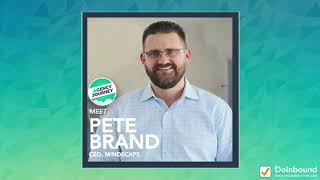
Gray MacKenzie talks with Pete Brand, CEO of Mindscape in Grand Rapids, about using data to drive marketing strategy. They cover inbound marketing, growth-driven design, and how agencies can shift from guessing to measuring what actually works for clients.
Another week, another podcast. What's up? This is Gray. And this week on Agency Journey, I have Pete Brand from Mindscape. He's a CEO and owner at Mindscape from Grand Rapids. And he comes on the podcast and we got into a lot of things. We could have talked for a lot longer, but we talked about what their big focus for 2018 is, what they see and what they're going to be moving into. Talk about how they are doing growth driven design, but not necessarily hyping it. Or right now, we talk about his background. We really didn't spend any time on their amazing office building that they have. And we could have spent a lot of time on a lot of different things, but spent time really diving into their team structure, how they structure their retainer agreements, and what they're looking to do in 2018. So I'm excited to share this episode with you. Let's go ahead and dive right in.
How do you build an agency that allows you to live the dream that you have for yourself and for your family, for your community, for your team.
While at the same time helping your clients knock it out of the park.
And doing it all profitably? These are the big questions that we.
Tackle here on the Agency Journey podcast. I am your host, Andrew Demski.
Now let's get to it.
All right, happy to have Pete Brand from Mindscape on the podcast this week. Pete, I thought maybe we could start with kind of your personal background and then ultimately Mindscape coming together. If I'm, if I did my research right. Is Mindscape a combination of two businesses from way back in the day, or is Mindscape its own separate agency that started after some other experiences?
Actually, Mindscape is a standalone agency that at one point we teamed up with one of the top, actually the top advertising agency on the west side of the state of Michigan. We sold a minority share of our business to them about 11 years ago. Excuse me, about nine years ago. And then we bought out our partners about three years ago. So now we are just Mindscape again. Just how we started.
That's awesome. So you mentioned, obviously being in Michigan, you guys are in Grand Rapids right now. Can you kind of share? And so for anyone who doesn't know, you are, as far as I understand, the owner, I don't know if you have. Do you have partners, Pete, or what's the business structure like?
I do. My business partner's name is Paul Ferrier and his role within the agency, he's our chief strategy officer. So he works a lot on client projects and different things. Like that, as well as directing our own strategy and overseeing strategies we set for clients. And then my role is. I'm the CEO. My primary responsibilities are business development and also morale of the organization. So those are the two things that I really focus heavily on.
Yep, that makes sense. And is the whole team. I know that you guys have an office building. Everything. Is the whole team in Grand Rapids or in the greater Grand Rapids area, or you guys. Do you have remote team members as well?
No, we all of our team members work right here in Grand Rapids out of the same office. And, you know, we obviously offer flexibility like you have to do these days, where people can walk, work from home, or work remotely. Some from time to time. But the majority of the week, Monday through Thursday, everybody's here in the office, and they typically work remotely on Fridays.
Nice. I like that setup. I think that it's like, there's no denying the benefits of still getting together face to face as much as people are moving. And we've talked about this a little bit in the past, but I would not be surprised in the future of having an office building. I think today, and especially the last couple years, it's. It's seen as like a perk that you can work remotely or a benefit to people. And I think that as things continue to switch, and so many agencies especially. But businesses in general are going remote. I think a flip where the perk or the big benefit is the fact that you can work in person in the same office with other people. So that's cool to hear how you guys have that structured right now and are trying a little bit to blend the two together.
Oh, yeah. I mean, our office is. We use it for parties and all kinds of stuff inside and outside of the workday. And it really is. It's one of those places where still after we moved here about three years ago, and during the day, I literally could pinch myself every day because I feel so pleased to be in such a cool environment and surroundings. And so we do capitalize on that. And it really helps us from a business acquisition standpoint as well when clients get to come by and visit the space.
Right. That makes a lot of sense in terms of the team right now. Obviously, you guys are in an office space, and there's the. There's an article. We can even link this up if you want to, in the show notes about when you guys moved into the Whitakemb building. But what does the team look like in terms of. Maybe we'll just start with roughly the team size. Right. Now, how many people are on the team?
We have 17 people on our team today.
Okay, awesome. And then as far as the breakdown and this kind of blends into, you can answer this either way, but blends into the service offerings. Is it largely web design? Is it kind of, how does the, how does the service offering break down and then how does that translate into what kind of team members generally are? You know, is it largely design and development team? Is it largely content team? What's the breakdown there?
It's a pretty good mix. We, we've always considered ourselves as an agency that embraces the inbound philosophy, even from before when inbound was even a term. So back in 2000, 2001, when we got started in this business, it's always been about content and less about in your face advertising. So Today of our 17 people, we work in a hive structure. So we have two different hives that are operating where each hive has a client manager, which is essentially a project manager. And then we have a strategist in each hive. We also have a designer in each one. We have a front end developer, we have a copywriter, and then we have some floaters. We have one person who's got a ton of experience in the messaging side so he'll speak into any engagement. We also have another person who's primarily focused on traffic and that's traffic generation, not trafficking the project. So he's very good at social advertising and pay per click and all the other stuff that comes along with it. And then we have a videographer, photographer who also is a floater who'll get pulled into projects. So yeah, I would say it's a pretty even mix. And from a leadership standpoint, we're pretty, we're pretty thin at the top. It's myself, my business partner, our controller, and then our chief operations officer.
Wow. Wow, that's awesome. I'm sure that's gone through a lot of iterations over the years, but that's kind of cool to hear how it's broken down. I think that's the hive or like pod structure is becoming more and more prevalent in the agency space. And then I think those kind of specialists that can bounce back and forth is really valuable to have too. You mentioned your mindset or I guess you mentioned the focus for the business and that kind of prompted a follow up question of was that because, and especially the time that you guys started or you know, that's kind of always been a part of the mindset, was that because of the way that you and the team are wired. Is that because of beliefs about how people behave and what people like and this is just the right thing to do? What kind of drove that mindset when the space around you is, and still today is not overwhelmingly adopting that mindset.
You're talking about the hive structure. Why we adopted that.
Sorry, not the hive structure, but the kind of your. Instead of like all the advertising tactics or hardcore salesy stuff that was going on. You mentioned the mindset going back to the early days, even before inbound was like a term of kind of having an inbound and content oriented mindset. Where did that come from?
You know, I think some of it's driven. I have a. My personality. I'm very much a contrarian and frankly, I have a really intense bullshit meter. And I was always sick and tired of people trying to tell me that because 50,000 people drove by a billboard that all those eyeballs were going to see the billboard coming and going through the course of a day. Or if there's an ad in a magazine because they have 100,000 subscribers and it gets passed on to three other people, that 400,000 sets of eyeballs are going to see that ad while I have a whole stack of magazines still in the plastic in my office. So I just have never been somebody that believes what people tell me. And the thing that I really liked about digital in that actually, because I don't have any previous agency experience. So I decided to start an agency because I wanted to be able to do stuff that was measurable and that wasn't going to waste people's money. So that's really what drove that.
That makes sense. Even from the website, there's numbers all over weareminescape.com we'll link that up in the show notes as well. But there's numbers all over the site right now. That kind of makes sense. It's always cool to talk to people and understand what's driving the way that they've, you know, what goes into the marketing stuff, especially folks who I haven't talked to a lot in the past. So that's. Yeah, that's cool to see.
Well, we really do focus on the results that we produced. And if you notice the numbers on our website, like it doesn't say, you know, we improved. We improved bounce rate by 50%. You know, like, I think in one instance with a college that we worked with or university that we worked with, we helped them go from 97 applications being submitted online one year to. To 954 the following year. So our team is extremely competitive and they're always looking at what levers we can pull to impact the results. And we try to. I think our focus is on hitting those grand slam results, or at least that's what it used to be. But we always want to make the numbers be as big as they possibly can. And that really has been our differentiator in the marketplace.
Yep, that makes a lot of sense. Let me ask you, because I'm a contrarian too, so this is a little bit of a contrarian question. There's a lot of reasons why agencies who are talking about the ROI or the results that they've generated have to use percentages. But percentages. And some of those reasons are clients are much more comfortable with you telling the world that you increased whatever it was by 200% versus saying, you know, we went, we increased by three or whatever it was with a hard number. But sometimes when I see huge percentages, it makes me, and maybe this is just because I've been in this space, maybe it doesn't have the same impact on everyone else, but makes me think like I would much rather not see percentages. I'd much, much rather see, here's where we were before, here's where we're going. Do you have any of those thoughts about how you see. So there are the homepage right now, more sales, 1,860% increase in annual e commerce revenue is one. And to me, there's a little bit of a, when I see numbers like that, I'm like, okay, so they went from a very small number to a much larger number. And I know that because I've gone through that same experience where we increased traffic for somebody from 800 visits a month to 8,000 visits a month. And all of a sudden it's this huge percentage number. But that's because the starting number wasn't that large. How does that, does that bother you at all? That you have to. Sometimes you have to, for the client's sake, use percentages.
If we're showing a percentage, like for instance, if we have a specific client that we're featuring and we're solely using percentages kind of on the website. Right. So that the public can see it. If we're going to use a percentage, it's going to have some pretty strong numbers behind it that we can talk about in conversation, but we may not want to put in print on a website. So for instance, we helped a company go from $4 million a year in revenue to $8 million over a 10 month period of time while reducing. They were originally spending $100,000 a month in pay per click advertising and that was 100% of their advertising. Within that first 10 month period we were able to knock it down to where they were only paying for 6% of their traffic. And then over the course of the next 12 months they went from 8 million to 22 million. So like those are the numbers that we, that that are typically behind any percentages. So we don't ever put any window dressing numbers out there. And one of the reasons that we don't is, I mean marketers are really good at boxing something up and making it look really attractive, including themselves. And that's one of the reasons why I think our industry, it's so challenging for corporate side to be able to find an agency to work with that actually can produce is because they're really good at making themselves look good until the rubber hits the road. So we as an agency really try to put those numbers out front and center. And if we're going to use any percentage at all, we've got meaningful numbers that we can follow up with in a discussion. We just don't want to put them out there publicly.
That's awesome. And I, that is, I guess a principle that I would highly get behind and highlight is just if you're going to put something on the website and it's just a percentage, people are likely to ask about it. So make sure you have a good story to tell behind that that you are able to tell. That's awesome. Pete, as far as folks coming to you for work, are you typically approached about hey, we need a new website or is it more, hey, we have a problem and we, you know, we view you more as like an arm of our marketing department. Do you get which one comes to you more? Obviously I think there's some blend of those. A lot of times where someone comes to you for a website and you expand on that. But what do most leads come to you guys for?
That's really changed over the years. We still get a fair amount of people that say, look, we just need a website. And about two years ago we made a shift away from being a project company because we were juggling at any time 40 to 50 projects throughout the course of a month. And we shifted to have more of a retainer approach so that we could have more significant relationships and partner as an outsourced marketing team. So these days if somebody calls us up and says we just need a website, we're going to ask them why? Because they typically don't want a website, they want some type of result. And if they truly want the result and they're not just kidding or just talking about it or fantasizing about it, then we can have a discussion to be able to determine if we're a good fit that can help deliver that success that they're looking for. But if they truly are just looking for a website, they go to weebly or something like that if they want to.
Right. Have fun.
Yeah. So we want those people that are looking for results and are really serious about it and not just dreaming about it.
Makes sense. Is the kind of the client journey, is it typically start with a strategy and then in terms of those retainers, is it like growth driven design retainers or is it some more of the content side of things or is that all blended together? How do most of those retainers come together?
You know, that's really interesting and a discussion we have around here a lot because when the growth driven design philosophy came out, we absolutely loved it. Right. Because now all of a sudden you're making decisions based on data instead of just guessing. But we had a challenge. We had a challenge because when we were talking to clients, we'd say, you know, when we're looking at traffic, we're going to look at inbound marketing methodology because content's really the way to get them in and position you as a thought leader. But if it's going to be a website, then we're going to follow this growth driven design philosophy. What we've really done is blended the two methodologies together and we just have a conversation based on results. And then everything starts from a perspective of do you need traffic primarily or do you need conversions? And then that really drives a lot of the conversation that we have. So yeah, growth driven design is definitely a methodology that we fully embrace and we follow. But we try not to use that because, I mean, doesn't that really fly in the face of the inbound methodology and using gobbledygook and talking language that the client doesn't understand?
Right. What the heck is growth design?
Yeah, so we dropped it. We quit saying it and we just more focus on what it is that we do and the approach and how we go about it.
That makes a lot of sense. I do think framing things, kind of breaking that in. I think one of the mistakes I see a lot of young agencies and that I personally made was kind of buying the here's the inbound marketing approach and overwhelming the client and overwhelming ourselves with, hey, we're going to try and tackle traffic right now, plus conversion, plus nurturing. We're going to tackle all of these things all at the same time versus a focus of, hey, we might need to do something in all these different areas. But your primary problem is this. And let's solve that. If you don't have any traffic right now, it doesn't matter how much conversion stuff you do. Let's fix the traffic problem. Let's get some conversion stuff in place and then we can. If the traffic problem is fixed, then we can move to the next problem. But tackling things kind of sequentially instead of just overwhelming everybody with trying to address everything all at the same time and ultimately you just. The scattershot approach does not produce the same results as a more focused approach.
Yeah, I completely agree with you. Yeah. Spinning plates is not going to get you much penetration. Right?
For sure.
For sure.
How do you so with retainers? I guess I have another question that comes up pretty frequently, which is we want these conversations as agencies. I think we want these conversations. One of the big differentiators, if you're in the inbound space or the fact that digital exists and you can tie things together and showcase roi, I think more easily than in the past is we want to have these conversations around results. And I think one of the common disconnects is there's all these conversations around results in the sales process. And then the actual retainer itself is just, we're going to do XYZ deliverables and we're going to do that for 12 months and hopefully that's going to hit our results. How do you guys bridge the gap between the focuses on results? But what do we deliver? How do we know that we can deliver what it takes to get those results? Profitably for the agency?
Yeah, no, that's. That's a good question. And profitably for the agency. I didn't realize we were supposed to make profit as an agency.
Join the crowd, right? Yeah.
Yeah. I'm not so sure I'm equipped to handle that conversation. But yeah, I just. My ADD just kicked in. Yep. So reframe the question and I'll jump back in.
Yeah. So the people are coming to you. You're weeding them out. Do you just want window dressing? You just need a new website. Okay, I'll let you go unleash the piece.
In the very beginning, as we were watching other agencies and how they were structuring engagements and stuff, it seems like there's this gold, silver, platinum package mentality where it's almost like a one size Fits all. And we felt like a lot of agencies that were just getting started in inbound were kind of following that methodology because it was easier for them to be able to sell the different tactics that were going to be carried out. But just because you blog ten times a month does not mean it's going to impact each market the same. So the approach that we really take is, you know, initially when we go through that planning process, you know, the 30 to 45 days growth driven design methodology or whatever, we define what it is that we're going to do that we believe is going to move us closer to achieving the results that they're looking for. And then on a monthly basis when we're doing the kind of analytics review or just seeing what the impact of our work was, then we can make recommendations that hopefully fit within their budget. And then we're going to be. So we're going to be shifting from month to month based on what the top priority happens to be for that month. Does that make sense? I kind of confuse myself.
Well, it's hard to kind of. That's your whole job. That's our whole job is how do you take this super complex. There's a problem that needs to get solved and boil that down into, here's a solution. We're going to bring together multiple teams and cultures and service offerings and all these different pieces to deliver the right results. So I think that's helpful to kind of hear the way that you walk through that. And that's a continuous process of refining. I think it gets easier, by the way, as the client relationship goes on, as you learn each other and work together. Ultimately, the more as you start to deliver, the more trust is built. I think that makes those conversations and the results in the working relationship a lot better over time.
Right. Well, and I'm sure you realize too, like when you look out across the inbound landscape, you know, you've got some inbound agencies that are charging, you know, 1500 or $2500 a month for a package. You've got other people that are charging 12, $15,000 a month for a package. And when you've got client side sitting there trying to determine which direction they're going to go in, and there's not really much explanation between the differences of the two, it starts to make a really cluttered space that's hard to even operate within. So I mean, we came to the conclusion we were trying to do some of the smaller packages in the beginning. And, and if our, if our value proposition is going to be results. We can't do it for $1,500 or $2,000 retainer. You know, it needs to be more significant. So we had to kind of experiment for a while to be able to find out what that ceiling or what the basement was where we could still get the reporting and navigate the relationship and still actually deliver on our, on our brand promise of results. So, you know, it just took a little bit of time, but it certainly did not end anywhere near $5,000 a month.
Right. Right. Now, I don't think for most people, once you kind of hit the sweet spot, that that's where it, that's where it ends. I think there's also an element in pricing that a lot of young agencies. I had no clue when we started our agency in 2011 that pricing was a great way to weed out terrible. Like charging more is actually the right way to get better clients anyways to begin with. It's hard. I mean, it's a challenge. It's not like you can just come out and start an agency and say we're charging $20,000 a month for something and that's going to get you a good client. You need to have the right system and the right solutions in place. But I just didn't understand how that the thousand dollar a month client was way worse to have and way needier than the $10,000 a month client when we started. Oh yeah, yeah, that makes a lot of sense. Well, I'm going to. So we're coming up on our time here. I'm going to ask you one last kind of big picture question. That is, as we're looking towards 2018, is there any big either space that you're trying to move into or in what ways, I guess is Mindscape going to change in 2018? Is it just we've got a system, let's hone that and build on that or are there any kind of new avenues to explore or new things that you're looking to build on?
Yeah, we're really going to become a lot more involved in the sales enablement services. And one of the biggest reasons is we're always talking about results and that's our brand promise, whether it's more leads, more sales or more profit. But the challenge is when you're talking to a client and you generate. They may have not received any leads prior on their website and now all of a sudden they're getting a thousand leads, but that's not translating into revenue. It's really difficult to say, look, you didn't get any leads now you got 1,000 leads. We've delivered you results. It's a lot easier to point to revenue growth or profitability and point to that number. And without focusing on those sales enablement services from our perspective, we don't really get to control it. Once it becomes a lead, then that's as far as we could take it before. So now we see the opportunity to really have deeper, more meaningful revenue discussions as we round out those services and start to become better and better at that aspect of the business.
That makes a ton of sense. You're heading in the right direction with that one for sure. And that's a huge differentiator for agencies right now. And moving forward is the agencies who can help. Not just on the we'll get people to you, but we'll also give you a system for how you deal with those people. Because this is unlike for so many businesses, unlike how you've ever gotten business in the past. And there's a big transition to be made there.
Well, it elevates the level at which the company you get to interact is right. So now we're not just talking with marketing directors, but now we're having a lot of entry point conversations with CEOs, you know, and even some cases, CFOs that are finding that they're not, you know, they're wasting their money spending money on marketing. That's not effective. And now all of a sudden we have an opportunity to have that higher level conversation and control more of. It's more of a business conversation than a marketing conversation. And that just feels better to me.
Yeah, no doubt. And the next iteration beyond this is ultimately going to be agencies moving into. It's going to be hard at some point. Agencies moving from just the sales side into. Okay, what's the experience once somebody becomes a customer? The customer experience, there's like a never ending path here that's going to grow till I can see agencies being kind of brought in to help revamp the whole customer journey. From the first time someone's getting there in the marketing side, to the sales system, to the onboarding, to the retention and growth in the long run. So that's awesome. Well, Pete, I could ask you a million questions and dig into the business a lot more. But I really appreciate you coming on, being willing to share for folks who obviously will link up the website. Is there any place else that you would point people to follow you guys or your journey at Mindscape?
Yeah, our website would be a great way. I have a blog which kind of talks about some of the it's an intersection between my crazy hiking, backpacking life and business and how all that stuff intersects. And that's@petebrand.com if anyone's interested in that. And I have a podcast as well that is awesome.
Well, Pete, really appreciate your time here this morning. Love to bring you back on at some point, but thanks so much for sharing with us today.
Thank you very much. I enjoyed it.
Want more great episodes like this one? Hey, I'm Gray MacKenzie, a host here on Agency Journey. I don't know about you, but sometimes I get a little overwhelmed when I find a new podcast. There are so many great episodes and great guests, it's hard to know which ones to listen to first. That's why we put together a list of the top 10 most downloaded episodes of Agency Journey, and you can get a copy of that list plus all of our notes and takeaways just by texting the word doinbound to 44222. Again, that's doinbound all one word to 44222. Standard text rates apply. You don't want to miss these great episodes. Text do inbound to 4422 now.










