How to Operationalize and Create Templates at Your Agency
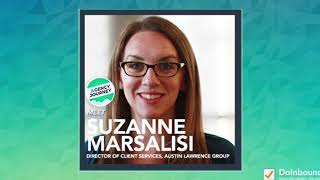
Suzanne Marcelisi, director of client services at Austin Lawrence Group, explains how a creative agency uses operational processes and templates to improve efficiency without killing creativity. She shares how her CPA background shaped her approach to systematizing client communication and process adoption across the team.
Hey, what's up, guys? Welcome to Agency Journey. This week I'm excited to share a conversation that I have with Suzanne Marcellisi. Suzanne is the head of client servicing at the Austin Lawrence Group, and she shares a really cool perspective in this interview about how she leverages her background as a CPA and an operations specialist to really deliver great results to clients and how she balances bringing process to a team of creatives. Really cool interview. A lot of actionable takeaways for you. So without further ado, here we go. How do you build an agency that allows you to live the dream that you have for yourself, for your family, for your community, for your team, while at the same time helping your clients knock it out of the park and doing it all profitably? These are the big questions that we tackle here on the Agency Journey podcast. I am your host, Andrew Demski. Now let's get get to it. Hey, Suzanne, welcome to Agency Journey. So excited to have you here this week. Can you introduce yourself to the listeners and let them know what your role is and how you got to where you are today?
Sure. Thanks, Andrew. I'm excited to be here as well. My name is Suzanne Marcelisi. I am the director of Client services for the Austin Lawrence Group. I do really, though, a variety of things for the agency, a combination of actual execution and delivery, a little bit of strategy, and also project management and all those other things that might typically fall under the client service and customer satisfaction umbrella at an agency.
Nice. So how did you, how did you get into this role? What's your background coming into this?
I'm actually a little bit of an anomaly, I think. I think because I do feel like I find people that same trajectory in that this is a secondary career path for me. I came up in public accounting. I'm a CPA by trade, and from that experience in big four accounting, I switched into operations for big four firms. And then that kind of naturally led to my initial role here, which was more on an operations focus. I had always had an interest in marketing. I had several marketing internships coming up through college and did a lot of freelance marketing work on the side while I was still in accounting, both paid and unpaid volunteering, like pro bono work with different not for profits in my area. So that was a way for me to cut my teeth and get enough experience under my feet that the guys here at Austin Lawrence were willing to take me on. So, yeah, I started, as I said, more of an operations focused role for them. And I've been here for about two and a half years now and had several really great opportunities to work with very experienced people that have given me good development opportunities. So it's sort of rounded out more of the marketing and agency side experience that then dovetails nicely with what I bring to the table from being in public accounting, which is also just very similar in that you are, you're doing agency services, you've got a customer, the deliverables are a little different, but you're working in a lot of the same scenarios in terms of tight timelines and things changing quickly and needing to do whatever it takes to make the client feel happy at the end of the day.
Yeah, that's really cool. So what are some ways that you see kind of that operational background being beneficial in the day to day life of client servicing? You know, you see a lot of bleed over there.
Oh, for sure. So in the day to day I find that anytime I'm in a meeting with a customer, with a client, excuse me, or internally here with my team, regardless of what we're talking about, I'm already thinking, okay, how do we operationalize this? If someone's, for example, I have a, an account where we want to integrate our automation with SurveyMonkey and they were asking a couple questions that were a little bit further down the line of oh well, can we send an email to people that give this type of answer and that type of answer? And you know, I was sitting there already thinking around the lines of okay, what are the mechanics of this? Do we need to build an API? Are we able to use what's existing survey to get the output to be the type of input we then want for automation. So I'm constantly that person in meetings thinking like the actual mechanics of what we're doing. You know, more broadly, anytime we're doing something for the first time with a client that we might not have done, or we're doing differently than we're doing for someone. For example, we had an event with a client earlier this summer. We do a lot of events with clients, but this one had a more nuanced nature to it. And I like to make sure when we're doing something for that first time, we're really stepping back and thinking about process and structure before we dive into the tactical aspect of it. Because if we don't have a framework for the project management and how we're operationalizing it, chances are you're going to run off the rails, you're going to at best maybe have some inefficiencies and at worst find yourself in a Situation where you're missing a deadline or under delivering or you're just otherwise, in a very obvious manner, having, you know, having a client that's not quite getting what they, what they asked for or at the level of what they should be deserving of. So I'm very focused on, okay, how do we then take this, build templates or processes and then push that out more broadly for future use or, you know, to tweak it and use it on a different account and, you know, have some, have some gained knowledge from that experience from one account to the other and operationalize things in that manner.
Yeah, I think that's such a huge opportunity that so many agencies overlooked is just, I mean, we're always solving problems, right? So if we can solve a problem for one client, capture that process like you earned that right there. If you can repeat it, you just increase your profitability on that new idea or that new process you just implemented. So that's huge.
Yeah, it's basically knowledge sharing across accounts and, you know, there's always room to keep doing it. I'd say we do a pretty good job of it. But the accountant in me is very type A, so there's always room for better and more and quicker and, you know, more efficiency and what have you. So, yeah, definitely something. It's, it's actually really lame. I kind of geek out on the idea of, oh, if I can like steal an hour out of my day or come in early and build out a template for, you know, next time this client has this type of requests and we'll have a whole briefing process that's built for it. And it's very, it's very lame, but.
It'S very helpful for the rest of the team. So can you talk to me about that? Like, as you came into this role, you say you've been there for about two years. What has it been like coming from that operational background with the rest of the team there? Like, has there been friction getting other people to kind of adapt to this kind of a model or was that embraced when you came in?
They embraced the idea of it. You know, they have, it's a lot. I'm surrounded by a lot of creatives and, you know, it's a lot of left brain, right brain type stuff. And so they would, they, they very intentionally hired me because of my background, because they recognized a need for operations and structure and process. But then actually adapting it can be challenge. Right. I mean, if it was easy, they wouldn't have needed to hire someone that could help round out that skill set for them. So there certainly was a little bit of struggle with it. But we're a very close knit team. I really value how well we communicate with each other. We can be direct and blunt but not in a detrimental way. So if something's not working for someone, they feel comfortable. I think that's the big piece of it is you feel comfortable speaking up to say I can't deal with this template, I don't like this process, I'm struggling with XYZ aspect of this. And then conversely, even though I was newer to the team, I felt very comfortable pounding the table and saying hey guys, I really need you to do this. You're driving me nuts right now. And they were receptive to being spoken to that directly and that level of open, honest conversation and understanding that people are coming from a well intended place which allows you to then essentially critique without feelings getting hurt. And then you can just address the pain point made that friction significantly, significantly less than what it probably would have been if this team wasn't as strong in that regard.
That's really cool. It's nice to have people that are receptive to that kind of table pound yeah. So from as you kind of continue to iterate and evolve and improve your templates and stuff like that, what are ways that you have found helpful to keep everything up to date and everything fresh as the teams following those processes?
That's a great question. I would love to say I have a process around refreshing but really there's the nice to do and then there's the must do's that we all have at work and it really becomes more a case of ad hoc as I see need for something then I go back and I refresh it. So we had a templated approach to how we would run a webinar for a client. And then you know, we, we did it for probably a year and a half and it morphed a little bit and then the also the, the software system we were using changed a bit as well. So that templated process no longer made sense. Now we were able to work like we all knew that that was like institutional knowledge. So we never updated the spreadsheet. And then we had an intern that came along and I tried to set him up on something and he was like wait, I don't understand this. So it, it kind of forced forces your hand in that way and that happens. That's usually the way those larger, you know, those processes get updated. Unfortunately it's not as there's not as much of A discipline or hygiene around it, as much as I would like it to be. We do. As one of my sort of quarterly goals for myself, I do try to build out two to three new templatized processes per quarter. And part of that is also, you know, it does involve some degree of, well, am I building on a new one or am I refreshing something that needs. Needs a new look? Because as I said, either your software changes or you pick up new best practices or other things, things no longer work and you change them. And it's so ingrained that you just do it automatically. But you need to go back and tweak language somewhere or change instructions or update timing delays or what have you. And it's easy to do when it's. When it's your existing team, but anytime you add in a new player, that's when you suddenly realize, oh, I really need to do this. And it becomes a priority.
Yeah, definitely. When you're going through the template process, is this something where you are kind of creating everything and then sharing it with the rest of the team, or is it kind of an agency wide approach where we kind of build templates and you bring them together? How does the actual creation process work for you guys?
It's a bit of a hybrid. Myself and one of our senior strategists do the majority of the actual templatizing of stuff. What ends up happening though, is often someone will create something for a specific use case and then I'll recognize that it would be good to templatize either that, that document or that item or, you know, the process around how it came about. And so I'll take what someone made as a client deliverable, for example, and scrub it and make it a template version that then lives in our shared drive. But in terms of actually making something from scratch, so to speak, it's primarily myself and one of our other senior strategists.
Okay. But you're kind of building off of the work that someone else already put in to solve an actual client problem. Gotcha.
Yeah, because like, yeah, like we said, why, why recreate the wheel when you have someone that's already done it and you just need to sanitize it, maybe round it out a little bit to make it more applicable or less specific to that use case and then you've got, you've got something you can work with.
That's awesome. Now, a typical problem that we have working with creatives is that they don't like to follow structure or they can think that process kind of hampers creativity. Have you hit that at all? And what strategies have you used to kind of help people go back to process and follow templated procedures, kind of moving deliverable to deliverable?
Yeah, I've definitely had that come up. And again, I think it goes back to the open communication because someone will make the argument that, hey, you know, this is such a creative process for this. We're not gonna, we're not gonna follow your document or we're not gonna have this str that your thing calls for. Let's just, you know, we have a wall that's all whiteboard. It's like the whiteboard paint. And someone will be like, you know, we're just gonna brainstorm and throw things up on the board. And you know, in the same way they had to learn to deal with me implementing structure, I've had to learn not all black and white. There has to be shades of gray. It's a two way road here. Let me see how many more cliches I could throw in. But it's definitely, I see value. And that's been a learning point for me to see the value in allowing less process in certain instances. And it's been learning to identify when that makes sense and when to push back and say, actually, guys, I think we still need some process around this. Yeah, but it's, it's definitely, there's room for both. It's not. You can't definitively say always process or you know, always create an idea and don't have any structured approach to it, even if the processes you're talking about is as simple as, all right, you guys are going to brainstorm and you're going to spitball. And I have a process around how I'm capturing what you're saying and spinning it back out into something useful. So, you know, we're whiteboarding or adding it into our notes. You know, usually I'll try to still facilitate, then at least to like gently guide them towards some structure to their creative process. And then I think that open communication I talked about as well is a big piece of it because again, we'll speak up when we think we don't need process and when we're better just to go with that creative free for all. And then also I feel comfortable if we've gone too far, we've done it for a while to step in and say, okay, drawing a line in sand, it's time to now take that next step. And we've got all this creative stuff. What are we doing with it now? We need to into some process. If this, all these great ideas or concepts are ever to become something tangible for our client, we got to do some process.
Gotcha. Does that this process live only on the agency side or is it something that you want to bring to the client's experience, whether it's meetings or how they're communicating? How do you walk that line?
Oh, I think you have to bring it to the client side. We have found more and more that clients have actively come to us and said I need process, I need structure. Because we have so many clients that are just stretched very thin. They have limited bandwidth. So they want, they want someone to put a fence around what they need to do and make it very simple and very easy for them to like make requests or you know, have not have to give much thought to. When are they going to hear from us next? What will next steps be for a project? What can they expect? 1, 2, 3 weeks coming out of a planning meeting? So we have a structured process and we share this when we do onboarding with all of our clients. But we have a structured process around meeting cadences and just general communication expectations that we set with them. And over time, as a result of clients saying I need this structure, I need you guys to help me because I don't have much staff and I don't have bandwidth, we've really gotten to a point where we've templatized some things for clients. So things like one of our clients that does a lot of events, they used to just send us emails or have like a kickoff call. Now we've written out a briefing document for them to give back to us that's very, very specific just to them and the type of events they do. So we wouldn't use it on another client per se, but it's, you know, like we store it and when they've got something up we go, okay, here you go. Like, you know, these are all the things you're going to need over the next three months to tell us. So start thinking about them now. Give us, you know, there's certain sections that say we need this by this deadline. So it drives them and it kind of funnels them to things and that kind of level of giving them that and then a lot of check ins and follow ups and sometimes it almost feels like over managing them. It's much appreciated. Which is why as I said, we've really would say like it's funny, it's like in the last six months, I don't know if it's like a trend in the market or what. But we've had so many people that have said, I like that you emailed to remind me about this every Tuesday morning. Please do it again, like keep doing this, that's so cool. Or like if we're guiding someone through a big project, you know, we'll have like every morning 9am they get an email with, here's the key focus for today, here's the key focus for the remainder of the week so they can drive against it. And you know, we'll do that for the final like two, three weeks. However, you know, many is appropriate for driving to a big deadline. And it's again, it's just the type of thing where you very senior level people at organizations saying basically I need you to babysit me and stay on top of me and thank you so much for doing that.
Yeah, yeah, I mean you're their guide but you're also like, you're giving them the peace of mind of knowing that they're in good hands essentially.
Yeah, that's the hope for sure. Right? Like you, you don't want to hire an agency and feel like you need to follow up with them to say, hey, where's my strategy brief? Or you know, what's the status of XYZ deliverable? Like you shouldn't have to chase us down anyway to find out stuff. So, you know, I kind of look at it as you should be able to either set it and forget it with us or you know, set it up and have us manage you to it as much as you need.
Awesome. Well Suzanne, I want to thank you so much for coming on and sharing your expertise here. I know that there's agency owners who are listening right now. They're just drooling saying like, I need this for my team. So thanks for laying out your model. It's cool to see how it's worked internally and also client facing wise. If anyone has any questions, is there a way they can reach out and say hi to you, say thank you, anything like that.
Sure. I'm happy to share my email. People want to find me on LinkedIn as well. I'm always happy to connect and look. I love sharing best practices and learning from other people. It's one of my favorite things about going to different industry events and trainings. So yeah, they shouldn't hesitate to reach out. I'm sure there's something I'm going to end up having questions for them on too. It's always fun to connect with other agency people.
Awesome. Well, thank you so much for taking the time to come on here and share your story.
Thank you.
It's been fantastic.
Great. Yeah, thanks for having me, Andrew. This was fun.
Want more great episodes like this one? Hey, I'm Gray MacKenzie, a host here on Agency Journey. I don't know about you, but sometimes I get a little overwhelmed when I find a new podcast. There are so many great episodes and great guests, it's hard to know which ones to listen to first. That's why we put together a list of the top 10 episodes like this one. Hey, I'm Gray MacKenzie, a host here on Agency Journey. I don't know about you, but sometimes I get a little overwhelmed when I find a new podcast. And there are so many great episodes and great guests, it's hard to know which ones to listen to first. That's why we put together a list of the top 10 most downloaded episodes of Agency Journey. And you can get a copy of that list, plus all of our notes and takeaways just by texting the word doinbound to 44222. Again, that's due inbound, all one word to 44222. Standard text rights apply. You don't want to miss these great episodes. Text do inbound to 44222. Now.










