How to Price Your Inbound Marketing Services with Blair Enns
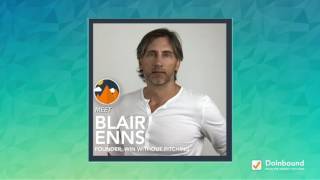
Blair Enns, CEO of Win Without Pitching, explains how to price inbound marketing services. He covers value-based pricing over hourly rates, why productizing services is harder than it sounds, and how agencies can choose between custom and standardized offerings.
Foreign welcome to Inbound Agency Journey. This is the show where inbound agency leaders share the strategies, shortcomings and successes they've experienced in their journey toward building their dream agency. Now here are your hosts, Andrew and Gray.
Blair. Welcome to Inbound Agency Journey. So excited to have you here today. Would you mind just taking a few minutes to introduce yourself to the audience and share a little bit of a background, your story and how you got to be where you are today?
Sure thing, Andrew. Thank you for having me. It's my pleasure to be here and I've just returned from a week long vacation where I didn't work or even think about work. So this might be a pretty mellow interview. My mind is still in the sun. My background is I'm the CEO of Win Without Pitching. We're a training company to creative professional sales training for creative professionals. And my background is I'm a reformed or recovering consultant. Win Without Pitching was launched about 16 or so years ago originally as a consulting practice and I was doing business development or sales consulting to independent creative firms. And about three or four years ago I decided to pivot from. I can't believe I just said pivot. I decided to scale up the business and go from a solo consulting practice which was essentially a lifestyle business. I had four small children. They were all kind of at a sufficient age where they needed their parents less. So my wife and I. My wife is my business partner and our COO or integrator in our firm. We decided at about the time when our kids didn't quite need us so much that we were going to scale the business and move from a consulting practice to a training practice. Win Without Pitching is a sales training organization to creative firms around the world. Prior to that, prior to me becoming a consultant, excuse me, I spent about a dozen years working in the creative professions. First working in advertising in an ad agency, a few different ad agencies. Then I finished out my career working in a design firm in all of my roles. I started out in account services and then moved over to business development. I like to say I've worked for some of the largest advertising agencies in the world and some of the smallest design firms in the world.
That's great. So it sounds like you, I mean you obviously have a ton of experience coming into this and a lot of things that can benefit agencies. Can you talk to us? How did you make that switch from kind of the just the consultancy agency to now more of a. More of a business development positioning there? What was that like and how have the results been since you've made that transition.
So the transition from consulting to training.
Yes.
Yeah, it really, you know, it's interesting when you look back on anything and try to explain what happened. You have this kind of this jar of stories and depending on your mood or whatever other variables, you decide to pick one story out of the jar and tell that story. So, you know, I answer this question differently all the time, but at the heart of the, at the heart of it was I one day woke up and realized I knew nothing about pricing. As a sales and business development consultant, I realized I didn't know anything about pricing and it was something that I needed to learn about. So I started to dive into it and I ordered three or four books and I thought, yeah, I'll figure this pricing, there can't be much to learn about pricing. I'll figure it out pretty quickly and then I'll be an expert. Air quotes in pricing. And I started to get into the topic and it just led me down this rabbit hole. I became fascinated by the topic. It really led me into behavioral economics and even other areas of economics that I had no interest in. I had taken some economics classes, but I had no interest in going to these places. But it just took me to all of these different places because pricing at its heart is really about judgment and decision making. After maybe the better part of a year of going deep into the subject of pricing, realizing that I had a whole lot deeper to go, I finally deeply understood the concept of value pricing. Even though I, I'd loosely talked about it for years. And I realized that my consulting practice was not. I was guilty of something that a lot of HubSpot partner agencies are guilty of. I was kind of quasi productizing a customized service business. And I realized that if I was going to do consulting properly, I needed to. I was kind of caught in the middle, mushy middle between value priced customized engagement, so a small number of highly customized value priced engagements, that's the way consulting should work. Or completely productizing my services and scaling up. In a consulting business, if you want to kind of prioritize the service and scale it up, one of the forms would be a training company. So I realized I was caught in the middle and I had to make a decision to go one way or the other. And I think my preference would have been to continue to be a consultant and to start value pricing my engagements where I would go deeper into these relationships with my clients, take more responsibility, like maybe even tie my fees or at least portion of my compensation to the, to the value that I would deliver, increase sales, increase in profitability, and work deeper with a small number of clients. And I kind of thought, well, okay, that's the way consulting should work. But I live in a tiny little village in the middle of nowhere, in the middle of the mountains of British Columbia. I'm a nine hour drive from Vancouver and I thought it takes me a day to get anywhere and sometimes a couple of days to get some places. So I thought true value price engagements. I need to be able to say to a client, okay, I'll be there the day after tomorrow. I just can't do that from where I live. That was really one of the deciding factors, the big deciding factors that caused me to go the other direction, completely productize and scale up the business. That's a long answer to a short question. Sorry about that.
No, it's a great answer because you just transitioned us beautifully into where I want to take it next. Because I listened to a presentation you gave at Digital Agency Day and I just loved how many times you brought it back to value. And the conundrum that you just described that you were in, how you're in this mushy middle between completely productizing something and then completely doing a custom value based offering. That's where so many agencies find themselves. And I know that I've been there in my agency as well, being caught there trying to present packages but getting sucked into deliverables. So I'm just to start off this conversation, what advice would you share to someone who's just maybe now realizing I'm in this middle? You know, I'm doing a lot of custom stuff, but I'm trying to present it as a product. What advice would you share to someone who's in that place?
Yeah, well, I guess the highest level advice would be you need to make a decision and you need to recognize that it's very difficult to have two types of businesses under one roof, like customized service business that has products that they sell. It's not impossible, but it's really difficult. The cultures of a productized service business are quite different from the cultures of customized service businesses. So you really need to think through the pros and cons and decide which way to go. And you know, within the HubSpot partner ecosystem, you see, there's a lot of what I would characterize, you know, the same thing that I felt prey to, which is I found myself kind of in pursuit of efficiencies, I ended up productizing more and more. So I would have a couple of different things that you could consulting packages that you could buy from me, and they were standard prices. And so you're packaging things up. And when what you're selling is completely packaged and you go into a sales conversation for the first time, you very quickly, before you've even uncovered a significant part of what the client needs and before you've uncovered even part of the information that you need to determine how you can best help, you're already thinking about what you're going to sell them. And if you've got two things to sell, you're just thinking, well, is it A or B? Am I selling these people A or B? And when you let go of that and you treat every client as a blank slate, then you can pay. You can just be intently focused on the client and trying to understand their situation. And that's the way consultative, customized consultative services should work, is every client should be a blank slate and you should go in thinking, okay, the I could do anything for these people. Let's just let go of what the solutions might be and let's discover what's really interesting and novel about this client. So the tendency is when you're pursuing efficiencies, and again, there's something about the HubSpot partners that are they basically signed up for a template, this inbound marketing thing? Well, there's a bit of a template and HubSpot does a great job giving its partners these tools, right. So in a sense, there's this kind of push towards productization because it's easy to just grab the tools, it's easy to look at what everybody else is doing and do what they're doing. Next thing you know, you've got, you know, you're a few steps down this road to building out a Me too, just another inbound marketing firm. And your package pricing looks the same and the package offering looks the same and everything looks the same. And that's, you know, I think for the vast majority. I'm sorry, I'm rambling again, but I think for the vast majority of HubSpot partners, they should be customized services firms and not productized services firms. And one of the things they do is they look at what HubSpot's doing as a SaaS company and they start doing those things. Well, SaaS companies are entirely different businesses from customized services businesses. So the first thing, the first piece of advice is you need to understand the differences between these two types of businesses. The cultures, the way you sell is different, the way your price is different, the volumes are different, the margins are different, the type of people you need to hire are different. The way you go about thinking about the client's problems are different. And you need to weigh the pros and cons of each and then make a decision. And you should go way out to one end of the spectrum or the other. I think most firms should end up going out to the customized service end of the spectrum and not the productized service, because product productization right behind productization is commoditization.
Yeah, no, I definitely hear that. And you can see that too, out there in the ecosystem with everyone throwing up kind of the same style of website. Well, then I just go to five of these and look side by side, which is going to be the cheapest and go with that one.
Yeah.
So let's break down price a little bit on the custom solution side. How would you advise someone to enter into that price conversation when they kind of put that menu of services out the window and they can just sit there and listen to a prospect, listen to their problems and try to figure out how can we best help this person? How do they start thinking about price and putting a number there?
Yeah. So the way we, most of us in most professions and most knowledge workers tend to come at price backwards. But let me explain how you should do it. First. First. So these are essentially the three or four. I'll give you the four step. Three or four steps to a value conversation. And there's lots of information on value conversations out in the world. I've got a few books on the subject here. I've got many more books that talk on it, speak on it. But I'll just point out here that the value conversation is where value pricing theory goes to die. Value pricing theory is real easy in theory, and where it gets difficult to pull off is in the conversation with the client. So the value conversation should work like this. First of all, you clear your mind of any idea going into the conversation with the prospective client. You clear your mind of any kind of predisposition that you might have, assumptions that you might have about what the client needs. And your focus is listening intently to what the client wants. What do you see as the problem? What do you see as the solution? How can I help you? Just get to the core of what is it that you really want and what I might be able to help you achieve. You're not thinking about solutions. You're thinking about the desired future state of the client. That's number one. You uncover the desired future state of the client. What's the beautiful place that you want me to help you get there. So that's sometimes referred to in a value conversation as the business objective. So what is it we're trying to accomplish? So it's the business objectives. I like to think of it as the desired future state. That's step one, uncover the desired future state. Step two is ask the client, okay, how will we know that we've arrived at this state? What are the things that we can. Because you can't measure everything. You can't measure the emotional state of the client. You can't really quantify it. But how will. What will we have to measure and what are those measurements to know that you've achieved this desired future state? So that second step is measure. So it's objectives, measures. And then the third step is uncover the value. It's essentially, okay, what's the value? What's the economic value? And there's all kinds of other forms or there are other forms of value beyond economic value. But let's just keep this simple. What's the economic value to you? And the organization of arriving at these measurements that prove that we've hit this desired future state. Okay? And the client might say, well, I mean, I suppose if we do all these things, sales go to X or profit goes to Y, then it's going to be worth a couple million dollars a year or whatever the number is. And this is the part of this conversation, it's real easy for me to recount it, right? To explain to you the steps. Some people have a hard time in particular with the third step and saying, well, what's this worth to you? We can talk about the different reasons that breaks down in that step. You get the client to essentially put some numbers on the table about, well, if we could get to this desired future state, then it's worth X, it might be worth one or two million dollars a year. Then the first three are fairly standard across anybody's model. Around the value conversation, I like to add a fourth step, and that's you're looking for pricing guidance. You've got what the value is. Now you want to get some pricing guidance from the client on what he's willing to pay you if you can get him to or close to that desired future state. Then once you have pricing guidance, then you go away. You say, okay, Mr. Client, I understand the desired future state that you want to. To get to, and you want us to help you get there. I understand how we're going to measure success. I understand what this would be worth to you. And I've got from you how much money you would be willing to pay, maybe in a range. We should dive into that a little bit more in a minute. So now I'm going to go away and think about solutions. This is how a pricing conversation or a value conversation should go. I, as the expert, I have to struggle as the expert person in the sales situation, I have to struggle with the fact that as soon as the client sees something, I see a pattern. And I think, oh, I've seen that before for this other client, we sold them X. And I need to let go of that idea that, oh, you need X. And it's this expert mind. And yet at the same time, beginner mind, the blank mind of a beginner. That's this dual state that you want to be in where you're recognizing patterns, but you're letting go of any assumption, what the client needs. And then once you have pricing guidance, value the value the client's hoping to achieve, the economic value, and some pricing guidance from the client, then you go away and you start thinking about solutions. So if the pricing guidance is, I might be willing to pay you from 100 to $500,000, then you go away and you think about, okay, what might I package up and sell to the client that would deliver a return on these different levels of investment? Let's say I had $100,000 solution, a $250,000 solution, and a $500,000 solution. Because you want to go away and then start thinking, once you have the price, then you start thinking about how you would deliver, what you would deliver at that price. And that's when it's not. In a customized service business, there isn't a lot of science here. It's mostly art. It's mostly feeling your way around issues like how much return, how much risk. If they paid you $250,000 for option B, how much risk would they take on? How much risk would you be taking on? So there's a bit of back and forth both internally as you kind of massage some different options. And you're going to have some back and forth in the conversations with the client when you come back to the client. But you come back to the client and say, okay, Mr. Client, we've talked about the desired future state. We've talked about how we're going to measure so that we know that you're there. We've talked about the economic value of that to you and the organization. We've talked about what you might be willing to pay us if we got you to different levels of outcome or if we got you to that place. Now, here are three different options. Let's talk about the options. That's the place you want to get to.
Gotcha. The stream makes sense, the logic makes sense. I totally agree with you that step three is gonna be the hardest or gonna be hard for some people to have that conversation. I know I've stumbled through that many times myself. What do you do when you get to that point when the client's like, ah, I really don't know what it's gonna mean to us if we get there. Or, you know, it's gonna mean we're, we're in a great place, or how do you bring them in and narrow their focus down to give you the numbers that helps you move this forward?
I think it's actually fairly easy to facilitate a conversation about what this might be worth to the client. Just let go of the idea that you need to nail it. Let's just talk in ranges. Might this be worth half a million to a million or 10,000 to 50,000? Just get some ballparks from the client and then you can say, okay, so it sounds like depending on how well we do here, you think we might be able to create economic value of between $100,000 and $200,000. Is that right, Mr. Klein? Yeah. Okay, yeah, Maybe at the high end, if you do all these things, if we achieve all these things, it's worth $200,000 to us. The actual, I think the hardest part is the fourth step, and it's the step that very few people actually pursue. It's not kind of one of the standard steps, and it's get pricing guidance. And I have a little trick that I, that I love to use that I think makes this step so much easier. And it's for. The fourth step of obtaining pricing guidance is anchor against guaranteed value. So if you get from the client, yeah, okay, if we do all these things, it's probably worth 100 to $200,000 for us. So you be the client, Andrew, and I'll be me, the salesperson. And I say, okay, Andrew, if I could guarantee you that we deliver $200,000 in economic value to you, what would that be worth? What would you be willing to pay us?
Nice.
Now this just opens up a whole kind of. Maybe it's a can of worms, but it's not a bad thing. If the client comes back and says, well, wait a minute, are you saying you can guarantee results? Because you're not. You're just saying, no, no. Hypothetically, I don't know yet if I can guarantee results, I might be able to. But I'm reserving the right to go away and come back with some options. And one of them might be a full guarantee. So if I could guarantee $200,000 in economic value to you, just treat this as a hypothetical question. Would you be willing to pay us 100,000, half that? And you might say, that's a bit rich. If you could guarantee 200,000, I might pay you 75,000. And I say, okay, good to know. So now I've anchored against guaranteed value. And I know at the high end, if I deliver $200,000 in value, you're willing to pay me 75,000. So I simply need to go back and work on my options, knowing that the largest option is probably going to be $75,000. Because whatever I package up and come back and try to sell to you, what I'm essentially selling to you and what you are buying is this desired future state that we talked about at the economic value target that we set, discounted for uncertainty. So if I can guarantee it, and there are different ways to guarantee something, you might say, okay, a complete contingency payment. You don't pay us unless we hit these numbers until we deliver $200,000 in economic value. That's an example everybody can do. And I'm not saying everybody should do it, but that is one end of the pricing spectrum is the contingency payment. You don't pay us until we hit these value markers for you. But the purpose of the conversation is simply to get your highest price out from you. So I know now that if I can guarantee results, you'll pay me 75,000, and I simply need to work backwards from there, and I need to do some sort of really loose equation in my own mind about, okay, if you're willing to pay 75,000 for 200,000 in guaranteed and maybe for $50,000, something that seems like pretty close to a sure thing, but there's no guarantees, etc. Do you see where I'm going?
Yeah, I see. So you're allowing the client to basically put the field markers in place, and now you're going to go back and calculate. How do you want to move against this field? Because in their minds, you're saying, okay, if in a perfect world I give you everything that you desire, what's that worth to you?
Yeah.
Now you're playing off of that. That makes total sense. Because a lot of times we go into these conversations, we go back, we present a price, and the only People we've considered is ourselves in this. We don't even have how much that they would be willing to spend. So it makes sense positioning it all in that way. I'm curious about the risk factor and what have you seen to be successful or other folks when it comes to tying risk to this? What situations make sense to say like guaranteed pricing here and what situations would it be, would it not make sense for an agency to tie what they're actually going to bill for it to the results?
Well, first of all, I know a couple of firm, maybe more than a couple of firms who actually their whole pricing model is tied to results and it's a nice sales message. I'm not a fan of that model. I think in a customized service business the first rule of pricing is to price the client and not the job. Because every client is a blank slate. You price based on the value that you would deliver for that client and the value that you would deliver for one client is different than the value that you might deliver for the other client. So I think in any situation you go in where it's a blank slate, it may make sense for you to have one or two high risk, high reward clients. Again, I wouldn't build my entire client portfolio based on that model because that's too risky for me personally. I know some individuals who've done it. It's way too risky for me personally. But I think every customized service firm who should be shooting for a target of about 12 clients should think about having one or two high risk clients where they don't get paid or they only get paid a percentage of the target fee if they hit certain economic targets if they create value for the client. Obviously the ones where you wouldn't consider are results are outside of your control. You really have to pick your spot. But the beauty of online marketing is ROI is so easy to measure compared to something like branding or maybe an offline ad campaign. I think for listeners to this podcast it makes sense for them to think about these opportunities to really value price a client and earn some significant compensation well beyond whatever they would charge on a cost plus base pricing model.
Awesome. Do you ever see a situation like that tied to like an agency tying their fee to revenue generated or any models like that? Or is it strictly like fee based on results?
No revenue generated is a good one. Even leads or qualified leads generated, that's another good one. Again, it's got to be a client that you trust where it's essentially open book where you can come in and look at whatever Numbers that you feel like you want to look at at any time.
Yeah, I'm definitely seeing that as a big contingency here because this is like we've got to be working in the trenches with these folks side by side. Because we're really saying if we are going to function as an extension of your team, then we want to be treated as part of your team because you're tying their fate to your fate, essentially. So there would have to be a ton of clear communication, very clear expectations. Sit there back and forth.
Yeah. And if you look at the various package, the pricing packages that a lot of HubSpot partner firms put on their website, the difference from package to package is either inputs or outputs. We'll spend more hours or more people, or will generate more posts, more ebooks, etc, etc, and the way you should be thinking about this is you should be building those options, separate options for each individual client. And you should be thinking whether or not you put forward an option like this. You should be thinking about the first option that you build is the closest, the one that's closest to a guarantee that you can think of. You build that one. So it's kind of the blue sky. We're going to ask the most amount of money and we are going to tie the money that we earn to the value that we create from the client. Then you can back up from there and option two or option one that are left of that and less expensive. Maybe you want to have some options where it's more clearly tied to outputs or even inputs and the value pricing gurus would just gasp at that. But yeah, inputs are time and materials, right? There is a time and a place to sell time and materials. There's a time and a place for it.
Gotcha. From a marketing perspective, how would you suggest positioning this either on your website or through your sales process, when clients or prospects at that point, I guess are just curious about how does the pricing model work? Any tips or anything that you've seen to be helpful in conveying the process to prospects who perhaps haven't gone through conversations like this before?
Well, how does the pricing model work? That question probably implies some sort of packaging that the client is getting from the agency, some subtle cues around how everything is packaged up. I would say if I were a consultant selling customized services, I would say, well, the pricing model is I figure out what you need, I put together some solutions that would deliver the greatest value to you, and then I figure out what fair compensation would be to both of us. That's how the Pricing model works.
Awesome. Okay.
Basically the question is inviting me to use formulas and to put things into spreadsheets, et cetera, and I'm refusing that invitation. Anytime your pricing implies a formula, you invite the client to use the formula to make the pricing smaller.
Yeah. You're giving them the tools then.
Yeah.
In this sense, they're the ones setting the boundaries.
Yeah. If I said to you this cost for us to do this for you, whatever this is, Andrew, it would be $50,000. And you said, well, that's a big round number. It sounds like you just made it up. I would say, well, that's generally what we charge companies like yours for work like this, for the value that we expect to create. That might open me up to a follow up question which is, are you saying you would charge a company of a different size a different amount of money? My answer is yeah.
Yeah, value is different at the end.
Of the day, yeah. Yeah.
Awesome. All right, last question I have here is, I guess operational. Once we close a deal like this and we're ready, we've agreed upon a plan and we're going to go implement it, what does like documented processes, operating procedures look like in an area like this? When we enter this with an open mind of just trying to solve problems, does it mean getting like certain clients, expanding the scope of the service of the agencies, or are we still building off of kind of the same menu of services, but only having that menu on the back end? Any insight or ideas on that side?
Gee, that's a great question. And it really speaks to, it really speaks to the pursuit of efficiencies, which is a little bit contrary to a completely customized services firm. I'm not an advocate for not having processes. I think there's a dearth of processes, operational processes in most creative firms that I encounter. But operational processes are one thing versus packaging up. How you deliver is another thing. I don't have a pat answer for you there. I would just say that as much as I value the importance of having standard operating procedures in a customized service engagement, you don't want to let the pursuit of efficiencies through SOPs impair your ability to innovate because innovation is a cost of efficiency. So when you're trying to be too efficient, usually you see the really dogged pursuit of efficiencies in a cost plus plus based pricing model. And then when in a customized services firm that's value based, standard operating procedures are still important, but they're a lot less viable to the client. And there's A lot more room to kind of feel your way around an engagement should be more room and more time. So if you think if the person who's delivering on the engagement is the person selling it, it's not always the case. Then you want to just imagine that the person who's sold it and has commanded significant margin, they've earned the freedom to spend more time on this. It doesn't mean they shouldn't be constrained by processes. I just point out that this is another duality like the blank slate of the mind of the beginner and the expert mind that sees the patterns. You want to run an efficient organization, but you don't want to let the pursuit of efficiencies impact, impair your ability to innovate. A value priced customized services firm is way more innovative than a productized cost based pricing firm.
Yeah, I think that's a really good way to sum it up. Again, you've got to sell in the margin to give you the opportunity to go out there and stub your toe. Because if you're innovating, you're going to have some home runs, you're going to have some foul balls there. So it's going to be important to build that margin in. And if you can document as you go, there's no reason you can't capitalize on that investment for future clients.
Yeah. And you have to accept that a value price engagement is messier. It's way messier than plus based engagement.
Awesome. Well, Blair, thank you so much for your time here. I really appreciate your insight, your perspective. I've had a phenomenal time. I've got a full page of notes sitting here next to me which is going to go right into the show. Notes. If anyone's listening, they want to learn more about your approach or they want to learn more about some of the services that you offer. What's the best place for them to reach out?
Yeah, I've enjoyed it too. Andrew, thank you for having me. WinWithoutPitching.com and I'm Blair Anz on Twitter.
Awesome. Well, thank you so much. If you guys have enjoyed this conversation with Blair, make sure to reach out to him on Twitter. Shoot him a thank you there. And Blair, thank you again for your time. It's been awesome.
Thanks Andrew.










