How to Work with and Sell Enterprise Clients
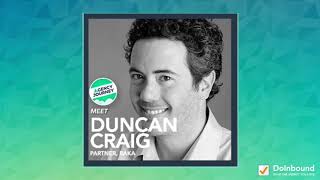
Gray MacKenzie interviews Duncan Craig from RAKA agency about building teams and serving enterprise clients. They cover how to structure an agency, customize solutions for different client sizes, and use inbound marketing to attract bigger accounts.
How do you build an agency that allows you to live the dream that you have for yourself, for your family, for your community, for your team, while at the same time helping your clients knock it out of the park and doing it all profitably? These are the big questions that we tackle here on the Agency Journey podcast. I am your host, Andrew Demske. Now let's get to it. All right.
Welcome into another episode of Agency Journey. This week, I'm really excited to have Duncan Craig from RAKA on the podcast. Duncan, welcome, man. I appreciate you taking the time to be here.
Yeah, no problem. Thanks for having me.
So you and I were just talking. Even as I asked the question. I knew I should have saved this for the podcast, but I was curious about the name itself of the agency. So maybe what we could do is just kind of blend together. If you could kind of give us a quick breakdown of your story in terms of how the heck did you get into the agency space and with this, and then also kind of where the name comes from, maybe we could combine those two stories as an initial intro.
Sure, yeah, no problem. So, yeah, the name. Well, both my start in the industry and the name sort of are one in the same story. I sort of started at a company back in 1999 called Wunderkind Studios, and that was owned by and the creative director for that agency was a guy named Steven Rockesader. And he was just an amazing creative and designer and just all around funny and great person. And he really took me and my business partners as well under his wing and sort of taught us everything that we know and ended up passing away in 2001 while we worked for him. And Rocco was the nickname that we had for him. His last name is Rakasader. So that was a devastating time, both, obviously, for the company, but especially for us as individuals. And so his wife, Lisa, came to us to the company and said, Stephen left behind two legacies. One was his children, which she was responsible for, and one was his company, which we were responsible for. So even though that business ended up being sold off shortly after that, we sort of took her words to heart and decided when we came back together to start this company, we really couldn't think of anything else to name it besides carrying on Steven's legacy and calling it raca.
I mean, it's a tragic story, but I think it's, like, awesome that you guys that he had that impact on you and that that's one of the better, I think, reasons behind a name. There's a lot of meaning in that name, I guess, is the short way of saying it. So that's pretty awesome. Tell me about the. So starting the business. How many business partners?
Sure. So when we started, it was three of us. And so I have Dan Marino, who's our creative director, and Zhang Garside, who's our director of technology. I was a designer as well, but we always joke that I just was the most charismatic out of the three of us. So I ended up being the project manager, sales guy, even though I was still doing design and stuff like that. But when we started, it was the three of us, and we produced all the work, we answered the phones. We did all of that back in 2004, and that was our sales pitch. If you like us, then you're gonna love working with us because we're the ones doing it all. But obviously, that's not very sustainable. Right. But one thing we didn't want to lose that sort of that feeling that you can work with anybody in the agency. We didn't want to lose that as we grew. And so we still have that today, where at any point you're gonna probably have a senior partner working on your account in one way or another. You can always pick up the phone and talk to us. And. And we're not somewhere off on the golf course. We are working in the office, working on projects and things like that. And so we find that it's a really. It's a nice experience for our clients to always know that they can work with anybody in this agency and that everybody's really going to have a great handle on what you're trying to accomplish. Right.
And that's obviously challenging. And I mean, that's the reason it's a differentiator is because that's. As a. As an agency grows, for a lot of agencies, especially agency owners, that's kind of the opposite of the goal. It's like, I would. Hey, I would rather get out of the client work.
Sure.
Which is anytime that there's something like that, where everyone's mindset seems to be one thing, that's like an automatic differentiator if you just kind of swim in the opposite direction. But talk to me about the team kind of size and setup right now. So you're in New Hampshire. Is the team in New Hampshire, or are you guys remote? How's that structured?
Yeah. So we're headquartered out of New Hampshire. Portsmouth, N.H. have you ever been to New Hampshire? Portsmouth is the best part of New Hampshire, as far as I'm concerned. It's in the far south part of New Hampshire, and we're on the border with Maine and Massachusetts. And. And we have. New Hampshire has like a 13 mile coastline which is a part of our city here. So it's like the coolest part. But we also have a small office in Boston that we use for sales and for meetings and things like that because we do have a lot of Boston clients, but our team is all based out of our Portsmouth office. We do try to keep everybody here and have everybody working together because we're a super collaborative group. Like I said earlier, at any point anybody in the company could be working on a specific challenge for a client. It really helps us to have everybody here as much as possible. But we also try to keep our culture as great as possible and as flexible as possible. And we want people to be able to work from home if they need to, or work remotely if they need to. Also just we try to keep really specific, really tight office hours so that people can go home to their families at night and come back in the morning recharged. Which I think is another thing that is different, at least for me, from when I've worked at other agencies.
Right, for sure. As far as the way that the team is structured for client work. So a lot of agencies are going towards the hive or POD or basically breaking into specific teams with a diverse set of skill sets kind of in each team. Is that how you have set up work on client projects or is it more different? Is it more open for Raka?
Yeah, I'd say it's a little bit more open. We have tried different team approaches and things over the years. One of the benefits of being this is going to be our 14th year as Raka and my business partners and I have worked together before that, as I mentioned, so. So we've been doing this for a while and we have the benefit of having tried a lot of different approaches and finding what really works for us. So we don't have any specific verticals we focus on. We don't have any specific teams that only work together within raca. What we try to do is find, figure out during the sales process if a client is a good fit for us, if we're really going to be able to help them reach their goals. And once we sort of determine that, then we say, okay, well, who do we have on our team that's really going to be a great fit for this? Maybe it's based on prior experience within that industry, but it may just be that this particular client has these specific goals and These five people are really going to be the best fit for them from maybe a user experience design standpoint and a content strategy standpoint or this particular programming platform, things like that. Right.
I wonder if part of this approach is tied into. That's what I'm going to lead into the question here from the website. One of the things that stuck out to me was that there is kind of some terminology or a little bit of focus around the enterprise. The fact that you do serve the enterprise client and I know that you guys also are in the SMB space, which is where a lot of the vast majority of agencies are predominantly in the SMB space. Is that the way that the team is structured? Is that partly a function of the type of clients? I think working with more of an enterprise client tends to lead to more of a customized approach on a client by client basis and less of a here's what you get, here's the slated deliverables and push this out. Is that a function of that or are they two totally separate issues for you guys? And then I'd be curious to know too, not to tag too much all into one question, I feel like I'm loading your plate up here. But I'm also curious to know kind of the breakdown between enterprise and SMB and whether there is much of a divide in your mind at all in terms of servicing or whether I'd say we do the same services. It's just slightly different. There's a couple of things we need to tweak.
Sure. Yeah. So we try to take a customized approach for everybody. And. And while there are obvious differences between the SMB clients and the enterprise clients and even nonprofit clients that we work with and things like that, we try to really take the same approach for all of them. Often when we're working with an enterprise group, we're still working with a team within that enterprise. We're not sort of working with a thousand person team trying to stupid steer some giant ship for them. Often they're bringing us in because they say we need to solve these specific challenges and we know that we can do it using online marketing, inbound marketing, website design development or UX on our product, whatever it is. So while it's a there are different things we need to do when we're dealing with an enterprise client versus dealing with an SMB versus dealing with a nonprofit, the approach we take is often just about the same because we're really going through our specific process where we're saying let's figure out what your goals are, what the strategy is going to be how it applies to your unique organization, including things like what size are you? How a small business can obviously be a little bit more daring than a giant, maybe Liberty Mutual. So there are a lot of things we need to determine, but we're sort of asking the same questions as we're going and coming up with the customized approach that really works for that company, no matter who they are.
That makes sense. And then if we look at kind of the servicing buckets that you guys do, and you just mentioned a bunch of those, but is there like, is one piece of the business much larger than other pieces of the business or is it kind of what's the layout in terms of services that you're providing to your clients?
Sure, yeah, yeah. Right now inbound marketing is the largest bucket, but that doesn't mean that there aren't others. There have been times in our history when Flash was our biggest bucket that we had. You know, it was probably 50% of our workload back in, I don't know, 2006 or something like that.
Yeah.
And you know, so, and, but yeah, no def. In 2012 we started building an inbound marketing team, got hooked up with HubSpot and have been really, that's our fastest growing team. We're adding a lot of content strategists and even whoever you are working here, if you're a designer or a project manager or a programmer, we want to make sure that you are fully up on inbound methodology and everything like that. Because that really is definitely the biggest part of our business and the fastest growing part of our business. But, but we have other areas that are still large portions of it, like UX design is a big piece of it. And of course that applies also to what we're doing for an inbound client that maybe needs to do an online property that needs some specific types of user experience design. But a lot of times we have a client called Plainsense, which is a really cool private jet chartering company and they came to us and said, okay, we need to acquire new owners to come in. So we need to use inbound marketing for that as well as online advertising. And we need to do a new website, but we also have this owner portal where people are going to be logging in and being able to book their flights and customizing their flights from everything from my wife is gluten free, so make sure there's gluten free snacks on board and things like that. Designing the user experience for that portal is also something we're working on. For them. And that's a good example, too, of the type of thing that we do for our clients, and that's a smaller business. But then we've also done that for Liberty Mutual, who came to us and wanted us to completely redesign the user experience of their agent portal, which is used by all of the agents at Liberty Mutual. Wow.
Those are some really cool projects. Is there anything in working with. This is a question that I don't get on a daily or weekly basis, but relatively frequently talking with agency owners. This does come up, which is around like, I want to move up market in terms of the client base. I think there's a natural progression that happens where most folks start working with the very small family businesses and move up. But for folks who are trying to kind of jump to more of an enterprise level, is there anything that you guys have? I mean, I'm sure there's a lot of things that you've learned, but anything stick out that either clicked for you? I don't know whether it was connections and network or whether it was referrals or how you guys got moved into that space, but to work with even those clients that you just mentioned, anything that either needs to be different or anything that leads to those type of opportunities for you guys.
Sure. Yeah. There's three things I'd say about that. One is that working with larger agencies, which is something that we still occasionally do but was a big part of back in the flash days, was a big part of our business model of partnering with large agencies who obviously have large enterprise brands. They would outsource work to us.
Okay. Like a subcontractor model where they're.
Yeah, exactly. Yep. We had some great relationships. And those clients, those agencies were fine with our talking about our position on that. And a lot of times that comes with working with a more traditional ad agency where it's very accepted that they're going to be outsourcing and subcontracting the execution of campaigns. So that can help because you can get some logos under your belt that make other large brands feel better. When you're going to pitch them, you say, well, we did this for this large brand that's similar to you. It gives them a comfort level that, okay, well, they understand that. Then I would say look for smaller groups within smaller divisions, within larger brands. That can be a way to get a foothold with an enterprise where you're sort of saying, okay, well, we may not be able to work on. So Bose is one of our clients, and when we first started working with them, we were working with a pretty small division within Bose, which was fun because they were a little bit less. They were a little more under the radar. And so we could do some more interesting inbound marketing things than perhaps the large headphones business would have let us do. But you prove yourself with a smaller division and then word starts to get around with the bigger teams within that brand. And you know, I said I had three things and I'm not sure what the third thing was, but two.
That's, that's, that's awesome. So I do think that's a really good point. Is I think a common approach or common. Like the initial solution that comes to mind for a lot of people seems to be networking in, in terms of people at the business itself to get into, which I guess is kind of tied into point number two, but I feel like more of like an account based marketing approach or like this marketing approach, rather than saying there's already people who have their business in ways that you could help them. I think that that first point is one that we've seen on multiple occasions be one of the best ways in and that that makes a lot of sense to go through. Who's already hired, they've already gotten over that barrier. If you can participate there, you do get some of that initial traction under your belt and some of the proof that you've done the stuff that you need to make enterprise clients feel comfortable. I guess that's not just enterprise clients. That's any type of client. They want to know that other people like them have worked with you and have had success from that. That's kind of a box that needs to get checked for emotional security when making a purchase.
Absolutely, yeah.
Duncan, if we look at 2018 and kind of the direction for the agency direction that you see the market going, is there anything that sticks out? Is it going to be a continued push into inbound marketing? Is it other services, anything agency wise that you're kind of pushing for or excited about or looking forward to in this space?
Sure, sure. Yeah. You know, I think that we, as I mentioned, you know, we've been doing inbound marketing. I mean, we've been doing it probably more loosely. We've been doing, you know, the activities since before 2012. But in 2012, we sort of made an active decision to say we are doing this, we're doing it this way, and this is something that we're going to grow our business based on. And I would say it has taken since then to really solidify our process to a point where we say we have figured this out to a point where we really, really understand what we need to do here to make this work. Now, that's not to say that our early efforts were not big successes and it was always working and things like that. But I feel like we're always tweaking our process, and we will always be tweaking our process and figuring out the best ways to do things. But I would say in 2017, we said, wow, this process that we have put together is really working for us, and it's working for our clients, and. And it's leading to really great relationships with our clients. This is what we need to do and really document it and expand based on this. And that's what I really see us doing in 2018 is saying, all right, we've got it down. Let's now grow based upon what we're doing here. Right.
That makes a lot of sense. Figure out, once you have the system that's working really well, then I think the next step is always figure out how to scale that. I think that's a good. A good takeaway for agencies. Listening to is one of the. I mean, this is a common problem, I think, especially in agencies, because typically the founders or the founder is a creative, which sometimes tends to be more of a distracted or shiny object syndrome type of personality.
Yeah.
There's just so many examples where it's just constantly looking to add a new service and bounce around. And I've got one client over here who said they could use that. Why don't we go do that? It's not that hard. We can figure out how to do that instead of saying, here's something that we're figuring out and doing over a long period of time. You guys have been doing this for five years now. Longer than that, but really with a push for five years now, why not just double down there and be really good at that? That's a great point.
Yeah. And I think that that's something that we have really. From talking to other successful businesses, not just agencies, you find out that the ones that are the most successful are the ones that say, yeah, we figured out how to do this thing and do it super well, and that's what led to our explosion of success, rather than just sort of going along being pretty successful. When you figure out what the best way to do something is and you can do it better than anyone else, and then you can really sort of push on that process, I think that that's where you can sort of find another level of success that's definitely true.
One of the things I find this just personally kind of funny or ironic. Anytime that a huge company that we're all familiar with, Apple or Google or somebody else moves into another space, there's this huge outcry from everybody of, well, are they becoming too distracted? Maybe they're not just focusing on their core product. This is a huge company that if anybody's in a position to be able to expand and sometimes they do make huge mistakes and they shouldn't have done it. But if anyone's in a position to expand, it's probably them. But then the same people who criticize the massive brands, we kind of don't internalize and use the mirror to see we're doing the same exact thing. And we're definitely not equipped to be moving to all these other areas.
Yeah, we can't spin up 100 people to work on this, right?
Yeah, they can actually dedicate resources to focus on this. We definitely can't do that. So that's awesome. Well, Duncan, this has been really fun. There's a lot of questions that I could ask, and it'd be fun to do another episode here at some point. But I really appreciate you taking the time to come on and share here on the podcast. For folks who obviously will link up the website rocketcreative.com in the show notes, is there anywhere else that you'd point people to follow you or the agency? Sure, yeah.
I mean, you know, all of our social is great. We're sharing a lot of great information on our Instagram and Twitter and Facebook and so definitely follow us there. But also check out our blog, you know, obviously on our website. We are launching a new website in Q1 and there's going to be a lot more interesting information there that I think will be useful not only to our clients and potential clients, but also to other agencies.
That is awesome. Well, Duncan, I really appreciate your time. Thanks so much for coming on and being willing to share.
No problem. Thank you.
Want more great episodes like this one? Hey, I'm Gray MacKenzie, a host here on Agency Journey. I don't know about you, but sometimes I get a little overwhelmed when I find a new podcast. There are so many great episodes and great guests, it's hard to know which ones to listen to first. That's why we put together a list of the top 10 most downloaded episodes of Agency Journey and you can get a copy of that list plus all of our notes and takeaways just by texting the word do inbound to 44222 again. That's due inbound, all one word to 44222. Standard text rates apply. You don't want to miss these great episodes. Text do inbound to 44222 now.










