https://www.youtube.com/watch?v=jp7lGfsfrJM
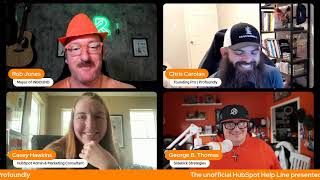
Rob, George B. Thomas, and Casey Hawkins take live calls about HubSpot problems. They work through data integration, NAICS codes, email analytics, and workflow automation while riffing on whatever comes in.
Hello, you've reached the HubSpot helpline.
Help behind helpline Helpline.
It's Rob, it's George, it's Casey and Kyle. Come with a problem and leave with a smile every Friday at 3. Come and join us as we help you with HubSpot. Open up your LinkedIn. Just make sure you call in and leave a voicemail about HubSpot. Make your Friday divine with the HubSpot helpline.
I can't get past that jam, brother. Okay.
Anyway, it is Friday. This is the HubSpot helpline. I am Rob, AKA the mayor of inbound. I'm here joined with George B. Thomas, also known as Chat gbt. He is extraordinaire here with Casey Hawkins also who has been quote unquote, putting in the business. I'm not sure what that means, but that was backstage, so congrats. We have Chris off camera. We have not summoned him yet because the show just started and nobody played the Ricola horn. And we have a special guest today that is a spoiler but to be announced momentarily. Kyle is not here.
Other than my niece. That's mean mugging the camera niece is also here.
That is not Kyle Jepson. Although there may be baby news, we're not sure. We are sending Kyle love, vibes, prayers, well wishes, all the good orange energy. How we doing today, George? How we doing today, Casey? Good.
I'm doing. Yeah, I'm doing well. I told George and Chris on the morning show today. I'm at my parents today. It is shaving cream day at camp.
Graham still makes me shaving cream day.
What is this, brother?
If she said this in the morning, it made me nervous then. It makes me more nervous now. I'm glad I don't live in that city. I didn't even know.
I have to know what that is. I mean, we got. We need to get to HubSpot questions, but shaving cream day comes first. Can you please.
Ellie, do you want to explain what shaving cream day is? No. So we put shaving cream in all of the water tables and we also add food coloring. So then we all lay in the colored shaving cream. And it's a very messy day. Graham only does it one day a year because it's so messy.
That sounds fair. Just from the brief description, it sounds like I'm. I'm a bit of a neurotic.
Anything.
I don't like stuff on my hands, George. I don't know why. Like, I. I gotta wash my hands. I'm the guy that. Yeah, cooking stuff every that use a whole roll of paper towels or a couple rags. That's great. I'm glad. Glad you brought your niece speaking. By the way, can I just say, y' all look great. I mean, it must have been a good week because y' all are showing up. You look good. I mean, Ricardo Montovon said it's better to look good than to feel good, but I feel like we're looking and feeling good.
I'm not in the Loves gas station this.
Yeah.
This week, so that maybe that's part of it. You looked a little, you know, islanded, stranded and a bit nervous when you were at the Loves last time, but a lot more comfortable this time. So. Kyle. Kyle, interesting update. Not only with him not being here. We wish him well. He had the voicemail number. And. And we. We do have a new number, by the way. Chris, if you want to roll, it's already rolling across the bottom. Is that the new number, Chris?
It is not the new number.
Don't call that number.
Oh, no, now I need to. I need to change the number now that Kyle's not here.
George, do you have a buzzer sound? Do you have it?
It's good enough that I have to do, but, yeah, I need to get the. What's that? Family Feud.
Yeah.
Yeah.
So just to fire that producer. What is happening?
No, we can't fire him yet. He's. He's. He's still. We're gonna give him a chance to grow. We're gonna give him a chance to grow better, as a matter of fact.
Oh, there we go. I like.
So. So what I would like to clarify real quick. I don't know if this was clear. We still want you to call in, just not that number because it's not in use anymore. So we have a new one. Chris will work on getting that across the screen. However, the big however here, because of that and because of a question and a birthday wish that we. From a guest, I think a week ago and two weeks ago, all the way back at the beginning, we decided to bring her in. It is Trish. Trisha, Miriam. She has a question. And you know what? We figured, who needs a voicemail when we could just deal with the real thing? Trish, welcome to the show. Thank you for asking the question.
Wow.
Sound effects are good. They make. They make the hype. The hype is there. I love it.
We're all about production value here on the hshl. So with no further ado, because I know our viewers are excited to hear the question and for Casey or George to talk through it, maybe draw it out. Maybe Chris can even pop in with some knowledge. Do you mind re asking? We. We can. You can do the whole voicemail again from scratch and we can sing Happy Birthday. Although it'd be belated a little bit. But if you just want to get to. And what we can help with, that'd be awesome.
Do you remember the word for word question, Tricia?
No, but I think I can make it better because. Never mind. The question has to do with bringing data into HubSpot from kind of a third party source. And in this instance this was a HubSpot Salesforce integrated portal. And I had to give the point to Salesforce which means I had to let Salesforce run that calculation because I didn't know how to do it in HubSpot and that always makes me sad. Makes me feel like I'm giving a point to the other team. I always want our team to get the point. So here was the task. Industry codes. We needed a way to categorize them.
Because.
The default field in HubSpot and Salesforce both, it's just text field. There's no inherent categorization around that. We built a categorization around NAICS codes because the way NAICS codes are structured is the first two digits describe major classes of industries and then as you add on digits to the right you get more granular into those categories. We brought all kinds of naics codes into HubSpot. That part was fine. But then I needed a way to do that classification and I have a Google sheet that says here's the NAICS codes, here's the verticals they represent instead of well, in addition to the NAICS code, show me what that vertical category value is in Excel. This is like a lookup. But how do you do that in HubSpot?
So default code was just a text field. Point to the other team. There's no inherent categorization. Part of the solution was building a categorization around makes codes where the first two digits are like general qualifiers that specify the need for. Have we all got the kind of the problem statement? Just making sure we. Chris from the background. Chris is working in the shadows on this one.
I'll give you a couple more examples just for more clarification. So I think like roughly 52 I think is a major categorization for manufacturing companies. And underneath that. Now here's where I don't remember exactly but like any NAICS code that starts with. Actually I think it's like 32. So let's say like 3, 2, 3. Any NAICS goes that starts with 3, 2, 3, that might be like pet food manufacturing where like a 3 to 5 might be automotive, like automotive parts manufacturing. So as you swing to the right with digits you get more granular in terms of industry categories and formula that we ended up developing was basic and I think like at the max length of 6 numbers is it kind of looked for a match on all six numbers in, in our. I don't know how it was done because it was done in Salesforce, but we looked for a digit match. If we couldn't find that, we looked for a match where the first five digits matched. If we couldn't find that it was the first four digits because somewhere in that lookup file, that reference file, there was going to be a match and it just had to do with how many digits you ended up looking for.
And is it a text field that has like how specific the specific industry or is it a drop down field?
Okay, that's a great question. So the logic went like if you can find a match and the first four digits are X, then give it this text value which basically mapped to the vertical name.
So and it's. Was this a Google sheet?
You said, you said it was a Google sheet. And the thing that made this so important is that you know, if you want to report on your major verticals, which you do because individual industries, it's too granular, you can't really get any insights. So having the ability to put major industries into vertical categories like just changed everything for us because we were able to really quickly see that the pipe to spend ratios for certain industries was way higher than others. Or the average deal velocity was much faster or the average deal size was much higher.
And am I correct that you're not doing this through like if then branches because it's too much. There's too many options. There's five.
There were in my sheet there were 500 codes.
Okay, just.
500 codes as like the total industry or total vertical volume.
There were you know like 500 NAICS codes in column A and then the vertical name in column B. There are only 12 verticals.
I'm wondering if, I'm wondering if there's an ASC Breeze or AI connector. But I will say, I wonder if we say manufacturing three times if Chris will come on or AI three times. I don't know what, I don't know what the series is. I know you've built, you've built those consolidations for open text fields down, but you did that for how did you hear about us? Which only had, you know, what, five, ten options.
Yeah, I think I expect to see AI like ask Breeze use cases, start to solve for this stuff. Like I've seen some really elaborate nix code set up like, and honestly I've never understood fully like how much value is created when doing that because usually there's a top group, like how many ad campaigns, like there's 500 codes, but how many ads do they care about? Trisha.
So those 500 codes represent about 12, like a dozen verticals.
Right.
And each one of those verticals probably has its own.
So do we need granular understanding of the 500 different codes?
No.
So I would look to do that like get to the 12 options. But those like I'm seeing similar things in like zip codes and like all these things where we need to be able to pick from these just huge number lists, huge code lists that people have done a magnificent job of preparing these spreadsheets that are pretty crazy. I think with a lot of the new data set tools we're going to be able to start accessing that information in a lookup kind of way in HubSpot. But that's where I would do everything in my power to try and not have to ever deal with those 500 codes, which I know isn't easy, but I see some coaching, some coaching opportunities there to just like what are we really accomplishing by tying this to a specific code?
Oh, it's that, it's identifying that you're, you're really getting traction with like pet food manufacturers, but you don't have the same, like for whatever reason your product is just really, really appealing to this type of business and that if you use the individual industry codes, it's too granular. You can't, you can't get that higher level view. So you have to have some to categorize them. And there isn't any way that I know of innately in other, in either HubSpot or Salesforce to do that. So you have to come up with some other way of putting these industry or company types into smaller groupings.
And the 12 is too broad, 500 is too specific and doesn't match.
12 was great. Like it wasn't the entire universe of industries, it was just the, the top ones that mattered to this business.
Yeah, but you need to understand the 500 in order to get down to the 12.
Yeah.
And what are we measuring? Just ad clicks or ad impressions or pipeline?
Average deal size, sales velocity.
How many deals win rates, how many deals how many deals? Like on a monthly basis?
A hundred.
People don't like this answer, but can we not rely on a sales team to manage like a hundred deals and assign like one of the 12 categories to like as soon as the companies are known? Yeah. What I see when I usually like that sometimes this is a MOPS thing and like marketing ops and like sales is not even involved. And they just try to create these very elaborate ways to get super granular and connect all the data. When. If there's a hundred deals a month, depending on how size, how big the sales team is, like so many times the industry means one thing, but then we get into the conversation and then it's a certain part of the organization that the use case is a little bit different. So even though they're both pet food companies, like maybe there was something else that got us in the door or closed the deal or the decision maker is different. There's so many things we try to apply, like try to get too objective about when a salesperson is really the one understanding all the insights. So I've yet to really see from an attribution perspective that kind of elaborate data structure actually turn into real value, like for an organization. But that's so that. And if you can get the teams to decide that all of a sudden we don't need to do like so much elaborate infrastructure to try and solve for this data connectivity. Now if they're doing hundreds of deals and they've got like enterprise global sales teams, like, it starts to make a lot of sense. But at that level. Yeah, I'll let you. I could go on this for a long time, but I'm gonna, I'm gonna step back.
Love to hear that production note. George is maybe back because he had some audio issues, but it seems like he's wanting to weigh in.
Am I, am I back?
You're back.
Are you okay? Yeah. Well, I was asking because I, I didn't hear. Unfortunately, I didn't hear about three minutes of that because all of a sudden my stuff decided to like, reboot and I was like, everybody's moving their lips and I have no clue what's going on. So.
Yeah, yeah, the, the TLDR is. Tricia is trying to invent some sort of Dewey Decimal system, it would seem for mixed codes and categorization among industry. There's a lot of stuff going on here. There's 12, 12 verticals. Each one has. Could have its own ad campaign, but there's 500 or around 500 industry types. And so there wasn't a way 500 was almost too granular. 12 was. Was right. But there just needed to be more, I guess, specificity on being able to attribute those not only from like a mops perspective, but also now we're talking about 100 deals a month. That is, that is what I gathered from that. But yeah, my mom was a librarian. As soon as I heard that first number categorized as something, second number does something else that reminded me of the Library of Congress.
And if I remember correctly, because this is a couple weeks ago, it was the fact that it wasn't a Google Sheet but you were trying to do it in HubSpot. And so it literally would have been like some type of lookup table or something like that.
Yeah. And I, I couldn't figure out how to do it in HubSpot but the Salesforce people did. So we, we built it in Salesforce instead.
I almost wonder. And this is again, I don't know what Chris said or what has been brought up, but part of me almost wonders if this would be like a custom card creation. Like, like, let me explain what I mean because you can do some stuff in HU. You build it to be in HubSpot. And so like we have this one client that we're building an actual drawing tool to be used in HubSpot because when an organization comes out, they want to do a rough sketch of like the architect of the architecture of the house. So that's not native HubSpot functionality, but it's going to be in HubSpot. And so I almost wonder if you. If it was because the reason the Salesforce people could do this is because they had like something they built coded. I'm using air quotes here that then it then worked in Salesforce. And if there was the ability to do something like that with like a card on a. On deals, I guess it would be. That might be an interesting. You'd need somebody way nerdier than me to do that and any of us on this call. But that might be an interesting piece that would be doable but native.
I'm also wondering if like it's already a Google sheet. You couldn't there use Zapier to connect the Google Sheet to HubSpot and pull the data that way. But I think you, I don't think you could do that native in HubSpot. I think you'd have to.
Use.
I think you'd have to use Zapier to, to connect in that way.
Wow, did we get stumped.
It seems like we did.
There we go. I was more optimistic when we didn't really understand the problem.
That happens with understanding the problem sometimes. HubSpot is 518210 and their sick code is 7374 for whatever that means. What, what is. I guess what is the categorization purpose of those? What use do they serve from not, not just to you or the. Or the partner whoever, but like, is this like a tax id? I mean there's a lot of ignorance over here, but explaining the use case for those or what they're used for would help me a little bit. Just an understanding.
So. So about a year and a half ago, I did a really. I did all this aggregation manually and I looked at all of the revenue that was generated from all the companies and all of their industries. But I manually created, you know, that kind of a categorization to help me understand like where's most of our revenue coming from? Where do we have the fastest, like the highest win rates and the fastest deal velocity. And there were some industries that really stood out as absolute. Like you get this situation going on, that is the type of deal that you want to put in the top of your priority list. Like you want your salespeople to reach out to those people first thing. So that's how it's used. Not only to understand how to better structure your sales team around what's in their pipeline, but also then to target those industries that you know you're a better fit for. Or like you're only having all this great traction over here and over here. What they ended up doing, the company is they double down and they created more targeted messaging around those segments. So that's the use case is you're always going to find that there are certain segments where you have more resonance and understanding is just understanding your ICP better.
Yeah, 100%. But you create it. So you said you manually created those like your own dossier of these or are they just from me not understanding them, it seems like they're issued like these are standardized and the companies have them. There's that. That's why I referenced Dewey Decimal is. There's already some kind of prefabricated. Here are the codes, here's what they are. And you can just upload those so that you'd be able to have the granularity of like this company, this industry and just plug them directly into, you know, HubSpot that way.
We do have the individual NAICS codes in HubSpot. Yes.
Okay.
Yeah, we just didn't have a way to group them together, that's all.
We said NAICS codes too many times.
For Rob's help and for other viewers who might not know what NAICS code means. NAICS code equals North American Industry Classification System.
Would have never spelled it that way.
It is a six digit number that categorizes businesses by their primary economic activity for statistical data collection and analysis.
Yeah, and I think the NAICS code comes probably from their tax return or their business license application or something like there's some way that the government is collecting this data and then attributing a company to ending scale.
Tricia didn't make up this Dewey decimal System.
Well, that's what I was trying to. So that takes out a lot of the work. But it almost seems like a, like a BI or advanced analytics thing where those are from whoever it is, those are automatically plugged in. You do the kind of deep analysis of how many of these first couple of numbers are the same, how many are correlated and you'd be able to pull them and you're. So you've done that. But the problem is being able to group them and pull them and look for other similarities out of HubSpot. And that's. That was what the Google sheet was for, huh?
Yeah. And it, it was because every time I wanted to run an analysis like all right, well like this is what it looked like two years ago. Is that trend continuing? Are we, are we still seeing like much higher average deal size from these segments? Does that, you know, does that continue? Every time I want to do that analysis, it's manual again. So to be able to get that kind of intelligence out of HubSpot would be very good.
Yeah. George, is there any like, seems like we're, we're half or 75% stumped here. But is there any correlation or any other use case on like geo or zip codes or any other type of coding that maybe works better to where you could group those. Where there's an established use case that you could kind of transfer over or not so much.
I mean not so much like historically like listen, I, again, I have another client that we help and we, we literally. Well, they used another software to get a massive. We're talking thousands sets of zip codes that we had to put in HubSpot. But kind of in the vein of where Casey's brain was going a while back is like we're all in workflows. We're all in workflows with all these thousands of zip codes and we're doing like crazy stuff. But there's Nothing that like then. Because what I hear Trish wanting to do is like, I want to be able to see the change, but then also see the change over time. And I don't want to have to recreate it and I don't want to have to really have to look it up. This is a happy mix of a lookup table that then creates itself Self dashboard. Honestly, I feel like if I waved a magic wand, it would be like whenever I do this, I see this and also this thing on a dashboard that I can look at later. HubSpot product team.
I was about to say, somebody get the product team on this call right now.
Let's get that update next week, please. I just described it.
When I've done zip code mappings in the past, I've either made a list and just put in the zip codes in that region or I will. There are some third party tools for zip codes that can work. Geomap, I think is the main one. I don't know if there's any integrations for the next codes.
Was that Casey's mom?
Yeah. It's a whole zoo over here right now.
Is that the product team in the background? Did we summon them that quickly?
Doing the best we can here.
He has all the powers. Speaking of power, just.
All right, I don't want to take up the whole call with this stumper, but I want to ask Casey a question, which is.
Oh, no.
So we. We used to do like once a year in the summer, a giant slip and slide, which just basically meant going and getting a giant plastic sheet from Home Depot, throwing it across the biggest lawn we could figure out a hose. And the magic ingredient was shaving cream to make it really slippery. So do you have slip and slides going on at the same time or is it just in the water tables?
There are no slip and slides at this stage. And it is. You know, the kids are getting older, there are more nieces and nephews. The shaving cream day is getting progressively more complex. So maybe next year.
Okay.
See?
Go ahead, George. Before I tell this quick story, you.
Mentioned shaving cream, because I was thinking, like, and maybe it's just because we're broke or because we're boys and dirty, but my mom would use dawn dish soap to help make it slide. So we would be having fun and cleaning ourselves at the same time.
That.
That might be a guy thing. I don't know. I don't know.
It's not. Well, maybe so. But we used to use bisqueen, which I haven't. Yeah. And dawn, dish soap. One of the most injured times I've ever been in my life was not checking where we put the dagum bisqueen before and having a pine. Yeah, it was. It was bad. There was pine needles, pine cones, there was scarring. It was a very, very near, er, experience. But.
Well, thank you all very, very much.
Oh, thank you. Thank you.
Thank you for coming on. If you have any easier questions next time, we'll be happy to answer them or get stumped again. Shout out, Chris for helping out.
And to be fair, I asked many, many people before you, and the answer was always no. The answer was always no.
Yeah. Note to self, when Trisha asks a question, bring a snack and a backpack.
Right.
All right, bye.
Hey, Rob, just so you know, when we need to summon Chris. I hooked you up, brother. That can be the. That can be the let's get Chris on the show sound.
I'd like to think that when George's headset was down and he was like. He was like, well, I better make the use of these three minutes.
Yeah, I'm gonna. I'm gonna go ahead and upload some stuff to the stream deck. I have a question before we move on to another question just in, you know, licking our wounds for a minute.
Yeah.
How. How often, just from a not as profoundly HubSpot tech strategist pro do those types of stumping. We don't know questions happen versus how often do they? Were they happening two, three years ago? Because it seems like the functionality and those types of things where it's. It's a hard no. Or this doesn't exist yet. Has dwind has been reduced a lot. But I'm noticing, you know, there's. There's a couple. That one in particular, there's a couple of these instances where the problem and the end state is. Is decently well understood, and there's just not anything yet that can be done to resolve that.
So I. I'm not sure how to answer this and not sound like a sort of kind of way. Questions like that, at least for me, have been very few and far between, like, normally and. And I think it's partially because of how my brain works. Like, since 2013, 2014, I have this, like, I'm gonna hack it mentality. Like, I'm gonna figure out how to make something in HubSpot work the way that I want it to work. I'm a big fan of, like, bending it to your will or wrapping HubSpot around your business. So what just happened? Live in front of hundreds and Thousands of millions of our viewers. That's not how many viewers we have right now.
Millions.
Yeah. Was. Was like, wow. Okay. That doesn't happen every day. Yeah, That's.
I mean, to. To give Chris some flowers here. Part of the reason I was asking, because there's almost two schools of thought. One is like, we're gonna hack it. There's enough to figure out a. A viable solution or viable workaround, if you will, to get the desired end state and kind of, you know, MacGyver, if you will, something together. The other part that I found myself more, as I've. As I've understood, like, solutioning on a more philosophical level is asking the question for coaching, or like, do you really need that level of why. Why could the sales reps not. Not provide some more qualitative detail? Or why can this not be simplified in a way that doesn't call for that? Is that George Chris Casey? Is that also normal to kind of challenge? Do you really need all those dagum nics codes? Is that more of kind of where things are going is being able to challenge things instead of just build a temporary workaround?
I've had the same conversation a couple times just in the last week or two, which is like, okay, so we can automate a lot of stuff in HubSpot now. At what point? Like, how much do we want to automate? Like, there is a point where we're losing something. We're losing something by automating everything.
It's called humanity.
But okay, yeah, well, I didn't have the sound the human.
Oh, yeah. I could have been.
Wow.
Oh, wrong one. Humanity, you know, so you said something that kind of broke my brain. So I don't think we're headed in the direction of challenging more, but I believe that challenging is a tool that we should use when needed. Like, what Chris did was a great opportunity to say, like, could it be another way? And I think, too, Rob, I think there's maybe even a third version of this, because I could try to hack it in HubSpot. We could try to challenge should it be done? But the whole time that this was kind of going on too, I was like, man, you give my boy Nico this and repl it in, like, 45 minutes, and it might be solved because. And I kind of. I kind of alluded to this with, like, a card being created in HubSpot, but, like, there's also the idea of, like, you can create something to do the thing that you need it to do, and then with an API call, shoot it wherever you want it to go. So like, and again that's, I wouldn't call that hacking. I would call that like building an infrastructure for the thing that you're trying to, to do. So there's maybe three of these. Like challenge doesn't need to be that way. See if you can hack it and if you can't hack it, then build a solution that ties into HubSpot.
What would you rent? Is it. Yeah. Is it problem dependent? And I guess that's, I'm going to say it's probably problem dependent. But how would you rank those? And, and just to clarify, challenge meant more. Not like you shouldn't do that, you should whatever. But really just asking the question like Chris did just to clear that up. But if you could rank those on your normal priority when it comes to like for the partner, for the client, for speed, you know, you said replit and you know, give NICO Replit in 45 minutes and it's done. Would you, how would you rank, Would you challenge build, hack? I mean how do you typically approach that?
Yeah, I challenge first hack, second build third. That's where my brain goes. But I mean Casey and Chris might think about it in a different way.
I would say Chris is like challenge re. Challenge consulting coach. I know you man.
And that's where we like, I think that's the difference now because as the platform has grown, the customer base is also growing. We're also going up market and that market in these different verticals that have not been touching HubSpot, they have had salesforces and ERP systems that are built to do whatever you want and everything. A lot of things are driven by accounting and there's just all this industrial infrastructure that is in place that tells you how you're supposed to do things. Right. I don't always do a great job articulating it, so sometimes I engage Claude and I did today and I asked for the pros and cons of relying on NAICS codes when considering business growth strategy. And of course the pros are coming up with some kind of like categories categorization mechanism and not relying on what all the companies refer to themselves as. Because this has been one of the problems with company insights where we get stuff from LinkedIn they're calling themselves this. You know, in HubSpot we see them as this. Which one's right. Companies usually just come up with their own versions of what they call the target market. But what Claude says about the limitation limitations, the classification system reflects an industrial area era understanding of business boundaries that don't align with how value gets created in modern markets. Consider a company that develops software for healthcare providers while also offering consulting services and data analytics. The NICS system forces artificial choices about primary activities that may not reflect the integrated value prop that customers actually purchase. Right. And that's the kind of thing like if we're not talking about. If we're talking about scale of 100 deals and like the salesperson is the one gleaning that information at some point and to Casey's point, like I've seen builds where they have separate objects for nix codes and stuff just so they can automatically associate everything under the sun. Meanwhile the salesperson just keeps. They don't even look at that stuff like they're just talking to the other humans. And that's where I think internally marketing ops folks, admins need to do a better job of explaining why they need this data so that we can ask a salesperson to. To do one or two things on a deal that should help the team if it's really that important to growth and bringing more deals in and helping the marketing team do things that support sales. Let's, let's ask them to say hey, classify this deal in one of these 12 categories please.
Yeah, I mean I think it was Jay Z who said I got 99 problems and the growth rate of HubSpot's product functionality team has caused nearly all them for trying to go up market and do all this crazy cool stuff. Could be wrong there.
I was looking for my button because going in a different direction I was trying to keep us pg.
This is a family friendly show and a child is literally on I'm on it. Right.
So I was getting ready with the. The little button over there.
Oh ye of little faith. Little faith. Do we want to. Do we want to attack another question? I think think we have one or two here that we could knock out maybe for something to quickly show or win on what we think. Producer.
Yeah, what do we got?
The Casey shared shared one from Looks like the Sprocketeer community.
Yeah I can. This is from Sprocketeer. Is there a way to grab the contacts who have opened an email from a specific campaign? I can't seem to figure out how to get to that information. Ideally I'd like to also be able to check if contacts with X custom property value did or did not open an email from X campaign. Is this possible?
So wait, we're just wanting to know if people opened an email or maybe multiple emails that there might be three emails in that campaign and I want to see anybody that opened one of them or any buddy that opened all of them.
All of them. No open and email from a specific campaign. So it does not specify all it just says. And at least one X is.
I mean I'm not even gonna get real nerdy here, but if it was me, I would go to the campaign, I would see the email attached in the campaign, I'd click on that, it would take me to the email and then I would just go and look at who opened that email. Like, yeah, unless we're saying we want to see in a dashboard like it. But that doesn't. That wasn't part of the question. So no, I would just, I would literally just go look at the analytics that you have per that email and see who opened it.
The, the next part of that was also checking if contacts with X custom properties. So I guess whatever custom property value did or did not open an email. So people that I guess if there's a custom property, you'd be able to check George your way and then also see who did not open the email on a campaign level.
Well, I mean, and I don't, I don't even know why we're talking about campaign unless I'm totally missing it because literally I could make a list that is a filter of this person has this custom property known and this person has engaged with this, opened, clicked, whatever, this email. I could literally create something along those lines as well. Or.
Chris, you want to add my screen?
Oh, oh, oh, hang on, hang on. We need Chris. Oh, just your screen.
Okay, just my screen. Sorry.
There it is.
That was an excuse. Sorry.
So. Well, yeah, so you can go in here and you can add marketing emails. This is a dummy account. So there's only one email and you can see the number of people who were sent the email. The. And also the number open. If you want to know who was sent the email but didn't open, you'd have to do a kind of combination here just to be clear.
Scent and did not open or whatever.
Yeah.
By the way, can I back up for a second too? Like as you're doing this, like, we also live in a world where anybody that I talk to about emails and they talk about opens, I ask them to please rethink the fact that they're looking at opens. Because with like everything that's happened with Bimmy and Apple and the Pixel and like there's so many emails now that say they're open that actually have not been opened. Imagine this question was actually more around clicks more valuable but I'll shut up and continue on. Casey.
But either way, yes, I agree and even clicks can sometimes be sketchy but yeah, maybe that's a tell for another.
Day.
But either way you can make a list based on specific emails, who is opened, who is delivered and you can combine them however you'd like. One thing I didn't know about until semi recently, I know this used in tab here is very useful. So from here I can use this in a custom report builder. It's automatically going to take everybody on that list, filter this down so then I can start looking at those properties from there and whether or not certain properties are in common and things like that. One thing, I'm not sure if this is part of the question and this is why we need to have more Tricias to come on the show.
Or Bob or Bob's.
Yeah, yeah, I don't think we can like we can. We can't say they've interact, they've clicked an email that was part of this campaign. Is there a way to do that? I don't think there is except. But wait, I have an idea. We now have the option to have a custom properties on emails. I wonder if there's a world where we could somehow map that.
It doesn't seem like something happens and then you set it or set that custom property. Well, if you're taking it back to the whole campaign question why. Why wouldn't you just use like campaigns tool to actually see the information that it gives you around, you know, contacts influenced or contacts whatever. Because that's, that's in there as well. But again it's more than just email. So the fact that we're using a campaign but the question is drilling it down to just like email. I feel like this is like maybe even an email reporting question, let's say.
Yeah, there's. I mean in my head it's almost, I don't want to say like process of elimination but if you know who opened and you can tell that with campaign metrics and you have a list that's for. For that campaign, you would almost just assume anybody not mentioned in the open portion or context that that thus did not open. I. That brings me to an entirely different question as kind of a part of. As a non sequitur or sequitur. I saw this on LinkedIn the other day. I thought it was incredibly interesting, especially the commentary after and it was about. I don't even care if the peop. If people open an email because I think it still has qualitative value as a soft touch. And it told a little bit of a story about like send an email wasn't opened could prove that. I know they saw it. I didn't get the HubSpot, like so and so has opened your email, but I'm pretty sure they saw it immediately after that. There was some activity. The deal then progressed. Do we find like, even if talking about click through rates and open rates, even if there isn't any way to measure the impact or the analytics of email open rates, that they still provide that soft touch and nudge? How valuable do you think that is? And like, what are your thoughts on that?
I want to be very clear very early. I don't want to go on the record saying we should send more emails. I think, I think Crystal cut me from the show if I came out here and said send more emails. Well, even if they don't get open.
He'D be okay if it was more emails about orders right with it. But no, I'm just kidding. That's totally a joke. Probably an inside joke. Everybody's like, huh.
I think it was more of a channel pro. Like I inter. I've done this before, like legitimately have seen an email come through, not opened it, made a phone call or sent a text or went through a platform. It did influence me. So this is not only one where I wanted your opinions and it's not about more spamming or more email volume, but just a, a different channel or, or, or watering hole if you will, in which you can, you can just drop in. Like it's, it was literally that for me and that's happened multiple times because of the email volume. But whenever there's something that I know I should be monitoring for, it's like a tap on the shoulder and I took action. And I know that their analytics are not going to say that I opened it. I didn't click, I didn't do anything with the email, but it still caused me to take action regardless.
Yeah, I agree. Go ahead, go ahead. Okay, so you're almost barking up like so, so.
So here it's been a rough day, your audio's gone.
So here's the thing. Like you're almost barking up the, the cousin or brother or sister tree of self attribution on the website. Right. The fact of the matter is HubSpot lies to us. They just dang gone lie to us. Because original, you know, source that is like organic or social or referrals is, is great because that's all it knows because it's an online SaaS platform. But literally if you plug in self attribution into your website, you'll see that like it was Linda that actually told them about it and then they searched it. And so HubSpot says it's search, but you know, it's really Linda like. And so yeah, right. You're almost like going in that direction of like dark email or like dark attribution of like there are these things that you could be doing that will get other actions. Like you may just see the subject line of something and be like, oh.
Crap, that is exactly it.
Just gonna go order that new laptop from Apple and I forgot. Let me go do that. Now. If you forgot that you probably need a nap and a snack, but you go by the, the thing and all you did was like read a subject line that triggered something that you were supposed to do. Something which by the way it could even be for another organization but the subject line to hit in a way. And you went and did this. There's, there's no attributing that. Like, and this is where I go back to the, the whole human side of it. We're messy, we just do things and sometimes you can't measure the things that we do. And, and I'm not trying to be self promotional, but ladies and gentlemen, if you go to Sidekickstrategies.com and you look at the latest article that I dropped, you will see what I am talking about when I say we are messy and sometimes we just have to do the thing as marketers or as business owners because like you can't, you can't reverse engineer everything. You can't manufacture everything. And so the article I released earlier today is trust first track later content that starts with conviction. Okay, just go read that and realize humans are messy.
I love, I mean I, in, in absence of a lot of the technical prowess that my peers, including the ones on this call have, I have said this and I, this almost kind of backs up to, for another plug the value first, which is, I'd rather approximate towards infinite correlation than direct causation because I don't think, I think it's a mirage anyway. And so one of the, you know, let's build, go to market, let's build community with Chris. In January, February, we had a Contact Us form that through some digging the. The result was he had seen this and seen us and, and the R in the background talking about his industry type and a specific problem. And that's where it came from. There was relatively zero attribution or journey on that. But the message to me was be visible in different channels, talking about, you know, problems and solutions with conviction. And it will, you know, it will lead to where we want to go. We. I think we have time for one more question, Chris. And he put. He didn't even put the phone number up. Did I miss it? There we go. Yeah, we talked about this a little bit last time. Are any of you using Buyer Research Intent successfully? Would love to hear examples. Are there any new examples since a week or two ago when we talked about this last?
No, I am. One of my weekend projects is setting up Buyer Intent, so maybe by next week. But I'm using it with a client who's running an ABM campaign. And so we are setting up Buyer Intent specifically based on. I'm pulling from their TPC Google Ads search keywords and going to integrate that using Buyer Intent with their ABM list so that we can use that in everyone's favorite topic lead scoring. So to help their sales team identify which account from the target account list might be some platforms like ABM platforms would call it surging. So we'll be incorporating that.
George, I have nothing to add here. Nothing to add compared to that or what we've talked about historically, like. Yeah, well, okay, I will add one thing. I'm forever shocked. The amount of. Because everybody has to realize I come at this from probably a really weird direction. Meaning I. I've done a lot of training of humans that use HubSpot for years and years. And even since the inception of this, the amount of humans that don't use it, like, don't pay attention to it, don't feel like it's part of their business. Is it like, to me is like, kind of interesting. So that's the only piece I'll. I'll throw in there is like the fact that the question was asked and the fact that this human knows it's there and they could be leaning into it for some type of strategy for their business is like, good. Great, actually. It's awesome. Fantastic. Supercalifragic xvl. I don't know what it is, but it's like. Yeah.
I'll just add that I think.
Just kidding. Go ahead.
Oh, man. If you have access to it in HubSpot, whatever it may be, and it can help you create intentional data in your portal right now. Do whatever you can to set it up for your business. Even if this is just an intake process and you don't have teams of people, you don't have SDRs that are going to do outreach. I think now is the time that more data is better than less data, as long as you're intentional about it. Because AI and Breeze are starting to see the whole portal and we're getting to AI lookalike lists and just the context I think will be invaluable. I'm usually not a huge fan of buyer intent. I love the idea of research intent because that's what random people visiting your website, it's about the only assumption you can make. But I think setting up whatever you can right now to create intentional data in your system, it's hard to see a lot of risk there. So that would be my. My message.
Here's a good time for a couple things. One is the dad joke of the day. I thought buyer intent was when somebody ordered your product from inside a wigwam.
Do you have a Boo George?
Okay, that one flopped hard. Hey, we failed at multiple things today. But we're here and we're trying to. Other thing is to shout out Chris profoundly rp. Really profoundly for then. And I wanted to get to the inbound correspondent in my Correspondent 25. Chris, can you kind of illuminate something you said earlier about how like I don't know if this is official, but I at least wanted to give credit to them enabling and being very communally oriented this year with a lot of the stuff they're doing. I know there's inmate correspondence on this call. I think we all are correct.
Yeah.
Yeah.
So I wanted to give them a shout out. Gabriel Herrera, the whole team advocacy at HubSpot. Big shout out to what they're doing. But I'll let Chris take it from there for any details. He's willing to.
Really put him on the spot there.
Yeah, he's out. Look, we have to summon him with the Imperial March. I wanted to just let him have, you know, let him close the showdown with some gratitude.
That one. It was appropriate last time. Probably not this time. This had a great show with Gabrielle Herrera, the leader of the Community Champions program on the road to Inbound show that I do earlier on Fridays. And they're working hard this year to, dare I say, make and make the designation of inbound correspondent. Like mean mean something and mean a little more. Giving us all opportunities to, you know, share what's happening at Inbound. So there are some opportunities brewing about, you know, recording stuff there on site. We saw a little bit of a window into what's possible last year with George's, you know, late late show after hours show that was got a seat at the desk, no longer in random closets or random rooms. And she shared that that was kind of like a test run to see like, you know, you don't have to be in charge of large companies or large organizations or super like popular media stars to get some FaceTime there. Because we got a ton of correspondence and HubSpot creators in the community that are doing work every damn day right now trying to get the good word out of HubSpot, including the four people on this show. So it's exciting. There's going to be some, some news dropping soon, I'm sure because that she and the rest of the community team are working closely with the inbound team and the creator team. And that's part like there's lots of teams involved and I get it, they're a big company, but they, they're recognizing what's happening in the community right now and it's, it's fun. I'm grateful to be part of it.
Yeah, that is exciting. We're at time, George. Final word on this Friday, man.
Okay. Farfect Nugan.
Love it.
I mean, you did, you did, you didn't give me any specificity. You were just like, bro, what word?
Hey, I'm just throwing it out there. I'll take it back to you. Anything, anything gratitude wise or anything you're looking forward to.
Casey or me, either one. Casey, go ahead.
Your best is good enough.
Everyone.
Hello, you've reached the HubSpot Helpline.
Helpline.
Helpline. It's Rob, it's George, it's Casey and Kyle. Come with a problem and leave with a smile every Friday at 3. Come and join us as we help you with HubSpot up and up your, your LinkedIn. Just make sure you call in and leave a voicemail about hut make your Friday divine with the HubSpot helpline.










