HubSpot Helpline 2/4/2026
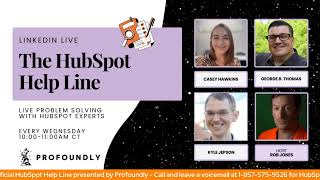
Rob hosts George B. Thomas, Kyle Jepson, Casey Hawkins, and Chris Musk to discuss HubSpot's AI strategy, which centers on capturing structured and unstructured data for AI agents. They cover new features like the Breeze assistant, Tasks as a full object, and transcript data in the CRM, plus Kyle's method of aggregating 150+ LinkedIn comments with Gemini to surface top ideas.
Chapters
Hello, you've reached the HubSpot Helpline.
Helpline.
It's Rob. It's George. It's Casey, Kyle and Chris.
Admin.
Call in, then tune in. You can't miss things.
Every Wednesday at 10.
Streaming straight from LinkedIn. Helping with HubSpot. Building community is our philosophy and we're so proud to be. Aren't you so glad that it's time?
I don't know how to follow up that intro song, but I'll try my darndest. It is Wednesday, February, the something. It's crazy. It's already February. I'm joined by four of the smartest people that have ever worn orange. Casey, greyhound of the helpline. Hawkins is in my bottom right. The man, the myth, the legend, George B. Don't ask him what the B stands for. Thomas, Chris Musk. Carolyn. He's a season out of style with that name and the OG HubSpot evangelist, Kyle Jepson. How are we doing on this Wednesday?
We're doing well, I think. I like that we don't have the video for the song because then you get to bring us in at the end. I don't know it just the timing. Good job, Chris. Nailed it.
That's nice.
Thank you. Figuring it out.
He is evolving in his role. Kyle, how are you doing today?
Great. Happy to be here. I don't know, should I have prepared a speech?
Ideally, yes, you would have, but that's why we have George. George, how are you today?
No speech here. I'm doing peachy keen. I'm glad to be here and see what we can do to help humans with HubSpot.
Great. Chris, same question to you. How's. How are you? How's the beard?
The beard is good. The beard is good. Helping me stay warm down here in Houston, Texas. So we're good.
Love it. One of the benefits of remote working, especially streaming, is that you can interact with and do live shows with colleagues, friends, aficionados while you have the flu. Type A on unrelated news, I might have the flu, but luckily for you, I'm not getting anybody sick because I am nowhere close to any of you. So shout out to remote work for enabling productivity and community, even in the throes of influenza virus.
I think that's pretty similar to the reason we all started working this way.
Not to. Yeah, not to contract the flu. Let me just clarify that point. But to, you know, to be able to still, you know, be maybe contagious and then still contribute to humanity. Speaking of contributing to humanity, I feel like I should ask a Question that was in the green room before the show. I have no idea. I have not been sleeping at all, but definitely not under a rock. But you guys were talking about some announcement or something that came up before we got on. Can. Can somebody fill me in on as to what that was before we dive into voicemails and bringing people in.
So yesterday I saw a LinkedIn post from Garmesh, and he was being Dharmesh. He was talking about agents and AI, which is what Dharmesh usually talks about. But then he said, this is why Yamini recently published a blog post. And that was news to me. I had no idea this was coming or happening. But yeah, on the official HubSpot company blog thing, Yamini has a post about how agents are the future and context is the thing that matters most and HubSpot's vision for how we're gonna adapt to the changing world.
Yeah, I love so many of the words that Kyle just said, but official blog thingy might be my favorite that he, he just stated. Yeah, it's, it's, it's very interesting where we're at, where we're going, what people are talking about. And I'm, I'm excited. Listen, I've been a fan. Chris has been a fan. Many of us messing around with AI have been a fan of context. Data structured and unstructured in many different forms, and maybe forms that people aren't even thinking about yet. It's just, it's going to be very interesting to see where HubSpot goes, especially pointing in that direction in a good way, by the way.
I think I found, like, for me, I was using Chat GPT for a really long. For a really long time, for months or whatever. That was my preferred method. And then at some point I moved to Claude, but it took me a while to move to Claude because ChatGPT had the context. Like, I had these threads and things like that. And then when I finally started paying for clawed, it was because of projects which then could group my context in like a bucket. And just recently I created a new Claude project for parenting where when I talk about kids stuff, I talk to that Claude. And just yesterday I was on the way back from the bus and I had a meeting at school coming up and I wanted to prep for the meeting at school, and. And so I just had my AirPods in and I was just talking about the things I was thinking about on the walk from the bus to back to my house. And then I got home and I sent it and then it, like made a Little dock. I looked very scary to the administration coming in because I had my little packet of papers. But that's all like context based and like all I did was I just literally dumped all the context I could think of in that during that walk into Claude and then I let Claude make that into something helpful.
Yeah.
So this is, this is all really interesting to me and I would love. Now anyone who's watching, chime in in the comments. Casey just did a great job explaining it, but prior to listening to Casey, just this very moment. Did context mean the word context in terms of AI? Is that a thing you all are thinking about? Is that a thing?
My God.
I know. For this group, yes.
Oh, oh.
I wonder if for the average person watching us on LinkedIn, if that has even crossed their mind. Because a week ago, at the behest of the product team, I published a LinkedIn post saying, asking, where are we falling down on context? Where do you expect HubSpot AI to have access to something and doesn't? And we have like 150 comments and I would say like 5 or 10 of them are on topic.
Yeah, yeah. Most of them are asking, like, basically posts that you did before feedback.
If you have feedback for HubSpot products, send it to me. I'll find the right place for it. It's never wrong to give Kyle Jepsen feedback about the HubSpot platform, but it just occurred to me, maybe part of the reason Yamini is publishing this blog post and Darmesh is talking about is I think a lot of folks don't know what we mean when we talk about context and why it's so important.
Oh, that just made me so sad.
Yeah, I think Yamini posted it because she saw the comments on your thread.
Well, let's take a look. Like if we can, let's take a look at her post because there's also a really good visual on the. On the blog post as well. So every leader I talk to says the same thing about AI. They're excited by the potential, but disappointed with current results. The gap isn't intelligence, it's context. In the past, your tools brought you the data and your people applied judgment based on the context. They know. They know which campaigns will convert best because they understand the audience. Which deals will actually close based on prior patterns, which customer escalations to prioritize based on conversations they are having. But that context is buried in people's heads, scattered across systems, and hidden in how your team actually works. Without that context, you get output from AI like emails Research summaries, but not better outcomes. Our point of view is this. For AI to drive outcomes, it needs shared context. And shared context is the combination of data about your customer, knowledge about how your team and business actually work, and the ability to learn. That is what will help humans and AI agents to work together as teammates. Thoughts? Before I bring up the visual.
Or.
Should I just add that I have a couple of, like, context examples, but bring up the visual first.
And I wanna, Sorry, I wanna highlight this part right, where customer understanding lives. When, when people started talking about hiring for context engineers last year, specifically AI context engineers, I. And I think it's still in my LinkedIn like, headline, like Human Contacts Engineer, right? Like we're, we were bringing in, like, oh, let's solve this with AI. Meanwhile, all of your humans in the organization, that's where the context lives. And they could all engineer that context if you ask them to, because they're forced to do it at every step of their process to serve their internal customers or their external customers. And the biggest challenge of CRMs in general is trying to pull that context into a system so that everybody can use it. And now it looks like, thanks to AI being such a possible value creator, people want that thing more than ever. But it very clearly cannot provide it without the context. So it seems to be like, finally front and center as far as. Because very recently unified data context has been a phrase I think I've been hearing since inbound. And I've heard leadership teams talk about it as a goal that they know they need, but they still don't have any, like, idea on what it's actually going to do for their business. Like, what does that mean to have unified data context and what are we supposed to do with it?
I, I found for myself, the more I use AI, the better it gets, because I start just naturally as I work with it, giving it context, which is great because, I mean, I tell people all the time, like, just start using it, just start using it and the context will just start building. But the downside of that and is I sometimes just assume that AI has the context it needs and it doesn't always. And that's because I've gotten so used to, like, I, I just use it for everything, so it knows everything. Most recent example being when I was trying to buy my new laptop and I went to Claude and I said, what laptop do I need? And it said, get a MacBook Air, you're good. And I told Chris this, and Chris said, you need more than a MacBook Air. What are you talking about? And I said, chris, I asked Claude and Claude said, I need an air. And Chris was like, does it know that you do a lot of streaming? Does it know that you're using Claude code now? Does it know all this stuff? And I said, chris, I use Claude for everything. Of course it knows. So then I poke over to Claude and I say, fine, Claude, do you know that I do a lot of streaming? And it said, absolutely not. This is the first I'm hearing of it. In that case, you definitely need more than an air. So I think there's just like a little, I just want to like call out like a little bit of a trap that I feel like I have found myself in recently where once you start trusting AI and you use it enough that it, you just like feel you think it has all the context.
Always, always check you, you have to.
Be, you have to be proactive about this. Like, like, listen, it's funny because when usually we talk about onboarding, it's like we're gonna onboard these new employees to our organization and part of onboarding is we're going to teach them how to use HubSpot. But have you ever onboarded HubSpot to your organization? Because we're. That needs to happen. Like it needs to have all the context of your organization and the context of your humans inside of your organization and the things that happen in their daily life. And trust me when I tell you, if you're proactive about this context building, magical things happen. Chris, I'm going to use content as an example if you don't mind. I'm going to share my screen and I have been a context junkie for a while. And what I mean by that is I create a lot of content over the last 10 to 12 years and I have a very interesting life over the last 54 years that has stories involved in it. And so one of the things that I did a couple years ago is I did a interview with Nate Brown, who is a premier voice when it comes to voice of customer. And I have this interview, I have this transcript laying around, but it's not really doing anything. And I'm like, hey, I need to write an article about that. Let's use the transcript as the foundation to build an article. But I'm going to use my AI assistant to actually write that article. But AI assistant, can you do me a favor? And I can only ask this next question if I'm being proactive and building like a story bank and giving it things like for instance, last Night, it scraped the GeorgeB Thomas.com website, the spiritual side of leadership.com website, and the Sidekick Strategies website, so it could start to build a story bank out of all three websites. Ladies and gentlemen, that's context on a different level. But this article, the reason I want to use this as an example is I said, hey, I want to write this article about Voice of Customer. It's very important. It's important moving forward in a world of AI, like, listen, customer feedback is context. Oh, my God. It's like we're in a, like, loop here for a second. Anyway, I said, can you please just pull in a relevant story about why Voice of Customer or why listening to what you're being told matters? And this is where it went. It says, I know what it's like to think you've got the full picture when you don't. Years ago, my wife's aunt Nancy, this tiny woman who exudes quiet power, made an observation about me. She told my wife, he's filled with anger. My response, no, I'm not. Now, it pulled in a life story around the importance of feedback into a voice of customer. I didn't write that, ladies and gentlemen. It added that in. I tweaked a little bit before it goes live. And it even calls back to the Aunt Nancy story at the bottom of the blog, blog article. But this is because you have context to tell those stories. I want you to think about your CRM, your unified data, your team, the people that you're helping, what story bank needs to be in there, what processes need to be in there, what mission vision. Like, that's why HubSpot is trying to build all of the tools. Like, if you haven't gone to, like, AI data in settings and like, done your Personas and your company and your products and your, by the way, everything. I'm listing your context in your context and your context. Like, they're giving you all brand voice context. They're giving you all the ways for like the last 612 months for you to get your context into HubSpot. Yeah, we're sitting here having a conversation of like, I don't know if many people out there know who, like, con HubSpot Academy, please create a context or the importance of context course for humans to be able to go through. That would be helpful.
Yeah, context is king, queen, whatever, very important. Can you, George, can you rattle off really quick what all that would look like as far as you just named a bunch of things, but very specifically, the problem with not having it. I, I accidentally Distracted myself with a. A quick Claude prompt about context, which may or may not have ruined my life, by the way, but we can get to that in a second. I just want to know what, what else context might look like. Because you said a couple of times it's you, the org, providing the context. Whereas what we really want to help understand customers and be able to help them is their context.
Well, and. And they're giving us their context. By the way, if you're watching this or listening to this and you're not using calls that are transcripts that are bringing. Being brought into HubSpot, that is unstructured data that can be associated to a human, and multiple calls can be associated to the organization to which then you can use Breeze to actually pull that context into something us, then you're missing a beat. Like if you're, if the, if any object or any information that you could have is not being stored. Listen, there's a roofing company now that we can do custom object. There's a roofing company that have a whole side of their business that they manage. Who has that computer, who has that truck, who has that thing? And now, because that's a custom object and because they can engage with custom objects, now they have Breeze that they can actually just ask it questions and speed up the process of when they're looking for things or trying to do things. Like, it's almost like I want people to think about how you would create and use objects, records, properties, associations, almost differently now that it used to equal data. Now everything. Data is context, data is communication, data is conversation. I don't know how else to say that, but Rob, it's like. Go ahead, Chris, go ahead.
Yeah, I was trying to highlight this statement here, like, context, where customer understanding lives. And we're at a point now where. Well, I think it's always been important. Like, we talk about storytelling and bringing people into the story, and you got to do that by knowing their story. But it's been very hard at scale, right, with actual customer data to keep track of that. AI helps with that now. And like, where customer understanding lives. Like, I want to go in there, and AI needs to go in there and see this story. Like, who is this person? Like, where are they in their journey? What do they care about? And those are the things that we know as humans. I think a huge part of why people don't think about context in a direct way is just because it's, it's inherent, right? Like when we show up and talk to each other, we're understanding all of these indirect communication signals that give us a bunch of context without asking for it. And we're built to process that. When you try to put that into a system, it's pretty much impossible to bring that level of metadata into the system alongside it. Now that we have transcripts, that and, and we're at the point some, some are doing this with videos and audio, like understanding tone and all of this stuff to where I'm super excited. And Casey and I have been talking about this a lot where like health scoring and sentiment analysis. Like we're going to a place where. But yes, please do all that AI like human. I could never understand all of the nuance of like hundreds of hours in some cases of conversations between all of the people that we're trying to serve. And we can get some really great insights now if we have all of that, that in here. Is that when you're thinking, Kyle, like when George says, do a, do an academy course about context. Like, how do you guys think about that in terms of like, if we were to say like, context is the story, like, should it be a course about building the story or like building the context?
It's been a long time since I built an Academy course. I've been off in my own little world doing webinars and social posts and things. But it's interesting you bring this up because as of, I don't know, January 1st or whatever, I'm no longer the only evangelist here at HubSpot. Crystal King and Aaron Schmaltz have have joined me and Crystal's heading is to help businesses make sense of AI. And she wants to speak specifically to like, business owners, executives, decision makers, not about, like how to, you know, implement HubSpot's latest AI features, but like, how do you think about AI generally? What can it do? What can it do? What do you need to give it to do its job? Well? How do humans and AI interact? What does that ideal world look like? How is this evolving over time? And I'm really excited to see some of the content she's going to be creating as opposed to like a six hour long HubSpot Academy course that you sit down and take in a go and we make it once and we update it once every two years. This is just going to be like shows and podcasts and things that Crystal is making on an ongoing basis, interviewing people. And so like, you don't just like get certified in AI context as of February 2026?
No, no, because that's going to be.
Useless in March 2026.
Yeah.
Hallelujah. Hallelujah.
You sit down with, with Crystal and you listen to her or you watch her interview an expert and, and you, you just constantly stay up to speed with how this space is changing. So that's.
Yeah, you, yeah, you got to be nimble. So I love that.
Yeah. I mean HubSpot Academy is going to continue making courses. Don't worry about that. There are always going to be things we can talk about and state emphatically that are true for a year or two at a time. But AI is just not one of them. Right. And no, to have this be Crystal's full time job, I think is going to, I think it's going to unload a huge amount of value.
Yeah. That's exciting. That's actually very exciting.
Yeah. And Rob, I would love to tie that in to delivering on the promise of this show because we have a couple of comments that are asking for help that I think we could bring in. And afterwards I want to like the real time help. Right. That's available for people like this whole like. Let's just get into the, the, the questions and then I'll share my thoughts. Is the default HubSpot Salesforce connector compatible with Salesforce person accounts?
Shout out John.
Thanks, John. So does anyone else have an answer? Is maybe where I'll start this or is this going to me?
You started talking first, so it's you.
So this is the first time I've heard of Salesforce person accounts.
I was gonna say the same thing transparently.
This is the first time I've heard of that. I have done some research and it does seem like it's possible with the native connection. You just need, you need to have the problem. The problem I've learned about Salesforce person accounts is they are looked at as both contacts and companies in HubSpot. Like HubSpot doesn't a person account is like I think, I think like a single person company like me. Like I'm a, I'm a person and I'm a company. I'm both.
Well, and I think they're meant primarily for B2C. Right. Like if you're not selling to a company, you don't care about someone's account record. Right. You just care about the individual here.
Right?
Yeah.
It literally says, by the way, I, I Google. Google is this junk. Because I need to learn more person accounts. Person accounts store information about individual people by combining certain account and contact fields into one record. That's what, that's what this thing is.
My Understanding is that you would need both the contact and company syncs enabled. And it. My understanding is it can be a little tricky on making sure which properties are mapped to the contact and which company. Which properties are mapped to the company. John, I am, I will follow up with you though, because I don't think I have enough information. I just don't know enough about this.
And it feels too like there'd be a good hackathon. So like for instance, if you did use the Salesforce integration and you had some properties going to companies and some properties going to contacts, but you wanted just to be able to look at one record, let's say the contact record, then all of a sudden it's like a, a universal degree in sync properties where you're just taking all. Because maybe you're not paying attention to companies. You're just using it to hack the data into HubSpot anyway. Yes. Yes.
Yeah. So many thoughts that I'm going to leave for a different show because a person account was created because that data model over in Salesforce is not built around humans and they need to like.
Identify can I, can I, Chris? Can I please Humans, right?
And so it's a person and somehow we're finding a way not to sync it with contacts. Like just maybe we could simplify the situation.
I'm gonna do something that's really uncomfortable for me and try to defend Salesforce in this regard. Wow, wow, wow.
Take him off screen.
No, like I, I kind of get it right. I, I, I, I suspect that in Salesforce on an account record you have like separate billing and shipping addresses that a contact wouldn't have. I'm not convinced that you need to like take account fields and contact fields and put them together into a new sort of record to accomplish this. I think what we would recommend any for anyone in HubSpot who's in a B2C context is just create some custom properties for the contact and call it a day. But I don't, I don't think it's crazy to think that there are things that in a B2B context would live on in, in Salesforce, an account record and in a B2C context would live on the contact record. I, I will say I, I don't. I've never been inside Salesforce. I've never used it in my life. And so to me, my intuitions are with yours, Chris, that there's probably a simpler way to do this. But I suspect that underlyingly there are some, some nodes that are being connected that maybe if you do B2C and B2B both. It's nice to have them all rolling up in the same way. But I don't know.
Yeah, I understand why Salesforce is kind of built around that account and the Opportunity objects. So lots of superpowers built into those things. But on the HubSpot side, it's pretty easy to say, okay, if this is a one man or one woman show and it's like coming from E commerce, this comes up a lot. Like the Shopify integration creates these issues where since it's revenue related, it's like trying to tie it to an account, but it's just a Gmail address. Right. And now that we have really robust associations and this is where we go data model, like if they need, if there's addresses to ship to, that's in the, you know, company object and that's associated to the contact, the human being that you're trying to deal with. So. But I imagine there's extra complexity because we're trying to bring it over from Salesforce and it has specific properties and.
Sure, yeah, the sync will always be the complicated part. But it's interesting to hear you say, like, historically Salesforce was very focused on accounts and opportunities. Historically, HubSpot was very focused on contacts. Right. Like we started with, that was the only object we had as a marketing platform. And I think it's interesting that it sounds like the Salesforce solution is like, we'll take a piece of this and we'll take a piece of that and we'll put them together into this new thing. HubSpot solution in recent days has been we're just going to unlock all the functionality for all the objects. Right. That is a march we are on and we are getting. And if you want to use Contact or if you want to use a custom object or if you want to use some other thing, like they're all going to work in workflows, they're all going to work in reports, they're all going to be able to be associated to each other. You can create custom properties, you can customize your views and whatever. And that to me is a very exciting direction to move in. But I'm sure it will complicate integrations with other systems.
The Salesforce in particular, I'm sure. But I'll be the guy who's going to defend HubSpot on this podcast. Use HubSpot then. It won't be difficult. There is no seek if you use HubSpot. Now here's the thing. What I really want to Say is, Kyle, I know that we've reached the promised land. When I open up my HubSpot portal and Tasks is an object. Then all of a sudden, like, the clouds will part and there'll be, like, angels singing, like. But I have loved over the last six months, eight months of, like, this is an object. This is an object. This is an object because it just unlocks the freedom to do so much more and give you so much more power. Based on what I think was a firm foundation is we're gonna focus on humans and then we can build from there. That's amazing to me, but that's just me.
Chris. When this is over, send me a clip of George saying that, and I'll send it to the product team and we'll make tasks the full objects. We'll make it happen.
There we go.
Will do. Anyway, to make the campaign name smaller. I don't know if anybody has access to this specific post.
Oh, I do.
Yeah, this is. There's. There's weirdness in Streamyard where sometimes I can't see people's names because of permissions in LinkedIn.
Yeah, that was a long UTM parameter.
Five different people streaming.
Oh, but I can copy that URL and just open it in a new window.
So I got Casey here.
I think the answer is no. I think he's asking about this, where it kind of starts to get cut off.
Oh.
And like, the autosave text is much smaller. Preview and test is much smaller. But this is large. That's the way I'm reading this.
Interesting. Yeah. It's funny, I never really complained about that, but I have run into where, like, man, can I just see the rest of what I'm looking at here? So.
But is that. Is that the. Am I right?
Is that the question? Because. Because the font size could be a good bit smaller right there and we'd still be able to read it.
I don't.
Yeah. The question. Is a campaign name smaller?
Yeah. Well, I mean, also, does the campaign name need to be all those words?
Yeah. Yeah.
And I think they're just proving a point in. Because this literally says in this box is very large and gets truncated, which is. I will say this usually when I'm teaching anything as far as workflows, campaigns, when it comes to a naming convention, I try to get people to use, like, a tagging convention with it. And so it can be like, smaller, like awareness, whatever.
Campaigns specifically, like, historically, HubSpot wisdom has been. Have very long names. A naming convention with pipes in between. Like, what region Is this What, what, what product is it supporting? What, what team is it for? Because campaigns didn't have custom properties. Right. But we fixed that two years ago, three years ago. So by all means, like make region a property. Make, make owner of property. Make, make all the different properties. And then yeah, hopefully the title can just be the title.
Yeah, I was gonna mention the custom properties too.
We've got a couple more questions, but I wanted to throw one on here that we skipped over. And it's interestingly enough is some context clues from Alan Parley. Can you throw that one up there, Chris? Anybody know what between 480 and 510 terahertz means? I googled it, so don't answer it. But really quick, Chris, George, Kyle, what does this mean?
Oh, did you look it up too, Rob?
I, I didn't, I didn't look it up, but for some reason I immediately thought of like back to the Future and like 1.21 gigawatts. Yeah, that's what my brain went. For some reason I'm like, what is going on? I have no idea what this is.
Your best guess based on context clues. Bringing context back into the forefront. Chris, do you know it or have you googled it already?
No, no.
On the electromagnetic spectrum, this is the area that corresponds to the color orange.
Oh, wow, nice.
Speaking of shout out for the comment today, in my opinion, we were talking about context and this is a very clever way to insert this in here. So that's pretty. Not to derail us, but that was, you know, just looking at the number 480 to 510, there's infinite almost things that that could have meant, but considering all of us are wearing some sort of orange, that being brought up the comment right before that, this was a very clever way to put that in there. So shout out to Alan on that and we can go ahead, Chris, with Samantha or Robin comment in the, in the thread.
Let's go with Samantha. Okay. Met her through Sprocketeer a couple years ago. How would you go about creating a roll up of customer data from campaign association campaign names in a row, sum of contact data counter pools they service in columns, thinking I need to create custom segments for every campaign. No true associations. So roll up properties on campaigns don't work.
This kind of ties back to what we were just saying about tasks where campaigns are one of those like, we call them like baby objects or like where they don't have like the full object functionality, which is I think the pain that's coming in here specifically.
And Usually in those situations, lists or segments is often a part of the workaround. But I'm not familiar with what the solve is here. So.
George, you look like Kevin McAllister from Home Alone. Are you?
I. I'm trying to break this down to get to the actual like what's the actual outcome? And and my brain is also wondering if Samantha is on like old campaigns or on Marketing Studio right now with this question because of what Casey said. So there was a lot going through my brain but like I almost, I know we've said this on many shows but I almost want to know maybe more. I know all of these words but I'm trying to figure out what the like maximum outcome and what action needs to take place on the outcome is on this.
Do we have time or is Samantha willing to join either this after today or next week question.
Samantha, if you're out there and listening.
To this dm, whoever, whichever one of us you feel the most comfortable dming if you want to join today or next week to chat more. I was working through a solution too but I just kept being like I don't think I understand like what we're trying to accomplish enough.
Yeah.
I'm not surprised it's coming up as we've like I think it's like 28 assets now. 27 assets. Yeah, a lot like that many asset types that we can now associate with campaigns. So I'd be very surprised if the team wasn't working on. The the solution here. She says she's in Marketing Studio not associated revenue but my own roll up. Is the campaign an activity or a strategy over a period of time?
Oh, next week works. There we go.
Right.
Bucket, nano bucket. We can get more details.
Let's do it. Oh so to that point like and we've talked about offline, we've talked about voicemails and how do we get people to call in and recent experience. I think the the truest of HubSpot challenges. It's hard for me to see a way that they don't get solved outside of one to one live conversations with another human being. And in the cases where we don't have a human around and it is quick fixes or you know, shortened to the point we have breeze assistant, we have all of our AI friends, we've got hub helper Harry and I'm reminded of the first time I experienced this back in 24 was somebody in sprocketeer sent me a DM about a thing I'm not very knowledgeable about which was like Reporting, I think reporting or workflows.
And.
I suggested that that person put that person put that question in like the ops channel or something like that so that more knowledgeable people could help. And within 20 minutes, he came back and said, I'm good. I asked, I asked Hub Helper Harry and. And now I solved it. That was 20. That was back in 24.
Yep.
Right. And so this mode, right, of like trying to enable everybody to be aware that they have access to like Breeze Assistant, but it's almost like we stumble into it now because the pain is great in that moment. We really want to solve it. So we might ask somebody, but eventually we're going to click on that assistant button and give it a try. And it only takes one wants to go right to then be like, okay, this is my new mode of like, you know, quick help. So cool to get some. Get some questions this week. But those are the things I wanted to share.
Shout out to Samantha. Just DM'd her and got her nice semi lined up for next week. So to another guest joining us to provide more. What is it, George?
Human.
Oh, contacts. You need a context. Helium voice for context. Yeah, I think.
Well, I could. I could do maybe something like. Let me see here. What do I. What do I. What I got at my fingertips, I could do like. Oh, let's see. What about. There you go. Whatever.
Oh, here's a great request for the product team, Kyle. Wow. Integration of Hub Helper Harry.
Oh, geez. I think it's called Breeze in.
Yeah, Breeze will be that good someday.
Yeah, I think.
I think someday. Someday.
Oh, Robin, feelings.
If you're like, what if we. Why don't we just.
Yeah. Hey, Chris, Great show. Thank you. I was auditing a high traffic HubSpot social media guide today and found a broken 404 link in the Instagram section. Who's the best person to flag this to? So the community keeps getting valid info, huh?
Drop us.
What if this is a. Is that a HubSpot thing for the guide?
Yeah, if we can see which guide you're talking about, we can maybe track down who made it.
Yeah, all sorts of feedback. I think they heard you because there was no comments prior to Kyle saying, like, welcome. All forms of feedback.
Right. Yeah, I love it.
Oh, for sure. No, it's great. Just saying you have this power. Like people just hear you from. From all over the place.
Summoned them.
Yes, yes.
Feedback, Feedback, Feedback.
Yeah. If you attach that link or comment the link, I can throw it onto Kyle's post and somebody will see it Kyle, to your point, this is distracting me. You've mentioned 150 comments. If you did it again, it's up to 218 now by the way. But people are actively looking at the the feedback which is good, so we'll add it to the list.
I would love to comment here because I'm sure people are like this is a million comments and I'm just speaking into the void. And I will say the number of responses we've gotten to my now two feedback posts has really amazed us and we are scrambling to put systems in place to get all this routed to the right teams. You may not see a reply to your comment, but no, it is being aggregated and prioritize now that Gemini, speaking of AI, lives inside of Chrome. I've never really used Gemini, but I really like that there's a Gemini button in Chrome and it can read the page you're on. So I've just been going to these pages and expanding all the comments and saying to Gemini, here's a a post I made in LinkedIn. There's a bunch of feedback about HubSpot. There's a lot of different comments. Please categorize them, count them, tell me the top ones. And it's I've been doing that every couple days and reaching out to those teams and being like hey, you've got 18 requests for this feature, just so you know. And it's been great.
Any man, any surprise category, categories or like the way that it's splicing things.
Up that I should have known you would ask a follow up question.
Well, well if you're looking, if you're looking that up, Kyle, while are you looking that up? I just hope everybody heard what you just said. You do? Because I don't know how many people watching this. I'll play Kyle for a second. I don't know how many people who are watching this actually are using Gemini in Chrome or Claude in Chrome for like their daily life or their daily business life. Because yeah, I mean have you gone to Gemini or Claude when you're on your home page and ask it to do a home page audit and tell you how it could be better? Have you tried that yet? I'm just. Anyway, I'll shut up.
Yeah, that's a great practical application of that, Kyle. It might be something to. I don't know if throwing it into this show as like an ending or a quick segment would be as useful given the context of what we're trying to do. But that type of functionality, since it is HubSpot product related I think would be great for people to to be able to see and use on their own as well.
Yeah, I've got it pulled up now. Do you guys want to guess? So specifically for my first post asks where are the gaps in in HubSpot functionality? Where does the data not work in one place the way it does in another place? I'm going to tell you and you're going to be like oh yeah, obviously.
I will guess shout out to Max Cohen. But nav like navigation. There's I think he was all caps for about three paragraphs of things.
He was. Yeah, but no extra points for all caps. So top umbrella category is workflow and automation gaps and top requests meeting based workflows, line item management and workflows triggering actions based on associations. Right. Workflow goals for non contact objects, date based logic hub DB access and workflows. We got two of those.
Yes.
Cross object trigger an action parody and then the second umbrella term is CRM objects and lead management. So lead object is not at parity with the other objects. Anybody surprised to hear that? Custom properties on tasks and activities. That one's for you, George. Mandatory meeting outcomes and types, Lead stage automation, syncing emails to company level. Then the third umbrella is reporting and data gaps. We want historical property reporting, cross object joining in reports, unified chart and filter options and then UI UX experiences. That's where navigation comes in. People would like to be able to customize the the colors of things. We want dark mode marketing and sales tools. Is is here near the bottom Marketing events object is is still not everything everybody wants it to be. Sales workspace has some feedback but yeah, uh, no surprise to me. People want to be able to automate literally everything in workflows and they want all the object parody across all the things. Whether it's a contact or a task. They should all just do all the same things. So yeah, that's kind of the main story and that is the direction HubSpot is, is moving. So I'm, I'm very hopeful that a lot of these requests will be fulfilled and not in the distant future.
So.
Good.
Have you tried any other way to parse those out? So instead of just like what bucket do these fall into? You gave us the three with like workflow automation, you know, interface or color preference or nav. Is there a like a sentiment or a desire behind those that you've come across as a common thread?
That would be interesting.
I would like to make my life more productive. Like I would like to do less so I'd like to automate everything. I'd like for there to be more.
I'd be really interested how well Gemini would do that. So a lot of these LinkedIn comments, some like Paul Ard is he gave me like 27 right in a numbered list and it's legitimately just like not even full sentences, meeting based workflows, customizable nav this this that there's no like why like five whys analysis of these things. But certainly some people like Max waxed poetic and and gave us an insight into he's passionate about the now they were feeling. And so it would be interesting to see what sentiment analysis and what like underlying jobs to be done sort of thing could be surfaced certainly with what now probably more than six or seven hundred comments across those two posts. We could, we could pull something out.
And it's interesting I'm looking at some of the comments right now and like the amount of project managers who have dropped their meeting links like in responses.
To yeah, no, this is a big and I Robin, I see you the age that the Ideas Forum is is getting a lot of love lately. I don't know if you saw my video a couple days ago where I played Count Von Count and came up to more than a thousand upvotes that we've resolved recently. It is true, Robin, you are not wrong that there are some posts that have been on the Ideas Forum gathering cobwebs for years. But we are repenting of that. We are changing and it's, it's a, it's a new year, it's a new HubSpot. I think, I think Ideas Forum is hot. I think that's a great place to post things but you are always welcome to reach out to me directly. Honestly, the best thing to do, I shouldn't say this because I don't really want everyone doing this but just like post on LinkedIn and at mention me and see if others pile on because then there's real visibility, right? And our product teams and even our executives are getting much more aware of what's happening on LinkedIn. I've seen Dharmesh commenting on posts. I've seen John Dick commenting on posts. And if you can get even a handful of people to pile on with comments that say ah yes, this drives me crazy, I'm 100% screenshotting that and dropping in a Slack channel all day every day. So but then also put it on the Ideas forum because we really want that to work. There's a lot of power on the back end of the ideas form where we can do reporting and we can see which posts are getting the most upvotes and how quickly they're growing and how long they've been on there. In a way that LinkedIn stuff just disappears into the ether. Right.
That said, if I could share some feedback about the ideas for if. Like, so in a world where we want response like quickly, I'd say last it was 24, I think when I did only two times I posted on there. I was, I wasn't surprised by the reason, but the fact that there's a 24 hour like delay to get approved and it's. I heard there was some spam, there was some spam issues and what happened was the only reason I, I was treating it like a slack post or a LinkedIn post. All right, I'm done now and I'm going to follow up real quick with the resources that I mentioned here. And I couldn't because there was this delay and I shared that with the team. Right.
Yeah, no, that makes a lot of sense to me.
But I think it could blow up if maybe that's helped out a little bit.
But otherwise HubSpot is itself having a lot of good luck with Customer Agent. And it would be really cool if Customer Agent could somehow integrate with the community and say like, ah, we have figured out that this is a feature request and either like here is the post to go upvote or is it okay if I create a post on your behalf? Here's how I would like to document it.
Ooh, that would be dope.
That would be dope.
I like that a lot.
Yeah. And I would like to wrap Rob on this example about Gemini and if you're struggling with uses for AI or like, whatever.
Oh, you've done it too now.
Well, where I started was since I was on Yamini's post.
Yeah.
And I wanted an example real quick was, hey, what do you think about this post? Right. So diagnosis, spot on. Output versus outcome, bad data, reality check. And then as you were talking about yours, that came over your post, I said, can you tie the comments from this Kyle Jepsen post to the narrative of the Omni post?
Oh, wow.
And so to give you some credit, Kyle, like in the importance of kind of creating this conversation and just asking the question about context, even if it was only 5 to 10 comments direct about context, there is additional context about all the features that people are asking for related to the overall like product vision, I would say. Right. And this kind of insight, you know, only can be Drawn out if the conversation is happening, like out loud or out. Out in public. So. But this is just this, this Gemini button up here. You know, sidebar comes in and ask it about anything on the page. Kyle is asking that you navigate from.
One page to another and it remembered where you were and was able to connect the two. That's really impressive.
The community is answering with two distinct categories that align with Yamini's fears. We can't store the context and the data is too messy to trust the context.
Yikes. But also my post here, the second to last paragraph, shout outs to the people who gave the most suggestions. Last post, Paul Lard gave 27, Laura Brennan and Jamie Shucks gave 13 each and so on. That was also a Gemini analysis. I was just like, who are the top contributors here? Do you know how long it would have taken me to tabulate that myself? I would have just not done it.
Exactly.
Yeah.
Excellent. Well, we are at time.
Great.
Before you close, go ahead.
Kyle said something that I want to repeat and you can make fun of.
Me for saying blog post thingy again.
No, no, no, no, no, no. I want. We said a lot of cool things, but what I really hope everybody heard today was Kyle said, it's a new year. It's a new HubSpot. All right, Rob, go ahead.
Hard tough to follow that. We will welcome Samantha next week. If you have voicemails to leave, leave them better as loom videos or some recording so we can have more. What's. What's the word, George? Context.
Context.
But join us next Wednesday. I think this was even better to an extent, Chris, as far as engagement, love helping people out, love getting more context. Would love for people to join. So shout out again to Samantha and everybody that's been commenting on Kyle and other posts. I am intentionally including the executive team on that because I've seen Dharmesh and John Dick and other people, especially product managers, comment. But this has been a great Wednesday episode where we wear orange, which is, by the way, between 480 and 510 on the electromagnetic spectrum. There's your knowledge nugget of the day. We'll see you next Wednesday. HubSpot Famous.
Hello, you've reached the HubSpot helpline.
It's Rob, it's George, it's Casey, Kyle and Chris. Admin call in, then tune in. You can't miss this Every Wednesday at 10. Streaming straight from LinkedIn. Helping with HubSpot. Building community is our philosophy to be. And we're so proud to be. Orange you. So glad that it's time.
Hello, you've reached the HubSpot Helpline. Helpline. Helpline.










