HubSpot Helpline 9/12/2025
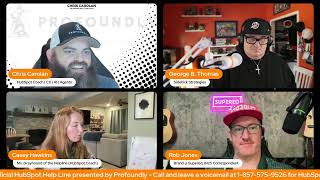
Rob, George B. Thomas, Casey Hawkins, and Chris Carolyn break down HubSpot's 196-200 product updates and how to actually keep up. They recommend prioritizing by pain points or role, watching for tipping points when HubSpot features beat third-party tools, and building routines to process changes. The volume creates real cognitive load, but Data Hub and Data Sync open new opportunities.
Chapters
Hello, you've reached the HubSpot Helpline Helpline.
Help behind Helpline Helpline.
It's Rob, it's George, it's Casey and Kyle. Come with a problem and leave with a smile every Friday at 3. Come and join us as we help you with HubSpot. Open up your LinkedIn. Just make sure you call in and leave a voicemail about HubSpot. Make your Friday divine with the HubSpot Helpline.
That song never gets old somehow. Yeah, it's always a good way to get way to start out. What's up? We are the HubSpot Helpline crew. I'm joined by a bunch of inbound correspondents and people that are probably still as tired as I am even a week later. We've got Chris Carolyn. His middle name is not Moss, as I joke with him all the time, but he is Mr. Value first, Mr. Profoundly 4000. We have Casey Hawkins who just got back from her first ever inbound and gave me a bracelet, which by the way, I have that right here. Mayor of inbound. I kept it nice. And we have George. Don't even pretend to ask him what the B stands for Thomas, because he won't tell you. It's a big mystery. I don't know. The. The humans. Speaking of, where are all my humans at? You have to summon them with the. The George B. Vocoder humans.
Wow. Nice. I'm not even sure what that is, but okay.
Yeah, you'll know you'll do it in the show sometime. I need to work on my intros because they're too long winded and eventually I think people just forget what we're even doing here. So I will recap. We are helping humans with HubSpot and we just got back from San Francisco for after. I was there for six days and then I spent three days recovering from weird jet lag and having my voice gone for the majority of the conference and then had a bunch of work to do. How has your time back been, Chris?
It's been good. A lot of updates to get through and thankful for for Casey's assistance in doing that. Some good sessions this week. Got through all 200 updates said out loud live on LinkedIn and we're actually doing something after the the live content too. We've already got one blog article up recapping all the updates and we've got big plans for a HubSpot updates like kind of like strategic meaning area on the Profoundly blog. So that's been one. Com. I mean since inbound, that's been the common thread for me as I talk to people. How do we understand what the updates mean? How do we know which ones are best for our business? Who can help us figure this out?
So, yeah, that's part of what we're doing here. But you've been doing that all day, so I assume you don't want to keep talking about it. But of the. I thought there were like 228. Right, right. At 230 over 200. Because I saw you made it through 130 and then did another 100. Either way, it's a crapload.
It's. It's a lot.
It's a lot.
We got to 196 today.
Yeah. Yeah. How do you. So it's not going to be 196 blogs, but how do you distill all that down into what people can actually use?
Like you can be. Stay tuned.
Oh, okay.
Oh, wait, Rob. There's more.
But wait, there is definitely more. Yeah, I think. Shout out.
It takes a village. It takes a village, Rob. And I believe we have gathered that village.
Wow.
At Profoundly. And so I know there's a lot of, you know, the mission with Profoundly is like, hey, we got all these individual experts everywhere showing up. Imagine if we put them in one place and made it easy for people to find the exact help that they need. I mean, this comes from a very specific request. Feedback from somebody who really enjoyed the Profoundly experience earlier this week. And the one thing, the one challenge that they mentioned was there's a lot of updates.
Yeah.
I wonder if you guys could make it easy for us to understand which of the pros could ha. Could help us with which updates to which I happily reminded the team, that could be what me and Casey are up to like, already. But yeah, I think if we just create the space and obviously all the AI tools not to just throw up verbatim, you know, product update situations, but to add a little bit of meaning and create the space for. For any HubSpot experts to come in and comment and like, share their piece about each update. I think could be. It's going to be really powerful.
So, yeah. And you are doing the work of the people. I. I view all of the update notes and all of that very much like the Apple terms and conditions. It's like nobody really wants to go through and read all that and then condense it and translate it into what it means for you. So shout out. What is the. Aside from the approach to raise a village of people to be able to do that? How do you how do you condense that into something that is actionable? Not a blog? Not because I view it very much as several different updates as an aggregate impact. Something that people need. Right. They're, they're one or two things away from being able to do this business function and now they might have it. So with that volume, I mean, you do what, 20, it's usually 20, 25 a week and now you have 200 dumped at one time. Does that take the full week? I mean, is that literally what you've been doing the entire week is trying to distill that down into like how to make sense of it?
So we did three hours on Tuesday to do the first 102. We did an hour and a half today to do the next hundred in between there, you know, got some help from, from Claude to take that three hour transcript and turn it into a foundational recap that we've published. One just to get all the updates listed. There's some other articles already drafted to contextualize everything, Put the Breeze updates together, put the data hub updates together. I think this is how I tie it into helping people. The loop marketing playbook. Right. Should probably spend some time on that today. Like, I think the major shift is that we are not any longer in a place where everything needs to be consumable without the engagement. Like instead of conversion without us, it's going to be conversion with us. And if we switch from conversion over here to signals that we can respond to and convert in the moment. Every piece of content comes with the expert advice, live and in conversational ways, whether it's from a human or whether it's from AI. I think what we're going to find is that the words on the page are going to take a backseat to like to whether they're there or not.
That just went completely over my head.
So like I'm. The priority is get the information out. Yes, because the product updates page and the Spotlight page on HubSpot is not good enough. The other spot we see it is on LinkedIn here today, gone tomorrow. Right. So how do we make. Make it so that the people that can answer the questions even like have it as a. At the ready so that not everything is just conversational or just an asynchronous piece of content. Right.
Less far over my head. I think I'm picking up what you're putting down.
Maybe George can, can help me out if he understands what I'm trying to say here.
Well, my brain went in a completely different direction, if I'm honest. With you, right? Because you went from the perspective of like, what you need to do to enable others to be able to then enable others. Because you're at this like three layer thing of like, we've got these pros and we need to enable them to be able to enable the people that they're helping. Because our business model is helping humans with HubSpot. My brain went to when you asked that question, Rob of one update at a time, followed by one action. See, here's the problem that we find ourselves in right now. 200 is too many. It just is for mere mortal humans. You see all the updates and what does it mean to you? Not jack lickety splot, you, you don't know what action to take, where to go, what to do. The amount of humans that I believe are probably paralyzed by this. Right. And, and where my brain goes is I recently was talking to a human, they're going through the HubSpot sales process and I heard these words. I've never used a CRM ever.
Huh.
Well, great. Let me take you to this page where there's 200 updates to a thing that you've never used in your life. Let me take you to another place where there's some articles on some changes to a thing that never. Like if I, if I was new in the ecosystem or even if I wasn't new in the ecosystem, I would figure out what is my major pain point, maybe my three major pain points. Then I would go on a search and rescue mission to find out if any of those updates had anything to do with the one to three pain points that I'm facing. And then I would take action on the one to three pain points that I've been facing. If they don't fix my problem, I don't give up. I'll stop. Humans, I'll stop if it don't fix my problem. Because see, nerds like me and Chris and Casey, we like to talk about all of them because they're solving somebody's problem.
Yeah, that's why I'm here, is because.
If I go to the individual human as the user, if it don't solve your problem, maybe know about it, but ignore it until the problems are solved. Then you can go and figure out, well, what's the next level after that?
Yeah, I view the update volume, I mean, very much like a problem in and of itself.
Right.
So to your point about not, I've never used a CRM before. How in the world, like, where's the entry point to even understand how any of the updates or any of the functionality could be fixed. Could help fix a customer pain point. Whenever you're not familiar with it, there's a. I forgot what the game is, but I think the metaphor works well that I played a mobile game for a while. Didn't play for like a year. I think it was Star wars, of all things. Chris, which is funny. And then hopped back in and the amount of stuff that had changed and been updated made me quit the game completely. Yeah. Very much like that. I. I looked at it, I was completely overwhelmed. Forgot why I even came back in the first place. And then there was. There was no behavior change. It was actually created like reluctance and resistance. And that's the last thing we want. When people are maybe to George's point, exploring HubSpot as a replacement or exploring CRM for the first time. Right. And. And now they have to contend with not only everything that's happened, you know, for the past three, four years up until now, but two, their first experience is 200 new things that could help you. I also created a graphic right here to help me see that. But ton of updates. There's Chris profiling pros and audience. So that. I think that's what George was saying. The three level. Three level. You know, coach through, explain through. That was my understanding. Hopefully I got it pretty right. Chris.
Yeah.
Right. I mean, the space between the audience and the updates is important. Like this world of product LED growth and that people who don't know what they're doing can get value out of tools they've never. Like complex tools they've never seen before. That's a. It's a myth. Right. And like, I'd rather just lean into it then. Yeah. That's the importance of loop marketing, like playbook, in my opinion. It's built to be there with them. Like not to like show up when they convert.
Yeah. So can I say something? And again, I have to preface the words that are about to come out of my mouth. I love HubSpot. I love HubSpot updates. But can we just call something what it is? 200 updates. The spotlight, ladies and gentlemen. It's marketing. It's marketing. We're showing you that we're doing cool stuff. Now, Rob, you started to throw a couple R words out there when you were just speaking. And I had to ask myself, was he at my talk? Because during my session at Inbound, I talked about, is your marketing creating resistance, resentment or rejection? And that's exactly what happened to you with the Star wars game is so much had Changed. You used I think the word like resentment or rejection or something along those lines. And so here's the thing. While 200 updates in a Spotlight is good marketing, is it? I love HubSpot. I love, see that I did the sandwich. I love HubSpot. I love updates. I love HubSpot. I love updates. But if you break down the mental capacity of humans in a four day period or even a three, four month period, like, they'll be, there'll be people catching up before the next spotlight happens.
I mean, think about the number of times that you show someone. Think about the number of times that you've shown people how a workflow works. Like you have enrolled someone in a workflow to send an email and they've been like, whoa, this is wild.
Yeah.
And that's why, like, and the number of updates I've read that I've thought, this is amazing. So few people are gonna use this. It's insane. Is, is disappointed. Maybe not disappointing isn't the right word. But, um, the tool is far, is getting more advanced, but beyond the capacity of a, a mere mortal to like, to advance that quickly.
So. And again, this is not a gripe fest. We're supposed to be helping humans with HubSpot. What we're trying to help you. Yeah, we're empathizing. And what, what I'm trying to get across here is like, you've got to break it down. And whether it's the way that I said of like, what are your top three pain points? Fine. Another way you might break this down is what are the things that we want to do that we've never been able to do. Right. And I go to like the whole video editing, you know, process in HubSpot. I go to the podcast process in HubSpot. Like so, so there's, you got to figure out like, what road are you driving down? And now that you know what road that you're driving down, what signs updates do you want to pay attention to as you're driving down that road? Otherwise it's like there's no way to take action any other way.
I have some clients that just are on Marketing Hub. Their sales team is on in Salesforce, their customer success team somewhere else, whatever. And that makes it like a little bit. That alone can make it a little easier because they might see these updates that are really cool. So there's the deal loss agent, there's the sales marketing align agent, there's things like that. But if that data doesn't live in HubSpot for whatever Reason then like very cool updates. If you want to talk about moving your team into HubSpot, we can talk about that. But like that there are so many conversations before we're talking about implementing these sales tools that you think are cool and that are cool. So I, for me it starts with, yeah, it starts with the problem, but it also starts a lot with the role. I'm, I've, my, I grew up in marketing. I've leaned into sales enablement quite a bit, but customer success has never been an area I've played significantly in. So when we get Help Desk updates, I'm always like kind of catching up on what even the update is. So I think that's also a way to kind of filter. If you don't do work in Help Desk, you, you don't have to worry about the Help Desk updates first. Like the updates that are relevant to you are probably the ones you should like, prioritize first. Chris is making a face because I'm guessing he's like, some of those updates are very cool.
But, well, here's where you sent my brain and then this might be where you sent Chris's brain to a point. And what I want to talk about is tipping point. There's, there's going to be a tipping point of when all of a sudden Help Desk gets better than Help Scout or name your software of choice that you might use for the other thing. And so there is some level of like, okay, maybe I need to spend a four hour period looking at the last six months of updates on a particular tool set. Right now I've given you three different directions you could go. You could start with problems, you could start with the future journey, or you could start with a specific tool. And now you're trying to. Well, I'm trying to find a tipping point. Has this, has this reached the point where it's better than the thing that we're currently paying for at a higher cost? Okay, now it's, now it's time to make a decision and really start to pay attention to that and implement that.
Yes. I just think when they drop 200 updates, if you're prioritizing where to go first, often like your pain points are probably the first direction it makes sense to start.
Yeah. To Rob's question, like that's the entry point.
Yeah.
What do you, what does your business need? Right. Like, but question, how much CRM adoption did we have before we were getting 10 updates per day?
I know where you're going with this.
There is an element of this and I Say this all the time on the morning show. This update is just as much for AI and maybe more so for AI than it is for the humans using the system and coming from a space in manufacturing where you feel so far behind and you're asked to digitally transform the organization and any plan you come up with feels like boiling the ocean and we can't do that. I've only with HubSpot have I seen it tried from the other extreme which is let's see if we can like let's make it possible to even try to do all the things and then like scale back to see how to balance it instead of let's just start with one with you know, let's manage everybody's expectations. By the way, there's 250000 customers now. Right. And just the enterprise nature of the business like they've got to go. If they are there to help us grow better, they've got to do these updates in my opinion and from a marketing perspective they. They start with current. Current way is broken. Here's loop marketing by the way. 200 updates. So you know, we're working on it but we can't really decide what all the updates mean for you. Just know that we're. We're moving forward in the way that we're asking you to. And that wasn't clear to me until I had a client call earlier this week where the beginning of the email is just book time with you so that we can figure out how we can implement the new loop playbook. Right there I'm like I'm probably not your guy because I'm focused on other stuff. Right. But then gives me all the business context and all the goals that they have. Right. And it's the same problems as everyone. We got to do more content, we got to do more video. Our data sucks. We're using too many systems. Yeah, right. So what that was insightful there is the loop playbook gave that person a frame like and a goal like to work towards instead of just get more out of HubSpot. Right?
Yep.
And I that was very powerful for me because we get on the call and this is the part where like ever boarding and that concept is so important and I hope that you got to find a way to get that to take off because we get on the call. The person who owned HubSpot just left.
Yeah.
We got an owner who I'm helping on the call because she asked show me how to. Show me how to add a file like to HubSpot. Yeah, right.
So here's the thing. Like, so do we need to know about every update, or do we just need to know about some updates? Like, could some updates go through and maybe there are, by the way, but could some updates a go through and we not need to hear about them or talk about them? They're just magical things that appear, and it works, and it's amazing. Do we live in a world where two updates should be being combined together as one? So. Because, again, here's the thing. We're. There's so many things coming at so many people. And by the way, this is not just a HubSpot problem. Let me explain. I'm laying in bed last night, and I'm laying in bed watching a video because I'm trying to catch up on something that I wanted to watch, but I didn't have a chance to watch because I'm helping humans with HubSpot, and I'm watching the apple event that just happened. And I'm watching, and I'm getting confused. And I'm watching, and I'm getting confused, and I keep watching, and I get more confused. Well, which effing watch should I buy? Which phone do I want to buy? There's so many choices and so many things, and there's so many megapixels and this. That, and high blood pressure. And I'm. I'm watching this thing, and I'm like, I have no way right now to take action on the best course to spend my money with your organization, because you have confused the. Out of me in an hour and six minutes.
What? The What?
And I'm. And I have their products. So this isn't just a HubSpot thing. This is just, I think, an in general cultural thing of, like, if we shove enough stuff, Adam, somebody's gonna pick something, and we're gonna. We're gonna. We're gonna win in the long run. And I think we gotta get to this place where we're disseminating the information that's going out into, like, smaller buckets or bigot. Bigger buckets and less time that we're.
Yes. That's where we're at. Because here's what I'm trying to solve or, like, my goal with this is when I go up to the. The. The marketplace booth in the HubSpot zone.
Yeah, right.
Which if it's got its own booth, like, that's.
Usually.
It's just hubs. Yeah, right. It's got its own booth, like, and there's a big breeze area over, like, Oh, I don't even like marketplace. What. This is a product now. Okay. Start talking to them. I understand it's, it's a great thing, by the way, like unifying this place to get HubSpot help, basically. And platform.
Yeah.
Solutions, partners, app partners, breeze assistants, breeze agents. Like. And I ask of knowing the answer just to make sure. If somebody wanted more information about this, where would you send them to? And the answer was I could, I could introduce you to someone. Meaning there's no content.
Right.
And that's where if I'm a. I'm not suggesting any business owner or, or user, even some of the admins out there, like, if HubSpot's not your full time job and you're having to manage, like, people around you, like, don't try to keep up. We just, I think collectively need to make sure when it's time for them to care about said thing, that there is an easier way to understand what it is and what it can do for them.
Okay, I hear what you're saying, Chris, but I do feel like somewhere in Sheboygan, Idaho or in the Philippines somewhere. Let's just go with that. Since Sarah's watching the show. There is a marketer who is scared to flip to death. There's a sales VP that is scared to flip the death that by somehow, some way, they're gonna go into work one day and the owner or their boss is gonna have heard something on some podcast or some LinkedIn live and be like, hey, how come we're not using this feature? And all of a sudden they don't realize that's a feature and they feel dumb and nobody wants to feel dumb. And so you're sitting here saying, don't keep up. But the lizard brain is like, if I don't keep up, I'm gonna look like a butthead in front of somebody at some point in time. They're gonna catch me. They're gonna realize I'm not as good as I am, or I think I am, or they think I am.
Right.
I.
And so there, there's like psychological issues around the conversation that we're having today that I don't think many organizations are paying attention to. The cognitive load.
Thank you.
And stress metrics that we're putting on freaking human beings. Click that and put it on the Internet.
I was gonna go there. So I would like to hear what you have to say in response to this. And there's a couple questions. But Yamini, I think two years ago, the keynote cited the crisis of connection, crisis of disconnection. Whatever had to help with a narrative for. For RP when I was there and it was about the CRO and what that led me to, insanely, it was one of the hardest things I've ever done was it's a. It's bigger than adoption, it's bigger than HubSpot, it's bigger than CRM. It is a crisis of continuity. And so what people are experiencing, you can't just start with updates. You need like a routine and a framework for that. Are you going to do all 200? Not if you don't do one every day. And then you can do two every day and understand and make use of those. So there's very much a continuity type of. Of issue that's happening that is destroying cognitive load. People can't like cannot keep up with all of it because there's 200 updates here and whatever percentage of their life that is. I'm sure there's 200 updates in other apps and iPhones like there are. There is too much to keep up with. It's not possible for cognitive load. And that's what I was. Is supposed to help take off of our shoulders. So the things that I think would be most useful. George, how long have you lived where you live now?
I've lived here for 11 years.
Okay. Do you think you could close your eyes and walk out of that room and into your car without hitting anything, tripping, any of that?
Potentially, but I'm historically bad at those kind of games. But probably I probably could. I know the amount of steps I might have to feel like a little bit.
But yes, probably that is how people feel. And it's because it's. It like artificial intelligence is great. People need environmental intelligence, which is like where they are in the flow of work or whatever it is they're doing. Something helps them at that moment in time, at that spot in in time. And I, I am horrible at. I have 2 screens and 15 tabs open on each one. And so that con. Not just cognitive load, but context switching back and forth.
Yeah.
God forbid, Casey, if you have to do it with 25 clients and have to remember that is a really, really, really difficult burden to bear. And so that is. It's bigger than just the update problem. Yeah, you need to start and you need to start training or having some routine for that and make sure memory is like very environment and context and mood and state dependent. So if you're. If I'm used to seeing George and his hoodie and background being the same every time, that that creates an Element of familiarity, of trust, of repetition, so that I then expect certain things that is very environmental in nature. I wish people were talking more about that. So shout out George for the cognitive load thing. It triggered me.
So can I. Can I just say, for anybody who does end up watching this or listening to this or whatever, I would, I would beg you to ask yourself a question. And it's like my brain goes into different. Where, where in the world is Carmen Sandiego? But, but my question to you is like, do you even know where you're at in Hublandia? Or do you just wake up in the morning and just wander around all day until it's time to clock out and hope for the best? That maybe I got to the right object, maybe I got to the right record, maybe I got to the right property. Maybe I took the right action. Maybe I said maybe. Maybe I'm not sure because Hublandia is a big ass place and I'm not sure if I got to the location and destination that I was supposed to. But maybe like, do you even know? Like, that's, that's the thing.
Yeah.
Listen, Rob, I want to break something down that you said. You said 200 update. If you did one a day or if you did two. Do you realize if you did one a day, it would be over a half a year?
Oh, yeah.
It's almost three quarters of a year. I didn't do the math, but I know 200 is very close to 365. And if you minus out the weekends, it's even closer. Like, so you how what? And knowing that there's more updates coming every single day in between the spotlight of the updates. Like, what?
Yeah, I didn't say it was a good idea.
I said, yeah, no, I'm just saying, like, it's.
You have to give permission. You have to give yourself permission not to keep up.
Yep, that is, that is. I think that's going back all the way to. What Chris was saying is like, there needs to be. It can't just be asynchronous, like articles and the updates themselves. And it can't just be a dialogue because there's a lack of interaction and a lack of context. One of my favorite Louie Anderson bits ever, by the way. And this is. I'm gonna tie this in. He's talking about working out. He was like, yeah, what'd you do yesterday? He's like a sit up. Like, you didn't do one your first day, did you? Oh my gosh, you're gonna. So, yeah, you, you need to get through them. But that, that is a. It's very much a muscle like your behavior patterns and you're like the way that you do things is a muscle that you have to train. So if you aren't familiar and aren't looking through updates and aren't used to this volume of data and information, you probably going through all 200 is gonna. That's what I was saying with the Star wars game. It is going to be more of a burden and more of a. Like you're. You will just reject that. Condensing all that down into make sense and how you can then apply it is really difficult. And maybe, I mean, I'm not saying there are people out there that don't do that successfully and they're probably a lot smarter than me. But contextually, if it's somebody that is new or just using Marketing Hub or that is trying to get in this and find some centralized place of that they can trust for information to help them. Humans looking for help. Right. I would not recommend going through all 200 today. To Chris's point. Give yourself permission to not keep up just because it's. I think it would do more harm than good. And that. That is kind of why we're here. 200. They're all great. Maybe a marketing ploy, which was a good one. We think kind of. We're all like split on that. Here are the three things you need to know right now, to George's point, that will help you. Right.
And I think we. The days where we can have that conversation without them, like, are over. Like because of the speed at which everything is moving. Like, I had a great discussion with Clemen on value first communication. Like one of the principles respect the context and timing of the audience, which we have zero control over. Yeah, right. And I know that all of us have heard feedback where people really, really want to watch our stuff or keep or like consume some piece of content and they just can't get to it. And they are the, the icp. It's the exact messaging they would love. But they are not hitting their inbox that day. They're not showing up on LinkedIn that day. They're out sick. Right. The boss is giving them heart. There's so many reasons that are out of our control and a common challenge to what? Like people asking me how could. Why does it make sense to do all this content? Like there's no way somebody could consume it all. I'm not. I know that there isn't. Anyway, I don't want them to thank you. But I can tell you what, when I in those calls, like from a sales perspective, you're listening to this. That call I had on Tuesday, that was a buying call, not a sales call.
Yeah.
Because I already had complete trust and could pull from any piece of content to help answer every question that came up in that call.
You said this yourself though, and correct me and I'm going to go somewhere that maybe Casey, Chris and George can speak into. You said the email said we're going to. I want to know how to implement the loop framework. Like I want to do. That's an out. That's like an output or an end state. Not I want to go through all 200 updates to figure out which ones are important to then be able. Like starting with that is really cool. It's really, really hard to do before, you know, Super Inbound came out with process boards. And Matt is a very. If you've ever talked to him, he's up here like, yeah, we. What is the output and in state that you want? We want a hundred percent of our sales team following 100 of the process, 100 of the time. Like, oh, that sounds impossible because of all the stuff we just mentioned. And it's like, what if you could push a button and do that? Literally click, hit a button and your playbook is now a playlist. So until HubSpot like has that, that's like loop marketing. Like hit go, hit play and then somebody's able to help talk through that. Whenever you run into knowledge gaps or need help explaining it to me, that would have been a better way to position it. Of the 200 updates, what is now possible? You can now build, edit, design and do all of your social media content within HubSpot.
Right.
Not. Not that that is actual truth, but that would be something that's like, oh crap, okay, what do I need to go figure out in order to do that? Right. That to me is a better way to position it.
Yeah. To answer your other. Your other question about. Or maybe George took in this direction about the boss and the FOMO and like feel bad. Feeling bad that you don't know. Right. Being worried about that. The real answer to that, like go to superhumanframework.com or. Or value first site and there's like cultural communication. All the things that get in the way of HubSpot that have nothing to do with HubSpot. And Justin Gracie shared a great. Like, they did this survey of the skills that are important, like moving forward to 2030 and somehow still training, coaching, Mentoring in the non essential zone, like that's not a HubSpot problem, folks. That's not a super problem. That's not any kind of tool or product problem. Right? And that's where like this, this, this line of give yourself permission not to keep up if the culture in your organization says that's not allowed, that's a completely different, you know, problem.
George, you love humans as much as anybody else, right? What do, what do humans want to do?
I mean, humans want to relax.
Not much. Right. Which I can get behind.
Yeah, humans want to relax. Humans want to have fun. Humans want to feel safe. Humans want to feel like they're doing a good job. Humans want to feel like they're part of something that has purpose. Humans want to be able to pour their passion out into the world. Right? And so Chris, you said superhumanframework.com but here, let's, let's be honest. What, what I would want people to do is I would want people to go to Sidekickstrategies.com and I would want you to search for this right here. HubSpot's loop marketing meets a superhuman framework os. That's what I would want you to do. Because there's, there's systems and there's principles, there's process and there's humans. And, and, and what we saw basically with this loop marketing and here, here's a system that we're putting out to the world because we sell a software that works really well with the system that we're going to talk to you about. Yet there's this underlying thing, and this is why I talk about purpose, passion, cognitive load, people feeling guilty because this is some real ish that's going on. Like just, just go check out how these two things might work together in your organization potentially. And, and it gives you another level to think about. But I do want to circle back to something that is very interesting that Chris said because I hope it didn't, I hope people didn't miss it. Because Chris, you just lickety split went right through it. You said it wasn't a buying call or it wasn't a sales call, it was a buying call. The, the words that we use matter. Right. And, and so here's one thing that's in my brain is like these are updates. Yes. And, and that's fine. But Rob, you said something about social and like doing all the social. And my brain immediately went to pillar. Like there's this pillar, this, this outcome, this thing. And so is there a world in which we actually have to transform this thing of like, we do these daily updates dates, and it's more of like, here's, here's the daily outcomes, like, based on the change. Here's what you should be thinking about today based on the changes. You know, and so imagine getting like seven updates, but instead of talking about each update, by the way, I am not saying change the show format. I am just waxing poetic here for a hot second. But imagine if there was a world where instead of talking about the seven updates, you talk about the two or three major pillar outcomes that are changed due to the updates that are in your HubSpot portal today. Now all of a sudden that's, that's easier to understand. That's easier to keep up with. Anyway, HubSpot, if you're listening, you got smart people. I don't know.
It's more attractive too. Not necessarily from like a clickbait. Think about any YouTube video. I like the mise en place and like MasterChef. And a lot of those start or have a thumbnail. That is the finished dish.
Yep.
Here, like, we made this. And then you watch the video for 30 minutes to figure out what all went into that.
Yeah.
Just, just from a pure attractiveness, getting people to note, getting it in their sphere of, like, attention. If, if you said something like, you can now what a good Chris would be. You can now have a CRM where you don't need a keyboard or a mouse at all. It's voice controlled. Here's what it. Oh, God.
Okay.
What do I need to do for that to happen?
Yeah.
And then I think that also creates.
Yeah.
Or Chris.
More willingness to. For the struggle. Right. Like, you know, you're gonna have to learn a bunch and like, apply yourself and figure out how to do that. But if you don't have some sort of output. More in sales conversations, the resistance part or the rejection part is like, who cares? Can it do xyz? Who cares? Is this, is this an output I can expect yet? And oftentimes that's either not answered or requires more research. So leading with, like, the steps is difficult.
Yeah. I think if Chris was going to do one, it would be like, here's how to ship orders without killing the humans in your organization. And using email. Like, that would be Chris's right there. That's, that's, that would be the completed.
Dish that's up there.
But one of the things I feel like, I feel like I'm always missing from our product, from our product updates. If George is changing the show, I'll change the show too. But like so often I get excited about these updates and then I use them and they just. They don't work exactly like I expected or they're just different than I expected. I'll use the deduplication one as an example because Chris and I kind of just talked about this. So HubSpot, one of the 200 updates was you can now create custom rules to de duplicate contacts and companies. I think is the like specifications inside of HubSpot. I had a client that was like, amazing. We use a different tool. So excited I said, here's the thing. It's like if you're using another tool, the other tool has like fuzzy matching and some more sophisticated rules that the HubSpot tool doesn't have. But when you read the update, it says custom deduplication. Set your own rules. Like it sounds. It sounds like it's going to replace whatever tool you are using. And oftentimes it's not until you actually use it that you realize it's not. Or it's different or sometimes it's cooler. I'm using a bad example.
But I'm gonna. I'm gonna take another word phrase from. From George because he's. He's been inspiring me and he. I wanted to go off on another RA candidly, which my favorite parts. We're not changing that about the show at all. Ever. Words are important.
Yeah.
And I'll be that guy. What it's not. They're not updates. They're changes. Changes are hard. Like changes are scary. Some of. Some of them in the past. And I don't really know specifically of any of these updates that will be frowned upon or like that's actually a downgrade. Right. But it is change and that requires change management. Think about Highlights magazine. Right. Like, what's different in this picture? That was so that's. That is hard for people to do.
Yeah.
Like evaluating the differences between status quo, current state and anything. Now multiply that by 200. So like give yourself permission. And the words do matter. Like, update is very much positive, like optimistic. But whether or not you view them that way, they are changes.
Yeah.
And that involves a lot of getting into the weeds.
And yeah.
Since they both. This is my. How I'm gonna turn it around and say this is why we're not changing the format. Like. And maybe this is what I meant by like conversion with each other. Right. Like when I started doing content, let's builds and start getting other people involved and had great ideas. And I told people like, you don't have to prep. Like, here's a portal, like, here's a demo portal. If you want to build some stuff, that's cool. And every single one of them, like, they wanted to build some stuff and they didn't get to it. We still had some great conversations that taught some people some stuff, strategically.
Yeah.
And I think I said those words on my first session.
Yes.
And then it took us six months to get back onto a live.
But.
Like, can we. It is so hard to create and help others with change management in a vacuum when they're not involved in the conversation. And all these tutorials, courses, all these things where they're like, they're not fully engaged until they're in the most painful of moments to go and learn about this thing. At this point, it's hard for us to be fully engaged when we're like kind of shooting in the dark saying, oh, this, this use case might make sense. Let me create some content around that so I can get to a meaningful outcome for somebody. Or this is where everybody, I think, underestimates the awareness factor. Like when we're on a call with somebody and somebody asks, can I do this thing?
Yeah.
And we can say, I don't know, but this update just came out. Let's pull it up and see what's what and learn together whether or not it's going to work for you. It takes obviously vulnerability on both sides to not know, like, whether something is true or not. But just the awareness difference between knowing that the. The product update exists or not is the difference in that call sometimes to doing major integration like and, and spending lots of money to try and solve a problem. Right. And that's ultimately the goal. Like, if we don't start with that knowledge of it existing in the first place, it's very hard to help in those moments.
Yeah. So it's interesting, Chris, where my brain goes when you're talking about this one. You, you sparked something that I used to say all the time is you don't have to be a know it all, you just need to know where to go to find it all. And, and we definitely live in a world where that. And so awareness is a little bit of that. The second thing you sparked in my brain is that, yes, I am a cheater. Because I find myself more times now than ever going to my clone and asking is this possible in HubSpot? And if it gives me a response, it's the thread that I pull to go find the knowledge article to back it up or the product update to back it up to then get it to the human faster. Because again, that's the thing is everything now that we live in, it's about speed. And so we can learn together. But if we don't learn together fast enough, then am I doing a disservice for the human that I'm actually trying to help? Like, you know what I mean? So there's. There's kind of this idea of like, how do you hack yourself in a way where you can get it. Get them to. At a rate of speed that they need it to the place where they get the aha moment that they're then willing to extrapolate the rest of what they need to learn, live in their house.
Yeah. And this is like, it's environmental.
Some. Some quick stats. Because I've been very, very deep in this. 70% of training content forgotten within 24 hours. That's Ebbinghaus. 80% forgotten within 30 days without reinforcement. There's about $350 billion spent annually on corporate training and coaching where there's not really a measurable rate of return. 23% average sales reps receive 33 hours of training per year. That to me can kind of parallel or have a metaphor for learning in general. Right. And so that's what George was saying. George said you can be a. You don't have to be a know it all, you just have to know where to go to find it all. What if all the answers found you? Like, think about. That's what I'm saying with ei. So George has like probably a voice app. Right. Everywhere that he is, he has something that is almost built into the flow of his work to be able to ask and receive like value transfer. And, and until. Until the systems are designed around humans and their ability to err, like the, the proclivity for them to err and forget and not know where stuff is, it, it will continue. How many updates do you think there will be next year?
300 we're getting.
Yeah.
And that's why I think that all these updates are for that future. Because when you see recommended actions and coachability coming from agents, then all this automated autonomous help, like, that's where we're at. And because so much of this is like process change is required. And again, like, I think this story, like should bring it together. Sitting with an owner yesterday, we're working on bringing a bunch of stuff, a bunch of process from QuickBooks into HubSpot. We haven't quite figured out how to Effectively go from HubSpot to QuickBooks with the invoices because of the way everything is structured and the way that the standard out of the box sync works. Right. So as we're looking at it and talking through it, I go back to the place that I've been 100 times, the private apps area. I don't think it's called that anymore.
Update.
I go and there used to be just a one sync tab. That's the sync management of the standard integration. And I go and see, this part is our problem, the fact that it syncs in this way. And usually if we can't change the process to support that, we would have to build a custom integration if we really need it to work the way that we're talking about it right now. But there is a new tab right next to that tab called Data Sync, which introduces you to Data Hub. In that moment, I get to be like, I've heard some stuff. Maybe this is the answer. Instead of building off platform and other integrations and spending tons of money right? Like that, it would. Most organizations are incentivized to just take it to the custom, you know, build route. And there's two things happening. There's change inside the platform with the Data Sync and there's process change. That's also another way to solve it. Right. And at that point, if I was not aware of what Data Hub, the goal of Data Hub and like the goal of just getting all your context in and making it easier to connect all data everywhere, I, I would. I was getting closer and closer. All right, I guess we're going to need to do custom, like custom builds outside of HubSpot. I don't think we'll be able to do that or I don't think we'll have to do that anymore. Right. So thanks for that update.
So with two minutes left before I have to jump to help a human with HubSpot, there's a couple things I want to say. 1. Yeah, Chris. Where it used to say private apps now says legacy apps. Just. Okay, so you got updates and you got renaming. Let's throw renaming of things at you. Not just updates, because lists and segments. Anyway, I don't. That's not my rant, Rob. You like when I rant, I have one last rant.
We got close. We got close.
You started to throw out some stats. By the way, all hate mail goes to Chris at or Casey at. Just saying that they will, they'll absorb anything that you handle it.
Don't worry, George, we got you.
Here's the thing. Those stats that you threw out is because We've built an entire culture over the last 30 to 40 years that have been taught to memorize and not taught to learn. Everybody memorizes for tests and they don't learn for their livelihood. And ladies and gentlemen, if there's some this world of AI and things flying so fast is it. Please learn how to be a learner because your life will be way better if you do.
100%.
That's where George ends.
We will see you all again, beautiful humans, next Friday at 2 Central. Stay. Awesome. Thanks for joining the helpline. Hello, you've reached the HubSpot helpline.
Helpline, helpline. It's Rob, it's George, it's Casey and Kyle. Come with a problem and leave with a smile. Every Friday at 3. Come and join us as we help you with HubSpot. Open up your link in. Just make sure you call in and leave a voicemail about HubSpot. Make your Friday divine with the HubSpot helpline.










