Innovative Marketing Solutions With Lindsey Huettner
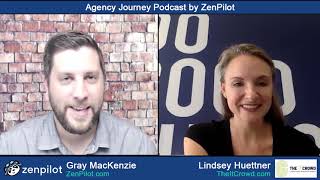
This is a YouTube video titled "Innovative Marketing Solutions With Lindsey Huettner" containing an English podcast episode from September 1, 2021. The episode features a conversation between Josh, the host of the Agency Journey Podcast, and Lindsey Huettner, CEO of the IT Crowd agency. They discuss Lindsey's entrepreneurial background, agency culture, client service models, team management, and her personal lifestyle choices such as living in an RV. The discussion also covers agency operational practices, KPIs, and technology tools used in agency management.
Welcome to the Agency Journey Podcast, where we connect with agency leaders to uncover the hidden systems and processes that drive their success. Now, let's dive into today's show. Hey, it's Gray. I want to let you know that today's episode of the Agency Journey Podcast is brought to you by Around. What is Around? It's a video calling tool that's lightweight, it's playful, it doesn't take up your whole screen. It has saved me so much CPU usage, and I was a super early adopter of round back in early 2020, and I'm so thrilled that they're sponsoring the show. We're still using it. It is the coolest internal communications tool that we've added in the past 18 months here at Zen Pilot. We absolutely love it. It's made our meetings a lot more enjoyable. The GIPHY integration is absurd and really fun. And, um, yeah, I think everyone's kind of gotten used to here in the post Covid environment. The fact that people are working from home, but they have some super cool tech that's baked in. Everyone talks about being AI based. They actually have AI based noise removal, camera framing, and background cropping. So basically you're not seeing a big square or rectangle of what your camera would be. It's a circle that centers on your head and it cuts out a lot of the background stuff. And then if you get people screaming in the background, I've got four kids at home. It's going to cut out a lot of that noise. It's absolutely awesome. So you can try around for free. Go to Around Co agencyjourney if you sign up. If you like it, shoot me. Your favorite filter. Ask me for a link to my secret room. I love to hear from other agencies who are using it. I think this is an awesome tool for internal agency teams. All right, let's get back to the show. All right. Welcome into another episode of Agency Journey. This week on the podcast, I have Lindsay, who is the CEO of the IT crowd. Lindsey, the first time I saw your site, I remember being like the IT crowd, which I assume you hear all the time.
All the time.
But I appreciate you taking time to jump on and join us. Could you give us kind of the quick. The quick profile on you and the agency?
Yeah, definitely. So serial entrepreneur. I didn't actually think that I was going to be in the agency world, but that is where I've ended. I actually started it because I was in a business prior to this. I was in a B2C business and I start right. I bought into that business. I was able to build that. And at that point I was really looking for something or someone or anything to come in and help me with marketing. I knew that I loved it, but at the same point I was running a business and so I couldn't really worry about what was happening with marketing. And truthfully, I just couldn't find what I was looking for. I really needed somebody to come in and look holistically at my business and whether that was supposed to be marketing or not. But just look at it and go, these are the things that you really need to work towards and this is how we can help with marketing on those fronts. And I found a lot of different agencies and this is, you know, they just are what they are. You have really large agencies where you've got line items of everything that you want or that they tell you that you need and there's a price next to all of those. But if that scope ever changes, then those prices change. And for me as a business owner, I really needed to know how much I was spending on a month to month basis with it. I found other companies that specialized in one thing. So whether it was a website or a billboard or a creative agency, and that's what they were selling me because that's the only thing that they had in their pocket. And there's definitely reasons for those types of agencies for sure. But again, for me, it just wasn't something I needed that extra handholding, I needed that presence. And so that's what I created because I couldn't find it. And so here we are. I started November of 2014 and it's grown since then, which has been really cool. And we are full service agency. We'll go into companies and take over everything that they need. Or there are a lot of companies that we work with that have somebody internal already, but they might not have the capacity, which we hear a lot, or they might not have some of the know how of some of the technical skills. So we'll help them with those things.
I didn't know the background that you're in a B2C or before. What was that company?
So it was actually clothing stores. That was the IT Crowd is my sixth business. And like I said, I've been very blessed to be able to start them and build them and sell them. And I just really liked the marketing side and felt that there was a need for it.
And here we are seven years into the IT crowd. Is this the longest stint that you've had with the company so far?
This is the longest stint. Yes.
That's crazy. So why have you stuck around with the agency for so long?
You know, the agency is a. It is a crazy world, and I don't think that if you haven't been in the agency world, I don't think that you really understand how crazy it is. So, one, I like that as an entrepreneur, I always like new things and exciting things, and so that feeds that itch, for sure. But at the same point, I've really found a vehicle to where I can help people. I can help not only business owners, but we strive to be able to help the teammates that we currently have, be able to grow their skillset, be able to do things that they never thought were possible. And then I've been able to use this company as a vehicle. Yes, we are part of marketing, and that's what we do, but our main job is to do good things, and it's to do good things with our people, with our clients, within our communities, and really make a difference. And so I've been able to use this marketing agency as a vehicle to be able to do those things, unlike I've been able to do before.
Right. That's awesome. And it comes through. And we had a chance to work together earlier this year. And even just getting connected, we see a lot of different agencies and a lot of different, um. There are a lot of different cultures that we get to interact with. And that's what makes our position fun at Zen Pilot is you get to see inside and touch something that's core to a lot of different businesses and learn from each of those experiences. And I think we share the same mindset in terms of, like, what we're doing right now. This is a vehicle to impact people's lives in a. In a positive way and be like to the world. And the work that we do is fun. We find a lot of meaning in the work itself, but the relationships, by far, matter most.
Yep.
That's one thing that stuck out about you. The way that you run your team and the team and the internal culture that you guys have built is the way that you attack things and reminded me, I don't know if you know Whitney Mitchell or Braden at Beacon Digital Marketing.
I do. So Whitney actually was the person that referred me to you guys.
Oh, that's right. I totally forgot.
So Whitney is in my peer group. And, yeah, she is fabulous. And she is growing like a weed. I mean, I'm so proud of her in so many ways. She's unbelievable.
Yeah. So there's some real similarities between, like, I think of Whitney, I think of. You think of someone like Lance Cummins at an agency called Nectify. I remember we had Ryan Malone on the podcast a couple years back talking about what he's doing with Smart Bug Media and some of the way that they're investing in culture. And so anyways, there's this group of agencies who you can just tell when you start interfacing with a team. There's an organization here where the leadership really cares about their people and not in a. I think most agency owners have. There's a level of care for the team, but there's a difference between, like, I want to care, I want to be good at things, and I actually will put in the time and effort to be good at things. You know, like, I want to be good at birthday gifts, but if I don't put in the effort or the time to make sure that that shows up, then, you know, you don't see the fall through it. It doesn't. It doesn't look like you care. So.
Yeah. And I think, you know, anybody that's listening to this and they want to have more of that within their company. We all have KPIs. We all look at them hopefully on a weekly basis. You might look at them on a monthly basis, a quarterly basis. And what was really important to me and what I've always heard is if you don't measure, it doesn't happen. And so One of our KPIs is doing good. So we look at it every single week and what have we done as an agency to do good in this world? And so that is being out and making sure that has nothing to do with our clients, has nothing to do with the IT crowd. It's what are we doing to impact this world? And it's something that we look at on a weekly basis because it is something that we believe in that hard work.
So if I'm sitting in one of your meetings, what does that look like? When do good? We get to do good on the scorecard.
Yeah. So it's a yes or no. Did it happen or did it not happen? And the way that we currently have it, and we've done it a few different ways, so pre Covid the idea around it and the way that it worked was we'd have two people go out for half a day or a few hours for the day, and they would be able to pick and choose whatever they wanted to do. So a local charity, whatever was passionate for them, and they would be able to connect with each Other and then also do something awesome in the world. And then you would switch partners. So you might not be doing something every single week, but every time your rotation would come up, you'd be doing something with somebody different. So, one, you got to know and understand the people that you're working with. But then also you were doing one of our core values. Covid ended up hitting. And so we weren't able to do that. So we started doing it as a team and finding virtual ways of figuring that out. And then every week, we would do good things as a team. Now we've gone back to the two every week. But one of the things that I would love to share with you, and I'm really excited about it, is probably about a month and a half ago, maybe two months ago, my managers came to me and said, it's really important to us that we do good things. And. And because of that, we're finding that this number, this KPI, we're just checking the box. And that's not what the heart is behind this company. And so we really want to make sure that we're doing what we're supposed to do as opposed to checking a box off. And so what they came up with, and I have to be completely honest with you, we were at dinner, and I started crying at dinner because I was so moved by their hearts to bring this to me and ask if this is something that we could do with this company, which then means that I have the right mentality around some of those particular people that were bringing that that to me. But we are starting. It's called the heart behind it. And so the way that that will work is we are going to open that up to the community that can be our home community, that can be nationwide. And we want applicants to come in with that. We want people that are doing good things. We want entrepreneurs, we want small business owners. We want larger business owners and 501C3s that are doing great things. And we have decided that our doing good will be to pour into those companies or that one company that we choose. So we will pour into them, and all of our resources will go to them for three months to be able to get them off the ground or into a better spot or into a campaign that they're specifically looking to do to be able to make a difference in the world even more. So we'll start that this next month.
That's awesome. Where did adding that to the scorecard, Was there an influence or someone else who you heard the idea from or did that come organically through the internal team.
I don't know. About two years ago, we really started to figure out what our core values were and did a lot of soul searching. As a business owner, that kind of starts with you. You hope that it starts with you. I did a lot of soul searching around that. And what did I want for the business? What is my. Why? Why am I wanting to continue with this, or do I want to do something else? And I actually have a blog post that's out there. I went to the Dominican Republic on a mission trip, and in that mission trip, it was so wonderful for me because I realized that the larger I grow this company, the more doing good I can do in this world, because it's not just me, but it's the people that are on this team as well. And so it kind of started with that, and then it went into, what are our core values and what does that look like? And why are we doing this? And we just believe. So I believe, and this team believes so much into pouring into others and making sure that we're doing the best that we can in this world and sharing our gifts. And so because of it, we monitor everything or we have KPIs for everything. And so we figured that this was a good fit to put on that scorecard as well.
Right. So you're running on eos Entrepreneurial Operating System as well. How long have you been using that framework?
3 and a half years.
Okay. Wow.
Yeah.
There's a lot of agencies who've gone through that. We just had Dean Braley on. We've had Marissa Smith on as well before, talking through kind of the implementation model or eos, outside of kind of the standard EOS stuff. And the. Did we do good as a metric on the scorecard?
Yeah.
In terms of caring for the team internally, Are there other specific practices that you have that might be atypical to other agencies?
I guess it's probably farther along the lines of the doing good. We give five days a PTO specifically for this, and we want people to do what they're passionate about. So for me, that started when I went to the Dominican and was really entrenched in that and was able to make a difference what I thought. So we do have that when it comes to benefits, when it comes to. We're a small business. And I think that as small business owners, we're always trying to figure out how to take care of our people. And with that, that was a cool way, I thought, to help facilitate what the company is about and Then also feed people's souls. We also have. We used to have work from home Wednesday. And so when we were in the office at all times, we do work from home Wednesday because that was a time for people to do life but still do their work and still have their weekends to be able to spend with their friends and their family and not have to worry about grocery shopping or getting their hair done or whatever were the things that most people do on the weekends. So we had that as a perk. Covid has somewhat changed that because we are now a hybrid model. But yeah, we try to do all kinds of things that are out of the norm that are not the initial health benefits. I mean, we have those and 401. We have all of those traditional things. But we try to add onto it as a small business to enable even better workers and better teammates.
I think there's a lot of room in the agency space for creativity around what the benefits are. And we're working in a field filled with creative people. Sometimes I think there's. Right now there's a lot of sameness in the space. And I totally understand it. We're all relatively small businesses. You're trying to figure out how to make it to the next. Next week or next month or next quarter's goals.
Yep.
But I love that creative approach there. So pivoting from the team side a little bit to the client services model that you have set up and even who makes a good client or the crowd, how do you draw that circle or that target around? Hey, here's somebody who is a good fit to work with us.
Yeah. I think most agency owners is like, do you have a budget? Probably that's one of the first things we would hope that that is the case. Other things, and this is. We have a scorecard for our clients as well.
And it's looking ideal prospect profile.
Yeah. So it is amount of money that they are bringing in. You know, the typical things that you would. Specific industry specific amounts of money, that revenue that they have. But then on top of it, we look at responsive time. So. So it's really important for us to have a client that's responsive to us. I think all of us have had clients that aren't responsive. And there's only so much that you can do with that. We talk about moving the needle and so we are. It's really important that we have clients that we can actually make a difference with. We are not interested in continuing to just take people's money just to do it. Like we have to be able to move that needle. And then how do they treat their employees? How like what is their culture and how do they treat the teammates that they currently have? So those are kind of the different ones that are on top of it.
So you're working across a number of different industries. You've got a full service offering and you have a team that is, you've got a well oiled machine but at the same time you've got a smaller team than a lot of full service agencies.
Sure.
How do you balance or who drives strategy in those engagements? Because often there's this trap for someone who's trying to be a full service agency without the staffing, like you know, without being a 40, 50 person agency team, working across a lot of industries where it becomes really easy to become the order takers and where moving the needle gets a lot more challenging to do with any kind of consistency. So how do you guard against that or design your client services to achieve the outcomes that they want?
Yeah. So our client services are in what we call puzzle pieces. And each puzzle piece represents a certain type of service. So we have eight different puzzle pieces. And with that, so you have the social one or you have the geek, which is going to be any of your online ads. That's how you've got the strategist. And so you have these different puzzle pieces where you can pick and choose which puzzle piece you want and you can move them around as you see fit month to month. And so the way that we do it is our proven process is discover, plan, execute, repeat. It's very simple. And we do that on a monthly basis. And so because of the fact that you are able to move those puzzle pieces, we're making sure to have those conversations with our clients all the time. And then on a business side I have people that are in house that are specifically client facing. They don't have to have the specific skills that every single puzzle piece demands because we have those ancillary positions, whether that's contractor or whether that is somebody that's in house that can work on those things. So they are as an account manager, they are just the middleman and they are the go to for the client as opposed to having the client talk to tons of people. There's pros and cons to that for sure, but that's how we have specifically structured it. And when it comes to strategy, there are some of our account managers that are better or not as great when it comes to strategy. And we either business development will really help with that. When somebody comes on board and creates that plan. And our senior account manager really helps with that, too. And so she's in charge of making sure that clients are happy. She's in charge of making sure that the ideas come and that we are on track with our clients and moving that needle. And then we also have another metric that we talk about on a weekly and monthly basis is how many ideas do you have that come to like, that you've brought to the client? How many of those have they accepted? How many of those have been completed and how many of those did they not like? And so if I'm on an island and EOS teaches you this, I can look at each one of those and I can say, okay, we have a problem because they don't like any of our ideas. What's the issue here? But then I also can look at it and can go, okay, we have had all these ideas and they love them, but none of them have been executed. Why is that the case, too? And so that's one of our KPIs, but that's how we kind of do strategy and overall delivery of services.
That piece is pretty unique. Do you tie. Is there a ratio between, let's say, the client retainer, what they're paying you, and how many ideas we want to push and then how many ideas we want to push versus there's no.
Okay, no, there's not. There are some that you have more ideas just because the fact that you're either more passionate about it or, you know, more about that industry. And there are some that, you know, it takes a little bit more.
And then is this on the scene, on your senior account manager, to review those and have those conversations, if there's. Is that. Who owns that? Obviously, we get the account manager owns what the inputs are, but then in terms of management of that.
Yep. Yeah. So they're both in charge of it, for sure. And everyone on our team has that KPI, so our graphics team has that KPI. Our social team, like everyone on the team has that KPI of. Did we present a new idea? Was it loved? And so social department, like, like I said, all of them have that for that client. And so the idea can come from anyone.
Right. I think that's a cool model that I've not seen very often in agencies that have that, like, hey, how much are we giving? And then to be able to measure that and show that to clients, will you? I would assume at some point that comes up in client conversations.
For sure. Yeah. And we talk about that. Yeah, we talk about that on a monthly basis. So we have pretty extensive reports. I'm in peer groups with agencies and they look at me like I have eight eyes because of the reports that we give out like 45 page reports and they're beautiful every month. But with that. That is part of it. Of how many ideas were presented? How many did you guys like? How many? Which ones are we executing on? So yeah, all of that's presented to the client.
That makes sense. I love that model in terms of kind of staffing. So I want to go to staffing the team and then bounce to a couple other kind of quicker questions for you.
Sure.
I know that you are growing, always on the lookout for good talent. The account management side, what are some of the open positions or positions that you're recruiting for right now?
Yeah, so the account manager role is always a. It takes a certain type of unicorn, if you like. And every agency owner knows that. So looking for those types of people. And we, we have a. An ATS system, so an applicant tracking system that we constantly are recruiting for. So definitely when it comes to account managers, graphic designers, social, those are kind of the main ones as of right now.
Yep. What ATS tool are you using?
It's called Preview and we went through a ton of them. Yeah, it's actually a assessment as well as an ATS tool and that's why we chose them. I1 liked the assessment. I liked the benchmarks that they had. And then I didn't have to have another tool on top of that to be able to stay on top of applicants. So P R E V U E. Unbelievable.
Awesome. So I'm going to follow that vein for a second. Then along the tool side, obviously on the project management side, you made the jump into ClickUp. So you made that jump. What are the main tool or what are a couple of tools? Maybe the tech stack that agencies wouldn't use, familiar with. Are there any tools that you're abnormally excited about in the tech stack?
That's a good question.
It's not an instant light bulb for you. Sometimes that's a light up and yeah, hey, I've got something right away. And sometimes there's not. So that's fair. There's not. We'll keep moving.
I just came across Dialpad. I don't know if anybody. Like, I don't know if you guys use that.
No one said it on the podcast yet.
Yeah. So Dialpad has seemed. We're. We're thinking about making the move because we have phone.com right now and Then we use Zoom and Dialpad actually brings both of those together. And so you have all of your phone calls there. You have. You can do zoom calls. And the cool thing about it is that you can transcribe those, all of that. And so the great thing about it is that if somebody ever needs to go back, they're not just watching a video, but they're looking at the transcription and they can say, oh, I need to hear this specific point. So we're looking at moving over to that. They are very intuitive. They plug in with a lot of things, I think, including ClickUp. And I think that that's kind of cool.
Dial pad and ringCentral. We sometimes see there's a tool, this is kind of a tangent to that, that we should connect about afterwards called Avoma that we've plugged in. And it's been super helpful for recording transcription. I need it AI based notes. That's awesome. From a financial perspective, as you're managing the firm, what are some of the benchmarks that you're building around as you build or like, what are the numbers that you're looking at on a consistent basis as you scale out the operations internally and try and figure out how fast can we grow, when do we hire, when do we staff up, scale down, all that?
Yeah. So this has always been, and I think every business owner, it's probably something that is maybe a pain point, I'm not sure. But I have hired an unbelievable accounting and external CFO group that takes care of all of that. So I can call them at any point and talk to my specific CFO and go, hey, I'm looking at expanding, or I just lost a client, or I want to bring on a new department or I want to start this new software or whatever it is. And I can go, josh, what do we do? And he sends me back all of the things that we could do and the projections of that. So that's a massive, A massive help for me because of those projections. And I told this team before, it's actually called Two Roads. I told them before, I said, I can do this, but it takes me forever to do it. And so I need somebody that is number driven that can help me with that. And they've been phenomenal specifically for, for helping me forecast and helping me go on a monthly basis. They'll go, lindsay, your cash flow, you need another client, or, Lindsay, you need to cut costs somehow, or, you know, you need to stay within this margin of whatever XYZ they're talking about. And we're not there. So these are the adjustments that we need to make. So they really kind of keep me on track of. Of where we need to go.
That's awesome. I think it's two roads co dot com. And you introduced me to Zach there, who's like, in the last couple months I've gotten a handful of Remington bag from Impulse Creative. They were working with account fully.
Yeah, they're fantastic. And Zach is awesome.
Yeah, that's awesome. Okay, last thing for you. I think when we first connected, you were traveling around, living the RV life for a little while. Is that a normal thing in the life of Lindsey for you? Or was that like, hey, this is because I was trying to remember, is that pandemic? Like, hey, we're gonna go do. We've got the freedom to go do this now. Or is that a typical thing?
No, pre pandemic, that was not a typical thing. When Covid hit, it was. I mean, I just gave you a small tour of the office and we have a large open space and I sent everybody home in March of last year. And our space, I don't have to go through any other doors or elevators or whatnot, so it's still safe for me to go into the office. So I was the only one coming into the office. And at some point I was just doing cartwheels down the office. I mean, I mean, because no one's here. And my husband, our soon to be husband at the time, we looked at each other like, why are we doing this? Like, we could do this in Alaska. And that seemed to be a far fetched idea. But we were netflixing and we saw a couple that was doing it on a boat. And Ryan was like, we should do it on a boat. I go, yeah, but the water, like death side of it is a little hard for me. And we have no idea what we're doing. And so maybe we can do it on land first so we don't have like that extra danger factor. And so I remember we were exploring one day and that's what we would always do. We're here in Dallas and we'd go somewhere and we'd explore for the weekend. And we were on 35 and there's an RV dealership that's there. And I was like, let's just go in and let's look at it. So we walked in and we went into our first rv, which was actually a trailer. And I looked at it and I was like, oh my gosh, we could do this. This is awesome. And Ryan had the same idea so, no joke, the next week, we put both of our houses on the market because we weren't married at the time. So both of our houses have sold our cars, all of our possessions, everything. We have a teeny, tiny storage unit at this point in Dallas, and I have my car that's here because I come back to Dallas every once in a while to see the team. We bought a motorhome. Again, no idea what we're doing. Not a clue. My husband at the time is not handyman, and everything breaks at all times on these things. And so we bought it. And last October, we started traveling across the United States. And, you know, everyone was virtual. So that's how it was. And now the team has come back into the office, or we're doing a hybrid model, and I get to come back about every six weeks and see them and hang out with them and then fly back to where I'm supposed to be. So right now I'm in the office. Happen to be in the Office, but the RV's in Portland, and so I'll be there on Saturday. And we have a crabbing adventure that's happening on Sunday, so I'll have some fresh crab to send out.
That's amazing. That's, like, my dream. It's picking up, and I don't know why. I was talking to someone recently who said, me, use the point in time where you have so much stuff, that this actually might have been Paul from our team who said this to me. When you have so much stuff that you fantasize about your house burning down, like, here's your son. You're too tied to yourself. Yeah, I'm not quite that far, but I. I can relate to this, like, call the minimalism or like, hey, I. I don't want to worry about any of the things that.
Yeah, I have to tell you. So my house sold with everything in it. So they bought furniture. They wanted, like, all the cookware. They wanted everything. And that was a really surreal moment. The day that I locked that door and walked out and drove, and I was like, I'm homeless and I have nothing. All within, you know, signing a piece of paper and very surreal, but at the same point, and just a weird feeling, but now it's. I would never. I don't want to go back.
Are you keeping so long term, do you wind up back in Dallas, or are you scouting the country for where you might wind up? Or is it, hey, we're happy doing what we're doing for the foreseeable future?
I don't know, you know, we have family meetings about once a month and we evaluate that both of our families are here, sets of families are here. And I would like to have children. So, you know, that's important. And having friends and family around you that have been established and that are there. We don't particularly love Dallas. There's no nature. There's a lot of concrete that sort of it. But family might outweigh that. Or we're looking at kind of a 2 to 4 mile or 4 hour radius around Dallas to where it's still very accessible for me to be with the team for children to see grandparents and that side of it. So it's a constant conversation. And the answer is I don't know right now.
Well, that's awesome. I'm glad you're living that dream and getting to experience that. That's amazing. Cool. Well, the site is the IT Crowd. Theitcrowd.com Ray, you can't say it like that.
The IT Crowd.
Wait, I can't say it like what?
The IT Crowd. Because then I'm gonna get calls saying I did.
I spelled it out instead of, you know, why did I? I don't even know. I just did that. But yeah, that's. It's spelled just like you'd think. The itcrowd.com. good point. Any anywhere else that you point people though, Lindsay, if they want to follow along, apply. Get connected.
Yeah, I mean, we're out there. You're. You're gonna find us if you look for us. So the only thing is the it crowd also was a British TV show, so we are not that. But we do own the domain now, which was a really fun accomplishment for us to get that from them. But yeah, so you can find us really kind of anywhere. And if you're looking to apply, definitely on our website, you'll be able to see the open locations and what we're looking for.
Awesome. Well, I appreciate coming on, being suggested with your time. Thanks, Lindsey.
Great. I really appreciate it. Thank you.
Thanks for listening to the Agency Journey podcast. Visit agencyjourneyinsiders.com to join the podcast community and be sure to subscribe for future episodes.










