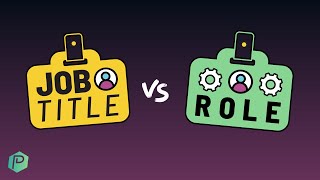
Job titles are external labels like CEO or Marketing Director. Roles are internal descriptions of actual responsibilities, and one person can hold multiple roles. Small teams should use roles to clarify who does what and build systems.
Chapters
Hello and welcome back to the channel Process drivers. Today we're going to be answering a question that you guys have asked a lot on the channel here, which is the difference between a job title and a job role. And I've used these terms a lot in the videos here on the channel, so I'm probably long overdue to define these. First up, let me explain job title because I feel like that's the one that most people come into this channel or our little cool corner of the Internet. Being familiar with a job title is referring to your external name. When you are within a company or organization, this job title is typically something like marketing director or assistant or CEO. And honestly, these are names that are primarily just made up by organizations to make it easier to classify people in their traditional hierarchy. And these job titles tend to be unique to a person. And if nothing else, each person only has one job title in most instances. Now, there are always those CEO and founder titles or the Chief Happiness Officer and Play Officer. You know, weird stuff because these are all just arbitrarily made up. But in general, one person, one job title, and the focus is on describing that person to the outside world. Basically, job titles are a marketing function. If I can be so bold, that is what job titles are. When it comes to summarizing job titles in an organization, they're typically done through a traditional organizational chart that looks like this. This traditional organizational chart shows each little job title as a box and connects them with lines together to signify reporting lines in most cases. Again, since each person only has one job title, each person usually only shows up on this traditional org chart one time. Now, the problem with this and why we don't end our conversation just by talking about job titles is job titles are not particularly helpful tools for small teams. And this channel, if you haven't gathered, if you're new here, this channel is all about systemization for small teams. So for you guys here in our audience and for us here at ProcessDriven, job titles aren't very useful. Because when you see a traditional org chart for a team of, say, one one, it looks something like this. Yeah, not very helpful. If you have a team of two, it looks like this. Also not very helpful. In fact, job titles in general are not a helpful tool in my opinion, for just about anything, unless your organization has at least 100 unique people in it, or if we really want to be accurate, at least 500 unique individuals in your organization. Only when we're at that size or scale is our business, you know, built of enough Specializations that someone's job title might actually tell us what they do in a day. But when we're a small team, it's not quite so clear. Because each person in a small team, even if they just wear the title of assistant or founder or owner, they're doing so many things. If I told you that John's job title was owner, what does he do in a day? You have no idea. However, in a larger organization, job titles are much more specific. So you might have a job title like level one Support Assistant. Okay, that makes sense. But for the rest of us here in small team land, job titles just are filled with ambiguity. So that brings me to the alternative, which is a job role or just a role for short. A role is a description of what somebody actually does. A role is a clustering or collection of responsibilities, duties, actions, tasks, and put them all together, put a name on them, and that is a job role. Unlike a job title, job roles do not tend to be public facing. Also unlike a job title, when it comes to job roles, it doesn't necessarily have to be one person per role. In fact, a team of one, a one person business might have 10 roles. In the business, they're all done by one person, but there are still 10 roles. In fact, in most small teams, you will find that most team members have at least two roles in their official job description. That's because on small teams we can't afford to have 50 specialists. Instead we have five team members, each doing about 10 different things. Okay, the last point of distinction between a job title and a job role I want to highlight is what functional area tends to own these terms when it comes to job titles. As I said before, focused on a marketing function, whether that's marketing in terms of recruiting and hiring, or marketing in the pure sense of the word, Marketing tends to be where job titles come in. You need that fancy business card that says you're the VP of, you know, taking out the trash just to say that you're important. Whereas when it comes to job roles, this is typically owned by an operations or project management or integrator in the organization. This is focused on results and actions. And so these names tend to not be as sexy or succinct, but they are generally quite descriptive. To wrap it all up, job titles are fluffy and mean almost nothing, whereas job roles are descriptive, boring, but describe almost everything. That distinction is why we recommend to all of you and also to our clients inside the ProcessDriven membership to utilize job roles as a supplement, not to replace job titles. Entirely, but to give you a more concrete and operations focused way of keeping track of who is doing what. Job roles are perfect for those small, savvy, nimble teams that many of you are on or are building. And job roles can also be a great unit of measure when it comes to systemization. Now natural next question. Okay Layla, job roles sound great. I want to implement that. How do I do it? To me, the easiest way to define a job role as opposed to a job title which you can just pull out of a hat make up A job role can be defined most easily by defining what your business does and in terms of processes and systems and then grouping those. Color coding is my go to choice, but to each their own. In fact, in the description of this video I'm going to drop the link to my training where I walk through how to define the processes of your business. That is the precursor, that is the step you need in order to start defining these job roles. And if you guys are interested more in this topic, if that training you're like okay, I'm ready, let's do some more. You will also find a whole lot of content about job roles, responsibilities and systemization focused on team inside our process driven membership which again check out links in the description below for all of this good information. We go deep on this topic and I think it really is so transformative for organizations who are used to org charts like this to instead start to look at functional charts of job roles like this. One last thing before we go here. If you found value out of the video today, I'd love for you to drop a comment below and write part 22 because I have a second part to this video that I would love to share with you guys, but I'm not sure if there's interest in this whole job roles conversation. So comment below part 2 if you'd like to see more content like this. Otherwise, thanks so much for watching and until next time, enjoy the process.