Lets roll!
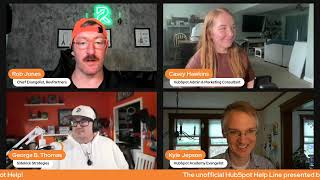
Rob, Kyle, George B. Thomas, Casey, and Chris answer listener questions about building HubSpot surveys for online courses, including timing and LMS integration, plus how to use HubSpot's Prospecting Agent for AI-powered outreach while keeping your brand voice intact.
Chapters
Oh, you've reached the HubSpot Helpline. Helpline, helpline, helpline, helpline.
It's Rob, it's George, it's Casey and Kyle. Come with a problem and leave with a smile Every Friday at 3 come and join us as we help you with HubSpot. Open up your lips, link in Just make sure you call in and leave a voicemail about HubSpot. Make your Friday divine with the HubSpot Helpline.
Welcome back to the HubSpot Helpline. Kyle, George, Casey, Chris in the background. What we think of that little jingle jam intro there, George?
Pretty good. I. I'll give it to the AI that was. That was all right, bro.
Hey, I. How dare you.
No, it was definitely that. That was Rob getting down. Listen, I got goosebumps during that. This is such a pleasant. Like that is, bro. I was like, I need to just listen to this on repeat the rest of the night. Like, how do I get this. This cover. Come on.
The problem. Leave with a smile.
Exactly, exactly.
Look, we had a. We had a writing exercise to do this. I learned, Chris, some things. Some of the. The AI prompt, you know, didn't work out as well. And I was like, trust me, we got to get the style right. Let me come up with the lyrics and put them in here. There were some versions that were not very good, but this one, this one felt like a bop. And what better way to start off than asking people how their week was and then jamming a little bit.
I mean, you wrote the lyrics like.
Oh, yeah, yeah, I wrote all that AI by hand.
That's right.
Hand.
He wrote it in hand, in cursive, and then gave it to the AI.
What, with a calligraphy pen? Yes, with a calligraphy pen. And then I photo scanned the picture into. Yeah, this whole process took me four weeks from last Friday, but here we are.
That's why we didn't have a song last week, right?
That is exactly it.
Seven years ago, our forefathers sat down to write a jingle for this show.
You're not. I mean, are you a real show without a jingle? I mean, maybe that's the. Where we need to start the debate. But now we have one. Now I feel like there's some legitimacy behind this. How was everybody's week? And then we'll go to Kyle for how many. The flood of voicemails and what we're going to get into today. Because as the jingle insinuated, we will be helping people with HubSpot problems over the next 55 minutes.
And if I can just Say we've got our number scrolling. Here it comes right there. Call it. You will be leaving a voicemail. Don't. Don't leave your phone number on the voicemail. We will play the voicemails live. Yeah, we don't want to share your. Your phone number with the Internet.
I did change that. Ask in the voicemail. A re recorded one. I don't know if you put the new version in there.
I have not. No. Did you send that to me?
Probably an oversight on my part because. No, I didn't send it to you. How else would you put it there? That's my fault. So I, you know, not starting off on the right foot right after the jingle. I'd missed that layup. So apologize for that, Kyle. But, yeah. How's the week going so far? Casey, how many lives have you done?
All right, so we're five morning shows, a link, a lead scoring Monday, two hub spot admins. What do you do first? And then an AI show and now here. So we're on 10.
Holy moly. And so I mean, the best for last. Is that what I'm hearing?
10? Yeah, obviously. Obviously.
Very nice.
Well, Rob, you're the only person I haven't lived with this week.
So though I. I know I. I got to get better. I've been following in the footsteps but, you know, way behind of Chris, George, Kyle, so I, I commit to doing at least one other lot, you know, crawl before you can run type of thing. George, what about you? How was the week?
Week was awesome. We made it to Friday. We started with Monday. There were some hills and valleys along the way. I, by the way, did not create as much content as Casey this week. I started to do the quick math and I think it's like six lives, plus this would be seven, which I feel like is enough. So I'll just be. I'll be happy with this week and excited to help people moving forward.
Love that. Kyle. How's your week been, friend? Good.
So I actually yesterday, for those of you who've been following along on my journey, I haven't told anyone yet, but since I'm here among friends, I got to give do my first pitch of my Joan of Arc movie to an investor who probably has the necessary $15 million. So I am. I'm just waiting to hear back if this is going to happen. It feels good. I did the thing, the thing I wanted to do. This is the farthest I've made in this journey so far. I got to actually pitch it, so.
I love it, brother. This Is amazing.
Quick follow up question on that. What makes you more nervous? An inbound session or that pitch?
Ooh, that's a good question. I really. The thing is, inbound is super friendly, and I've done it before. I had never done this before, and I don't know if I'll get to do it again. Like, if it's successful, I don't ever have to do it again. And that would be great. I messed up so many things up. I messed so many things up. When I take the stage to talk about HubSpot, success is pretty much guaranteed. All I. All I talk about these days is HubSpot. I can't help but talk about HubSpot. Pitching this project, man, I was fumbling. So it was. It was harder. It was new for me, but it was. I feel I'm just floating today because, like, I did this thing I've been working towards for a couple of years now, and it happened.
So I, like, Rob, I'm gonna answer for Kyle, even though you didn't ask me to. My immediate thing was like, the pitch, like, gee, many Chris I've seen Kyle at inbound is like, I was so.
Excited for this pitch.
I don't.
I don't know if I've ever rehearsed for. For any presentation as much as I did this time. And, like, it just. I was so ready to give it. But then, like, I. I sent the. The Calendar invite out and I put a Zoom link in it, but because I use Google Calendar, it automatically put a Google Meet thing in it. And so I was sitting on Zoom and everyone else was sitting on Google Meet. I got there early, and like, five minutes into our scheduled 30 minutes, I'm like, why is nobody signing? Signing in? And then I got over there and they were all just waiting for me and wondering why I had stood them up. So that was not a great start.
And you were like, hello, I am Kyle Jetson. I do technology.
I am the one who called this meeting, and I am excited to be here. The good thing is I don't know.
If Joan of Arc did technology, so you could have done some random play of, like, you know, I don't know.
Yeah, there's a thing. Everybody keep your eyes open for the carrier pigeon. I'm only using period technology for communication on this project.
That's it. Yeah, the five minute delay is odd. That happens to me more often. Well, as often as people would believe. But I was gonna. I was gonna see if this is something George would say. I was gonna say maybe stressful because it feels like you're out of your element. But I feel like George's advice would be, wherever you are, that's your element. Yeah, that's pretty good.
So, brother, it's funny because this has nothing to do with HubSpot, but maybe everything to do with HubSpot, the way that HubSpot changes and the places that HubSpot will put you in life. But I have this thing called the Chameleon effect that I used to think was like a negative, but now I realize it's a positive. You just go into a space and you authentically, naturally turn into who that space needs you to be.
And when you can.
When you can have that superpower, which, by the way, I've seen Kyle do it. I've seen Casey do it. Rob, I've even seen you do it when you don the orange. Like, you just become not in. Not in an authentic, not in a fake way, but you become who the people and the space need you to become. And that. That is as. As HubSpot users, as HubSpot super admins. If you can embrace the chameleon effect and realize when you're talking to, like, co workers, you're one thing. When you're talking to the C Suite, you're another thing when you're taught, like.
Yeah, no, you're right. I mean, there is a. There's definitely a correlation there. And it's kind of a single thread theme with the chameleon effect. Speaking of that, I know people are tuning in for HubSpot help. Let's be what we need the audience to be and what the voicemails are requiring of us by letting Kyle fire up the first voicemail so we can dive into some solutioning.
All right, here we go.
Hi, my name is Camille Bosley. My phone number is. Come to you for some recommendations on using HubSpot surveys. We have a survey that we want to send out to some of our previous customers or people that have signed up for some of our online courses that haven't been selling or getting as many enrollments in my registrations as we would like them to. So we're sending out a, you know, essentially a feedback survey to ask for some recommendations about why, what they're interested in, some pricing feedback. But this is my first time working with HubSpot surveys. I work with Survey Monkey a lot in the past, so I would just love your recommendations on anything that we can do to configure the surveys in a way that'll make it really easy for us to Analyze the data, ingest the data, make some recommendations, and maybe even follow up with the people that fill out the survey in a way that helps them with their responses. So thank you guys so much for your support. Really looking to hearing back from you.
I love this question and I feel it's very meta because this is kind of a survey about survey. It's like they're surveying the panel about how to do this. Casey, I said you've got a screen ready rip, rare and roaring, ready to go.
Look, I'm a professional now.
Yeah, you are. Well, now I think this is like.
A while, but starting today, everyone, she made it.
Hey, more applause. Yeah, this is a good. I'd love to hear some, some commentary on this and kind of show what. There's an element that's like, that's like a CS question of like, when's the best time? What's the best. Like questioning when to do it. But there's also, there was an element of like, how do you build it? How do you configure format the survey to possibly get better responses? So maybe we could discuss kind of both. Casey, you want to start off?
Yeah, I mean, I have some takes. So if this is your first time doing a HubSpot survey, first and foremost, welcome. But there is this analyze tab which is going to automatically give you the responses to your survey. This is a dummy account, so there are no responses to said survey. But they would come here. I have had a little beef with the survey tool in the past. I'll say, oh yeah, it's happening. We already started. I don't like sending surveys through. You can create a survey, customer survey.
Sure.
You can send it by email or shareable link or webpage and then workflows in data. The email one I have had pain points with because after it's sent, you can't. It's hard to resend it, it's hard to change it or anything like that. So I tend to use the shareable link or webpage and then just email with a. A marketing email and send it to my audience that way. I found that to be more flexible.
Yeah, can, can I back up 50,000 foot view for a second?
No.
So, so the. Where my brain goes is I don't know if you're using Kajabi, I don't know if you're using circle, I don't know if you're using Mighty Network, if what. What you're using for your courses. If you're using HubSpot for your course, which would be super Dope, the content hub, you know, and, and doing it in a way that is like super dope with like, you know, the actual, like they can log in and they've got a dashboard and they've got their courses they can see. Anyway, I want to just. The first thing that came to my brain with all of this was like they're only sending out one survey and it feels like it's after the course is actually done. And hang on a second, let's think about humans. Like if it was me, I would maybe want to do a pre course survey, meaning they've signed up and let's go ahead and give them a survey asking them what, expecting to learn out of the thing that go on a journey and learn. And maybe there's some other relevant questions that is like before you get started traveling this path that you're going on this course that you're going to create. The other thing that comes to my mind is like in course checkpoints, because fundamentally I as a human am bad at telling you the ish that I just went through because I went through it and I forgot about it and I'm moving forward. But if there was like a live chat that was available on like the course pages where they could be asking questions or giving feedback based on the thing that they're actually learning in the moment now, like you're getting real time Voice of customer or voice of Edu. It wouldn't be educator of student, voice of student, voice of learner. Right. Vos V O L, whatever you want to call it. Because we're marketers, we give them all letters anyway. You could be getting like real time feedback, right? And then all of a sudden you're like post survey, like let's ask them like what do they wish they would have learned? And so what I'm trying to implement here is there might be a route where you're using a live chat, you're using a form that people could fill out at the end of each module of like a seven module course. You might be using a pre survey and a post survey and then add those pre and post survey information. What Casey said about maybe potentially using the link or a website page to like extract it, but like there's a whole bigger strategy than just the question that was asked.
Yeah, and I would say on that too, I so what I got from the voicemail is people sign up to take these courses and then if. Or they create an account so they can start taking courses and then they don't actually take any courses or they abandon them or something. And we're checking in to see like, hey, what went wrong? To your point, George, if you're wanting to know beforehand what the person was looking for, like I feel like that could be part of your signup flow, right? However it is, someone creates an account, they give you their name, they give you their email address, you would have a drop down or a multi select. That's like what kinds of things are you hoping to learn about? And you can check like I want to learn about sales, I want to learn about marketing or whatever. And then you have that information about them and you can, you can track their behavior and like maybe it's just people looking for sales education, for example, that then don't go on to take any courses. And that's now something you can dig into. Right. Additionally, you could have a little bit of automation built on that, that form field. Like if it's been a week or whatever and they haven't started a course, you could have an email that says, hey, you told us you were looking for sales courses. Here are our top sales courses. Check it out, see what you think, let us know if you have any questions. You know, and I think having those sorts of things in place first is probably good. And then yeah, totally, if people just aren't engaging with the courses. One thing she mentioned I think is pricing feedback. So maybe it's not transparent before you sign up how much these courses are going to cost, right? I'm thinking I'm going to take a free online course and I hop in and it's $7,000 and I'm like, I'm out of here. You can solve that with a little bit more transparency before the signup flow. Here's what to expect, here's how much it costs. But also, I mean, yeah, you could, if people don't sign up, ask them specific questions like hey, what did you not find what you're looking like select which option best describes you. I didn't find what I was looking for. Something else came up. I have other priorities. Not enough time, it's too expensive, I can't afford this. And then you can start bucketing things together.
It's interesting because you started, Sorry, Rob. Kyle, you, you mentioned something that I had forgot was in the actual voicemail of like a way that I can maybe automate some of this stuff. And so diving into workflows and then like how workflows could align with surveys and then where my brain goes to that is like, well, actually could it be how pipelines work with workflows that work with surveys. Meaning like if I had a pipeline where the course was sold and course went to closed one, could I then automate the. The delivery of that pre survey. Right. If that to a pipeline where it's like each module there's a way that it's being tracked that it's completed and when it gets to the you know, module seven core, you know, lesson, whatever or module seven completed, like then being able to have a workflow that kicks in and sends that like post course. So like now and you can have a hands free automated system happening around the thing that you're trying to gather which is the valuable feedback to probably build the course to be better over time.
Yeah. And it again depends a lot on where the course is hosted and how much of that data is connected to HubSpot. But yeah, I think absolutely in an ideal world you have workflows that are like deal status is closed, course status is not started for more than seven or 14 days or something. Send engagement email. Hey, here are the courses we recommend. Email is unopened for 7 or 14 days. Send survey like hey, looks like you didn't find what you were looking for. We would love feedback on how we can serve you better.
Love it.
My head goes less than in the configuration and where it's hosted and all that. But like starting with a quick story. I got a survey for feedback after a webinar that I was in recently that was literally delivered to me as it was ending. So for me there's, there's a couple things. One is like the timing is really important. Two would be the amount of the ask. Right. From like a sociological perspective, I feel like people are more likely to give a survey either a when it's the worst thing ever and they want to leave negative feedback and be a detractor or a when it's like beyond, you know, an 11 out of 10 experience and they want people to know. There's even like a multi step form type of parallel component where setting expectations kind of was the third part up front. Like this survey will take two minutes to complete because it is an ask. It is asking people to do something so structuring it in a way that feels easy and not like it's a huge ask. The timing of when they go out is important. And then to your point. Yeah, being able to automate that whenever they know something's completed with a workflow I think would, would definitely help out.
Yeah. I will say though, I as a person am losing faith in companies when they say, take this quick survey. Take this two minute survey. Because so many of those I've clicked on and it's like 10 pages long, and it just like. No, I thought this was going to be like one NPS question. You. You tricked me.
Well, to that point. Like, depending on. Depending on the course length. Right. Like, if you compare, you know, HubSpot Academy courses, some of those are four or five, six hours, right?
Yeah.
If you have a survey at the very end that asks you to recount your experience of the whole thing, number one, you're not going to remember. Two, you're going to know it's going to take longer than if it had been in little steps after each section or after each part. So maybe splitting it up and then working on the timing, you know, would be. Would be where my head goes.
Yeah, I think. Listen, I got to say this because I've always thought this, and now I'm getting an actual place that I can vent and vocalize.
Oh, no.
Anytime I get started to do the Growth Driven Design certification, I'm like, I need a snack and a backpack because I'm about to go on a journey. Like. And now in that case, it could literally be, you should probably be surveying me or asking me a question after each one of those modules, because that bad boy is like six, seven, eight hours of, like, rich, robust information. I'm not gonna remember the first hill I climbed.
Yeah.
I think one of the biggest mistakes I make when doing surveys is asking too many questions. I mean, I am a marketer. I am curious. I want. I want to know everything. And so I like the idea of breaking it up because then I. I have the option for asking more, but it's less overwhelming and more likely to be completed if it's at the same time.
And I will say too, the more you can capture implicitly through their behavior, the better. Right. Whatever LMS you're using, if your courses are multiple modules with multiple videos and things, you should be able to see, like, what percentage of the way they got through. Right. You should have actual data helping you understand the difference between a person who signed up for the course and didn't actually start it, the person who watched the first video and never came back, the person who made it almost to the end and then got distracted, and maybe segment those and treat them differently.
Yes. Yes.
Yeah, Jasmine, great thought.
Yeah, I like that.
Yeah. The comment right before that said, we've done them in the webinar. That's kind of what it felt like when I got one as I would, you know, clicked out of the zoom email, Bam. Survey, which I thought was a nice touch and made me want to, you know, the timing made me want to complete it. This is good. Anything, any other final thoughts on surveys in HubSpot and helping this caller out?
Now, should we move on to the next one?
Yeah, yeah, yeah.
Numero dose. Let's tee it up, Kyle.
All right, here we go.
Here to tell me, how are you using the prospecting agent? Because it seems great, but it also is a big offlip to do in a week in the chat, GPT integration and everything else that Kyle has been posting forever. So do your worst.
Little snark. Love that.
I don't know if. If the screen unmuted in time, but his opening line was long time listener, first long time caller. No, first time caller, long time listener. And just like we got this yesterday. No, last week during our. Our first ever show. So I like this person, whoever it is. They did not share their name.
They've listened from the beginning.
From the beginning. Our longtime fan finally calling in.
Shout out to you, Tony. Thank you for listening to the. Since the beginning of this.
So. So I can't share my screen because I actually use the prospecting agent. The reason I can't share my screen is because I can't show you emails that are literally on the dashboard of my prospecting agent. But here's one thing that I want to shout. Here is one. I don't let it be automatic.
I manage it semi autonomous.
You're googling it. Yeah, it's semi autonomous because I want to be the empowered human with the AI assistant that brings things forward to me that I want to look at now. Here's a byproduct of me loving this agent inside of my HubSpot one. Even when it's not a right fit, I love to read the emails. Let me explain. I get people from HubSpot who email me because we have conversations. They work at HubSpot, they want to meet with me, I want to meet with them, whatever. And so they'll end up in my prospecting agent list. One time I went and I read the email and it was in that email that I actually was alerted to that HubSpot acquired a company that I didn't realize HubSpot had acquired, to which then I could go research that company and learn more about that. But it was because my prospecting agent actually found a trigger moment or a point to talk about. And so, like, I would call this my prospecting and research agent because I get to see things that I don't have to take time out of my day to go see in an instant. So a couple of things out of this. One, I love it for research. Two, I love it because it creates the templates. Three, I love it because it actually analyzes and gives me tracking and reporting on the things that we're actually doing. And I just love it fundamentally because it saves me time.
Yeah. And I will mention, just yesterday I had a meeting with a good friend of mine here at HubSpot who oversees the team that is building Prospecting Agent. And I asked him a question. I've been getting a lot, which is like prospecting agent sequences. What's the future? How do they fit together? What's going on here? And he didn't, he didn't really tell me the future because he knows I go on shows like this. And whatever he would say in the current state, I thought it was really interesting. One thing someone had said to me recently was the prospecting agent can't assign tasks. It doesn't really feel like a collaborator with the sales team because it just does its own thing. And I brought that up to him and he said, yeah, we don't, we think of these two things differently. Sequences is really like, you know, someone, you got an inbound lead requesting information. You know, this person wants to book time with you. Set a sequence to call and to email and to book that meeting. Or someone doesn't show up to a call, same thing, enroll them in a sequence, reschedule that meeting, off you go. Sequences are for when you know you, you, you have a person and you need to help them move in a particular direction. They've agreed to your, your contact, that sort of thing. Prospecting Agent is meant to be a net new addition beyond your current efforts. Whatever your sales strategy is currently, keep that. Great, I hope it's working well for you. Turn Prospecting Agent on and see if it can surface some new stuff that you otherwise wouldn't have thought of. Right. And as these emails pop up on your dashboard like they do for George, you can look and be like, oh, that's interesting. And send that. Oh, not that one, no. Oh, wow, I didn't know that. Yes, let's do that. And hopefully it just, it's a new source of prospecting effort that you yourself don't have to do.
See here you're knocking on the door of something that I teach all the time, Kyle. And it's a fundamental flaw. And I think some people, the way that they might think Immediately of sequences because they go template sequences. It's communication, it's the baby brother to marketing workflows. Like sequence is a process builder. Yeah, you're supposed to build a process. It's this call, it's this task, it's this LinkedIn outreach. And amongst that, it's this email. That email, that email. And so it's like a seven step process that I want to put people into where when I think of the prospecting agent and I literally kind of like embarking on this based on my previous answer. It is a system that I know will research, create and communicate. Like that's what I'm trying to do with that. It's researching who that person is, creating the templates that I need. Usually I have three. And also, by the way, I'll add in that, I love that I can add in like my capabilities deck and my meeting link that automatically just shows up in these emails and then it's like, yes, please start this outreach, this, these communication. Yes, start that. If I want to go to LinkedIn, I'll do that. If I want to enroll them in a sequence that could pair nicely with this prospecting, I'll do that.
I wanted to ask George, how long did it, like, how much time did you spend setting it up?
10, 15 minutes, 20 minutes. But that's because I had spent copious amounts of time setting up my AI data sources because we did a three. We did a three episode. Two, three. I don't remember two or three episodes on the Hub Heroes podcast of AI data sources and setting up the products and setting up. So there's probably time that I'm not equating to that. But if I just generally say you as a human educating yourself and getting it set up, maybe an hour and a half, maybe two hours at most. And all of a sudden you have this pretty legit agent kicking butt and taking names from a prospecting standpoint.
And I will say that depends a lot. Like the AI data sources are important. This is where you tell the system things about your company, your customers, your value, propos, all these things. And if that is stuff you already have documented somewhere, you're just going to do a bunch of copy paste and off off to the race as you go. If this is the sort of thing you're going to have to like figure out and formulate and put into words for the first time in your history. Yeah, you better plan a couple hours because you want to do a good job on this. And then also, you know, but you get it set up and, and you send it off. There's, there's more fine tuning you can do over time. You can create these different selling profiles. So if you have different Personas you reach out to or different products you're selling, you can, you can have different, basically separate agents that specialize in those things. Don't start there, right? Just, just make your first one send it out, see how it does and then like continue to train it just like you wouldn't. Boy. Hey, hey. I noticed you made a little mistake here. Let's, let's. And it learns, right? As you reject emails, as you, as you accept emails, it gets smarter and learns what you actually like. And it will get better over time.
So a little bit of context and background here. My collegiate experience was in memory. I worked in a lab, we got a grant. So one of the things humans struggle with the most from a behavioral standpoint is retrieval. It was an eyewitness memory lab. It's not a problem of, of attention as much. It's a problem of or, or long term memory storage. It's a problem of being able to access it at will. It's a retrieval problem. George saying, like it finding stuff, it's more like prospecting and research agent. Here's an idea for HubSpot, like not only should I think you humanize or animalize that, how cool would it be that you're retrieving the information as it's updated and you name the agent spot, it's a dog that goes and bark, bark, goes and gets all the stuff for you. Because whenever you set up a sequence to George's point, the what it, what it revealed and how it helped him was that information had changed. There wasn't. HubSpot had acquired a company that was new to him. And so then your decisions and the outreach types can change according to the new information if you do all of the research up front. But you know, in a week, in three days, with how fast HubSpot in the world moves now, it's outdated and thus you're not as relevant. The timing is off and it would be less impactful. So is that, is that fair for me to think of it as, as being a retrieval of information? Kind of like you were going, george.
I do, I do like it in that way now. It's nothing like a deep research, you know, type thing like that. But I do want us to be careful. I want us to be careful because HubSpot moves fast as lightning. AI moves fast as lightning. If you're an auto repair shop trying to prospect some new clients, you'll be just fine. Like, literally the statement out of your mouth. It's like this bubble that we live in and, and I choose to live in it. Like, it's like there's sometimes I'm like, who put a treadmill at 8.2 under my feet all day for 10 hours before I go? Like, just watch a show because I can take a break. Like, not everybody lives that life. Not everybody's prospecting at that. No. But not Everybody's software has 19 updates a day. Like.
Right.
Well, careful.
I think in that same vein, you know, HubSpot's mission statement is to help millions of organizations grow better. We are very focused on growth. If you're in a company, in an industry where growth is your top goal, then you probably love how fast we're moving, right? But to George's point, if you're, if you're in the auto repair shop industry or if you're like, my first job out of high school, I worked at a mom and pop office supply store, right. Whose clientele was just the people in the small town I grew up in. Right? Like, those are extremely valuable businesses who probably don't need cutting edge prospecting tools. Right. Like, and, and we're not really designing with that use case in mind. And so I, I think you should really, I think now with AI changing so fast and with all technology evolving so quickly, people talking about quantum computers, which I don't even know what those are, Right? Like, this is a good moment for you to look at your company and say, what kind of company am I? Am I trying to grow? Am. Am I hoping to unicorn on out of here? Like, okay, yeah, you better keep up with the trends. You better be on that treadmill. But if you're just like a business serving your neighbors and you're doing okay, it's okay. That's fine. Yeah, you don't have to. You don't need the latest thing.
Yeah. I love Kyle. Sorry, I'll shut up in one second. I love that Kyle. You mentioned quantum computing. It made me think of a headline that I saw earlier today that AMD is getting in the ring with Nvidia around chips for AI competition always makes the world more interesting. So I'm super curious to see where that goes. Casey, I'll shut up. Go ahead.
I've heard a lot of hesitation from people I've talked to about the prospecting agent. And one of the things I've heard is people I'm talking to are feeling like their inboxes are being flooded with AI messaging and they don't want to be part of that. And I think that's where two things when you're setting up if you want to try out the prospecting agent. That's why I think two things are very important. One is spending the time setting up your sources, setting up the information that you're enriching your AI emails from. And two is the semi autonomous mode. I, I don't think, I don't think going fully autonomous, at least to start. Probably.
Autonomous. Nobody. I hate semi autonomous. Train it for a while and oh.
And I'll add a third thing that I wasn't gonna say, knowing who to put in to the prospecting agent and knowing who not to. To your point, Kyle, like if somebody raised their hand, said hello, I would like a demo, maybe we don't just send them a automated email from an agent. Like they're gonna come to a person.
Yeah.
So that's something.
So we've got to list a fourth thing, by the way. I want to reverse back to how you started that. You know the thing that I hear people saying is like their inbox is flooded with AI. Well, that's because it smells like, tastes like, looks like AI, ladies and gentlemen, if you have not leveraged your HubSpot brand voice to actually, because by the way, the way that it's going to write the prospecting emails is by looking at the brand voice that you've set up. So AI data sources, brand voice and then boom, magic. And it sounds like you instead of sounding like a robot.
And I will say I, I. When HubSpot first started developing prospecting agent, I was definitely in the camp of nervous people. Casey, you just described. Because spam email has been around for a long time and we don't. But the fact of the matter is I receive emails on a pretty regular basis and did even before AI came around that were just completely untargeted. Right. I have, I have received emails from people trying to sell me a CRM system. Like, do you have any sense of what I do for work or where, where I work? Right. I get, I get emails from like shipping logistics companies. It's like, what do you think I am shipping? Right. And I don't expect AI to make that worse. In fact, if anything, even as AI is increasing the velocity, the magnitude of the sorts of emails being sent, hopefully it will at least on some small level improve the targeting. Right. And I will say, I mean, if you hop over into Claude or ChatGPT today and say I'm sending an email to this kind of person, sending this sort of thing. You will get a super generic email. It'll say, like, you know, hope this email finds you well and all the other things you're not supposed to say in emails. And our hope is by having AI connected to your CRM data and going out and doing this research that George was talking about on company events and things, you now get an email that actually says something sort of interesting. And that is. That is such a huge. Even if it's just a little bit interesting, even if it's just almost relevant, that's such a huge leap forward for. For the kinds of emails people have been sending for since email got invented. And so I'm actually pretty excited for this.
Like, listen, the amount of emails I get, that is like, do you need help with your SEO? And I'm like, no, no, I don't. But. But listen there. Hi, xyz. As director of web production at ABC Company, by the way, it's. I'm adding the company. And what is it? Redacting the company and the name of this. But it literally looked and said, hey, their title is director of web production. At this company. You likely balance multiple web and marketing technologies. And it's a complex world. Like, that's not.
Do you need help with your SEO?
Like, it's contextual to the human, right?
Yeah.
It talks about friction and it talks about efficiency and then it talks about, hey, at Psychic Strategies, we specialize in implementation onboarding training. By the way, here's our capabilities deck. And if you want a quick chat, doesn't say, oh, my God, a quick chat. You know, it's not like, schedule a demo you did, like, no, I wouldn't talk like that. So it, like, sounds like us, but the context of the human and the organization is in there. Like, it's not. Not. Ladies and gentlemen, it's not a poopy piece like, okay, I'll shut up crew.
Well, Chris hopped in, which he has produced. We either got something wrong or he wants to add a point. So Chris.
Well, no, I just wanted to add a little bit. I did a great unboxing show with. With Clemen Robot, who actually does like, they build a product that is already. Already does stuff like this. So it was really insightful to unbox the prospecting agent and from scratch, mind you, this is in the situation that Kyle described where I had a bunch of stuff ready to go in Claude. Right. About brand voice and all this stuff. But from scratch, like, no, none of that. Data in HubSpot. You know, it was about half an hour of setting it up, which was copy pasting. And that's one of the things I love, is it's harder to misuse some of these tools because they force you to fill out some of this information and some of these questions that maybe some businesses have not even asked themselves before. But one thing he brought up, which is definitely something to think about in terms of metrics, right? The same metrics like open rates and the kind of AB testing we might do on subject lines and all that stuff is unlikely to apply here when you think about every single email being personalized. Right, right.
We are not talking about like personalization tokens. Fill in the blank. Like every email is fully bespoke.
Right. And something that was brought up at the AI Summit this week, which I see makes sense for a lot of people as you start to understand these tools that they were talking in terms of customer agents. But any of these agent stats are trying to interact with, with humans starting to see them in lists right next to the other reps. Right. Just take care if you're going to do that and understand the differences of the execution. Right? Like if some reps are using sequences or other kind of outreach mechanisms, they're doing different things than what the prospect agent is doing. Right. So just keep, keep that in mind because there's a lot of metrics tied to outreach and how emails are performing and this is just a different, different ballgame.
Yeah, go ahead.
I was going to round us out because I know we have one or two more voicemails.
Wait, wait, wait.
But I'll let you get your. Yeah, go step back in here, George. Come on.
Because I think this is important because as soon as we talk about agents, as soon as we talk about AI, some human out there watching this show or if it becomes a podcast in the future will be like, well, George, you know, it could be hallucinating and that might not even be the right information. I want everybody to understand there's a more. And I was. Again, I'm trying to find somebody that I can show this and not show their information, but it's almost impossible. Dang on it. But there's a more tab and there's a view research evidence that opens up a sidebar that will show you where it pulled the research information to actually write the email. So you can double check that it's not bull crap before you actually enroll the communication.
That's exactly where I was going. I think it's a good place. You know, to get to another voicemail. Quick, quick short story preceded by two words that I would caution people to. To use when dealing with this prospecting or whatever is, number one, discretion, like making the right choice and using it when applicable, I think is mandatory. You know, Kyle said, like, that's what he was trying to say. Do not start off fully autonomous, everybody. No one should do that. So there's a discretionary element. But George, somebody that is such a. Like a proponent, a super fan of AI, somebody that's native, somebody that does shows like that, you started this whole thing off by saying, with an element of curation, right? Like, I still want to be the empowered human in the seat. And so the story is that, I mean, I do weird ab tests all the time on LinkedIn. I had a cowboy hat emoji next to my name for a while, and I. For like a week and a half, I changed my LinkedIn title to the Chief Content Commissioner of Bombass Content. Whatever. And you would not believe how many people would send, like, congrats on your promotion to that role, or they would send something to Rob Jones, and there was, like, hyperlink errors because it was scraping the emoji and, you know, weird characters. So. So that all you need to figure that out is your eyeballs. That. That does not take, you know, anything other than you looking at it. So discretion curation is where I would. Is where I would. Where I would go with that.
Yeah. Listen, I gotta. I gotta say this with you dumping that. Then we'll go to the next question. And this is a HubSpot advice. This is life advice. If you do what is easy, life will be hard. If you do what is what's hard, life will be easy. And if you keep looking for that marketing easy button, that sales easy button, that service easy button, shame on you. Dank on it. Put in the work and do good stuff for humans that you're trying to serve.
Amen. And with that voicemail number three before.
Whoa. Breaking news. Breaking news. Kids. Come here. Pa. Pa. All right, come over here. So my kids just got home from school. I don't know if you can see.
Yep, yep.
Not really see. There they are. All right, so what. What have you got? Show me. Show. Tell the world.
So we had a school talent show.
And what did you guys do? They did an act together.
Yeah, we did a double act on a magic show, and we won first place. So we got this cool certificate, but we also got $20 worth of Duncan.
So. If you need magicians for a birthday party or Bat mitzvah. We've got. We're.
We're.
Yeah.
Now an award winning team over here.
That's a Boston prize if I've ever seen one.
Yeah, absolutely.
Inbound 28.
And it was a fifth grade talent show, but I still got first place. With Paul.
With Paul.
That is awesome.
Love it.
All right, now with. Now we can go on to the next. I just want you all to be the first to know magic tricks on the creative front.
Yeah, I don't know if we'll be able to. I'll go ahead and say we're not gonna be able to do any of the same magic that they just won the first prize for, but let's try some magic on this third voicemail to see if we can help somebody out.
All right, here we go.
Hi, my name is Dylan Fuller at 512. My question we're more looking for thoughts on is I struggle with the lack of object parody for line items and quotes. I was hoping maybe some of y' all could speak to that because it seems that there are so many objects rolling out that these two essential objects are somewhat ignored and don't possess the same functionality that these new objects that I have no use case for have, you know, calculated fields with line items, no additional properties that we can put on the quote. Not being able to add multiple companies on a quote with association labels. I have a laundry list of things around the CPQ area that become very difficult. Often need some HTML work that I feel like should be done easier. So if y' all could speak to that, I would love some thoughts and opinions there.
Thanks, George. I couldn't tell if you were having a stroke like this question a lot. I don't know what was going on. You were pacing back and forth more than you normally do. What you got?
I. It's. It's gonna sound dumb, but I'm like, did Chris plant this call? Like, did Chris call a buddy and say, hey, call in and say this stuff? Because it sounded very familiar to like. And. And because, like, if you orders and CPQ and ERPs and like, that's my boy, Chris, like, you just, you know, you're gonna have that conversation.
But.
But I do agree with, like, part of my brain was being torn and the reason I was pacing is because I don't know how much of what is still true versus what has changed and actually what you can do now because again, I'm not like in the trenches with line items. Also, my brain was freaking out because this is another place where HubSpot has made it complex where I have to actually teach people that products is line items and line items is products. And why we're calling it two different things, I don't know. And then also my brain went to like, yeah, but this quote happily fix 90 of what you just said. I don't know. Dang gone. And I wish Max was here. I'll shut up. As you can see, that's like my brain was exploding on that question.
You, well, you did summon Chris directly into the middle of the screen. So here he is, Chris number one. Is that a plant?
Certainly not. I think this is a well known problem. Well known.
We're going to be authentic for anything. So I want to dispel that notion right now. Is it? No, Chris wouldn't do that.
Well known enough to the point that HubSpot bought a company last year to solve for this thing specifically.
Yeah, I think Riley's got it right in the chat. This new hashtag, let's make it a thing.
Yeah. And I got to meet with that team yesterday in person. This is very important to me, solving for this thing as well. I like to help people with quote to cash and post order stuff and. Right.
I told you.
All we can say is that they're working very hard to solve this problem as we speak. And I think it's easy to spend a lot of time wishing that the current situation was something that it's not. I know that's not super helpful at the moment, but yeah, the team's working very hard.
I, I, I think, Dylan, I think in a lot of calls on this show, we're going to be like, no, HubSpot. You're underestimating HubSpot's capabilities when it comes to, to line items, quotes. No, no, you, what you see is what you get. That's, that's where we're at right now.
I want to say real quick that both times Chris has jumped in. He's, he worked in like a very subtle brag that he was at the AI summit most times. So we know that's really awesome that you got to be there, Chris. But he's, he's done that twice. I'll, I'll third that and I'll even reference what George said earlier is like, if you want life to be hard, do things easily. If you want life to be easy, do the hard things. This is obviously a very complex issue that requires a lot of product dev and everything else. And so I would almost as, you know, frustrating potentially as it is. I would like find Solace in the fact that one, HubSpot is, George said, 19 updates a day, like they're thinking about it. And two, the fact that it's taking a little bit longer I think means it's going to be worth, like, it's going to be more impactful and more valuable when they, when they start rolling this out.
Well, the fact that we acquired Cash Flow says right, that's like a big monetary investment and an admission this is, we need help to fix this. Right. Like, we haven't gotten it right yet. And so, yeah, I, I think Riley's got it right. Keep your eyes on Inbound. I, I, I can only imagine good news is coming because the pattern was we acquired Clearbit in like September, October, and then a year later at Inbound Breeze Intelligence. Then just a few months after that, we acquired Cash Flow. Let's, let's do it again. You know, let's see the, let's see the pattern.
Yeah, we talked about quotes last week too, and I think, unfortunately right now I think all of us are just like, yeah, quotes are not, not any of our favorite features of HubSpot. Fair to say for everyone.
I mean, I will say the quoting tool. And maybe this goes back to what George has been saying. I don't know. Like, it's really easy to use to do the thing it does, right. If you have very straightforward quotes, if you're not doing anything fancy with pricing and discounting and stuff, man, you can generate a quote and send it in minutes in HubSpot and it's, it's, it's, you know, it's a quote and there it is. But if you're doing a lot of bundling and tiered pricing and, you know, if you need calculated properties, like Dylan said, yeah, you're going to want to look at some of our integration partners. Quote, happily is great. There, there are others who do just like quoting and documents kind of things. And, and that's going to be your best fix.
Right now, George is on mute and doesn't realize it, so that's just a, he's fallen victim to being on Live all day, all the time. George.
Chris muted me. Dang on it, Chris. Anyway, I'm gonna blame the producer on that, although it might have been so big dumb idiot moment. But I've gotta do it because we're on this conversation of acquisitions to fix things. So maybe I'm just gonna put this into the ether that maybe HubSpot could acquire like teamworks or ClickUp or Asana, and maybe we could fix Projects.
Or as Max likes to say, maybe we could fix projects and put all those other companies out of business.
Yeah, something. Come on.
Well, George, I thought you were going to say. Well, Chris has previously stated publicly that they're done with acquisitions.
Yeah, yeah, we know that's not true. It was like a week after he said that. Got some news for you.
About the big acquisition this week.
Oh, wait, what?
HubSpot bought org chart Hub.
Yes, I did hear about that.
Wow.
So shout out. Awesome.
They're now my co workers. I have them on Slack.
Wow.
And you can see it because of their software and you know where they are. That's pretty awesome. Chris, I didn't know if you saw the. The question I asked if you want to do that. If not, I wanted to. It seems like what everybody's saying, not only is it like it's, it's a work in progress, but there's also. Kyle, you mentioned like, if you're just. If you have a pretty straightforward product or product line or quoting like super easy, super simple, quick. Awesome. So the question is like, would you have advices to specific industries or verticals where, you know, you mentioned, Chris, like industrial is like that's probably not. Like you're going to have more issues if your quoting process is more complicated. Where is there, is there like a trend there of seeing certain types of businesses with quotes that, that would have more difficulty because traditionally they're more complex with quoting, manufacturing, anything like that? Or is it all contextual? I mean business by business.
Yeah, I don't, I don't, I don't know enough about quoting and things to say for sure. I just know I have met people who are pretty happy with it.
Here he is. Oh crap, we summoned him for a third time.
Let me just finish though. Like I do know people who are really happy with our quoting tool. Like it meets their needs and that is, that is a real thing that actually happens. They are not nearly as noisy as the people whose needs are not met by it. I hear a lot more from those people and they are. All that is also a very real situation. But I don't mean to stand here and say like HubSpot quotes are garbage. They don't work for anyone. Because that's not true. No, it's just a fact of the matter that if you have a fairly complex pricing structure, for example, or if you need quotes with multiple attachments or lots of different signatures or whatever, then yeah, HubSpot's native functionality is probably not the one for you right now. Yeah.
Before the great and powerful Oz. Go green. I use quotes daily, weekly. Like every month. I'm sending out quotes. I have no qualms, no issues. I need one signature. I need you to agree with the stuff I've put on the page. I need you to see comments and terms, my little logo and know that it's me so that we can move forward. And I can send you an invoice, which I also send out of HubSpot and you can pay, which then directly goes to my accountant and to my bank account. I'm not complaining at all. Yeah, I think it's awesome.
George is happy.
Yeah, I'm happy. I'm happy.
Now here comes Chris, who is perpetually unhappy.
Great and powerful, come on, tell us what you got here.
I'm unhappy with the approach that people usually take because what you're saying is true. And there's almost always an opportunity to use the easy feature like quotes for some of the quotes that you do. Right.
I like that a lot.
If I have my challenger coach hat on, it's like, show me your process. Like, do you have your process documented? That shows how complex and why you need all these complexities. Like, what's your product strategy? Do you actually need so much configuration for every single thing usually that the answer is no. And almost 100% of the time when a CPQ is a part of the stack, it is the most sophisticated, complex piece of the stack. People want to go from paper processes and word docs and all this stuff right to cpq, because one or two of the products require that. That's just take a step back and understand which situations do you actually need such complexity for?
I think that's really wise. And I like what Jasmine says in the chat. The HubSpot tool favors simplicity, which may mean our CPQ processes need to be as well. And I think there is this danger where if you have one corner case and you buy a tool, a CPQ tool for that one corner case, now you have all the buttons and knobs and switches and fields that you could ever want, and those will slowly start creeping into every aspect of your process. Because they can. Why not? Sure, let's make people pay on a sliding scale because we have that functionality now and it's, it's. I, I don't mean to say it's always wrong. Like sometimes you got to do some. You're in a tricky space and you got to do some complex stuff. But if you can simplify your process, I'm sure your customers will appreciate it's Easier for them to understand. Also, you know, that's where that was.
Where it was born out of is. You know, we deal with a lot of different verticals and industries, but it's primarily PLG, SAS 1, 2, you know, that type of thing. And so there's not a need most of the time from like an overly complex thing. It's you want like pro meat, whatever. Right. But my wife is in corporate insurance and all of that is a nightmare. Like. Yeah, so. So it seems like there could be duality among like different types be just inherently being more complicated by nature of what it is. But that was, that was great, Chris. Thank you for ozzing your way back in and adding value.
Did he even mention the AI summit that time?
No, he didn't. Yeah, he. He shot me a mean text message and a picture. So I, I wasn't going to mention it again.
Were we at. Are we at time now? I forget when we said we would go till.
We are at 4 Eastern. And that means, unfortunately the time has come for us to bid everybody goodbye. Happy Friday. Any weekend plans?
I am going to build a bear tomorrow with my two nieces.
They still have build a bear?
They still do In Annapolis. In Annapolis they have a build a bear right here. And fun fact, if you go in your birthday month, you pay, you get a build a bear for however old you're turning. So for me it would be $21 perpetually. But for my niece, we will be buying her a five dollar bear.
That was great. People didn't laugh hard enough at that. That was a great line there. Yeah. And I know what my week.
I mean it was, it was barely a joke. Because it was. I mean it's so.
I mean people probably didn't know barely a joke. Oh.
People probably were like, she's probably. She's not joking.
Yeah, no, not at all.
Look at this face of collagen.
Here's the thing. I will.
I will not being the only girl.
I will not be going to build a bear this weekend. I will be just chilling at the house because it is me and my son. The wife and daughters are away for the weekend and so it's a chill weekend.
Kyle, any magic tricks or rehearsals for. No.
And I'm sorry to be the downer in the group. I'm going to a funeral tomorrow. It's not anyone I'm close to. Not actually anyone I know very well. But I don't know if this is well known. I'm a bishop of a Latter Day Saint congregation here in Boston. So I am hosting this funeral for a family in the area. I will just be, you know, greeting guests and. And reading the program. Now we will hear a eulogy from. From this family member. I've never. I've never run a funeral before. This is new for me, but I'm hoping to make it a nice experience for the family.
So a little unknown fact, since Kyle is jetting stuff out. I too am a ordained pastor and I have actually done funerals before, which is not my favorite thing to do.
No, I'm not.
And just take a deep breath before you step in, brother.
Yeah, look, it will not be anywhere near as bad as the pitch and the zoom call five minutes that you weren't in there for. So. Yeah, look, I mean, that's. That's pretty crazy commonalities and, you know, love the love that both of that is happening. As far as us being able to talk about it. One of the things that, you know, dropping facts. I have four kids and today, you know, this weekend is Father's Day. So I think the. I think we're cooking steaks and we're doing whatever got all the kids here. So it's great. I'm gonna. Gonna be able to spend some time with them.
We should say happy Father's Day to everybody who has a father who is actually watching or listening to this. That's a good.
Yeah. Happy Father's Day this Sunday, you know, it's. It's gonna be good. We. And look, that's two weeks in a row we sang Happy Birthday last week.
Yeah, yeah, yeah.
I don't know if there's a Father's Day song, but maybe I'll make one and you know, happy Father's Day Day to everybody out there.
Happy Father's Day to the panel.
Thank you. Thank you.
Word. Well, I'll.
You have a happy Father's Day too, Casey.
Thank you so much.
On that note, I'll wrap this up. We will see you guys next Friday at when?
George, it is three Eastern.
That's right. Just listen to the jingle. It tells you all you need to know. Great show, guys. Thanks. Thanks for tuning in.
Hello, you've reached the Hub spot Helpline Helpline. Help behind helpline Helpline.
It's Rob, it's George, it's Casey and Kyle. Come with a problem and leave with a smile every Friday at 3. Come and join us as we help you with HubSpot. Open up your LinkedIn. Just make sure you call in then leave a voicemail about HubSpot. Make your Friday divine with the HubSpot helpline.










