Let's talk about a Human Powered Content System!
George B. Thomas, who has written 16 million words and produced 400+ podcast episodes, shares his system for sustainable content creation. He uses Obsidian as a "second brain" to store everything, then deploys Claude and AI agents to automatically generate blog posts, audio, and images while keeping his voice consistent. His framework rests on four things: love, purpose, passion, and persistence.
Chapters
Some leaders are one bad week away from quitting content altogether. You start strong. You've got ideas, the energy, you've got a plan. And then life hits. A client crisis, maybe a missed deadline, a season where you just have nothing left and the content stops. Weeks turn into months and the silence starts to feel permanent. Here's what nobody tells you. The leaders who show up consistently aren't the ones with more time. They're not the ones with bigger teams or better ideas. They're the ones who stop trying to create like a machine and learned to lead like a human. My guest today has written over 16 million words, hosted 400+ podcast episodes. I'm at 170, I think. So 400 seems like a lot. And build one of the most recognizable personal brands in the industry. And he hasn't burned out, not because he's superhuman, although that might be questionable. Maybe he is, but because he's built a framework that works with his humanity, not against it. George B. Thomas is here, and in the next 30 minutes, he's going to show us, you, exactly how he does it. This is Strategy Talks. If you're ready, stay tuned. I'll be right back.
Let's strategize together. Let's hear it from an expert. Join the conversation. It's informative and free. You and me, let's talk some strategy. Here's your host, Tareed Morin Van Dam.
Hello, everybody. Welcome to another episode of Strategy Talks. I am so glad that you are here. If you're watching us live, either on George's channels, YouTube, LinkedIn, or online on LinkedIn, Facebook, YouTube. We welcome you. If you have questions during this live show, please ask them. We'd be happy to answer them. And for those of you who listen to Strategy Talks as a podcast, welcome. So I'm going to bring up on the stage with me my friend George. How are you tonight, George?
Doreen, I'm doing good. Can I just tell you that that intro music makes me smile? I'm just like, that is so good.
Uh, so I know, I know. I was just telling somebody the other day we were going to change it. And then we changed our mind because it's so good.
Yeah, just makes you want to like dance a little bit, makes you smile. I love it.
I love it. I know. I know. I don't know who it's for, if it's for the guest who smiles when they come on, or for the listener who's like, yes, Doreen's coming, or, you know, I don't know. But it makes me smile too, each and every time. So that's awesome. So George, 16 million words, 400 episodes, and you still love it. Most leaders can't get one newsletter out. What are they getting wrong and what are you getting right?
Well, I think there's a couple of things. And by the way, I do get some things wrong. Like, while I do have a framework called the Superhuman Framework, I don't think that I'm a superhuman. I think I'm a normal guy. But I think it comes down to a couple of things. First of all, I have just been very passionate about creating content since I fell into this in 2013. And By the way, falling into content creation, like I never planned to do the thing that I do. Ended up winning tickets to Inbound like in 2012. By 2013, I was working for Marcus Sheridan back when it was the sales line. And he said to me—
That's when you and I met.
That's when you and I met. Yeah, that's when we met. And he said, hey, I wanna start a HubSpot-specific podcast. And I said, bro, I don't know anything about, podcasting or what? And he's like, we'll figure it out. And so we started doing, uh, what then was the Hubcast and did 272 episodes of that before The Sales Lion got acquired by Impact Brand and Design. And, um, but I fell in love with getting behind the mic. Uh, we also started doing videos in 2014, which was way before, uh, video, you know, the year that it's cool to do it. And so started doing tutorials. I created probably about 4,000 HubSpot tutorials, and I just loved it because I felt like my purpose was actually educating humans and helping them get to a place where they might not get if we weren't creating the content we were creating. So I want you to kind of hear two things, and that's the purpose of being an educator and the passion of creating content. Because I've always been the guy who is like, hey, let's add value. Well, I haven't always been. I feel like I'm making up for the beginning portion of my life that I affectionately call Dirty George, uh, to then later on in life where I'm like, and let me go ahead and make up for all of that dumb crap and add some value into the world, because for years I was extracting it. And so this idea of purpose and passion and adding value into the world and just being very human about it, not jargon, not complex. And I think that's one of the superpowers I do have is simplifying the complex along the way. And Doreen, here's the thing. All of that adding value, all of the passion of creating content, it built a personal brand, which then all of a sudden I was on stages and talking to people and like George B. Thomas, like, was a thing. And I'm like, oh, well, this is interesting. I guess the strategy is create content, add value in the world, and all of a sudden you become known, like our friend Mark Schaefer would say. And so that's kind of why I continue to do what I do for the last 14, almost 15 years of being a content engine.
But you make it sound so easy. And what I'm hearing you say, it's consistency and doing something that you love. And, you know, it's hard. It's easy to give up when things get hard. You know, we were talking in the green room about things that are happening in our lives, you know, and so it's easy to say, I don't feel good or something is happening in my life. I'm not going to show up. But by having a variety of pieces of content, you, if you can't be in front of the mic, you could write. If you do feel good, you can be in front of the video, right? So having these different pieces of content, what I'm hearing is Consistency is, is really key to this. Am I correct on that?
So yeah, consistency is definitely key to the building of the brand portion of this. What I'll tell you, two things that come to mind, uh, the making it sound easy, um, is because it can be. It can be. But let me talk about that. So since the very beginning in 2014, when Marcus was like, hey, and also I think we should make video tutorials, my one thing that I focused on like a just madman was how do I optimize and simplify this process. And so while everybody was still taking like their camera and setting it up and pulling a card out of it and then putting in their computer and dragging the files over and waiting for them to like get to the— I had figured out a way to like directly connect the, uh, camera to the computer recording into the computer. And so it's like, how do you optimize the thing that you're trying to do? How do you cut any sort of fluff, any sort of, um, distractions, right? So I'll tell you a story. One, one weekend, uh, we went to what we call the River House. Again, this is back in 2014, 2015, uh, with Marcus, and we shot 45 videos in 2 days. But that's because we had a system and we blocked out time and we knew that we had videos for a very long time based on the weekend. And by the way, we had fun that weekend too, even went fishing a little bit. And right, so it's like, do the thing and so you have time to live the rest of your life. And what I mean by that, the second thing other than optimizing the crap out of the process is coming up with a system. And I wrote an article, I launched it earlier this week because we just did a complete website overhaul. And I didn't want anybody to just think that we did a website overhaul because what we did is we created a web system overhaul. Like I think websites are dead, but web systems are the thing that we need to start to pay attention to. And what I mean by that is that yes, it's a website, but under the hood, it's a content engine because there are systems that we can create things that historically were difficult. And so optimization and systems around something that you're passionate about and you feel like your purpose is— now all of a sudden it's like, no, Doreen, actually, um, content creation is easy, and therefore I don't get burnt out.
Yeah, well, that's good. That's awesome. So, I kind of looked at your framework. I did some homework. And you have 4 cornerstones: love, purpose, passion, persistence. When a leader is burning out on content, if they're like, I just— is there one that's actually missing of those 4? Do they not love what they're doing? Do they not see the purpose? Is the passion missing? Or is the persistence? Is there one that really doesn't, you know, that's usually missing?
Yeah, well, and so I don't know if it's missing. But I think it might be misdirected.
Okay.
And I'm gonna explain this as like just general as I can, but let me tell you a story and kind of where this comes from. Um, in 2012, that's when I won the tickets to Inbound. I heard Gary Vaynerchuk speak for the first time, and I became a Vaynerchuk fan. And I, I, for 20 12, 13, 14, 15, part of 15 was like hustle my face off, like hustle culture, like rise and grind, right? And, and Doreen, to the point where I woke up one morning and, um, I was probably burnt out— wouldn't say that I was burnt out— but, uh, ended up in my closet on my knees sweating profusely, my ears were ringing And, uh, my wife is like, are you— like, are you having a heart attack? And I go, I don't think so. And so she called one of our friends and they were like, call 911 right now. And I'm like, don't call 911. And she's like, where's your, uh, phone? And I said— I said something like, my number's over there. And then as soon as I realized I said it wrong, I go, call 911. And of course I— I crawled down my steps because I didn't want anybody carrying my big butt like down the steps and stretch. So I got like Go downstairs, and here's the punchline. They have me on a stretcher, they're rolling me out to the ambulance, and I look back at my wife and I say, I can't do this, I have a meeting in 10 minutes. Well, needless to say, for 3 and a half days, my wife did not let me have a computer, did not let me have a phone, did not know, and no technology. And I had to sit there and think about what in the world was going on. And so here's the thing, usually when I see people, leaders, getting burnt out. It's because it's a hustle fire, right? Not kind of this like healthy hustle. And that's the thing, like, yeah, so you can hustle and be healthy about it. Uh, you can have, uh, guardrails and goalposts. Um, it's when you let anything— by the way, we're talking about content today— but when you let anything overtake your life to an extreme, there's a chance that one of those four things are going to get out of balance. And usually it's the passion piece that will dwindle, uh, first because you're like going too hard in the wrong direction, right? And I only know that lesson because I've lived it. Like, by the way, I didn't have a heart attack. They thought I had a stroke. Lori, thanks for the hashtag truth. Um, And it's like you just sometimes you got to realize you got to hit that chill. And what I mean by hit that chill is it's much easier to stay persistent about the thing that you're passionate about and you know you're fulfilling your purpose and because you love it, when you just allow yourself to get into what I call the flow. Nothing else exists. Today is today. Yesterday's mistakes are gone. Tomorrow is not here yet. Just get in the flow, be human, create value, have a strategy, and have optimized systems that you can use to create this content for your business.
All right, I think that's what we're going to talk about next. Let's talk about that clone. You said you build a 24/7 AI clone of yourself. Trained on all the words you've written.
Yeah.
What can it do that would genuinely surprise somebody that's listening to this that are drowning in trying to create content? What, what can a clone do? What does it take off the table? What does it help you with just initially?
So much. And by the way, clone, the clone was V1. Uh, what I'm doing now is even like, it makes the clone look like child's play and people are like, this dude has a clone of himself. And I'm like, you, you should see my other stuff. But the Clone, what's fun about the Clone— and by the way, Marcus brought me like kicking and screaming into podcast and all that stuff. I have another buddy, his name's Mick Hunt, and he, um, has a dope podcast. Um, it's— you can go check it out, it's like just search Mick Hunt, he's everywhere, I swear to God. And, and, um But he dragged me kicking and screaming. He's like, dude, you need to create a clone. And I'm like, nobody wants a clone of George B. Thomas. Like, would not. And he's like, I'm telling you, you need to, you need to create this clone. So finally, one weekend it was him and I and another client slash friend, and we're hanging out at Mick's house and they're like, okay, we're doing it. And I'm like, okay, we'll start. And so we start pouring in the content into this system, Delphi.ai. And within the first 2 hours, I'm messing around with it and it's talking in my voice and I'm like, this is creepy yet cool. And all of a sudden it's telling me something and the moment hits me where I go, oh my God, this is gonna be life-changing. Because all of a sudden it was explaining something to me, Doreen, and it said, and that's automagical. Well, automagical is a word that I made up. It's like it's automated in HubSpot and it's magical for your team. So it's automagical. And so it started saying automagical, and then it was explaining things like the way that I would do it. Like it simplified the complex and it was just like, and it, it was conversational. Like you could call it, it was not really typing. You could type to it, but you could call it. And so now you're having a conversation and all of a sudden I asked it to tell me like, hey, well, what about HubSpot versus Salesforce? Right. And I'm like, I'm trying to trick it because Doreen, I'm like, I never wrote an article on that. Um, all of a sudden it starts answering me and I'm like, where did you get that answer? And then the citation points to an article that I had written like a year and a half ago. And I forgot that I wrote the article and I'm like, oh my God, it can find all of my content that I can't find like lickety-split. And so I'm like, okay, we're going to build this thing. Now here's where the real magic moment happened. I finally got it built and I put a post out and said, uh, my clone finally got its 1-888 number, like 1-800 number. Call it and check it out. And all of a sudden I get, like, probably 20 minutes later, I get this Facebook, uh, chat and it's Bella Vasta and she's like, dude, what have you done? And I'm like, whatever do you mean? There's a lot of things that we could be talking about right now. She's like, dude, I was having the worst day ever. I called your clone and within 5 minutes I felt better. Now I want you to understand that I felt better. And she posted on Facebook about this and the experience that she went through, and it was— she said it was just like talking to you. Now the fun part about this is her post ended up me being on her podcast And I even end up being on Michael Stelzer's AI podcast because he saw her post about what had gone down and wanted to know what was happening. Well, now I want you to pause for a second. I want you to think about my team. If I load all my SOPs into the clone, can they ask the clone instead of me? Yes. If you think about the clients who are up late at night and they have a question for George, but I'm sleeping because I'm doing the healthy hustle, can they still call the clone and ask a question? Yes. And so there's multiple directions where, like, one of the highest users, by the way, was one of our employees. I'm like, bro, did you just like talk to me or what? He's like, no, I'm like asking questions about the work that I'm doing. And so that was like a weight off. And then the clients was a weight off and just the ability to, again, perception, brand, people go, this dude has a clone. And so it's just like this magical piece of helping to build the brand, but also helping to help the humans. And by the way, you're probably hearing a recurring thing happening here where for me, everything that I do, or many things that I do, go down to the line of I want to help humans. Right, because I've had a life where I wasn't always this guy, and I was a guy who was like, man, if I could just get a hand up— not a handout— if I could just get a hand up, boy, I'd rock this bad boy. And so when I did finally make it— I don't think I ever made it— like, but when I made it and I knew that I'm, I'm in a platform and a place where I can help a lot of humans, it's just like, how do I double down on that? And podcasting, video content, creating a clone, building the system that I now rock out, you know, with to just do some crazy amazing stuff. Like, it all comes back to loving humans, wanting to help humans, and, and be of value as I walk the planet.
Wow.
Wow.
That is a lot of things to unwrap. If I want to get to your AI system, but I've got, I had a couple other questions. I'm going to grab one more question. Someone's listening, hasn't posted in 3 months. They're exhausted. They don't have a system. They need your system. What's one move that they should make today besides, I think, connecting with you? I mean, what's one move that they should make?
Yeah, it's funny that you say connect with me because immediately my knee-jerk response— and I've probably never said this on any podcast, uh— if they're that person, haven't posted in 3 weeks, they're burnt out, they probably need to reconnect with themselves. I would say like halt everything, go out into the woods or whatever place you love, uh, spend a day or two just allowing you to figure out who the heck you are and who you want to be moving forward. Figure out what fills you. Figure out the humans that are around you that might be draining you. And come up with a new plan because if you're sitting there and haven't done this in 3 weeks and you're burnt out, that's not scalable. You ain't doing nothing, right? And so you gotta come back to your why and your because and then figure out a method to the madness moving forward.
All right. I think that is really good advice. And I know a lot of us are in this space right now, um, because it's like we've been told to use AI in marketing. There's lots of stuff going on. I've had several conversations in the last few weeks and months with marketers who are disenchanted with what's happening. I know we need to step up and use AI, but they don't know how to use it in order to be more productive. They might get more stuff done, but then they pile extra stuff on. And I love what you just described, what happened with the clone, because I've seen that with several of my clients who've created a clone. And then I can talk to the clone because I'm the marketer. You know, they're busy, but I have a question. How would you say this? Or, you know, I need to post something, but I don't know the subject matter. I can go to the clone and ask that question. And so, yeah. I've seen it work and I think that's fantastic. So let's talk about the AI system that you've created and what it can do. I know you have some slides for those of you listening. George is going to share some slides. He's going to talk about what's on them and kind of get a little bit in what you could do today or some things that you can take home because we want actionable. We want this this to be actionable for you today.
Yeah, and, and here's the problem with AI is everybody skips the foundation. They're like, let me go into ChatGPT or Claude or whatever because it's the smartest thing on the planet and it already knows all the things. It doesn't know all the things. It knows a lot of things. It doesn't know all the things. And so I'm just gonna start to kind of crest the corner of like Here's where I would start if you want to end up getting a dope system with AI, uh, versus what you're getting now. And so don't get hung up on the tech. I want you to get hung up on the technique that I'm about to talk about. So, uh, Doreen, if you want to share my screen, uh, what you are looking at here is a platform called Obsidian. Okay, not a big deal. Um, but what I want you to see, the circle that we're looking at, that is the brain of the system that I have built. So like, if I hover over some of these things, you'll see that it's like a blog article or upload. Like, this is how to upload files to HubSpot, or this is like, uh, you know, let me just drag over one here, uh, use themes with HubSpot. You can see how it's also connected, like it's a neural network that it's all the content that we put in here. Okay, now I'm going to talk about a couple things. When I say it doesn't know everything, I'm going to start up here at the top. So Beyond Your Default, what this is, is this a podcast that I did 60 episodes of, and I really tell everybody it was like my personal therapy chair where I want to just talk about my life. And I was really doing it to unpack like a book that I wanted to write called Beyond Your Default. But in here is every episode of the Beyond Your Default podcast, which means it also has all of the stories that I told on the podcast. So right here I have this, which is George's stories, and I have George's stories by episode, or I just have George's stories. So now when I go to create a piece of content using AI, imagine being able to say, hey, I'm going to write a blog article or we're going to write a blog article on XYZ, but I want you to tie in this, uh, story that I tell about masks. And now notice when you go in here, it's like card-carrying member of Masks Are Us, because I just want to be authentic human. I want to be able to be a vulnerable human. I don't want to have to wear a mask. And so notice though, it's tagging like vulnerability, fear, identity, transformation, honesty. Uh, coach, blog post. And here's my story out of the podcast for this piece. This is context. This is true context that I can then say, hey, right-click this and copy this path. And now I can put that into AI and say, use this. Now here's— that's only part of it. I want you to see this second part where it's George B. Thomas identity. And when I say identity, it's like I can give AI this entire folder, but inside this folder it's got a start here, which is like who I am. The Superhuman Framework, by the way, you talked about these cornerstones. Yeah, the 10 pillars of the framework. My philosophy: seeds over 2x4, significance over success, healthy hustle, not hustle culture. I think we talked about that.
Yeah, right.
Stories, how I show up. And so look at the math teacher that told me I'd never amount to anything and how I'm a high school dropout that now teaches million-dollar businesses about HubSpot and AI. Like, all of the COVID-19 stories are in here. Voice and tone. So warmth, reliability, motivational, uplifting, conversational, engaging. What I believe. So when I say, hey, we're going to write this article and make sure you align with my mindsets, my beliefs, and my core values on anything that we create. Now it knows what those things are. And then the— well, a chef's kiss is it actually has a timeline of who I was and what I was doing in what years of my life. So it knows that I was born in Canton, Ohio, but moved to Lincoln, Montana by the age of 3, where I lived in a one-room log cabin with no running water. It knows by 9 that I was riding a pony to a one-room schoolhouse in Springhill, Montana. It knows at 17 a math teacher told me I'd never amount to anything and I dropped out and joined the Navy. And my whole life timeline is here. And guess what? AI knows it. Now I'm gonna go down here because there's a Sidekick Strategies identity. So brand values and principles, services and capabilities, voice and tone guide. So now when I go to create content with AI, I say, here, copy path. Is the identity of the business. Here's the identity of me, the human, and here's the story bank that I want you to pick a story out that is relevant, and we're going to write an article on SEO or AEO or whatever. And now when I say that it sounds like me, why? Because it is me. It has literally all the context, and people are skipping this part. They're not thinking about how do I use AI to create a second brain and then leverage the second brain for the content system that I'm trying to actually build. So for instance, Doreen, if I do this, I come up here, uh, and here's another key, by the way. I use a program called Whisperflow, and I'm in terminal. Let me just take a hot break Church, listen to me. Terminal used to be nerdy. Terminal is no longer nerdy. Terminal is conversational. And so I use a thing called Whisperflow, and what I'm gonna do is I'm gonna just do something like this. Uh, Doreen, give me a marketing topic real quick.
Um, content strategy.
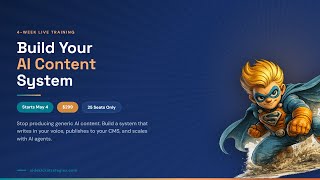
Cool. Okay, so Claude, I want to create an article on content strategy, and so what I want you to do is I want you to think about the 5 top things that marketers need to think about when it comes to content strategy. Now, what I'm also gonna do is give you my identity, and I wanna make sure what we write is aligned to my mindsets, my beliefs, my core values. I'm gonna give you the business identity, and I'm gonna give you where my personal stories are. I want you to pick the best personal story out of the story bank, and I want you to go ahead and craft this blog article so then I can come back and make any revisions that I need. Now notice that was my prompt. I didn't type a thing, I just talked to it. I had a conversation. And so what I'm gonna do is I'm gonna literally copy this path and I'm gonna move this out of the way so we can actually see this. And all I have to do is I'm gonna paste this path in. I'm gonna copy my Sidekick Strategies path, which I should have closed my stories 'cause I'm like going forever. Now I'm gonna copy this. Okay, because I spent the time to get the base and the context, and then I'm gonna give it where my actual story bank lives. And so you can't see me scrolling back up, right, which is boring anyway. And by the way, people who are listening on the podcast, uh, two things. One, I'm scrolling in Obsidian, you're not missing anything. I'm copying pasting things in the terminal, you're missing that. You might want to go to Doreen's channel, my channel, somebody's channel, and watch this part. I'm just saying. So now what I'm gonna do, what I'm gonna do is one last thing. As I'm thinking about it, I'm gonna say, hey, by the way, make sure that you're very aligned to the voice and tone. Make sure you simplify the complex. And guess what? I'm a little funny. Can you be a little funny along the way as well? Boom. Now I'm just gonna hit enter, and now it's gonna start choreographing, right? And now while we sit here, I'm gonna go ahead and pull this down And I'm gonna just say a couple things. One, this is the article that I built about, uh, in the age of AI, websites are dead, web systems are not. And if you want to go deeper in what I'm talking about, you can read this article. But then also I have deeper what I'm talking about here, a system that is a 4-week training system, Build Your AI Content System From Scratch, where you can come and enroll to this, and I will get nerdy and teach all sorts of wonderful great things on the foundations and the way that you can actually build teams, because Doreen, guess what? I don't do this alone. I don't do this alone, believe this or not. I'm going to show you this right here. The human top is the human part of this. But usually when I'm doing what I just showed in my terminal, I'm also invoking these agents that I've hired. These are the agents of my organization, And you'll notice we have a writer and a designer and a developer. And these designers and developers— watch this, I'll go ahead and give you like Quinn the copywriter, 16 skills. And here's like the operation modes and here's the skills they have. And so now I can literally say I'm going to use my agent team to create the thing based on the conversation and the context that I just showed everybody.
That's crazy. Hey, we have a, we have a quick question while the, while this is, is thinking and creating the blog post. Lori is asking, how often, and this is a great question, how often do you keep uploading content to keep up with all you do? Because is this an ongoing thing? I know you have the foundational work, which is kind of like the knowledge bank, but then if you have new articles, have you automated that process too? Where you have a new article and you push it back in.
So it's funny that you mentioned that because here's the thing, what this, what my terminal is doing and what we're creating is we're actually creating articles that go into this CMS that I'm using. And so my AI also knows everything that's published in this CMS. So this CMS, like the whole website is also part of its brain. Because when I showed you like this thing, this, uh, Obsidian is literally the local folder that I'm using Claude Code in to create the things that we're literally creating now. So when it creates, it's literally adding it to the brain of the thing, and so it's progressively getting better. Also, let me, let me blow your mind for a second, talking about progressively getting better. I mentioned the team Yeah, um, I have these teams, these agents, where they have their own training progress. And so what I've done is I've given each of these agents like YouTube channels that I want them to go watch. In other words, they go find the video that's important, they look at the transcript, and then they, uh, give me their learnings. And so if I actually go into like Alex's training and Alex briefs, these are things that Alex has gone and learned And so when I call for Alex to do work, Alex has these things that he has learned or given us, or any of the other, uh, agents. So like, when I talk about systems, I'm talking about self-learning. I'm talking about— okay, so here we are now. I would usually say go ahead and push this into the, um, the thing, the, the CMS. But for right now, we'll just go here for a little bit. 5 things every marketer needs to think about. By the way, you're listening to this podcast still and you haven't gone to LinkedIn or YouTube. I'm now looking at Terminal and I'm looking at the article that, by the way, is quite robust. By the way, I'm trying to, I'm trying to see if it like actually gave me a word count. Let's see if at the end it gave me like story use graphics for worship, the consistency that built everything, the couch, the laptop, Marcus Sheridan, Echo voice alignment. Uh, doesn't look like it gave me that. Okay, but what we're gonna do here is we're gonna just say 5 things every marketer needs to think about when it comes to content strategy. Um, and yes, I learned most of these the hard way. That's how, by the way, that's how it's— and yes, I learned most of these the hard way. Let me tell you something, I've been creating content for over 12 years, 2,000+ videos, hundreds of podcast episodes, blog articles I've lost count of. And if you've told, if you've told 2012 George that content strategy was going to be the thing that built his entire career, business, and life, he would have laughed, grabbed another pot of coffee, and gone back to doing everything wrong. Because here's the truth: I didn't start with a content strategy. I started with chaos. I started with sporadic. I started with what I call Plan A, Plan B, Plan C. And when those didn't work, Plan M. Like Come on. So I actually started my first business called Graphics for Worship. We designed images and videos for churches to use during worships and sermons. It was a great idea. I was genuinely good at it. And if I would have stayed consistent, if I would have had an actual strategy instead of being so dang sporadic, I've often wondered where that business would be today, especially with how massive multimedia has gotten in church services. But I didn't stay consistent. I'm not going to read the whole thing.
Yeah, you didn't have a strategy. Wow, wow, wow, wow, wow. George, this is incredible. Is this what you teach in the course?
Yes, yes.
I want to know, like, all these tools that you use, how to set it up. How long did it take you to fill or create this brain? Can I just ask that question? I know people are going to be like, oh my God, George, how long did it take you to create the brain?
Yeah, well, so see, okay, so I'm gonna answer this in a couple different ways. But I love the question.
Yeah.
One, I've been creating content since 2013. Yeah. So I don't really have all of that content because it was different companies, but I've been creating content for me for at least the last 4 years. So I have all the podcast episodes for Beyond Your Default, all the podcasts for Psychic Strategies. I have all the articles that I've written. But also, Doreen, what I was able to do is just do internet research and go find every podcast that I was ever on. And pull that information in as well. I've actually asked the brain to, um, interview me about things so that I can feed it in that way. Um, but let's just talk about, like, from what I'm teaching now, not, not even counting of, like, just being able to bring all this stuff into the brain, but going from never using Terminal to building agents and having a system that I can literally You saw it, uh, 10 minutes I could go from nothing to a published article because all I have to do, by the way, at the end of what we're reading is go ahead and seed this to Sanity, get Morgan to generate a featured image and do this, this, and this in the image. And then when it gets to Sanity, I hit a button and I hit, uh, generate audio. Because by the way, one thing that you'll notice on these articles, if I go resources and go to like this one where inbound became unbound. All of these I'm putting audio on. And this is, by the way, this is ElevenLabs, my voice. So I'm reading the articles to people because I want it to be my voice, my brand, building trust with me. And so 10 minutes, I could go from zero to published. But I usually take a little bit longer than that because I want to be the human in the loop. I want to make sure I tweak it a little bit. But imagine this, you might be working 2 to 3 hours to get a blog out. I'm working 30 minutes. So I can do, you know, 4 or 5 blogs in the time that you might do one. So who's, who's adding time to first value first? By the way, I'm just gonna— I'll say one last thing, because once you realize everything's code Once you realize everything's based on the knowledge in your brain and you can build a system, I have created this prompt. This is for the nerdy marketers out there, okay? I have had this prompt, and by the way, you can go read the pillar page on my website for this. Hey Claude, I want to create a content cluster. What I want you to do is create a pillar page, and I want you to create 8 pages that go with it as the, the cluster. I also want you to create an offer that can go with it. And so at the end of the day, the content strategy here is we're going to do a pillar page on data hygiene, 8 pages that go with that pillar page, and an offer that people can engage with. Let's go ahead and do deep research with an agent team and sub-agents. Make sure you tag in our agent employees that we have and use these XYZ skills. Let's go ahead and create a plan because, by the way, pro tip, I spend 70% of my time in Claude Code in plan mode. What you get out of what I just said from a prompt, mind-blowing. Wow.
George, you've blown my mind. I thought I knew a lot about content creation and AI and deploying agents, but I've never seen behind the scenes look like the brain that you created. I have knowledge base, I have voices, I've created it, but I've not put it together in a system the way you have. So yeah, if you found this, if you're listening to this podcast, you've got to go watch the video. It's on George's channel, it's on my channel under Strategy Talks. If you are watching this live or watching the replay on LinkedIn or Facebook, connect with George. George, this is Fascinating. You're giving us an inside look about on what's possible. And I think so many of us are stuck. There's like all these phases of, you know, there's people who are barely touching AI. There's people who are using AI like they used to do Google. There's people who are experimenting, but then there's also people who are only using AI, have taken the human out of the loop. And I think you're in that sweet spot of three of deploying the agent, having the voice, human in the loop, and you found a way to really expand what you're doing. And if I feel like— and I can say that you're on the cutting edge of what's possible. So thank you. That's really— it's really— I'm so glad you were here today. I've had some— I have a lot of amazing guests this year, and I'm really glad we have this theme of content strategy because that's really what I wanted Strategy Talks to be about, yet we talked about all kinds of strategy in the last 4 years. But this year I'm really honing in on content strategy because of AI, that we still need humans in the loop, but we're building systems. And I know we can talk a lot longer, but we're past our time. And George, this was fascinating. I know Lori, you absolutely— I can see all the emojis, your mind's blown. You were here live. Thank you for your great question. And yeah, this is incredible. If you're at stage 1 or 2 of using AI, then this is going to absolutely move you forward in a way that you can't even imagine. George, is there anything you want people to know if they've watched this and they're like, oh, I don't know, I haven't created enough content to even create a brain? What would you say to somebody like that?
Yeah, well, first of all, I'd say this. One, uh, the best time to plant a tree was 10 years ago, uh, or today. And so start creating the brain now. Uh, I haven't created a brain, but, uh, you've been living 20, 30, 40, 50 years. You have a brain here. The only thing that we need to do is extract this brain into the digital brain. So you have been creating a brain. Um, the content just hasn't been delivered yet. The other thing that I want to say real quick though is I want everybody to realize that we are in a world where once you get activated, you see what I am showing, and you actually get to the point where you can do it. Everybody needs to realize that we're in a world where the question that you should be asking yourself and then activating yourself on is, is it possible? Because it's amazing the amount of things that I've been able to build by saying, Claude, is it possible? Could we build something that does this? And then having a conversation and all of a sudden that thing exists in reality because I said, is it possible?
Wow, that's a great way to end this podcast. Thank you, George. Thank you so much. Um, for those of you who stayed all the way to the end, thank you so much for being here. Thank you, listeners. George, um, I will be in touch with you soon. I can't wait to learn more about your program. I will make sure that all the resources and the tools that George mentioned are in the resources of this podcast and the live show so that you can go explore, as well as check out his website and, um, everything else that he, that he talked about. I'll be back next week with another episode of Strategy Talks. Thank you so much. Bye, everybody.










